
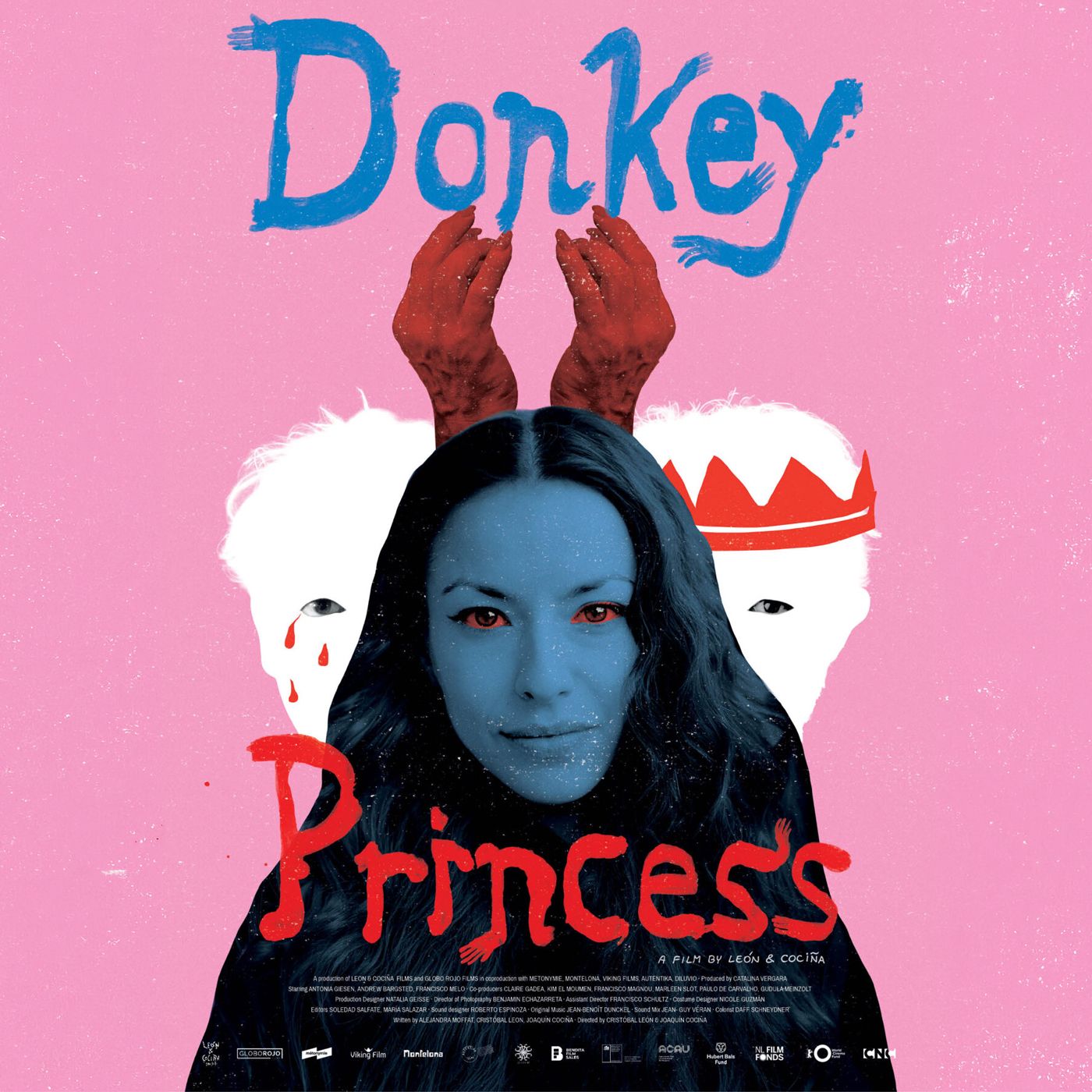
About this episode
León and Cociña describe the chaotic, caffeine-fueled process of splitting one overstuffed script into two films, Donkey Princess and its companion piece The Hyperboreans, written during Chile's 2019 social uprising and the pandemic that followed. They talk about the year and a half they spent animating a sequence for Ari Aster's Beau Is Afraid, their resistance to letting the film's politics dictate its story even as an editor read it as being about patriarchy and dictatorship, and how Francisco Melo's own experience as a father reshaped the king's arc.
The directors also get into fairy tales as a shared cultural language, the six-stars-that-used-to-be-seven storytelling parable that keeps them hooked, and what's next — including a stop-motion adaptation of Hansel and Gretel. Donkey Princess, also starring Andrew Bargsted as Lalo, is awaiting North American distribution from KimStim, which previously released the duo's The Wolf House.
Transcript
Automatically generated, so expect the odd misheard name.
Hold your ears, folks. It's showtime. People pay good money to see this movie. When they go out to a theater, they want cold sodas, hot popcorn and no monsters in the projection booth. Everyone pretend podcasting isn't boring.
Turn it off. In a kingdom where love was forbidden, a princess was never allowed to love. A king who loved so much, he forgot what love was for. But destiny has its own desire. An ancient bracelet.
A forgotten power. And a world beyond the horizon where every wish comes true. Diana. She was not born to obey. This season, one princess will discover that the most powerful magic in the kingdom... was always in her own hands.
From the creators of The Wolf House, Leon and Cressinia, a motion picture fantasy, Donkey Princess. Can you hear my voice? Hey folks, welcome to The Projection Booth. I'm your host, Mike White. Today I'm talking with Cristobal León and Joaquín Cochina, the Chilean filmmaking duo behind Donkey Princess, a wonderfully creative feature shot on location inside of a museum in front of a live audience.
Donkey Princess played the Fantastic Fest ahead of its release in Chile in with distribution rolling out in the U.S. and France. I had a great time talking with these guys, had a great time watching their film. Really hope you get a chance to check it out. It's incredibly creative. Enjoy.
I loved Donkey Princess, and I'm so curious. Can you tell me a little bit more about you and how you got involved in filmmaking? I come from contemporary art. I studied in college. I studied design and animation. art, like visual arts, I don't know, fine arts, I don't know how you call it.
And at some point during my studies, I became interested in animation. I started working on animation for my thesis project, actually. I made an animated short film, and it was really like a turning point in my life. It was like an epiphany for me. This is what I want to do for the rest of my life.
I'm talking about 2020, 22 years ago. And then I was looking for collaborators and I went to the exhibition of this guy who was making drawings, like really beautiful drawings. And I said, let's make a short film together. And this guy was Joaquin Cosinha, who is my collaborative partner until today. We've been working together for 20 years.
And we made a short film and this short film started to circulate in festivals and became really like successful for a short film. It became really popular in internet. So like it was really encouraging for us to continue making films. And we still are like, we still make exhibitions and like visual art and filmmaking at the same time. And normally our projects have like a foot in each world.
So like, for example, Donkey Princess was shot in a museum here in Santiago in front of the audience. So we normally do this. We use the galleries and project spaces to shoot films or we make exhibitions after the shooting with the film that is already done. We mix the two worlds. You shot this at a museum in front of people?
People were really respectful. They always asked me, how did you make with the sound? And people are, I would say, more respectful than the crew itself. I was curious about the working relationship between you and Joaquin and how you split apart or what you do together. Tell me more about that relationship.
It's always fascinating when two artists are working together. When we made. Our first short film, also together with an American Chilean filmmaker who is still our company partner, Niles Zatala, who has really beautiful films too. We invited Niles because he was like a photographer and we thought that he would be in the camera, Joaquín would be drawing, I would direct the animation, but really quickly it became clear that the three of us wanted to do everything. And we decided not to have separate roles.
And it's been like this with Joaquin for 20 years. We don't split roles. We do everything together, which is maybe not economically very smart. But we write together. We paint if we have to paint.
We construct things. We direct. Normally, when we have the shootings, Like organically, it's not that we agree or we have a plan, but organically it happens that one of us is more focused on the actors and the other one is more focused on the technical part. So directing the, talking to the DP and yeah, like more focused on the other part of the world. But this happens really organically.
It's not something that we program. And also it happens a lot that we have many projects at the same time. Like now we are doing this, but we are also working on an animation feature film that we are working on. So we sometimes say like, oh, we have too much work for this month. You can concentrate on this project and I can concentrate on the other one.
That happens too. Can you tell me a little bit about your earlier projects, things like the Wolf House? The Wolf House was like our life project in a way. We've made many short films before, but The Wolf House was this accumulation of experiences, of experimentation. It took us five years to produce.
We also made it in museums and galleries, as I told you, with this new one. We shot it in maybe 15 different places. places, like galleries, over 20, if we consider also the studios that we had at the time. And it was like a very great process and a great period of my life, I would say. And I can tell you, because maybe people don't know, the film is a completely stop-motion animated film. We were inspired really... vaguely, or not so vaguely, but on a historical case of Chilean history, that is Colonial Ignidad, which was a cult of German people in the south of Chile.
And that was a very dark episode of our history. They tortured people there. The leader of this sect, of this cult, was a pedophile. He abused many boys. It was a very dark...
And also, It's very infamous, I don't know how to say it, in Chile, because they have really close ties to the Pekínotec government, so to the dictatorship in which Joaquín and I grew up. It also served this place of the cult as a concentration camp for people, political prisoners of the dictatorship. It's a very dark... And when we made this film, it sounds like really dark. It's a dark film, but maybe it's not necessarily strictly political.
It's more abstract, I would say. And we made a film thinking that we were not making a film about this cult, but that we were making a film produced by this cult. So playing a role-playing game, which is a system that we love to use for our art making and filmmaking. It's like we imagine that we are someone else who is making the film and we construct a character that makes films or something like that. Joaquín, buenos dias.
Buenos dias. Sorry about the delay. I'm in the south of Chile and the connection is really like in the countryside. A country like Chile. It's nice to meet you.
Thank you so much for joining. Nice to meet you, Mike. We were just talking about some of your guys' previous projects. Can you tell me a little bit about the Hyperboreans? The Hyperboreans and Donkey Princess comes from the same process in a way.
After the Wallhouse end, it was a five years production and we were really tired of ourselves on the studio working on animation. So we thought, okay, let's change. Let's make something different. And also we thought that our live action film will be faster to produce, which was wrong from us. We were wrong.
So we started to write a script with Alejandra too, Cristóbal, Alejandra and me. Alejandra Mofat is the co-writer. We write together with her all of our feature films. So we started to write and then there was this big social explosion and political explosion in Chile. And then COVID came and we started to get crazy, I think, writing.
Everyone in their own house. And we started to go into this loop of writing. And we were like three months far away from starting the production of a film. And we realized that our script was really bad. Not bad only, but super.
Have a lot of subjects and sub-stories and topics and different stuff. So we decided to divide the topics. So it's okay that politics and esotericism, racism, and many other things were in the Iberborians. And we took other subjects that we can talk later for the donkey princess. So we write down, again, this Iberborians script in three months with all this long writing process.
So it was like a full of caffeine, I would say. writing process, and really intense. During that period, the Wolf House and the Hyperboreans, we spent one year and a half working on a segment of a film by Ari Aster, which is called Bowies of Red, with Joaquin Phoenix. And there is, in the middle of this film, there is kind of an animation sequence. Not strictly animated, but with animated elements, and really visual and really theatrical. And we made all the animation for that, and also the look development.
And it was COVID, and we were locked in our studio with a bunch of people working on that, and it was really intense. Also because it was the first time that we had spent such a long time not being directors and not being artists ourselves, but doing a commission. The Hyperboreans and... also in a way, but less, I would say, than Donkey Princess. It was also a way of, yeah, like investing all what we got during that period, like what we learned, but also to make the things in our way. It came also a bit from that experience, I would say.
The Weeper Voynets is also a film that we took it as a lesson class film of how to direct an actor, because it's one actor in a house, because there is a friend of ours that appears as a human being two times. And so we still have Antonia and all the rest of the crew is puppets. So we thought, OK, we want to jump from animation to live action, but we will make a film that is actually only one actor, two, and puppets. So it's in a way an animation movie in a strange way. I would say it's like Sesame Street in those terms.
So yeah, that's the technical part of it. And the film works also as a documentary of our incapability to write scripts. It's like something that is never really done. The reality never stays and Even the main actress or the main character actually is the same in this case. It's lost in the film.
She's trying to understand what's going on and she cannot actually understand. So for us, I think it was a bit of a comedy too about our incapability of writing in a straight line. Yeah. And also was a film that took this political side that Cristóbal was talking in a more humoristic and absurd way. As an outsider to Chile, I felt that there was a lot of politics going on in Donkey Princess, and I was wondering if you could talk a little bit more about where those are coming from.
The king forbidding love, just the stay indoors after 8 o'clock p.m. because the bats might get you. There's a lot of stuff going on where it felt like this is a commentary on something I'm not exactly sure I can put my finger on. You are not the first one to mention this, but we really, I don't know, maybe... Of course, we can see those layers, but we were, I think, really trying to make our first non-political film. The Wolf House and The Bones, which is like a short film that we made, and The Hyperboreans were so political, and the conversations around the films always turn around political subjects, and we thought, okay, let's make a film that is really not about that.
I also like to refresh... are making, but of course, like our subconscious is there and is like making these things. And yeah, when we were talking about the film, the first conversations with Soledad, one of the editors, like the chief editor, I would say, of the film, she said, this is a film about patriarchal values and Pinochet and dictatorship and blah, blah. And we were not really thinking about that. We understand those layers, but we don't want to take our creativity through that pipeline because then, for example, like, well, I will give you an example. There is this almost sex scene.
I don't know how you call it, like erotic scene. And one caught a friend of us. I will not say her name. She said, oh, it's good that we only see his nipples and not her nipples because then it becomes less matches and blah, blah, blah. And we immediately took the nipples of her back.
I'm just saying that because it's like we don't want to feel that we are like being correct and being, okay, the king is Pinochet, the socialists, the social base is like the people from the country. And then you have the clash and feminist patriarchy, which is, it's really confusing for us to go into that path. Because then you start to respond to what, how the world should be for us and not how the story is actually going. taking us. So we see that, but we try to make this film less about that. And we try to play less with that.
But as Cristóbal is saying, yeah, of course it's everywhere. Like Chile is a country of patriarchy and it's a country of, no, patriarchy, I don't know, but it's a country that it's based on oligarchy and it's based on big male figures and rich people taking care of politics. Our tradition of art and filmmaking is so political. when we studied art in university, it was all about politics and about conceptual, but also a lot about politics there. And the film scene in Chile is like, maybe not, if you take all the films, they are not all about politics, but you have this sense, and people have this feeling that Chilean, that that's also the reason why they don't go to the cinema to see Chilean films.
But it's all about politics. It's all about dictatorship. So it's so much in our DNA, like in our artistic DNA, that it's impossible for us to not be being political. This is something I realized. Even if we are trying to be apolitical, it's like something that is there somehow.
Yeah, I would say that, as Cristóbal is saying, If we don't want to be political, we have to make that decision. It's like, okay, today we will not dress with shirts, like something really like a... So we try it, and of course we fail. As you are pointing it out, Mike, which is fine. I'm curious how much of Donkey Princess kind of owes itself to donkey skin, the old fairy tale, but also just how you... like to play with those type of fairytale things.
I see, Cristobal, you've got Wizard of Oz figures behind you. I can tell that you are entrenched in fairytales. I'm curious as far as how you play against that. For me, maybe fairytales, it was the reason why I started doing films. it was like i was in this point i really in love with it i love like i collect like fairy tales and children books and i love the wizard of oz and i love and at some point i when i was in university i started like researching more about fairy tales and about like the older versions and like I came like through the illustrations you know like we have a big library in this in that university and I started like watching like these books of illustrations of and I was in love with that world yeah it's a very like I love like how these tales were like constructed through tradition like really organically which is something that I really feel that Maybe that's the thing that I love more about, the most about fairy tales.
For me, it's like a paradigm of how art should be, like something that organically grows, not through the mind of one creator, but something that happens like a force of nature or something, like something that happens through the evolution of culture somehow. And I love that about fairy tales. I would say all of our films, I think, There's a fairy tale base. Maybe the Hyperboreans, not so much. Maybe the Hyperboreans, not so much.
So maybe it would be better. I don't know. No, it's everywhere. I was just listening last night because my wife loves, but it was about really old storytelling. So they were trying to, these two journalists or whatever they are, They were trying to reach the oldest storytelling.
And there was this beautiful case of a story that repeats in many cultures for many thousand years. It's like seven producers or virgins or adaptations of that. There is always one missing. So we see it's six, but it used to be seven. That's the base of the story.
And they realized that there was a base of seven stars. But you can see only six. And then... a scientist realized that thousands of years ago, you could see seven stars in those six that now we see. So they don't know why is that connection. But I think it's a good illustration of what Cristóbal is saying.
There's a base of something that you don't know what it is. And then you have adaptations, changes, and famine, big earthquakes, or whatever. We start to tell the same story with different versions. And I have the feeling that's goes through cultures. We are like, yeah.
Here in, I'm in Chiloé now, a big island in the south of Chile, and you have a lot of storytellings really local here, but are based on the encounter of some witches from pre-Hispanic, and one guy from Spain, and they made a fight of, how do you say brujería? Like spells? And she won. Yeah, the Mapuche one. So she protects the island from the Chileans, actually, for many years.
So whatever. I'm just saying that it's... Witchcraft. Witchcraft. I'm just saying that it's like a...
It's... I think that base of storytelling... Sorry, base in fairy tales is like it's all the time on there and we love to take that and we think it's... I think we enjoy a lot doing what Walt Disney does, and North Americans in general do in film that is taking all the fairytales from all over the world and assuming they are like theirs. So it's like Hansel and Gretel, yeah, North American.
I don't know, like, it's so, we think it's funny and political in a way to take all these big traditions of Western, of, yeah, of the Western world and assume that we can make our own version being Latin Americans. This is linked to two things, I would say, like what Joaquín was saying. One thing is like, these were the tales that we were told as children. We were not told, you know, like tales of Mapuche or like original cultures of Chile or like a Spanish tradition of tales. We were told the Grimm fairy tales or the Perro fairy tales, you know, like, so that those are the body of stories that are the constructs constructed my base of the understanding of what narratives, also through Walt Disney films, of course, because maybe they are like the base of my storytelling education, you know, like it's the world where I feel more comfortable with, you know, like it's like that.
And also like, maybe like the donkey princess, I remember this point when I would talk about my experience, but I started during the script writing, seeing the story more as a fairy tale, and I could connect more to the film. And then I was trying to push these references to the donkey skin, because I said, well, we have a similar kind of story, and we brought a donkey into the film, like this. So it was about the part of your question about donkey skin. It was not there from the beginning. It was not our starting point, but yeah, at some point we realized that we were like kind of sharing some things of the story.
So we forced them to be like an adaptation of Tanki Skin. And of course we love the film by Jack Demme. So because we come from arts, but we spent a lot of years working on animation like that. And we feel that, you know, you have the big animated theater films, the big animated films of the animation history are like fairy tales, you know, Walt Disney, Miyazaki, Miyazaki are like Japanese fairy tales, you know, like, and you have like also Alice by Janice MacMayer, you know, you have like this, it's like the main genre of animation films is fairy tales. So we are trying to make our own South America strange contribution to that tradition.
I will just give you a hint about our process that I think that Cristóbal, what Cristóbal was telling about the process of taking one film and making it at the end like a version of a fairy tale that was not at the beginning. I think that's a good example of how chaotic and open to the changes our process are. I don't know, well, chaotic, I don't know. But we start with an idea and we jump into the process and then something starts to appear and we say, oh, yeah, this is actually really good. So we change all the background of the film.
And we transformed that in an adaptation of something that was not there at the beginning. With The Wolf House, it happens the same. I don't know if Cristobal told you because I was trying to connect, but at the beginning of the film, it was not about Colonia Dignidad and Paul Schaffer. He was not there. We were not working with that consciously, but then it started to grow.
And with Donkey's King, it happens the same. In a way, yeah. So it's always like that. We start with an idea and then we start to say, this actually looks like this other stuff. And can you change this?
And we are open to change that. Change everything, basically. When it came to, I believe it was Hyperboreans, that it was the first time you really worked with an actress. And that's the same Antonia that's in Donkey Princess as well. I am curious how you found the other actors, Andrew and Francisco, and how it was working with these three.
Especially, I love that you're pushing them into all of these different timelines and things and having them assume different roles throughout each. I will say that we are lucky or smart enough to work with really smart actors normally, intuitive, but also really intellectually active. Andrew is really, I think it's a genius. It's just like a, I think he was, he had more clarity about the evolution of the character than us or than me, at least than me. I was, a little bit confused about his acting in one scene.
And then I said, okay, let's just get with the flow. And then we started to edit the film. And it's like, oh, fuck, yeah. That's why he was acting like that, of course, because he saw the evolution. Yeah, it was amazing.
And Francisco is a great actor, really smart, and really, he has a lot of hours and years of television and theater. So he was, yeah, he was super easy to work with. And he also had a really interesting approach to the character that changed actually our view of the king. Because at the beginning of the script writing, the king was really bad. Like evil.
Like evil, bad. And he made a connection with his own paternity. Because he had a daughter. And he said to us, I will not say his words because it's dangerous. But he said, actually, I can connect with this.
When my daughter came with the first boyfriend. I was totally touché. I was like broke in a way and happy for the other hand. And he made this approach to the character who was really good and was really like, we changed our script for him because of that. So yeah, we are like, and Antonia, she's amazing also.
She's really smart too. I think that's one big part of it. We found them through a casting that Amalia Casay did. Amalia is the actress of The Wolf House. She does the voice of the main character.
We asked her to do the casting and she made this beautiful for the role of Lalo, of Andrew. She received a lot of self-tapes. And Andrew's tape was amazing. He made like a short film almost. And he created it.
It was very special because we received many good self-tapes, but they were a lot of talking in all of them. And Andrew made something really smart It was very well done, really well shot in a way. There was a decision about the shots, but also there was a decision about using a lot of silence, watching this character not talking a lot, but not knowing him with the words, but also with the silence, with the presence. And that was really, really amazing. Yeah, actually, I think one of the first things that we said to him in the meeting, we said to him that you have to direct.
You are a super good director. You don't, I mean, you should do it as soon as possible or take your time, but you have to do it. Yeah. So it was good. And about the going through different moments or worlds, Andrew was, as I said, really good on that.
We tried to make that the base of the acting was naturalistic. So it is not like that all the time. And we struggle a little bit with that, but the base should be as naturalistic as we could Of course, the king was difficult to make it completely naturalistic in contemporary terms with all that costume and all the backgrounds. But that was the goal. We were going to that and all the evolution of the acting should be going there.
So that was more or less the north or the south, you can call it. Where are your previous films available for people to watch? The Wolf House has a distribution in the US. I know it is distributed by kimstein in the u.s and i know at this moment it's on a eternal family which is a really great platform i don't know if it's available in any other platform i would have to ask a kimstein people and the hyperboreans i don't think it's available in the u.s i don't think so i'm not sure but i don't think so and also like the wolf house has a dvd release in the u.s too A Blu-ray, no? I think it's DVD in the US.
Blu-ray is in Japan. In Japan. But maybe I'm wrong. Maybe I'm wrong. And you also have The Bones, which is for free in Vimeo.
Recently we made that. We also have many short films online, like in YouTube, Vimeo, and so on. So that will be with our name. You will find out things in our channel too. That's more or less.
And I know Donkey Princess is going to be playing at the Fantastic Fest, which is wonderful. I'm so glad for you guys. What's next after that? Thank you, Prince. It's also going to have distribution in the US.
I hope soon. We haven't defined the dates yet. And for us, we are working in two different fields at the moment. One is this animated project, similar to the Wolf House in a way, technically, aesthetically, I would say. It's an adaptation, as you mentioned before, of Hansel and Gretel.
And the second one is we are working on an adaptation of a Latin American tale. with a Brazilian production house. So we're working, and that's a live action film. So we're working in these two feature films projects at the moment. And also the Donkey Priest will have a distribution in France. And we are, of course, also like showing the film in other festivals, like in Colombia or in Australia and, yeah, Mexico probably soon.
And also we will have, of course, we will distribute it here in, It will have a theatrical release. Here in Chile. So, yeah, that's what we have confirmed so far. Is there a good place to keep up with the movie and with you guys online? I think it's Leon Cocina Films.
It's Instagram. Then you have Leon Duner. No, Cristobal Leon. No, Cristobal Leon. And Joaquin Cocina.
It's my Instagram. And we have our webpage, but yeah, it's a webpage. Yeah, it's like leoncocina.com. But every time that I say webpage, it feels really old. We should say TikTok, but we are not that hip.
Gentlemen, this was so nice talking with you. Thank you so much. And thank you so much for making Donkey Princess. It was such a delightful film. Thank you very much.
Thank you. Thank you, Mike. Thank you for your interview, Mike. You have a beautiful voice. I don't know if you work with that, but it sounds great in my headphones.
I really appreciate that. I will buy anything that you sell. Definitely. We will contact you for our next trailer. I was going to say, if you need an American voiceover, just let me know.
That sounds so great. Probably we will. Gentlemen, thank you so much. It was really nice to be with you. Nice to meet you.
Thank you. Thank you. Thank you for watching! Thank you. Thank you.
Thank you. Bye. Bye. Bye. Bye.
Thank you. Thank you.
More from The Projection Booth



Similar episodes across the network
Matched by shared keywords.
-
Episode 24: The Wacky World of Mother Goose
1 shared keyword: charles perrault
-
The Wizard of Speed and Time
1 shared keyword: stop motion
-
Episode 9: The Easter Chronicles
1 shared keyword: stop motion