
About this episode
amputation), and how the film's pyromancer heroine — burned in a firefight, fitted with an artificial "nanoskin" graft, and left afraid of the very fire that once made her exceptional — turned out to mirror his own ordeal without his realizing it until the film was done. He also breaks down directing a movie from the picture outward: writing dialogue to match lip movements already on screen, voice actors in Scotland, LA, and the Philippines who never met in person, and the four years it took to get from the first assembled scene to release.
Transcript
Automatically generated, so expect the odd misheard name.
Hold your ears, folks. It's showtime. People pay good money to see this movie. When they go out to a theater, they want cold sodas, hot popcorn and no monsters in the projection booth. Everyone pretend podcasting isn't boring.
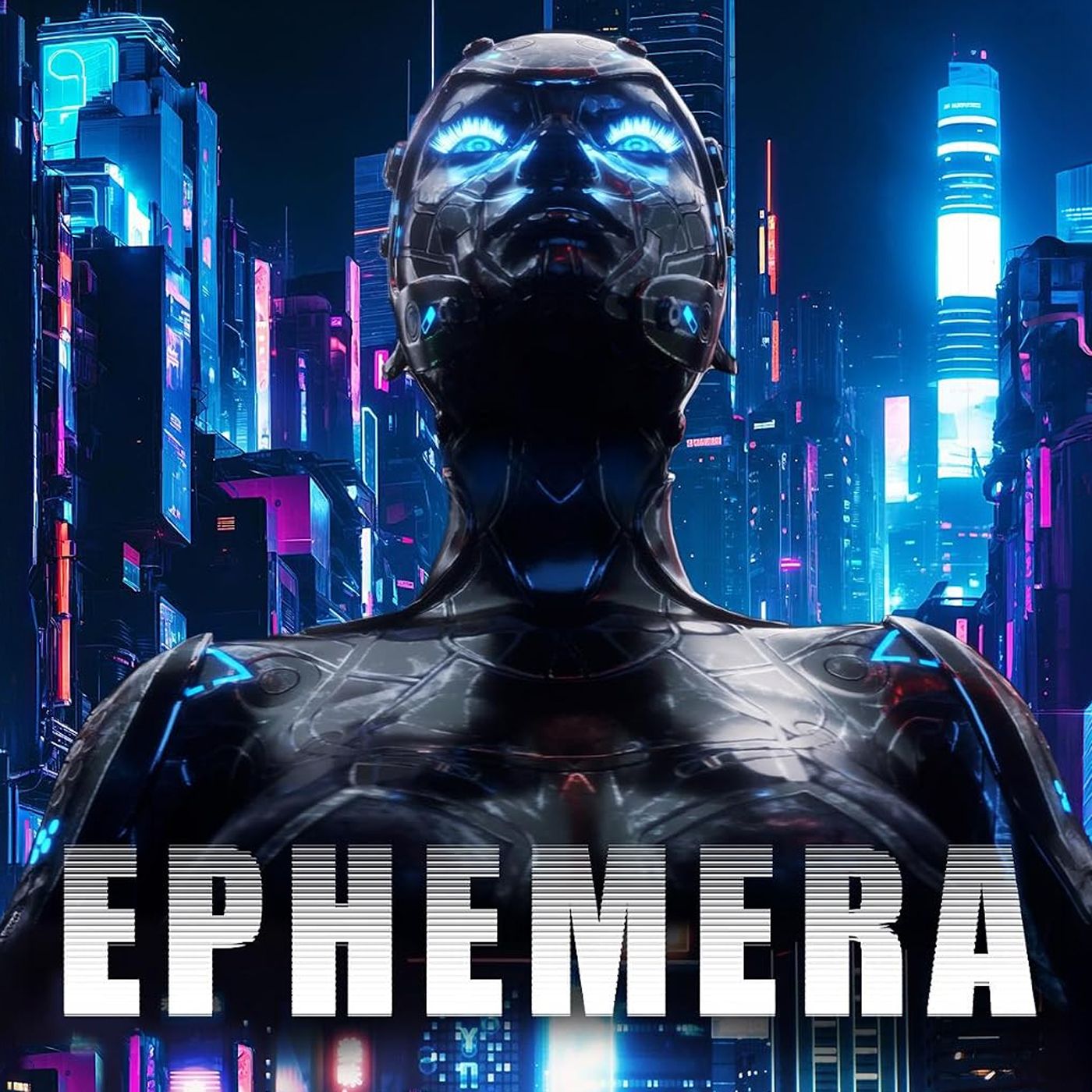
Turn it off. Hey folks, welcome to The Projection Booth. I'm your host, Mike White. Today I'm talking with writer-director Bill Richardson about his debut feature, Ephemera. It is a film built almost entirely out of stock footage and voiced through ADR.
It's all about a woman whose synthetic skin lets her change her appearance. And it is a story that Bill didn't realize until afterwards really mirrored his own recovery from a near-fatal medical ordeal. Ephemera is now streaming on Amazon and lands on WaterBear and Tubi in a few weeks. I had a great time talking with Bill, and I hope you have a great time listening. Enjoy.
Bill, before we talk about Ephemera, I want to know more about you. Tell me your story. I've been a filmmaker for decades. I've mostly worked on other people's shows. I produced a series for the History Channel.
I've worked on multiple features. I've done I don't know, 26 shorts. I've got about 40-something awards from film festivals all over the world. And written novels, written books, comics, poetry even. I always hate saying that.
People always think you're an idiot when you tell them you write poetry. But I've been a creative in one way or another. I've done magazine covers and covers for books and posters for films. So I've just been a creative in a lot of different ways for a very long time. Is that your artwork I see behind you?
I'm a collector. So this is Boris Vallejo. This is obviously a Conan thing here. I don't know if you know. Yeah, I was wondering if that was Franzetta.
It is. I do have some Frazettas. Not the big, super expensive ones, but... I was a fan of his work since I was 15. And I basically eventually got to the point where I could buy a Frazetta.
And it was a pencil drawing. And it was one of those things where I'd aspired to it my entire life and then, you know, got to do that. And it's now I'm at the point where I'm starting to sell this stuff just because I need to eat. But, you know, it was just an amazing thing to get to that point where, you know, you fulfilled a dream that you'd had since you were a kid. And so I'm an art collector, but I don't know how much of this you can see here.
But there's a couple of my books, but I also do these sculptures here. And then this is a magic card art. There's a guy named Dave McKeon. Have you ever seen the film Mirror Mask? Yeah, I think so.
Yeah, Dave McKeon's real quirky. That's Dave McKeon. And I've got a bunch of his art. He's just an amazing guy, just super talented. He did the Sandman covers. the early Neil Gaiman run he did.
I knew his name was familiar. Okay. Yeah. He did the first 60 something of them. And I've actually got, I've got one of his covers, but I've always been just so in awe of the people with that sort of talent way more than I've got, but I've always envied the people who were, you know, just geniuses at one thing.
I've always been pretty good at a lot of things, but, One of the things that's happening is that it's coming around. That's actually a good thing because with a lot of the new technologies that are out there, being able to do a lot of things is actually something that's really helpful now. Like on this film, I wrote it, edited it, fully sound edit, special effects, directed it, even did a little bit of acting in it. Being able to do a lot of things in this world of side hustles and that sort of thing is actually starting to be something that's foundational to a lot of what a lot of people are doing. How did you end up getting into filmmaking in the first place?
There was a film called make one that came into the area where I lived and I went to the, and got a job as an extra. And so I spent, I worked 22 of the 40 shooting days. And as an extra, most of your time is spent sitting around waiting for something to happen like it is on most big budget films. And I watched them doing this and I thought, I could do this. This is, it's not that hard.
It's physically hard work, but it's just, it's not something that's undoable. And so I then started, went from there to producing a feature documentary and then working as an AD on a feature. And so that experience of just getting to watch a film being made in front of me just demystified it. It made it something that was a real practical, realistic thing that a person could do. And so from there, I just started finding jobs that people would give me and mostly for no pay until I got to the point where we just became a regular part of my life.
Is Ephemeris this your first feature film? It's the first feature film I've directed. I've spent my life working on other people's films and I decided that I wanted to direct my own. I honestly was sort of looking at death in the face at the time that all this came about as part of the story of the film. And it made me realize that time short, get on the stick.
Yeah. Tell me a little bit more about how this came about. What is that? The real story? I ended up spending a year in a hospital bed.
I had a wound in my leg that was 12 inches long and six inches deep. It wouldn't heal. And so it was this horrible gash. I can't even look at the pictures now. My wife took pictures and I can't look at any of it.
And so the wound wouldn't heal. And so all this time, the hospitals kept giving me these infections that were nearly uncurable. And became septic and all these different things. And so they, at two different times, they wanted to amputate the leg thinking that was my only hope. And there were times throughout it, then it didn't look like I was going to make it.
I'm sorry. I have flashbacks sometimes. Oh, no problem. So anyway, the film came about was I'm a, I'm a creative person. And when I don't do something creative for a very long period of time, it just works against me.
I become uncomfortable and miserable and irritable and sad and all kinds of different things. And so I wanted something to take my mind off of what was going on with me and also something that could allow me to be creative. And I found this stock footage site and started using that footage to cut together music videos. They had music and pictures. I was cutting together these music videos and it was fun and it was distracting and it was no pressure and it was just great.
And along in that process, I discovered that there was some of this footage, there's enough pieces that you could actually cut a scene together from it. Maybe a car chase or a bank robbery, some different things. And I thought as a creative exercise, I just did that. I just started cutting together a scene with it. Because again, I was just trying to find something to do creatively to keep my mind off of what was going on with me.
And after a while, I had 10 scenes. And one of the ways to look at a movie is that the average length of a scene in a movie is about three minutes. Sometimes they're one, sometimes they're five, but its average is about three minutes. So if you've got 33-minute scenes, you've got a 90-minute film. And so I thought, I wonder if you could make a film this way.
And... that creative challenge became the thing that consumed me and distracted me. It was such a weird, odd thing. Because think about it. When you make any whether you're writing a novel or doing a film, what you do is you start with an idea and you figure out how to create the pieces to tell the story, the scenes, the chapters, whatever it would be. And this was in reverse.
This was starting with the pieces and then building it up into a story. And I thought, and I'd done some similar things in the past where I had used visual art. I'd cooperate with an artist and use their art and tell stories around that art in prose. So I thought, let's try that because it's a new creative challenge. One of the things that you're, as a creative person, you're always looking at new ways to get ideas and to get inspired and to do things differently.
It's hard for me to break out of the whole formula way of doing things. I'm a very structured, top-down sort of person. And this was a way to force myself to be creative in a different way. So anyway, I started putting these things together. Eventually came up with a concept that would allow me to tell a story using these very disparate pieces and worked on it for about a year and a half.
And so put together the pieces. then begin developing the sound and the music and all the things that you needed to make complete film. And it was exhilarating. It was really fun to do something in a way that nobody's ever done it before. What the process was to me was, you know, those 500 piece puzzles that you get, it was like taking a hundred boxes of those puzzles and and taking a handful from every one of the boxes and then reassembling them into a completely seamless new image that you really can't tell that it was made that way. And that is in effect what ephemera is.
It's taking all these disparate pieces and bringing them together. Most of the people who've never, you know, I'm doing all this publicity and I'm talking about how the film was made, but the people who see the film without knowing how it's made don't realize that it was made that way. And then when they find out, they go, oh, holy cow, man, I'm going to go back and watch that again. Because if you know it going in, you look for the scenes. It's just human nature.
You're trying to figure out, well, how does this equal that? But when you don't know that backstory, you don't really realize that the film was made that way. And that shows that achieved what I was trying to do is to make something that was a fairly seamless narrative, even though it was made in reverse. And then also using the voiceover to tell the story and keeping your character's voice in her head. Very smart.
Filmmaking is problem solving. No matter how you make a film, it's problem solving. And the idea that this girl had an implanted AI allowed me to do a lot of the exposition that you need to do to tell story without seeing people talk. And that became fundamental. There were two basic plot ideas that made this film possible.
That one, and the fact that one of the things that happens to the woman, and I won't go too much into the plot because I don't want to do too many spoilers, but she is horribly burned in a firefight. She's a pyromancer, and she's horribly burned in a firefight. And develops a fear of fire as a result of that. So think about this is your one claim to fame, the thing that makes you better than anybody else, and it becomes your nemesis. And as a result of that, where she's horribly burned, they do these technological skin grafts.
It's called nanoskin. And so this artificial synthetic skin that they put on her allows her to change her appearance. And so those two things, the fact that a lot of the exposition I could do internally. And then the fact that the character can change at different points in the movie are the two plot devices that allowed me to make this, tell this story in this way. Tell me about the actual shoot.
How much did you shoot? And tell me about your actors too. It's so close to zero that it's statistically at zero. There might be like, sometimes you just need this one little piece of a clip, something less than a second. So all of this was stocked.
And then it becomes the entire film was done as ADR. All the dialogue was done as ADR. And it's not unlike an animated film when you get to that point. You're telling the story through just the voices. And I'll tell you something.
I did one of the characters in the film, but I have done this before on a film years ago. Being able to act with just your voice is a talent that most people do not have. It is a very difficult talent to find and to pull off. I was able to find some people. One of the guys who plays the director in the film is Stephen Kelly, who's the guy that does a lot of video games.
He does a lot of animated films. And of course, he was dead solid. Anita Shakurkar, who is my two leads, she actually plays two characters in the movie. She had done VO, voiceover, but she'd never done this. And she's done a phenomenal job.
You would never know that she's doing both of those characters if you heard them. Not only do they have different ways of talking and different styles of talking, but different accents. So just was tremendous. And the thing about being a filmmaker is it's a collaborative medium. And you can do your job perfectly.
But if your collaborators don't, it can kill the project. And I was so fortunate to find people, the ones that I mentioned in Sky Soleil and a few others, who could pull this off and make this convincing. And I was just I was so fortunate to find people that had that talent. With animated films, I know a lot of times they will bring in the actors first and have them record their lines and animate to them. Similar for you, or did you have them come in at the end?
They came in at the end. I was starting with the visuals. That was the first thing. It was starting with the visuals, and then they had to. And I had to write the script in such a way.
Now, the lip sync is not perfect in this film, and that's one thing that some people have a problem with. There's really only... one scene in my opinion where it's where it's more noticeable, but, but one of the things I did was I wrote the dialogue to fit the lip movements of the character. And so instead of just say, you need to say this, but we need to say this in this way and in this rhythm and would, and sometimes would give them that rhythm. But if you watch films like there's a, on YouTube, there's a making of one of the Wolverine movies and, And it shows him running and then he's talking. And so that ADR where an actor looks at his own performance and then says it in rhythm with how he said it on the set, that's a common thing in Hollywood.
But it's a lot harder to meet the rhythm of somebody that's not you. Somebody who has a different mannerisms or way of speaking. But basically, the picture started first. Then I tried to, between the way I wrote it, the way the performance was, and the way I edited it, to make that so that it's not terribly noticeable, somewhat, that somebody else is doing the lines. I don't imagine you're renting a studio and having a live reading while you're doing this.
I didn't meet in person anybody on the film. That's one of the great things about the world today. There are people that work on this film from Scotland. Stephen Kelly's from Scotland. Skysa lays out in L.A.
One of the characters was from the Philippines. The great thing about the world today is you can work with people. You can find talent anywhere in the world. And this film has got people from a lot of different countries in it. And it's shot.
There's probably 20 countries that you see in the film. It was a shot. Yeah. What did you use to bring this all together? What's your editing platform?
I did it in Premiere Pro. I'm a professor emeritus at West Virginia University. And one of the things I get is being one of the few perks of being a professor emeritus is that I still get to keep, I get to utilize the technology suites of things that WVU has. I spend 14 hours a day today, this morning before I got on here. I spend hours and hours every day editing on Premiere.
It's remarkable that you're able to bring this together. And plus, you're talking about the wound that your main character gets, the fire. Seems like you're working out the trauma of your leg at the same time. This is the craziest thing about this film for me personally. So I put this film together.
I don't start with a plot. I start with scenes and develop a plot from them. I get the film done. It's in the can. And I'm starting to write the log lines, which is the short description that you put on when people find it on Rotten Tomatoes or wherever.
And as I'm trying to write the log line, it occurred to me that the film I had just made mirrored what I was going through. I had subconsciously told my own story here's a person that's very capable a healthy peak of their life something happens to them physically that completely crushes them and then they have to fight their way back to get to where they were before that was what I went through And I told that story, not even being aware of it. And to me, that is one of the most fascinating things that has ever happened to me. I'm a person who's pretty much self-aware, but I had no idea that I was telling my own story in this film. I had this wound that wouldn't heal.
I spent three months in a hyperbaric chamber, which is this glass tube where they force oxygen into your body because this giant, a gas this long, wouldn't heal. And so one of the things the character does in the film is that they have this artificial skin that is applied to their body. And that was basically what I needed to be able to survive, even though I couldn't get it. And so that's another one of those things that was just my subconscious working. And I didn't even realize it.
Wow. Yeah. It just blows my mind today. Yeah. No, that's wild.
It's just like your body. Or your mind telling you that you need to process this. And the whole film was an exercise in exercising your demons. A lot of creators, that's what you do. You're exercising your demons in your novel or your film or whatever.
And that is totally what was happening here. When can you actually say, okay, this is done? There's sort of two poles of that. First of all, no human being on earth is objective about their own work. You're the least objective person there is for all the reasons you just said.
But on the other hand, I usually have a pretty good idea when it's time to put a period on something. This film was actually 25 minutes longer. And to me, one of the ultimate sins, I've never seen a three hour movie that I didn't think this could be half an hour shorter. One of the hardest things to do as a creator is to be self-aware enough to say, I need to make this tighter, way tighter. But I realized that this movie, it couldn't bear the weight of two hours.
I realized that. And so I cut it down to 87 minutes. And I feel proud of myself that I was realized because some of the stuff I cut out, I just loved. I mean, and it's always the case, which is such really cool stuff. But it had to go because the whole is more important than the sum of the parts.
But when I got it down to 87 minutes, I sent it out to a few people and then got their feedback. But also, we just got to the point where there wasn't really much more I could do with what I had and the tools I had. This was really before AI footage and the things you can do with AI existed. I've been working, I'm four years into this film now at this point. And so this started in 22.
And so the AI stuff wasn't really available. And there were things I could have done with LimpSync with AI that I couldn't do back then. But film was already in the can. It was at the distributors and all that stuff by that point. And there just becomes a time when you just say, you know, here's one of my rules of thumb.
In most projects, most of the time is in the last 10%. The first 90% is usually something that most people can do if they've got some expertise. 90% is usually fairly straightforward. The last 10%, the finishing, the perfecting, the getting at all the little rough pieces takes the longest by far. And I think that the last 10% is 90% of the time.
And so I got to that point where I just realized I had done all I could do and it was time to let the world see it. What happens when you say, okay, we're good to go? Do you have some sort of bigger screening or send it off to the distributors and say, bon voyage, good luck? What's the story of the film now? I got a producer's rep.
There was a guy named Glenn Reynolds who I found on YouTube, honestly. And the thing I really liked about him was he didn't blow smoke. He was a very practical, down-to-earth, told you all the hard things up front. And I really liked that. I'm a realist and I want somebody who's just going to tell me to straight dope and not fool me.
And I felt that he was that sort of person that he was. And there's only about eight film festivals on the planet that can actually help you as far as getting a distribution deal. And of course there are things like Sundance and Toronto and Tribeca can, things that are nearly impossible to get in. But we went to those festivals, submitted those festivals. And of course, they get 16, 15, 20,000 submissions.
Those didn't happen. That killed eight or 10 months right there. And then we started going to distributors and found a couple of three distributors that were interested in the film, picked the one we liked the best. And then from the time that I signed the contract until the date that the film came out was another year. Wow.
And People see an 87-minute film, they consume it in 87 minutes, and they just, oh, that was nice, and then they move on. They don't realize that was four years of your life. How many projects do you work on at a time? Because you are a man of many talents. Normally, what I do is I move along until I find an idea that I like that's worth the time.
As you become more mature and you've been on Earth a little bit longer, you realize that... you need, if you're working on something, it needs to be worth the time and effort. When you're 20, you can throw something away and it works or it doesn't. And that's good and bad. It makes you more selective, but also makes you more risk averse. And so you're not as free-flowing and creative because there's a little bit more pressure on you that you feel.
Normally though, when I get to the point of starting a project, that's the only thing I'm working on. And I see it through And most large creative projects are at least a year. They're at least a year of your life. Um, whether that's a novel or whether that's a film or, or, you know, anything that's, you know, large, large stories. Right now, however, I've been, I've got two different things, the process that I'm jumping back and forth between them.
When in film, especially the people in Hollywood, they'll have 10 different projects that they're trying to get greenlit and they're all in different stages and, Unfortunately, I'm not one of those people that have that kind of an opportunity, but I am in that point where I've got different projects at different levels of completion. One of the ones I'm working on right now is an animated film, and that's a completely different kind of challenge. And the technology is getting better, but it's also slow and frustrating for people. Because every animated film is basically done on a computer these days. There are just bottlenecks in that where I just finally say, I've got to go, we're going to do something else for a little while.
So I've got two main projects that I'm working on right now. Are you still doing your novels? I'm not doing any novels right at the moment. And there's a very specific reason for that, is that the technologies are changing so rapidly in film right now that it is... an opportunity that has really never existed before. This phone is better than the first 4K camera I bought and paid $ 25, 000 for.
It shoots better than that camera did. The editors, the things that you can do, creating your own special effects now, those opportunities have never existed ever for filmmakers, and it's completely democratizing filmmaking. And so I'm trying to, I'm really focusing on film right now because of that opportunity that's there that's really never been there before. If I wanted to tell folks where to go and find out more about the movie and see it, where would I tell them to go? Right now it's on Amazon and it's going to be on Watch Free and Teemo and every other platform on October the 2nd.
One place is to go to find it and watch information about my novels and other things is my website is BillRichardson.com and it's Bill with one L to B-I-L-R-I-C-H-R-D-E if someone. And that has information about ephemera, links to the trailer and some other things. That's the primary place. And like I said, after the 2nd of October, you'll be able to find it just about anywhere you want to. And you can get it free or you can get it paid, whichever one you, if you don't want to watch the commercials or if you do.
I hope that we can talk again. This was so wonderful talking with you. Thank you so much. I wanted to say to you, I'm amazed by your podcast. It is tremendous.
How many episodes are you up to now? Altogether, this will be what I call a special report. Altogether with those, probably about 1,500. Wow. That is an amazing achievement, man.
Congratulations. And the depth that you go into is just tremendous. It's just tremendous. Thank you. I really appreciate that.
But yeah, I appreciate your work so much. And I was so glad to talk with you today. I really thank you so much. Thank you for your time. And I hope people will try out the movie.
And thank you for bringing this story to your audience. Just how many ways to gravitate in an inner space age flight? Sometimes we pretend to levitate like the laws of nature violate our rights. Hey you, what's with you? Uncertainty principle proved Pale in the sun Parched in the rain Attention marauders.
It's fair game Think of something fast Better make it last Or be forever famed as Phantoms of ephemera. If not actionable, call Sled Bear. Just humdrum or uncouth. Unnerved by all these divergates and the baleful. Glare of poison gas.
Uncertainty brings a brute Hail in the sun, parched in the rain Attention marauders, here's fair game Think of. Something fast, better make it last I'll be forever faint as the phantoms of ephemera. I'll be forever famed as the phantoms Of ephemera.
More from The Projection Booth



Similar episodes across the network
Matched by shared keywords.
-
Wild Palms
2 shared keywords: cyberpunk, science fiction
-
BONUS EPISODE - Vickie Sampson on those stolen Return of the Jedi Tapes
1 shared keyword: adr
-
123 - The Art of Dialogue Editing - With Vickie Sampson
1 shared keyword: adr