
Season 1 · Episode 123
123 - The Art of Dialogue Editing - With Vickie Sampson
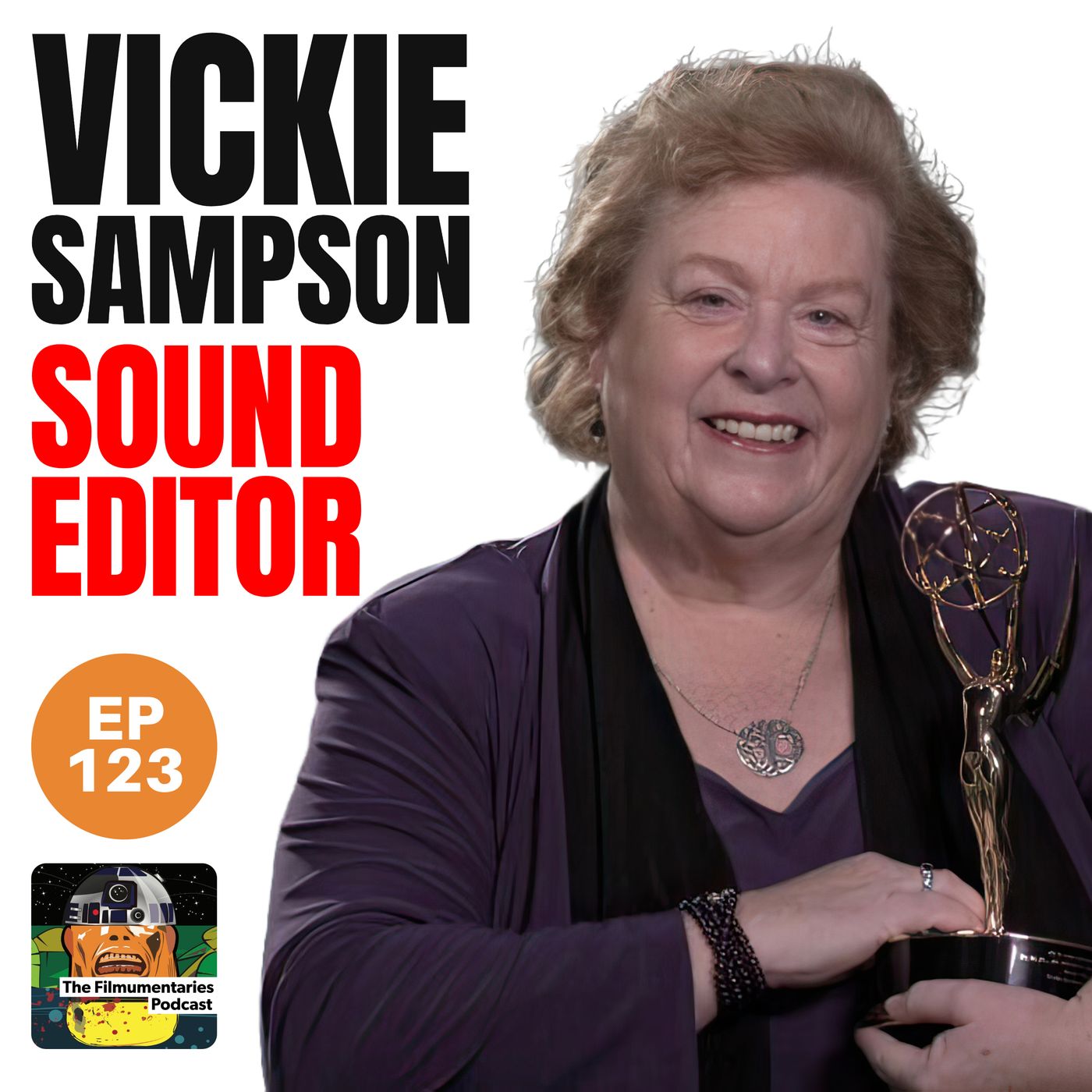
About this episode
- Growing up surrounded by film and sound
- Her hands-on experiences on shows like The Big Valley and The Rifleman
- The vital but often misunderstood role of dialogue and ADR editing
- What makes a great production sound handover (and how so many indies get it wrong!)
- ‘Temp love’ and the challenges of directors getting attached to scratch tracks
- Working with actors like Keanu Reeves, Meryl Streep and Sigourney Weaver
- Her time in London supervising ADR for Return of the Jedi – including a story about the reels being stolen from her car
- Why clean dialogue is the bedrock of a good film
- Her continued work as a director and teacher
- Skywalking Through Neverland Podcast – Episode 72 – More on Vickie’s Jedi reels story
- Simon Hayes' article on the sound of Wicked
- “A Letter from Your Sound Department” (available upon request or via Vickie’s site)
Grab some merch: filmumentaries.creator-spring.com
Or support on Patreon for just $1 a month: patreon.com/jamiebenning
Follow me on social media:
@filmumentaries on Threads, Instagram and Facebook
Filmumentaries Linktree
This podcast is completely independent and made possible by listener support. If you’d like to help me keep making these episodes, you can join my Patreon community here: https://patreon.com/jamiebenning
Watch more on YouTube:
Check out the Filmumentaries YouTube channel for behind-the-scenes clips and extra content: https://youtube.com/filmumentaries
All my links
Transcript
Automatically generated, so expect the odd misheard name.
Weirding Way Media. Hello and welcome to episode one hundred and twenty three of the Filming Mentors podcast. I'm your host, Jamie Benning, and as usual, you're in for about an hour of wonderful behind the scenes chat. Yeah, episode one hundred and twenty three. Every time I say which episode it is, I just think, Wow, how did I get here?
One hundred and twenty three? Amazing. I hope you've enjoyed my recent episodes with Jim Frederick and Howard Berry if you haven't heard them. Jim worked in movie marketing for a few decades, cutting trailers and making posters for some of the best known films of the time, and I loved his stories about the Shawshank Redemption and Kubrick's final film, Eyes Wide Shut, and his experience are coming over to the UK and cutting those teaser trailers on the Kubrick estate. Yeah, just such a unique perspective on a job I really didn't know much about.
And then, most recently episode one two two, I spoke with director Howard Berry about his film Her Name was Movieola, in which he rebuilt a traditional edit room and enlisted the expertise of Walter Merch to recut a scene from Mike Lee's Mister Turner in the analog way. It's totally fascinating and I really hope it gets a wider release soon. It's currently doing the festival circuit at the moment. But no. It's a great chat with Howard.
I've known him for many, many years online. We've been in the same room a few times at different things, but it was great to finally have a chat and properly talk to him about his passion project. Before we jump into today's conversation, I just wanted to let you know that I now have a merch shop at Filmmentaries dot creator nash spring dot com where I'm selling some new stuff. I've made some new directed by Irvin Kershner t shirts and mugs, some et sweaters and some Film Mementary's logo T shirts and some inside jabber t shirts and mugs and bags and all sorts of stuff. So please check them out.
It's just another way that you can support the podcast. If you do want to support the podcast as usual Patreon dot com forward slash Jamie Benning. For just one twelve dollar payment, you can support the podcast for an entire year. I really do love making this podcast, and I still don't make enough money to justify the amount of work and the amount of time it takes me away from my family. So if you love listening to it, please consider supporting it.
Thank you, and also big thank you to the one hundred and thirteen people that already do. Support the podcast. Okay, In this episode, you'll hear my conversation with Vicky Sampson. Vicki is a veteran of the sound department. One Hour cannot do her career justice.
She's worked as a director, a sound designer, dialogue editor, adr recordist starting in nineteen seventy three and she's still working in the business today. She's worked on so many big movies and movies that you'll know, including New York, New York, Ordinary People on Golden Pond, Romancing the Stone, National Lampoon's Christmas Vacation, Return. Of the Jedi. Now you know why she's on the podcast, Tank Girl, The Fifth Element, and so many more. And we don't get a chance to talk about all of those, of course, but it is a good conversation about what her job entails and some cool little stories along the way.
So here's my conversation with Vicky Sampson and I'll be back at the end for a bit more Jabbring on. Yeah, I have a funny story about Jaws because my mom, who was k Rose who won the Oscar up there. You're but you're not using video for this right podcast. Okay, there's an oscar on my shelf behind me. But and she was best friends with Verna Fields, who was the film editor of Jaws, and she and Steven Spielberg and Verna were very close.
And I used to swim in Verna's pool. She lived in Sherman Oaks suburb into the Los Angeles to Verna's house. Yeah, yeah, yeah, wow, I found it. Oh wow. Yeah.
Anyway, so I used to swim in her pool, and Spielberg used to bring his Springer Spaniels over to swim in the pool too, And so one day he came and he said, hey, Vicky, you got to get out of the pool because we have to film an insert of Bruce the Shark for Jaws. And it's like, oh, I got to get out of the pool. That shot would have been the shot with the guy's eye hanging out in the boat. And yeah, they think they I think they poured milk in the pool to like make it murky and yeah, amazing. Yeah.
I didn't get stay around. Yeah, I didn't get to stay around for the for the shoot of that. But I saw Spielberg after a screening of of Fableman's and he was very protected and everybody was around him, and I was like, Steven Stephen, it's Vicky Rose, you know, k Rose's daughter. And he's like, of course, Vicky, I know you. You know, you never know if they remember or not.
And I said, remember about the Jaws thing and you had to get me out of the pool. He goes, yeah, yeah, my Springer Spaniels and he named them, you know, and that was pretty fun that he remembered that too. Yeah. Yeah, we're trying to get him for the doco because it'd be great to have him and Joe sat on the sofa talking about just things like. That, you know.
But we hit to talk about you today. Okay, Vicky, how did you begin your journey into the industry. I understand you have family that was already in the industry. Yes, I like to say I was born in a trim bin in Hollywood. A trim bin for those people who are in digital mode, was a metal bin that held trims a film.
When you'd make a cut, you'd have to hang it up and be able to find it later. So that's just sort of an apocryphal thing. But yeah, my dad was a film editor and a director, Sherman Rose his name was. And my mom was a sound editor, the first woman to win an Oscar for sound editing, by the way, for the movie The River, directed by Mark Raydell, which I also worked on, but you know, she was the supervisor, so she got the Oscar. And I you know, my dad was a graduate of MIT.
He was into computers way before, like in nineteen thirty seven, and so he was always fast technology. And I think we had the first black and white TV on the block and the first color TV on the block, and he took it all apart to see how it worked, you know that kind of thing. And yeah, and they got divorced when I was five, so I was pretty little. But my dad kind of gave me my love of technology and horses and airplanes. And my mom just loved movies, you know, she was a big movie buff.
She went to Hunter College in New York and in a film class, the teacher felt the professor felt like she knew more of them, but he was teaching, and so he told her to teach the class. That's how deep her love of film and story. So I grew up with loving stories and my mom. My mom read to me, and I imagine things in my head, and I always wanted to be a writer of stories, and so I started writing stories when I was really little, and put on plays and all that kind of stuff. And I never really thought about going in the business with my mom or doing sound editing.
I knew I wanted to do something in film because I just valued her very strong love of storytelling and movies, and she really should have been a producer. She kind of got stuck in sound editing as well, which was a very tough profession for a woman, especially like in the fifties, and she had to make a living because my parents were divorced, and you know, my dad was very supportive and all, but not you know, she was the one who really raised me. I saw him on weekends, you know, and we'd fly his little plane around the valley here and go to Palm Springs sometime. He had a little, you know, two seater plane, and I would accompany my mom to go to you know, her work sometimes and play with the film cores, which are you know, the the little round thing that keeps the film without a reel, you know, so it just held.
I'm trying to describe it because I know people can't see it. So it's a little a little like two inch two inch to four inch circle of plastic and I would stack them up and then I pull I take all the sound and pull the tops out and make like towers, and of course it would topple over and then somebody would have to wind it up. And when I was little, it's like when my mom would come home from work, her hands would be like black, you know, and the first thing she'd do is wash them off. It's like, what does she do that her hands get so black? Well, it's running film through a movieola, you know.
Oh, your hands get really black, which I discovered when I started. And yeah, I started helping her out on things like she and Verna Fields, who was the editor of Jaws. Verna had a cutting room in the back of her pool house, and because her husband had died and she had two young to raise, so she got kind of special dispensation to bring a movieola and a bin and a bench and all this equipment you needed back then, and so she could edit at home and be with her boys. And they had a big dog, big German shepherd dog named Bubbles, who was a black German shepherd who would just lay across the Moviola pedals, you know, and get hair all over the tracks and things like that. So I think one summer I helped them on a film that was directed by the son of Mattel, whose name was of course Ken, and his sister was Barbie.
But anyway, so Ken wanted to try his hand directing, so he made this not so great film called It Meant through many titles. I think it ended up with the Fusty Pendant, which who knows what that even means. But he got all these really well known, experienced people to work on. He got Verna to do the film editing, He got my mom to do the sound. He got George who was a music editor, to do the music.
They dubbed it with Richard Portman, who was a very famous re recording mixer, and so I kind of, you know, helped them out in the summer. But you know, between my last year of high school and I got bit by the film bug. It's like, ooh, this is really fun, you know, like we could put all these pieces together. I had gone to the set with my mom. She worked on The Big Valley and the Rifleman series and at CBS, and I used the CBS address forty twenty Radford as my emergency contact for her because she was a working mom.
And this was in the you know, late fifties, sixties, and women weren't really divorced, and women didn't really have careers, and her approaching working was not only from a love of films, but also of necessity, you know. So she would go out for jobs. And she told me once as she went for a job about a submarine movie, and the producers you know, were interviewing her and they said, well, you're a woman, you know, what do you know about submarines? You know, And one of the guys waiting to also be seen for the for an interview he says, like, I'm a guy, I don't know anything about submarines either, so don't count that. Yeah, good for him, exactly.
And she was very much supported by men throughout her whole career as far as you know, recognizing her talents, but you know, a few of them still had holes on, like women don't do this. In fact, I mean that filtered down to me on a couple movies with a very well known composer who felt that women shouldn't be sound editors, like what do we know about sound? It's like, well, we listened better than you do. Yeah, well, yea, my wife always tells me yeah. But I mean, it's it's a thing I think sometimes when women speak and no offense to you or any man who's listening, you know, they just kind of go blank, like I've and this has happened to me more than once.
I've been like the only woman on the dub stage where we mix the movie, you know, and most of it as always men. There was three re recording mixers, one for dialogue, effects and music. Now we do it with two. Sometimes we only do it with one. And you know, the director would be a man.
Producers at the filmmatter every man, right. So I remember on one film I stood up and I said, you know, it'd be really cool if we could move that sound from the left speaker to the right speaker, you know, just move it across the screen and I could see them nodding their heads. It's like okay, And five minutes goes by and a guy stands up and goes, you know what, let's move that sound from the left to the right. I'm like, I just told you guys that five minutes ago. Oh, we didn't hear you.
There's a there's a whole comedy sketch in the UK. There's a show called The Fast Show over here where that is a sketch and it runs throughout all of the series where a woman has these ideas and then all the guys take the ideas and it's it is a real thing. I've seen it. I've seen it happen. I don't know what.
It is what it's. Called The Fast Show. Cool, it's from it's from years ago. But that, yeah, it's a well known scene in that, or a sketch in that kind of runs throughout. Oh it's that funny.
But you spoke about the sort of relationship that your mum had with verner Field. How important is that relationship between a sound editor and a picture editor in. Your experience, it's it's the most crucial because you know the film editor, especially today, I'll say, in the past we had you know professional film editors that had a professional film assistant who would prepare everything to give to us, because the film editor has to prepare are all the tracks for us to receive them and then work on them. I don't know what people in your podcast know about the process of sound editing, like. Yeah, absolutely, yeah, this is partly why I do the podcast as well.
Myself. I know a little bit, but I'm always willing to learn more. So, you know, on the set, they're recording the sound as well as the picture. Sometimes they have a boom guy who will move the mic from person actor to actor. Sometimes they are not paying attention, or an actor will improvise and so part of the words might be off mic, which is the worst thing that can happen to a film, especially student films, Because you know, I've been teaching post production since like ninety two, where I started at UCLA because I wanted to pass along not only my experience but also the teachings of my mom and why I have the ethics in sound that I do.
And I could see even back then that it was deteriorating from lack of experience or just bad teaching. You know, you get teachers who learn pro tools and then they teach that to the students. And it's not about the machinery, it's about, you know, the brain and what happens you have to think about. I write a buy was a bi monthly I don't know, a quarterly quarterly column in our MPSE which is Motion Picture Sound Editors Group magazine called Dialogue Detective. Because you have to detect, you have to discover things.
You have to find out like what is the problem, what are the options to fix it, and how to fix it the best and most efficient way. So while on the set they're recording the sound, the sound has to be sunk to the picture, which is a whole nother thing. I mean, nowadays we have smart slates and you know, slaved sound devices and different recording techniques, but the principles are all the same, no matter how much the technology changes. The principles of how to set it up properly. So once the film is shot, it goes to the film assistant, who then seeks up the dailies so the film editor can have an orderly way to find the scenes.
Because we might shoot you know your angle today because the camera is in front of you, and then tomorrow we may shoot from a different angle, and you know, all of that has to sound like it's consistently shot them the same day, even if it's not so. So once the film editor puts all the pieces together, let's say, in the right in the order they want them with the director, then they have to create a turnover to sound. And what that involves nowadays is like if you're editing an Avid or a premiere Da Vinci, we have to receive what's called an AAF, or it used to be called an OMF AAF, which is uh, I don't know audio, but I don't even know what it stands for. Actually, yeah, And so what it is is it's a translation.
It's a file that's a translation of the film editor's session. So they might have ten tracks of dialogue and five tracks of temp music and six tracks of sound effects they've thrown in for fun. And then when I open it in a pro Tools, which is the audio digital audio workstation that most people use nowadays, it opens up as a session that I can then edit and then that and so if the let's say you have a live mic and a boom mic on each actor. There's a wonderful article by Simon Hayes who did the sound recording on Wicked, and he has a whole column and it's it's amazing what they did. You know, they did live recordings while Cynthia Revo was flying around.
They had live mics, and they had a thing called silent wind, so they could just shoot the wind right at the cape to make it move and not hit the microphones. I mean, when you see that, you should look him up. Simon Hayes. I think he's English as well. Anyway, Oops, I went off on a track.
I do that a lot, so okay, so once so if they have a lav and a boom on an after a lot of times inexperienced people will just put a combine track in on for the film editor cut with because they got to do it fast, you know, has to get done fast. Somebody else can sink it up later. It's like, no that somebody is me and I don't have access to time codes in pro tools as far as syncing up, I have to do it by eye, you know. So if the mics aren't sunk up right, I have a mess of a session. So then my creative time that they're supposedly paying for is going out the window while I'm you know, putting in because I'll say to them, did you guys have a lave in a boom?
I always have a lot of questions to ask the direct or. If somebody says, oh, can you do the sound on my short film it's only four minutes, It's like, well, your four minute film is going to take me about a week to do, depending on these things. Like so I'll listen to I'll listen to what they send me, and I'll say, did you have a love in a boom? Yeah? I said, I don't see them in your session that you turned over to me.
They're not there. Oh well we'll send you the raphiles. It's like, no, it's a lot easier for you to go back and sync it up. But this is the thing, it's like all these standards of what used to be a professional way of turning over to sound. Now everybody with an iPhone, you know, can make a movie.
So the discipline has gone in many ways. So because I would imagine that, you know, when you're receiving all of that material, you're going to want, you know, the script, the reports, the whoever's mixing on set. You want their notes, You want any details about wild tracks they've recorded, the listening character, because all of that stuff has got to be there because I mean, you're you know, you're not going to see the wood for the trees at this point if that's. Not right exactly, And you know, a lot of independent productions, I'll say, oh, do you have a you know, a lined script, which is what the script supervisor does on the set and explains all the different takes of each scene and what camera lens was used and what time it was shot in any kind of sound notes like oh, there's an airplane that flew by during our western section, not my fault or generator was left on, you know, different notes like that that really help us.
And really, in all these independent things I've been doing for the last like ten years, I have not hardly ever seen the line script, right, so because nobody has the budget for it, you know, these independent films, but professional films, yes, they have to have a line I mean when I worked on Pirates of the Caribbean, we had two notebooks that were like eight inches thick. That was the line script. I mean. And you know when you go when you do a scene like let's say it's scene one, and take one is the master and then one apple. Take one is a different angle.
We went through like and then when you get through a to Z you start going abac. We were down to like ABC numbers. There was that many takes and everybody was miked, so they had like eight actors in a scene. There was eight lav mics, and you know, a film editor doesn't want to drag all of that in their session. It would make it massive, so it has to be really properly set up to access those.
You know, when we get it back, it's like, yeah, here's the here's the first take, which is usually a combine, and then there's like eight LAVs and a left boom, a right boom, A. You know, it's like incredible amount of stuff. Do you see picture at this point as well? Have you got like a low res kind of prosson running there as well? Yeah?
Oh yeah, I mean on professional films, they're never locked till they get released pretty much, and so along the way, imagine, you know, I'm editing something that has maybe fifty to sixty tracks of sound, and they make even a one frame change I have to go through and change. It was worse in film days of course, because you could only put two tracks at a time in your little synchronizer. But now with you know pro tools, we have, you know, hundreds of tracks we can. I remember those synchronizers with a little rocker kind of yeah. Yeah, yeah, because I used to work for a company called London Editing Machines that still had all that stuff.
Oh nice in the early two thousands. But you said, like when a film is released, was it ben Bert says that film's escape doesn't. Films aren't released, they escape. Yes, I used to show that section to my classes. Yeah, that was great.
But you know, so there's a lot of practical technical things that you have to deal with. So I have a list of questions I send out to directors about you know, what to look for, what to do? You know what to send me? Like, yes, I want I want access to all the I don't want just handles on the on the clips that come to me because they can designate that in their export you know, it's an export option. It's like, no, I want the whole take because I want to be able to pull out lots of stuff because I'm looking for clean pill, which is the sound between words.
Yeah, so which is like gold. When I worked on the Sex and the City movies, they they talk all the time. There's no pauses in any of their dialogues. So and the reason for having good fill and that's part of production dialogue editing, or we just kind of name it dialogue editing. It's production sound that's recorded on the set.
We have to smooth it out. So let's say I'm shooting you today and you have an ocean behind your traffic. I shoot the other angle of the other person, and they don't shot on a different day. It has different traffic I have to try to make. I have to protect the voice most of most of all.
So like in a scene with people in the background, like a restaurant there, those extras are instructed not to talk because they don't want to mess up the main dialogue. If actors overlap, that could sometimes be a problem because somebody's on mic, somebody's off mike, you know, especially like in a master shot, everybody can overlap because it's all getting recorded. But in coverage, you know your your close up, your medium, her medium shot whatever. When you put those together, then you can hear the change of ambience in the background behind the words. So we're really looking for a good you know, signal to noise ratio that your voice is above the noise floor.
And uh, if somebody's you know, talking way down low like this, they're not projecting enough. You know. It's really you can't make somebody sound on mic. There hasn't been a plug in that I know of that can take off mike dialogue make it sound on mike. So if there's problems like that, then we have to ADR it or loop it automated dialogue recording where you have to bring in the actor back and I own Yeah, a lot of people do.
Like Donald Sutherland, he purposely speaks low because he wants to come in and redo it on the ADR stage. Oh really what sort of almost like refine the performance in a way. Yeah, if people use it that way. Like when I worked on Speed, the movie Not the Drug, you know, they the director's choice was to film everything on a moving bus, and of course the conceit of the film is the bus has to stay at sixty miles an hour blows up, right, But they're only driving from like second to third gear and you can hear all the gear changes, you know, so that kind of destroys the believability of the action. So and he was told, well, you're probably going to have to bring in all the actors to loop them.
He's like, oh, okay, that's all right. I mean, he had been a cinematographer. He didn't really care too much about the sound issues. But that's that was my job. I was the ADR supervisor and we recorded everything of all the actors, even the background people on the bus.
You know, we had to bring them into the record studio. And Keanu was working on Johnny Mammonic at the time and up in Canada. So every Friday, the director his assistant I would fly up to Canada and work with Keanu on Saturdays and Sundays for three weeks. By the third week, poor guy, he was like picking up chairs and throwing them through the wall because it's very you know, it's very frustrating. But he was very dedicated to it because he knew it had to be done.
You know. So if the director is behind the ADR recording, then the actors will follow suit, you know. I mean, I've had a few obstinate directors who hated ADR. It's like, let's try to use it for what it is. And I I do my homework.
I don't just willing Nelly program lots of ADR. You know, I thoroughly investigate alternate takes because you know, if you're on you know, thirty five's Charlie take seven, I know that there's six other takes that I could listen to that I might be able to, you know, pull out a word or two or something, and I always try to match performance. You know, there's nothing worse than having a film editor talking about the film editor relationship, There's nothing worse than having the film editor distrust your judgment. I worked with a guy, I think it was on fifteen in the movie Fifteen Minutes with de Niro, and he was very wary of like changes to his tracks, like, don't you know, don't cut any alternates.
I said, how about I'll cut them with performance in mind, and I'll bring them to you and you could listen to them. And he's like okay, And after the first couple months he's like, wow, that you're amazing. Yes, I trust you, but there are other people who just know, don't even change a word of what I've done. But I said, but there's a big noise behind it. Don't you want it to so I always bring this up to the directors and the filmmatters.
It's like, what's worse. You know, you're running your movie in a theater with an audience, and they don't understand the line of dialogue. So they stop and turn to their friend and they go, what do you say? I said, Then you've lost them for like five to seven seconds, and they're frustrated because they didn't hear it. And isn't it better for somebody to hear it, you know, like then than to to be disrupted in there, you know, sustaining the disability and not disability you know, yes, say yes, sustaining the disbelief.
So and I said, look, I always have the production. I will make sure the production is as good as I can make it, but we have the ad R as an option, you know. So I find, sorry, do you find that some directors kind of fall in love with there or editors fall in love with a kind of temp mix and difficult to break out of that totally. We call it temp love, temp love, And it happens a lot with music, like you'll just throw on a piece of music, yes, and then that you know, that becomes wedded to the images that you're watching, and then that becomes like the Bible. A great example of that is when my mom and I were working on Ordinary People and the assistant editor just threw in like poco, bell, cannon and d music to have something behind.
And the score was supposed to be written by Marvin Hamlish, but Redford fell in love with the temp music so much that he just like put in a few of her Hamlagh's music as tokens of like, okay, we're paying you five hundred thousand dollars here, but yeah, it happens a lot. So I just finished a little short film for somebody and sent it to her yesterday, and I said, please be open because you're going to hear sounds you haven't heard before, and even for me because I also direct. Now, I've been directing short films and stuff, so I know on both sides of the fence. It's kind of funny. When I have my director hat on, my sound hat just goes out the window.
Again. I tell people, get wild tracks, get you know, get ambiences, get things that you are indigenous to your movie while you're there. And but I hire good people and they look out for me. But uh see, there's so many things I want to tell you. Like a great thing that I learned from Mark Rydall is he'll always say and action, so he'll put this pause it.
It's like, oh, I can use that as pill because wild tracks don't cut it. I tell people don't bother getting room tones unless it's something unusual, because number one, the set is very busy. They don't want to wait even twenty seconds to get your room fill. And somebody is always making noise, and it's never the same as what you get from the actual scene itself. So those pauses of and he does it before and an action and and cut, so that there's that sound with all the people in the in the room at the same time matches, whereas a wild trac never usually matches.
I get wild tracks of uh. To give you a really good example, on the movie my mom won her oscar for which was called The River, a Mark Raydell directed film. He cares about the sound so much that he sent her to Tennessee with a separate recordist so that they could compile a library of sounds indigenous for the film. So like they went to the smelting plant and they recorded all the equipment in the smelting plant. They recorded the tractors and the farm equipment, and the chacadas in the in the cornfields, and the machinery and the animals.
So she had like a library of sounds that were fresh and new, which is always good and consistent with the film, and just could just slot them right in. So she was able to. Read to have a director, you know, bring sound on that early in a movie. Still today it's budget you know, because he couldn't. He couldn't ask the production mixer who's working six days a week on location, you know, to use his seventh day to go record you know, Cickada's in the cornfield right, So he knew it would be important for the movie.
And it's more energy and time and money efficient to think about sound ahead of time and in fact in British movies. I mean, this is what was told to me. I don't know if if it stays true that a sound consultant is brought on before they shoot and goes over the script and makes suggestions about what to record, which I think is a fabulous idea. And Randy Tom who's a very famous sound editor, works for Lucasfilm. Yeah, you know he he does that.
He will do that, you know. And I've offered to do that too, but no one's taken me up on it as far as consulting. So it's really about the budget, you know, if they have a budget to bring on another sound per I mean, it saves so much time and money. I can't even tell you. Like I'm looking for Mister Goodbar.
That was a movie my mom and I did, directed by Richard Brooks. He wanted there's a scene where Richard gear dances around the kitchen in his little tidy whities and he has like a fluorescent knife, a switchblade, and he's dancing around. He's beaten on pots and pans and all this stuff. And Brooks wanted him to have the music playing while he did this so he'd have the energy of the music. I guess he didn't think about earbuds at that point.
But and so then immediately after they did the film take, he says, Okay, we're going to do the same thing, but we're gonna turn off the music. And darn it if his timing because it was in his muscle memory because he'd just done it, you know, and my mom just had to make a few adjustments in this wild track of him just dancing around, beating on the pots and pans, and you know, and it worked perfectly. I mean, to fully a scene. So Foley is a re record, you know, creating sync sound effects to the picture, you know, to do Foley for that would have taken probably half a day. And here she got a wild track that she could just adjust a little bit here and there and have it just slide right in and it's the same ambience in the room.
I mean, they've done this a lot, a lot of like Shawshank Redemption, I think they they did Foley on a live set, like they kept the sets up with the foots, you know, the wood and the you know, they had the whole sets to make Foley with. And John Rush who's like the premiere Folly walker in the world, who just just retired, you know, I think he did it. And they just had a little monitor and they would look at the monitor and walk along and they had a guy with a boom, you know, following them. And it's just because it's all about believability, you know, if you're if you're taken out of the movie by anything continuity, a flubbed line, something out of sync, you know, getting back to speed. I mean, we worked really hard on that, and that was before digital, so everything had to be you know, I could only cut a quarter frame out.
You know, there's no way to do anything less than a quarter frame in film because it was for yeah, forced brockets to a frame or to adjust it. Now we have time compression expansion. We could like stretch words and shrink words and it doesn't affect the pitch of the words. And uh, the director told me afterwards, he says, we got we got a better performance from the ADR than we had in the original. And I show that to my classes.
I'll show them the original production with all the wind and engine noise, and then I show them the finished scene with the you know balance because their their voices were way below the noise floor. So it was even in the intimate scenes, you couldn't you couldn't enjoy it, you couldn't get lost in it because you're just bombarded by noise. So that's how we like to protect things. And like my mom, you know, she taught me to listen for little clicks and pop we call you know, non diegetic sound. It's a sound that doesn't go with the image.
So you know things happen on a set. Yeah, somebody drops a wrench off stage and there's the director who is it, Michael Man, Well, Christopher Nolan does this too. They don't want to clean out like sounds because oh they're there. It's like, this isn't a documentary. We don't have to keep the sound of the wrench in there just because it happened to get recorded, you know.
And I my mom always taught me that those are things that subconsciously take you out of the movie. Like if you hear a lip click or a pop or a a snap or something that doesn't belong there. And this is where Phil comes in. So you take that piece that to little piece out and you have to fill it with the same ambience that's going on in that scene. So if you have, you know, space between words, you can just snip out or copy a little piece of that and paste it right over a little click, and now it's smooth.
Because anytime you notice a difference is where you're taken out of the movie and you're reminded that, oh, yeah, you're watching a movie. You know, you want it to just be smooth. So, yeah, I don't see people really no, they don't. They don't see the value of sound. I mean I always sort of describe like in the in the era of pirate VHS videos, you could watch one if it had a bad picture and good sound, but you couldn't watch one if it had a good picture and bad sound.
You just throw it in the trash, right. And you know, with student films, the biggest giveaway is the sound. Like, you know, they can study the you know, composition and the color of temperature and the lighting and all this stuff, but if they have bad sound, it just sucks. I mean, even people doing their you know, fundraising campaigns, it's like, Okay, you're gonna shoot it with your iPhone, put a mic on them, because your iPhone is still going to give you air and room. And it makes you look like you're asking people to make your professional film, and yet the way you're asking is unprofessional.
So I try to get students to think of that, and really it's just a matter of them opening up their ears and giving the giving a sound edit or a chance to do it right. Because you're sitting in the editing room for months. You're on the set for a day, but you're sitting in the editing room for a month and trying to, you know, make it sound good. And then of course the whole point is like everything is singular until you start adding sounds like you want to add. You want to be able to add sounds.
It's a lot harder to take them away if they're not right. And we do have a lot of you know, people think, oh, well, we have plugins for that. You know, you can you can take out I mean I use VX clarity Pro all the time to take out just a roar or rain or you know, things that I don't want there, and it's pretty darn good. It keeps the voice very clear, but it takes out the annoying background. But you still have to smooth all of those out, yeah, because you can't, you know, And you can do it by overlapping backgrounds.
When you're editing. You can, you know, go up to the end of the word and overlap the the ambience with the incoming word. You know, you can hide the ambient change under the outgoing word and the incoming word if that makes sense. So and then once you get done with all that, then you can start thinking about sound design and you know, backgrounds and because dialogue is always going to come out of the center channel. Dialogue and folly usually it comes out of the center channel and you go fully but people walk from left to right.
But yeah, and then the then the camera changes angles so suddenly that you're going to be more aware of the person jumping going left to right and then all of a sudden right to left. You know, fullywise it wouldn't make sense. So folly in dialogue usually come out of the center unless you have extra supportive things going on, or you want to do something fun, But stereo backgrounds is what you need or whatever. You know, if you're doing a five point one, you know you want the background because I've talked to directors too, and they go, what do I need backgrounds for? I said, well, because your dialogue is going to come out of center and you have no sound supporting it in the theater, you know, to put people in that environment, like you even if it's just air, you know, just stereo air or wind or rain or you know you're on a submarine or something.
Yeah, some ambiance is some kind. And when you work on a film like I know you worked on Return of the Jedi, you know, back in eighty two eighty three. Whenever that was did you ever you talked about, you know, using the sounds like at the start of the dialogue or the end coming out at the end of the dialogue. Did you do you have any other tricks that you used on a big film like that where you could sort of hide things under the I don't know, under the music or the sound effects, you know, in terms of dialogue. Well, I mean a lot of times we don't even know where the music is going to be, right, So it's really good to have a tempt score because then at least we know, oh, this is going to be heavily covered by music.
But then in the off chance that they decide, oh, we don't want any music there, let's just go with sound effects, and then you go, oh, I didn't cut any you know, you told me not to cut it. Usually we have what's called a spotting session, which is I haven't done one of those in a while either. I don't know if they've gone by the wayside for professional big movie films, But we used to sit in a theater and run the film with the director, the film editor, the composer of whoever else wanted to be. The re recording mixer, and we would discuss, oh, yeah, this scene's going to be really driven by music, or this one's going to be dialogue heavy, you know, and then we would go and do our respective chores on the film.
So and that was a great way to know kind of what everybody's doing. I mean, temp effects are good because it's it's really hard to imagine sound that isn't there, even for sound professionals, you know. And sometimes directors will say, well, I'm I'm I want to make this deadline, so I'll just submit what I have. And it's like, believe me, you don't get a second chance to make a first impression, Like you can't turn in your halfway edited film and expect people to fill in the blanks, you know. So when I worked on Evan Almighty, we actually gave the film editor some sounds of animals that would aren't there yet because they're all cgi you know what's his face didn't really want to work with any live animals, like he was afraid of them.
So almost all the animals are digital. So we sent them like a library of sounds for potential animals, and the film editor put those in and darn if we didn't change. If we changed one of those, you know, the director got very upset. He's like, well, I like that dog bark. It's like yeah, but it's like the traditional you know, you know that's in every movie.
And he's like, but I like it. It's like, okay, you can have that one, you know. So we try to give the film editor certain sound effects that he or she can put into the film ahead of time, so they just stay there. I mean even when I directed I directed a short film in twenty sixteen called Shelby's Vacation. It was a thirty five minutes short film, so it's not short compared to what today's are.
And even when I tried to change a line of dialogue in ADR, I was like, wait, wait if you know, like made my hackles go up, because it's like, that's not how it sounds, you know. It's like I tell people, it's like, you know, you have a favorite music group, right like Fleetwood Mac, Let's say, and you've listened to their album over and over. You know, every nuance, you know, every note you ever, you know, and then you go hear them live and you're like they're not doing it right. You know. That's not the way it goes, you know, like how dare they?
So we do get like wedded to certain things. And that's why I tell people just try to be open. You know, everything's changeable. Just listen to it once or twice or five times and see if it works for your story, because that's the thing I always go for as the story. You know.
I don't put sound effects in for my sake, and nobody goes to hear movies I work on for the sound effects. Of course, I'm not known as a sound effects person. I'm known more for dialogue and ADR. But like on Jedi, my job on that was supervising all the London ADR. So I was there for two weeks at Lionel Struts studio.
I think it was across from Hyde Park or Green Park, I forget which one it is now, but it was an old cow barn had the arches and they would lead the cows you know in the old days, across the street down into the barn and they turn that into an eight R stage. I always love that. And every day at four we break for tea and Marmy Marmiet sandwiches. Yeah, Marmite Marmite had Yes, I love that stuff anyway. So on Jedi, I mean, there's a funny story about the film getting stolen out of my car the night before I was supposed to go, but that that's for another time.
Yeah, I show up and and George Lucas already knew about the stolen film and he's like, what are you gonna do? You know, but that's the only lucasfilm I've worked on. But I don't know if that had anything to do with right, Yeah, did all the English ADR in life? And so there was a close up of a guy stormtrooper guy uh, a medium close up and he's in the big barn. And I would notice that, you know, people usually inhale before they talk.
You know, when you inhale, your shoulders rise a little bit. In production sound, you don't really You might hear a wisp of it, but you don't really connect it to the words because it's very you know, indigenous to the scene. Right when you ADR it and all you're hearing is this dark ADR that's clean and doesn't have background sound behind it, Suddenly that breath looks like it's missing, and then you can tell that it's ADR. So back in the day, the machines didn't go into record until after the imaginary fourth beep, so we'd get beep, beep, beep talk so and it would go into record after that third beep. So if the actor was inhaling to say the line where the imaginary fourth beep would be, it would be obliterated by the beeps that are on the speakers.
So I would like furiously make notes about where you have a breath in that one, you know, because I knew I would have to steal a breath. Finally, I said, could we just adr his inhale? And I had like three sets of eyes just turn whip their heads around, like what are you talking about? You know? And I said, trust me, you'll you'll thank me later, because it's important to have his inhale as part of his words.
And it's really hard to program for the inhale because you'd get beep, beep, beep. Okay, Frank, go over there, you know it just people actresses couldn't do that, And so nowadays we can put the beeps only in their headphones and then I can use and that it goes into way record because it's in pro tools, so I can use you know, a lot of the but back then no, So so they they humor me and do the inhales, and I get a call from the dub stage like a couple of weeks later when they were mixing, and they're like, nobody can believe that line was eighty yrd because of that breath. It's like, yes, that's what I wanted to accomplish. So it's it's all about, you know, sustain suspending your disbelief that you're watching a film and being having nothing distract you from it.
Like even a sound effect could be distracting. I mean in a horror film, you have sound effects distracting you all the time because that's what they're meant to do, you know, like they want to scare you and stuff, so you have these these stingers that come out at you. But in a dialogue driven film, you know, you want to try to make it as smooth and easy on the ears as possible and still hear the dialogue. Yeah, do you still like hear these things when you go to see movies? Do you still think, oh, that was a that was a moment that could have been sweetened a bit more, Because I I think I've always had a pretty good ear for sound.
I had a little tape recorder as a very young kid that my grandad gave me, and I would record my parents talking and things off the TV. And I've, you know, work in live TV as well, and I'm listening out for things, and I do notice things, I think. I think. Actually a big example of that for me is in Jaws. Actually, Richard Drapus is going through the what's left of Chrissy, the first victim of the shark, and there's a line inserted in there.
He says something like, and this is what happens, and it's clearly lifted from another scene because the ambiance sounds different. You don't see him say it, you just it's sort of an over the shoulder shot, but it sounds different to everything else. Do you notice things like that as you're watching modern movies as well? I will notice glaring things, because I mean, I want to get last in the movie as much as anybody, and so yeah, people ask me that a lot, like how can you even enjoy a movie? I said, Well, because I'm gonna get last in it, and it's only if something's really sticking out to me, like like what you just said about Joss.
Yeah, I would I would notice that. And you know, and also when I when I go to work on a film, I want to watch the whole thing. I mean, we used to watch it in a theater with the director, but you know, because again, you don't get a second chance to make a first impression, and so I want to. I want to get the impression of what the movie is about, even at its base level. Like I don't sit there and go, Okay, well I'm gonna have to have Foley for that, and that's gonna no.
I just want to get lost in the story. And then I could go back and kind of frame we call it. I don't know if this is allowed, but frame fucking oh. Did we say the same thing? I mean like to be editing, so we say exactly the same thing.
Okay, so you know, later I will go back, but I'll I'll still have that first impression of like I might say, oh, I'd really like to do this to that scene. You know, I'll just it'll just kind of sit there in my mind. And and then when I go back to actually start working on it real by real, you know, foot by foot, minute by minute, you know, then then I can take it apart it's like it's like hyper focus, you know, micro focus, and then like it's like zooming in, you know, I zoom into the problem, but then I zoom back out again to see, Okay, is it worth it to ad r this or is the production you know, gonna work? Can people still hear it the first time through so they don't turn to their friend and say, what do you say?
You know so? And and it's always changing. So that's the thing. Like when I work on independent films, I say I want a locked picture, meaning you cannot make more changes because it's too time consuming for me to keep up with you. So just send me the locked picture when you're ready, and then we can you know, go from there.
And all those other questions that I like to ask, like did they have a love and boom? Did it get put into the system? You know, I have access to it, and uh, they'd be surprised. I mean some people they would have just edited with the combine tre and not known there was anything better, because I say, I can't believe that this would be your recording. And then I find the law and it's nice and clean, you know.
Oh, so yeah, I try to I try to go with the feeling of the movie too, and in choosing sound effects, like this little short film, I sort of don't even know what it's about. It's sort of like an art film. And the director said, well, just you know, put in some he's in the city and he sees a coyote on a tennis court, you know. And so I went from like the contrast of helicopters city sound city scapes too. She wanted to put in like Amazon jungle.
I don't know what that has to do with the coyote, but hey, I'm I did it, borr or send it to her and see what she says. But you know, so I try to do contrasts of things so that you do make a difference in how Sometimes you want a big contrast and sometimes you want subtle contrast. So it really, like my mom used to say, the story dictates what you do to it. So if you're doing a comedy like she did a car Reiner film called Where's Papa? Do you know that film?
I know of it. I've seen George Siegel and Ruth Gordon. It's an amazing film, way way way ahead of its time, and it was before I got in the end. I think I was like fifteen, and I went to the dove stage and they had to like shield my eyes because certain scenes were a little raunchy, and I couldn't even buy the book, like the book was R rated, you know. But in that film, you know, it's it's kind of a very black comedy, and you know, the George Segel was a lawyer in a very rundown office, so much so that my mom put a little creek in the floor every time he walked on to the other side of the room.
She put a floor creek in a spot, you know, and nobody's gonna say, oh, wow, that floor creek was great, And Carl Reiner didn't say, oh, put a floor creak in there. That was from her thinking about the story and what could be added to make it even funnier, you know. Yeah, And that's really the art of it. And you know that's why cutting sound effects is so much harder than editing production dialogue. Production dialogue's a real puzzle piece, like you figure out all these problems.
There's all these problems clicks and pops and uneven ambiences and all this stuff, but it's there, it's presented to you, and then I just find a way to fix it, you know, whereas sound effects, it's like, well, what kind of bird do I want? What kind of rain? What kind of sound do I want? When he puts his hands on a chain link fence? You know, like in reality does it would it even make a sound?
And why we enhance it with I once did a funny workshop for some inner city kids, and the friend of mine was doing an after school program for these inner city kids, and I said to her, tell them to bring something that makes, you know, noise, like something in there, because it was going to be kind of a live, little folly session. And they all brought mostly empty spray paint cans. So I was telling them, like how in movies we tend to make things bigger than life, And I said, like gunshots, Like most people don't really know what gunshots sound like. And all these kids just kind of just sat back in their chair and like cross their arms and said, lady, you're talking to the wrong people, you know, because a real life gunshot just sounds like a pop.
But if we put that in a movie, you know, people would like not accept that. So yeah, yeah, but being a dialogue editor that you must have quite a sort of weirdly intimate relationship with these actors that you're listening to all day long because you're hearing every little nuance of their voice in your headset or you know, with your your great sound set up. There are there any particular actors that you really love listening to over and over? Well, that's funny. Well see, that's why I like a d R because I'm actually on the stage with them live in person.
That's true, working with them as a as an editor. I mean, there's an adapt that's adapt. The question is there somebody that you think is you know, particularly gifted at a DR that you've worked with? The numbers, Oh goodness, yeah, I mean there's there's so many that are gifted and so many that aren't. But like Meryl Streep is great, she's very professional, and you know, of course, and I worked with Sigourney Weaver and Robert de Niro, I mean all of them mostly who they know, they know the reason for it.
Some people just come in and say, well, why are we looping this? And and if it's a performance issue, I can't say, well the director thought your performance sucked. I can't say, so I have to say, oh, there's like a tone. You don't hear it on these tracks because these aren't the real track. You know, I have to lie to them.
Uch, I don't like to do. And I said, always tell me to add diplomat to your job title. Then is definitely definitely yeah. Being in and ADR supervisors are really hard position to be in, especially if the director's combative. I was working on a film that starred Chris Rock years ago in the director you can look him up, but he I put I.
So Chris Rock set a line of dialogue and behind it it was out they were shooting in Central Park or something. Behind it, somebody went whoop like that. So it was right under his words, and I did my due diligence. I looked for every outtake. It was an improvised line.
It didn't happen anywhere else. So I put it on you know, the ADR sheet, and and all it was was the words were lion king. I can't do that because he was a ticket scalper. Those are his words, like five words, right, lion king. I can't do that, all right, six words.
And we get to the aer stage and Chris Rock is there and the director's there and he picks up the sheet and waves it in my face. He goes, why are we looping this line? You know, waste his actors time yelling screaming at me. And I said, gosh, we could have recorded five takes in the time it took you to yell at me. But you know, and I told him the reason why, you know, because it had a sound under it.
And he goes, oh, so we're going to waste his actress time loop this line, and then you're going to put loop group people behind it. And I said, yes, but loop group people. We can adjust the balances of the levels. You know, this married thing to his words, you know, I can't unmarry it, basically, so and he he wouldn't do it, He wouldn't do those lines. And we get to the dub stage and the mixer turns to me goes, you know, there's a word under this, like I can't get it out, and he said, why did you loop this?
It's like, uh, and of course you can't say oh the director tell me not to and yelled at me and made me cry. You know, But you know what, I never I never got back to saying like how I got in the business was just got gotten bit by the by that bug. And then I was just about to go off to college and and do writing and stuff like that, and my mom got a call to do a film and they were looking for an apprentice editor, and she did not believe in nepotism, although of course the opportunity was there. So the film editor Don Cambern, who was a really great editor and he was president of the Editors Guild for many years, he said, well, let me look at the availability list. And he goes through the list and he's like, ah, now they're all drunks.
Okay, Vicky can come on, because you had to like go through the list first before you could hire somebody news. So I got it on as an apprentice editor when I was twenty on a film called Cinderell Liberty that Mark Rightell directed, and Mark would call my mom before he even knew who the actress were, like he you know, I said, hey, I got a movie coming up here, you know, make sure you're available. And do you want to have your team? Don't you want to have the people you can trust around you throughout in those early stages It must be really important. Yeah, friends by your side?
Well, and you know it's people develop relationships, like Spielberg and Richard Anderson met at USC and so Richard Anderson did the sound on a couple of Stevens' films, and you know, I just saw Wicked, which was great, by the way. And John Hue had met his DP Alice Brooks at USC when they were studying together, and you know, she worked on all his films up to this and including Wicked. You know, so people you know, you want to work with people you know and trust because you get developed a kind of shorthand and it's nice. I like loyalty and in those relationships. And film editors too.
I mean the film editor had, you know, requested me specifically for Speed because the sound supervisor who ended up winning an Oscar and didn't even thank me on the broadcast, and the Academy had gone to him. I don't know if you want to include this in your thing, but the Academy had gone to him and said, you know, you should really advocate's name is as co supervisor because she did a phenomenal job, don't you agree? And he's like, yes, but I get single credit and am he what is it to put a person's name on And then it wins the Oscar for Best Sound. So navigating egos is a time wasting. It wastes so much time in our industries.
It's just I find it's so frustrating. I was talking to somebody the other day who was John Bell, his name was. He was a designer who worked on a lot of Spielberg and Ilm stuff, and he was saying that, you know, when you get ego out of the way, you can just get stuff done like you could. You've all got a common aim. You're not trying to navigate all the time and second guess each other.
Just get it out the way, and that's when real creativity it can happen. Well, it was so encouraging to hear the dialogue from John Chu and Cynthia Rivo and Ariander Grande and Alice Brooks and the costumer after the screening of Wicked, because you could tell they're just a very collaborative team who cared about the movie, cared about each other. And it's so much better than the model of like I'm the dictator of this film and you'll do what I say, you know, or off with your head kind of thing. And I've worked for those kind of directors too, and it's awful, but you and you just tolerate. It's sort of like the election.
You just tolerate it till you can elect somebody. But yeah, so yeah, but so I I That's how I got in and and then a lot of people get in from their parents, but they don't stay. Yes, so yeah, I mean I was. I was. I became the ADR supervisor on New York New York like four years after I started, you know, being an apprentice.
And remember Lisam and Ellie we were looping her that day and I was trying to make a connection, like, hey, you worked with your mom. I work with my mom, and she she could gives me five dollars and says, so go get me some beer. I said, I'm the ADR supervisor, I'm the PA, you know, or something like that. Yeah, but you know, it's funny you said about being attuned to voices, like I'll be here in my little office and my wife is, you know, watching TV, and I'll just out of the core of my ear hear a voice I recognize. I go, oh, that's so.
And so you know I noticed the Wilhelm scream. Yes, we probably know about that, you know, I'll notice that, Oh it's in a Pringles commercial, but it's like, my ear just goes right to it. But I love that they found the original recording session of that where you can hear the guy being directed and he's like, no, you're being attacked by an alligator. It's it's got to be a. Scream, right, right, right.
Yeah, that's a funny tidbit. I love talking to you, though I feel like there's so much more I told you that you did, you did. I could do this for four hours. So what do you think that you know, are the kind of combination of skills that you have that have enabled you to work for so many decades, through the analog periods, through the digital you know, into the digital period, and now into perhaps even a new period with AI. What have you got, Vicky that has kept you going so long in the industry.
I think it's my love of story, Like I want to be able to enhance a good story with the use of intelligent sound, editing and design concepts and contributions to the story through sound. I mean, I'd rather do them from writing and directing now than sound, But I still do sound for people, and I think and I love teaching new filmmakers about the power of sound and try to get them early, because there's you could make a bad movie be better by good sound. You know, it's not going to say the movie, you know. And I don't like horror films. I know a lot of people start with horror films, but I just I don't like putting that kind of energy out in the world.
I don't like I don't like their message. So I like good things. But you're trying to get people to understand the power of sound and getting it, you know, right the first time, Like don't let your brother Bob hold the boom mic, you know, or say, oh, I could record it on my It's like I even pay for people to record sound on my films. I don't get people for free. I get because when you pay somebody, they're obligated to you to do a good job, and I want to honor their talents.
And yeah, I can't pay what you know, the big studios pay, but I pay something that makes their time worth it, valuable and just thinking about the story. So that's I have a great document which I can send you called it's basically a bunch of people me included who wrote up a thing of like, oh, it's called a letter from your sound apartment, and it's just about you know, making sure things on set don't add more sound, Like if you're only seeing people in a medium close up, why we have to hear their feet? Feet could be added later. You don't want, you know what, things cluttering up the dialogue because that's where the story is. And if you get good recorded dialogue with a good signal, then you know, that's where your story comes from.
Is the dialogue. If people can't hear it, I mean, look at the movie with Bain, you know, the Batman and Horrible. He does not care about sound at all. And you know, you don't want to frustrate people. People want to enjoy your film.
You know. I heard Robert Altman say one time, like, oh, I don't care if they understood the dialogue. Let them go pay for it and see it again. It's like, no, that's not how it works. And he was the master of like multi track recording, you know.
Anyway, So did I answer your question? I don't know. You did? You did? You did?
Well? We're gonna have to leave it there, I'm afraid, but it's really lovely to talk to you and maybe we get another chance to talk at length with some more, you know, some more of your experiences, because I just know there's so much more in there, VICKI, Oh, yeah, it's like an hour doesn't do any justice whatsoever in your mind. I know, people keep saying, oh, you should write a book. It's like, yeah, but who cares? But I don't know, I think about it.
I do love telling the stories if they're educational, like, you know, make it, make it count, like make the sound count. And I mean even George Lucas feels that it's fifty one percent of the movie going experience. Well, I recently sat in the ranch in Georgie's seat in the theater. There, Oh nice, and heard what he. Wants to hear, you know.
And I can't go to my local cinema anymore because it's just not good enough. Right right. Yeah, we get we get a little spoiled. I know, I get spoiled going to Academy screenings. Like that's how we sow Wicked.
It was at the Academy. But yeah, I mean during the pandemic, we all had to evaluate movie sound on our home systems. You know, there was no screenings and that was that was awful. But you can you know, you can still measure it. But yeah, I like to get lost in the movie and I want the audience to get lost in the movie.
And part of that is due to really good sound. Yeah, make the sound count. I like that. I hope you enjoyed my conversation with Vicky Sampson there. Unfortunately I had another meeting lined up, so I had to end our conversation after about an hour and twenty or whatever it was.
But as you can hear, there was so much more that we could have talked about. In fact, if you want to hear the rest of the story about how the return of the Jedi reels got stolen from Vicky's car, I found an episode of the Skywalking Through Neverland podcast from twenty fifteen in which she goes into detail about that particular incident. I'll leave the link to that in the show notes. It's episode seventy two of the Skywalking Through Neverland podcast. Coming up on the podcast, I have some great conversations lined up, one with a producer, a director, a documentarian, a via fex supervisor, so many more.
I'm also maybe doing a talk in London in the summer. I'll keep you posted about that as things developed. Can't say too much at the moment, but it's exciting. I'm also lining up my next couple of articles for ILM and Skywalker Sound. You can find out about all this stuff in the link tree link, which I'll include in the show notes as well.
Oh another piece of news, my power Rachel Finch is going to Stars celebration in Tokyo in Japan in April and is going to record some reports from the convention, which I'll be posting as little bonus episodes of this podcast. Sadly, I can't go to Japan. I have a lot of work over that period, and if you know anything about the TV and film industry at the moment, just to have work is a great thing at the moment. So I'm trying to make hey, why the sun is not exactly shining, but while the sun is up. But Rachel had booked her trip there some months ago and he's going to be there for the whole thing.
She's going to go to some panels, She's going to be talking about just the general vibe going on there, because you know the clash of Star Wars culture and Japanese culture is going to be quite a spectacle, I would say, so. Look out for those special reports from Rachel on your podcast feed. So thanks for joining me, and I hope you can do so. For the next episode of the Filming Mentories podcast, Freeze, come. On, get up, m go, get your ride, take her back to base.
Yes, sir, weirding Wave Media



Similar episodes across the network
Matched by shared keywords.
-
Special Report: Ephemera (2026)
1 shared keyword: adr
-
Special Report: The Mandalorian and Grogu (2026)
1 shared keyword: lucasfilm
-
The Mandalorian and Grogu (2026) — "The old protect the young and the young protect the old. This is the way."
1 shared keyword: lucasfilm