
Season 1 · Episode 124
124 - Push the Button - The Curious Career of Jeff Okun
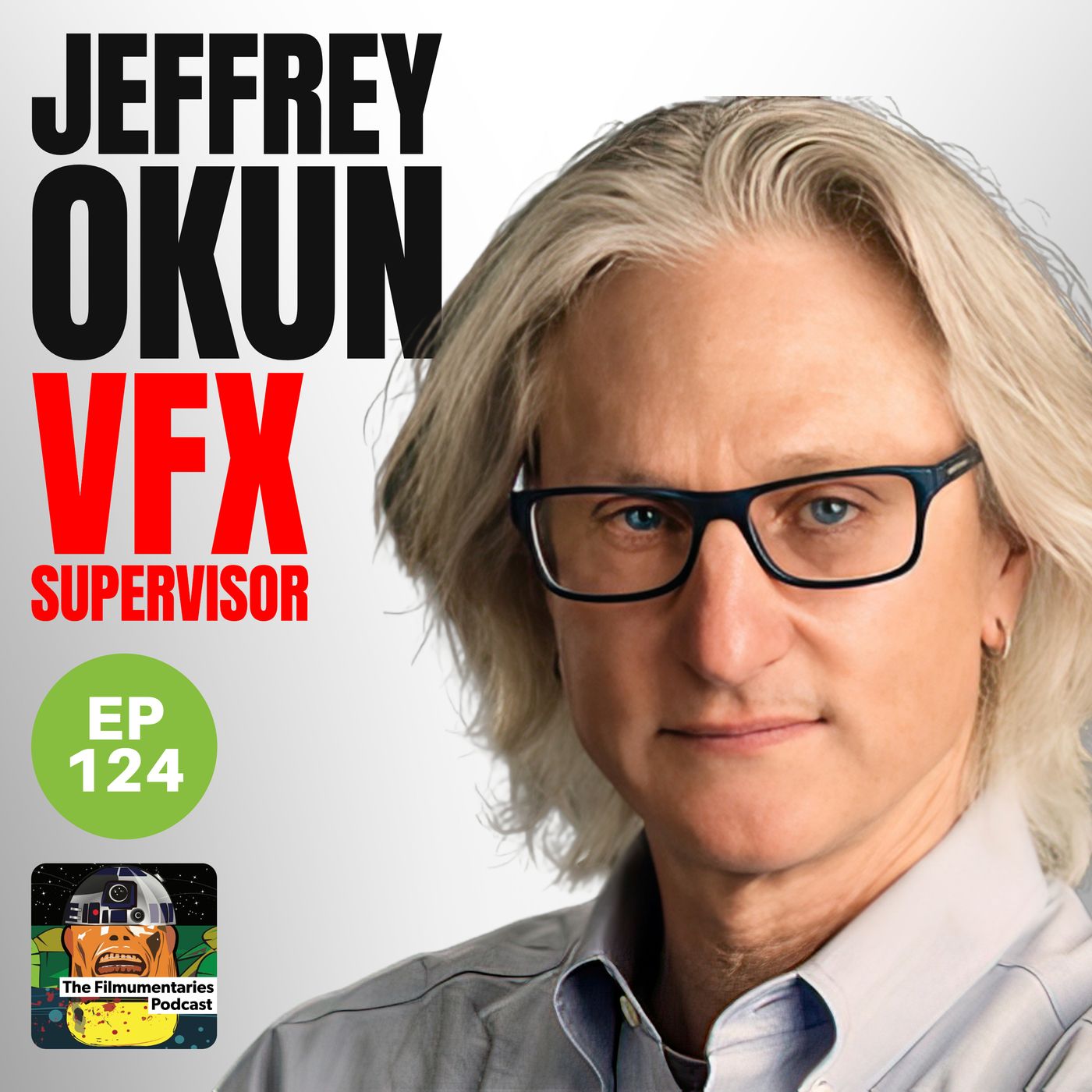
About this episode
Like many visual effects artists of a certain vintage, Jeff Okun didn’t plan on a career in VFX. In fact, by his own account, he didn't even plan to work in film at all. "I’m a completely accidental human being," he told me with a chuckle. His ambitions began on a very different stage — as a stand-up comic — until a sharply atheistic routine delivered at home earned him a lifetime ban from performing in front of his parents. Instead, Okun’s creative outlet took the form of magic tricks, homemade stunts, and Super 8 visual gags. “I would blow up model ships and fake fights in rush hour traffic,” he said, “and I’d be in the bushes filming with ketchup for blood.” All of this childhood chicanery ultimately gave way to a fascination with the trickery of movies — the kind of illusions you could only pull off with careful camera work, sleight-of-hand editing, and an appetite for mischief. Learning the Craft the Hard Way Okun's first job in film was with the legendary graphic designer and filmmaker Saul Bass. The experience was, in Okun's words, “awful,” but also profoundly formative. As Bass’s gopher-turned-editor, Okun was thrown into the deep end. “I hated him,” he laughed. “But he taught me everything: editing, sound, post-production supervision, how to shoot, how to frame. It was a masterclass.” Working for Bass meant operating in a visually precise, effects-heavy style — layering camera moves, creating in-camera effects, and often relying on labor-intensive optical printing processes. When optical houses turned down Bass’s business — too exacting, too expensive — Okun stepped in with cost-saving workarounds and pricing schemes that actually worked. “We doubled the budget, added a contingency, and somehow still landed exactly on target.”
“By the end of it, I ended up loving the man,” Okun said. “Not because he gave me a break, but because he was so specific and difficult to please that when you did please him, it meant something. He learned how to prep lineup sheets, how to composite with interpositives, and how to break down 140-layer optical shots into manageable components. “I was just the fix-it guy. I didn't know what I was doing half the time. I still don't.” VFX by Way of Accident It wasn’t long before optical houses and producers began calling on Okun when their films were in trouble. One fix led to another. His reputation grew as someone who could step into a crisis and calmly solve it — usually with a combination of ingenuity, humour, and brute-force trial and error. “I think Saul trained me to see puzzles. That’s what it comes down to — seeing what’s broken and putting it together in a way that works. Most of the time, it wasn’t about having the right answer. It was about trying 50 wrong ones.” This kind of lateral thinking came into its own on films like Stargate (1994), where Okun — working with Jeff Kleiser and Diana Walczak’s fledgling CG company — had to convince director Roland Emmerich that computer graphics were even worth attempting. “Roland didn’t believe in CG. So we built the shot, made the CG glider deliberately less detailed to match the miniature footage. Showed it to him. He said, ‘Exactly — that’s what I’m talking about. Miniatures are the way to go.’ And we said, ‘Nope. All CG.’ That’s when he finally came around.” (Fun fact, VFX supervisor Jeff Okun was paid homage by Brent Spiner in Independence Day in the role of Dr. Brackish Okun. There’s uh, a slight resemblance.) - Credit to Nofilmschool.com
Penguins, Moose, and the Invisible Effect Okun is quick to point out he wasn’t a Star Wars kid. In fact, he avoided the original film for weeks on principle — he doesn’t do queues. But he did get a behind-the-scenes tour of ILM’s original Van Nuys facility courtesy of Bass and George Lucas. There, he saw motion control rigs, Richard Edlund on his knees filming the crawl, Phil Tippett animating the chess game, and pyro tests in the parking lot. It was, he admits, a little magical — though it didn’t change the fact that his creative allegiance remained with illusion, not spectacle. “My favourite effects are the invisible ones. I started out as a magician. The goal is to make people believe there’s no trick. That’s where the real artistry is.” Still, that didn’t stop him from sneaking penguins and moose into the background of multiple films. He once gave a horse antlers in a Cameron Crowe movie. In Blood Diamond, he added a huge penguin family to a wide evacuation shot — no one noticed. “It’s like the gorilla basketball video. You just don’t see what you’re not looking for.” The Shark That Ate Sam Perhaps his most famous — or infamous — contribution to pop culture came on Deep Blue Sea. Samuel L. Jackson had just delivered a particularly rough eight-page monologue, and Okun, unimpressed with the script, asked Jackson what he wanted to do. “He just said, ‘Kill me.’ So I said, ‘If you make it to the front of the moon pool, I’ll kill you.’” The surprise shark attack that interrupts Jackson mid-speech is now legendary. It wasn’t in the script. “Renny Harlin didn’t know until the day,” Okun said. “Sam did take after take but always got to the kill spot early. We cut the rest. I shot the elements. It was a massacre. We even had baby sharks pull him apart for fun.” The Changing Landscape Much of our conversation revolved around the changing realities of visual effects — the rise of AI, the complications of LED walls, and the shifting expectations from directors and studios. “People think VFX is just hitting the ‘do it right’ button and then the ‘do it fast’ button,” he said. “There’s so little appreciation for how hard this stuff is, and we’ve done ourselves no favours by making it all invisible.” He sees today’s VFX artists as increasingly anonymous — a shift he’s spent much of his career trying to reverse, both through his own visibility and via his tenure at the Visual Effects Society. “We don’t sell our artistry. We sell our software. You know the names of the DPs, but no one can name last year’s VFX Oscar winners. That’s not sustainable.” The Invisible War Stories At the end of our chat, Okun expressed a desire to tell more of the “true” stories of VFX — the screw-ups, the late-night fixes, the shots that weren’t supposed to work. He wants more people to know that the chaos behind the curtain is often where the real creative breakthroughs happen. “It’s always fun. That’s the only reason I still do it. And when it’s collaborative, when it’s people bouncing ideas off each other, it’s magical. That’s when everyone forgets the pain and just remembers the movie.”
All the Filmumentaries Links
This podcast is completely independent and made possible by listener support. If you’d like to help me keep making these episodes, you can join my Patreon community here: https://patreon.com/jamiebenning
Watch more on YouTube:
Check out the Filmumentaries YouTube channel for behind-the-scenes clips and extra content: https://youtube.com/filmumentaries
All my links
Transcript
Automatically generated, so expect the odd misheard name.
Welcome to you, episode one hundred and twenty four of the Filmingmentaries podcast. I'm your host, Jamie Benning, and as ever, you're in for about an hour of behind the scenes stories from the people who helped make the movies we love. Thanks for tuning into my recent episode with Vicky Sampson, who gave us a crash course in the world of sound editing ADR and even stolen returning the Jedi Reels. I must get back on the podcast because we need that story for this podcast, and it really felt like there were so many more stories from Vicky that we could hear about. Before we jump into this week's chat, just a reminder that you can support the podcast in a couple of ways.
Head to Filmmentaries dot creator, dash spring dot com. I'll put it in the show notes. A bit of a mouthful that one for some nerdy but stylish merch. I've got irvincursion of T shirts, et sweaters, Filmingmentaries, mugs, all that good stuff. And if you'd rather support the podcast directly, you can do that at Patreon dot com, forward slash Jamie Benning, or by the PayPal donation button at filmimentaries dot com and I believe that button now lets you decide whether it's a one off, a monthly thing, or an annual thing.
So yeah, one twelve dollars payment on Patreon supports the show for an entire year. And a huge thank you to those of you that already support the podcast. It really does help keep this going, trust me, and I really need more of you to support the podcast to be able to justify the effort the time that goes into this. Right onto today's guest, Jeff oaken Now. Jeff has one of those careers that feels like a film history course in itself.
He's been a visual effects supervisor for decades and came into the business via Saul Bass, of all people, learning everything from editing to shooting to compositing before or digital was even an option. He went on to work on The Last star Fighter, Stargate, Deep Blue Sea, Blood, Diamond Sphere, and loads more. And he's got a wicked sense of humor, very dry sense of humor. He did want to be a comedian as well. He has an eye for invisible effects and a habit of sneaking moose and penguins into his shots.
Yes really, as I say in the interview. There really should be a YouTube video of this. Maybe after hearing this, you want to go and make that video yourself. So here's my chat with visual effects legend Jeff Oaken, and I'll be back at the end for a bit more jabbering on. So, Jeff, thanks for joining me today.
What inspired you? What was your sort of early interest in movies visual effects? And then how did you kind of translate that into something where you thought, this is how I'm going to break into the industry. Did it happen like that? No, I'm not at all.
I'm a completely accidental human being. I had a very unique upbringing. I guess you know what I wanted to be. I think everybody knows I wanted to be a stand up comic since my early ages, and I wrote out a really great routine on the pointlessness of God. And my parents were so shocked that I never did comedy in front of them ever.
Again, they did not like that routine. But what's important to notice note for me is that my neighborhood, so we grew up. I grew up on the poor side of bel Air, which people have a hard time with that, but we lived in normal houses. We were by the freeway that hadn't been built yet, you know. But to my right lived Andrew McLoughlin, who is a great director who did Gun Smoke and Have Gun Will Travel in a bunch of Western feature films like The Guns of navarroon and on the left.
I had eventually this composer named Jeff Alexander who wrote scores for movies, and he invited me to go down there and watch them score a movie, which was intensely impressive. But I think, you know, talk of rambling. So my dad was a dentist, and he was a dentist to the stars and people that he dentled on when they had emergencies, they'd always swing by the house. So we had the likes of Frank Sinatra, Dean Martin, Tony Curtis, Lana Truhner Turner, Jean Barry, and Keenan Wynn, who I know, nobody will know who that is was my godfather. His dad was Ed Wynd.
If you don't know who that is, you need to look him up because he is the best comic actor ever. So we had all these movie star types coming into the house all the time, and we go down to Westwood Village and you'd see somebody that I didn't know who they were, but my mom would go agog over it, you know, and I tripped over their feet and she would just be thrilled. And Andy, whose son Josh is like the first ad and a producer for you know, Jim Cameron and a bunch of other people. And his sister, you know, is a producer who does really great films. So when I was young, I'm talk at five to six, we had a fence between the two houses and on a weekend if they were having a pool party, you'd see John Wayne's head go bobbing across the fence, and James Arnest and then Richard Boone and various other people.
So I would go over there and John Wayne would bounce me on his knee and he would say to me, there ain't a horse that can't be rode, and there ain't a man who can't be thrown, and then he'd throw me in the pool. He bounced the off the sneed at the pool. So I love that. And then Andys father was Victor McLaughlin who won an Academy Award for acting. So five years old, I got to hold an oscar.
So given all that I had a split major in life, if one was money and the other was trickery. So when comedy failed at home, I took up magic. And as I got deeper and deeper into magic, you know, it became like, oh, I'm doing some really cool stuff here. And my dad had a Super eight camera, and I would buy Super eight film and use his camera without him knowing it, you know, and basically I would do George Maylay's kind of visual effects, you know, magic cuts and trick double exposure, you know. And then I would steal my dad's nikon and go take pictures and do all kinds of crazy stuff.
And then I would build model ships and get the both cameras out and I would set them on fire and then blow them up, you know. And then one of my dad's friends was my dad was a huge golfer, so he played golf with all these people. Was I can't remember the guy's name, but he was a stunt man. And if you go back in the commercial world, he did Laura Scutter potato chips. It's like very very old.
And he drove the cars in you know, a lot of the James Bond anyway, and he would teach me stunt tricks, and so I'd get all my friends together and then on Roscomer Road at rush hour, it's a shortcut from the west side end of the valley. It'd be bumper to bumper traffic, and we'd have a fake fight on the corner and I'd be in the bushes filming it, and there'd be we'd use ketchup for blood, and a number of times people would stop and get out of their cars to see if the kids were all right. So all of this tom foolery chicanery made me go, wow, I bet there's something else out there, And so I gave up the search for money. Because I don't know why money was my thing. My kids will tell you it still is.
I don't see it anyway. I think that's evidence anyway, But what's this. I have a dog at my feet, so it's hard to explain. But I ended up going to college, making a deal with my dad that if I got a degree in business, he would support me in entertainment until I could earn my own way. Now I didn't know what kind of entertainment.
I'd been an actor in high school. I just feel like sung to her in odd couple which changed my life forever because I became fastidious. But I had a straight a's in college except for the acting class because I accidentally turned my back. Well it wasn't accidental. I purposely turned my back to the audience in a stage show to get off stage because another actor had worked so far to the audience there was no way to exit and not look stupid.
So he gave me a B and ruined by average. And I took a directing course from the guy who played Major Hofstetter on Hogan's Heroes, and he and I became reasonable friends. And he would tell me tales and all the tales of John Wayne and James Arness and Richard Boone and all the rest about being on location and the bars and the women, and the driving through towns and a stagecoach drunk and all these great things. And I just going, you know, this is the life for me. So I graduated, and I got a job with Saw Bass, who's a graphic designer.
Most of you probably don't know who he is either, but at that time he was the leading graphic designer in the entire world and invented corporate identity logos and carpets and walls that pull it all together anyway. And Saw had done films, He'd done title sequences in many films. He's the father of the modern title sequence. He'd made many short films. And I was his gopher, and I absolutely hated him.
I just hated Saw. You know. He would always like, you know, I'd have to pick him up because he didn't drive, and bring him into the office. And he'd go into his office and he go, could you get a dying man a cup of coffee? And I'd always bring him his coffee and the things I put in his coffee, which he knew, but anyway, and so.
Without a match of personalities, then like, he's just not your kind of person. He was a perfectionist, and I was a gopher, And you know, to my point of view, what's to be perfect about a gopher. I changed the water bottles, I get the donuts, I bring him a coffee. I do whatever they tell me to do. I do the shipping, I collect the mail whatever.
And Saul would go, you know, coffee is not hot enough. He goes, I don't see you writing anything down. I need you to be taking notes. And I go, but I don't need to take notes, I know what you're telling me to do, and he goes, he goes, I feel like I'm on quicksand with you just write it down, and you know, he was very persnicty. But what happened is because I'm a fan of pushing buttons.
If you have a button, I'll push it, and so don't let me near the nuclear ones. I got thrown out of more than one trade show for pushing the wrong button. But there saw was making industrial films and there were a lot of buttons to push, and I met this producer for him named Gary Rockland, and I said, oh, I really want to, you know, learn whatever it is you guys are doing. And Gary said, yeah, you could sit in any time. And you know, I sat in with the editor and the assistant editor to see what the heck they were doing.
And then they hired another guy named Larry Starkman who became a good friend of mine. And Larry let me actually push the buttons and taught me how to work a moviola and it was I was in heaven. You cut stuff, you're making magic. It's really fun kind of magic. And there's this story we're doing the NBC's fiftieth anniversary television show, which was a week long event which saw for some reason brought me to dinner with Orson Wells at Musso and Friks to talk to him about him doing the voiceover for the sequence.
And let me tell you, you really haven't lived until Orson Wells calls you up and reams you out. And for that fact, what was that guy's name? Auto Premager and Otto was also a famous hothead. And you know, I get calls every morning from somebody reaming me out about something, and Saul would tell me stories about it. But what happened is is that they had a sequence.
It was on soap operas, and they decided to throw it away, and so I asked Gary, can I Can I take a crack at it? So I took six weeks, stayed there all night, I did my job from eight thirty to six every day, and then grabbed dinner and then edit. And then at the end of six weeks, Gary comes in and goes, hey, whatever you did, take it apart. They've decided they want to have the soap opera thing. And I said, okay, but do you want to look at it?
So Gary looked at it and he goes, wait right here, and he runs out of the room and he comes back with Saul and they look at it. Saul goes, who did this? And I said, I did this, and he goes, hang on a minute, and he got the NBC producer, who I think was Abby Man that time, Abby Singer, Abbi Man, one of them. He came in and he goes, hey, it's the first thing you showed me that's done. This is on air.
And Saul said to me, well, from now on, you're my editor. And I went, I went great, I go, I'll hire somebody to do the gopher and he goes, no, you're still a gopher and you don't get a raise, but you're my editor. And I said, but Saul, I don't know anything about it editing. And he goes, I'll teach you. And so over the course of the next few years, Saul taught me editing.
He's taught me post production, supervision. He taught me how to record sound, he taught me how to frame, how to shoot with lenses. He taught me, you know, with his sensibilities about backgrounds and four grounds in depth of field. And it was a master education. And at the end of the time.
I ended up loving this man, not because he gave me the opportunity, but because he was so specific and difficult to please that when you play eased them, it was something. And I've carried that through my whole career. So back to your original question, and you thought this was going to be hard. Uh. The way Saul put together shots were all visual effects.
He would shoot something like, you know, a slow push in and then a slow pan left to right, right to left to slow pull out, a slow boom up, and then we'd buypack it together with something else. And then he found well, it's moving too fast, forward's going in the wrong direction, or it's this or that. So I had to go to an optical house, which I didn't know what that was, and I went to several optical houses, Mercer, Pacific Title, several others, and everybody said, well, I would love to do the job. And then I go, okay, so you know, here's the po from Saw Bass and they got saw Bass. We're out, We're not doing it, and pack Title said to me, the reason we don't do it is because we lose our shirts every time we do a sol Beast thing.
Because he's too finicky and so putting on my producer hat I came up with a formula based on old paperwork that I saw pack title gave me on billions and things, and I said, what if we take the budget, double it, add a ten percent contingency, double it and add a fifteen percent contingency with a ten thousand dollars bonus on top of that, and they go, we're in. And oddly enough, that's what the job ended up costing. And we never told Saul because he would get irate. But we ran through. In those days, there's things called interpositive and inner negatives, and you had to make all these things in order to do composites and stuff.
We'd run through those ips interpositives like crazy, and they're always having to remake them because there'd be a fleck of dust because we'd done twenty seven takes because the color was one point off here or that and this. And through the course of all that, the gentlemen that worked at the optical printer and the lineup and the negative cutter in house, they let me stay and watch what they do and how they do it, and taught me how to do lineup sheets. And I was very curious, and it was just fun because there's more buttons to push. And then what happened, much to my shock and surprise, is I got a phone call from somebody a pac title and they said, hey, we need to know if you would go and go to this cutting room on this movie.
They're in a lot of trouble and they can't quite figure it out. We think you can, and I don't know what I'm doing, and they said just just go have a look. So I went to the cutting room and I looked at what the problem was and it was an easy, solid, you know, fixed it and packed title was Heroes. And then they started sending me out to all these movies in trouble, and then my reputation spread and I would get calls from everybody that, oh, you know this that, And as I like to say, there's something great about being a fix it guy, which is if there's nothing wrong, you're congratulated for fixing something that never was broken. If there's something wrong and you can fix it, you're congratulated for fixing something.
If there's something wrong and it can't be fixed, they go, well, thanks for letting us know. Now we don't have to chase this rabbit. So for four or five years that's what I did. I was a fix it guy. And you know, it all sort of came about because Saul did this commercial for Japan and it was I forget I think it was one hundred and four layers and there are no cuts and pack titles said it couldn't be done.
And I came up with a really simple solution that said it could be done, and then they did it. And that's what gave him the confidence to send me out because I knew how optical printers work, and this work, and that work in. The solution to do one hundred and forty layers. Then well, the first thing is that don't make eyeps of everything because you can't afford it. So instead of using eyeps, we use low content, low contrast positive prints.
And then what we did is we did in a six head printer, we did two tripacks and we just you know, the exposures took forever. And then what that gave us is a way of breaking down the shots so that you'd have a six layer dissolve you know that was only two and a half seconds long, and then another six layer and then another and then you take those and make eyeps of those, throw them in and then you could just dissolve pieces. And when something was broken, you know, or dirt or the color wasn't right, and one thing, it wasn't a redo of the whole thing. It was just to redo a couple of seconds. So we broke it down that way and it worked.
And I wish I could remember the name of the of the commercials online somewhere, but it's got all the Saws classic you know stuff bypack. He was a bipack, tripack, six pack, sepal pack idiot. We had a special mechanism made for the movie Olo so he could put six pieces of film in the gate at one time and wouldn't rip it up so you could see what it is. And we had a special ballb that you know, saw would go I need to see it, dude, to be brighter, and I'd go find somebody. And because of all these wacky errands, you know, I got to know like everybody.
And one of the highlights is, first off, I'm going to say something blasphemous. I was not a star wars Man. It was out for six weeks before I saw it. I refused to stand in line for anything, and so I eventually saw it and I thought, well, that's a It's a lovely thing. I really enjoyed it.
It was fun, you know, and I wasn't smart enough to know why. But Saul mentored George Lucas when George was at USC. So one of the things that was great about Saul is all these big time directors would be dropping by, so you'd have Richard Books out of Preminger, Alfred Hitchcock, IRV Kirshner, George Lucas. And. Lieu of others.
So I was always I'm like the Lucy Ricardo, you know, I'm just so impressed that they're there. You know, it's like, can I get you some coffee? You know, mister Kershner, Oh call me here? Can I get you know? So it's gonna bring a dying man, I get yours.
But but so George arranged a tour of the Valgen facility I l m at the time that would soon become Apagy And so we went out there and George showed Saul around and the producer showed me around. And it was a pretty amazing thing because not that I knew who any of these people are, but I've seen photos since like Richard Edlin on his knees shooting the crawl. The opening crawl, they had this giant dish starfield with the most control camera that's moving all over and I'm watching it, you know, they're they're showing dailies with that have philled dip tippet in them, and he's animating the chess game. Out in the parking lot. They have the alley run and they have a ship tied up to an old red Ford pickup truck and they're pulling it on a wire and it's blowing up and it's very unimpressive looking, but you're going wow.
And then on another stage, like I said, I didn't know at the time, it was Grant mceune and he's walking around with an X Wing Fighter and a sand you know machine, and I put Saw back in the car when we were finished. Oh we saw. George took us up to the loft, which was this room up top that had a player piano and an old beat up couch and a really stained drug and he showed us the trailer before it came out, and I was blown away by it. And we're driving home and so goes. I don't get it.
What's the big deal, you know? And I go, well, have you ever seeing the model do that move before? So convincingly? Have you ever seen It's like they could do multi passes with the motion control, and you know, he has all that. Showed you the footage of the of the World War two fight cut together, and then we saw the the X wing fighters you know, doing that and these guys are hand at me.
He's got it all under one roof. It's an amazing thing. And so I was like, I don't get it. And then Saw went to the Academy Awards with George. So that was exciting for me because they came by in their tuxedos, and they came by afterwards in their tuxedos, and I had assumed that George would have an oscar with him and he didn't.
Instead, Yeah, I was so disappointed that he didn't have the oscar with him. Anyway, I prepared a little celebratory thing that nobody ever saw or got to eat. And that's sort of the long version of how I got individual effects. It's nothing I ever intended to do, so apparently Saw trained me, or I have that that kind of mind where I see the puzzle problems and I figured out ways to put together and then in my later career, I'm very used to people, including my own producer, going well, this isn't going to work, and just going it will work. And just to share with you, the thing that I hate the most is that I hate people that say, oh, I know it's going to work, and I you know, I knew it.
I was never worried and I had no anxiety or ever when somebody said it wasn't going to work, I would have a lot of upset stomachs and the guy it's going to work, it's gonna work. It's going to work, and ninety nine percent of the time that it did work, much to everybody's surprise, including mine. I guess it's a stubborn streak in me, but you know, it's it's fun. That's the only reason I do this is it's fun. Yeah, it sounds like like a lot of the other people that I've spoken to, like Ken Raust and Dennis Mureen your problem solvers first and foremost.
And you know, you mentioned a couple of times where you were put in positions where you said I don't know what I'm doing. Was there ever a point where you thought, I know what I'm doing or do you always relish that kind of challenge ahead of you, like that thing that everyone's saying can't be done well. I like what Rob Legato told me one time. He goes, if I'm in the zone where I'm confident I know what I'm doing, that I'm not doing it right. So there's some things where you know what you're doing, but you can't do it that way because of a DP or a schedule or money or whatever it is, and you're forced to do things you know how to do in different ways.
And what that's all about to me is without having learned the history firsthand of how that things were done in the photochemical day. And then you know, in my own way studying in camera stuff like taking a photograph and sticking it to a piece of glass and then shooting through it to people far away with a big depth of fields, so the scales. Like my friend Larry Starkman who taught me this stuff, he did a short film on giant hot dogs on the beach and he showed it to me and I was like, how did you do that? And he pulled out a piece of glass with photos of hot dogs on it because this is how to do it. So and then you know when Ilem moved up north and Apage was there because I knew where it was.
I used to hang out there all the time. And just down the block was Illusion Arts with Sid Dutt and that Bill Taylor, and you go over there and Sid and Bill would teach you about hanging miniatures and matte paintings and and you know, double exposures with this, you know. So it's like I was lucky to have a very thorough, exciting education. And that's that's what I for nowadays. Because everybody knows how to do what we do.
It's mostly about controlling their expectations because they don't know how to do what they do. You can read an article doesn't mean you know how to do it, and it doesn't mean they're telling the truth. One of the issues that I had with sin Effex magazine is every story read in the same rhythm, which is I was hired to do this job. I propose this thing. Everybody loved it.
They gave me all the time I needed. We put it together and everybody loved it. And when they came to me, I said, if you're going to do that kind of article. You don't need me, just write it yourself. I go, I want to talk about this was on Stargate, I said, I want to talk about how I got fired twice.
I want to talk about how we couldn't figure this out, how this accident happened that made this thing work. I want to talk about the anxiety of running up against the deadline and we still didn't have the solution. And you know, those are the interesting things, is how did you deal with the impossible or what felt impossible at the time. So when people write these magazine stories today, they only write about the successes. They don't write about the failures.
And as such, directors and producers and cameramen all just think they know how to do it, you know. And it's like I recently worked on something where the cinematographer who became the DP did not believe in green or blue screens. He believed in roto And I'm going, yes, we can do that, but it'll cost more, take more time, and it's not going to look as good. Why don't we just do it right? And you know, that's more of what you're dealing with these days is educating somebody on the whys of it.
You know, people come to me and they go, well, AI can do this, and you go yes, with a lot of back and forth and you know this and that and so on and so forth. Right now, I'm working on something with I. Guess I'm allowed to say. I don't know if I signed a non disclosure with the Cosmo people. And there's AI, a lot of AI involved in this, and you know we're trailblazing because you know Cosmos talks a lot.
There is no five second take in Cosmos. Everything is a minute. AI can't do a minute. It could only do ten seconds. So how do you get this ten second clip and this ten second clip to overlap seamlessly so you can join them together.
So when AI's creating stuff, it doesn't do that because next time you hit the button instead of this, it does that this, And then you go, well, here's the branches of a tree. They're like that, But then next time they're like that. Go it doesn't work. So we're problem solving those things. I'm out of my depth, but it's where I like to be and it's very exciting.
But everybody buys by everybody, Producers, directors, DPIs, hey, I can do it a meta humans. I don't need to use you know, my actors. I had a director come to me and he goes, let's do this all with meta humans, and I'm going okay. So it's an eight page fight between five people that starts in a room, goes off a balcony, lands in a swimming pool, and then does an underwater fight for a couple of minutes. The complexity of putting that together versus shooting actors second unit, you know, and it always comes down to money.
What does it cost to do it with a metal human and you know, a procedural water or if specialized water? Is it motion capture? Are we going to key frame it? You know, there's so many questions, and then of course I always go, well I want it next week, and you go, well, that ain't gonna happen, but you can't. This has this change though.
Really, you know, if we take you back to what nineteen eighty three, ninety eighty four for Last star Fighter or ninety three ninety four for Stargate, you were still coming up against massive obstacles for things that hadn't been done before figuring out what could be done with what was available and trying to kind of push the boundaries of what was possible at the time. Did that feel different back then to you as it does now in terms of people's expectations. Yeah, because literally back then, I didn't have people saying to me, well, simple, you know how to do this. You know, we're just right, you know, we'll just do the computer will kick it out. Just have the computer kick it out.
Just hit the button, flip the keyboard under, hit the do it do it right button and then heard it on its side and hit the do it fast button. We know they're there. So the expectations are now more difficult to manage. So you're acting is not as only as an artist and technician, but as a diplomat in some ways, trying to kind of, yeah, get your way politically. It's really more that, you know, because these days it's about scripts have great visions, Directors have enlarge those visions, dps have great ideas on how to shoot something, you know, but then there's a budget, and then you know, you don't want to be the guy that's always going, well, we can't afford that, you know, lock that camera off and put that blue screen there, and you know, and let's not have that explosion, but you know we could do.
You know, you want to be the guy that goes, okay, I'll figure this out. But at the same time that self injures us because the none of these people are in the trenches in post. When you think about a DP, he does what he does. He figures it all out. He figures the palette and figures it.
You know, we'll have this equipment of that equipment, and then he has to be beat up by the producers because it's too much equipment, too many lights, you know, And then he shoots it, and then he's climbed his mountain and now he's waiting for the DII. He doesn't see that we just threw out ninety percent of what he just did because we can't use it. So thank goodness, we light ourd the set and we did photo reference on the whole thing and textured the whole thing and scanned the actors, you know, and this and that and that and blah blah blah blah blah. They don't see that pain, and the director doesn't see that pain. What the director sees is why does this take you so long?
And then when you give him the credits, they go, why are there so many people? You know? Because I only see three people one, Why do you have three thousand or three hundred or whatever. So we've done ourselves a great disservice because we're such fans that we keep the process invisible. Then we lie in articles and only talk about all the positiveness of it, and then you're faced on set like I remember when Dennis Spearen did War of the World's and the pr was about we had ten weeks to do the entire visual effects on the thing, and then everybody after that when they come to the go they did War of the World's in ten weeks.
You know, why can't you you know do this? Why is I going to take six months with these three CG creatures interacting with these you you know? And you go, well, A, you can't. The ford is l M. You know.
B Are you going to accept what they accepted or are you going to It was a great thing. I once had a director. This is a big difference from the old days too, because digitally, when you're showing stuff, it all loop forever. So I had this director and were fixing all the prosthetics, which turns into actor replacement because they didn't like any of the prosthetics, and the prosthetics got nominated by the way that year, even though I'd replaced them all. And we had this one little three second shot and it's looping and it's looping and it's looping.
And then after about two minutes, I go, well, I guess that this is a final and he goes, no, no, no, yeah, looping, looping, looping. Five minutes gone by, and I go, so are we good here, and he goes, let me just keep looping. I'll find something wrong. You know. It's like back in the old days with film, the film would shred.
You only had so many times you'd build a film loop with five takes up it and splice it together and put them on trees that go through the projector and after about a minute everything with shred, and you go, so what did you think? But that's the problem is that there's a lot of misinformation about how hard it is to do what we do and how long it takes to do it, and there's a lot of comparison to to you know, this guy did it in ten weeks and there's like eight million shots in it, and look at them you know, their entire city building and world building and creatures, you know, and you just go, yeah, the latest one, what's the name of that movie that came out last year with the AI Kid where you could see through his head that creates it, The Creator.
Yeah, the latest one was The Creator. And everybody's going, well, you know, they shot that in three weeks, and they did this, and they did that, and again, you don't want to be the nick negative guy, but you do want to find out what's going on. So I found out what's going on and goes and the answer is, yeah, they did it in six weeks or whatever it is, but they planned for three years, and they did previs of every single shot, and they built all the assets ahead of time, and the director said this is what I want and didn't change his mind, and you know, it's like, yeah, those are a lot of things. It's like, one of the biggest things I run into these days with led Walls is directors don't want to make their minds up.
They go, can't you just you know, let's make like five versions and I'll pick from that on the day, And you go, it doesn't really work like that. You want to pay for that no, no, no, no, we were not using it. I shouldn't have to pay for it, you know. And it's like LED Walls is taking the post and putting it in pre and if people planned really well and don't change their mind, it's magnificent. I have a another director friend of mine, and he just goes, look, I'm going to do something.
That's why we were not going to shoot on a wall, because I'll either want to slip the sink or put a different scene back there, you know, or you know the effects are going to evolve as they go on, and I can't really wrap my head around it before shooting. So he goes, I don't want an LED wall, And I'm going, well, what if we just build what you want? You know, We'll shoot it at forty eight frames a second and every other frame will be green and then we d in the leave room. So if I need Matt, I've got Matt, you know, but you at least have the character with interactive lighting on him. That's good idea, you know.
And so he's you know, tried it and it worked out when he really you know, slip sync a lot. But there's this expectation, isn't there that a certain technique, I guess is going to be some sort of panacea, whether it's the led wolves, whether it's like face replace a stuff, whether it's the green screen overlase screen. Back in the day, it seems to be that kind of expectation, it's just going to tick cool boxes. But ultimately these rule tools right and you have to find the right one right for the right time. There's a secret to the whole thing, which is what you learn from magic when you're doing magic, is you don't want to use the same thing over and over and over again.
The audience will catch on to it. So what are the various tools? But the director or the producer goes, you know, we're going to do this this way, and you go, but you know we could yeah, yeah, anyway. So it becomes a really fun creative process, especially when you're working with collaborative people and you can bounce ideas around and before you know it, you end up with stuff that's far better than what you thought you were going to be able to do, and everybody's it's a love fest. There's no hate in the room, and you know, and with a good visual effects producer who's handling the money and what I think visual effects producer's job is these days is to manage expects.
Yeah, as opposed to you know, yeah, they have to track all the costs and notify everybody and all that stuff. But if they manage expectations properly, when they add the eight million dollars extra to the future visual effects budget, nobody's shocked they had it in reserve or whatever it is. As you were about to. Say, yeah, and also, I was thinking, you know, back when you're doing something like Stargate, for instance, there wasn't that big a crew on the visual effects crew. I mean you look now on the credits and literally hundreds of people go by from different continents across the world.
Do you think that it's become very difficult to kind of manage that singular vision that the director has given that there are so many vendors involved these days. No, I find it easy. But that's said, I'll go back to the fact that I've never worked for a visual effects company. I've always been an independent super and early on in my career I discovered the more vendors I hire, the less likely somebody is going to be able to bottle up my pipeline and that when a shot is going south, I have options to dual track it and let this vendor keep working on it and this vendor work on it too, and the best, you know, will be what it is. So given that, like on could have been long Kissio night, I think I had twelve or thirteen different vendors working on the show.
And when I did, I got called in on Fantastic four at Fox to help when they got into trouble. So one of my vendors was in San Francisco, another vendor somewhere else, you know. And so back in those days, it was about hopping on a plane. So I'd go up to San Francisco every Wednesday, have my meetings there that I'd fly to the next place directly from there, which was somewhere cold, I can't remember, probably Seattle, you know. So Thursday was those guys.
Then Friday was back to the cutting room, you know, to talk about everything that we did, and then Monday was the local company. Tuesday was organization day. So now that we have Zoom, I hate it with all my heart, but it makes all this much more doable. And what I hate about it is is that back in the day, boy, I'm sounding old. But back in the day you would be in a room with all the artists and so you could talk directly to the artist.
And you know, I think my career is a lot based on the fact that I could say to an artist, look, so this is the minimum of what it is I need you to do. If you have a better idea, do that as well. And many times artists would come up with really great solutions and I would present them and the directors would go, oh, you know this is great. I go, yeah, it's you know, it's it's uh, you know, Jony over at CIS or you know this came up with this idea, And so sharing the credit is a valuable thing. Now you're pretty much like we are.
It's like, I don't know how many people you have behind you helping with this, you know, podcast. When I talk to a vendor, sometimes they put all the people in the room, but they're so small I can't really see them and interact with them, and they speak a foreign language, and some of the jokes don't work, and jokes, you know, warm up the room and loosen people up and allow for people to say things. And at a lot of companies, especially the Indian companies, I find that they don't even do group dailies that you know, the supervisor looks at it and then he sends everything you know out, And I find when you get all the different departments in for group dailies, it's like, on one show, we had a water problem going on, and then we're having a really rough time with this shot, and another person who is in the room goes, wait a minute, I'm doing something just like that on another show.
Let me have a crack at it, you know, And so you get this senergy and the zoom call meeting kind of loses that. This becomes a little bit less personal and more formal, and it's harder to gauge the reactions of people, you know, because like, for all, I know, you've got a guy sitting right over to your left, yeah, and they're going, you know, I don't know what what's going on in your in your environment. So I just I just find it easy to organize, easy to keep the look and and everything the same because of the past experience, you know, you learn how to break up shots based on what the strengths and weaknesses are, and you go, oh, this company'd be great for this and then you share your your look files, you know, and your references and things like that, and yeah, I don't find that a problem.
I always enjoy it. I just wish that we could fly. I wish we could teleport and be in the rooms with these people. Yeah, yeah, I feel the same. I used to travel for my work and now I do it all remotely from a hub here in the UK, and it's not the same.
It's just not the same having breakfast with people and just talking something over and you know, having meetings in person. That you're saying, is there a director that you worked with over the years that you felt kind of synergy with in terms of their understanding of what you were trying to achieve together and you'll place in achieving that and their role, you know, understanding the sort of delineation between you two. A lot of them for different reasons. One of them is Brannon Braga, who you know, Star Trek Fame and Cosmos and everything, and that Brandon is such a fan of films that we had a language we developed and I went to him, you know, on Cosmos Season three and we had a giant dinosaur sequence but no money, you know, and I go, you know, we could do it.
I'll find a way to do it, but it's not going to be as dynamic and look as good as it'll look more like, you know, a national geographic channel, you know. And Brandon would just go, let's cut the sequence, you know, and so you go, well, can you can you do that? You know, because he's a writer, he goes, yeah, watch this, and he would, you know, change it to something else. I remember I said to him, I go, look, we could do it really well. If we put the forest in fog in their silhouettes, then we can, you know, then we can do something nice.
But he didn't want to do that. Another director is Albert Hughes, who I did Alpha Witch with. If you haven't seen Alpha, I think it's some of the best work I've ever done. And it's a great story. A troubled project because of personalities outside my level, which is why I didn't get a big release like it should have.
But Albert it was a lot like sol Bass, and it was really great because he had a specific point of view with what things should look like graphically speaking, you know, and I tuned into that and it was just fun and we played off of each other and we were able to build some really interesting, the beautiful sequences that was. That was a It wasn't a tough film in terms of creativity, it was a tough film in terms of what you get for your money because we had a lot of CG handoffs and fixes on a wolf that didn't look enough wolf like and you know, and then the studio got involved and said, no, we want it to be more disney like, and it's like, no, the whole point of the movie is an interesting movie because Albert wrote it.
It's great. It's a it's a it's a twofer in that it's a coming of age story and it explains how we ended up with dogs, and it set twenty thousand years ago and stars Cody Smith McPhee there's a you know, big actor now anyway, and Albert wrote it so that you wouldn't need dialogue because nobody knows what language this tribe of people spoke. So you had a person from the London Natural History Museum come over and give us the finacic language of what it's likely to have been. And the studio came in and goes, well, we don't understand a word they're saying. And you go you don't have to because look at the picture, you know, And they they dubbed in a narrator and they added you know, voiceovers and stuff.
But if you turn the sound down, the movie is magnificent. And then they came in and recut it a little bit depending. They released four different versions of it. It was a huge hit in China. But they took the action sequence it's not an action movie, and they put it up front and then they play it again at the end of act one, cut for cut, which we never understood.
But anyway, so Albert was great. Sometimes you work with directors who have no clue about visual effects and they're fun. Like Barry Levinson when we did Sphere with him, he was just so open and collaborative to ideas, you know, and he'd set aside time and you know, he said to me early on, he goes, look, I don't want to see how the sausages made. Just make me a really tasty sausage, would you know. And we did.
We had a lot of fun on that film. So and then Roland was a lot of fun back then in Stargate because Roland didn't believe in visual effects. He definitely didn't believe in computers, and I had to do all these tests to prove to him that computers can do things. And you know, I think, I don't know if he'll remember this now. He's grown so great, Hey, Roland.
He came over for dinner one night and I barbecue chicken and I served this ashen smoking hulk. Anyway, but they made a lot of miniatures, and second unit shot a lot of miniatures of the gliders, and there was the shot that they wanted and I said, no, we'll do it. CG. And he goes, it's not going to work, and I said, it'll work. It's not going to work.
We're not going to do that. We're going to send out shoot miniatures again. And so my crew, which was called Kleiser Wallzac back then, with Jeff Kleiser and Diana Wallsack. It was their company. They got the job, they hired me, and then the crew was like six people to do the entire show.
Seven people. You know, Frank Vitz was inventing stuff on the fly while we were doing it, and the compositing folks were inventing everything. We were all inventing stuff. But we had Jeff Williams, who you look up. Jeff Williams.
He's a super smart guy and he hand built the glider in his own spare time, and he put together the shot and he showed it to me and I was blown away because he did such a great model. And I said, but unfortunately, and I took him down to the screening room and showed him the miniature that they had shot. I go, what do you see? We see no detail, we see no color. It's basically a black blur.
I go, so make your beautiful ship a black blur. And so he did, and you know, we put the shot together and then we called Rolling in and said, Rolling, you got to look at this piece of film, and we showed it to him and he goes, yeah, this is what I'm talking about. See second, the miniatures are the way to go. I guess the CG. This is all CG.
Come upstairs and look at it. And it was from that moment on that Rolling goes, oh, OK, well, so computers can work. And he offered me, he indeed said, do you want to be the head of the new company we're going to start, you know, And I said, no, said you don't want to start a visual effects company. You'll lose your shirt. If you're doing other people's projects, fine, but if you do your own, not so good.
So they started Centropolis without me, which is another dumb decision on my part. No Stargate felt like it sort of really pushed the boundaries and kind of opened the door to more technically demanding science fiction films. I remember seeing that trailer for the first time and kind of going, oh, wow, this is something new. Do you feel like that it's a milestone in visual effects history in a way. Well it should be.
It is a good story, it was well acted, and everything we did hadn't been done yet. I mean, when you think about the morphs, you know, there was no morphine software. It was all hand done by Ed, and you know, he bought a package that claimed to be a morphine package that just was a disaster. It was a two D thing and we had to do three D stuff and Ed found a way to make this work right at the last second got fired over that, but you know, and it was a good coming together of Old World and New World because you know, the miners, we had five hundred miners. We didn't really have to duplicate them, even though we did the exodus across the desert is actually sticks with rags on them with a wig styrophone wig head on the top of the stick, you know, you know, And so we had live people foreground and then that trailed off to them.
So there was a lot of tricks used, and the production design on it was really good. Holder did a great job on that, and those were really enjoyable special times. And it was a kind of show when you would fly into the location to do your shot and fly out and wasn't the kind of show that you lived on. So we could get a lot done and I'd fly out and go roll and look at this. So it was fun and rolling.
So those are my favorite directors. When you worked with Rennie Holland, I understand you. You helped craft that surprise attack shock attack for Samuel Jackson on Deep Blue Sea? What was how what happened there? Was that something?
Did I read something about Samuel wasn't happy with the scene. I was happy with the dialogue, and you came up the idea. Is that right? He came up at the idea. It was my third film in a role with sam and we ran into each other and he called me up one night and he goes, did you read what we're shooting tomorrow?
And I said, yeah, I read it. I go it's eight pages of the worst dialogue I've ever heard my life. And he goes, you should just kill me. And I said, if you get to the front of the of the moon pool, I will kill you. And so, you know, I told the story many times, but Rennie wasn't in on it.
I went up to Rennie in the morning. I did say, Rennie, you know, Sam doesn't really want to do this and asked me to kill him. And he goes, We're not killing him. He's the star of the movie. You don't kill the star of the movie, all right, whenever you want.
But Sam would do take one and he starts way back with a little bubble sub and he has to walk over and around the pool and come up, you know, and he like did it in like three lines, which I think were you know, there was twelve of us on that mountain and only eight of us left. And if you think waters fast, you should see snow. And he was in position, you know, and cut, cut, cut, you know. He goes, yeah, Sam, we got you know, six and a half seven more pages to go. You need to take your time and explore it, and he'd just do it time and again, time and again, and Renny got very frustrated with the whole thing.
And then we're in cutting and we previewed the film with Sam saying the whole thing and got horrible test results, and so they fired the editor or the editor quit or something happened, and they brought on Frank Curiosity, who is the staff big shot editor at Warner Brothers. And Frank, you know, looked at it because there's a terrible scene. He goes, what do we do? I go, use take one, Use take one, and we'll kill him. And so Frank goes, can we do that?
I go, I can do that. We're all set. I shot all the elements. So I did it and the audience went crazy. Most gratified scene ever.
Sam called me up, the best death ever. Then he called me up said things I can't repeat, but it was. It was fun because we were doing something that was going to make a difference. It was you know, you don't do that. That's not down in the middle of a speech.
You know, if you read the. Way everybody remembers about that movie, like it's the first thing that comes to mind when I mean I saw it in ninety nine, say six years ago now, and that's what I remember of that movie. Well, it's a nice scene. I really enjoyed making it. Thad Bear did the work on it over at Hammerhead, which was obviously I had to hire a Hammerhead because it's a shark movie and they named themselves after a shark.
But we couldn't get it to look right. You know. It kept looking to me like the whale and that Disney cartoon that's singing, you know, the Italian Opera with the frilled collar, you know, and it just if you look at it frame by frame, you go, it doesn't really work. But you know, we did everything we could. We shook the camera and Thad goes, let's hit the lens with blood, and I go, all right, hit the lens with blood, you know, and we made it work.
But we had a huge problem. I don't have the model with me, but I do have this from that very same film, which is the parrot being eaten by the shark. But if you look at the shark's mouth, the shark can't it can't grab somebody because the mouth is way back here. So we kept going, well, I have them. I have him go sideways and grab them, you know, and it's like, no, I really didn't like that.
I have him come over like that, and then no, that's too awkward. Don't you know this? So we finally worked it out and then we put it together and the studio, you know, loved the scene that they decided, Okay, let's gild the lily, and so I said, what's that mean? And they go, after he's pulled down, let's have the two baby sharks come in and pull them apart. Great, let's do it.
Sounds fun. So that's how we killed Sam. Yeah, and I'm sure that has had an impact on just audience expectations and how films have made since, because we don't expect the big name to die. But it has happened since, not not to the same, you know, the same extent that this shocked everyone at the time. I mean, you clearly have a sense of humor with your with your work, and I understand you like to insert little east eggs as well.
Is that the is that the frustrated comedian in you? Yeah. It all started when we were doing The Last starfre And, which was a film I was called in to fix m and the director, Nick Castle, who I love to work with, by the way, just doesn't work anymore. He makes more money being The Shape than Halloween. But that's a whole other story.
See I think you could see right there's a little bit of the Shape fallen over sideways. But anyway, he signed it. Nick and I are good friends. I don't forgot what I was. Gonna say about the East egging last time.
Oh yeah, So Nick Castle, the director, used to call the studio guys gumbies because they are all like the Gumby cartoons and they'd walk around, and so Nick goes, let's put some gumbies on the space ship. So we redesigned the space ship to have the outline of gumbies all over it. And so nobody's ever said anything about the gumbies. So on the next film, I went, well, how far can I go with this? So I started thinking about moose.
I think moose are funny. So I would put moose in unexpected places in various films, and then I would show the director. I go, look, I put put a moose over there is that? Okay? Can we leave it?
He goes, what's the moose for? And I go it's funny. It's an Easter egg. Nobody will know, you know, it's a moose, so they usually would let me keep it in. And then and then moose became penguins.
So and I got really, really bold on a Cameron Crow movie with the moose. We put moose antlers on a horse in a gas station. It's just there. Nobody said a word about it. Camera says okay.
But it was really big. It wasn't hidden in a corner. It was like here. So in the next film, I put penguins in it, and I put them really big, and they like walk across the frame, and they were overly bright. I couldn't get the vendor to tone them down, and we couldn't do it in the d I in those days, and nobody said anything about it.
So I started putting more and more things in. And then I found the UCLA study on the gorilla playing basketball, which if you haven't seen it, have a look at it. It explains why you can do this stuff and nobody sees it. I was just thinking that very thing when you were talking about the penguins. Yeah, yeah, so I see how far I can get it.
And I've lost a job over it. I got interviewed for green Hornet, Yeah, the green Hornet, and the director I said, you know, I like to sneak things in and he was he got outraged. Just how dare you? You know? I go, no, no, no, it's fine, And if you don't approve it, I won't do it.
But I always do it. No, no, you cannot do this. This is not this zeckl rely is you don't do that anyway. I didn't get it with that movie anyway. Well, I didn't get a call back on it.
And one of the things I find is that if you're working correctly, meaning the collaboration and flow is casual and more deep, that you can sometimes affect the outcome of a movie. Like you know, Rennie and I used to collaborate, although I don't know if he would agree with that. But. You know, you go, you really shouldn't shoot a scene like this. Can you just move the camera over there and place them, you know?
Or you know? Yeah, And a lot of that happens in pre production, and nowadays you do it with previs and you know, you build it. The last thing I did, they would do storyboards, but they wouldn't share them, so I did my own previs, you know, and I would show it to them and then we would shoot stuff and they go, well, we never saw your previs. And you pull it up and go look shooting it cut for cut coincidence, great minds think alike. But it's really good, so you know, it makes it easier, and then you know, when you get a reputation such as it is, it makes it easier to approach the director and go, look, I just put four penguins really big, like like on Blood Diamond.
There's a they're evacuating free Town and they're coming across the frame in a huge diagonal line with a village burning way in the background. But right here is a family of four penguins, really big, you know. And I showed it to Ed and I go, I put those there, and I go, here's a version without them, you know, and he goes, well, they're too big, And I said, well, let's let's see. I go invite some people in from the office here and let's see if they say so. We invited people in and nobody saw the penguins, so Ed final it goes fine, if it'll make you happy, keep your damn penguins.
It sounds like there's a YouTube video waiting to be made of all of your penguins colleated in one place at one of the other strings to your many strings to your boat is the VS. The Visualist Effects Society. When you chaired that for a while and kind of advocated for, you know, workers in the industry better conditions. Was that something that was really important to you at the time, Having, you know, seen what you've seen over those decades, it's still important. Yeah.
The problem is is that VS. Isn't the isn't the organization to affect that kind of change. I don't know if you know it, but back in the late eighties I tried to get a visual effects guild going, and I met with the unions and they really didn't want anything to do with it, and they said, oh, you should, you know, go talk to the TV guys because you're really you know, tape operators is more a it's more of a tape operating kind of thing what you do. And then I tried again in the early nineties, and then when this whole industry went global, I was like, well, I don't know what to do. And then the union came to me when I was chair of the VS and said, you know, we wanted visual effects union.
So we put together a secret group of influential visual effects and special effects people and we worked with IATZI to try to get them to do it the way we wanted it done. And after a year or two we ended up just going our separate ways because effectively what they wanted to do would have gotten everybody fired, you know, and it wasn't going to bring about the change that we wanted. At one point, Local six hundred, which is photographers cinematographers, came to us and said we'll take everybody in the VS into our unit, and we were met with them. Bob Coleman was our treasurer at the time, and we met with them and Bob asked the question that broke the bank, which is, so you're going to waive all fees and wave all dues until you actually can represent us, and they went no, we're still going to be an entrance fee and you're still going to have to pay dues.
And we said, well, how when will you be able to represent us? And they go, oh, well it could take twenty years. There's a whole process and people are going to have to sign these cards and this and that, you know, blah blah blah blah blah, and so we essentially, you know, it's a hard thing to say. We essentially said, our deal is you let us in no entrance, fees, no dues until such a point as you can actually represent us. Otherwise you're just taking our money and we're not getting any benefit from it.
And you know, when you think about unionization, which is what would have worked, you know, when you're union to get a pension plan, you get a health plan, there's a place to go if you're working you know more than you know, eighty billion hours a day when you don't, you know, And it's what we need. And the problem now in twenty twenty four is that the industry's global, the union is local, and until there's a world union, all that's going to happen is, in my opinion, is that it will be more people. If you want a job, you're going to have to go to another country. That they'll be less and less and it's certainly not going to make it any more competitive. It will make it less competitive.
And with. You know, the tax incentives that people are offering, we're already the migrant film workers and we travel to where it is. I haven't shot anything in Los Angeles since one sequence in Cameron Crow's movie Elizabethtown and before that Stargate, so it's a rough thing. And the other problem that's very disconcerting to me is because we have gone out of our way to sell the equipment as what does the work, the software, the computer processor, you know this and that, because the perception of producers and directors and production managers is, well, I have a computer. Yeah, I hit the button.
So if you don't want to hit the button, I'll find somebody else to hit the button, you know. And we've really sold ourselves short. And I always like to do the comparison with the directors of photography is you never hear them going, oh, I shot it with a Panavision gold Star camera. What you hear is John Toll shot this movie. John Told did this, and John Told did this, and they sell their artistry so that you know names like Billy Freakin and John Toll and Michael Goy and all these people.
I like a game, and I'm as guilty as the next person failing at this. But so who won the OSCAR last year for visual effects? I know it wasn't the creator because I remember following that and I've forgotten who it was now. Right, And there's your point. Yeah, that's the point.
I don't even care what film. Who are the four people that wont it? See, we're not selling our artistry, we're selling our equipment. And as such, it's not like, oh, the best artists are in LA. What they hear is, oh, the best computers are up in wherever Ilm is these days, or New Zealand.
If I need monkeys, I need to go to New Zealand. That doesn't matter that all the artists that did that left the company and moved somewhere else. So I follow artists, I don't follow companies. And it's very hard because the artists are what used to be a very small group of practitioners is now blossomed into thousands. And as such our job has become more of a factory job.
And they don't see the faces and the fingers. They just see, here's the assembly line. It's got all those computers and processors on it. And that's not a good thing for us. Was it was Godzilla minus one?
That's correct, yep? And there's only three people and one special effects guy, can you name any of them? One of them was the director. No, I can't let this point. Yeah, no, it's good.
I mean that was probably the first time in a number of years, though, that I'd actually seen the faces of the winners. Because the other thing is the broadcast of the Academy Awards. Sound editing gets removed from the broadcast to catch up with the delay, you know, to meet the specific window of time that needs to be broadcast. Editing gets cut, visual effects gets cut. But that was one time I did see the faces of the people involved, So maybe there is a small positive to be had.
Well, thus the Visual Effects Society. That's all I could say is that when we designed the award show, when I created the award show under duress from those it's a whole other story to that. But anyway, the whole point to the award show is to recognize an honor and to be able to publish these names and get press coverage and all that stuff. And you know, when you think about the categories of Visual Effects Society honors right now, there's twenty five of them. You know, I left the committee after nine years or something, you know, and they've they've expanded there are things, and they're they're handing awards out for some things that some people find a little odd.
But at the end of every award season we always get quests for you know, why don't we have my Emotion Capture Award? Why don't we have an editing award? Why don't we have a previous award? You know, all I can say is when I first presented the awards to the board, under Jim Morris was the chair, I had eighty four awards. We covered all that.
The board voted it down, saying that the awards show itself would take three days at that rate, considering it takes two and a half to three hours to hand out twenty five awards eighty four awards that nobody wants that. So the awards does what it's supposed to do, but we as practitioners need to take the start and talk about it. Meaning you need to say people's names. It's like, you know, it's it's there. It's becomes very political because you don't want to look weak in front of somebody that's hiring you.
But it would be like, you know, it's like, you know, oh, if I could only get Mitch Draine, I could knock out these sixty four shots because he's an excellent artist. You know, if I could only get the cloud the Deer Brothers, you know, but we don't do that. We just go, well, City Site did this, Maybe we could, you know, I'll hire Cinny Site, you know. But meanwhile, nobody's there anymore. So well, I feel like I'm doing my little bit, Jeff with my podcast because I put people's names in their faces forefront.
You know, Tomorrow I'm speaking to Pablo Hellman, and then I'm speaking to Stephen King and Rob Coleman, and I've spoken to Nila Rhotis and you know, a whole bunch of people. I think. You know, some podcasts they put the movie up front. They say you know so, and say work this movie. I don't do that, actually, and I'm probably suffering for that fact.
But I do like to sort of point to the artistry of people rather than the film itself, and you know, the umbrella that they worked under. Yeah, we'll TELP. First off, Telp Pablo, I said, hey, we'll do. But the problem is when you think back on it, you know, we we know the Holy Group, you know, you know, Dykster Mirror and Ralston, Edlin and Tippett m h. You know, then the next generation is like Rob Legato, me Pablo, most of the visual effects supervisors at ILM.
And but anyway, it's like it's hard to get down into the weeds. It's hard to go after the artist. But again, if you go back to the let me tell you an imperfect story instead of a perfect story, then you can have an artist and he could show you look at what they shot, never mind why they shot it, which is a whole the other thing. Look how I figured out how to do this. So the artists are doing what we used to do, you know.
And one of the things, as an aside, that the artist seemed to like is they love my war stories. As to why I did not shoot it correctly, you know, and you go, well, you know, we did the best we could, but unfortunately they dropped the camera in the sand and we didn't have a thing, and the sun was setting behind the dune and we had to get the shot. So I grabbed this other camera and we had held it on this tripod because we didn't have time to do that. So we're lucky we got it at all. And they're going, well, I got to stabilize it, and I got to do that, you know, and it's like, yeah, you're doing all the great stuff that I was supposed to do because I'm supposed to know what I'm doing.
But that's like a whole show is like iconic shots from various movies. How did they really happen? I don't want to hear. You know. Rob had this great idea and then he tested it and it worked perfectly.
Everything happened and it was nice. And as a compositor, all I had to do was hit the button and watch it come to get you know. It's like there's some stories out there that will and producers and dps and directors need to understand this in order for them to really buy into helping us help them. And sometimes we have that sometimes, you know, like Albert and Brannan and even Roland even though he does these sequences. Nobody can shoot anything on anymore, but you know, they do the stuff.
And by the way, my favorite kind of visual effects it isn't the Marvel watch me create a universe, even though some of the work and that is studyingly beautiful. My favorite stuff, because I remember I started as a magician, is the invisible visual effect that looks like there's no visual effects in this project. That's that's where it gets exciting for me. But I love the do the giant thing everywhere now and again because I really like giant explosions, and so does Ready Harlan. I hope you enjoyed my conversation with Jeff Oakan there.
I just love his blend of deep technical knowledge, problem solving spirit and that totally irreverent sense of humor. From what looking under sau Bass to Samuel or Jackson getting eaten mid monologue, it's clear that Jeff had a hand in some iconic moments, often in ways we never knew about without a podcast like this one. And that's exactly what this podcast is here for a sort of oral history in a way of behind the scenes unsung heroes, you know, pulling back that curtain to celebrate the creativity, the chaos as well and the craft behind those movies we love. Coming up on the podcast, I've got chats lined up with a director, a concept artist, some more VFX folks, and also Walter Merch coming up soon as well.
My friend Dave Barkley Puppeteer, has just released a book as well, and I've got him on the podcast. It's already recorded. That'd be coming up in the next few weeks. And I'll also be writing some more pieces for ILM and Skywalker Sound, which I'll keep you posted about in the show notes and on my link tree, and I'll talk about those in forthcoming episodes. Also keep an eye out for some special episodes later in April.
My pal Rachel will be sending back reports from Styles Celebration Japan, which I'll be dropping in as bonus episodes here on the feed. I can't be there myself sadly work commitments, but Rachel's going to capture the vibe for us. I'll be out in Vegas just before that. I'm going to work for one of my clients at the big show out there, NAB, demonstrating some of their kit. So if you're at NAB, I know some of you are in the industry, come along to the EVS Broadcast booth and say hi, thanks again for listening, and I hope you can join me next time on the Film Youmentaries podcast.
Now you've seen how bad things can get and how quick they can get that way, well, they can get a whole lot worse. So we're not going to fight anymore. We're going to pull together and we're going to find a way to get out of here. First, we're going to see you after. This podcast is produced, edited, and presented by Jamie Benning.
Music is by Michael Hewitt Brown of MB Music. Thanks for listening, weirding Way Media



Similar episodes across the network
Matched by shared keywords.
-
Garret Dillahunt - Unsung Cinema
2 shared keywords: last, the
-
Special Report: Beware Boiúna (2026)
1 shared keyword: vfx
-
Seasonal Differences, Shifting Fandom
1 shared keyword: the