
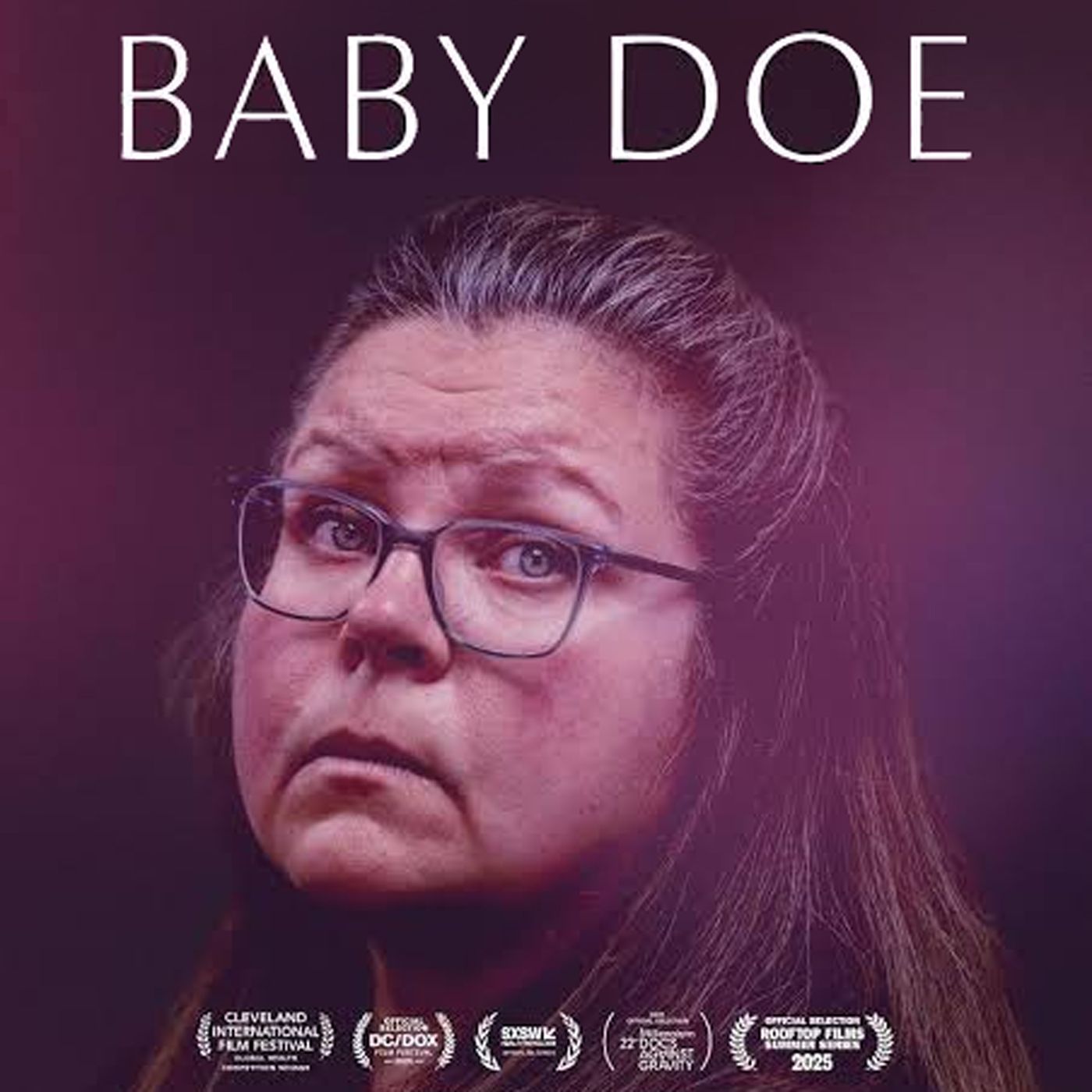
About this episode
They dig into building trust as a nearly one-woman crew, archival footage pulled from prosecutors' files, decades-old news coverage, and Gail's own home movies, and denial as a survival mechanism. Earnshaw talks about the case's all-male jury, how Gail's Baptist upbringing and shame around premarital sex fed her silence, and how screenings in Birmingham, Alabama drew unexpected empathy from Christian audiences.
Baby Doe streams on Apple TV, Amazon Prime, and Fandango. Follow at Baby Doe Film and @jess_ernshaw on Instagram.
Transcript
Automatically generated, so expect the odd misheard name.
Hold your ears folks it's showtime people pay good money to see this movie when they go out to a theater. They want cold sodas hot popcorn and no monsters in the projection. Booth everyone pretend podcasting isn't boring. Turn it off. She was an amazing mom.
All officers are on the scene. Suspect wanted for questioning. We just wanted to see if we could talk to you first of all. Do you have any idea what we want to talk to you about? It's about a baby.
Yeah? What about? A baby that was left. Over 26 years ago, Gail Eastwood Ritchie left her biological child for dead. I did not know I was pregnant.
The next thing I knew, I was giving birth to a baby in the toilet. How do you create a life and just discard. It? She could face a maximum sentence of life in prison. She has not only married the baby's father, they have three other children together.
Church going, family, I just don't understand. Given her religious background, abortion would have been murder. Gail has been adamant that she did not purposely cause this baby's death. She kept repeating she's sorry, and all I could do is say, I forgive you. There's a lot of shame in these families, secrets.
They're making her out to be a criminal. This is not acceptable in society. There has to be a punishment. I don't care about the evidence. As long as I know my mom can come home, that's all that matters.
We've seen a lot of people who are monsters. They're not a monster. Welcome to The Projection Booth. I'm your host, Mike White. Today's guest is Jessica Earnshaw. director of the documentary Baby Doe, which follows the case of Gail Ritchie, a woman prosecuted decades after concealing a pregnancy and digs into the psychology of pregnancy denial and the shame, faith, and silence that surround it.
Baby Doe is available now digitally on Apple TV, Amazon, and Fandango. Visit babydoefilm.com for more information and to find out where the movie is playing near you. I had a great time talking with Jessica, and I hope you have a great time listening. Enjoy. Can you tell me how you got involved in filmmaking?
Was it through photojournalism? It was. Yeah, I started as a photojournalist in New York and ended up getting a grant to photograph aging in prison. I spent a lot of time doing that in Maine, a Maine state prison, a Maine correctional center, and That photo essay that I did was published in National Geographic. And while I was there in the women's prison is where I happened upon Jacinta, who's a participant in my first film, Jacinta and her mother, Rosemary.
And then I just didn't mean to change paths, but that's kind of how it happened. Sounds like aging in prison has to be one of the most depressing things I could ever think of. It is. It was very eye-opening. Before I went into the prison, I was very nervous to go in.
It was the first time I'd ever gone into a prison. And then when I was in there, I found that the men and women that I spent time with were nervous in some ways, especially the men, to meet me. They hadn't had many visitors. I think you realize when you go into prison, or at least the prison I went into, that there's so many people that seem they've done potentially terrible things, but that there's so much life that leads to those moments, often so much trauma. I just really had a sense that people who are in even for life sentences are just, there's no, nothing necessarily monstrous about them.
They're just like anybody, anybody could end up there in a way, but yeah, it's also sad. How was that transition for you moving from photojournalism to filmmaking? At the beginning, it was a little bumpy because I was still, so when I started filming Jacinta, I'd started it a little bit as a photographer. So I was photographing it and then I would like film a little bit and photograph. It's really difficult to do both.
And so I realized in that, that in the prison, it felt so much more, they have people's voices to see their interactions. It was just so much more revealing than just photography. I felt like you would lose a lot in photography in that way sometimes, but it's very similar though. I'm just, For Jacinta, I was just a one-woman crew following them. And in a very similar way with photography, I'm just there by myself.
So you have to film so much more than you do in photography. You have to catch everything. Now, I'm old enough to actually remember the case that was discussed in Baby Doe, but how did you come about it? I came across Emily Weaver's story first. I read about it in an Elle article, and I was just fascinated with this idea of pregnancy denial, or as they now call unperceived pregnancy, reached out to Emily's attorney, spent about a year filming that story.
And because it was held up in appeals, I realized I needed to look for another story that I could track through a trial. And so I had a Google alert out looking for different stories. There's so many that are like, once you're aware of them, you just see them all the time. And I came across Gales then, and I had never heard of it. And I didn't know what had happened in 1993, because I live, at the time, I actually was living in Canada.
I'm Canadian. And And so, yeah, I reached out to her attorneys and I went down to the office and I spent about four hours speaking to her and her husband, Mark. And at the end of it, Gail agreed to let me follow her in hopes that it would help Emily's story because I was mostly talking about Emily when I met her. When did the pivot happen? About a year after.
I met Emily in the summer of 2020. And I met Gail in the summer of 2021. It feels like it was well-documented at the time, but you obviously are not looking for the same things that the news media was harping on at that moment. I got all the archival from the prosecution. They gave me a whole box.
Because it had been a cold case for so long and the community, they called the child Chiaga's child. They were very invested in solving it. Every year on the anniversary, they had news on it. And so there was a lot. Also the fact that the detectives recorded the funeral.
It was a stakeout. They were trying to find the woman, the mother. They also staked out the graveyard. So there was a lot of footage that could be used there. But it was also great because Gail and Mark had a ton of footage Home movies, which I was able to, I basically took all their material, got it transferred.
And so we had a ton to work with there as well and tons of photos. Yeah. So there was a lot of archival that we were able to find. How do you build trust with your subjects? For me, it's a lot of time spent with them.
With Gail, I basically, and I was asking for full access. to really be with them throughout the process of leading up to the trial, through the trial, and also with the attorneys. I wanted to be there for everything. And so I was asking for a lot. And I think when I just, I spend a lot of time, I don't stop filming. And I think over time, you just become part of the fabric in a person's home and part of the journey with them.
I feel like in a lot of ways, I'm on a journey. with the people I'm filming. I'm just there experiencing everything that they're experiencing for the first time. You said with Jacinta, you're like a one-man band. You're there filming everything. Do you have a crew for Baby Doe or is it still just you?
I had another shooter, cinematographer Emily Thomas. So she was there with me whenever it was something like I would need more than just myself. I was there through everything, but then occasionally Emily would come in, especially for the trial. She was there all the way through the trial with me and the lead up to the trial. Cause there was a lot of trial preps that were happening, but yeah, it's a very small course, just either me or me and her.
What was the most surprising thing that you found while you're doing your research and filming this? Gail's in denial of her pregnancy, but how much of a coping mechanism denial is just to survive. Not only was Gail in denial of her pregnancy, but the family also was like in denial that anything that this could ever go badly for Gail because they just so believed in her innocence and also that And also believed in the justice system as being fair and that everything would work out in the end. And I think also just on that topic of denial, the mind and the body, it's just the body doesn't show. You're not looking pregnant.
And that's just fascinating. And actually, that's something I learned at the very beginning of doing this. But it really... From all my research in this, these women are not, they're still, they don't seem pregnant. No one's noticing.
They're in their families often. They come potentially from neglect. People in their lives aren't really seeing them. They're unable to ask for help. There's definitely a common thread through these women.
And what I think is interesting is the girl's invisible and then the baby's invisible. to her and to everybody else as an extension. Are these babies just visible to men? Because it feels there's a moment in the film where it's like, these are just all men in this court case, and there's one woman. It really feels like she's ganged up on. What's your thoughts about all that?
I definitely think that women definitely have more, it seems like, more empathy overall for these cases, maybe just because they can understand that how this could happen. I know that in pitching the film before we actually finished it, whenever I would talk about it, women almost always got it immediately for me talking about it, whereas sometimes with men it was a little harder to get there. Even with my own editor, my editor is a man, we would have arguments all the time where I could completely see how this could happen and he would be questioning it. Interestingly enough, like when it comes to, Gail had a full male jury, two alternates that were women. And the prosecution went down to, we're doing tons of research at the time.
And there's a girl in our montage, Gather Richardson, who's a cheerleader. How in the film, you can see how right up until her birth, she's not really looking pregnant. And they, we have all these kinds of clips where she's not growing in size. And. In her case, she was acquitted, and her prosecution told Gayle's prosecution that they thought women would be the best jury to find her guilty because they wouldn't believe any of this, that you could be in denial for pregnancy.
But the women in her case came out hand in hand, and they acquitted Skylar Richardson. And so that's part of the reason the prosecution went for an all-male jury, because they felt guilty. they understood from that case that women would actually probably be more sympathetic. She definitely is very involved in the church. How do you feel that faith kind of plays into her story? She came from a very broken household as far as her father was an alcoholic, very emotionally abusive towards her.
She really didn't have any support in her family. And in order to get away from him, she started going to church regularly. at a very young age with a family down the road. And I think she found community and safety there. And she even says to this day that her faith really saved her life back then. And so I think it's really a double-edged sword for Gail because I can completely see how her faith was this thing that was so important and necessary in her life, but also I think made her, there were moments, especially with having premarital sex.
I think the fact that she had felt so unloved as a child and she had never really felt worthy or loved by anybody in her life. And she meets her husband who, her then boyfriend, who sees something in her and loves her and they start having sex. And I think for Gail, it was like this lifeline. Oh my God, somebody loves me. And, but I think that was really tough because she was also in a purity group at the church.
And she felt like she was the only one who was having sex out of marriage. And she felt like she had, she had sinned and it was, she was bad and like all this stuff. And And she really didn't feel like she had anybody she could tell when she actually did get pregnant. And I think that actually is probably true. I think I've talked to other people, including her daughter, who has grown up in a similar church.
And we've played the film in Birmingham, Alabama, where we played to an audience of people who grew up Baptist as well. And the idea that She definitely wouldn't have had an abortion. It was totally like against, she would have considered that murder probably. She couldn't tell anybody in her life without being totally rejected because that is such a sin, having premarital sex. She really just didn't know what to do.
So I think that really played a huge part in this. And I think if Gail, I think, felt like there was support there, I actually think she wouldn't have been in denial of her pregnancy. I think it was like this element of, I'm not going to deal with this now. This isn't happening. I can't deal with this now.
And I think the psychologist in our film does a great job at talking about how it's almost like having a tumor or having a lump on your side that you're like, oh, I don't want to. If I find out this is cancer, that's I don't want to find out this is cancer. So I'm not going to get it looked at. And that happens so often as well. It's like a way to cope and get through.
And yeah, for Gail, it was like, I'm not going to deal with this now. And then all of a sudden she had to deal with it. And it It was a crisis. You talked about how this plays in Birmingham, Alabama, and I'm curious, are there different reactions from different crowds across the country? Are things regionalized?
We did play a lot of places, like we played Pacific Northwest and New York and all over the place. Birmingham was the first place where I knew our audience was going to be a lot more Christian, and so I was curious how it was going to play there. But it was really... fascinating playing there because I think when you have grown up in the church and Gail grew up American Baptist, and I feel a certain way watching Gail talk about her experience, but it doesn't compare at all to somebody who also has gone through that upbringing and how they interpret Gail. And the level of empathy and understanding that I found in Birmingham I don't know if it was like totally unexpected, but it was a little bit. They had us play.
We played in a church. Patty was there with us. Patty and Pastor Royce came and were part of our Q & A there. And Patty told the story about how she had an abortion when she was young and the shame she felt. And she kept it a secret for 30 years also.
This is a friend of Gail's who's very important in the film, I think. And there were a lot of women who came up to us and came up to Patty who said that they also had abortions they hadn't told an eBay about. And so there was just such an understanding, which is amazing. Where is the movie at today? Where can people actually see this now?
So we are coming out digitally on Apple TV and Amazon Prime and Spotify. Fantango on September 17th. And it's going to be a rentable film. And then what about you? What are you working on these days?
Right now, I'm just traveling around with Baby Doe. We're doing a whole screening tour across the United States. We're playing a lot of law schools. We're showing the film to a lot of young law students, which has been really interesting, in different theaters. And so I'm really just doing this for the next few months.
Do you have your next project in mind already? I'm looking for it. I don't have an answer right now, but yeah, it'll be within this realm probably of women in the criminal justice system. And where's the best place for people to keep up with you in the film? We are Baby Doe Film online.
That's our website. And we're putting basically all our updates there on the film, where it's playing, and any kind of exciting updates. And then I'm at Jess underscore Earnshaw on Instagram and I post the same things basically. Ms. Earnshaw, thank you so much for your time.
This was so great talking with you. Oh, thank you so much. I so appreciate it. He's so dumb, dumb, dumb.


