
About this episode
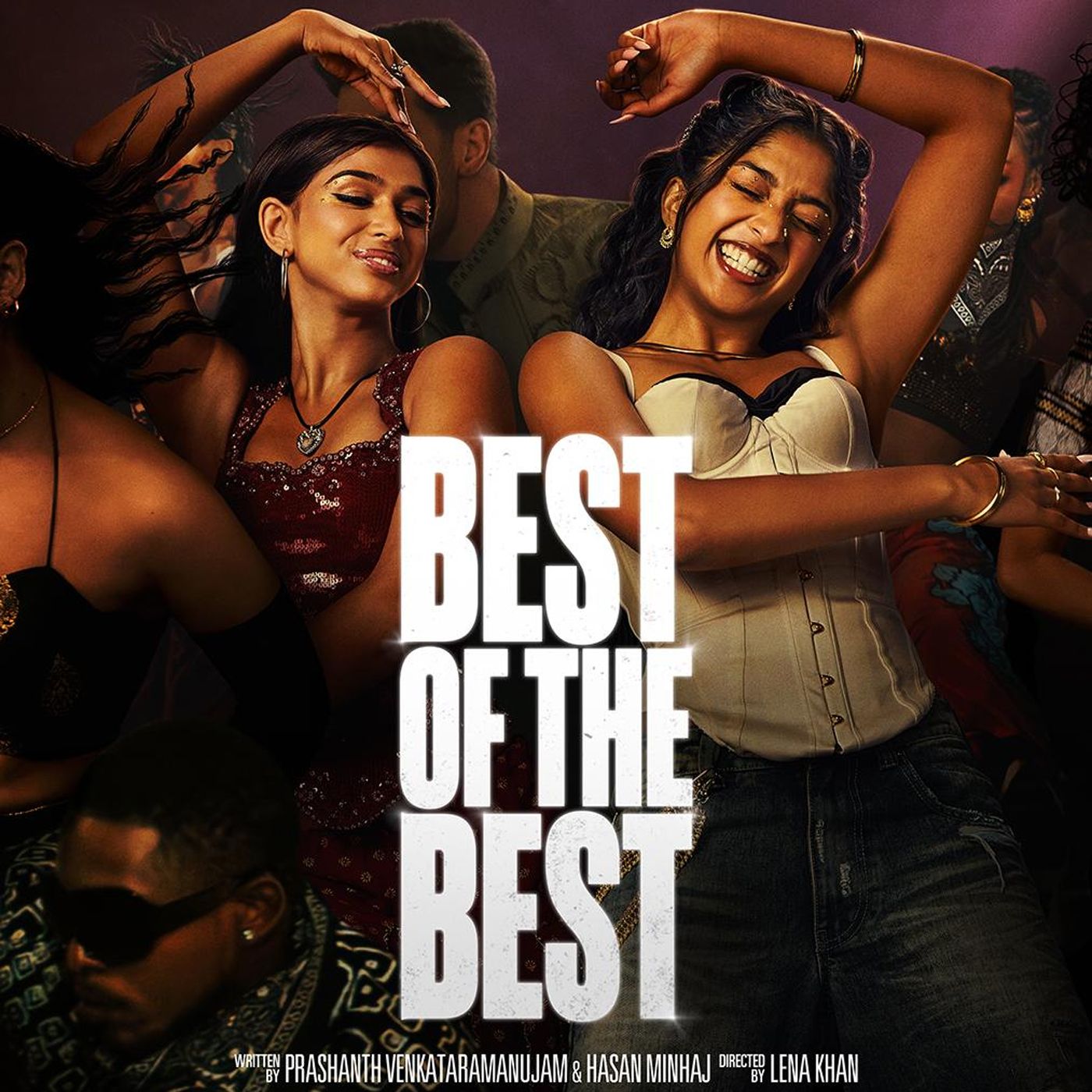
They dig into the rewrite process, Khan's push for tonal consistency across the film's teen-comedy, dance-movie, and female-friendship strands, and her call to trade a boy-subplot for a betrayal that lands harder. Khan talks choreographers Phillip Chbeeb and Mackenzie Dustman, cinematographer Adam Carbone, shooting dance numbers in a single day versus Bollywood's usual five or six, and calibrating the "15% Bollywood" spectacle without tipping into Glee. She also talks working with Rizwan Manji, mining her own friendships to crack a character, and what's next with her project Baby.
Best of the Best is now streaming on Netflix.
Transcript
Automatically generated, so expect the odd misheard name.
Hold your ears, folks. It's showtime. People pay good money to see this movie. When they go out to a theater, they want cold sodas, hot popcorn, and no monsters in the projection booth. Everyone pretend podcasting isn't boring.
Turn it off. Turn it off. Like, at college. Can you believe it? I just need one.
Can you sign me up for the dance team? If you try out for the. Team with me, I won't let you fail. Ladies, we're literally two minutes into day one. So sorry, sir.
Professor... man? You are stepping into a legacy. Whoa. Which is why our goal is simple. Be unforgettable.
Every Bollywood team has a few stable characters. Over there, you got your breakers and trickers. Then you got your Bollywood baddies. Hey, baby girl. And every Bollywood team has one random white person who just knows more about Indian culture than everyone else.
I'm Harry. Let's get to work. Our next competition is in eight weeks. Tonight, only the best move forward. We are so screwed.
I couldn't agree more. We gotta respond. Let's put bleach in their water bottles. What? No.
I meant with our routine. We're going rogue, aren't we? That's right. And I can't talk you out of it? You won't even try to be a team player, ma'am.
But we need to stand out. It's happening. What's going on? We're in 54th place. Too hot.
That is bad. I should walk in. You're my best friend. I can't do this without you. Welcome to The Projection Booth.
I'm your host, Mike White. This episode, I'm talking with director Lena Kahn about Best of the Best, her Netflix comedy about a Hollywood-Bollywood intercollegiate dance competition and the friendship it threatens to break apart, co-written by Hasan Minhaj and Prashant Bhargava. Best of the Best is streaming now on Netflix. I had a great time talking with Lena, and I hope you have a great time listening. Enjoy.
Tell me a little bit about you. How did you get involved in filmmaking? I'm South Asian, so that was never the first choice for a career path when you're younger. But I would always make films for everything, like every school project I had, making short films when I was younger, when I was in college, using for fundraising for the organizations I was in. And so it wasn't really until...
I came at it as more of a do-gooder activist approach. I used to be a very activist in college, and I was doing stuff for Sudan at the time. I was at UCLA, but we'd plan all these things and nobody would come. And I remember... Don Cheadle came two weeks later and he had just done Hotel Rwanda and I was like Rwanda's two countries moved over from there and but all of UCLA descended and I remember having conversations that was very formative time because I was like wow that is the power of like sort of cinema that it can move people and it has power and people respond to that and they don't learn as much about life in the world from the classroom so I applied to UCLA film school had finished my bachelors.
And when I got in, cause it's a small program, I was like, okay, that means something. And went from there. Can you tell me about some of your earlier movies, like some of your shorts and then especially the tiger hunter. So I was doing like random music videos, short films. I was doing a lot of music videos also because they help pay for themselves.
So we're doing like random country artists and stuff like that. And then I was, I started interning and then got a small job at participant at the time. which unfortunately is not here right now. But while I was working there, I was writing The Tiger Hunter. And so it took a bit. And I remember at the time, I never thought like stories from like my dad, who immigrated from India, and his dad was a tiger hunter in India at a time when they're man-eaters.
I didn't think any of those stories might be interesting for a movie, but kudos to my colleagues, that participant. They were like, no, this is like fascinating. You should do something. It's okay. It's okay that your family is brown.
People can still be interested. You always think when you're from a minority, or at least South Asians I know, we're like, do people want to know our stories? It was different than it is now. What was it like working with Rizwan Manji? Rizwan Manji is fantastic.
He does what the richest characters, actors do, which is they have an identity and a backstory and all those sorts of things that far transcend even the amount that shows up on screen. But they're like glaciers, the part that is above you notice. And he really just puts so much work and love. Everything he does is... It is a work of passion, and he feels like I'm making small little changes over time with the work I'm doing, and it's true.
He's one of the reasons that so many things changed in 10 years. How did Best of the Best come about? Best of the Best started with Hassan and Prashant, Hassan Minhaj and Prashant Venkataramanjan, and they had written it together, and I think they were trying to do something that had a South Asian story, but also something where you will find eyes watching this movie. So I think they wanted something that was like, had bigger scope. And so they're like, wait a minute, our intercollegiate Hollywood, Bollywood dance competitions are insane.
And so they're like, let's do something around there. And they very soon found it would be easier for various reasons to have it be around a female friendship. And then it went from there. And then they, when they had some their script and ready to go out and start making things. They contacted me while I was traveling one time and they're like, hey, can we get your feedback on the script?
And I thought they just wanted like feedback from like a colleague. So I was like, this is great. Maybe do this different. Oh, it would be cool if this different. And then they approached me later and said, hey, can you let us know your take if you're to direct it?
And went from there. Had you worked with them before? I hadn't. And since Hassan is super famous, I feel like I say he wouldn't mind, but he auditioned for the Tiger Hunter, my first movie. Oh, wow.
Nice. That's all I knew him from. We just knew of each other. What were the differences from that earlier draft that you read to what we're seeing coming up on Netflix? Prashant had probably already done 50 drafts before I came on board and after I came on board.
We probably did another 100. I don't know. Not really, but we did. We did an insane amount of drafts. The biggest difference had to do with just making everything richer and more.
My thing that is important to me is to make things very tonally consistent. And this movie endeavored to be many movies. And it has a lot of different things. You have your teen comedy. You have your female friendship.
You have your dance competition movie. So which one is it? And what is the tone? And so, for instance, there would be scenes that had 10 jokes in it. I was like, I think this movie you really need to.
I want it to be a little bit more premium in terms of a lot of things. But one of them is the relationships. And if you're really going to come on board these things and have this really tell the story we're invested in. picking those things. There was a lot of work in making the female friendship kind of as rich as it could be, but also what are the real things that are pushing them over the edge? Because there's the inclination, especially with female friendships of any age, to just make them yelling at each other a lot.
People do that. And I was like, I have lived many a female friendship and the passive-aggressive stage, I remember saying this a lot, is the passive-aggressive stage is way more cutthroat and harsher than a fight. How you get past fights or avoid fights is much more interesting. And what is it that causes the final thing that becomes the real fight? And there used to be things, there was a couple plots, to their credit, it was never really about a boy.
But there was a boy subplot that was coming between them. And I was like, I don't think this has to be as important as you guys think. And we had some debates with Netflix and internally, and I was like, I know it doesn't sound like it, and maybe it's not as sexy sounding, but what Maya reveals with Sunny Singh when she's drunk I was like, her revealing a secret that was hers to hold and protect from Anjali is going to be much more juicy and important and inviting than if it was just about a boy. And that's what happened. People always audibly gasp.
At that moment. The friendship feels so real. And I was curious, how much of that did you bring to this? And then how much of that relates to you in your life? I always want to give Prashant and Hassan credit.
Prashant was more like the day-to-day writer. They're working relationship, you know, this for another day. But like I worked most closely with him. And everything ended up, you know, would get channeled through his voice. But we were talking script 50 times a day.
It was all we were doing. So a lot of it, like we did a whole kind of do-over with the script. Not do-over, but a lot of changes. And a lot of it, yeah, did come from life. Anything from, you know, small things.
Like there'd be, I was like, you know, Prashad, maybe you don't know this, but when two females spend a lot of time together, their cycles actually end up syncing. So which means if there's a fight, then you can make a joke about that. So he made that Bluetooth joke about like, what do you mean you disconnected our Bluetooth without telling me and it's about something else? Anything from that to like, yeah, I kind of, when I was trying to figure out how I work with this, this is maybe not answering your question the way you want, but it is a crazy but lovely lady named Joan Shackel, who she describes herself as a director's guru or also workshop development. She works very closely with Jonathan Dayton and Valerie Ferris.
They workshopped all of Little Miss Sunshine through her, Nikki Caro, many, many people. Anyway, one of the things she always helps is just make things, helping you make things really real. And so I was having trouble connecting to one of the characters as much. I didn't relate as well. So I did a lot of like Guided writing, random things, just going deep to find me like, how can I like really feel empathy and connection to this character?
Drawing off of like relationships in my own life. And I did found some fights in my own female relationship that actually ended up, I was like, wait a minute, I can understand her. And that got incorporated in a lot of both script level and just like execution with the actresses. Of course, the choreography is so important to this movie as well. Can you tell me about that?
I can't imagine how much work it was just to do the dance sequences, much less to film the dance sequences. The dance sequences were nuts because the biggest thing that I kept singing when I pitched it to was I was like, A, I needed to not feel like, OK, now cut to music video. I was like, even though I want the aesthetic to be inspired by a music video, meaning that it's just richer and a little bit more artistic. Like I was like, it's basically like I don't want it to look like Glee because that's a different way. It's fine, but that's a different type of work.
And I was like, I need everything to be inspired by what is the story trying to tell you at that moment? And so the first thing was, I was like, I need Philip Chabib and Mackenzie Dussman. They are the most innovative choreographers I've ever seen. They are weird and unconventional, but also they are so soulful. Everything is intentional.
Everything. So if you look on how we talked about everything under the sun, like how do we tell the story of their dance through the duets in physicality? When is there a codependence? When is one person being more supportive? And you see it even though you don't say it.
And what is the difference in physicality and movement between the different dance teams based off of what their strengths and weaknesses are? And when are you inside of them? And when are you watching as a voyeur? And so all of those things I chat about. I'm super, super proud of working with them.
And then Joy Akazi, who... has worked in the Bollywood circuits, helped us with, she joined that trifecta that was amazing. So it was a lot of, it actually started with the music. This is a lot because there was a lot, we had to fit so much. Cause I kept saying, I was like, I don't want it to just be kids dancing on a stage, even though that's what these dance competitions are. I was like, I need it to feel like how you feel and they feel.
And so it's the cinematic fantasy of that. And so that was very important to me. And I was like, so that's why we're going to steal a little bit of 15% of Bollywood. from that because that is spectacle and that is the feeling of what you think it is. But the problem is we only had about a day to shoot all of those and Bollywood traditionally spends five to six days on a dance sequence. So it was a passion project like no other from everybody involved to really just plan everything out of Carboni, our cinematographer really took things to the next level in terms of just like, how do we capture it now on camera?
But yeah, it was like, how do we stuff in the things that really tells our story is visually arresting every 10 seconds. And we could fit it into a day. And sometimes you had to make compromises. And hopefully we just got the big things. Are you doing this like multi-camera setup?
Because it just feels like there's so many cuts and so many different angles that we're seeing. There is. And it was interesting when we were editing. We did sometimes because you're going very fast. And Netflix is doing things like focus groups.
And we're like, should we do quicker cuts here? And sometimes we actually just let it live, breathe in its moment. But to answer your questions, we did have multiple cameras for many things. Some of them, I was like, that is not the type of approach I want here. And I was like, I know it doesn't feel as effective, but I don't want them all to start looking like the same thing at the end.
Where it's like, here's your close-up, here's your whatever. And our choreographers are really big on that too. They're like, we are choreographing for the camera for special types of movements. So we would all talk several days before we shot it and come up with a plan that this is going to be the shot we have for this 15-second sequence. And there might be one other camera, but maybe not.
And you're just going to have to start trusting it. How are you communicating with all of these different things? Because, yeah, again, you've got the choreographers, you've got your camera people, you've got you, you've got the dancers. Are you sketching this stuff out or is it just rehearse, rehearse? Everybody has a different approach.
So Adam Carboni, he's very techie, very digital in a really nice way. So he'll do the equivalent of previsits. He'll set up his little thing. He'll show the moving camera we're going to do here. Or sometimes we had dolls.
We had a lot. I had a lot of peg dolls. I have them here. And I got one of those little eBay cameras that are tiny. And we would actually be like, the camera's going to come down here.
It's going to weave around here. It's going to do that. And then we'd have to work with, and we were working very hand in hand with the choreographers to be like, they would do their, as much as they could of previs, but they didn't have a crane when they were rehearsing. And we only had sometimes a small amount of time to rehearse. So between all of that, and then sometimes I would cut videos using the camera movement or the types of moves I wanted, like screen capturing music videos or dances and be like, I'm looking for something like this.
And I cut it to the music and I go, okay, so we just got as close as we could. You've got your step up movies, you're bringing on movies, but in those do a good job of storytelling through dance. But yeah, Having that Indian connection and just the way that dance elevates the story in any sort of Indian films that I see, it just gives it that extra. Like you said, 15% extra. I just love that it brought more of that drama to this without being overly melodramatic, which is tough to do when you're dealing with young people because the nature of their lives is so melodramatic so often.
It is interesting that you say that, though, because Before, when I was pitching to Netflix, the cinematographer I wanted, the style of the dances, this and that, I was like, yes, everything is dramatic. But I was like, I want to harken back to a time 15, 20 years ago where movies with young people were not necessarily called. YA. Yes, they were dramatic. Yes, they were that.
But that is just what life is. And a lot of it is stuff that we deal with later on, too. Anyways, that was a tangent, but it just reminded me of it. Yeah. Yeah.
The Bollywood part just gave you permission. Sometimes I think we try to be too cool here when it was really like, no, what will serve the story and will serve the actual feelings that people are inhabiting at that moment? This is coming out on Netflix, but what is the life outside of that? Do you get to see this at a theater? Like what else is happening with the film?
Because it's so good. I want everybody to see this, even people that don't have Netflix. Ah, yes. Well, the main, its home is going to be on Netflix, and I'm sure Netflix wants everybody to get a Netflix account to watch it, but there will be. We have a premiere in New York, and I think they're doing some ticket giveaways.
The premiere is on the 9th, though, so I don't know when this comes out. They're doing some screenings. They're doing a lot of watch parties at colleges, and where I think they're even having sometimes dance teams come, so there's opportunities like that. Otherwise, it is on Netflix. Do you have your next project already working?
I have a couple that I'm working on. You're at the stage where my project, which is a baby that I wrote and doing with some fantastic producers who've done some cool things. I'm working on that and also flirting with some other ones with some folks. Lena, thank you so much for your time. This was great talking with you.
I really appreciate this. Thank you. This was lovely. . . Man dhadkaaye badarwaan Kaale mega kaale mega paani to barisao Kaale. Mega kaale mega.
Paani to barisao Brijri ki talwar nahi boondo ke baan chalao. Megha chhaaye, parkha laaye, kirgir aaye Thank you. Thank you. Ke man dhadkaye badarva man dhadkaye badarva. Man man dhadkaye badarva Rasa agar barsega, kaan phir tarsega.
Koyaliya gaayegi baithi mundero par. Jo panchi gaayenge, naye dil aayenge. Ujale muhs kuda denge azehro par Prem ki barkha me bigha bigha tanman Dharati pe dekheng paani ka darpan Chaiyo tum jaha jaha. Dekhiyo wahan wahan Yehi ik. Sama ki dharatiya Pehne.
Saath rangon ki chunariya Thank you for watching. Kale Megha Kale Megha. Paani To Barsao. Kale Megha Kale Megha Paani To Barsao. Dijri Ki Talwaar Nahi Bundo Ke Baan Jalao.
Hey. Hey. Thank you for watching. Now it will bloom in every lane. Now it will laugh in every lane.
When the wind blows, it will make a sound. When the body and mind burn, it will give light. Kale mega kale mega paani toh barisao Paani toh barisao Bijri ki talwar nahi boondon ke paan chalao. Boondon ke paan chalao Ghanan ghanan ghir ghir aaye har ra Ghanan ghanan ghor ghar chaaye badra Dhamak. Dhamak guje badra ke dhamke Chamak chamak dekho Thank you.
More from The Projection Booth



Similar episodes across the network
Matched by shared keywords.
-
Episode 25: The Last Laugh (2019)
1 shared keyword: netflix
-
90s TV Babies Meet The Golden Girls: Uncovering Timeless Comedy | 80s TV Podcast
1 shared keyword: female friendship
-
Warrior Women & RJ Stewart: Xena and Gabrielle's Impact on 90s TV
1 shared keyword: female friendship