
Season 1 · Episode 762
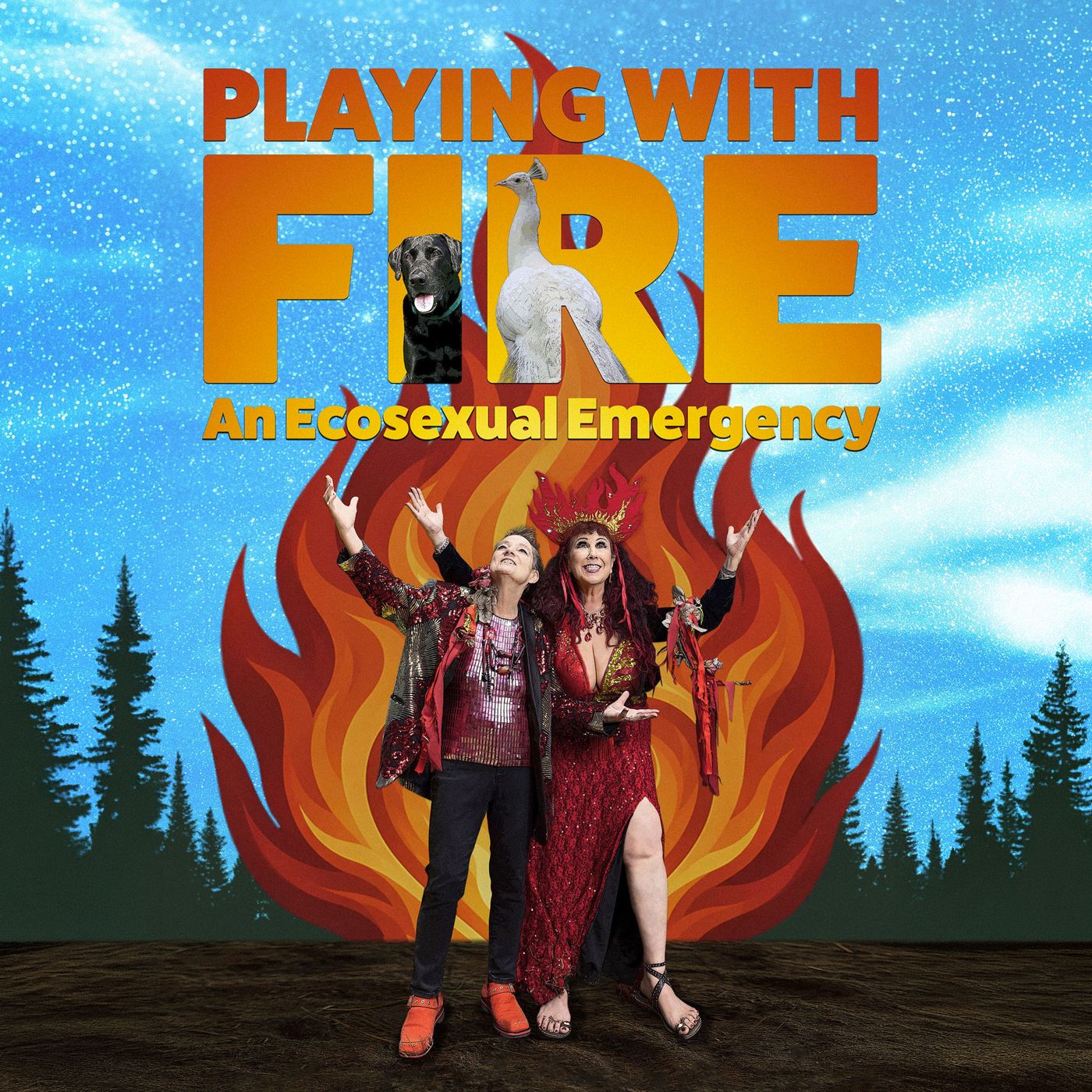
Special Report: Playing with Fire: An Ecosexual Emergency (2025)
About this episode
Stephens and Sprinkle unpack what ecosexual means (loving the Earth as a partner, not a mother), the indigenous fire science behind the film via Melissa Nelson and Kim TallBear, incarcerated firefighters paid a dollar an hour, and loggers, pot growers, and academics banding together to protect their neighbor Albert. They also cover weddings to nature, Sprinkle at 72 after 50-plus years as a sex educator, her breast cancer diagnosis mid-release, and a possible fourth film, about air and AI.
Find out more at https://sprinklestephens.ucsc.edu/
Transcript
Automatically generated, so expect the odd misheard name.
Hold your ears, folks. It's showtime. People pay good money to see this movie. When they go out to a theater, they want cold sodas, hot popcorn, and no monsters in the projection booth. Everyone pretend podcasting isn't boring.
Turn it off. Check it out. Hi, I'm Beth. I'm Annie. We love the town of Boulder Creek.
It has everything we need. There is something you don't see every day. And this is Butch. He's a good boy. Albert!
Albert! Hi, I'm Albert. Hi, Albert. Oh, Albert, we love you so much. We were having one of our driest summers ever. when nature finally said, wake up.
This, this is trouble. It was one of the wildest nights I've ever experienced. Smart thing to do, in most cases, was to leave. Get out, get out now. This is a hectic situation.
I know about four comrades that have perished in this line of work. I was waiting on the alien horn. I was like, this is it. Burr. The indigenous peoples, they lived in balance with fire, and they didn't have these massive, catastrophic fires.
The concept of being caught and very possibly immolated is really scary to me. Fuego, pasión, and desire. Fear of burning to death. Fear of change, of destruction, of tearing it all down. Abracemos el fuego, let's embrace the fire, or it will burn us alive.
Cause damn, you're a b * * * *. Fire is the power. Of loss and light. It's the kiss of death and the spark of light. Hey folks, welcome to a special episode of The Projection Booth.
I'm your host, Mike White. On this episode, I had the pleasure of speaking with Beth Stevens and Annie Sprinkle all about their 2025 documentary, Playing with Fire, an Equal Sexual Emergency. It is a wonderful film talking about the fires that they and their community experienced. There is a lot of talk of Albert. Albert is Boulder Creek's mythical white peacock.
So Albert, When you hear about Albert, that's who we're talking about. The film is going to be playing quite a few places coming up. Definitely check out SprinkleStevens.org, as in orgasm, as Annie says. Thank you so much for listening, and I hope you enjoyed this interview. Well, I want to know a little bit more about these eco-films that you guys are making, because I wasn't aware that Playing With Fire is the third of this trilogy so far, correct?
Yes, it is. And we started making this series of ecosexual films. We made our first one or finished our first one in 2011. And it was about West Virginia, where I grew up. And as I was saying, my family, my dad's family is from Michigan.
So they all moved down to West Virginia. They had been actually copper miners up in the Upper Peninsula of Michigan. And then they moved to West Virginia to start doing coal mining. But now there's a strip mining method called mountaintop removal mining. And my family wasn't involved in that.
But it's horrible. They just blow the tops off of mountains and just push the what they call overburden into the valleys and the streams below. So I was horrified when I saw that practice happening. So we made our first film about that. And then the second film, which was in 2017, we made about water in California.
And It was called, or it's still called, Water Makes Us Wet, an ecosexual adventure. And it was a road trip around California, really looking at the different flooding and the droughts and, you know, how all of those things were impacting the state and the people and the animals. And now our third film is about fires. And we were evacuated in 2020 in the Santa Cruz Mountains, where Annie is right now, because there was a huge fire there. And we were, you know, evacuated for it.
Two and a half months almost. And so, you know, fire is really impacting the whole world right now. And there are water issues around the whole world. And, of course, there's mining all around the world. So all of these films are highly relevant to the things that are going on in the world.
But what we add is a sort of spin to try to maintain some hope in the face of these things. And also, you know, we really celebrate how beautiful and sexy the earth is. So that's what the ecosexual gaze is, is looking at the earth and just, you know, kind of getting turned on by the clouds or the beautiful flowers or. Well, the first film was subtitled An Ecosexual Love Story. That was about the mountains in Appalachia.
And the second was An Ecosexual Adventure. And the third one, this one's An Ecosexual Emergency. So there are three... queer environmental feature films, but they're for everybody, that address serious issues, but are also a labor of love for the earth, for water. We adore water. We need fire.
And we use a lot of humor, and we do weird performance art and try to make it palatable and make the medicine go down in it. unique way using strategies of joy and pleasure activism and queer powers and things like that. So, yeah, this was the third in the trilogy. Beth wants to make a fourth. I think I'm done. The first one we made was, that was, by all academic accounts, was the first feature-length queer environmental film that had ever been made.
So we're pretty proud of that. And we're showing this trilogy at the Music Box Theater in Chicago, in Chicago, just in a few weeks. So we're pretty excited about that there in Santa Cruz. And at the Museum of Art and History. We're doing a little tour of the new film, but while we're at it, we'll show the whole trilogy.
We love making films. They're very collaborative and collaborative. fun to make and direct. And we actually got a Guggenheim grant for this film. So we worked extra hard. The bar was raised.
We had to really put a lot more into this one, time and energy thinking. But the other two really hold up and they're really great. Well, you mentioned the word fun and these movies are very fun. I had a great time watching the latest one, and just the back and forth with the goats and the dog and the peacock and all that. I mean, there's so much joy to be found in a very, very serious subject.
Well, we love our animal neighbors and companions, and a lot of times environmental films don't really acknowledge all of the other life forms. I mean, of course, there's, you know, the environment that's being destroyed or whatever, but it's like the composition of that environment, the kind of complex scale fabric of, say, a neighborhood or, you know, kind of a long-term relationship with a peacock, right, that is rarely focused upon. And so we go into this almost micro relationship situation instead of focusing on the macro, which can be so overwhelming and depressing because it's really hard to do something in the face of like really huge problems. But when you, you know, when you narrow it down, to your neighborhood and your neighbors and personal relationships, a lot of times you can do things about that.
And that's how you can change the world, I think. Act local, think global. Well, it's sort of a distraction, you know, sort of always having this diet of thinking globally. I mean, I do think it's good for us to be aware of things that, you know, are happening on the other side of the world because, of course, you know, U.S. imperialist politics are causing a lot of those things to happen. But, uh, There's not a lot we can do about them.
I mean, we can only do little things about those two. And so we're hoping that these films activate people on a local level. And then maybe we can somehow all join together to change the international level. This latest film really gives you a sense of the community that we all live in. And just feeling that, I mean, just that everyone's so concerned about the peacock.
And hearing from all of these other neighbors and just the network that you had when you had to go away from this horrible area where, you know, the area is not horrible, but the horrible fire that is consuming the area. I mean, just that sense of community continues on. You know, you're staying in contact with your neighbors. You don't get neighbors like that very often. Yeah, our film's about a little town in Santa Cruz Mountains in the Redwood Forest, but it's a microcosm for Australia, Greece, Canada, everywhere that's having these catastrophic fires.
The fire in our film burned an amount of land the size of Delaware. It was huge, huge. And people don't think about it much or they just think how many structures were burned and how much will it cost as a kind of capitalist news cycle. Like they don't talk about the peacocks that die and the, you know, There's huge, massive loss of life of trees and plants and caterpillars. But we need fire.
You got to burn it down to grow new things. And so it's also about social issues and social justice and the catastrophic events that we're experiencing now, the amount of war and destruction and violence. Fire's a metaphor for all that, which made it really pretty interesting. And we wanted to have a kind of an ecosystemic overview or way of thinking about what's going on. It's, it's really, everything's connected.
And what was also so amazing about making this film is that local, the local guys who are like, they're loggers, uh, they're, you know, pot growers, they're, um, one guy's got a motorcycle school, and that person who had the motorcycle school, a lot of his guys stayed around on their motorcycles during the fire, and they were supposed to evacuate, but they drove around videotaping houses to tell people whose house was still standing, whose house had burned. They would check in on Albert. And these are people that ordinarily, in my ordinary academic artistic filmmaking life, I wouldn't really cross paths with too much, but they were all concerned about Albert And they were concerned about, you know, letting people know what was happening.
And they donated footage to this film generously, not asking for a cent, right? And I think that that kind of togetherness across difference is so important. And if we could do more of that in this country, we wouldn't be having the troubles that we're having. you know? And I mean, at this point, people, I think, have split back into some of their political parties. But we were.
Walking down the street the other day, and this big old logger, he yelled out, hey, Beth Stevens and Annie Sprekel, right? And we went up and gave him a big old hug. And, you know, I just love that. And I think part of it, I am from West Virginia, and I grew up with a real diverse group of people, you know? And I've always loved, I've always loved talking to people, even if I disagree with them.
And in the moment, maybe I don't love it. But in the big picture, I do love that kind of difference, you know, and that because it is an ecosystem. And if you don't have diversity in an ecosystem, the ecosystem dies. I really like that story that you tell about the way that the Native Americans would burn things on purpose just to kind of resupply the earth. Right.
Well, that was Melissa Nelson, who is an incredible author. scholar and person. And she's a filmmaker too. She's the one that told that story. Go ahead, Annie. She's indigenous.
And she says how indigenous people, the native people that were here in this area knew how to manage fire. They knew how to do gentle, slow, soft burns. And we didn't have these catastrophic fires that we have now that are just devastating. They just, you know, Maybe the dinosaurs had them, but. Well, the world has changed.
Fossil fuels have really changed a lot of things. And, you know, it's a different world now than it was. But we could bring back some of the indigenous science techniques. I mean, there is a field called indigenous science now, and Western scientists are really looking to that field. In fact, our friend Kim TallBear, who's teaching at the University of Minnesota now, she's an expert in So is Melissa Nelson, Indigenous Science and Technology.
We also interviewed Brandon Smith, who was a prison firefighter. And this is, of course, a big thing in California. So many prisoners are fighting our fires, but they get like a dollar an hour, like really risking their lives and doing dangerous things. And Then they get out of prison, they can't get a job. So this is very concerning and unfair and cruel.
Fighting fires side by side with these guys who are professionals, but yet, you know, they have to do the exact same job. Slave labor. When it comes to these films, you describe each of them as being ecosexual. Can you kind of talk about what you see as being ecosexual? Well, one thing that I see as being ecosexual is that we truly are making these films because we love the earth.
And our core definition of ecosexuality is that it's someone who loves the earth. Now, because it has sexual in there, people's imaginations run wild. And we like for people's imaginations to run wild. But I think most people do love the earth. I mean, hunters love the earth, even though they're out shooting, you know, wildlife and Uh, you know, a lot of the execs of these, uh, you know, big mining corporations, they go out, you know, fishing when they're off.
Right. I mean, and then of course, uh, farmers love the earth because it's the, you know, basis of their, their living and their life. And so, I mean, I think that, you know, that's really the kind of idea that we're trying to spread through these films. But we have a lot of fun with it. We do push the envelope of what sex and sexuality could be.
And we're really challenging the sort of binary of what is culture and what is nature or what is human and what is non-human. And those ideas are important to us. A lot of people imagine the earth is mother. Some cultures imagine the earth is fire. We like to imagine the earth as a partner or a lover.
Or a collaborator. Yeah, the earth is full of sensual delights. And we like to promote, you know, getting outside and enjoying nature and giving back. Tell the water you love it. Go skinny dipping once in a while.
So we have, I think, 25 ways to make love to the earth. We have an eco sex manifesto on our website. sprinklestevens.org, that's P-H-E-N-S. And we have a book called Assuming the Ecosexual Position in the Earth is Lover. And that really lays out all of our sort of core tenets and ideas and a lot of our early adventures. We've had some really fun adventures too.
We eroticize nature a lot because it is so sensual and it's kind of a mindfulness practice. You can watch a sunset and be oblivious, or you can really throw yourself into the mystery and beauty and the miracle of a sunset. So it's like what you put in is what you get out. A lot of times you're not allowed to talk about these things. You know, you can go clear cut a whole forest and nobody even blinks an eye, except, you know, maybe the environmentalist.
But if you hug a tree... You know, everyone just gets up in arms and they want to declare that you're mentally ill or something, right? And what, there's something wrong with that picture. We're sinners. We get a lot of critiques, but, you know, eco-sex gets people's attention and it gets their.
Gets their heart pumping. So it's controversial, but we like, that's how we roll. And we're an affinity group, for sure. We wanted to create a... environmental affinity group that can be drag queens and trans people and sex workers and freaky artists and punk rock people, people on the fringe, a place where they can join and care about the earth. They all care.
We all care about the environment. We don't want to breathe smog. We don't want to drink polluted water. And I don't want my students to, you know, face a future where they don't have drinking water and they don't have, you know, everyone's so concerned about students getting jobs. Well, I want students to have like, you know, water and clean air and soil to grow their food in and things like that.
I've been making films about sexuality for 50 plus years. I started out in adult films in 1974. I made my first one. So I've documented my interest in sexuality for a long time. And with eco-sex, we're expanding the idea of what sex is to beyond just our human bodies to the critters that we are, our biome clouds.
There's sex going on everywhere outside. I'm sitting outside. The bees are pollinating and the seeds are falling off the trees. And gravity's holding us in its embrace. Well, that's the thing I've always appreciated about you, Annie, is just that your adherence to education, you know, that was probably the first time I ever experienced you as a person was more in an educational role, not even a sexual role.
That came later, but just seeing you teach people and talk openly about things and That's the thing I really appreciate about you so much is that you're bringing that. And I'm so glad, like, feel the love of you and Beth while I'm watching this. And just it makes me feel like, oh, gosh, I wish this couple was in my life because they're so fun to be around. Yeah, come on out and visit. Oh, well, come on out.
We do love each other like crazy. And we love the earth. We'll take you on a walk, an ecosexual walking tour. Thank you. Well, we have a lot of fun.
And Beth and I have been together collaborating for 24 years. And we're both artists, so we use all kinds of art and multimedia. And we get excited about things, sharing things. And we're very community-oriented. And we collaborate with a lot of people.
And we love to feed people. So, dude, come on out and we'll feed you. Do you. end every one of these movies with a wedding. We didn't marry water in the water film, but we have married the ocean a couple times. We do.
One of our art project series is Weddings to Nature Entities, and we're about to go to Berlin and marry fire. Hopefully it's our last wedding because we're kind of. But we always say that. And we love them too. And for the people who don't love them, we always have the fair witness part of the wedding so they can, you know, object.
I just love the pageantry. I mean, showing some of those weddings in this latest film, it's like, oh my God, this looks amazing. Yeah. And like art projects mixed with weddings. It's so great.
Oh, thanks, Mike. Well, it sounds like you might have a little eco-sexual bone in your body. It's a lot of fun, and you don't have to give up any other identities either. But Beth and I fell madly in love, and our love just grew to cosmic proportions. And we get excited about something or concerned about something, and we just want to spread the love and hopefully seduce people into doing little bits, whatever they can for the environment.
Of love and kindness for each other and for the earth. And those little bits can make all the difference in the world. But we are eco-sinners. I have milk in my coffee and I feel for those cats. I have a cell phone.
You mentioned that it's going to be playing at the Music Box. Annie mentioned a museum that it's playing at. But it feels like this is a whole screening series that you have coming up. Can you talk a little bit about. That, Beth?
Oh, we're really excited. This coming Saturday, which is September 26th, we're going to be at the Red Cat Theater in Los Angeles, California. And there's just, it's a big old fancy, CalArts runs it, but it's a big fancy theater that We're just, you know, we're excited. And, you know, what are we going to wear? That's the big question.
And then we're going to the Music Box. And the first night there, we're going to be playing with fire. And that is September 29th. And then the 30th, we're going to be showing Goodbye Golly Mountain and playing with fire. Then we're going to go to the Anthology Film Archives in New York City.
And we're going to play two nights of playing with fire. And then we're going to Berlin. And we're doing a night of playing with fire. And we're going to have this big wedding to fire afterwards. And the film is also playing in Rio de Janeiro at their Museum of Modern Art on October 23rd.
I'm jumping around a little bit now. But people can look at our website, Sprinkle Stevens. And my name is with a P-H-S-T-E-P-H-E-N-S dot org, like orgasm. And our whole schedule is up there. And there's some more information about the films there.
And You know, we just want to show, show, show this film as much as possible because we want to give people hope in a world on fire. And that's really our goal with this piece. And, you know, to show people that even in the face of disaster, we can still use strategies of joy to stick together and keep each other as safe as possible. I mean, we don't always succeed, but, you know, we keep trying, right? It's like Mother Joan said, I'd rather, you know, die standing than be on my knees.
Beth, what's your next project? Well, I do want to do another film because these films are the three, you know, there's the three elements, the earth, water, and fire. And I would like to do something about air. And so air has AI as the first two letters of that word. And I'm very interested in the pros and cons of this new technology that we have, which is an invisible technology.
I'm very interested in sort of invisible forces that, you know, affect us and run us and, What did Karl Marx say? All that is solid melts into air, right? So, and this AI, I mean, we all know what it, we don't know what AI is, but we know what it's doing right now and what the controversies around it are. And so I'm quite interested in connecting those two issues together. But, you know, it's, I don't know.
I mean, really my next project, my one and only project was just keeping Annie happy. Well, she's starting her semester today. Day after tomorrow, she's a professor, 30 plus years at UC Santa Cruz, and shaping young minds and hearts. And being shaped by young minds and hearts, too. It's a two-way street, let me tell you.
The impression I've gotten of you, Annie, over the years is that you never sit still. What are you working on? We just took our first vacation where we have a lot of exciting trips all the time, and they're work-related. We love our work, but we actually went to Maui and unplugged for a week and just watched the clouds go by and had, yeah, just a lot of eco-sexy fun, swimming and resting, and we saw the eclipse. But we are hard workers.
We're very passionate. Life is art. So we live life as art and we're just, we can't help ourselves. I don't know, but we, I am 72 now, so I need to slow the fuck down. Right.
Last fall, Annie had gotten a diagnosis of breast cancer. So we actually premiered this film in 2025 at Frameline at the International Gay Lesbian Film Festival in San Francisco. But then we had to pivot to take care of Annie's boobs. And part of the caretaking of her boobs was to have this show, which was like a psychomagic show. It was called Bazoombas in Love.
And it healed her cancer. So we did that. And we also got an Art Forum review, which was very nice. And you can look it up, Art Forum Magazine, Bazoombas in Love. And then we're pivoting back to the film now.
So we're just, we're like little whirling dervishes. We're ecosexual whirling dervishes. We've been very blessed. We're very privileged, very lucky. And our last film, Water Makes Us Wet, actually showed at the Museum of Modern Art in Manhattan three times.
So we've surpassed all our wildest dreams. But this next year, I'm interested in doing a lot more visual art. But again, we make art about what we're excited about. So, and we teach what we want to learn. And yeah, I've been a sex educator for a long time.
And I think our films are good sex education too, because we, you know, sex is about more than just genitals and sex toys and garter belts. It really is much bigger. And if you think about it, probably most people's best sex happens outside if they can swing it. There's a lot of talk about community care these days, and we like to think that filmmaking is community care. We may be preaching to the converted or the perverted, as it were, but that's fine.
If it buoys people and helps keep us going and keeping us focused on the eyes on the prize, world peace, a clean environment, love your neighbor. Love your neighbor. Eat with your jerks. And enjoy being alive. And yeah, have some eco-sexy fun out in nature.
When the earth's your lover, you're never alone. Beth and Annie, thank you so much for your time today. I really appreciate this. Oh, thank you, Mike. You're fun.
Yeah, thanks, Mike. Lonely feeling deep inside Find a corner. Where I can hide. Silent footsteps crowding me. Sudden darkness but I can see.
No sugar tonight in my coffee. No sugar tonight in my tea. No sugar to stand beside me. No sugar to run with me. Da-da-da-da-da.
In the silence of her mind Quiet movements. I can find Grabbing for me with her eyes Now I've fallen from the skies. No sugar tonight in my coffee. No sugar tonight in my tea. No sugar to stand beside me.
No sugar to run with me. Da-da-da-da-da-da-da. Da-da-da-da-da-da-da. Da-da-da-da-da-da-da. Da-da-da-da-da-da-da.
Jocko says yes and I believe him And we talk about the things I say She. Hasn't got the faith or the guts. To leave him When they're standing in each other's way You're tripping back in kinds of places you've been to You wonder what. You're gonna find You know. You've been wrong but it won't be long Before you leave him all far behind Cause it's the new mother.
Nature taking over It's the new splendid lady come to. Call home. She's getting us all She's getting us all. Jocko said, no, when I came back last time, it's. Looking like I lost a friend.
No use calling because the sky is falling and I'm getting pretty near the end. A smoke-filled room in a corner basement, the situation must be right. A bag of goodies and a bottle of wine, we're going to get it on right tonight. Because it's the boom of the nature taking over. It's the new splendid lady come to call It's the new mother nature taking over She's.
Getting us all. She's getting us all. The only fear. Chalice is a guess. And I believe inside.
Keep up with all the things I say. Find a corner. She doesn't got the faith or the guts to leave. We're acting with our hands in each other's way. Silent footsteps.
Out to places you've been to. Until you know what you're gonna find. The sudden darkness. Strong and it won't be long before you see them all far behind. Cause it's the doom of nature taking over.
It's the new splendid lady come to call. It's the new mother nature taking over. She's getting us all. She's getting us all.
More from The Projection Booth



Similar episodes across the network
Matched by shared keywords.
-
Star Trek Ladies: Nana Visitor | Deep Space Nine, Part 1
1 shared keyword: wildfire