
Season 1 · Episode 624
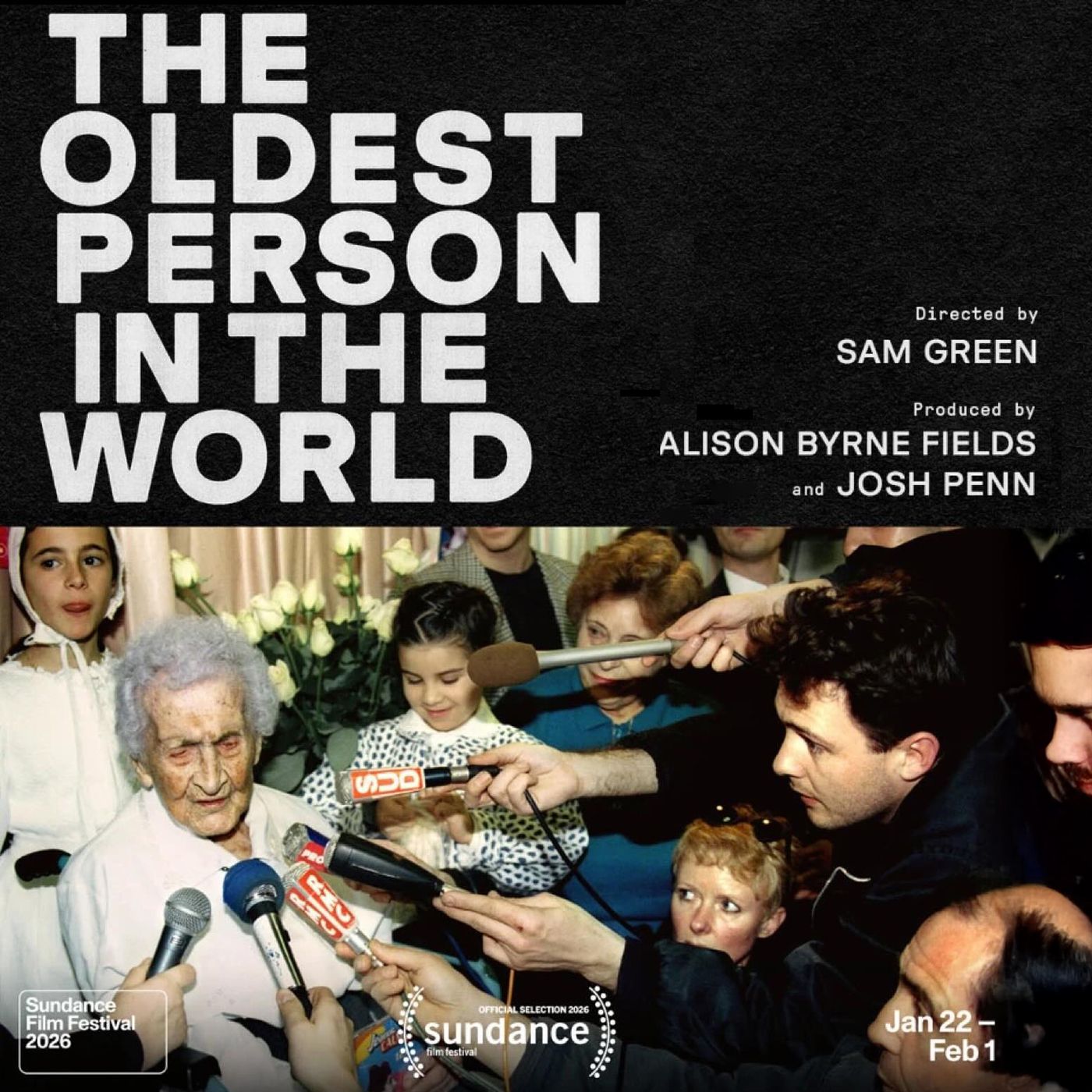
Special Report: The Oldest Person in the World (2026)
About this episode
Mark discusses the importance of using sound to tell a story and recounts his work on Dune and Mad Max: Fury Road.
Look for screenings of The Oldest Person in the World at https://www.theoldestperson.com/
Transcript
Automatically generated, so expect the odd misheard name.
Oh is, folks, it's show die. People say good money to see this movie. When they go out to a theater, they want closed sodas, pop popcorn in No monsters in the Projection Booths, everyone pretend podcasting isn't boring. Got it off? Hey, folks, welcome to a special episode of The Projection Booth.
I'm your host, Mike White. On this episode is the return of Mark A. Mangini. He is the sound designer of the new documentary The Oldest Person in the World. The film add it's premiere at Sundance this year.
It is a fascinating look at the people who old and have held the title the Oldest Person in the World. Had a great time talking with mister Manginie about this as well as some other things both loud and quiet. Thanks so much for listening, and I hope you enjoy the show. Since we last saw each other, I'm trying to think if there's anything I did a Werner Herzog film called Fucking Faster that's really it's his first narrative film in some time, and boy, what a treat it is to work with Werner Herzog. I can't even imagine I just his voice is so great.
Sometimes I forget that I'm not listening to a podcast or something and he's in the room with me, and I want to just listen to him talk because like being in film school and I'm supposed to be working with him. Pretty fun. You also worked on the latest Spinal Tap movie. How was that. I don't know about you, but that was a bucket list item to work with Rob Reiner and Christopher Guest and Michael McKean and Harry Sheer.
Those cats sat behind my partner Larry and I at the mix for seven days and just just cut it up every minute. They can't sit still, they can't stop making jokes, and it was fall man, it was like being in Spinal Tap. It was a real treat. That was nice seeing those guys reunited after all these years. And yeah, how good.
And sadly Rob's last film, it said, when I think back on it, poking myself for not having made more of the experience. Every day we'd break for lunch, and we'd have a communal lunch and we'd sit with each other. We'd share stories about family and stuff. But I didn't think I got enough of Rob Reiner. I know it's stupid to even beat myself up about it.
But what I do remember about those moments at lunches and working with him is that he's done it so long that he's really mastered the fine art of being a diplomat. Because Harry and Michael and Chris are wild cards. Man. They're actors. They're real hardcore, and they think and they behave like actors, and sometimes they're petulant and sometimes they're brilliant and sometimes they're angry.
And Rob just was a master at working with them collectively. Real lesson. So you are known mostly around these parts anyway, around my house, you're known mostly for your science fiction work, your narrative feature work. How is it comparing that to working on a documentary. I take documentaries very seriously, I think in a healthy way, which is I feel like there's an unwritten code for docs.
There's a written code I think for like Dogma or Verite, where you should never do anything that isn't an absolute representation of the truth, whether it's visual or sonic. You should never lead the audience as a director, and you should never lead the audience with sound. So that's really important to me, and because of it, it makes it a kind of a bigger technical challenge. For example, most documentaries are shot, they don't have a lot of money. They usually have a mic on the camera.
There's a mono shotgun on a boom pole, but that's not very similar to that's not veritae. And so my part of my goal is to expand that frame, make the audience, help the audience feel immersed in that reality. That means I have to be that much more attendant to the ambiences that I use. I can't just put in the sound of a bird background if it's a bird background recorded in Upstate New York and the scene takes place in a forest in Germany. So it creates these technical challenges of being as authentic as I possibly can with the sounds that I do.
Add now, it's something like the oldest person in the world. I haven't had the opportunity to see it yet. There I'm not allowing the journalists to see it right now. I imagine that it takes place all over the world. And this isn't giving anything away.
This is in the press materials. Sam had this idea about as he does with all his films, he develops an idea without necessarily a plot or a direction, which I think is really healthy for a documentary filmmaker. He was intrigued by old people, and so ten years ago, in twenty fifteen, he started going around the world and recording interviews with whoever was that day or that year's oldest person. And as you can imagine, if you're interviewing the oldest person in the world, they usually don't live much longer. And so the next year or the next two years, there's another oldest person in the world, and off he goes to Japan, or off he goes to Paris to capture these amazing interviews, and so he collected a number of them, but ten of them are represented in the film.
And it's fascinating because Sam didn't have an objective. He just wanted to capture what they had to say. He never led his interview with what would be these sort of tropish questions like what's the secret to aging? You know, he's too smart of a filmmaker for that. Perhaps.
Unlike a documentary that might document the war in Sarajevo or a larger scaled event that had sounds as a much more significant component, Sam was only ever really one camera and a love and maybe a boom, and that technology hasn't changed much in twenty five years. We had great production sound, and I was happy to expand that with ambiences that I could collect that were appropriate. When does the film come to you? What kind of shape is it in? When you get your hands on it?
I get to brag a little because Sam is such a progressive filmmaker, which is to say, the canon, if you will, in filmmaking is movies are divided into three eras pre production, which is screenwriting, casting, etc. Location scouting, production, shooting, and post production, which is where arguably I'm supposed to come in. And this is the way every budget is structured. Sound is in post production after shooting has occurred. But Sam is much smarter than that, as he did on thirty two Sounds.
Sam engaged me as he made this film, and Sam would call and we would just talk and he'd say, here's what I'm thinking of doing. What do you think can sound advance the narrative here in ways that I haven't thought of, And so we get to have very collaborative conversations along the way that help him build a more complete film. Now, was it typical or is this pretty radical for a filmmaker. It is extraordinarily radical for a documentary filmmaker. It is radical for narrative filmmakers.
I know when I was hired to do Blade Runner twenty forty nine for Dennis Villeneuf. He brought THEO Green and I on as sound designers as he shot the film, and we designed sound as he shot to scenes that were just shot as Joe Walker edited the film, and we had a deep collaboration with Joe, Hans zimmer Ben Walfish, the composers, and ourselves where we were constantly informing each other's work in a very elastic way, where sometimes the music drove the edit, and sometimes the edit drove the sound, sometimes the sound drove the music, and were always pushing and pulling each other to find the perfect version of a scene long before we ever hit post production. In documentaries, this is extraordinarily rare.
When I was hired on Blade Runner twenty forty nine, Denis Villeneuf and his post production supervisor was told by the studio, we don't spend this money. This isn't done like reading a line from the playbook. We don't put sound on and we don't pay for it until it's time for post production. So there's in fact a lot of friction there that I've been trying to overcome with a great deal of lecturing and teaching and doing podcasts like this. Ah.
So thank you Mike for letting me spread the gospel. With Zimmer's score, I mean, his last few scores, it feels like he's really it's not necessarily ambient, but there's definitely it's not just like, oh yeah, here's a cute little melody to entertain you while you watch this movie. It's so much more layered than that. I can see him being a very interesting person to collaborate with. He's great because he thinks like I do, and I think like he does.
I'm a musician. He's a sound designer, and he loves weird noises. And that's part of his process is he brings people on that are specialists just in creating unusual sounds or textures or sound effects, if you will. That he's going to bend and layer into the score in rhythmic ways or not rhythmic ways, and that's part of the collaboration. Sometimes he has a brilliant sound that he wants to work with that might be something I was already working on or vice versa, and that allows us to have a conversation about, well, which is the better way to do this?
How do you want to approach this? And then you've got the things like the worms and just those amazing who knows what a giant sandworm is going to sound like? And then you have to kind of start from scratch. Yeah, how do you even decide this is what a worm sounds like? Interestingly, on Dune Part one, it started with failure.
My first instinct, which I think would be almost anyone's instinct with a four hundred meter long creature, is to give voice it like a monster, like a dangerous and I'll use a better term, like godzilla. That's a great caricature of what we wanted. We wanted it to rear up the first time we meet it and open its maw, and a ear shattering roar should emit from it that echoes across off mountains hundreds of kilometers away. That's the instinct. From a sound designer standpoint, maybe even a non sound designer standpoint.
We'd all want that big moment. And when I played that first iteration of the worm for Denis Villeneuf, he said, I see where you're going, but it's the wrong direction. Here's what you didn't consider. The worms are revered by the Fremen. They're a godlike creature that they are in awe of because the worms, through the creation of spice, provide them their lives on Oracus.
And therefore we should have a sound that is nothing that has no component of fear or danger in it. It should feel godlike. And that gave us a whole nother direction to go in for the first film. While I've got you on the horn, I want to ask you a little bit about Fury Wrote, because that is a personal favorite of mine. And that's another instance where you've got the driving music that Junkie XL score going through, so much of that, and then the sounds of those cars, I mean, even the doof there with his guitar and the flames and the drums and things.
I mean, how are you able to bring so much life to that film? It just is brimming. There's two specific ways. The first is the day I landed in Sydney, Australia to start my work on it. I met Junkie and I was brought in as sort of a sound I don't know for the right term for it.
The movie wasn't going in the right direction sonically, and George brought me in to help him get his sonic vision on the screen. And so junkies saw me arrive and I immediately befriended him, and he began a daily collaboration. Maybe because I am a musician and I spoke like a musician, and the way I wanted to treat the soundtrack was the way with the sensitivities of a musician. He and I began having coffee every morning before we went to this mixing studio. We'd meet at seven, we'd have a couple of coffee lattes, and we'd just talk about the day and what we were working on, what we wanted to achieve, and if it meant it.
We would come to a consensus, and when we landed at nine am, George Miller would come in and we present our thoughts. And this created a very very cohesive soundtrack. So much so because not only did we have coffee every morning, but his composition studio was one door down from mine, so at any moment I could hear him noodling with a distorted electric guitar. For the diff Warrior, and I could just run and say, hey, what are you working on? Oh, I'm doing this.
I didn't know you were doing that. There I might do this instead, and vice versa. So we would collaborate that way and end up having a very, very seamless soundtrack. But that's to leave George a little bit out of the decision making loop. George I learned a great deal from George Miller, And one of the things I learned from him is this technique that he called the Pyramid of Importance, and he would end up whiteboarding this for us on a whiteboard outside of the mixing studio, And all it really aims to do is to focus everyone's endeavors on in any given frame, beat, scene, act, what's our focus.
So if we get really granular in any given shot, what are we looking at while we're looking at Max and we're looking at a little bit of the war rig and we can see the intake valve of the engine, what do we want to say there? Do we need to hear Max's dialogue or should we hear the air and take open up and breathe and take in the fuel that NUS is squeezing into it? Well, in this beat here at five minutes thirty seven seconds, what we need to know is that the only way they can gain speed is for him to squeeze this benzine or whatever it is, into the engine. That's the sound we want to hear. We don't want to hear five other trucks, We don't want to hear all those war boys screaming.
We want that sound, and we do that for every all twenty eight hundred shots in the movie, beat by beat, shot by shot, what's our focus in this shot? We need to hear Furiosa say, scream max Well, turn down the engines, turn down the score. And so every moment finding peaks, creating focus. It's a brilliant technique. It's brilliant because most of my career I've always felt that my job was too for lack of a better term, a American colloquialism hit a home run.
My ideas had to be big ideas that we're all encompassing. That had arcs across the movie, and those are important to have. But what George taught me is that you like a pointless painting, Every tiny dot made a difference, And every day we attended to tiny dots, and over the course of seven months that had added up to a beautifully articulate picture. And that never occurred to me that you could work granularly like this. I wanted to have the big wins.
Hey what if this means that and I'm going to make this big sound. Well that's a good idea. But what if every day just a teeny little pinprick, put in a little color here, put a little color there, move that color over there. Well, over seven months, that stuff really adds up. Now are you able to apply that to other things that you've worked on since then?
Ever since Fury Road, that has been a big part of my approach. It really speaks to a very simple idea, which is you can't really do your job. I don't think as a DP or as a sound designer until you know the story you're trying to tell. Once you understand the story dynamics, the creative side becomes a lot easier because you know why you're framing a shot. You know why you're making a sound.
The why points you in the direction of what the sound should be, because it's there to support the narrative. If it's just a sound, because it's a cool sound. It's kind of like eating popcorn attempty calories. It doesn't nourish the viewer at all. It really pushed me even further into that direction of I gotta really understand the story down to the shot level, because they're no director, much less a George Miller creates a shot arbitrarily.
There's meaning in everything in the framing, the color, the size, the image, the detail, the lack of detail, the focus, the lack of focus. All of it is telling you something that he wants to tell the audience. How to sound consonant with that? Well, I want to flip it back to oldest person in the world. Yeah, please, So much of a documentary is you know you said Sam didn't go out there with an agenda.
He didn't have a set of questions that he's going to ask every single participant. How's he finding the story? And how are you helping him find the story? At the same time, Sam finds the story in because the story tells the footage tells him what the story is. Once he had interviewed twenty of the oldest people in the world, and he sat with the footage and looked at it.
The footage told him what the story was because it's such an honest way of making a movie, which is listen to what you got back and start to pull on the threads. You start to see threads like, oh, there's some connectivity to some of these individuals ideas and thoughts about their lives. I want to pull on that thread and see how I can connect that to a bigger message perhaps, although Sam isn't a particularly big message kind of director. I mean, you'll see the film and you realize he really wants to leave it to you to decide what the meaning of aid old age is and how you want to live your life based on how you saw these people live their lives. But Sam did a very beautiful thing that he could comment on, which is what the contrast he found over those ten years is that he had his son Atlas, who is now ten years old, and he saw this beautiful relationship of the youngest person in the world.
He introduces Max as at this moment, my son Max, who has just been born, is the youngest person in the world for about a split second, and then another thousand people will be born today. And then he does this dual track showing Max growing up and the oldest person persons in the world aging to a point where some of them die and we have to he has to confront that. So the movie gives itself to him. After he's created compelling footage along the way, he sharing that with me and hopefully I have some observations, usually in the form of because he trusts me my life observations. I don't tell him how to make the film.
I tell him how I've felt about my grandparents dying and my personal aging process, and he just soaks that all up, as he does with anyone else he trusts and talks to during his filmmaking process, and then, of course, when he turns over a rough cut of the project, he's really keen on knowing how it made me feel. And one of my strategies or techniques is that this viewing of a film for the first time is a sacred moment because you only get to have it once. I've been in training my whole life to document first impressions the minute I have them. The minute I have an intellectual idea, I dismiss it. I just want to be like an actor in the moment, and if I feel something good or bad.
Sam, this made me bored. Sam This made me cry. Sam. I got really excited and I couldn't wait to see how this scene played out. And I give Sam a beatboard of how I feel, and I think that's the most valuable feedback I could give a filmmaker.
And here we are talking about this epic road chase through the out back of Australia. We're talking about sandworms on Oracus and then switching gears, and here you have probably some the more quiet that you've had to be in a long time. We had a cut that we loved and we final mixed to the movie, and there's a beautifully quiet moment where we go to total silence, which is really hard to do and dangerous to do in cinema because if you do it wrong, the audience thinks there's a technical problem. And so here's my advice to sound designers watching this. Never go to all zeros, as we call it in digital speak.
Always have a bed of something and lightly interrupt it, because it's the interruptions that remind you it's been quiet for a long time. But that's not the point of the story. The point of the story is we do a beat where he's interviewing an oldest person in the world, and he asks her a question and she closes her eyes and wants to think back to a time that Sam's asked her about, and we decided to leach all the sound out of the scene. And it's the quietest scene I've ever done in a movie. It was dead quiet except for just the sound of an empty room.
And we just loved that moment. We came out of sound in the hospital, leached sound back in as she opened her eyes and came back into consciousness, and it was a gorgeous sound moment. But unfortunately, after we finished the film, Sam had second ideas about the edit and that scene had to come out. So it's not you get to meet this character, but he took that beat out of this character's representation. You talked about your relationship with Junkie XL and on somewhere.
What was it like working with the compelled this one. These composers were great. It was two composers, William Fritch and T Griffin. Those guys were great. They were, of course, very concerned about the score sounding as best as it could, and so we engaged very early on and shared mockups of their scores before they finalized them, and I would give them notes on here's the best way to deliver for a five point one or a seven point one mix.
And I remember the last day of the final mix there was a queue that didn't get right and Will. We were back and forth with Will four times. He lives in New York, I believe, and he's in his studio and Sam and I are mixing, and Sam's coming up with ideas and he's sending ideas to Will. Will sending new tracks to me live flotted them into the mix. It was really fun.
So it's great to have a collaborator like that. Have you seen this one an audience yet? Well, I can't wait. Sam said. He premiered it at Sundance and he said, you got a huge applause and standing ovation and people were buzzing about it.
So he's we're all excited about it. When you're mixing stuff, are you mixing both the theatrical and the like streaming or DVD version at the same time. No. Never, I always mixed to what we call the vernacular in the sound community is the hero version. Whatever the highest form is, that's my first mix, because everything else is a what we call a down mix.
From there, So I mixed in seven point one so Sam could hear it, and it's in it. I think it's in its sort of finest form. It's most immersive, it's most dynamic, it has its highest fidelity. And then after that, I will make a five point one mixed down, a stereo mixed down for like streaming YouTube streaming, although you can have five point one or seven point one on YouTube, and then I still have not yet done what we call the near field, which is a reduced to dynamic range version or a home theater version for when it streams on Netflix or another platform like that. And when you do that, you make sure to take the dialogue and put it at the lowest possible and turn up all the music.
So it's really difficult for anybody watching. Oh Man Secrets Revealed, passed down from generation to generation. I'm just the work by remote, like writing that volume, Like, what the hell did they say? Where's the captions? That's the point of the near field is to reduce that dynamic range so that when the loud music or the loud sound effects come at a level that you're not comfortable with, you haven't turned it down to a level where the dialogue now is hard to hear, so we squad Gosh.
Dialogue kind of lives at a very normal peak, whether it's the home theater version or it's a movie theater version, and the sound effects are up here, and the music can be up here for big exciting action sequences. For the home theater version, we bring all those peaks that the dialogue never moves because this is the way we hear. We know what the right sound level is for the way we speak to each other, so it always stays here, and we bring down those peaks down here so they just jump like this at home instead of jumping like that making you squeeze your remote. You talked about the Hearthog film, and I'm curious, do you have anything else lined up? I have a lot lined up coming up.
I'm just finishing the final mix on a Netflix documentary on the explosion of Mount Saint Helens in nineteen eighty. It's a killer documentary about volcanoes and volcanologists and geologists and government officials dropping the ball and it's extraordinary story. And then I'm going to do Teenage Mutant Ninja Turtles two with Jeff Row. Having done Mutant Mayhem a year and a half ago. And then I'm going to do a beautiful movie about for Gavin O'Connor, who just did Accountant two.
We're going to do a movie about high school track, a really emotional story. And then I'm going to do a documentary about losing the coral reefs in Florida. So I have a pretty good a pretty good slate this year. Exciting. I'm not one familiar for your filmography, and I'm trying to remember have you done much when it comes to like an animated or claim, I guess that's animation, that's sony animation.
Have you done animated films before? Funny? You should ask. My first job in nineteen seventy six was three years at Hannah Barbera's studios making the Flintstones, Huckleberry Hounds, Booby Doo, you name it, all that Saturday Morning fair and that was my training ground. Then I got my first big animated break on the first animated Beauty in the Beast at Disney, and then I did Aladdin and then The Lion King, and then I did the first Mickey Mouse short called Runaway Brain in thirty or forty years right after Lion King, and then I did Space Jam, and then I did Cats Don't Dance.
I did one other animated film, and then Ninja Turtles came after that a couple of years ago. So I love animation. How has it changed over the years. I mean, philosophy, I imagine has changed. Just you know, the two dnus of the old flat hand of Barbaras and then you know you're talking Space Jam, where these characters are in a three dimensional world, and the animation style of those teenage mutant Ninja Turtles the first movie.
At least, it's such a different type of thing than we're used to. The animation filmmakers like Jeff Row understand that animation done well can be an adult art form, and they've embraced it as an adult art form that can serve two masters. You can make a great movie for kids and make an enjoyable movie for adults. So, for example, I'll never forget in my interviews for Aladdin, Ron Clements and John Musker were the directors. In our first meeting, they said, we want Aladdin to feel like a cross between Raiders of the Lost Arc and a Mickey Mouse short.
They wanted both worlds. They wanted the big action stuff. There's big you know in Aladdin, Remember there's the flying through the molten lava and caves with tigers and all sorts of mayhem. And they wanted it to sound like a Hollywood movie, not like a Disney cartoon. And in fact, I was very quickly chast died for using the word cartoon, because we don't call them cartoons anymore.
They're animated feature film. And because of that, I learned some really valuable lessons about animation two D and three D animation, which is which was I had to let my own prejudices of cartoon sound fall by the wayside and discover how to make scenes funny. See anime, good animation doesn't need funny sounds. It needs sounds that make the scenes funny. And that's a lot harder to do than blinks and whistles and you know, all the usual Saturday morning fair.
Yeah, no, I can completely see that, And yeah, I love that distinction of cartoons versus animated films. I almost got fired. Mark. Thank you so much for your time. It is such a pleasure talking with you always.
Thank you, Mike, thanks for taking the time. Only shoot me an email when this is gonna air whatever, wherever it goes, I'd love to hear it. You're older than you've ever been, and now you're even older. And now you're even older, and now you're even older. You're older than you've ever been, and now you're even older, and now you're older.
Still, time. It's marching on, and time. It's still all marching. Ah. This tab will soon be at an end, and now it's even sooner, and now it's even sooner, and now it's even sooner.
This tab will soon be at an end, and now it's even sooner, and it's sooner. Still you're older than you've ever been, and you're even older, and you're even older, and now you're even older. You're older than you've ever been, and now you're even older, and now you're older still
More from The Projection Booth



Similar episodes across the network
Matched by shared keywords.
-
KCxTPB: Dune (2021)
2 shared keywords: denis villeneuve, dune 2021
-
Jackass: Best and Last (2026) — "Welcome to the first day of our final film."
1 shared keyword: documentary
-
Melania (2026) — "Here we go again."
1 shared keyword: documentary