
About this episode
JUNKIES
Father Malone: FatherMalone.com
HP: hpmusicplace.bandcamp.com
Heather Drain: https://www.mondoheather.com/
SPOTIFY PLAYLIST
https://open.spotify.com/playlist/2fH01dxkFBJQ5oRyx8zJfC?si=bd535dbe6be54ee2
Transcript
Automatically generated, so expect the odd misheard name.
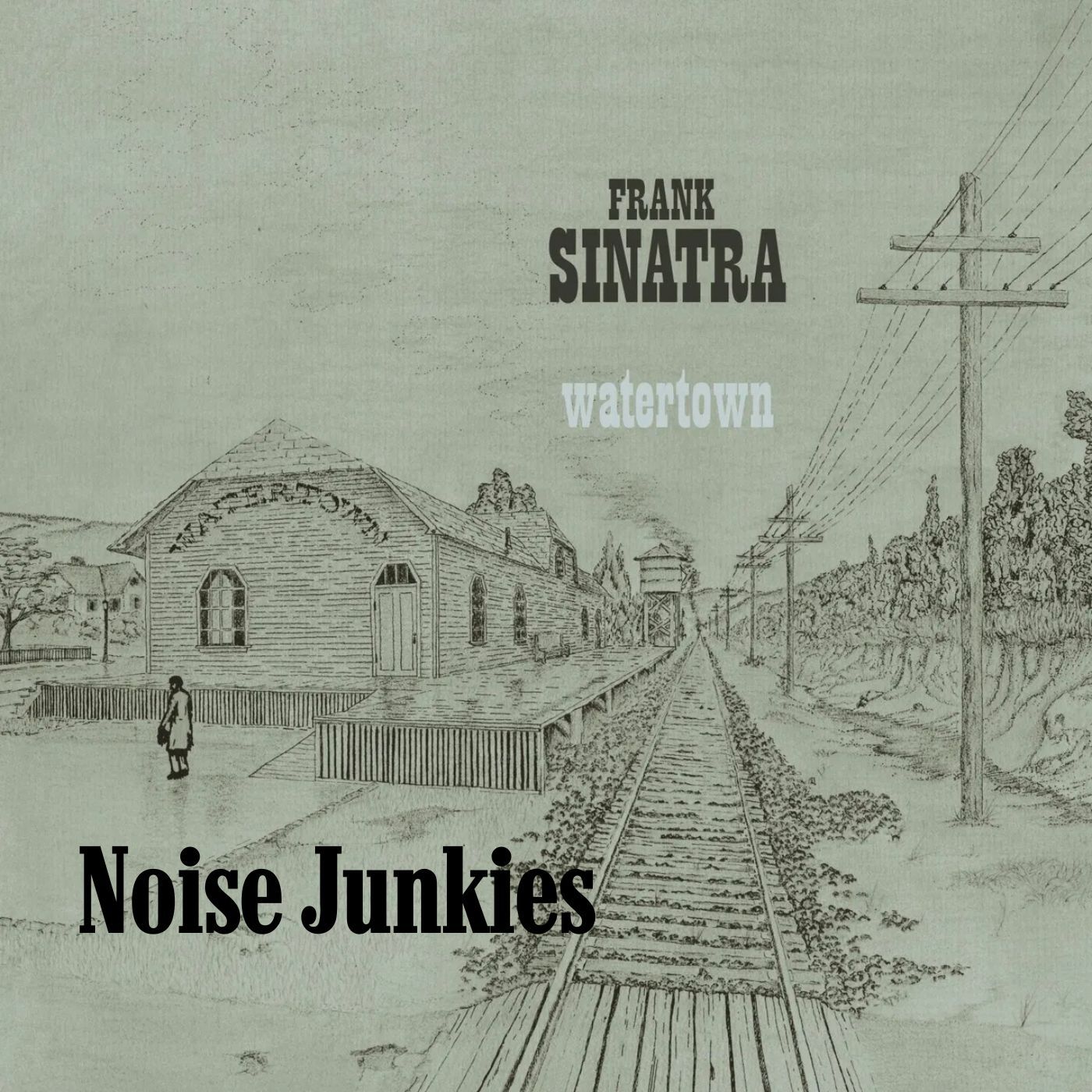
The legendary Frank Sinatra made a career out of putting out so called concept albums. However, these are not concept albums a llah The Who's Tommy. Or Bowie's Ziggy Stardust. Those records were more akin to opera in their method of telling a story through music and lyrics, hence the term rock opera. Sinatra's concept albums were more literally conceptual.
They were albums unified by a central concept or mood rather than a literal story. But he did record one album with an actual story, much like those aforementioned rock albums. Tonight, I'd like to examine this album, this outlier in Sinatra's catalog. Join me as we take a trip to Watertown. Hello, listeners to.
Another special episode of Noise Junkies. I'm hp this episode, I'll be discussing the nineteen seventy album Watertown, produced by Bob Gaudio and co written by Bob Gaudio and Jake Holmes. I'm gonna be perfectly honest. I was never that much of a Sinatra fan. I recognize his place in the pantheon of pop music and respect all that he brought to the art form, but it always seemed like old music.
To me, the sound of Sinatra's records didn't captivate me. It sounded old and low fi to me. When I was first getting into music, Frank Sinatra was always either a really old looking guy performing standards on TV, or he was in old documentaries a then youthful guy singing jazz pop in fuzzy kinescopes that I couldn't relate to either. But all that changed when Watertown was reissued in twenty twenty two with a fresh, new remix and additional bonus tracks. I've always been a sucker for a deluxe reissue.
I can't tell you how many older albums I've been able to discover because a record company took the time and effort to give it an old spit shine and re release. Frank Sinatra's career was at a bit of a crossroads in the late sixties. His brand of crooning was out of step with the rock music of the hippie generation. His record sales were low. He'd already made a residency at the Sands Casino in Vegas, which in itself could be taken as a sign that his career was slowing down.
In an effort to reverse his fortunes, he decided to enlist Bob Gaudio to produce his next album, Who's Bob Gaudio? You ask, well, I guarantee you've heard music that he's written, produced, or performed. As a founding member of the Four Seasons, he co wrote the majority of their big hits Sherry, Can't Take My Eyes off of You, Big Girls, Don't Cry, Walk Like a Man December nineteen sixty three. Oh What a Night? All were written or co written by Bob Gaudio, and for other artists well, he wrote the Sun Ain't Gonna Shine Anymore for the Walker.
Brothers Lonely. It's the. Later Gaudio would produce You Don't bring Me Flowers for Neil Diamond and Barber streisand you. Don't bring me flowers, you don't sing me love songs. Yeah, let's talk to me anymore.
When I come through the door at the end of the. Day, I remember where you couldn't wait to love me, used to hate to leave me, love after. Love me, Laden. When it's good Pi, You're feeling all right? Job after all?
Unto love. And you don't goingly flower say. Gaudio was quite the music heavy hitter, and with his list of credits. It's easy to see why Old Blue Eyes would want to work with him. However, I'm not sure if Sinatra was really prepared for what Gaudio and his writing partner Jake Holmes were going to present to him.
You see, Gaudio was going through an interesting phase in his own career. Spurred on by the Beatles Sergeant Pepper album, Gaudio sought to move the Four Seasons into the realm of socially conscious music. One night, he went to the Bitter End, a club in Greenwich Village, and saw a folk singer named Jake Holmes performing. Gaudio was so taken with Holmes and his music he decided to collaborate with him on the next Four Seasons record. That record would turn out to be nineteen sixty nine's The Genuine Imitation Life Gazette.
Rather than the customary Four Seasons love songs, these songs would comprise a concept album that tackled subjects like racial tension and war, a far cry from Sherry Baby. Indeed, chameleons changing colors while a crocodile cries. People rubbing elbows but never touching up, taking all their masks revealing still another guy. Genuine Imitation people buy un happiness. And many you're fattious funds.
Everybody's doing what everybody's done. You count on lots of people, you can only. Count to one. Genuine imitation line. In Much of the credit for this shift and focus must go to Jake Holmes.
Like Bob Gaudio, you've probably already heard tunes that Jake Holmes had a hand in writing. As a commercial jingle writer, he wrote the I'm a Pepper jingle, which was omnipresent in the seventies and eighties. I drink doctor pepper and am prouder. I'm out of an original crowd, and you look around. These days, it seems to be a doctor Pepper craze.
She's a pepper? Where a pepper? Where'd you like to be a pep? Two? He's a pepper, Give you two, doctor pepper.
Pepper two, be a pepper three, doctor Pemper. He also wrote the US Army recruitment jingle be all that you can be. Your reaching deep inside you, Oh the things you've never known. It's been tough, rough going what you haven't gone long. We do more before at nine am than most people do all day.
Hey for a sergeant, good morning. Can do it. But most notoriously, he wrote a little song called Dazed and Confused. Some of you are saying, wasn't that written by Jimmy Page for Led Zeppelin's first album Well No. The original version of Dazed appeared on Holmes's nineteen sixty seven album The Above Ground Sound of Jake Holmes.
I'm dazed and confused as its days ago, Robbie and choosed, but I just like to know. Give me a clue as to where I am at. Feel like a. Mouse and you act like a cat. I'm dazed and confused, hanging on by a thread.
I'm being amused. I've been better off letter and stand. A cheese, and I'm starting to crack. You're out to get me your arm on the right track. In August nineteen sixty seven, Holmes opened for the Yardbirds, Page's first band, at a gig in Greenwich Village.
According to Holmes, this is where Page first became aware of the song. It was later released on the live album Yardbirds sixty eight, credited to Jimmy Page. Alone, I'm dazed and confused? Does it stay? Is it gold?
Give me a two? I just want to know, Give me a two as to elmad if you like a mouse sound. You wag like a cap? How these and confuses this to say? Is it go us?
And I think us you would go com on Bamie. I'm done to bag. You had to get me. Eventually, Page recorded the song again with his then new group Led Zeppelin, again credited solely to Paige. And this is likely the version that you've heard, been days.
And confused for so long. It's not true. Walt a warm and never bargain for you. Lots of people talking fuel them. No soul love a woman was created and the low you coffuse telling all of your life.
Run, says the baby alone on the hypnottrack Slee a Baby, I don't know where you're been Alla love your name come Aga. Over the years, Holmes fought in court for his songwriting credit, eventually settling with Page for an undisclosed amount in twenty eleven. The version on the first Zeppelin album is now credited to Page, inspired by Jake Holmes. As for Sinatra, he was likely feeling the pressure of his careers downward trajectory by now, and some resentment at the new generation of rock musicians coming up. He likely felt the urge to prove his continued worth, to show that he could still produce hits.
Sinatra must have wanted the Bob Gaudio behind those monster four Seasons hits. What he got was the Gaudio who used his cachet to push the bounds of ambition on the genuine Imitation Life Gazette. What Sinatra got was Watertown. Watertown is a concept album that tells the story of a man living in a small, boring town called you guessed It, Watertown. The man's wife has left him and their two young sons to seek a more exciting life for herself in the big city.
He spends the entirety of the album describing his loneliness and longing for her return. As sighted in Pitchfork's review of the reissue, these are on the whole, the sparsest and saddest songs that Sinatra ever sang. As I listened to the album for the first time, I began to understand the Sinatra thing. As he sings these lovely songs of heartbreak, longing, and hope, you feel every drop of emotion in his delivery. One of the things I cherish about Watertown is how down to earth the whole story is there is no outsized drama, no explosions of emotion or action, just a lonely, sad guy who still loves the wife that left him and their family and aches for her return.
Take this line from the second song on the album Goodbye. She quietly says. There is no big explosion, no tempest in the team. The world does not stop turning around, there's no big tragedy. Sitting in a coffee shop.
With cheese cake and some aplebad, she reaches out across the table, looks at me and quietly says, football, goodbye, said. So easily, Lady. Goodbye, said so quietly, football. Football bootboard. The simplicity of those lyrics the banality of the setting.
While the narrator's world is upbended, breakups seldom happen like they do in the movies or TV. They usually happen in the. Midst of the mundane. While the rest of the world goes on about their business. A man's world crumbles quietly over cheesecake and apple pie.
The matter of fact details of life underpin the entirety of Watertown. Throughout the album, the narrator expresses himself through what appeared to be a series of letters. To his wife. In the song Michael and Peter, small details of the narrator's day to day struggles creep into the lyric. Sinatra mentions an old man who mows the lawn who can't help asking where his wife is gone.
It's such a little detail. But exactly the kind of casual encounter that eats away at the narrator each and every day. Him became to cut the long. Can. He asked me where you'd gone?
I can't tell you all at times he's been told, but he. So yes, That's all the news I've got today. Please, That's all the news that I can say. Maybe soon the words will come my way. To my One thing I find remarkable about the depiction of Watertown's narrator is the utter lack of anger in his attitude towards his wife and her abandoning the family.
Through their words, Gaudio and Holmes ain't a poignant picture of a man who dearly loves and misses his wife and might even understand somewhat the reasons why she made her decision. In the song I would be in love Anyway, the narrator admits that, even knowing that she would someday abandon their family. He would still not change a thing. If I knew that you, If I knew you wouldn't stay. I would be in love anyway.
Sometimes not think about before. Sometimes I think. If I knew what I know, I don't be I'd ever change somehow. The song what a Funny Girl You Used to Be helps flesh out the character of the narrator's wife with a wry sense of humor. The lyric economically illustrates how much the narrator loves his wife, those little quirks and qualities that make up a loved one.
You always had a thousand things to do, getting all involved in something new, always some new recipe. The kitchen always look like World War thro What a Funny Girl You. Used to Be? In the penultimate song on the album, she Says. The lyric suggests that the man has finally heard back from his wife.
It suggests that the wife might actually be coming back home. But as hopeful as the lyric might be, the melancholy music seems to underpin the hopelessness of his optimism. She says, the weather's cold. She says, there's been some ray. She says, there's lots to see.
She says, she hopes we're fine. The prize is horn, oh. The scar and she says, she says, She's coming home. The closing track on the album, The Train, sees the narrator at the train station, eagerly awaiting the return of his one, but he finally reveals in the lyric that all those letters that he wrote to his wife were never sent. He was just fooling himself.
She was never going to come back, and in the closing lyrics of the song, his tears mixed with the rain as he watches the train leave once again. The crossing gate is coming down. I think I see the train. The sun has gone, and now my face is wet with heavy rain. The passengers for alan Town.
And are gone. Train a slowly moved, but I can't see any. And I'm no for sure i'd recognize your fool. And I'm no for sure recognize your fate. Sinatra always struck me as larger than life, belting out New York, New York to adoring crowds that he held in the palm of his hand, just from his very presence.
The Sinatra of Watertown. However, was a revelation to me. His performance at turns his haunted, precise lonely, resigned, despondent, above all vulnerable. That someone who seemed the giant to me could allow himself to appear so fragile and vulnerable helped me to understand what a masterful performer he was. Throughout his recording career, Sinatra would record his vocals live alongside the band.
The music for Watertown, however, was recorded separately, and Sinatra overdubbed his vocals later. This was the first time Sinatra recorded his vocals in this fashion. I think it suits his performance. Hard to imagine Sinatra alone in a vocal booth performing to a pre recorded track, and how that must have imparted a sense of isolation to his vocals. Released in March nineteen seventy, Watertown was not a success for Sinatra, garnering mixed reviews and poor sales, reportedly the worst selling album of Sinatra's career.
He would announce his retirement the following year, but would eventually come back to performing and recording in nineteen seventy four. Watertown would ultimately be relegated to a footnote in Sinatra's career until its eventual rediscovery and reappraisal. It's hard to pinpoint a precise moment for this reappraisal. The best I can tell is it started happening sometime around twenty twenty. Articles started popping up online about Sinatra's lost masterpiece.
Eventually, this led to the deluxe reissue of Watertown that was the catalyst for this episode. There was no question that Frank Sinatra left behind an incredible legacy as a peerless performer and a master interpreter. His music continues to be repackaged and re released decades after his passing on May fourteenth, nineteen ninety eight, at the age of eighty two. Each new generation of listeners has new chances to discover his music. I think we're so fortunate that we live in a time where underdog albums like Watertown can be rescued from obscurity and be listened to and reassessed the new.
I might have never encountered this album otherwise, for anyone who thinks like I did, that they just don't get Frank Sinatra. Give Watertown a try. It's well worth the journey. That's it for this episode of Noise Junkies. Thank you for indulging me once again.
When I'm not listening to music, you can find me elsewhere. In the weirding Way Network. I co host The Night Mister Walters, a taxi podcast alongside midnight viewings fatherm Alone, and I'm an occasional guest on The Culture Cast with Chris and I have a bandcampsite hpmusic plays dot bandcamp dot com, featuring a brand new album just released called Wired and Waiting. As always, please feel free to write us, rate us, review us. We'd love to hear from you in any manner you choose.
Thanks again for listening, and we'll see you again next time, the Next
More from Noise Junkies
Similar episodes across the network
Matched by shared keywords.
-
Robin and the 7 Hoods
1 shared keyword: frank sinatra
-
Special Report: Tommy (1975)
1 shared keyword: concept album