
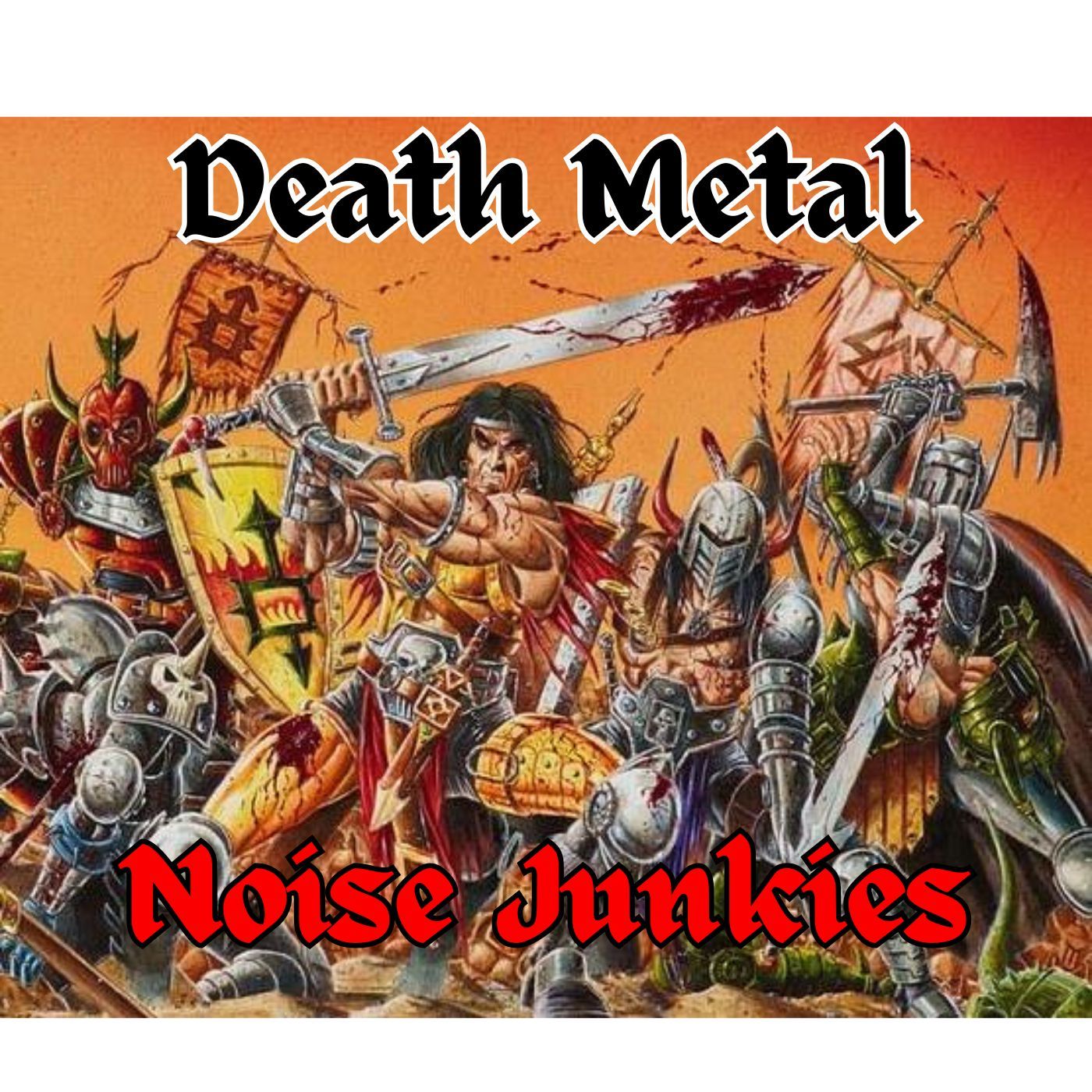
About this episode
Along for the ride is the very person that introduced HP to the majesty of death metal, through a chance meeting involving a guitar riff played in college. And stick around to find out how 80's pop band Mr. Mister, and grunge legends Nirvana, figure into the conversation!
JUNKIES
Father Malone: FatherMalone.com
HP: hpmusicplace.bandcamp.com
Heather Drain: https://www.mondoheather.com/
SPOTIFY PLAYLIST
https://open.spotify.com/playlist/4VA4pfIyZyTSp2RrHSfIIL?si=8ee65a4d115144ee
Transcript
Automatically generated, so expect the odd misheard name.
I like to think I have a pretty wide ranging taste in music. There's a famous quote commonly attributed to Duke Ellington that says there are simply two kinds of music, good and the other kind. If a piece of music moves me, it doesn't really matter what genre label is applied to it. But almost no other genre has put that credo to the test than the one I'm spotlighting in this episode. Buckle up, because tonight we're treading the thick, churning waters of death metal.
Hello, listeners to another special episode of Noise Junkies. I'm hp this episode will be covering death metal. I'll discuss the genre signifiers in which bands are carrying the death metal torch high and proud. Growing up in a suburb north of Boston, my taste in music was typical of other kids growing up in the seventies and eighties. A big part of my formative musical education was shaped by simply riding in my mom's car, getting shuttled to and from school, the mall the movies, what have you.
She usually kept the radio tuned to stations that played AOAR hits of the day, that's album oriented rock. Eventually, this resolved to a lifelong affinity for what became known as yacht rock. By the way, for more info and yacht rock, please check out my earlier Noise Junkies episode on the very subject. Later on, I developed a taste for the evergreen hard rock acts led Zeppelin, ACDC Kiss, among others. But for some reason, when Metallica's in Justice for All album came out in nineteen eighty eight, I couldn't get into it.
Something about the offbeat time signatures, growling vocals, and extended riffing just didn't compute to a fifteen year old HP. It was almost like some part of my brain hadn't developed enough to enjoy this type of music or even make sense of it. Flash forward a few years and I'm starting college at Purdue University. My main friend group was comprised of guys a year ahead of me who DJ'ed at WCCR. WCCR was the radio station housed in my freshman year dorm, Carrie Quadrangle.
It was one of the oldest student run stations in the Big Ten. My interest was sparked, so I got involved at WCCR as well, both DJing and working as the music director. More crucially to the topic at hand, I started to hang out with my friends during their radio show, and their theme was death metal. By this point I was fairly well acquainted with Ozzie Black Sabbath, even some of the hair metal bands that made the MTV rounds, like Dokin and Quiet Riot, but death metal was something else Entirely. If I thought Metallica was rough and ready, imagine the culture shock when I heard this for the first time.
Lies already. Do I say that. That's Land of Tears by the band Pestilence, one of the galaxy of death metal groups that I was getting a crash course in. We'll hear more about Pestilence in a little bit. All these bands had deep, deep, guttural vocals that evoked snarling beasts more than anything else.
The drumming was so fast and precise, just a brutal onslaught with a particular emphasis on quick double bass runs. The topics all seemed dark and death obsessed, although I would eventually learn that that was an overgeneralization. Look closer past the heaviness and blast beats and you'll start to notice the differences. For example, I was surprised to discover that there was such a thing as Christian death metal. The casual listener wouldn't know the difference.
Sometimes the album cover would offer clues, but mostly you had to look deeper at the song titles and lyrics to get the message. One such band that got a lot of play amongst my friend group was called Vengeance Rising. Their nineteen eighty nine album Human Sacrifice included such songs as I Love Hating Evil and He Is God. Here's another song off that album called Receive Him. By the way, that's not an edit, it's the entire song.
Did you blink or cough at that moment? Here it is again. Death metal songs can be long and technical, with frequent time signature changes, but some songs like Receive Him can be extremely short, typically punctuated with blast beats. Again, the more I heard these bands and the variety of shapes and styles, the less it all just sounded like noise to me. I could start to discern each band's unique identity and sound.
Let's delve into several artists that turn my head around. No discussion of death metal can really begin without talking about guitarist vocalist Chuck Schuldener and his band Death formed in the early eighties in Altamont Springs, Florida. Death was one of the early pioneers of the Nason death metal sound. I remember one of my friends quoting an ad from the time that stated death the first word in death metal. Their first few releases, nineteen eighty seven's screen Bloody Gore in nineteen eighty eights Leprosy helped establish the death metal template that countless bands would follow.
However, the nineteen ninety one album Human pushed the genre in new directions. It brought in more progressive elements and was a more technically accomplished work. Take a listen to the song lack of Comprehension. Cried Bud under God Dropper Up wid l by Bar in the movie Live Back. The intro features spacey guitar harmonies and the drums have a textured, phased effect on them.
This kind of delicate, almost jazzy styling was pretty much unheard of at the time, and I was drawn to its beauty. Once again, here was a death metal song and album that challenged my preconceived notions about the genre. Schuldner would continue to evolve the death sound over the next few albums. Throughout the mid to late nineties. Tragically, Schuldner was diagnosed with cancer in nineteen ninety nine and would ultimately die of the disease in two thousand and one at the age of thirty four.
For me, no band exemplified the sound of death metal more than the next act I want to discuss. Boat Thrower formed in Coventry, England, in nineteen eighty six. They took their name from a weapon in the Warhammer tabletop game. In fact, the artwork for their early albums was provided by the game's publisher, Games Workshop. Both Thrower featured Joe Bench on bass guitar, one of the few women in the scene.
Their music was initially a thrash based, distorted style more indebted to hardcore punk, until their third album, nineteen ninety one's war Master, which signaled a transition into a more pe your death metal sound. Both Do chose war as the main theme throughout most of their music, the madness and aggression of war throughout history. The first track off war Master, Unleashed upon Mankind, was regularly used to kick off my friend's radio shows. It Your Life The plays only York that will survive us don't fail this. Yeah, let's say powers, waste upon notes.
Joy. For me, this is the sound of death metal, pure and simple. The band creates a thick, chugging wall of sound over which vocalist Carl Willetts barks his lyrics, punctuated by Andrew Whale's drum fills. Both Thrower songs also had more melody, which helped set them apart from other more simplistic bands of the time, and the production was much cleaner. The one two punch of war Master and its follow up, nineteen ninety two's The Fourth Crusade remained two of my favorite death metal albums.
The third death metal band I'd like to discuss is the one from the top of this episode, Dutch band Pestilence. They too moved in a more progressive direction with their second album, nineteen ninety one's Testimony of the Ancients, but their third album, nineteen ninety three's Spheres was a game changer for me. They expanded their progressive sound even more on this album, incorporating guitar synthesizers to allow them to bring in more orchestral and synth textures. They also brought in other influences, including jazz fusion, spot no I remember Spheres, being considered by my college buddies as a lesser effort at the time, but I loved the band's progressive spirit and the guitar synth dabbling that expanded their sound and gave the record an almost outer space type feel, and history would validate these choices, as progressive influences in synth work are much more prevalent in today's death metal.
Check out the track the Message Tablet won by the band Blood Incantation off of their twenty twenty four album Absolute Nowhere. Blood Incantation and other latter day bands are taking the best of what came before them and adding their own unique spin on death metal. Like any musical genre, it needed to change and evolve in order to survive. The core elements are still there, the spirit and passion, but flung into new directions and sounds that my friends and I never could have predicted as we spun records and CDs in w CCR back in the early nineties. There's no way I could get into this discussion about death metal without having the very person who introduced me to this music some thirty plus years ago.
Something like that I have with me, my good friend Bob from college. Bob, how are you? Oh, awesome man, Thanks for having me. This is an honor, it's a pleasure. Now, just for the listeners out there, just some background.
Bob and I went to Purdue University a long, long time ago, and Bob was one year ahead of me. I got to Purdue not knowing anybody, not knowing his soul, and I was in my room playing DRIs think for yourself the riff, the main riff. Bob came in with another friend nodding their approval, and that was it. Man. All of a sudden, I had a place in the dorm.
I had a place among the friend group, and things just kind of grew from there. So Bob and his buddies had a radio show in the radio station in Carrie Quad, which is the dorm lived in. It was WCCR, which I've already talked about a little bit earlier in this podcast. But it was one of the oldest radio stations in the college system, was it not, Bob. Yeah, I think it was among the earliest.
I wish I knew a little more history about it, but when we were there, we didn't really care. We made it ours. They still produced content, they still have DJs. It's a lot more sophisticated now than it was then. Back then, we were literally playing records and CDs.
Bob and his buddies had a metal show. Was there a name to the show, Bob, can you remind me? Oh? Yeah, it was the Bob ex Penslayer Metal Show. I got an interest in the radio station, like I mentioned earlier, and Bob and his buddies would let me sit on the show sometimes watch what they were doing, and maybe even contribute a little bit.
And I think maybe one or two years into it, maybe by the time my sophomore year, Ish Bob correct me if I'm wrong, You and iched off and started doing the show together. Was it my junior year or was it right around that time? I don't remember. I think I think I did shows with pins Layer all the way up until he was gone from Purdue, which would have been my fourth year. But I liked college so much I stuck around for a fifth year.
And I mean because you were always a part of the show. We never put you in the title, but you were integral to the show. And then that last year, when your fourth year my fifth, we did the BOBBYX Tip of Rothgar sex esteem workshop, which I forgotten William. You know it was us and there was a guy Dave who would do it with us, and also Dave George George, his buddy George, who also didn't really last too long at Purdue. But ye was it so I thought it was the last couple of years, but maybe it was just the last.
My senior year was when we did it, But I felt like we did it for a little bit longer, just exclusively just you and I. But at any rate, I basically inherited the show with Bob and it continued in that same vein My education on death metal just continued on from there. But I wanted to pick your brain a little bit, Bob. But these are questions that I don't think I've ever actually asked you a lot of these things, but I'm really curious. First thing I wanted to get into is how did you get into death metal?
Originally I talked a little bit earlier in the episode about my beginnings were with things like Black Sabbath and Ozzie and ACDC, the typical hard rock, But how did what was your entree into this type of music? It was kind of a two stage process. The very first I even heard about death Metal would have been my freshman or sophomore year in high school. There was a guy in my class that was talking about this CD that he saw at the music store and he said it was by this band called Death and I was like, that's an interesting name for a band, and he said, yeah, there's a song in there called Regurgitated Guts and I was like, wow, that sounds it's weird, but I never really sought it out. And then flashed forward a couple of years.
I think it's this summer of my senior year, getting ready to go to college, and I'm at the record store and I'm looking and I see a band called Pestilence and there's this album cover with this guy with ants kron all over his face. I was like, that looks cool. I was like, hey, I gotta try I gotta check this out. Because by then I was in the Slayer, I'd kind of grown out of Metallica a little bit. Megadeth was still really cool, but.
I was pretty much in a thrash and I thought Pestilence was going to be another thrash act. And so I bring it home and I'm listening to it. And I'm like, why is he doing that with his voice? That's just weird. And I, to be honest, I didn't really care for it so much.
I just I was like, I appreciated the drums and the guitars, and I just I couldn't get over the voice. And so I kind of shelved it for a while. And then that summer I just went on a CD binge. I mean, I was just an idiot. I went out and I saw it out that being Death.
I picked up all three of theirs and then go down the list of suicidal tendencies. I've been all kinds of stuff, and so I flashed forward to to Purdue and then I'm starting I'm starting to get into Death. I'm like, Okay, these Death guys are pretty cool. I'm starting to understand the vocals. But I still Pestilence was still this thing that was like this odd.
Thing, and so finally I pop it in. And this might have been by the time Martin van Drunen had left and started as Fix and I started but technically joined as Fix. And I'm like, okay, I like Martin van Drunen, well he. Was in Pestilence. Let's listen to this again and then I was like, Okay, now I get it.
It's funny because I had a very similar reaction when I but before Purdue, before college. For me and I talked about this a little bit earlier, but I'll relate it to you a second time. It was Metallica, it was Injustice for All and I had a similar thing where it seems silly now, but I couldn't something about Hepfield's voice. I just it's like I wasn't my brain wasn't ready to really understand what musically how to approach that. But it's a very similar thing to what you're talking about.
When you tried to it was like a puzzle you had to solve with this pestilens CD and you're like, I know, I really dig the vibe and I know I like the music, but there's something about the voice that it's almost like you have to acquire the taste for. It right, totally, totally. Who do you consider the godfathers of death metal? It sounds like, obviously you can point to bands like Slayer and these thrash bands that kind of laid the groundwork, But knowing what you know now, who do you consider the forebears that led to that, the creation of that genre. I love the question because and I know anyone that's going to listen to this, I just I stress I am not an authority on this.
This is my opinion. There's a lot of subgenres of death metal. I don't seek out. That's what that's the joy about these things. For discussion, it's all opinion, but the first and foremost I look at longevity, So it starts and ends with death.
Chuck Schuldener, to me, was a brilliant mind and taken from us way too soon. Death is I mean, they're the goat as far as I'm sorying, they're the absolute goat. They are amazing. So Death is there, and then you got obituary. Those guys, they've been pounding it for years.
They're consistent. I consider them the ACDC of death metal. You always know what you're going to get with them, and you're not disappointed. Cause of Death is another formative album. I remember that there's something distinctive about that album.
Covered. This was all pre MP three's and streaming and all that kind of stuff Spotify, so we would have to go to the record store to actually buy these CDs when they were released, and a big part of it, correct me if I'm wrong, is you would look at the album covers in some cases and go, oh, it's kind of cool. Maybe I'll check that out right, because you already said Pestilence was like that for you. Mm hmm. Yeah.
There was a guy named Dan Seagrave, and for all I know, he still makes album covers. But odds are if you saw a death metal album in the nineties, it had a Dan Seagrave art album cover. I think he drew most of Malevolent Creation stuff, all kinds of acts resurrection. A lot of the names escaped me, but Dan Seagrave was all over the place in the nineties. But yeah, so you were saying death obviously, as I mentioned earlier, is the first word in death metal is death.
There is no death metal without Chuck Schuldener and without what he accomplished with his band Obituary, what other like I guess this is we're kind of talking about who's on your Mount Rushmore of death metal. So there's a couple who else is on your mount Rushmore besides Obituary and Death. My mount Rushmore. It's after that there's longevity but it's like, yeah, they're not really around anymore, but you kind of alluded to them Bolt Thrower. And that's just a personal thing with me.
They were my favorite band for years, and now that Carl Willits is with my Moriam, I almost consider that kind of like both Thrower, you know, mock two. I can't do a good Nigel impersonation. Sorry, guys, I tried. So there's both Thrower, there's Obituary, there's Death. Who's that coveted fourth spot on the death metal mount rush Warbom.
And I tell you this fourth band. They it was because of their comeback after their seventeen year hiatus. I have really been getting into them, and it's Pestilence. Really. I think Patrick macmelli is today is what Chuck Schuldener would have been if he were still alive.
Now, Mammelli's got more of a jazz influence than Shuldener did, but I think Shuldner would totally dig the progressive elements that Patrick mcmelly brings to Pestilence. I just the combination of the time changes, the blast beats with the drummer, and his vocals have really gotten better each with each album. I just yeah, Pestolents. I could see the shock on your face on the zoom call, so that's awesome. I'm glad I blew you away on that one.
The reason for that is, and I talked about this a little bit earlier, is Pestilence for me the Spheares album from ninety three. I remember very clearly when that came out, you and I going down to Rose Records or wherever in West Lafayette and picking it up. But you and others were not that into spheres specifically because it had so many out there progressive elements, like they were using guitar synths. They had more interludes that they kind of did that with Testimony of the Ancients, but they really did some creative odd things with spears. But am I misremembering?
Was that not? I thought that was You considered it one of their lesser efforts basically, But am. I bout justice? I freaking hated that album when it came out. I was like, what in the world are they thinking?
This is garbage? I didn't appreciate it. You were always way more musically mature than I was, so of course you would get it. And I'm sitting here like, ah uh, I hated it. Just give me the flast stuff and it's one of those things that you know, time away from it.
And once they came back with the Resurrection macab I started going back to all their back catalog and I was like, you know what Spears is actually pretty good. What do you think of the shift towards more progressive elements? Like it's almost like dream Theater shook things up a little bit and then bands started to see what they were doing with the long form songs and the technical riffs and the keyboards and everything. Is that something that you've learned to kind of make peace with? Is that something you still feel a little bit of friction about listening?
Because I hear that everywhere now with death metal. I've talked about this band, Blood Incantation and their last album, which is Absolute Nowhere, which is literally half punishing, grinding death metal and half soundscapes and keyboards, and it really works. But what's your opinion now, being a more died in the wool fan than I ever was, how do you feel about how progressive rock has kind of infected death metal into such a degree now? Well, I think at some point it had to, because even in the nineties when this stuff was new, there was a lot of bands that you really couldn't pick one apart from the other. I remember how disappointed I was when I heard the third Malevolent Creation album, still Born.
I was like, this is no different than the other two. And there's a difference between doing what doing something insane like the Black album and then just trying to grow a little bit and expand like what Death did. Chuck had the ideas, I think, with leprosy and spiritual healing, but he didn't have the musicians around him. And then Human came out and it was like the doors got blown off. He really went progressive but did not sacrifice the brutality, and his vocals are as pointed as ever, and he just got better and better.
There's a band that I recently discovered called Gone in April. It features the bassis Steve de Georgia, who's played a lot with Testament and some other bands, and they actually it's a two vocalist band. They've got a guy who does the death grunts, and then they've got this lady that almost sounds like an opera singer. And you talk about the dichotomy of vocals, and they make it work, and the musicianship is it'll keep you there because they keep a lot of the elements of death metal, but then there's these vocals that really. Offset that but make it work.
There's a long answer to your quick question is yeah, I have absolutely made peace with it, and I actually appreciate the bands that can pull this off. I think you raise a really good point is that death metal really has no choice. Like any good musical genre, it doesn't have a choice but to evolve at some point, and I guess the question becomes like, what does it evolve into? Now? You can't.
It's almost like I can't hear a death metal album without hearing the ambient keyboards or the interludes where there's everything kind of breaks down a little bit, it gets quieter, and the dynamics are really where it's at now. But you're right though, and that was my challenge as an early listener of this, is that I'd be in your radio show and it wasn't always easy to tell apart one band from the other, because, especially at that time, it was all so homogeneous, right, it was all about like blast beats, So it was great that I could grab onto a boat thrower history will show that they're one of the more unique bands to come out of that genre, because everything about them was so distinctive, even the fact that they had a female bass player, which was it still feels kind of unheard of and ahead of its time.
Right. But when you look at that band that you just described with a female vocalist, I can't think of one band, one death metal band back in the day that had a female vocalist. She really remarkable. Circling back a little bit, we were talking about albums that we liked and that we got into. I'm really curious now we talked about your mount Rushmore bands.
But let's boil down. What are the four albums death metal albums that you would consider as classic examples of the genre. In other words, and this can be from any time. It doesn't have to be from our heyday in college. But if you were if an alien landed on the planet Earth in your backyard and said, what are the four prototypical examples that will teach me about death metal?
What would you give them? Bob? Which four albums? And why? Man, that's a fantastic question.
So I think I would have to pick some variations. They got to hear Human Death's Human has to be done. I would have them listen to Carcass's Necroticism that there's a longer subtitle to it, just because they cover some really wild stuff. I mean, it's an interesting story about Carcass. But yeah, because I guess the guy is the son of a mortician and so he's talking about cadaver stuff in great detail.
It's like, okay, so that covers kind of the weird glory part of it. The CD Underbelly of Death Metal, Yes, absolutely, I would go also with As Fixes the rack. The title track of that disc is a classic. I think it shows you what a death metal rock opera would be. It's an interesting intro and but then you hit Van Drudan's vocals and it's there you go.
So As fixes the rack and then gosh, a fourth one, Oh boy, is a tough one. You know what, you gotta go with your faves, right, Yeah, we're gonna go with Bolt Thrower and it's gonna be the fourth Crusade. Yeah. I agree. The easy answer might have been war Master because that one was like the template that they followed over the next several albums, right, because before that, it wasn't quite as as recorded as well, and there was some it was just not it didn't que add up to the sum of its parts.
But I agree with you. I actually think Fourth Crusade in a lot of ways is better than war Master. I like Fourth Crusade better. It's got twelve songs. Anytime you've got a sample size that's bigger and there's no weak link.
Bring it on. It's an amazing album because they had kind of found their formula on war Master. But then Fourth Crusade is where any good band consolidates what made them great or what's making them great, and that's it's kind of like a statement album, right, this is who we are, and to me it's so iconic. That's an overused word, but I remember that coming out and just blowing us away. I remember it being played on the radio show All Killer, No Filler.
Right exactly. Yeah. Yeah. The other thing I wanted to mention not only is Bob a diehard death metal fan, but curiously enough at the time at least, because that's all I remember you really really listening to. But the only other band that I remember you really really being a huge fan of at the time, and surprising maybe then not so much now because we're all older.
Is Nirvana definitely in our friend group. I think you were the biggest fan of Nirvana, and I thought at the time it was really interesting because I never heard you listen to anything but death metal, but you were big into Nirvana at the time. Hey, I'll never forget when that it was before never Mind came out. This single it was smells like teens spirit. I couldn't get it out of my head.
I was absolutely mesmerized, And yeah, I had the Nirvana bug and holy crap, and that band was. I really dug Nirvana? So yeah, you're right, that was a format shock And if you want to go even crazier, my favorite non metal band, and I'm not even joking, my favorite non metal band is Mister Mister. What is it about mister and mister specifically that speaks to you? I guess, and is one of your favorites.
The song Stand and Deliver. I love the bassline, Richard Page's vocals. The guy was an excellent singer. Being in the pop world has got to be brutal because if you try to diverge it all, you are absolutely massacred. And after welcome to the Real World.
They didn't put out another pop friendly album and then that killed their career. I love Welcome to the Real World. That's a great album. It was huge because they had the two singles, they had Kirie A and they had Broken Wings. Right.
Yeah, the Nirvana thing. I always respected the fact that we were that young. The music you like becomes such a part of your identity. It's almost like armor, right, It kind of reflects who you are. You wear the band's shirts, you dress like.
You see these bands dressed on the covers, and that's your thing, right, So for you to be a little more out of the box at the time, I thought and just unapologetically go, you know what, I love this alternative band, Nirvana, even though they have nothing to do with both Thrower or more goth these bands that I love so deeply. But you didn't care what anybody thought. Alternative kind of at the time could be a dirty word for a lot of people because it was so omnipresent and it wasn't considered quote unquote hard like death metal or metal in general. So it was kind kind of cool that you were big into Nirvana at the same time. Respect don't know.
What it was they just there was that lightning strike boom. Which is not to say it shouldn't be all that surprising because they appealed to a lot of people. Obviously, they they they're legendary for a reason, and they sell a lot of records for a reason because they spoke to a lot of people. So I thought I thought that was kind of cool. I hope the listeners can appreciate how much knowledge you bring to the table with this genre.
I've learned so much. Again, you're the guy who introduced it to me. So hopefully maybe some people listening to this will go off on their own and investigate death metal and appreciate it like we do. So this was a real treat. This is an honor to have you on here.
It's like the radio show come back to life in a sense. Bob, thank you so much for joining us. Is there anything else you want to leave our listeners with? Any of last words? Hey, thanks for having me appreciate it.
I just want to say, hey, don't be afraid to give this genre a try. But it's not just all ggger. There's progressive elements, so there's all kinds of stuff, So don't be afraid to go out there and try something new. I mean, I think there's some fine bands out there. That's it for this capsule intro into death metal.
When I'm not listening to music, you can find me elsewhere on the weirding Way Network. I co host The Night Mister Walters, a taxi podcast alongside midnight viewings Father Alone, and I'm an occasional guest on The Culture Cast with Chris Thashu. And I have a bandcampsite hpmusicplace dot bandcamp dot com. Please check it out. As always, please feel free to write us, rate us, review us.
We'd love to hear from you in any manner you choose. Thanks again for listening, and we'll see you again next. Time, asking anything
More from Noise Junkies
Similar episodes across the network
Matched by shared keywords.
-
Who Can Turn the World on With His Smile | Bruce Boxleitner, Part 2
1 shared keyword: 90s
-
Nominated For Best Indie Podcast | Help Us Win a Webby Award!
1 shared keyword: 90s
-
Gay 90s (and 80s): The Rainbow Remix with Denise Warner & JD Danner
1 shared keyword: 90s