
About this episode
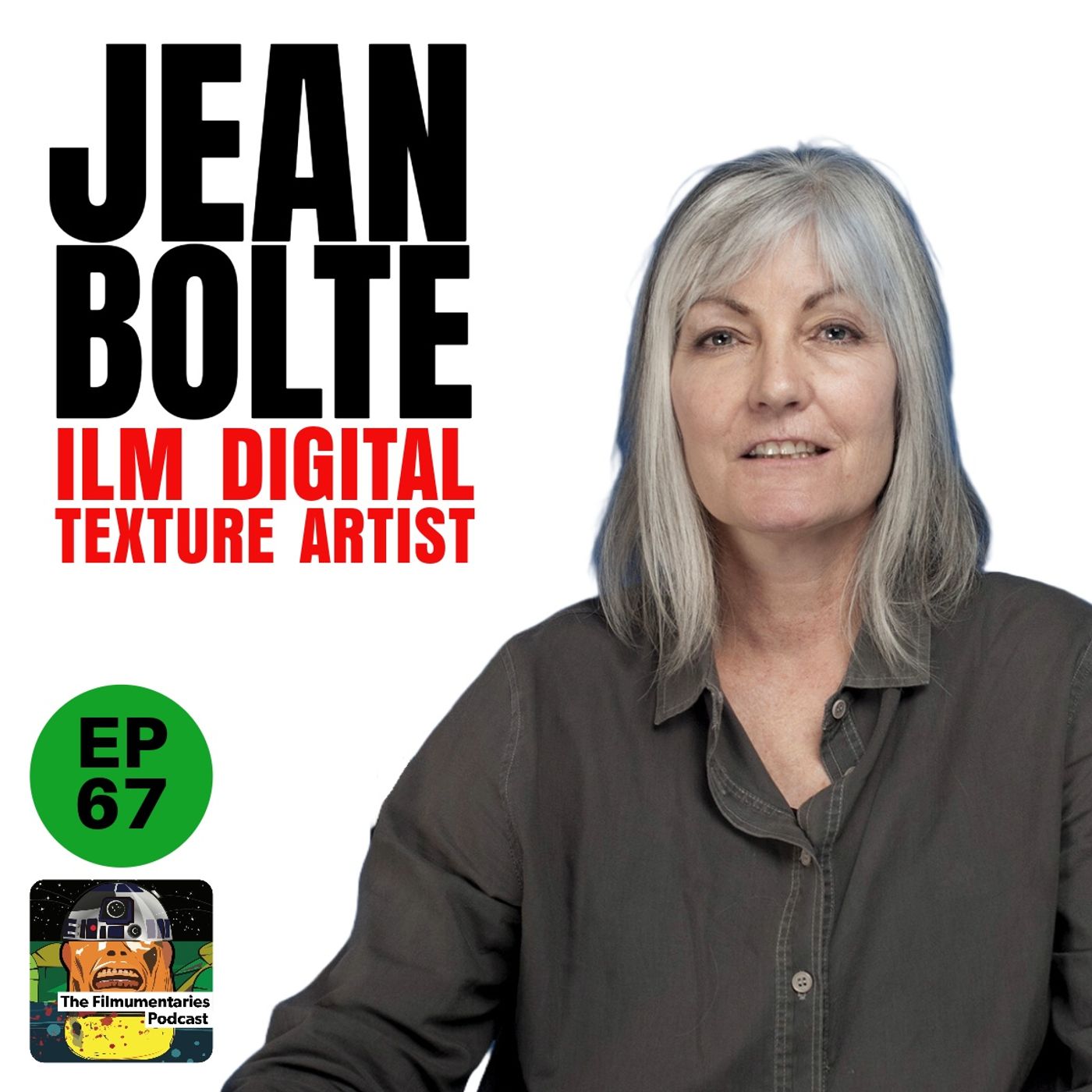
Jean has worked in the film industry for many years. She started in wigs and beard, then moved to ILM in time for Willow for which she was a model maker. The thumbnail for the episode shows Jean working on the ostrich for the famous morphing scene.
She then went to work on Hook, Jumanji, Men in Black, The Phantom Menace and so many more huge movies as a digital texture artist.
She’s recently handed in her notice to ILM but is going to be staying very much in the creative world.
Jean was just so great to talk to, we hit it off immediately. Chatting with her was surprisingly relaxing and also very inspiring.
So here’s my conversation with texture artist and supervisor Jean Bolte... Nick Notle and I’ll be back at the end for a bit more jabbering on.
My Filmumentary Videos on Vimeo
The Filmumentaries Podcast Merch
Podcast Patreon
This podcast is completely independent and made possible by listener support. If you’d like to help me keep making these episodes, you can join my Patreon community here: https://patreon.com/jamiebenning
Watch more on YouTube:
Check out the Filmumentaries YouTube channel for behind-the-scenes clips and extra content: https://youtube.com/filmumentaries
All my links
Transcript
Automatically generated, so expect the odd misheard name.
Welcome to episode sixty seven of The Filming Mentor's podcast. This is Jamie Benning talking to you here from my little cave here in southeast London. It's January twenty twenty three. It's bloody freezing and this is the second episode of the month. A little later than expected, but I managed to get a bunch of work for January that I wasn't necessarily expecting.
The life of a free life, so it never gets boring. If this is the first time you've listened to the podcast, welcome. You have about an hour or so of film history chat ahead of you. Please do check out some or all of the previous sixty sixth episode. You've missed some great ones.
I mean they're all great. If you are a regular listener, you'll know the deal and thanks for your continued support. If you do like my work, and this is work, we'll be at work that I love. Then please visit patreon dot com forward slash Jamie Benning as jam I E B n G Patreon being spelled PA t R e O N. You can now support the podcast as well by buying some film mementories much including Film Momentories, Logo mugs, t shirts, bags, bottles, and even socks.
Yes, socks. You can be walking around listening to the podcast with the podcast on your feet. It doesn't make any sense, but there you go. Also t shirts with the inside Jabber and inside GEWS posters on them. Why not buy one for your next film fair or film convention.
I doubt there'll be many people wearing one. They're pretty cool. All of that and more can be found at film momentories dot creator, dash Spring, spri andg dot com. I'll post both those links I've just mentioned in the show notes as well. Thanks for the feedback on the Lean Critch episode number sixty six earlier this month.
It was great to talk to Lee about his megabook projects Standy Kubrick's The Shining and I may may not have purchased one of them. It depends on how my wife reacts when I finally admit it to myself and her. Let's just cross over that. Please also remember my feature length and short film momentary video projects are still available on vimeo dot com. So that's vimeo dot com forward slash film Mementories again.
I'll put that in the show notes for any of you that have only found me via the podcast. You might not know my previous stuff. I think you'll enjoy it, Okay, So for this episode, I had the pleasure of speaking with the ultra talented and lovely human being, Gene Boalti. That's Balti rhymes with Nick Nulty. As she told me, Jean worked in the film industry for many years.
She started in Wigs and Beards and ended up working on Labyrinth, then moved to Ilm in time for Willow, for which she was a model maker. The thumb now for the episode shows Jean working on a Ostrich for the famous morphing scene from that movie. She then went on to work on films like Hook, Jamanjie, Men in Black, The Phantom Menace, while the list just goes on lots of huge movies, finishing her career on Indiana Jones Fire. As she told me, so, she's quite excited to see how that's gonna land with the fans. With us.
She recently handed in her notice at Ireland, but it is going to be staying very much in the creative world. She talks about that towards the end. Jeane was just so great to talk to. We kind of hit it off immediately. Chatting with her was surprisingly relaxing.
Sometimes it can be a bit nerve wracking talking to people you've not met before, and also very inspiring. You know, she just got a really nice way of describing what she does and why she does it. And yeah, I was quite inspired by the end of it. So here's my conversation with texture artist and supervisor Jean Bolty Nick Nulty. Remember, and I'll be back at the end for a bit more jabbering on.
So, Jean, you're clearly a very creative person. Where did that kind of journey begin for you? I think that it's a kid and this is actually it's a question that it's close to my heart, because I didn't have the confidence to feel that I could ever do, you know much with art. That seemed to me like those were people who were born. You know, an artist is not You either are or you're not.
And so I devoted. I was a devoted follower of my local art gallery, which is the Nelson Atkins Gallery in Kansas City, which I think still at that place remains I think one of the best galleries in the world. And I go back there and as soon as I walk in the door, it's like my whole childhood comes back to me. I knew every single piece in that gallery because I would get dropped off there and I would spend hours wandering all through every bit of that place. Some of it was terrifying, you know, some of the Warhols and things.
I you know, was exposing myself to stuff that I found just so confusing and scary. But I also love that too. So the reason that I'm saying that it's close to my heart is when I do presentations for the schools, which I love doing because I think if you get those kids at an early enough age, there's a swim that can be flipped. And all kids have such natural creativity that if you look at a kid's composition when they make, it always feels right, and it's because this is something innate there. And then they start to doubt themselves when they hit sort of middle school age, you know, teenage or preteen, and I well, I'll do a presentation.
I'll show some of Doug Chang and Chris Altman's Christian oltsmen's work and stuff, and I'll stop it and I'll say, Okay, I'm sure that there's some of you sitting here who think that you could never do this. And I'm here to tell you that it's not true that artists are not born that they It's all about curiosity, interest and time and if you if you will devote yourself to something that you you know, if you care about it enough, your talent will come to you. Whatever it is that you have inside of you. It may not be a photo real piece of work. That may not be the right goal for you, but you know, don't give up.
And um, I don't know if I've ever you know, made a difference, but I sort of wish somebody had done that for me when I was that age because I just did not think that that I had it in me and I never went to art school. Um, but I drifted just I was just so drawn to be drifted, drifting back into something where I did draw in pain sculped and I sort of found that that, uh yeah, I actually didn't have to be a natural born artist. I could find my own way. And well, I'm just gonna say it's my it was my natural escape to me. Um, it's the best drug and really what I'm always looking for that, Um, you know, it's kind of a drug that has no side effects that I can get completely caught up in something.
Painting is kind of the best for me, but also sculpting and other things. You know that that will allow me to just disappear. There's a kind of a euphoria that comes with that. And when I know that I've nailed it, you know, when the scale clicks and you look at it and you're like, Okay, that's that I feel that you know it's working. That's what I'm going for, and that's what I've gone for all my career, and I am It's it's like I just want to get I just want that drug.
I want to get high in that way so that, um, I disappear. Yeah. Yeah, it's the meditative aspect of it, isn't it. And I think I heard you say in another interview there's there's this kind of moment where it kind of smells, right, I think was the term you use that. There is that kind of sensory aspect to it, isn't there.
I'm not a particularly creative personal. As a kid, I was known as one of the best drawers in my school, one of the best artists as a young kid. I kind of lost it in my teenage years. And I've found in recent years just having the iPad with the stylus, I'll doodle away because I know I can rub it out because I lost my confidence with paper and pencil, you know when I became a teenager, because I was told I needed to learn business and I needed to learn physical education, all those other things, maths, whatever. But it's really important to kind of rEFInd that, I think for for a lot of people, and it is that meditative aspect, and it's great to hear that you still get that.
You know, when you're working and you paint yourself. Now I can see some paintings behind you with a yours or this one is that's one. And I also have done I'm doing a series on kind of devil clowns because ever since well Bush and Cheney really started it for me, and then Donald Trump, I just felt that I had just some of how express this this craziness in some characters. So yeah, well I can to stand that I've been watching from a far Well, I've a family in the US, so it's you know, we closely watched politics there. I mean, it's no better here at the moment um, No, it's not.
You were here, right, we do. I just want to say that Jamie, that we share we share that um, that sense that when you went to college, m that you had to do something sensible, you know, that you had to study something that you could make a living out of. And so for me that that, you know, I was not I mean, I came from a very supportive family, but I still had that sense that, like art was not something that you could ever feel was a path. And that's another thing I really would like for for kids to know that that it's okay to consider that to be you know, you can you can tell not everybody makes a living being an artist, M but you. But that don't rule it out.
You know. I was going to say that's great, and I was to say that talking of politics here, of course you were over here for a number of years. What what brought you to the UK and what did you work on while you were here? Oh? I you know, my whole my whole history, Jamie as being in the right place at the right time.
It's just a serious, seriously of incredibly fortunate moments. And so I wanted to get as far away from Kansas City, where I grew up as I could, because as much as I loved, you know, I mean I have very, like I said, a wonderful family there I had when I went to the gallery. When I went to Nelson Gallery and looked around, and I saw and on the antiquities and all these everything in there, that they were beautiful things. But they did not I didn't feel that they were coming to Kansas City. It was hard for me to feel that that I could experience that.
You know, it's a kind of it's it's a landlocked you know, we don't get a lot of exposure there to traveling and all that, and I just wanted to get away. So I remember I added from early days that I would go to college somewhere else, and London was an obvious choice because I you know, I studied languages, but that when I didn't have to worry about so I did. So I went to college in London. I fell in love with England and the UK generally, and then as soon as I could, I got got finished my degree in the US and I went back there and I lived there pretty much the entire time that Margaret Thatcher was in office, so there was like eleven years, yeah, which you know, politically not the best time, but actually for the film industry, quite a good time, because the tax relief had arrived for film production, and that, of course is what brought Spielberg and Lucas and Henson and all those guys ever exactly exactly, So talk about timing.
There were all these big budget American films are being shot at Elstree and Pinewood, and they were actually seeking people to work on them. And so my job that I had, I was being paid cash in hand. I was illegal, and that really wasn't that big of a problem. Actually at the time. I don't know what it's like now, but being getting a job cash in hand was like, that's pretty normal thing to negotiate.
So I wasn't paid much. I was in a sort of sweatshop in a basement in the West End, learning to make wigs and mustaches and facial hair, and they paid me by the piece work. And I mean it truly was, you know, a pretty Dickensian situation, but I didn't care because I was in England and I was just rent was practically nothing, And all of a sudden I started these movies were coming in and at the same time I negotiated a marriage of convenience, And so then I was a legal alien instead of an illegal alien, and I was able to work at that point. And I got a I was working in theater, which I think is a fantastic place to learn this business. Um, you really have you learn how to collaborate, and they'll throw anything at you because you're paint being paid practically nothing working in the theater.
But oh and I was at the RSC. I worked with some of the great actors in the RSC. They all ended up like in Harry Potter movies, you know, over the years. And was it still doing hair and wigs and things? Was it?
Yes? And expanding at that point into two costumes and that kind of thing. So I got a call, would I would I would I consider coming out to Elstreet and an interview to work on um Tobe Hooper's movie Life Force, And I was, I mean, that was the beginning for me. So I worked on that, and then it was just jumping from one film to another, which a lot of it was Hanson's work. That that was a pretty pretty regular employer, and working with Jim Henson was quite quite an education.
Yeah, And that was what Labyrinth was it. And Dark Crystal. I did not work on Dark Crystal, although I went and hung around and saw what was going on, and I learned quite a bit just just because I had friends there and I was trying to, you know, angle and see how how could I how could I get in here? Because oh my god, the workshop at Hanson's there in Hampstead was just this incredible playground. And um so luckily enough, yes, I managed to get crude onto Labyrinth, and Jim was an extraordinary director and leader of his company.
He knew everybody's name. And that wasn't just London. That was also in Canada where they're doing Fraggle and then New York Shop where they're doing all that the curst them uppet stuff. But the London Shop I think was kind of his playground real like I mean, not diving to but push push up our our profile. But I do think it was kind of an elite place for him to really experiment, and so that there were I mean, for example, there was a year of prototyping before they shot things.
There was just so much a luxury of trying things and experimenting, and so yeah, Labyrinth was a blast, and watched we watched that film a couple of times every year. Like I've got daughters aged from seventeen to fourteen to eight, and they all loved that movie. And what my wife loves that movie. It's just one of those ones that has kind of it didn't do well initially, did it, I don't think in the cinema, But it's found a whole new, whole new life since then. But what was working on it?
Like, so are you about to say, well, I mean of Chris, David Bowie was around and he liked being on the set and hanging out in the workshop with us. He didn't want to just sit and as win a baygo. So that was he was just wonderful. But I have to tell you a story that I think back on when I think I'm working on this. Pine went out and all the setups there, and one of them was his was Bowie's little castle scene the interior there where they did dance magic dance, you know that song.
And so David Bowie's on a kind of throne and there was there was a vulture up there behind him, there was a pig running around all over the place. Down in the pit where all the puppeteers with all these muppets that were dancing around like this music playing, chickens running around, and I was on the set kind of, you know, helping kind of get the puppeteers what they needed. And one of the chickens ran across my lap and laid an egg in my hand. Madness on the set, I know, And I took it over to the chicken wrangler and I said, this egg and they couldn't believe it, because chickens are supposed to go off their lay right when they're you know, it has to be kind of nice, and it was calm for them. And you can't imagine a more chaotic scene just all squished together like that.
Anyway. Yeah, it's so bizarre, but yeah, I really really loved working on Labyrinth and being around um um the Hanson family. They were all such so creative. Brian, did you get to tend to David Bowie himself. Not really, No, he had his own people and that wasn't my area.
But but I certainly, you know, we chat. I mean he was right there on the set just sitting around talking to people. Yeah, yeah, he loved it, he loved all that. I spoke to Toby Philpot, who was one of the puppeteers on that film, and he was also inside jab of the Heart for a turn of the Jedi, and he tells me of he's like fifteen minutes outside with Davy Bowie asking him if he had a cigarette, you know, and they just had a chat for fifteen twenty minutes, and he wishes it was longer. And you know, looking back now, he realizes how big a deal that was.
I guess, but you know, we can Yeah, I know, it's so true when I think back on that, it just seemed so normal. And I think a lot of times at ILM, you know now that we look back on the history of you know, what we've done there and all these things that we did that were so much fun, But at the time that was just your day job. It would just go in and and and of course, you know, having it. It was a playground working there, especially in the model shop, but it was also just you know, that was that was that was our lives, and I think a lot of us look back on it now and realize how fortunate we were. You know, did you did you have coming from the sort of wig side of things, did you want to get into the prosthetic side more like the kind of our guess.
Dick Smith would have been the name back then. Oh yeah, Dick Smith and Rick Baker in incredible and I did a little bit of that, but more it was other people were the ones creating the look of things, and I would be doing application right, especially on Storyteller. I don't know if you know about that. Hanson did a series of Storyteller with John Hurt and that that was a lot of fun. Yeah, yeah, I remember that.
It's quite terrifying. Seriously, have I have? I got goose bumps when you mentioned it then. I haven't thought about it in like thirty yard years. Well, one of their designers is Ron was Ron Muick.
I don't know if you're familiar with Ron's work, but he's gone on to do his fine artwork and he's in galleries all over the world. Um, there's the hyper real sculptures that he does which are just astonishing. You know, there's some real talented people back that. One of the people I met m was Neil Scanlon, who is that. Yeah, he's still a good friend and he's carried on, you know, being at the top of his top of his field.
How yeah, I'm aware of Chris's work obviously in recent years as well, he's he's been pretty pre Lificum, how did you find trying to navigate your way into the area that you wanted to work in? Because in the in the late seventies, early eighties, mid eighties we're talking about now, I guess at what was elaborate eighty five, the film industry, particularly in England was very kind of driven by older white men. Yeah, yeah, how did you find navigating that kind of lengths? I, you know, this was I still can't quite believe the way that things were handled on the set when the construction guys, you know, the chippies, the plasters and the you know, the woodworkers, Um, we're on the set. It was a terrifying environment for a woman.
They I mean no, I didn't actually I didn't find it terrifying. I just thought they were stupid. But you'd I often would ask if I was if I had to go out into the set and to do stuff, I would see if somebody else, another woman wanted to go, like, do you have anything you need to do on the set? Because as soon as you walk into one of those big stages where they're all up on their course, safely up on their catwalks, just a chorus of abuse raining down on you. As soon as the woman came in.
That was an opportunity for them to all just shout, you know, oh darling, you know, like you're walking into a men's prison. Oh exactly right. Yeah. And this was before I need a hill. It was before I need a hill.
And there was no recourse. I mean, it wasn't like you could go and say anything about this. This was just standard practice. This is the way it was. And I'll never kept going from that.
I'll make a jump here, but to the ILM stage. And I had to go out there when I just first started there and only been a couple day or two, and I had to go out to this to the stage to do something, and I kind of crapt out there. And the other thing was the unions were so strict. I mean, I understand it, but I remember going out and asking Michael Loggy. I said, you know, one of the stage hands there, I said, you know, can I can I move this a little bit?
I need to work on this spot And He's like, yeah, Gene, you can just move it. Just put it back when you're done moving lights around all that they were incredible gentlemen and it was a it was a tremendous shock. Now, I think that's possible that the culture is very different now. I can't imagine that that kind of behavior is glad continue. But just still that jump from going to what I knew in London to ilm um was that was culture shock for me to just be treated with with respect.
Well, that's good to hear. I hope it isn't purely an Anglo American thing. I mean I did speak to mad In Most who was a second camera systant on Star Wars and Empire, and she said similar things like I think the DP of Star Wars said, why is there a fucking girl on my set? You know, so she had to prove herself by climbing up this gantry with a huge you know, panel vision camera on her back to be one of the lads. You know kind of well, very ridiculous.
Yeah, it is ridiculous, and but ultimately that's what I thought. I just thought, this is ridiculous, and I didn't let it start me. And I think in some ways it kind of it kind of helped me to to realize that you just you know it toughened me up basically. I mean, I'm not talking about the really hainous, you know, Harvey Weinstein situations, but there's that kind of micro and the macro level that have to exist together for each of them to exist. Yeah.
Yes, yes, so yeah, I've I've been in situations of work. I work in the live television industry where you know, women are kind of putting certain roles that auld eily women's roles, like in film. I'm in live TV, but in film it was always like hair and makeup and continuity. I mean, up until recently it was continuity girl, wasn't it. Yes, yes, Oh, a product production, there's you know, there's a lot of women in production.
Yeah, but I've had to kind of say, no, I think she's good enough to do what we do, and I think we should give her the chance, you know. And some people say, well, it's going to change the dynamic. I said, well for the better probably, so why not do it? And no, I'm glad that I've been able to do that occasionally. Oh that's great, Yeah, I do.
I mean I think things have come obviously come a long way, but um, and I think there are women who probably had. I mean, to be perfectly honest with you, Jamie, I think that I have not had a tremendous sense of ambition throughout my career. And I think it's because of that thing I was saying earlier about just wanting to get that euphoria, euphoria of of doing this hands on work and then seeing it on the screen. Like I can look at something on the screen and I go, I know exactly what that sweat came from. I know exactly about why that leather looks that way.
I know, you know, I helped to sculpt this thing, and there it is. And as as you move up and I mean, you know, effects supervisors have a very very specific and and and you know, the best ones are people I admire their their breadth of knowledge is enormous. But that wasn't ever something that I had had a real desire to do. And so I also think that's allowed me to probably have the position that I have that, um, I didn't feel very oppressed most of the time that I've worked. I haven't felt that I've had to fight, you know, to get recognition and had I really tried to push, push harder to have a job that has a bigger profile then perhaps I'd have other stories to tell.
Yeah. Interesting, How what was that transition from working in London to then going over and working for ILM? How did that come about? I got a call and it was in the middle of the night because they had the time wrong and they said, which I know. I was actually having a party at the time.
It couldn't have been a very good party if you could hear the phone ring come on. So so it was about I don't know two in the morning, and jeff Mann from the model shop asked me if I would come over and work on Willow and I not only did I say yes to all that, I negotiated my salary. The whole thing was all out of the blue, completely out of the blue. Somebody had recommended me. And then the next morning, you know how, you kind of go through your like what happened?
And I think, I'm my God. I got into job at ILM and that was my dream, I have to say for a long time too. And as much as I love the jobs I was doing at Hanson's and other freelancing in England, the work was getting more scarce. Those tax breaks were going away. It was it was you know, harder and harder to be freelance, and London, as you know, is a kind of tough, depressing city to live in if you are not feeling like you have a great path you know, to financial security.
So I was thrilled, you know, that ILM called me, plus the fact, you know, just seeing what everything that they had done there, I was just so astonished that this is the place. I mean, it was just a well known fact, is like ILM is the place where they can do anything. So I couldn't wait, you know, I just got on the plane as soon as I could and went over and worked on Willow. But I wasn't quite settled. It wasn't like I immediately landed and then I had this full time job.
I mean, Island was also still freelance place, and you would work on a job, but the jobs were coming in regularly, and in fact, the stage hands used to call that the country Club because it was a place where you know, the works to the work was good, and the people were great, and the location was wonderful and you had this sense of being part of a steady community, which was a complete anathema to me. I'd never had anything like that in England, it was always like you work on a project and then it would disband, and then there was a sort of scrambling that would go along to try to, you know, make sure that you were going to be thought of for the next one. So I mean, that's that's freelance, right.
So to come to Island it was still sort of a freelance situation, but but not in that same sense of having absolutely no security, because they kind of say, well, gosh, that went well, you know, we'll call you for the next one, and then it would be a few weeks and the phone would ring, so back and forth. I still wasn't quite out of London, I wasn't quite in San Francisco. And finally I just said, Geane, what are you doing? Why are you going back to England when you know the weather's better? They could shoot, you know, they could set up entire shoots outside not here, no, never in the UK.
You couldn't even trust a sunny summer's day. Yeah, So I was like, this is you know, and plus you know, I'm American clearly, you know. As much as I loved and was coming, really more and more of an thinking that England was going to be my home forever. There was something that tugged at me to come back, and you know, I've heard people say this, there's a kind of a about a ten year span when you leave your home, that it will come back to you to kind of make you draw you back, and so that, Yeah, I made a permanent decision to come back to I LM. And luckily after that the work was pretty steady.
Amazing that you arrived sorry, go and say that again, well, in fact, incredibly steady after not very long. Yeah, good and amazing that you arrived on a film like Willow where there was that kind of very early merging of physical and digital, you know, with the morphing scene between. In fact that I saw today that wonderful picture of you with the Ostrich kind of just touching up the Ostrich like little paintbrush, and amazing because what a sequence that was when we see that character change and morph. I kind of blew my mind at the time and still today looks fantastic. You know, I showed my daughter the movie recently and she gasped at that point.
Really yeah, wow, still seven year old. Yeah, did you feel that that change was coming that you were working in the model shop. Yet you could feel this kind of new thing appearing, this new digital world appearing. Well or did you just have you a mind on the job. Now, I'll be perfectly honest with you.
I think that all of us in the model shop truly felt that we saw that we knew that this because this was really Dennis at the time was really pushing, you know, to to to to the I mean, there have been plenty of innovations that happened in CG that were very significant, but I have to give Dennis full credit for the fact that early on he saw this. He said this vision that CG was gonna that computers were going to have open doors. But we didn't. We didn't really think so, you know, we kind of thought that we would always be on top of the you know, that we would be the go to the model shop and the stage and shooting, and that this computer Graphics would just be there to kind of decorate what we were doing.
Um, And so I didn't have a clear idea at the time that nobody did. Nobody could see the tidal wave that was and a hit that company. But we were also I loved going over to the computer Graphic I mean I've always had a real soft spot for well, you know, I shouldn't say geeks, because you know, we were all geeks really, but I was fascinated with the Computer Graphic Department right from the get go. And they were in their own building. They were only just like on a floor of about you know, I don't know, twelve people or something.
It was so small, and I loved going in there to see what they were up to and much more, I think, you know, to be perfectly honest, I had much more curiosity about that than almost anybody else in the model shop. I think everybody else kind of felt like this was just some dark room and it didn't appeal to them, you know too, because you know, we loved what we were doing, and CG was just this kind of kind of brainy, dark, you know, kind of unhealthy kind of environment, you know, which is sort of true. Really. Yeah, there's you with your mask on, using you know, all sorts of chemicals for your model making. So that's well, you're right about that.
We liked our version of the unhealthiness. Yeah, yeah, God's truth. Yeah, all the chemicals and you'd get you put your mask on in the spray booth and you'd be working and then you just get tired of wearing that thing and just whip it off after a while. I mean, we really felt invincible, and the more toxic the materials were, the better they tended to work for us. So of course that would just gravitate to that.
You know. Was there a particular film with regards to the CGI that you saw that you kind of thought, Okay, something has changed, Like I'm I'm I'm trying to kind of work out the years in my head, but I'm guessing The Abyss was one of those films where everybody kind of sat up and went, oh, this is this is different the Abyss. The Abyss was huge, although I was not there for it. I mean, each each leap was very significant. But I remember I went back to this was when I was sort of in my interim between am I in London, am I in in uh San Rafael and I went to see The Abyss and that clinched it for me, Ja because I remember watching that on the screen and when that water tentacle comes and she puts her finger in that face.
I my world shifted at that point, I think as significantly as my world shifted when I saw Star Wars. This was just like, there is nothing that ILM can't do, and I need to get back there, and I need to go there, and I think that is really what what to me was like, you know, I kind of packed up my apartment and said goodbye because I have a I have a possibility to be with these people again. And so that one was huge. The T two you know, the Mercury Man and all that, that was another huge leap um. But of course the thing that was just I mean goes without saying the thing that was the earthquake was a Jurassic Park.
Yeah. Yeah, So you move from you find yourself kind of interested in the CGI side of things, and you're going up to the department and kind of keeping an eye on it. When was the moment where you finally decided or it was decided for you. I don't know that you would make that transition from the kind of physical world into the digital world. Okay, I'll try not to round on because this is a big topic and I want to make sure that it's I condense it enough to be interesting because yeah, okay, so what happened was on Willow Doug Smyth, who was one of the guys who invented the morph technique was coming around to the model shop and I was like, how do you have all this time to hang out here?
And he's, oh, well, I'm rendering, and I was like, God, that sounds like a great job. You just get to tinker around for a while and then you take hours off while you're waiting, you know, to process. And so I got to know them, and also because you know, I was hanging around that, and they invited me over to their Friday lunchtime. Every Friday, they would make spaghetti and the entire computer graphics department was in one room, kitchen kitchenette room, sitting around one table eating spaghetti lunch. And that was their little tradition.
And I was really pleased that I was invited to come and part in this. So it just transpired, you know, that I was you know, I just had like, you know, like I had my ear to the ground about what was happening over there throughout and I didn't do anything in computer graphics any training until Jurassic Park was going and they were way they were well, you know, I mean I jumped over the whole spas marked to pay kind of you know, dropping an atomic bomb on the company. And but of course that was a big lure, was just to to be around these guys and to see what they were doing, and so I just wanted to learn it. And the company was really generous to all of the model shop. And it wasn't an easy thing for that them to offer, because there was I'm telling you there was actually there was resistance on both sides.
There was terrible resistance in the model shop to learning about computer graphics. But there was also a great deal of resistance in some places in the computer graphics department to train those of us who are traditional practical workers. And so luckily there were a few key people who bridged that gap and said these you know, we want to bring these people over and train them and give them an opportunity. And one of them was Steve Williams. I mean, I'm forever indebted to him for that.
Steve Rosenbaum was another one, John Burton. They said, okay, well, well, well we'll invest in them because we think, you know, they may be able to you know, they have a history that is useful to us, They know how to work together, they have an artistic guy, they know about how to construct things, you know, with compositions and and you know, all those skills that we had. Luckily, some people realize that those were going to be valuable. Because computer graphics guys at that time were really mostly u heart from people like Steve Williams. We're not all that well versed in the arts, you know, so it needed to come together.
Ye. So yeah, they trained me to work and I learned a little bit about modeling on alias, and then I was given the opportunity to paint and the texture painting was what really you know, that that's what I loved the most. So yes, yes, that's right, And that was Jamanji. Well, Jamanji was the first after Jurassic Park came out and the entire computer graphics department at ILM were walking on water. They went to Siagraph and it was you know as as of course you can imagine, just heralded as the breakthrough that it was.
So Jamanji was the first time, you know, actually Casper, which was a film that kind of came and went, but I spent I can't tell you how long painting twinkies and little Hostess cupcakes that were part of the props in that film. And given a great deal of time to do it. But I also tell you something, Jamie. This was another thing that was crucial to me, was that I did not want to make a jump. I wanted to have this be another opportunity for me to learn and to work and to provide something and to you know, have it be in in my artillery, you know.
But I also really really wanted that for the rest of the model shop. And they were resistant, but I wanted not. You know, a lot of them were going through some of the training with me. I just don't think they loved it very much. But I could see, we could all see that the model shop was waning, you know, that every everybody wanted computer graphics.
All these films. These production companies were like the films were like planes like hovering over ILM, just like waiting for clearance to come into land, and they were holding off their schedules so that ILM could work on these things. So that was the atmosphere. It was like, oh, yeah, you know, everybody wanted this thing, and nobody was all that interested in the model shop anymore because that was old you know, old hat. But of course there wasn't enough opportunity I mean, there wasn't enough bandwidth for a CG to cover all the demands.
And of course Model Shop did some of their biggest best work on like the Prequels. You know, those were huge times from the Model Shop. However, one thing, if I could dial back time and change the way that things were set up in the company. They had a policy that they would take a shot and they would give it to the Model Shop to build bid, and they would give it to CG to bid, and whoever came in sheepest got the job. And I talk about creating a resistance between the two departments.
And it was really an unhealthy time because people were pitted against each other. And of course understandably, the Model Shop were very frightened, and I was frightened for them too. I mean it wasn't just Model Shop, but you know it was also like you know, an optical and all these other things stage chum, and I wanted to be sure that if those mostly guys, those guys and gals had at least given it a chance, then they would know that they were making educated choice to say no to it. So I went back and forth, and I had a job over and during Casper I was given the job of running this show, for running this big shoot for Dragonheart, this big giant hydraulics head of a dragon that went over to uh somewhere in New Central Europe to shoot.
But I was met with some pretty frosty welcome when I tried to go back from the CG department and work on a job back in the model shop, right, And I don't know that I should go into too many details about that, but this this was an awful time for me. Actually, I again, I was toughened up because I'd had years of kind of saying, Okay, you know, just focus on the job, Gene. That is the number one thing you have to do is focus on the work. And of course you know it's important to collaborate, but don't let somebody throw a wrench in it if you see a path forward. And so yeah, these people who were in the model shop, some of them, of course, in all of them, but they were my but but the entire model shop were family to me and remain so we are incredibly close knit group of people.
And it's partly because we're just the Model Shop is a particularly I think, particularly wonderful group, like they just Um, if you look at all these personalities and skill sets, Um, I'll never experience anything like it again. And there's there's the chemistry of all these people working together. But it's made us incredibly close and to this day, you know, if somebody's you know, we have wonderful party, reunion parties, if somebody needs something, we step up and help each other. Well, this family were were some of them were in real opposition to me being back there again with them, and I just really had to like just just try and remember that one of my big motives. I know this makes me sound terribly altruistic and all that, but that I wanted to be able to make sure that door was open, and that's that that people were crossing back and forth.
And in fact, John Burton in the A CG Department when he interviewed me to train me, he said, okay, Jean, I want you to absolutely commit to being a computer graphics artist. Boy. And I said, I've literally had behind my back my fingers crossed in I said, yeah, of course I'll do that, absolutely zero intention of turning my back on my work in the model shop and my people. I just wanted to sort of say, look that this is a whole other set of tools, and they're available to any of you if you we should all be able to feel that we have the opportunity to try it. And I guess part of that kind of conflict was borne out of the fact that it wasn't necessarily apparent what was the best tool for each particular job at that time.
Was it models? Was it seed? You know? Was it you know, pushing further into this CG world. But great to see, like on a film like The Phantom Menace, and I think not a lot of people really realize actually how much model work is in that movie.
But you were working with view paint by this time, doing the textual stuff. Can you describe how you do that job. I've I've got an idea in my mind of what it looks like, but what is your kind of day to day working as a view paint, texture painter or supervisor later on as you were on The Phantom Menace. Well, it's you know, basically, it's doing the same thing that I did in the model shop when I was painting a model, but I was painting on it, you know, on a flat surface. There was a lot more preparation to make it work.
All sorts of mathematical formulas had to happen and lay out things to to make sure that that the textures that I was were painting would actually find their way correctly onto the model. So and that would take actually weeks and weeks to set up, whereas now it takes moments. And that was a proprietary like internal software. Was it a few paint that was, Yes, it was, And Dennis Mirran said that that was the big leap on Jurass. Well, I like to think so, because that was what I was doing.
But before that, with the Mercury, you know, man, the t two work, the paint, it really didn't have a surface that told you a story about this thing, you know, like that that was rusty, or that it was scarred, or that it was you know head iridescence or later on feathers and hair and all that stuff. Um, So that when they were when when people were actually to get their hands on a wakem and paint on those dinosaurs was one of the biggest leaps about that whole show. That was John Schlagen little those guys that were Yeah, I was talking about that shot. I think it was the Dennis Mirror when I spoke to about that shot of the t Rex when it came out from the darkness behind when the fence breaks, and just how that shot still holds up now, and he was talking just about how well it was comped and the textual work on it and everything.
And that's the thing I think people just go they think Jurassic Park, they think Dennis Murr, and they think Phil tip It and now they probably think Steve Williams SPADs as well. But there's so many other people behind doing a shot like that, and I think it's always I always try and make an effort in these interviews to try and point out that, you know, there are people involved in every single aspect of it. It's not just somebody's just given this shot and it's their job to do that shot. And I've never spoken to a textual artist before, but I'm kind of wondering how you'd mentioned this earlier actually about the render time, because obviously when you're working on a model, you're able to see the results instantly, step back, decide, have a proper look at it, decide whether you want to change it or take away from it or add to it.
With the CG work particul clean those those early days, what was it a render? Render might last a whole evening while you were asleep, and then there's a problem with it the next morning and you have to start again. I mean, that's the difference between a good and a bad day. Right, Well, you're you know you you put that perfectly, because that is exactly my feeling when I would I couldn't wait to get up in the morning and get to work, and it was all about my render and if I had a good render, I had a good day. But you know, and that goes right up to now you know, I'm still an employee, I am, but that that I love that feeling of getting up and seeing what transpired overnight and um and often it's you're horrified, you know, because it's not you know, something you didn't didn't give you didn't hit, or the right button or just you know, it's gone wrong.
And yeah, that that's that's a kind of a a rhythm of working that was hard to get used to. And yeah, when we were used to being on the set and just like get out a big brayer and just spray something and just stand back and you know, okay, good, You're done, you know, shoot and the timing of waiting. And then also the other thing that I still to this day have issues with I really loved in the early days of ILM is that you would get a couple of takes and then that was it, and then they'd show the dailies the next day, and you know, unless it was a disaster, which sometimes you know, like something would happen and then get incinerated or something while somebody working on it, but basically that you know, you had the camera in front of it on the set and they took how you know, several takes and then you were done.
And there might be some tweaks that that you know, rodo and paint could do to something, and the comping could could could could do something with it. But basically it wasn't this thing where you had in ability to keep minutely incrementing something over and over and over, and it's it is a little bit hard, I think, to keep yourself, to keep your spirits up, because I love there's nothing I love more than like early in a project, when everything sky's a limit and there's just you's a sketch and that's all. And I generally and I still do that is just go ahead and get my own reference photos and um, you know, try to find something unusual that no one's ever seen before, like you know I used to. I remember I called these women from the bat these women that were bat experts, and they brought a bat with them and I've spread the wing out live bat on a light box and took photos of that.
And I went to this place where this guy had an incredible collection of minerals and shot photos of minerals because we wanted to get ultra on to have a look of something that they had. They always want something to never seen before, And in fact, it's not that hard to find. If you really just go out into the world and look at what's out there in nature, you will find something that surprises you. But after that, you know, once that initial thing happens and things you know, you get it like eighty percent there and it's all just it's a great pathway to seeing what it's going to be like. Then you really have to have the kind of stamina to see it through and to still care about it.
You know, when something is just being really minutely tweaked, and that has become you know, more and more the standard of what what we have to do, you know, to complete a shot. I don't resent it or anything like that, really, but I do sometimes think back to those days in the model shop where something was so you know, this was your shot and this was your opportunity to get it right, and the director had to be creative with what he was given and too, you know. So yeah, kind of miss those that aspect of the work. Yeah, yeah, I would. You were talking earlier about how the people in the model shop were very much family and still are, and I wonder if that's something to do with the collaborative nature of working on a single piece together.
And although that happens in the digital world, you know, you're not physically necessarily in the same space as you're doing it. You might go off to your booth or your to your office to work on that, and I wonder if that's part of the thing that you miss, is about kind of being in that same space with people and both having your hands on a on a model and painting it. I think that's crucial, but I still think you can recreate that and I actually I feel like the San Francisco i LM group. I just finished a project working on Indiana Jones and look enough, they pulled together a lot of us older people, you know, who've known each other, like the vast majority of that tight crew where had been working together for at least twenty years, and so we uh and I think we have some of that family feeling, you know, that we had in the model shop, just because we've been through battle together for so long, and and we had been in each other's you know, we had been physically together so all that time.
I wonder about the future of of visual effects work when you don't have that kind of proximity. But I'm not trying to say that I think it won't work because I've seen so many changes at ILM, and so many times you know that we feared that some new approach was going to change the nature of our company. I mean, I really believe I have such a strong attachment to that place and that legendary company that George George made there is still I still feel that, you know, I still feel that way about it, even though it has expanded and we've got companies, we've got people working in all different countries, people don't know each other. I still think there is there is something that is there's a maintenance from from from that the sense of the reputation of the place.
Yeah, that I think still stands. That's hopefully always will Yeah, it's good to hear that that heart kind of still exists there. And that's the thing is there are very few companies, probably not just in the effects but anywhere where there are people that have been there for you think of like Dennis only left a few years ago. I mean, he was there for decades. You know.
I did wonder with the effects, you know, because you think of those those kind of milestone movies, obviously Star Wars and then sort of optically complicated Return of the Jedi, and then Willow and Young Shirlock Homes for the CGI, and then of course Jurassic part of this Jassic Park and so on. I wondered if at some point the effects technology would kind of plateau and it would end up being used purely as a storytelling device rather than a let's see something new, let's let's find a new wow moment on the screen. But it seems that companies like ILM are still always kind of pushing forward or forward, always trying to push the envelope and you know, find themselves in new territory. How does somebody like yourself, working through that period, through the nineties and onwards, how did you find the challenge of kind of keeping abreast of the new technological changes.
Because it's a good question, because man, it's not easy. Yeah, because I would imagine, like one job, you're working one show, you're working on version one of some software, and then by the time you reach the next show, it could be version ten and the tool sets changed completely. You've hit it on the head, Jamie. That is one of the big challenges for me. And the thing is, there are plenty of people in the company, people doing my job who are much better at it than I am, and they are younger, and they're sharper, and they they can pick up software quicker than I can.
And I've always been I've always been conscious about that. But the thing is, I got to the point where pretty quickly I got to the point where I didn't care if people knew that I didn't know how to do something, and I managed to to I keep thinking, every time I got a new show they give me something, I would be like, God, I've I've I've tricked them again, Like they've still they still see some reason to keep me around even though I have I feel the struggle. But then if you talk to other people, you find out that they're they're all sensing it the same. You know, you think, what, we're the only one. You think I'm alone.
I'm I'm really having to constantly feel like I'm battling to keep up and keep on top of things. I don't think I'm alone in that feeling. And I think it is very much the nature of the business right now is there's tremendous pressure on people to stay abreast of what's what's the you know, the bleeding edge of you know, the latest ways and best ways in most efficient ways, because of course that's always the pressure now is how can everybody everything be done, more work done in less time that you can't hold on to old tools and be expected to keep up. Yeah, it's weird, Like I probably won't leave this in but just as an aside, I work in the live TV as I said, and I work as a kind of live editor, I guess you call it.
And the equipment we use has been used for quarter of a century, has not changed. They've added, they've added to it, but it's been there for a quarter of a century. Right now, in the lit twenty four months, a new iteration, like a brand new way of doing it has arrived, and the resistance is unbelievable for the old cruise. You know, people just are scared of change, aren't they. That's that's the Oh yeah, And well, I mean that's a luxury to be able to feel that you have mastered the tool set that you have.
You know, I'm kind of interested in what your place of work looks like like as somebody who's doing all this textual stuff. Do you have like fabric hanging on the wall, and fur hanging on the wall, and photographs plastered all over the place for each particular job you're working on. Yes, I definitely did that. In fact, I don't have that it's around me quite so much right now at this moment. But I remember Lynn when Brannon giving a tour, when I when we're still before COVID, and she's coming into the room and I had just I have this huge array of bones and snakeskins and feathers and rocks and rusty metal and let and she's like, and here's Gene and and and all of Jean's creepy things, and I didn't think they were creepy, and I thought they were absolutely beautiful.
But yeah, that that's something I am surround I try to surround myself with with whatever it is that I'm working on, to have as many visual examples of it as possible and set up set up you know, boards and do collages and things so that I'm inspired by by real things. You know. Dennis was always very very big on that. Was um, he bring an elephant to Ilm so that people could watch the movement and and and to see it, to see it yourself, And so I was always a big I was a big follower of that. And I believe in that because it's so easy to just google something and then you take that and you know, use it.
But it is the truth that you do. You know that that quote that I gave earlier about when you see it on the screen and you can smell it, that's when you know that you're getting somewhere. And I don't think that it's easy to get to that place if you don't have some firsthand, you know, in your face examples of what it is that you're going for. Yeah, Dennis was talking quite a lot about that. He's a big proponent of that idea is the observing reality, and he talked I asked him about has he ever thought about writing a book?
And he kind of lifted this manuscript from beneath his desk and said, this is it. Maybe one day. You know, my wife keeps trying to make me, make me do it. And I said, well, listen, I know a lot of people would be interested in reading that. And he said, well, okay, maybe one day.
Thank you. He's been working on that a long time. And I used to love to stop in his office because he had stuff up on his screen and he would spend time, generous time with me talking about like, this is why this shot works. You know, this is something, this is the thing I mean. I think one of the high water marks from ilm is is his collaboration with Spielberg on War of the Worlds, which is not it's a film that kind of came and went, but watching and knowing, understanding and listening to Dennis talk about how they collaborated together so that because they had almost no budget compared to most you know, things that I come in, come in and out of the company, and because that it was this this two minds together who understood visual effects so well they were able to really get the maximum out of that.
And I think I think it's a good subject for people are interested in visual effects to study directors to study and so like what what how did they do that? And like what were they It was so sparing and yet it was so effective that sequence. I was talking to Dennis about this, that sequence with the freeway and the kind of trucks kind of rolling off it and the bridge disintegrate. I remember I was saying to Dennis. I think that I realized I was holding my breath when that scene was over.
I just kind of like, yeah, really kind of hit you full in the chesse. And you know why it worked was because Dennis and Spielberg understood that the reason that that thing would have the maximum impact is if the camera was in the position of the viewer of Tom Cruise. If that camera didn't went up into that bridge and you know, you had to close up of the car exploding or something, you would be taken away from the sense that you had that you were actually the protagonist in that film. Yeah, and it's interesting, like you can talk about a shot that somebody else did that you admire, But what do you How do you feel about shots that you worked on? Can you see them as a viewer or are you kind of going, oh, I remember that bit there that wasn't quite how I wanted it.
I used to think to myself, and you know, when we were all gathered together, and we still do. We still do that. And the show that you know, like the last show I worked on, we still collected every week at least once in a mirror in the big screening room. And to see the work properly on a big screen, it's crucial, and to see it together. And there's things that you I really hope that we never get to the point where we don't have the opportunity to look at the work on a huge screen, because that's what you notice, the details and things that really matter that you can't see on your little computer screen.
And they each other's work as well. This is so you're observing, yes, everybody's work. Yeah, yeah, all together, open feedback sessions, Yeah, exactly. Island's always been good at that. It's always been like if you see something, I mean, you know kind of you do have to watch when do you speak?
You know, it's important to know when it's important to keep your mouth shut too, because not everything matters. But I used to that point. I used to think that there's everybody in watching that movie had their own film in their head, and they were looking at the thing that they worked on that they didn't like, and you know that they were dying to kind of correct it. I mean, I don't think I've ever worked on anything where I didn't have a sense that I would like to go in and tweak it. And you know, yes and no, you do.
But generally speaking, it's really hard to ever feel that anything is good enough. I mean, you just at some point the effects soup says that's it, you know, or the director and you walk away because it's never going to be perfect. It just won't. And especially as we're chasing photo reel, that's a that's a rabbit hole that will, you know, be endlessly impossible to achieve. I think you know, and surely part of your demeanor, your personality of being an artist is about improving each time, and is being able to learn from your your previous not mistakes, but your previous work, and that's what kind of drives you forward.
So of course you're never going to kind of look at something and pat yourself on the back and say that was perfect. I mean, maybe it happens occasionally, but once in a while I have to stay and not just with my work, but there is a lovely feeling once in a while when you can just sit back and say, like, that was a really pretty shot. And I remember Roger Gayette saying that Ridley Scott said to him once, Okay, go for photoreel, but if it's not going to be photoreel, make sure that it's beautiful. And I like that idea that, yeah, sometimes photoreal is not necessarily the goal, but you know, once in a while to be able to just sit back and to say, you know, yeah, that is a beautiful shot. I had that experience, you know, several times on this show that I'm just finished my part in and yeah, I love that.
And I look forward to seeing that properly on this in the cinema, to see if that's going to hold up, because you just never know how things are gonna be, and you know, it's always a mystery until you're sitting they're watching it. You know, when it's finished, it's always a surprise and they always come under so much scrutiny now, films and you know effects. I mean, people are really wise to the technologies. You know, there's a lot of people online who will kind of tear a film apart, and it kind of it upsets me when that happens, because you know, there might be a shot that might look a little bit wonky. But if you're kind of noticing that, then maybe it's the storytelling that isn't actually working.
Perhaps, thank you. Yes, I know there's so much brutality out there with people's judgment on our work, isn't there. I mean they just can't wait to pile on and sound superior about it. I mean, you know, Indiana Jones is going to be an interesting project when it's released, because I think it's because it's such a beloved, you know, series of movies. And that's another reason.
It's a real honor to work on a film that I know is going to be getting that much attention. Yeah, did you give yourself the chance to kind of look back and think, hang on, I've worked on Star Wars movies, Indiana Jones movies, Marvel movies, all these huge I hate the word franchises, but all these huge films and series that mean so much to people. Do you give yourself the chance to kind of look at that and go, that's pretty good? You know what, Jamie. I One of my favorite things that I worked on that I can have this my feeling of feeling proud about it is as much as any other thing I've ever done was a commercial for Control cat Litter and we had these cats on a fense and what year was this?
Don't remember when this was? Like, what the period are we talking? Is this? This is CGI? Right?
No? No, no, this was this was back in the model shop and it was yeah, not a little bit after Willow. Um, but I don't care what it is the outcome of it actually, um. I mean, like I said, it's an honor to work on Indiana Jones. But at the same time I was, I was, I was so happy to work on that cat letter commercial because we just had it turned out really well and I think you have to and plus the collaborative experience, the whole experience of it was such was so much fun.
And I um, I think that the moment that you start caring about the end product, which I had nothing much to do with, you know, nobody ever asks ever asked me about a script or a casting or any of those kind of decisions. You find the thing. I find the thing that I worked on, and I can love that. Yeah, and I can. I can care about it just as much, you know, um on a commercial as I can on a on a Star Wars movie.
That's really important, isn't it, to find your kind of joy, your little nugget of joy in that huge, huge production. Well, you're so right, And I think that's why sometimes it makes me feel a little bit sorry when I hear people feeling like they've been slighted, because that's such a I can't I would never ever be able to feel that way. Getting credit for my work is like, that's not what it's about. It's like I'm you know, it's about waking up in the morning and having a good render. It's about being able to lose myself in the job that I'm doing, and once it's out of my hands, I'm onto the next thing.
I don't care if I get a credit on the film or any of that. It's more I'm much more interested in just the day and day out and the pleasure of doing this thing that I've actually really loved doing for thirty five years, well more like forty years. Yeah, it's the experience. I want to ask you one final question, because I'm aware we've been chatting for an hour of fifteen here. How can I want to keep you too long?
No, No, it's fine. I'm happy with the length of it. No, it's great, it's fantastic. I don't want to keep you. I could talk to you for days.
It is a big question, so it's probably unfair to leave it to the end. But in doing this podcast, I think you'll be my sixty eighth episode, and you'll be the third woman that I've spoken to. I think fourth woman, fourth woman that I've spoken to out of those sixty odd episodes. I'm focusing kind of on seventies, eighties, nineties, sometimes newer films, and it kind of speaks to that period that I'm talking about, that women weren't really women didn't belong in the industry at that time in those roles. What do you think is maybe one of the solutions to encourage young women, girls even at school age, to be able to enter into the industry and feel that they actually do have a place there.
I think it's terribly important to catch them early. That's why I like I do always, you know, whenever I've been asked if I could go and speak to a high school even earlier actually so that they can see that there's a woman. They can look at me hopefully or some of the other women that that do my similar jobs and say that's a job that I could do. And if you don't have representation, you know they're not going to aspire to it. So I think that's crucial.
I firmly believe that more. I think there's more women coming up in the industry and are being encouraged to do so. I think I get together. I have a group of women that I love who are we're all academy members at ILM, and we get together and do a zoom like every other week, and we came up with a list of things that we thought would be important and we gave them to executives at ILM, andres a couple of things. One thing that does not tend to happen with women, and it happens more naturally with men, is that kind of collaborative mentoring that happens where somebody is taken under the wing and women, I think you know, for whatever reason they were rushing home because they had kids, or they just you know, we're not being They weren't collecting together in a way that gave them somebody to to mentor them.
So to make sure that that's actively going on is important. I also think that it would be really cool if if more women were able to do job sharing so that because women tend to step back and if they want to have a family, it's really on the women. We've always known that that really hasn't changed much. Working from home is helping, I think, but still the pressure on women to do a full time job and raise a family makes if they could have more of a two people together sharing an important role. I think would really help to see more women rising up and taking on more responsibility, because otherwise you kind of hit that ceiling, don't you, Because I've heard it in my part of the industry, where I've heard bosses saying, well, there's no point promoting her because she's going to have a kid in a couple of years, you know, And it's horrible to hear, but there is a certain reality to that, and maybe job sharing is the key to that.
I know when I spoke to I think I mentioned this to Rose when I spoke to her a couple of weeks ago that I interviewed Paul Franklin, who worked for Danegg over here, and he was saying that he thinks that that might be the key to getting young women into the industry, is just kind of showing them that there is still a ladder to climb, there is still a path forged a head for them, and it's not just I work to this point, have a child and leave and then try and get back in after maternity leave. So well, exactly, yeah, exactly to support for them, to have more support to be able to do, you know, because I was lucky enough I had two kids and was able to work. I work part time for years at Ireland, and that was a great privilege for me to be able to do that.
Not very many women can work part time. Yeah, and that was partly because I had I always had a right hand person there who would take on the meetings and things that I couldn't go to. So there's a great little video of view on YouTube actually where I don't know what year it was, but somebody came along and shot a video with you and showed you at work and then kind of rushing off to pick up the kids and all of that stuff. I'll put the link to that in the in the show notes as well, because it was a nice little insight into into your life at that time. Oh yeah, Jeff Light did that.
Yeah, that's right, it was. Yeah, what is that? What's left for you? Now? What's kind of your aim at the moment?
You know, you've, as I say, you've You've worked for Ireland for a very long time. You've gone through different departments, different roles. Where do you see your kind of your your happy place right now? Well, I'm I'm really excited about the next chapter. I wrote my letter of resignation, which was really hard to do, and I sent that off right before Christmas.
After thirty five years. I'm actually going back to the thing that motivated me early on, and I'm going back to the old model shop at Ireland, which still is in existence there. The main stage is still there, and all the tools, all this stuff, all the woodworking tools, all the toxic chemicals, the spray booth in that you know, the vackform machine and all that is there. And I'm going to do my own work. And my intention is to make because I also was I'm really fascinated with electronics, and I'm also fascinated with anything that I realized early on like four even beforehandsons, that art is you know, it's great to be able to do painting.
That's you know, I'm going to do more of my own painting. But when something moves, everybody gets captivated by it. And that, you know, Hanson realized that, you know, with the animatronics, and and so I want to make automata like old Victorian automata that turned with a crank. And so I have all these designs that I've started started even in on some of those things. And that's going to kind of take me back to to my early beginnings in the in the subject matter and also in the location where I'm going to be going kind of back home again.
So I'm really excited about that. Thank you, Thank you so much. It was such a pleasure. And you asked I mean every question that you asked him to be something that was really really relevant to like, you know, a change or a turning point for me. So I think it well, you know, when I started doing this two years ago, it is very much outside my comfort zone.
But I feel like I'm slowly honing my skills. Definitely, definitely, that was terrific. All right, well, I thank thank Rose for recommending me. I'm going to write to her right now. Okay, thanks, I have a good day, take care you bye bye.
Well. I hope you enjoyed my chat with the great gene BOLTI there. Thank you to Jean for your time and to Ian at Ilm for helping organize it in an official capacity. Just a quick update on the Not Your Average Joe documentary that my buddy Patrick and I are working on. Despite not reaching our Kickstarter goal, we've not let it damp in our enthusiasm for the project.
In fact, we've just booked flights to LA to interview Joe some more as well as interviewer writer I'm not going to say who yet, an actor, a special effects supervisor and a very well known creator of creatures, and he's a showrunner as well, all out of our own pocket, of course, So the Bennings will not be going on vacation this year. But hey, you know, time waits for no man. If if you're going to do these things, you've got to do them. Next up, I have composer Stu Phillips. I've already spoken to VFX artist how Hickle, who was great to talk to.
I'm drewe to speak with VFX legend Ken Rolston soon as well. Excited about that one. I've just lined up an interview with Van Ling as well. If you don't know the name Van Ling, just look him up and if you're anything like me, you have to give him a lot of thanks for his great work. I'm thinking of those laser discs and DVDs he made back in the day, but he's had a really interesting and varied career.
Oh and I've just arranged a date to speak to VFX wizard Todd VAZERI if you're on Twitter you might know Todd. He's just tweeting all the time about VFX and he's great to talk to. I've only chatted to invite DM so far on Twitter, but yeah, we're going to have our conversation in the next few weeks. I'm also still trying to get costume designer Marlene Stewart, who I first contacted I think in twenty twenty one. I just need to speak to people who aren't so busy, you know.
But we are getting closer to setting a date, which is good, and while I'm in la if time allows in March, while we're there for our documentary, I am intending to do some podcast recordings too, So Mark Hamill, if you're listening, you know you're just down the road from there, just let me pop down and we'll have a chat. I won't even chat about Star Wars. I won't ask you those boring questions. I'll talk about slip Stream and The Giver and Batman and and maybe reprising your role as Luke Scarwalker. Maybe let's all go here.
Really, you know, I got the podcast, got my regular work, got the documentary, also doing the book with Justin Burger, the Unofficial Timeline of Return of the Jedi, which we're working on to release on May twenty fifth this year, so not long to go now. And the F one season is about to start, which is some of my more regular work. So my calendar is looking pretty fall and I feel really super grateful to be in that position as a freelancer. But you know, I am keeping in mind I need room for the podcast and the documentary too, so I'm doing less of my normal work I guess to accommodate that stuff. Because you know, I just I've got to get it out.
I've got to do it because otherwise, you know, it's just the same old, same old, and you look back and you think, what have I actually achieved? Well, I'd like to look back this time next year and think, well, I've made a documentary and maybe by then I'll have done you know, eighty podcasts or something. But anyway, I'm waffling now. Thanks a ways for your support on the podcast. Please tell your friends of family about how great it is.
Leave a comment on particularly on Apple podcasts, because that helps it get seen and heard by more people. And thanks for joining me, and I hope you can do so again for the next episode of the film Mementor's Podcast



Similar episodes across the network
Matched by shared keywords.
-
Episode 755: Return of the Jedi (1983)
1 shared keyword: ilm
-
Episode 701: Alien - Romulus (2024)
1 shared keyword: cameron
-
Noise Junkies - Bowie
1 shared keyword: bowie