
Season 1 · Episode 66
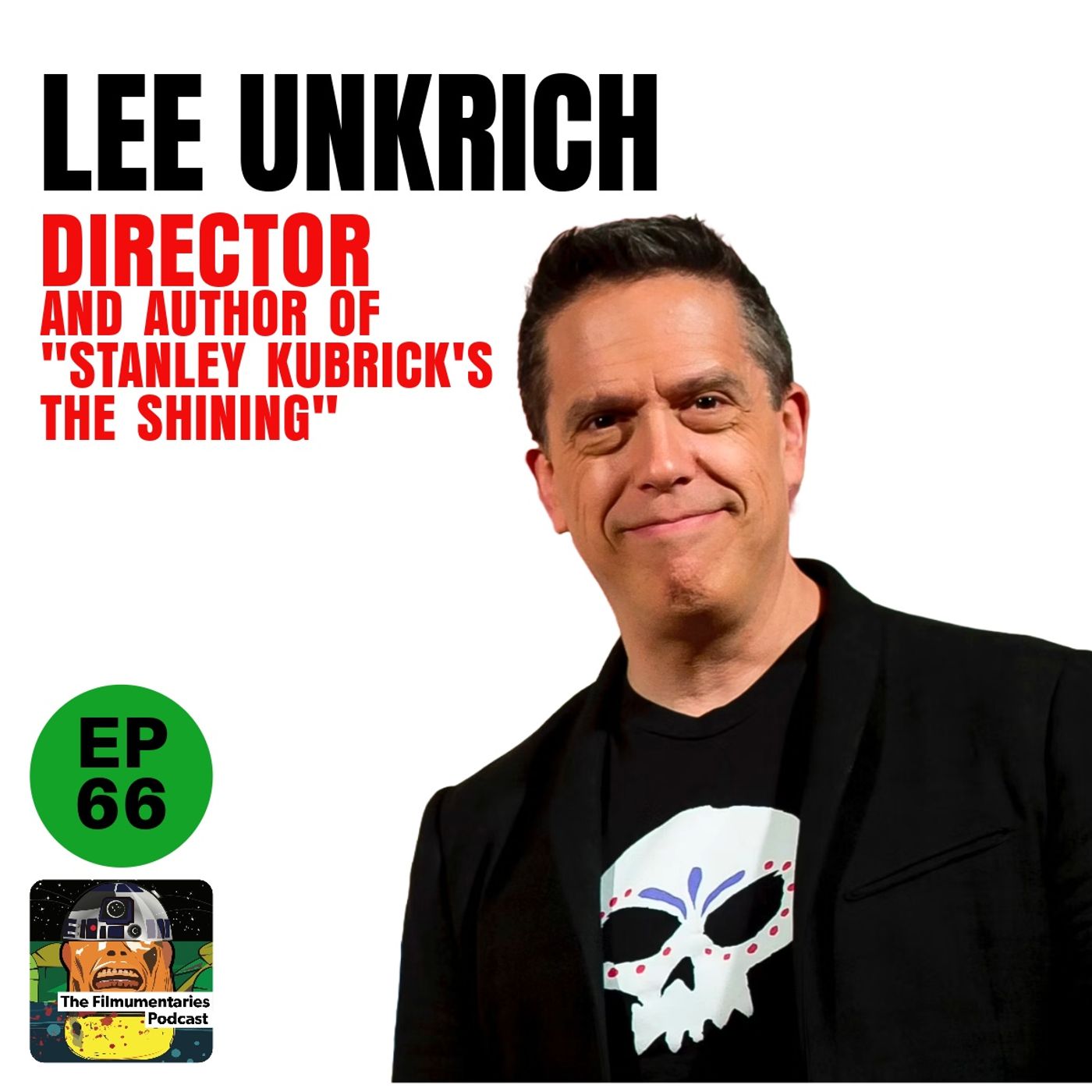
66 - Lee Unkrich - Author of "Stanley Kubrick's The Shining" Book from Taschen
About this episode
After ten years or so in the making, he is just about to release his book, published by Taschen and limited to 1000 copies (in the collector edition at least). It’s called Stanley Kubrick’s The Shining. I spoke to Lee just after Christmas 2022. So here’s our conversation. I hope you enjoy it.
Taschen's new "Stanley Kubrick's The Shining"
This podcast is completely independent and made possible by listener support. If you’d like to help me keep making these episodes, you can join my Patreon community here: https://patreon.com/jamiebenning
Watch more on YouTube:
Check out the Filmumentaries YouTube channel for behind-the-scenes clips and extra content: https://youtube.com/filmumentaries
All my links
Transcript
Automatically generated, so expect the odd misheard name.
Welcome to episode sixty six of the Film We Mentors podcast. It's January twenty twenty three. Happy new year to you all. It's Jamie Benning here. You join me in this large hotel i'man in Colorado.
The walls are adorned with Native American art and we're snowed in sadly, but spirits are high for now at least. Thanks for the feedback on the last episode in which I spoke with Rose Degnan. Rose, of course, worked for Lucasfilm and ILM for twenty or so years, and it was great to get her unique perspective on working with George Lucas in those early days through to the onset of digital v effects. If you're new to the podcasts, each episode is about an hour or so of movie history conversation between me and my guest or sometimes guests. I try my best to let the conversation flow and most importantly, to give them a chance to talk, because I find it quite frustrating when I hear podcasts in which that doesn't happen.
There are so many hosts of podcasts out there that try and outdo their guests with their knowledge. Just ask the question, let them talk have a conversation, so I'm always aware of that. I don't always succeed. Sometimes I accidentally butt in on people, but the intention is always there, and I hope that makes all the difference. If you enjoy my work, and this is work, will be at work that I love, then please consider supporting the podcast by Patreon that's patreon dot com forward slash Jamie Benning.
There are several tiers you can choose from, but for just about twelve pounds or the equivalent in your country, you can support the podcast for a full twelve months. That's twenty four episodes. Actually, I've done more than twenty four episodes each year. I've done this because I've done a couple of bonus episodes as well. Okay, so for episode sixty six, I have an Oscar winning director, but weirdly I don't talk to him about his films at all.
Instead, I talked to him about a book he's written. Leon Kripch is probably best known by film fans as the director of Toy Story three and Coco. He of course won an Oscar for both of those. What you might not know, or maybe you do, he is a lifelong fan of Stanley Kubricks The Shining. For many years he ran a website and runs a website called The Overlook Hotel, which he fills with everything he can find about his favorite film.
And after ten years or so, he's just about to release this book published by Tashian. Yes, Tashi and the people who make those enormous coffee table books. There was a fantastic one on Star Wars the original trilogy and the prequel trilogy a few years ago. It's limited to a thousand copies. The collector's edition is at least and that's the only one that's being released at the moment.
It's called Stanley Kubrick's The Shining Fitting Lee and I spoke to Lee just after Christmas. So here's our conversation and I'll be back at the end for a bit more jabbering on. So, Lee, I understand you were twelve when you first saw The Shining, and it seems to be those films that we watched between the ages of five and maybe fifteen for me that are the most transformative. Tell me about that first time you saw The Shining and what it meant to you. Yeah, I guess so I do feel that way.
My mom loves movies, loves movies, and she didn't have a lot of people to take with her, so she was often dragging me along to the movies, and I got exposed to the movies that I probably was not old enough for, but I don't know, taught me about life, taught me about being an adult, and so I don't really regret most of it. There was one movie she took me too, called It Lives Again, which was the sequel to It's Alive, and it's a terrible, terrible movie, but it hit me at an age where I just I was completely traumatized by it and had nightmares for like a year. And that was about two years before I saw The Shining. So I don't remember much at all about that very first time that I saw The Shining. All I do concretely remember is my mom turning to me at some point during the movie and asking if I was okay, because I think she was worried she was going to be like traumatizing me again.
But I do remember just being transfixed and saying, no, I'm fine, everything's good. What rating was it back then when it was initially released. It's always been our right, Yeah, yeah, for the Nudian violence. Yeah, yeah, it's weird because we don't have a kind of equivalent over here in the UK. You know, we have fifth we had it then, we had pg.
Fifteen and eighteen. So if I wanted to get into one of those movies, it wasn't a matter of being taken by a parent. It was about trying to sneak in and yeah here if it's rated R if you're under seventeen, as long as you're with a parent or guardian, you're good to go. That's amazing. I mean, it's no wonder like twelve Arrived and all those things for you guys over there.
So the book is has been ten years in the making. What was I mean, obviously it probably the seed was planted back then, right in nineteen eighty. But when did it really start to come to you that, you know, there's a book here, there's a possibility I could make something. It was visiting the archives. Was it just all this stuff you'd collected over the years, because you're known for being, you know, the most knowledgeable fan of the Shining You know, it was a long journey.
The book itself was ten years, but yes, it was. This was all in the making long before then, I kind of take it all the way back to when I first saw the movie. A few days later, I bought the paperback of Stephen King's novel and it was the movie tie. In addition, it had Saalbass's yellow and black logo on the cover, and in the middle of the book were a bunch of black and white stills from the movie. And at some point, I don't remember when, but at some point I realized that one of the stills was a scene that I couldn't remember being in the movie, and specifically it was a It was a shot of Shelley Duval cooking in the kitchen in her robe, presumably know, there's the scene in the movie, you know, where she takes the breakfast in bed to Jack in that robe, and so I saw this still and I was like, was there a whole scene where she was actually cooking that breakfast?
And that really got my brain going. I started to wonder, you know, were there other scenes that were shot and not used. I started to become fascinated with the idea of the you know, the film outside the film, and I think I'd also heard back then rumors about the hospital eplogue that Kubrick had cut out of the film after its initial limited release, so I remember, even as a you know, teenager, trying to track down a screenplay, like I wanted to read that hospital scene. I wanted to see what other scenes were in the film, but unfortunately, the only thing I could ever find was a We'll tell the post production screenplay, which was literally just a transcription of the absolute finished film, so it didn't reveal any secrets to me.
So I just had to be content with, you know, finding what I could online when the Internet became a thing, and I slowly collected little bits and bobs of info and articles and interviews, but it was pretty slim pickings. But I had what I had, and I enjoyed having it. And at some point back in I don't know, like ninety eight ninety nine, maybe I think I started this tumbler where I could put up stuff I had found having to do with the Shining, and I figured, well, if there's somebody else out there in the world who likes the movie as much as I do, then they'll have fun seeing this. And I also had in the back of my mind, you know, maybe people will send me stuff that I've never seen you know, and so that that actually did start happening.
I mean, people turned me onto things, and I made some friends who really liked the movie. And then eventually one day I got this guy named Jeff Blyth wrote to me, and Jeff told me that he had worked on The Shining and wanted to know if I was interested in talking to him, and so of course I was, And turns out he was the camera operator in the helicopter that shot the title sequence for the film, and so he had a lot of stories to tell. He sent me photos that I'd never seen before, which is awesome. So again I just kind of filed all this away and had that going as my side hustle while I was working at Pixar. And you know, Stanley died, of course in ninety nine, and at some point after that, I can't remember when, but the family donated his archives to the London College at Communication and that opened at some point though it was very difficult to get in, but I pulled some strings and I managed to go visit In twenty ten, when I was over in London doing press for Toy Story three, I stayed an extra three days just so I could hang out in the ar Kid and see everything having to do with The Shining, and finally, you know, after you know, thirty years of trying to find stuff, here here it was, you know, all of Stanley's drafts of the screenplay and his personal notes on King's novel and photos I'd never seen.
I mean, it was just a treasure trove. It was amazing. And that was the first moment that I had an inkling that maybe there could be a book, because there had been a lot written about The Shining, interpretations, meanings, critical analysis, but there was very little out there about the actual making of the film. And what was out there was apocryphal and some of it didn't seem to be real. So I reached out to Yan Harlan, who executive produced The Shining and with Stanley Kubick's brother in law, and you know, told him who I was, what my pedigree was, and that I was very interested in doing a book on the making of The Shining.
And he said, great, we would love to do that. We've done all these other books on Stanley's films, but no one's done anything on The Shining. He said, the problem is we've just been approached by someone else who wants to do a book on the making of the Shining who also has a great pedigree, and we can't support both. So I said, well, put me in touch with them, maybe we can join forces. So that other person turned out to be Jonathan Wrinsler, who at the time was working for Lucasfilm and he had written a number of best selling books on the making of all the early Star Wars films and Indiana Jones films and Alien and so he kind of knew how to do this kind of book, and I had the knowledge and the cachet to get doors open diesely and so we oh and the other things.
He turned out he lived up in northern California, where I live, so I had him come by Pixar. We had a lunch and we really hit it off, and that was the beginning of a really great working relationship ship that went on for years. As we developed this. The intention was always to do the book with Tashian, but you know, we had to sell Tashi and and doing the book, so that there was a period of time where I was just completely self financing all of this and doing interviews, and we didn't have a publisher. But I wanted to forge ahead because I figured the more we had done, the more enticing it would be.
Yeah, for a publisher, hopefully Tashian. So, yeah, that's sorry, I just rambled on there for a while, but that's that's a great early genesis of the book. Yeah, those moments where if you're a fan of a particular movie and suddenly you start seeing things you've not seen before, Like it could just be a you know, a photo that was taken a few seconds before the one that everyone has seen. There's just something so tantalizing about that. And that archive is so incredible for that stuff.
I mean, they still have things like and I'm sure it's in the book, like you know, the typewriter text in English and in Italian and in French. I mean it's all there. They have the boots from Barry Linden and clappables from everything. I mean, yeah, you can you can read documents in the archive where you can see Stanley's pissed off because he's typing harder, you know. Yeah.
Now, and you know what, the people ask me what the biggest thing I got out of this whole experience was, And yes, I got to meet so many people who worked on the film, and got to be friends with them and uncovered photos that nobody has seen before. But really the biggest thing is that the process of going through the archives specifically and talking with Diane Johnson, who wrote the screenplay with him, it just really humanized Stanley for me, because it's really easy to put Stanley up on a pedestal and think of him as this genius who kind of birthed these films into the world. And he was a genius, but he was also a human. He struggled, and he didn't always have the answers, and he was always asking questions of everyone around him and soliciting opinions, and ultimately he was making the final choices of course as the director, but he was very open and collaborative, which is not something that people typically think of when I think of Stanley Kubrick.
Yeah, I was going to ask you about that. I wondered how much of writing this book was about kind of setting the record straight on The Shining, because there's been so much stuff put out in the public domain that is, you know, misleading and has been overblown. Yeah. I don't know, Yeah, I don't know what it is about The Shining specifically. People talk about it a lot, and people, you know, I have a standing Google search on the Shining, and almost every day there's some clickbait article about, you know, top ten things you didn't know about the Shining, and you know, seven out of the ten are completely not true.
So yes, in writing the book, I did want to set the record straight, or at least have there be a definitive, accurate record of a lot of these things. I tried not to specifically, you know, note things that are false that are out there, but I do sometimes I couldn't help myself. Occasionally I'll write things like, despite the common knowledge that this happened, this is actually what happened, you know. I mean the things that people mostly talk about are like how Shelley Duval was treated. I see constantly, and more so lately, articles about her mistreatment which are completely overblown and exaggerated.
And I really like to leave the final word with Shelley herself, because when Shelley is interviewed, and I spent time with her as well talking to her, she doesn't have anything bad to say about Stanley. She says it was a difficult shoot. You know, it was difficult for her to have to work herself into that pitch of hysteria, you know, day in and day out from a certain point forward. So it was not an easy film for her. But it's going too far to say that she was abused in making film.
I mean she was an actor like anyone else. They were all professionals on a set. They had lives outside of the shoot day to day. She was dating ringo star, I mean she was, she was out there. She wasn't just like locked up in a cage and led out to to film apart certainly.
Yeah, so that's talked about a lot. You know, the number of takes that Stanley shot for some reason is that's like a common thing. And unfortunately, some of the casts, some of the crew members are listed as sources for this info, but it's just based upon their memories or I don't know what. Because I actually have the receipts, I have all of the production documents. I know how many takes were shot on each and every shot for the entire movie.
And yeah, there were some scenes where he went high up in the numbers, but they were almost all scenes with scat Man cruthers because Scatman didn't know his lines right and they had a lot of big speeches, so that's where you really see the numbers going up. But yeah, anyway, so there's all kinds. Yeah, there are all kinds of stories out there, and I'm hoping that my true stories from this book somehow managed to worm their way out onto the Internet and hopefully some of that stuff can go away. Most of it doesn't matter, But I do get upset about when I read disparaging things about Stanley that just aren't true. Again, people like to think of him as this like evil genius, you know who it was a totalitarian and treated people poorly, and it's just that's that's just not true.
Yeah, I think people kind of put two and two together and come up with five seeing some of those documentaries, you know, from Full Matle Jacket, from The Shining, where they might be moments of you know, passionate discussion between Stanley and an actor, and people just don't know. They magnify it something for someone, they do they they yes, and yes, there are two moments in Vivian's documentary where Stanley is kind of kurt with Shelley. But I mean, these things happen, and that scene in particular where he's yelling at her at the door. That was one of the very last things that they shot. They were all fried.
It was at the end of production, they were tired. But Stanley also chose to have those in the film. I think that Stanley, I think Stanley like to perpetuate this myth of him being powerful because because he really because it wasn't that way was he was an introverted guy. He was nice, very very smart, but socially kind of introverted. And I think that he liked seeing those moments where he was like being tough director.
And that's kind of corroborated by people I've spoken to who didn't work on it. So but but the unfortunate thing is that because of those two moments of the documentary, people do extrapolate out they assumed that, oh, all that happened, then every day on the set must have been like that, yeah, yeah, right, and again just like nothing can be further from the truth. Well, it sounds like this is going to be the very much the definitive book, and definitive definitively answer a lot of these questions that people have had over the years. Of course, he was very famous for keeping all of this stuff and we've already mentioned the archive or the amount of you know, documents there are within the archive.
Did you have to look much outside the archive to find things for the book as well? I did. Once I got the green light from Yan to start developing a book, the very first thing I did was, you know, I spent really a couple of years tracking down every person I could find who was either in The Shining or worked on The Shining, And I didn't care how lowly their position was on the film. I wanted to talk to them because everyone has stories to tell, and you know, nobody's getting any younger. A lot of people, unfortunately had already passed on who worked on the film, and a lot of others were really getting up there in years, so it was critical that I tried to get people's stories.
So that's really what I focused on initially. And how was that divided up between you and Jonathan? Did you do the majority of the interviews? I was a gentleman. Was I did a combination of the two?
Yeah, I did most of them. Jonathan did some. Jonathan flew over and sat An interviewed yann and Christiana. At one point I wasn't able to go over because I I was juggling all this with making movies, so I pretty much was up weekend mornings interviewing people over Skype where it was, you know, late afternoon in London. The other thing I want to mention is that, in addition to the interviews, what the interviews opened up which I was hoping would.
I would always ask every person if they had any materials from their time working in the film, had any photos squirreled away in an old photo album or anything like that. And most of them didn't, but several of them did, and so I started getting my hands on lots of photos that I'd never seen before. I mean, they weren't published because they were just people's personal photos, but the motherload really was. Once I tracked down d sorry Dan Lloyd, who played Danny Torrence, and convinced him to talk with me. Now he's got more of a public face on Twitter, but at the time he really was like being really low key and didn't want people to know about his past.
But I tracked him down and convinced him to talk to me. We're now friends and at some point he did an interview. Like once I tracked him down, he did an interview with some for some British paper about being in the Shining and they took a photo of him. They had a portrait and he was in a cemetery and he was holding a photo in the photo and I zoomed in. I'm looking at the photo and it's clearly him in the hedge maze, but it's like a behind the scenes photo, and I was like, what's that?
And so I asked Dan about it right away, and he said, oh, I pulled that out of my parents photo album. They have a ton of photos. So somewhere along the line there, you know, I convinced him to introduce me to his parents. I befriended them, and then one summer I was in I happened to be back in the Midwest, and so I drove to their home in rural Illinois and spent a day with them, and they showed me this photo album that they had, and I just about died looking through it because I was seeing aspects of the production I'd never seen photographed before. Of course, because they would have been on set all the time, because he was well, yeah, they weren't on the set all the time.
They really trusted Leon vitally with him, but there were times they were on the set and they and when they were there, Stanley was fine with Dan's dad, Jim taking pictures. You just said, don't don't solve them or anything. You know, there's no internet back then, so Jim took all these photos. The photos and the album were pretty faded. So I said, do you happen to have the negatives for these?
And they said yeah, So they ended up sending me about four hundred and fifty thirty five millimeter negatives. Wow. And it was really once I got my hands on those that I knew for sure we had a book. Because I knew if we're going to do a book with Tash and it was going to have to be image heavy, and I didn't want it just to be all the same old photos we've all seen behind the scenes. So between that stash and other photos that I got from different sources, I you know, I finally had what I needed.
And you know, I just I just did some back of the Napkin math recently, and I determined that seventy five percent of the images across the three volumes of the book, not counting stills from the finished film, take those out of the mix. Seventy five percent of the rest of the images have never been published before, and a really healthy percentage of the seventy five percent have not been seen by more than a handful of people. So I think people are going to be Anyone who's a fan of the film and knows what's been out there are going to be blown away by picture after picture after picture. I even found I found a stash of pictures in the archive that through some slew thing, I came to realize that Stanley had actually taken himself.
Have a number of those in the book, which are very cool because you know, he started his career as a photojournalist when he was seventeen and had an amazing eye, and you can see it in these photos on the set. Amazing. Oh, I could just so tantalizing just to even talk about. I can't imagine what must have been going through your mind at the time. Somebody feels like they've seen everything that could be seen.
To uncover something outside of the arclive of that magnitude must have just been Yeah, it was incredible. I mean, they had costumes from the movie, they had Danny's costumes, they had one of Jack's Jackets. I mean, they had all this stuff, all this memorabilia. They just kept everything in a trunk in their basement and they it was just part of their deep past. And they actually they told me they were really happy that I came into their lives and were doing what I was doing this project, because they felt like it was kind of happening all over again a bit.
They were just remembering all the feelings of being involved in something special. And because you know, they were from rural Illinois. Jim was a railroad conductor. They were just living, you know, a nice, simple Midwestern life, and this crazy thing happened to them and they ended up in England being in a Stanley Kubrick film, and then they went back to their lives again and that was it, Like that was just this like crazy year in their lives. Yeah.
I mean, there's got to be so many families that had a similar experience of their kid being whisked into a Hollywood movie. But it's not has never been more than a handful of movies that have got a character this iconic that everybody recognizes. Even if people haven't seen the film, they know that image of Danny on the tricycle I mean, I can't imagine, can't even begin to imagine what it's like having that as part of your life. You know, he's Dan's kind of more amused by it than anything. I mean, he's he's a he's super nice guy.
He's kind of quiet. He told me that his almost his only relationship with the film now is that when it's on sometimes he has little kids. They're a little older now, but he said they would just make fun of his haircut. That was That was kind of all they cared about the fact that he was in this film. I'm sure as they grow up they'll think it's pretty cool.
Yeah he did, he did. I don't know, Sorry, no, go ahead, I was gonna say I think he didn't. He do a video introduction when there was the screening up at Saint Alban's here, and yeah, yeah, yeah, I talked him into self taping that. He actually did a great job. It was funny.
Yeah, he's really sweet. He's really shy, although he does stuff now and then. I mean he um, he did a little cameo in Doctor Sleep. They reached out to him and he agreed to do that. So I think he has he has fun with those things.
But it's not his life. Certainly, did you did you manage to get on the set of Doctor Sleep at all, because I mean, seeing some of those things had I know. Unfortunately, I didn't find out about it that it was even being made until after production was done. I think it was when the first trailer came out and I saw you know, the overlook again, Kubrick's overlook, and I flipped, especially because I just didn't understand how that could be because I know firsthand how much Stephen King hates the movie. Say Stephen King state Kubrick's movie.
So I reached out to Mike Flanagan, who directed it, and asked him about it. I mean, I interviewed him for the book because I have a section at the end where I talked about the impact, like the cultural impact of the film. So he told me the whole story of how he convinced Stephen King to let him embrace Kubrick's you know vision of the film, which was fascinating to me, and he had me to hit me down to the studio to watch a cut when it wasn't quite done, um, which I really appreciated. But I didn't get to visit the sets. I mean that kills me to this day because I would have I just would have loved to have felt just the volume of it, because I know they worked off the blueprints of the Colorado Round, so they built it to the right scale, and it would have been really really cool for me to be on that set.
Unfortunately it only existed for a few days. They built shot the scenes in there, and then it got ripped down immediately, so um, yeah, I would have loved that, and then I was disappointed there. You know, there's supposed to be an Overlook limited series that that J. J. Abrams was developing, and it got picked up, but then it kind of went away, so it's in limbo right now, and it theoretically was going to be embracing Kubrick's design of the Overlook, but just telling stories like deeper in its past.
So again I was hoping that would happen because I would just love to just be cool to walk into a sound stage and feel, you know, what it would have been like to have been on some of those sets. I think it's one of those few films from that era where I feel like it's a genuine location, such personality. I don't know if it's something to do with the way the light comes in through the windows. I think it is, because it's so convincingly just natural light coming and people, I mean, I've had so many people over the years say, oh, where did they film that? Where they film that movie?
And I'm like, well, in England on sound stages. You know, they're only a handful of shots of the real hotel, the Timberline. There's a helicopter shot at the end of the title sequence, and then there are a few establishing shots kind of throughout the movie. Otherwise it's all you know, everything close is a facade built on the back lot at Elstree. Yeah, now a tescoes part king lot right.
Well, the place where the facade was is still there. That part of L three still exists, but yeah, what's no longer. There are the big stages, you know, where the Colorado Lounge was in the lobby and the interior of the maze at night. And also there was another stage previously there where the gold Ballroom was built and a few other sets were in there as well, but that that stage has gone. Yes, just a tesco.
It's really sad. Yeah, but I still love going to Elstree. I still love. I've gone up in the building. It's called the Enigma Building now and back then it was it was a building where they all the kind of the art department offices for the Shining War and Stanley's personal offices kind of were up there.
And but they actually took away the art department at one point and built the kitchen set. So the whole kitchen of the Overlook was built not on a sound stage but just in this office building at Elstree, and I've gone in there. I couldn't go back to the area where the kitchen itself was, but the way on the way into the kitchen, if you watch the film, there's a big industrial elevator. You see it a lot, and that's all just there because it was really part of the building. So it's weird to just be in England in a movie studio, standing in a real building that you uncannily realize is part of the Overlook.
Yeah, I've been there too. I had a tour there in the I guess the late nineties from a guy that worked there in one of the prop departments, and you know he was pointing out where, you know, like the Death Star Hangar Wars and the what village was over where Tescos was, and then he took me in that same building and it is kind of I think, I think that was the really cunny thing. You know, not only did they have these amazing set builders and set deck crazies, but they used genuine physical places and seeing Vivian's work as well on the making of you somehow feel even more connected to that physical space because you're seeing the dressing rooms and you'll seeing all behind the scenes there as well.
I mean, that's that's what got to be one of the best making of docum mentions out there. I just wish it was longer. Well someday maybe yeah, well she has there's around fifty hours of yeah a footage but still exists under lock and key. Yes, yeah, in the archive maybe someday. Ump.
So that that film obviously was partly of course promotional, but it also am I writing thinking that Stanley you know, had the kind of last say on it with with Vivian, they kind of discussed over what should and shouldn't be in there, and it's pretty pretty open in he was pretty open and as much as letting him be seen in different aspects of his personality and you know, it feels like honest filmmaking. It was, yes, but it was skewed right again, like I said earlier, because I enjoyed there being a certain kind of, you know, version of him out in the world. So they definitely steered into that. They had other scenes that they wanted in the film that they had to cut out because Stanley wanted more footage from the finished film in it, so they had to lose some other bits and bobs.
Yeah. I talked pretty extensively to Gordon Stainforth, who edited her documentary, and he also ended up working with Stanley. He was an assistant editor on the film, but he ended up cutting a lot of the music in the film. Stanley really kind of gave a lot of that over to him, interestingly, and so he has a lot to say about it, and I have a lot of those stories in the book. Really fascinating.
Again, I think this, I think my book. I've read a lot of books about Kubrick, and I'm excited that. I think that people who read this not only are going to get this definitive making of the Shining, but it also gives a lot of windows into who Stanley Kubrick was as a person as a filmmaker, how he was to work with that I haven't really read before, or at least not this extensively. I mean, we have a lot of sidebars and side trips into just talking about Stanley and people read and missing about you know, working with him on the Shining specifically. So that's another thing that you know, I think people are going to really enjoy when they read the book.
Very cool to see you up there in Stanley's house for the launch as well, Um with your Shining jacket on your Ted Baker shining. Yeah, that was fun. That was a fun night, except I was kind of sick. I got really sick that week, but I rallied for that party. Um, it was wonderful.
I had been out to Chittickbury before, just socially, um, but this was fun to be at a party kind of in the public part of the house where they where they throw parties, and you know, we did this Q and A in a room. Well we were at the party and this Q and A were in two big rooms that formerly were Stanley's offices in the house. So um, that was very cool. Um. Yeah, I just love being out there because a lot of The Shining was edited out at Chittickbury in a stable block right opposite the house.
Um, you know, and they've eaten a meal in their kitchen, sitting at the table which was Jack's writing table and the Shining it's now their their big dining room table in their kitchen. You yeah, I mean, come on, for a fan. Doesn't get any better than that, does it. You've mentioned the book being three volumes, but can you describe to us because I'm aware that the price tag for this limited edition is pretty high at the moment, there's a lot of people with fingers hovering over mouse buttons right now myself. I know, I you know, I know a lot of people have been waiting for the book a long time, and I fully expected that people, a lot of people were gonna be really disappointed that they couldn't just get it immediately because of the price tag.
But you know, it's in keeping with what Tashian's done on the other Kubrick titles that Tashian for, you know, kind of for their marquee titles. They like to do these collector's editions, limited collector's editions, so there's only a thousand of them. They put a lot of money into them, so it's not like they're just selling some paperback for fifteen I mean, there was a lot of care and costs that went into creating this set, and eventually there will be a trade edition that'll be much more affordable, so it'll be in line with what they've done with the other Kubric titles. Yeah, it's three volumes. The first volume when you open the box is this big oversized scrap book.
It's a kind of a facsimile of the scrap book that is in the movie that's Stanley actually cut out that you see throughout the film, but it's never referred to. So we did a big oversized scrap book and I created a ton of clippings from the history of the Overlook that are in the front of the scrap book, using a lot of remnants and copy and stuff that I found in the archive, and then those clippings kind of give way to it's essentially it's a beautiful oversized photo folio. So one photo per page is the bulk of that book. So just like a big oversized art photography book. The next thing that people will find in the box is a kind of a facsimile of Jack's box of typing paper, and when you open that, at the top of that box, the first thing people will see are exact replicas of all of the all work and no play pages that were created for the film.
So they're all in the archive as you mentioned earlier, all the original typed pages, and so I scanned all of them front and back and we created a set of those papers for the box. Once you get below the box the typing paper rather, there's a kind of a series of smaller books within that box. I have an exact facsimile of a continuity script that Vivian Kubrick gave me. That's very cool. You can see all kinds of scenes that are not in the finished film that they shot, lots of polaroids taped in little bits of paper right out of Stanley's typewriter he was making changes on the set, so that's a very cool item.
There's also a booklet of all of Saul Bass's design work leading to the final design of the Shinings poster. There are a few things that have been online from that stuff that Saul actually presented to Stanley and Stanley gave notes on. But I actually got into Saul's personal archives and found everything like every last shred from the earliest doodles he was making, so we recreated a whole selection of those in one booklet. I also found some production design sketches for the Overlooks Lobby and Colorado Lounge that I'd never seen before, and so we made a book of those. And then there's also a book of caricatures done by Tom Smith, who was the makeup artist on the movie, and his spare time he would sit and draw caricatures of the cast and crew, and so we put together a selection of those.
So that's everything that's in the typing paper box. And then the last thing in the bo is the is really the the Holy Grail. It's the actual making of book. It's a smaller softcover book that's about nine hundred pages long and also has a ton of photos in it, and that's the complete definitive making of It's always practically a day by day during production making of the film, with a lot of stories that I've never seen before. And you know, I just read the book again recently just to get ready to start talking about it, and I really like, I love it.
I love reading it. It's just fun for me to hear all these stories told so candidly. Had somebody kind of high up, I don't want to mention the name, but somebody who's high up in the hierarchy of of folks read it, and they they were very surprised that I had spoken to, you know, out of these lowly crew members, because typically on a movie set, you know, the story of the making the film is very well crafted by ePK crews, and only certain people are allowed to be interviewed. And but I interviewed everybody, and I don't I just think it's cool. I think it's cool to hear from everybody, from Stanley down to you know, a stage hand.
Some of my most interesting stories came from people that you wouldn't have otherwise thought had interesting stories to tell. Yeah, well you'll, I think you'll be my sixty six guest on this podcast. And really that's what this podcast is about. I haven't had much opportunity to speak to high profile directors like yourself. I have spoken to a couple, but it's talking to those people who's you know, like you say, everyone's got a story, but it's talking to those people who don't always get the chance to tell their story because you know, for whatever reason, they've seen too far below the line.
But some of the best stuff I've had, you know, has been from exactly those people. It's an insight that you just don't often get it. And I'm so glad to hear that that that's in the book too. Yeah, and I didn't, you know, I wasn't sure everything was going to be allowed to stay. There were some bits that weren't disparaging of people's character, but there may be some things that were, like I don't know, maybe the family wouldn't want out in the world or whatever.
But I you know, I was only asked to make one change very early in the book, and it was a pretty minor thing. Otherwise everything stood between Warner Brothers and the Kubrick family. They were good. So everyone gets to kind of see the full version of the story. Is there are there particular scenes or particular kind of unseen parts of the movie that you are most excited about getting in the book for like minded fans, Well, yeah, I mean certainly anything having to do with scenes that were shot that aren't in the film.
I mean, I think anyone would find that interesting. From the end of the end of the movie that was originally excised. As you mentioned, Earli, we've seen these pictures that you put on your website, but I think that's about all that's out there. Well, soon there will be more cool. I actually got my hands on a number of stills, actual frames from many scenes that Stanley shot, and we cleaned them up and made them look beautiful and they're in the book, and it's it's important for the book because the book is a day by day telling of the making of the movie, not just the making of what's in the finished film, but truly the day by day making, including scenes that Stanley saw fit to write and spend time shooting, only to later decide they didn't need to be in the film.
And for me, as a filmmaker and as an editor, like that's fascinating. I like to know. I like to see a glimpse into the thought process of how a final work of art was shaped. And even though Stanley wouldn't like that. Stanley, you know, didn't want people to know how the sausage was made.
He just wanted the finish films to speak for themselves. I think it's important, especially with his stature in film history, for people to be able to new generations to be able to learn from him, and part of that is learning from people's mistakes or blind alleys they went down. And I think it's all important. And if we're going to talk in the book as we do about the filming of these different scenes, I thought it was important to actually see them. So through a combination of continuity polaroids, behind the scenes photos that I had, and some actual frames from these scenes, it gives a very kind of rich telling of the film that's beyond I know, anything that's been out there.
That's very cool. I mean, I like the idea that somewhere deep down Stanley, although he wanted people to see the film for themselves and they exist, for us to you know, understand what he was trying to do in that movie and not kind of as you say, you know, I know how the sausage was made. But I kind of like the thought that by donating this this archive, that the family kind of understand the importance of his legacy and they understand maybe, you know, maybe Stanley himself understood the importance maybe in four decades time, for somebody like you to come in and dig all of this stuff up again, I don't know. I mean, yes, the family did think it was important to have these be available for researchers and students.
I don't think Stanley ever would have wanted this to happen in terms of the archive. That's my personal opinion, and from talking to people close to him, I don't think he would have wanted that, but who knows, like after he's died. Possibly. I mean, the one thing he did do, he had Leandertali incinerate all the outtakes from the films, especially like the last five films he had made, mostly because he, you know, he saw what was happening with DVDs and there were director's cuts, and there were deleted scenes, and he never wanted any of that out there at all. I guess he didn't want to take him out of his hands, right because his studio could have reissued or recut something exactly, and the moment something's out there, you lose control over it.
And so that's why he had everything incinerated, because he knew that people could even on you know, Leon told me that Stanley even had the fourth the foresight to realize that people could take one of his finished films and these scenes and like cobble together a quote unquote director's cut, which wouldn't have been of course, it would be a monstrosity as far as he was concerned. So he just he took the steps while he was alive, and then even after he died, because they because Leon also burned the outtakes for Eyes Wide Shut to prevent that from ever happening. But like I said, despite his best efforts, there were still things out there that I managed to get my hands on. Good for you. I just want to also talk about Jonathan Rinsler, you know, a huge loss.
I had him on the podcast weeks before he passed away. He kindly agreed to an interview. I think he actually thanked me afterwards, giving something else to think about for for an hour. Or a wonderful writer. I mean, those books, those Star Wars books really are the high bar of the behind the scenes making of books.
When when was it apparent to you that Jonathan was absolutely the best guy to do this job? Well, it was right away. I mean, like I said, they they had these two competing proposals to do a book, and Jonathan happened to be the other one. So and how far he got into doing it I did he have much research at all, right, none? None, really, He had just approached them recently with the idea of doing it.
So I'm not going to say I didn't have a choice, because I did so, but it just it fell into my lap, and it was like it just seemed perfectly too good to be true, because I'd never written a book before, and that's all Jonathan had done and was write books, and I just between the two of us, I knew we could create something. So I ended up hiring him out of my own pocket before I had any publishing deal, just to to start working on the manuscript. And we worked together very closely for a long time through the whole writing of the book and editing it and shaping it, and it actually we were starting to lay the book out, and Jonathan saw some of that when he got his diagnosis that he had pancreatic cancer.
He was only given like I think, three to four months to live when he got that diagnosis. He ended up living a year, thankfully, but but he didn't live long enough to see the book in its finished form more, you know, or have it come out in the world, certainly, So I did dedicate the book to him. And you know I talk about him in the book, and you know he's we we we share credit for the for the project, you know, as he should of course he. I mean he he did an amazing job writing this book. It's very easy to read, it's very thoughtful, um exciting at times.
It's it's just good. It's a great I think it's great. We'll see what people think. My fingers still hovering on that mousepod. You know.
Well, listen, I'm really great for you to you for giving your time, and I just want to say thank you as well for your Your films have meant a lot to me and my family over the years, and thank you. Have to have somebody like you finally get this out after ten years. I think we spoke very briefly on email about I don't know, ten years ago when I was trying to get to visit the archive and I was doing my film Mementories, and I was thinking about is there one that I could do on the Shining But and I know you were talking about the book kind of back then, and it's so great to finally see it, you know. Yeah, it's time to file between COVID and any number of other obstacles, but all that matters is it's done now, and it'll be in a thousand people's hands soon and then hopefully not long after anybody who wants to get their hands on it.
Cool. Thanks so much, Lee, absolutely good talking to you well. I hope you enjoyed my chat there with Lee Unkrich, director and now author. Thank you Lee for your time. It was great to talk to you, and very much looking forward to seeing the book.
The preview images I've seen look amazing. My fingers still hovering over that mouse button, but I can't really afford fifteen hundred pounds or even fifteen hundred dollars as it is in the US. I'm sure the shipping would bring it up to fifteen hundred pounds anyway. But to those of you that can, I hope you enjoy the book, and as for the rest of us, let's wait and hope that the sort of consumer general consumer edition is out is out soon enough. I've recently lined up interviews with VFX artists Gene Bolt, Hal Hickle, and Ken Ralston.
I'm also due to talk with composer Stu Phillips. We've had a couple of cancelations at either end but we hope to do that at the end of the month, and I'm also chasing a bunch of people who were keen last year. I've also got a very nice happy New Year message from the guest of episode seventeen, Nilo Rhodis jamiro It's still one of the most popular episodes actually, so I've suggested, not just for you, but for me as well, that he come back on to talk more about his amazing career. He's such a great guy, Nilo, and I feel really privileged to have talked to him because he doesn't really do interviews. Last year and twenty twenty two, Jim Maxwell and I previous guest as well, had plans to do a special video episode, but what with one thing and another, it didn't come off.
But we hope to resurrect that idea for twenty twenty three. And for those of you that love movie Matt paintings, I'm sure you'll love what we produce. We're hopefully can have a conversation with a couple of people that were involved in Matt painting in that kind of golden era in the eighties, and yeah, I just want to kind of showcase some of that work and talk about it, and yeah, I think it's going to be a really nice episode. We'll try and do an audio version of it, but the video version will be great obviously because we'll be able to see the artwork. In the meantime, please share this podcast online with your film nerd friends and in person with anyone you might bump into.
I'm still getting about thousand listeners per episode and I would really love it if this could get a wider audience, and with your help, I'm sure we can achieve it. If you leave a review on Apple, apparently that's a great way for it to get kind of moved up the charts. At the moment, I'm kind of languishing in the top kind of seventy to one hundred film history podcasts in the UK. At one point I was in the top ten. I'm not sure.
Maybe people stopped during reviews and just got a bit comfortable listening to it each week. But if you have been a long term listener or you're a new listener and you like it, please do leave a review, Share on Twitter, share on Facebook wherever you can. It'd be really I'd be really grateful for that. I should also mention that I'll be uploading some video versions of several episodes to the Filmingmentory's YouTube channel. These video versions were often a perk for patrons of a certain tier, but I figured after a while, you know, they've seen those, and not many people do watch them on Patreon actually, because I think mostly you're kind of altruistically just helping support the podcast.
But I think, you know, putting them on YouTube is going to get them out there to more people. It's a different arena, of course, it's not a podcast arena. It's a video arena. So where I do have video recordings of my conversations and where those people are happy for me to upload them, I'll be doing that in the coming weeks, so look out for them. Thanks as always to Michael Hewitt Brown.
I do sometimes forget to thank you Michael for your wonderful music composed, especially for this podcast. You can find Michael on mb Music that's embe music dot co dot uk. So if you need to music for your podcast, your TV show or film, he's done all of those things. Do consider Michael. He's a great guy and he's a wonderful collaborator.
Michael, I forgot to post your Christmas card through the door. It's still in my car, so maybe I'll just save it for next year. Anyway, I hope you can see you soon and take the dog for a walk and have a chat. I hope you're keeping well as for the rest of you. Thanks for joining me and I hope you can do so again.
For the next episode of The Filming Mentor's podcast,



Similar episodes across the network
Matched by shared keywords.
-
Special Report: The Age of Disenchantments (2019)
2 shared keywords: book, documentary
-
Special Report: Timon Singh on Born to Be Bad
2 shared keywords: book, documentary
-
Special Report: Following Harry (2025)
1 shared keyword: documentary