
Season 1 · Episode 79
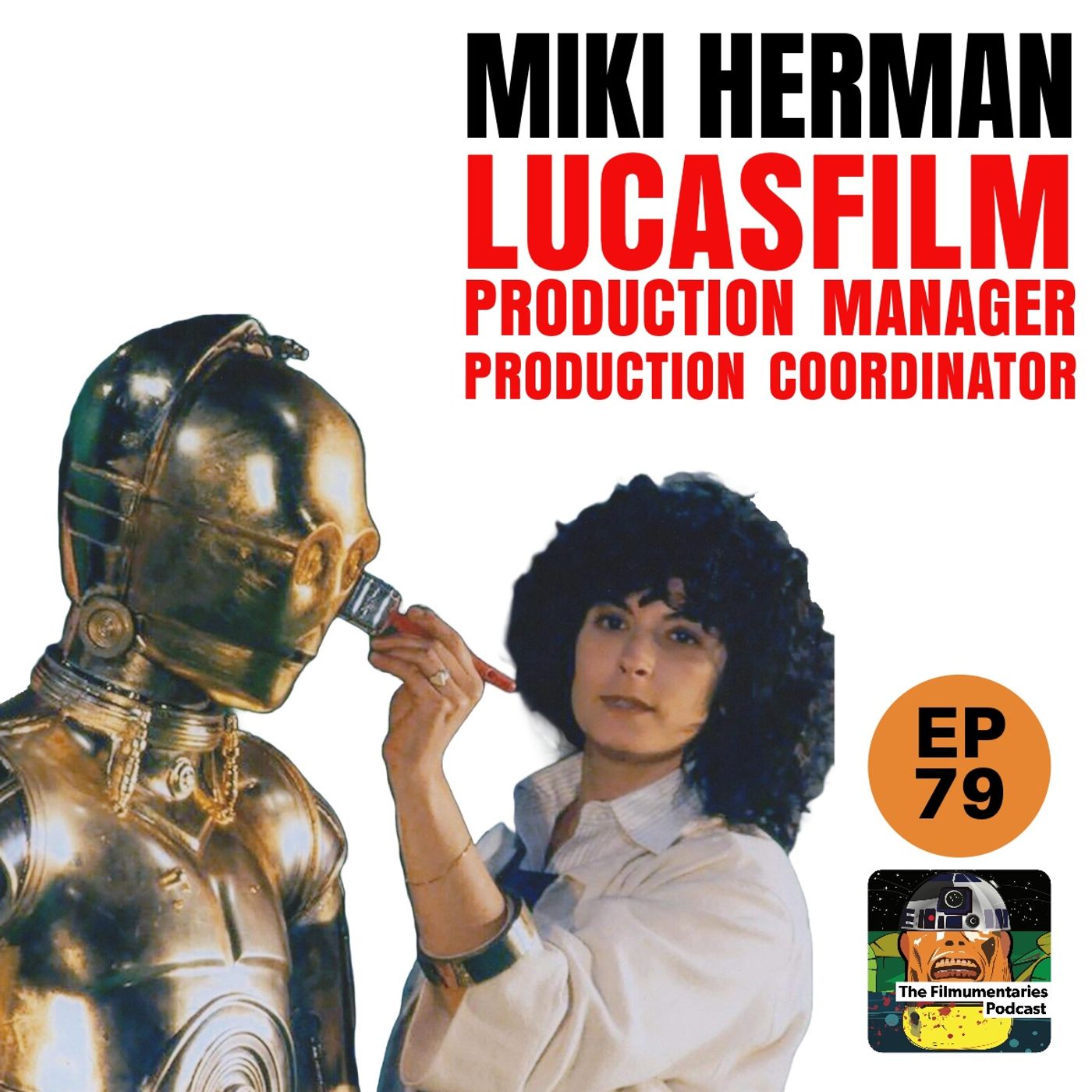
79 - Miki Herman - Lucasfilm Production Manager
About this episode
She worked on the original Star Wars trilogy as production assistant, production coordinator and unit production manager, respectively. She was later a consultant for The Star Wars Holiday Special and became co-executive producer of the Star Wars Droids and Ewoks animated series.
Big thanks for Miki for her time.
Links
Return of the Jedi Timeline Book - Register your interest!
Filmumentaries Merch
Support the Podcast on Patreon
Linktree
This podcast is completely independent and made possible by listener support. If you’d like to help me keep making these episodes, you can join my Patreon community here: https://patreon.com/jamiebenning
Watch more on YouTube:
Check out the Filmumentaries YouTube channel for behind-the-scenes clips and extra content: https://youtube.com/filmumentaries
All my links
Transcript
Automatically generated, so expect the odd misheard name.
Welcome to episode seventy nine of The Filming Mentor's podcast. This is Jamie Benning here talking to you from my home in southeast London. It's warm and muggie here at the moment, and outside my house there is currently a high of activity. ITV, the UK broadcaster, are here shooting a drama in a house just up the road. They've taken over most of the road with trucks and personnel bustling around.
I don't know what the drama is. Presumably it's about murder or something grim, because that generally is why I TV tends to do that in game shows. I guess my neighbor is a bit shocked at all the equipment and all the personnel bustling around, but it's quite fun for me to watch all those personnel and not be part of the TV show for once. If this is the first time you've listened to the podcast, Welcome. The remit of the podcast is really about preserving film history.
You could treat this and the seventy eight episodes that came before this as an archive of film history that can be used to listen to for your entertainment or for research material for a book or a podcast or an essay that you're working on. You would usually have about an hour of film chat ahead of you, but today the conversation is slightly shorter. More on that in a moment. If you're a regular listener, hello, and thank you for joining me again and for all your support, and thanks to the one hundred or so of you that support the podcast via Patreon, Patreon, dot com, forward slash Jamie Benning. So if you can spare just twelve dollars or your local equivalent, you can support the podcast for an entire year.
That's twelve pounds just for the year, or twelve dollars just for the year. That's twenty four or more episodes. Because I do throw some bonus ones in there, So that's fifty cents per episode if you're in the States, And I'd call that a bargain really, and it would really help me focus my time and resources on the podcast. It is work. It's work I love, but it is work.
You know, it does take research and organization, and I pay for the podcasting platform, and you know I pay for Adobe Premiere to edit it, and you know it does cost me money. I don't really make much on this it's mostly out of the joy, but if I could make some money on this, then it would mean that I could focus, as I say, my time and my resources on it as opposed to the other freelance work that I have. There are several different tiers to choose from a patren with different perks, including videos that are exclusive to a certain tier of patron. There's also merchandise on there, and if you want much, you can find it out film Mementories dot creator, dash spring dot com. I'll leave that link in the show notes.
That includes T shirts, bags, bottles, and even socks. There's some t shirts with the posters that were made for some of my film Mementories, which are pretty cool and you're probably going to be one of the only people wearing one. I have sold a few bits recently, so thank you to those of you that are supporting the podcast that way. As I said, I'll leave the links for the Patreon and the shop in the show notes. You can also find me on Twitter at Jamie s WB and on my profile there's a link tree to all my various bits and bobs, including my Vimeo channel, where you can find hours of video to watch for free.
On films like Star Wars, Raiders of the Lost Ark, Jaws and actually talking of Raiders, I'm going to see Dial of Destiny this afternoon. It's opening day here in the UK, twenty eighth of June. How I didn't manage to get to the premier here in London the other night, I'll never know, and I'll be forever bitter about that. Looking at the photos seeing Harrison there and Robert Watts there. Great to see it, Harrison and Robert you know together again.
I know they have a huge affection for each Other's just so wonderful to see some of those photos that were coming out. Some of my pals did get to the premiere. Sadly I didn't. It's only up the road for me. I could I could have gone.
I could have covered it for somebody or for my podcast. But never mind, I'll see it today, onwards and upwards. So my conversation today is with long time Lucasfilm employee Micky Herman. She was engaged at Lucasfilm during the production of Star Wars and stayed long enough to work on the Ewok Android cartoon. She worked through Empire and Jedi the Holiday Special as well.
Now I always feel like I make a connection with my interviewees, and Micky isn't really an exception to that. You know. She was smiling and occasionally laughing, but something seemed a little off. I'm not sure if it was my connection was delayed to her or something else was going on. People have lives.
Who knows what might be going on in people's lives. But sometimes I didn't get much of an answer from Micky. You're here some long pauses and some very short answers at times. So, as I mentioned earlier, today's conversation is a little shorter than usual, but it's still worth your time. There's still some great little nuggets of information in there you might not know about, and I am very grateful to Micky for giving her time.
I know it's not easy to always recall these things easily, you know, when there's some guy from England on the other end of the line firing questions at you. So here's my conversation with Mickey Herman, and I'll be back at the end for a bit more jabbering on when did you realize the film industry was the place for you? And what did you do about getting there? It was fun and I like having fun, and my dad used to say, can't be fun, So yeah, I wanted to. When I was in college, I was an art major, painting, and then I got into filmmaking took some filmmaking classes and I really loved it, and I went to San Francisco State University and when I graduated, I moved down to Hollywood to be a filmmaker.
And that was pretty salacious to just come down and say here I am. But fortunately I volunteered at the American Film Institute, and that was really the secret of my success of getting my foot in the door, because I met a lot of people, directors and producers and students, directors, student directors, and my boyfriend was a cinematography and directing fellow, and I was production manager with Danny DeVito and Ria Perlman on their film at the AFI called Minestroni, And so I just called all around for freebies in favors, because that's what you do when you make a film at the AFI, and I met Jim Nelson, who was the associate producer, and he set a biolem and so he got me a bunch of freebies in favors, including a free mix at Fantasy Films in Berkeley, And when the film was finished and we had a screening at the AFI, I invited Jim and he told me that they had just returned from England from principal photography and they needed a production assistant and they so that's how I got my foot in the door.
It's just really lucky fate. Yeah, it sounds and it's great that it came out of volunteering as well, that you weren't jumping into the first job to offer to pay check, that you were just doing it out of passion for it, and that led to something even better. I had a day job at Paramount Oxford Films, which was the subsidiary of Paramount, and we did My first screen credit was How to Save the Choking Victim the Heimlich Over So that was historic too. Yeah. Yeah, And what that role is production working on the production team on a short film for Danny DeVito.
What did that role kind of entail? Yeah? It was production manager and we I secured the locations and the different props and costumes and things like that, and I coped. Rhea was co producer, so she with her help, we did a lot of fun things together. And was that shot in and around La then, Yes, it was.
In fact, one of the of the scenes was that his name was Ludviko. We shot him at the Academy Awards, arriving at the Academy Awards, which was actually going on. Yeah, and you mentioned Jim Nelson there. It was do you see him as a kind of mentor to you? Do you think would you describe him that way?
Yeah? Absolutely, he liked me and he was very grumpy but very sweet. And there really a shame that he took his name off the credits of the film because he got very upset with George and Gary Kurtz and yeah, so he didn't feel that they treated him very kindly, but it clearly deserved some credit because it was involved quite a long time with the film from what I understand, Yeah, he set up the whole ILM and he watched every single penny that went into that film. He was very He got the guys at IM into the union. They were very happy about that.
So when you joined Star Wars, the Star Wars Company or whatever they were calling themselves back then, that was just after principal photography had finished, did you say, and what sort of state was the film in at that point. Actually they were at ILM. They were doing the special effects and there was some second unit photography that I was involved in. I went to Death Valley for the scene with the tests and raiders and R two D two in the canyon, and then we did the cantina pickups shots. It's really fun.
And then the photo that I sent you or that you saw on the first article from Lucas Film. I was reading for Grito when we shot the scene where a job where Han says to Grito, tell job, I've got the money. So George said to me, this is your big chance because I got to read hansl those lines, so I'll never forget child job you have the money. That's cool, yeah, because those scenes had been shot in London, hadn't they. And then George decided he wanted a bit more articulation in Grido, I think, and then you reshot a whole bunch of those which inserted into the movie and you wouldn't as a viewer, you wouldn't know the difference.
Really they looked like they belong but two different cinematographers, different actors. But it was that a fun time to be involved on the ground as it were getting just behind the camera. Yeah. And we were a small company then, so the people that were in the canteenas scene pick up the band, they were all employees, young kids from ILM. Yeah.
Yeah. I spoke to Peter Kuran recently and he said that he was tasked with dressing up a C three PO for some of the shots that they did of the land Speeder because he was slim and he fitted in. So it sounds like early days when the company was small, that you bore lots of different hats on a daily basis. I also heard the honor of dressing up the C three PO for the first shoot. Again, that one ended up in the editing room floor because it was a mismatch.
So then people in the final three PO outfit so it was the same kind of scene that you were working on, there was it. Yeah, But that stuff was Some of that stuff was shot by Carol Ballard, wasn't it. Yes, Yeah, which I don't think a lot of people realize they I think they just assumed that the cinematographer was the same throughout the movie. But of course, when principal photography wrapped in the UK and it moved over to the US. George was just doing these bits and bobs, filling in where he needed work.
Interesting to have somebody who's renowned for his own work to be involved as a cinematographer for George. Definitely. Yeah. Were you involved then with the shots of the Banthers, the dressed up and one of that how what did you think? What the heck are we doing here?
That was incredible, absolutely incredible, just seared in my memory to see that Bantha walking up Death walking up the I can't I can't remember which location was shot that in in Death Valley, but it was really amazing, and that costume that they made and the Tuscan raiders riding on the back, it was really cool. Did you have kind of belief in the film then? You were young, you were very keen, you were very motivated by the sound of it. I'm willing to jump into whatever choose you needed to on the day, But did you have a faith in the film that it was going to be something special? Absolutely?
I remember the first time I was in Daily's at ILM and I saw I think it was the shot of them coming into most Iclee and I saw three po the gold Robot and I just thought, this is something really out of this world. It's just incredible the things that cast and crew that George put together, and how it cut together so seamlessly in the end, thinks to Marsha Lucas. Yeah, Marsha obviously a big part of Star Wars history that we don't often hear about. Really, is there anything that you can think of that kind of describes Marsha and her ability as an editor. She was good at it, and she enjoyed it, and George wanted everything faster and all action, and she was the one who really knew the story how to affection and anger, and she put all the emotion back into it as well as sorting out the end the og fight and the end shot when La shoots the torpedo.
That was her brilliance. Actually, by the way, we're having a return of the Jedi fortieth three union in San Rafael. I made twentieth. Oh great return of the Jedi. So I see her at all those three unions.
Nice, that's good. Yeah, I'd love to speak to her one day because I think, of course, because of the difficult split with her and George and everything, I feel like sometimes she gets written out of history. And I was like enough to speak to Gary Kurtz a couple of times, just a year or so before he passed away, actually, and as soon as I asked him about Marsha, he lit up. He was spoke very enthusiastically about her involvement in the movie, and it wouldn't have been what it was without her and all of you you will had your involvement in the film, but obviously Marsha having a very big impact on the emotional impact. That's as you say, I think sometimes George's subsequent films have been a little bit cold in many ways.
Maybe he needed somebody else like Marsha to inject some of that back in. That was more of a statement than a question. Do you remember the cast and crew screening? What was the atmosphere like? Once everything I can pull together?
Thank God. I wish you could have been there. When the Star Destroyer came in over camera, the rumble and chasing the blockade runner. I got goose bumps. Everybody's here stood on the end.
It was just to see it in the big screen, not just in ILM Daylis, but in a really big theater and the big screen in seventy millimeter. That was just amazing. Do you remember who you were sat with when you were watching it? Actually I don't, It's quite a long time ago now. But then you are after the sort of meteoric success that nobody really saw coming.
Maybe only a few of you new had that faith in the film you were. You engaged immediately onto The Empire Strikes Back. At that point, I guess you had the press to do first though, right, you were touring with a movie. Yeah, Harley Lippincott recruited me to do a lot of the very stuff, and again, because we were such a small company I did. That was like a liaison getting clips for Kenner for the toys.
I was taking the actors around to different shows, TV shows and awards ceremonies. So yeah, and then I moved up to the Bay Area to work on The Empire Strikes Back, and that was really incredible. It was a big move and I just had no hesitation. I absolutely wanted to keep working on the next Empire Strikes Back. And there were a lot of logistics.
I was production coordinator and the Empire Strikes Back. How does that differ as a role, What was in addition to what you've done before we had to get new amer's built and we had to find I had to help the English crew get whatever they needed snowmobiles and things like that for the FINSA operation, and Brian Johnson, the special effects coordinator from England, I helped him get stuff that he needed and then all of the shots. There was many more shots on the Empire Strikes Back than on Star Wars, and I was in charge of getting all the storyboards made and distributed to the US crew and to the English crew. I went with George into the screen room at the new ILM and end up all the storyboards on the board and George said, organization is the key, and so we numbered and named all of the shots.
And there were a lot of shots. Are there any shots that you can recall the number of because it was a problem or a shot that had to be redone several times, or that was maybe one of the most complex shots. Because I know I still remember things from twenty twenty five years ago in jobs that I used to do, like codes to get into doors and things like that. I just wondered if there's any anything that you still remember from that particular film. One of the sequences had the letter M for like Nicky M twenty three, M twenty four, So I don't remember which sequence that was.
It might have been the Walkers shots. It was like that amusing and I've seen like early kind of hand drawn animatics for those some of those shots from that sequence. But who was doing those animations? Was it people within ILM themselves or were they outsourced somewhere? It might then Bert he did a lot of that.
Really, yeah, it must have been done and I ALM, but yeah, I think Ben helped do those antomatics. Interesting. I always think with the Umpire strikes back, it must have been there must have been a huge amount of pressure because the success of the first movie, everybody's looking as soon as it was announced that a new episode was coming out. The expectation from not only the audience but from the industry itself must have been enormous. Must Was it daunting in any way to you?
Or do you feel like the family atmosphere of lucasfilm protected you from that? It was an independent film because George himself, he was very smart with his negotiations with Fox, so he got the loan from the Bank of Boston, and I think he was a little bit nervous because, let's see, kersh was way over schedule Irvin Kirshner the director, and way over budget, and he was a little bit nervous because he thought made some feels would come and break its knees or something. It's a hugely bold thing to do, though, isn't it. To have made all of that money from the first film and then to reinvest that money into making the next chapter. That really takes a lot of confidence in what you do and confidence in the people around you.
On George's part, and you being a part of that team. That must have been pretty amazing to be entrusted with something like that. It was great because he didn't have to answer to the studio he was He could do whatever he wanted to do. And that's the way he likes that. He likes total control.
And I guess I would imagine you guys and girls were giving one hundred, one hundred and fifty percent on everything, staying late, and it became I guess it becomes your life working on a film like that. Absolutely, And I didn't mind. I loved it. I would be the asked one to leave the first one, and yeah, it was really family together I've been lucky enough to speak to some of the people who worked on Star Wars and the Umpish Tricks, but I returned the Jedi as well. I spoke to Mike Pangratzio recently, and Jim Bloom and Dennis Muren and Ralston and you know, all these names that I've known since I was five years old looking in the making of books and the documentaries, and it was great to see the new documentary Light and Magic kind of covering in a bit more depth.
Some of that was that a real trip down memory lane. Yeah, and Joe is directing a new audition for that Light and Magic. Who is sorry? Oh Johnston obviously is correcting the follow up for Lag and Magic. Oh wow, that's great.
I've actually been in contact with Joe over email for a couple of years now. He was reluctant to do an interview for a while because he was off doing non film things for a while, but he said totally in the coming months would be able to have a chance to talk. So it'd be great. They're great to see that because yeah, I mean that that documentary bended in the optical era, didn't it in many ways? And it'd be good to see the sort of the rest of the story of ILM.
I've been speaking to some MILEM people who are there now, and they're still forging ahead with this incredible technology. I wish that they would have talked to me, because I would have flected been part of their documentary. Yeah, it's a shame. I wonder why some people get overlooked. I think when I spoke to Peter, he said he wasn't approached either, And I think Jim Bloom was in it in an archival shot, but wasn't interviewed for it, which I understand they can't for everybody, but it would have been good too, because that's the kind of ethos of my podcast.
I like to chat to people, not only whose work I admire, but people who don't always get the opportunity to tell their story, because you look at those credits, and everybody has a story, don't they. Whether it's a good one or a bad one, everyone has one. When the Umpire Strikes Back came out, of course, it was another huge success. Were you at that point wondering which direction you might go in terms of your career and was there a particular area that you wanted a hone in on I wanted to be. I always wanted to be a filmmaker and an artist, but somehow or other I ended up in the production kind of it.
Yeah, I guess producing piqued my interests and I did get Here's what's really cool about George. He would just people he'd liked. He would say, go ahead, produce the anime that series for TV. One of the guys that used to work at his house as a driver or something, he led him write the Ewok movie. He just gave let you take the ball and run with it, and it's so cool about it.
And you worked on those cartoons, didn't you? Droids and Ewoks, which I remember in nineteen eighty five. Wow, there's more Star Wars. There was an exciting time to see that stuff on the screen. What was your involvement on Droids and Ewoks?
Well, I hired Navana who did the cartoon for the holiday special special Let's just go back. Let's just go back for a moment to that holiday special. What was your role on the holiday special and what are your memories from that time? That's what everybody wants to talk to me about that more than anything, It's infamous as you say, it is infamous, and I yeah, I was the liaison, the Lucas Film liaison between the producers the TV producers, and the special that George envisioned did not really come out the way he wanted it to say the least. It was supposed to have people like Anne Margaret and Barishnikov and people share people of that caliber.
And the producers they got were people from the Carol Burnett Show, so it was such a mismatch from day one, and they didn't know what they were doing. And the Yeah, the writers that they got were people from let's see Lenny Rips. He had worked in pantomime with Shields and so he was a good pick too write. He had a meeting with George that lasted a whole day. He said he even didn't even eat lunch, which was unusual for him, and he wrote the first draft and then the network they kept wanting it longer, and that's was not supposed to be ninety minutes.
They had a lot of space to fill and so I worked with makeup artists Stan Winston and to do the Loo Geese and the Yeah, it was not the Ewoks, the Wookies. I get free created critters mixed up, so that was interesting. Originally, it wasn't supposed to be the whole outfits, the whole families. I was just supposed to be like the back of the head or something like that. The whole just bloomed into something that George said he wished that he could destroy every copy of it.
Stuff, and some people really like it. Yeah, it's funny. I got back into Star Wars in the very early nineties with the kind of wilderness year is where there was nothing happening, and it's when the collectibles started appearing a bit more people were swapping and selling collections and things, and I came across the Holiday special for the first time. I'd never heard of it, and I thought, Wow, this is finally going to fill in the gap between Star Wars and The Empire Strikes Back. What I didn't know is that it was going to be this kind of camp pantomime show.
But I love that, I must have been. I'd love the cartoon side of it, which I think a lot of people have an affection for. So you re engaged that same company to do Droids and Ewoks many years later, and that was quite an adventure for me. We went to a Korea, Taiwan, Hong Kong to work with these animation companies abroad. So these and they're Canadian animators.
We did one of them in Korea and the other one in Taiwan. We did the Droids in Korea and the Ewoks in Taiwan's. Yeah, it does sound like an adventure. Getting to travel around for work is one of the kind of most eye opening things you can do. Is I traveled a lot in my work before COVID hit, and now I'm doing it all remotely.
But it changes your perspective, doesn't it Being able to move around the world and meet different people from different cultures. And I think it enriches us, doesn't it. Oh, it's fabulous Tokyo. I was struck that none of the street science were in English. Yeah, we had guides to take us everywhere, so that was good.
What was the Were the cartoons regarded as a success. As a nine year old kid, that I loved them, and I remember the second season of Ewoks and everything with a different theme tune, and but I never had any gauge on whether they were regarded as a success or not. We didn't have a good time slot. We were against the Smurfs and so that was a disadvantage. So we were disappointed the way the TV studio didn't support it enough.
So I was replaced by some other producers from LA when I got laid off of that show, and I said, the music was different. I love the tash Mahal we are the e e Waks I love. And then Stuart Copeland from the Police, he did the music for the Droids and that was fun. How did that come about? That's a bit out of left field, isn't it.
It is I don't know. Somebody bumped into Stewart at a party in San Francisco, and then I can't really remember we went. I remember going to England to his Stewart and to get the music's going, but I yeah, I guess it was just happened that somebody bumped into him socially and he was interested. So it's often how these things happened, isn't it. The circles you move in.
Prior to these cartoons, of course, you worked on Return of the Jedi, and I saw in that interview that you did with Lucasfilm recently that you said you just had the most wonderful time scouting around for that film. Can you tell us about some of that some of those adventures. Wow, that's all I can say. I've scouted every Redwood forest from Santa Cruz to British Columbia to find a location where we could build a bunker and blow up some trees. And so I was in every kind of vehicle, from helicopters to airplanes to ferry boats, and met some incredible people along the way.
And we finally found this place in Crescent City, which is just below the Oregon border in California, and also in Humboldt County where we did a lot of the plates for the Speeder Chase, so that was a lot of the groves were called cathedral groves. And if you ever had the experience of being alone in the cathedral grove, you'd know why they call it cathedral grove. It was just such a mind blowing experience. I regret to this day that I got very close to going to the Redwoods and didn't manage to find time some years ago. I must do it the next time I'm over in that side of the world, because Yeah, it's a remarkable spot, isn't it.
It's just beautiful and I can still see the wild rhodogendrons growing along the road side. So just a beautiful place working with that crew. And what were you on set or on location as the filming was going on or was your job done by then? No, I was on location with them. Yes, a lot of my job was done by then.
I had to like the nurse me to the cast and crew. I had to get everybo hotels and get some catering stuff. And then when I got in trouble once because there was a widowmaker right near a seeing what we were shooting. And that's it's called the widowmaker because it's a limb, a large limb that can fall, And so I got in trouble that had to get that out of there. That's a hell of a remit to be in charge of hotels, catering and things that can kill people.
Yeah, what was that? What was that cast and crew like to work for? Were they a good bunch on the whole? They were? They had come from the desert because before they did the barge Jobber's barge shoot in where was it Yuma?
Arizona? Wasn't it Arisa? And so a lot of the people got sit going from the dry to the dam, and so we had give them e twelve shots and everything when they came to the forest that they were I don't know if I should tell this story. No, I won't tell it. That's fine, that's not a problem.
I did you remember Roy Arbergasts, Yes, I went and saw. I visited Roy in his house about in March this year. I'm doing a documentary about the production designer Joe Alves, who worked on Jaws and Close Encounters and Escape from New York and many other things, and he worked with Roy a few times. So we drove from la down to Tucson and interviewed Roy one morning, and he spoke very affectionately about his time in Humor and in Crescent City. And it's funny how I could draw on a board right now.
You're all interconnected in some way from those movies back then returned the Jedi being the sort of final chapter for many years. What was it nineteen ninety nine was the next Star Wars chapter? Did it have a finality to it for you? Because when we work on shows, I work in television. You move around the world and around the country with a family, almost, don't you.
But did it feel like you were saying goodbye to a lot of people. Was there any kind of sadness about that? You know, yeah, because actually I didn't go anywhere. I still stuck around working on the cartoons and all the ancillary stuff. So that was a bit of sweet time too, because George and Marsha got divorced.
Yeah, just and then there was all these other things that George was developing. Then he was like developed, being edit Droid and working with pixel and the computer. He was very interested in anything computer generated. So a lot of the stuff that went on after a Return of the Jedi was developing all the smooth technology. It's amazing how you can see all of those threads now Edit Droid turning into Avid and he's interesting in computer technology, giving birth to a whole new phase for industrial light and magic and gaining as well.
I remember those early lucasfilm and Lucas Arts games. It's great to be a part of that family in such an interesting time. You must look back on those times very fondly. I would imagine, Yeah, a blur blasts from the past every time we have these reunions, just so great. And there's a come there is an internet group that this accountant from Chicago, character Cruz started, and so we all communicate now on this website.
Nice. Do you know who's going to be at the anniversary screening of Return of the Jedi. Oh, it's not as screening, it's a reunion. Just a reunion. Okay, that's going to be every Yeah, the people Ilum people.
But also I think some of the other technicians are going to be there too. I know, well, if that's guy Kevin Pike, he's going to be there. Oh. Do you know I visited Kevin the other week as well at his house up in the Californian Hills when when the snow had just happened, he was snowed in for about four days up there. He said he was getting a bit rough.
He had no heat, no electric, no internet. Wow. Yeah, Roy Arbogas said to him, listen, you're a special effects guy. Think of something, he said, I think solved the problem. Yeah.
So one you were laid off after the second series of Ewoks was it Did you feel like you wanted to stay in the industry or did that feel like time for change? Yeah, I definitely wanted to stay in the industry. By the way, the two shows. I run Disney plus the cartoon shows. Right, Yeah, I've shown my kids.
I showed my eight year old Ewoks the other day. Yeah. So anyway, what were we talking about. Yeah, did it feel like time for a change or did you want to stay in the industry? Oh, I can't.
I wanted to stay in the industry, and so I moved down to La and I because I was friends with Danny de Vito and Ria Perman. We I had this idea for a movie, and I brought it to them, and so we went to Paramount to Sid Ganis, who was the head of Paramount at the time, and got a development deal at Paramount and Ria sister Heidi Perman with the script. But so many Hollywood things that went into turnaround didn't get made. But I still was really wanting to do some more in the industry. But then there was like a strike, a writer's guild strike, just like now a writer's guild, and there wasn't much going on, and so I decided to change careers.
I didn't think I could sustain myself in the industry, so I went back to school and I got my master's degree and my PhD in clinical psychology. So I changed careers, and so it's really funny because when I see people from the film business, they said, oh, you were so smart to get out and do something real, And then people in the psychology business said, you did that, Why do you want to do this? The gross is always greener on the other side. Yeah. Yeah, and you stay doing in that same industry and psychology for the rest of your working life.
Yes, great, great. There are people always look to the film industry as if it's this exciting, wonderful place, and I'm sure it can be for a lot of people. But being able to do a job that genuinely affects people's lives for the positive films can do that too. You've had a pretty good run of putting good stuff into the world. Yeah, thank you.
I like watching movies now and I like reading. I like being retired. I like mad having to sit on the same spot and listen into people's problems all day long. But it was really I had a good run. Yeah.
It's interesting, isn't it. The word problems comes up quite a lot when I talk to filmmakers, which is they often say filmmaking is problem solving. It's about knowing what to do to solve that problem. So I guess there is a certain amount of that skill set that you can carry you did carry into your new career. Yeah, as a producer in production, you spend a lot of time putting out fires.
Yeah, yeah, I can imagine. Listen, Mickey, it's lovely to talk to you, and I really appreciate you giving your time. And yeah, I'm sure when I speak to Kevin next or Roy Next, or any of those guys Ken and Dennis, I'll be sure to say that I spoke to you as well, because they always speak with affection about you. And there are other colleagues I'll pass that on. Thank you so much.
Wonderful to meet you, and I hope if you're on this side of the pond you will be able to meet you in person, definitely, And are you going for a nation No, I'm sadly I'm working tomorrow. I'm in London working, but on something completely different. Yeah. Yeah, but I'm sure I'll have half an eye on the TV. Yeah, nice to meet you, Take care, byebye.
I hope you enjoyed my conversation with Mickey, albeit shorter than usual. And do you see what I mean? I don't know he just felt like, I don't know, maybe we just didn't make that connection that I normally make, or maybe at the connection the internet connection wasn't working for her or something. I'm not sure, but thank you Mickey for your time. I do really appreciate it.
Next up is special effects supervisor Richard Vandenberg, who I met when I hosted the and Or special Effects and Visual Effects panel at Stars Celebration earlier in the year. Richard started his career on Ridley Scott's Legend, a pretty good way to start, and most recently, as I said, supervised the special effects on and Or. He's a really great guy. We had a really nice chat. He's clearly very good at what he does.
That will be the first episode for July twenty twenty three, so make sure you hit the subscribe button. Please share with your film nerd friends about this podcast. It's still a very small podcast. It's just me and my laptop and a guest or guests and hopefully you listening at the other end, So please share it on social media. On Facebook, I'm on film Mementaries.
On Instagram it's film Mementaries. I'm on filmomentaries dot com, and on Twitter. As I said at Jamie SWB, that stands for Star Wars Begins, and I'm kind of stuck with that. Thanks to also to the three hundred plus of you that I've bought the new Return of the Jedi Unauthorized Timeline book that me and my friend Justin Burger have put together. It's been great to see so many people talking about it on social media and great to see it in the hands of our friends Dave Barkley, Toby Philpot.
I've just sent one to Mike Edmonds, who was an Ewok can was also operating Jobber's Tale in Return of the Jedi, sent one to him this morning. You know, Mike Pangrazio has been talking about it. Lawn Peterson. I saw Tim Dry who worked in some of the creatures in Java's Palace, talking about it as well. So yeah, it's just great to see.
So if you don't know about that book, go to Jedi Timeline dot com and you'll see that you can buy it on Amazon in your region. Hopefully we've got it available all around the world in different regions. Hopefully you can find one near you. The price was recently reduced by Amazon, so you might still be able to catch that, and you know, don't We don't really make much money on this book. You know, it's less than a fifth of its price.
The rest of it goes to Amazon, but then you know, they get our book around the world. So i'd appreciate your support. I'd appreciate you posting about it if you particularly, if you like it, please leave a review on Amazon. That's another way you can help us kind of push this to the top of the pile. We've been getting some lovely feedback and we're both very proud of what we've managed to put together in our spare time between life and work and kids and wives and everything else.
But yeah, appreciate it, Appreciate all your support. Thanks for joining me, and I hope you can do so again. For the next episode of the Film Mementors podcast



Similar episodes across the network
Matched by shared keywords.
-
Father Malone's Christmas Roundup - Batman Returns (1992)
1 shared keyword: devito