
Season 1 · Episode 80
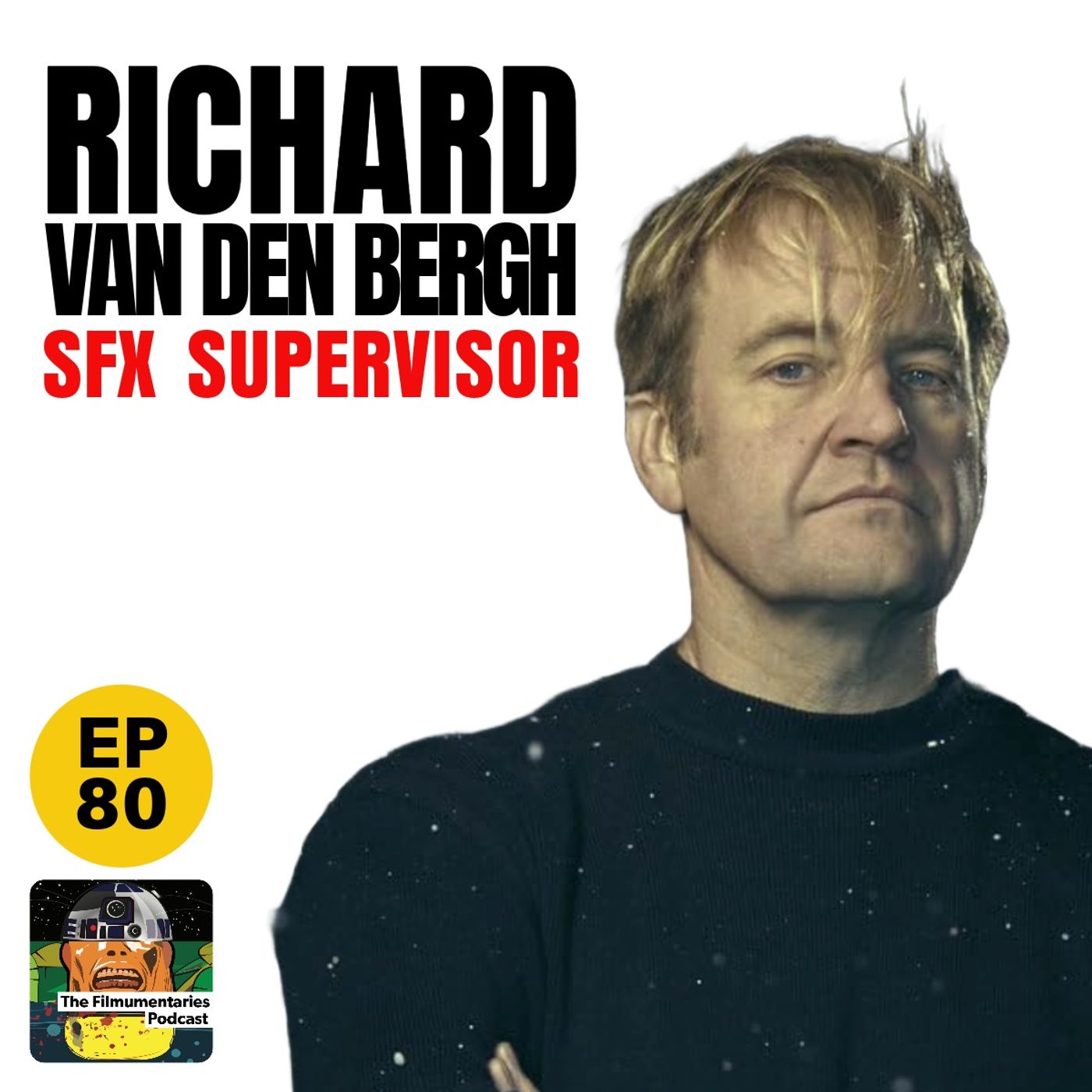
80 - Richard Van Den Bergh - Special Effects Supervisor
About this episode
I met Richard when he was one of the panellists on the Andor SFX/VFX panel at Star Wars Celebration in May this year.
Richard is clearly an expert of his craft, whether it’s model making, making atmospherics or supervising. He’s had some much experience from starting in the industry on Ridley Scott's Legend, to his most recent work on Andor for which he was nominated for a Bafta.
I hope you enjoy our conversations.
Links
Return of the Jedi Timeline Book - Register your interest!
Filmumentaries Merch
Support the Podcast on Patreon
Linktree
This podcast is completely independent and made possible by listener support. If you’d like to help me keep making these episodes, you can join my Patreon community here: https://patreon.com/jamiebenning
Watch more on YouTube:
Check out the Filmumentaries YouTube channel for behind-the-scenes clips and extra content: https://youtube.com/filmumentaries
All my links
Transcript
Automatically generated, so expect the odd misheard name.
M weird in Way Media. Welcome to episode eighty of the Filmy Mentories podcast. This is Jamie Benning talking to you here from my home in southeast London. It's pouring down outside. I'm not sure if the mic is picking that up or not.
It's been full and sunny and I was pouring down. I'm forty seven. I've lived in the UK all my life. I'm still not used to it. If this is the first time you've listened to the podcast, the Remit is all about preserving film history.
Treat this and the seventy nine episodes that came before it as an archive of film history that can be used to listen to for entertainment or as research material for your book or podcast or essay. I want people to use this as a resource. And you have about an hour of film chat ahead of you, and I hope you enjoy it. If you're a regular listener, thanks as always for joining me and for all your support. Thanks to the lovely one hundred or so of you that support the podcast via Patreon that's Patreon dot com forward slash Jamie Benning b NIG.
If you can spare just twelve dollars, you can support the podcast for a whole year. That's twenty four or more episodes, because I do do bonus episodes as well, so that's just fifty cents per episode, and I'd call that a bargain and it would really help me focus my time and resources on the podcast. There are several tiers to choose from on Patreon with several different perks, including videos and merchandise. You can also support the podcast by buying some merchandise at filmimentaries dot creator, dash spring dot com, including t shirts, bags, bottles, and yes, even socks. I'll leave the links for the Patreon and the shop in the show notes.
You can also find me on Twitter at Jamie swb and on my profile there is a link tree to all my various sites, including my Vimeo channel, which is film Mementaries, where you'll find hours and hours of videos for you to watch for free on films like Star Wars, Raiders, Back to the Future, Jaws, so do check that out. Also on Facebook as film Mementaries and on Instagram under the same name as well. Okay, so for this episode, the first of July twenty twenty three, I spoke with special effects supervisor Richard Van Denberg. I met Richard when he was one of the panelists on the and Or Special Effects and VFX panel at Star Wars celebration in May this year. Richard is clearly an X but of his craft, whether it's model making, making atmospherics, or supervising in that senior role, He's had so much experience, from starting in the industry on a Ridley Scott movie to his most recent work on and Or, for which he was nominated for a bafter So here's my conversation with special effects supervisor Richard Vandenberg, and I'll be back at the end for a bit more jabbering on.
So, Richard, where did it all begin for you? If I look on IMDb, I see Ridley Scott's Legend. Tell me about that. Yeah, well it was actually I was still at school, just finishing sort of very level time, my teeth everything, and a good friend of my father's, he was doing the snow on Legend and he said, come and get some work experience. I was going to art college and he said, yeah, would be good.
So three weeks of mixing snow tanks and arrest is sort of stems from there. Really, I sort of went to Art College, not be grudgingly, but I sort of sort of thought I'd already found my calling. But yeah, and pretty much straight after I left Art College, I sort of straight into back making snow again, actually with him for a couple of years before I sort of branched out. Yeah, which was I'm sure that sounded really Yeah. Sorry, I was just going to say, it's a really wide eyed view of sort of from a seventeen eighteen year old of what the hell was going on?
Really? Yeah, I mean that's a big film to walk onto. Ridley Scott, you know, one of the highest directors of the time, big production obviously of course the famous the famous fire and everything there. I mean, there's there's many, many different stories about how it happened. I'm not sure any of those stories probably worth telling because speculation, rumor it wasn't me.
Yeah, well that's that's the main thing, right. I Mean I heard things of like, you know, fight a fireball just kind of shooting through the through the top of the gas are collected or whatever. That's the story we've heard. But a hell of a hell of a thing. And I mean that that's one of the Ridley Scott films I know the least.
Probably I don't. I wasn't really into sort of fantasy movies as a kid. I was more of a like action and sci fi and stuff like that. But it's a great but great thing to have on your CV from day one. Yeah, I mean, I mean Gordon who I worked for, who was a bit of a crazy guy to be honest.
He's still alive ninety two now, m he. So. I think the moment that I just thought I really want to be in the film industry was the day I went to work with him and he said, I said, oh, watched one of my favorite films of all time last night. He said, he said, oh, what's that? I said, the Shining And he said, oh, yeah, I did a bit on that.
And it sort of transpires that he was effect supervisor on it for a while. He was did all the snow or the maze scene or the you know at Elstree and and I just thought, wow, you know, that is such an incredible movie and it's very lesser fair about the whole U sort of experience. But for me, that was sort of a bit of a selling point in the film that stew I just thought, if I can be involved in a film like that, then I really want and having already been involved obviously with a legend, but I didn't sort of it wasn't sort of for me that you know, the thing that sort of really turned me onto it really was Shining just incredible for him and still today is just incredible. Absolutely Imax. Yeah, incredible.
Yeah, that was that they did an Imax screen. I didn't know that. I've seen it but a bunch of times on the big screen, but never the Imax. Yeah, yeah, I did seventy mil Yeah, I think it was probably probably five years ago. I think.
Yeah, I went with a few friends and it's still just incredible. I mean, and when you see a film and that size as well, that even a film, you know. I mean I saw Jaws when was it last? Was it this year or last year? When they rereleased it in Imax?
And I've seen that film one hundred times, but I saw things in it that I'd never seen before, because there's something about seeing the faces that big and the eyes that big and seeing the eyes interacting and stuff. You really get a sense of the emotion. I'd love to see the Shining. The Shining is like one of those films you know, which I can appreciate as a film, but also just from a technical point of view, is so good that that snow scene in particular. You buy that outdoor scene, don't you.
I mean that's part of the magic of what has drawn you in, like wow, that I want some of that kind of thing. Well, yeah, I mean because also gaud explain to me that it's only really the opening sequence that is the only bit that's actually on location. The rest of Yeah, ever, everything is at Elsetree, and I mean heeds sort of many like a hundred tons of dendretic salt just for the maze scene alone. Um, you know, sort of crazy sort of It's just an incredible I mean, the movie itself is just so special. I mean, Kubrick's one of my favorite directors.
Yeah, along with many others, readily Scott being obviously one of them. M Yeah, you can see almost a similarity between the use of the camera sometimes. I think you think of those opening scenes of Alien where we're looking around and Nostromo and they're kind of gliding through, you know, and we're and we're well, I think both him and Kubrick give us a really good sense of the geography of a place. Sometimes in the shining he kind of messes with us a little bit like you were like where are we now? And that's deliberate, But some of those moments in those both those directors films, you you really get a sense of where you are and then the field kind of film kind of builds from there.
So back then, when you were made in snow and you know, mixing all this stuff up, what was it more hazardous then than it is today? I think that depends on who you ask, really. I mean I think because in those days that there was like it's an ex sort of cavity wall insulation foam that that was sort of later sort of from the Est Ransom Show actually sort of like put into into into sort of questioning. Um. I mean, you know, I've never had any problem with it, and it is it's a bit of a one of a kind.
Obviously, paper and things like that of super ceded, but they all have their issues. I mean, there is probably thirty different types of snow you could call on to make in a film, and I think it just depends on what you're doing. Some methods we use a lot more than others today. I mean, if you want that gritty sort of I mean the snow on Huntsman. You know, we did you know, sort of quite a gritty sort of atmosphere dom as well actually done too, and that was very gritty, very grimy, and that was sort of like magnesium sulfate everywhere and huge, great sort of bicycles everywhere.
And then you take the flip side. I did the Paul corbar I did the snow and ice for Beauty and the Beasts, which is like obviously the reverse supposed to be very fantastic and the actual and actually we sort of spent a long time making sort of rococo frost flowers for Sarah Green with the designer. I mean from like massive frost flowers to tiny ones on the windows and you'd have to look pretty carefully, but they literally years of frost rococo frost flower running through the whole film in every single set. Yeah, I mean any anywhere that's snowing, which is pretty much all of it. That's the thing that strikes me about your job is, you know, there's three simple words.
It's either you know, specialifics technician or forming or supervisor. But the remit of yours your job title is enormous. One day it can be snow. The next day it can be smoke and fire, and it can be flipping a car or all of those things. Is that something that you really enjoy about, you know, the challenge of the job that you're going to be doing at such a multitude of different things.
Yeah, I mean absolutely, I mean it is. There's so many different conditions within special affection and one day somebody might be doing electronics or electrics controlling a massive rig via computer. You might be making snow, rain, smoke. I mean, the list literally is endless. Or you might be making a seagull poop on somebody's shoulder.
You know, it's it's that ridiculous. And I've done all of those obviously, and the levels of complexity change enormously. I mean, you know, for people, you know, a seagull, people on my shoulders, presumably like yoga or something, you know, but then you've got all the way up to like a gimball that you know, a big star is riding or something like that. Yeah, I mean on Star and all series that we did. I mean a few of the things which I know obviously we've spoken about before.
I mean, we had a massive. It's like a rig of a spaceship as a poppit and one section of the spaceship and that was I think it's twenty meters by twelve meters on a gimball, which is massive. I mean, I think just the rig alone way, I think it was just under sixteen tons, and that was computer controlled, and you know, it's quite a lot of action within that. We you know, we're flipping speeders, you know, blowing up various vehicles. I mean, I must say that was one of my favorite films or series rather to do because we really literally we're doing everything from snow to rain to you know, very simple, very atmospheric.
I mean, I think actually dan Or is really great example for what we've done as atmospherics because it really you don't notice it, which is the key with you know, our job, a lot of it is to try and not make you aware of what we're doing. Yeah, if you know, if you can see it, we probably didn't get it quite right. Yeah, Yeah, I mean there's obviously there's a little its massive sort of undertaking we did for Backgirl, which is unfortunately, I think, never to be seen. I mean, we had sort of fifty foot flame throwers on fire engines going down the streets of Glasgow every night for five weeks and you know, you know, I mean the safety aspects alone is a sleepless night every night. Yeah.
Yeah, it's changed over the years, hasn't it, the safety aspect of things. It's a lot tighter these days than it was maybe when you started. Yeah, yeah, of course, I mean, I think and obviously for the better. I mean, you know, I'm not saying that people were blast but that's I think to tighten, you know, because we are making a film. We don't want to endanger people's lives and it is really important.
There's a lot more just I mean from a supervisor sort of role, you're you know, the cost, the health and safety that every day paperwork alone is a massive job, and the supervisors job has changed quite a bit from being very hands on on the floor into doing that and try to distribute as many of the roles as possible so that you can actually be involved in the creation, which is what you started in special effects for o course is to design and create an amazing effect and see it on screen. Yeah yeah, well did your job start then by when you get the script you're kind of going through as a team at the sort of department heads and you're saying, WELLOK, that's a visual effect, that's a special effect, this could be both.
Is that? Is that kind of how you would break it down? Yeah? Absolutely. I mean when we did Everest Visual Effects us designed Gary Freeman, you know, we were very close and really sort of made definite decisions.
Obviously we were governed by location and some of it was prime of studios in the bond stage, but you sort of really had to plan well ahead because it was quite a big undertaking. You've got a lot of people on the mountain. I mean, just getting four ton wing machines on a mountain that sixty degrees to blow people, you know on you know, basically, I think it's basically two and then we and then we got it up there. Took us a week to get four wind machines up there, all the equipment, and then there was an avalanche warning. We all had to come off for two week to return to find the wing machines said about two inches going, so we had to dig them all out again.
And I think that logistical side of things is just massive, you know, So so I think actually as some visual effects and design. It's much closer today because it has to be just purely because you want to spend the money on the screen, and I sort of sort of, you know, I don't want to spend a lot of money doing something that would never be used because you know that that's somewhere I could spend the money somewhere else in the film, which is and the same for visual effects as well. You know, they don't want to be fixing our mistakes or our department mistakes. You know, they would need to spend their budget wisely too. Yeah.
One thing we talked about on that and or panel at Style Celebration, which I have I've mentioned to just about anyone who will listen to me talk about it, Yeah, is we talked about how, you know, some of your special effec on that kind of guided the look of the visual effects. Like you would add rain and then they would literally be trying to match that, or you would have an explosion that had kind of a lot of particulate matter in it, and then they would they would marry that with their visual effects rather than those sort of big gas explosions were used to in in the Star Wars movies. Well, there were I mean there was a bit of that as well, I must confess, and and but yeah, very much. I think the design was incredible Luke Hull I really enjoyed working with.
I think it's an incredible talent and will be somebody who will go a long long way and be making incredible stuff in the future. And I think from his vision with obviously Tony Gilroy who wrote it to begin with, and show running, you know, it was quite clear really what we had to do. But then working with them and working with the visual effects, you know, we had to sort of set the tone on the effects, let's say, and the atmosphere within the different sort of of star systems as it were. You know, from obviously that the Milana which is very clean and you know, very very much a richer area, you know, down to Ferricks which is very much a down and dirty sort of smoke everywhere, fires everywhere.
Yeah, I mean, and it was great. I mean there was the massive the opening scene. Actually there's there's a whole sort of section along a causeway in Corraton and literally we were only allayed on there for a little whiles and we did rain and we were literally following the camera with a rain truck with an open heads all the way down and it's literally you couldn't have two vehicles inside each other down the schourseway. So we did that. But then of course Momentuplex and the team sort of put all of the bigger stuff around, and then we came back into the studio for the bit where he actually comes in into the city and that's all in studio and it's all in camera, which was really great.
And that's sort of borrowing up and going back to whether it's actually you sort of don't know when we're outside or inside. I don't think, because I think everybody did their jobs, so well, yeah, yeah, it's about marrying the two, isn't it. I think that's something And I think we again spoke about this on that and or panel is that on and or? The direction and the work that you did, in the work that Mowen and TJ and all the guys did, was there were these moments where you sort of got a sense of the environment first before you saw the character or the sort of wide angle you know, the Star Wars kind of tropies that we you know, we're here on this planet and it's a big wide angle. But what they often did in that show is they started on someone's feet, or they started on a light with rain, or they started on a close up of somebody's hands, and then I don't know, you, I think as an audience, we just make a kind of a more visceral connection to that.
You know, there's something tangible that we can feel like we can reach in and touch almost, yeah, I mean, and I think we can all relate to it. I mean it's you know very much. I mean some of it. For me, I had quite a blade runner Field. I mean it was it was really and that's that's one of my favorite films four times, and it was just incredible to sort of have the chance to do that, that sort of atmosphere, that really all round effects.
It was just amazing. Well for me and the whole team. I mean, I've really blessed with the team on that show. I mean a lot of old friends and sort of people that worked with me for years. We were all together and it really felt like a great family.
And of course we had COVID in the middle of it, so you know, I know, we don't talk about it quite as much as we used to, but it was really hard sort of period. You know that you initially going back to work, I mean actually initially, as as I explained before, I was literally working here for ten weeks on my own in that sort of design period, which was great for the show in a way because I got to really sort of do something that I usually don't get the time, which is to completely design all those areas before we went back into the workshop. But you know, on another level, it was a very difficult time for everybody wearing masks and being under certain strict conditions and being very limited in our movements in some areas, and obviously close contact and the way our set works usually was very much we're a more distant and less connected.
Let's say, Yeah, I bet it helped that you had worked with that team before, because you've got that sort of shorthand that's been built up over a period of time where you can just look at somebody and know what they're thinking and what they're trying to communicate to you. I mean, I had it. I was all masked up at Formula one, and we were so used to sort of mouthing stuff to each other when we're on air, trying to be quiet, and that that option had gone, you know, but we managed to find ways of pointing and gesturing with our eyes and things and you kind of and because we worked together so much, we were able to do that well. They always say, obviously are some good filmmaking. Good acting is all in the most actors, you know, continue billion things by I mean, I remember seeing seven actually in Empire Let's the Square, I think on first of January, on my birthday, and I was like four rows back.
It's like the last seat available. I was on my own and just a bit of a sad day really, but one of the most because it's such a frantic, crazy film and it's all in the eyes actually that film, and literally I came out of there buzzing, but also completely shell shocked. I mean, yeah, incredible, Sorry little anecdote. No, no, I think it's great. I mean to be honest, I saw that film the cinema as well, and I don't think i've seen it since because it's one of those films you just come out of and you kind of just exhale.
You feel like you've been holding your breath for two hours. Yeah, and yeah, it was an experience I didn't want to repeat. Initially, but I will revisit at some point what comes across there, and you're saying that is that you're a fan as much a fan as sitting in this side, you know, of the screen. I think that's it's interesting to me that there's a generational kind of gap there, because a lot of the people that would have worked on movies around the time that you joined in the early late seventies, early eighties, you were mid eighties, weren't you when you joined on the middle legend, A lot of those guys were just that, you know, they were just working people. They weren't enthusiasts necessarily.
They obviously had a respect for their job and their craft and everything. But I do get a sense that a lot of those guys of that generation were just thinking about the next day's work. They weren't necessarily thinking about their back catalog of movies or they're the movies they loved and how they could integrate some of that into the movie they're working on now. But I think that a lot of that is because, I mean, obviously, special effects, particularly and visial effects was in its infancy and very new, very new at that stage. So a lot of people who were into special effects, came from outside the industry and didn't have that film school background and for that whole environment.
And you know, I think certainly the older generation today are far more into it than we are. I think they the older guys that worked with they've sort of overtaken. They know more about other films and the Nigeri Center is probably because they're watching them a bit more than I am, I guess. But if you're working, you're not watching, aren't you that the thing? Yeah, I mean Gordon came from here, had a plastics company, he had a Cavity of All insulation company, and him and his brother they built one of the models for the Battle of Britain.
I think they built chili Chili Bang bang and you know, things like that. But they came from other industries. And yeah, so film and film was quite a you know, in its infancy generally. I mean, you know, you're sort of talking forty years, I guess, which is quite young compared to today. Yeah, so it was really the sort of manufacturing disease industries that existed and how how can we implement what we need into our movie?
And we go to these industries to find a solution. Yeah. Yeah, I noticed on your like your list of movies that you've had a number of different roles. You're listed as prop maker on a few projects as well. Yeah, what does that involve?
Well, I mean I sort of switched. I started often, you know, went into special effects, actually went into model making, and then Visual Effects sort of took that over a bit and went back into pure special effects. But in the interim I had a company called Evolution Effects and Models and we did literally what it says effects. What were you making models on? Then?
Any what particular movies would I know of? We did Alien versus Predator, so definitely see that, I'm sure. Yea which which was the last big, big sort of model build that I did actually, and we sort of Bill Pearson, who was one of the guys that built the original and Astromo an alien, he worked on that with me and he did the sort of satellite and the ship and stuffing in England, and then I went to Prague and built all the big collapsing sets and sort of crazy stuff. That's interesting to go from like the miniature to the what what did I think? Lawn Peterson he's a model maker for ILM.
He had a word for them. They weren't miniatures. They were bigger chus I think he called them. Yeah, well they became known as big. I mean, certainly that was a bigger show.
I mean one of the collapsings at the end of that I think if I a call, and I might be wrong, was thirty meters by nearly twenty meters and it was I mean, the best way to describe it as like a reverse tabletop trick, you know, where you pull the so it's sort of like that, and literally as you did that, everything fell over the edge. I mean it's a great sequence. Actually, look look at that again. Yeah, yea. The live action is literally the actors and the predator running on green screen, jumping through the whaling station as it's collapsing.
Vision effects John Bruno's um a good friend of mine. They obviously did all of the sort of additional interaction, but you know, the majority of that whole end sequences actually a model. I think we did twenty two much miniatures on that job. Wow. So yeah, and so the company was doing miniatures and props as well, so you were actually that the actors were handling as well.
Yeah, I mean on Extodus we made all the sort of stunt lances and banners and things for the big fight sequence of things like that, and we did the borrowers. Actually, we've made things from oversized buttons for the costume to making fourteen time sized fairy lights for their interior which actually had ten k bulbs in them that actually lit the set. I just we're going back a little bit now. Yeah, yeah, I mean it's not. I mean, obviously I still get involved a little bit and the guys do, but you know, we don't do as much of the prop making anymore.
It's usually as a prop making department, which we if it has an effect within the prop making, then we'll sort of get involved. Now and it's become a very big thing. I mean, somebody said to me, you know with visual effects, how you know, surely it's taken loads of your work away. But I think, actually, I think there's much more prop making and in the not models, but you know, special effects, because it's you have to start somewhere, as we discussed earlier, you've got to begin with an actor on a rig in a green screen at least, do you know what I mean? So, yeah, and then the whole interaction.
Yeah, and the sheer volume of stuff that's being made at the moment as well, particularly in the Ukomian. All the studios are booked out like forever, aren't they At the moment. You know, you've got Lucas Film over here filling up Studio Sky, are building new studios and it's a lot of work. So just from a volume point of view, I think, and I think there is an appreciation still a lot for the model making. I was talking to some people last night on a film club thing that a friend of mine invited me to about Return of the Jedi.
They just watched it again and said, actually they were really drawn to the Matt paintings and the models and the physical effects as opposed to the special edition changes that they made, which now actually stand out and look more dated in a way than you know, the models and stuff, because the models were lit with a real light and somehow we but we even though we know it's not real, we kind of buy it. So I think that we're in a period now, And again we talked about this, I think on the panel or the Handel panel. There seems to be a period now where there's really a great understanding of the marrying between those two disciplines, if you like. Because I saw some of those scenes on Ferris and I thought, well, maybe that's a set extension.
Maybe, you know, I'm not sure whether they've got the budget to build the whole thing or not. And then I find out that isn't a set extension. Then the next shot cut and oh that is a set extension. I didn't know, you know. And then you see the barbicane in which they've augmented, and it feels to me like people are just I think.
I think Mo and Leo actually said this didn't either starting with something and I think you just said it as well, but starting with something in camera it is so beneficial for the visual effects SyES, even if they replace ninety percent of the shot, just having having that there as a starting point is really important. So your work is really valuable, even if you know there might be just a small nugget of it on screen. Well. I think also sometimes there is a thought process either by the directors producers, that that's going to cost a lot of money to do that in camera as a special effect, I mean. And a good example we talked about that on the panel actually was the band of factory with all the irons that dropped down.
I mean when we first started that, there was talk about us just doing a couple and it being all visual effects, and I sort of and it was that time in COVID where I had the time and I worked out the whole you know, sort of from the script, so sort of how I thought it might work, and we went ahead and I actually design it, and like there was like three hundred and eighty wires in the roof or dropping different things in different places, pulling the cotton rails up, pulling things across the building, dropping I think it's thirty six irons in the in the roof. At the end, all sort of came down and we doubled them up and sort of dropped them, dropped some of them, and then we dropped the whole lot again at the the end scene.
But as moment very graciously said on the panel, I mean, they were expecting to do a huge chunk of that part, and actually they said, you know, pretty much it was all in camera, with the exception of some additions. And not only was that very lovely to hear, you know, sort of it's a great achievement for our apartment. I mean, that's one of my first standout favorite sequences I've ever done. The thing really yeah, and really important to that show and that story as well, because it's the first moment we really see him in in you know, the main the main character in a moment of Errol and is he going to stay on planet? Is he going to leave?
And if we don't buy that, he's you know, in danger there. Yeah, we don't where are we going? You know, as an audience, it's like, you know, a thing I often mentioned is Spielberg always said, you know, if you didn't buy the dinosaurs in that first shot of Jurassic Park, the movie was screwed, you know, And it reminds me of that, of that kind of line, because I looked at that and thought, Jesus, it really looks like they're there and those things are falling. I even on the panel, I kind of assumed that because I think I asked you, you know, how much of that is the effects? And you said you better ask mo and a moan said, well, actually, it's pretty much all of Richard's work.
And then you amusingly said, oh, that's my favorite scene. I said, oh, you decided that now have you know. It's a great it's a great scene. It really is. Look at looking back again over your your career, like I see, you know there's been some great like TV show work you did, like Space Precinct.
I remember that TV show. Yeah, that was kind of a big deal at the time. It was a while back. What was that ninety four eighty five? Yeah, I think earlier.
I think it came out there. I think we're actually making it. Oh no, you're right, I think it was ninety three ninety four, right. For fourteen months, I think we were doing guns and the Boy comp machines, which which is quite funny because of course that's pretty much what we all walk around with now a little screen talking to people. But yeah, that was I mean it's sort of quite exciting in a way.
But I mean it's a classic Jerry Anderson sho and I was very fortunate get on because there wasn't a massive amount of work around at that point, so we really lucky. I just come off of a film that Steve Orenton directed called Death Machine, which is quite a classic horror movie. M and be not. It's actually quite a good very low right now on my pad here, very low budget. I mean Steve went on, he directed A League Gentleman and Blade one and things like that.
I'm not sure what he's doing now, but yeah, good one to watch. I haven't seen it for so long that I sort of probably have to see how it holds up. But I think it's pretty good. Yeah. I mean we did three or four minutes at the end of that as well.
That was good fun. Yeah, And then like I can see, like you know, the Borrowers, which you mentioned. I think Darling Buds of May is in there at some point. And you know, you're dipping in and out of the TV and the film industry because all your skills are applicable to both those kind of worlds, I guess, And you strike me as somebody you know, we talked just before we hit record that you're doing some work at the moment when really you were probably gonna have a bit of free time. But as freelancers and owners of our own companies, we do that, don't We We get a call and we say, oh, yeah, I am actually available, because you don't know how long this is going to last.
Obviously, your reputation is something you built up over a period of time, but there is a certain amount when you're freelance, seeing that you're only as good as your last job, especially when you're starting out, and it seems to me that your somebody's just strived to always be working. How do you keep that kind of motivation. Is it purely paying the bills? I mean, it's the passion as well, right, it is totally passionate. I mean, obviously it pays the bills.
There is a lifestyle that has to be I'm not I don't have an extravagant lifestyle, but yeah, I think I think because I actual we were saying earlier, I mean years ago, that wasn't loads and loads of work around. I mean, as I was just saying Death Machine and Space Priston, there wasn't a lot of work. And we come from an area where maybe you only worked six or eight months of the year, which of course people in the last fifteen twenty years have never seen it's been pretty much continuous. So yeah, and you don't get out of that thought process because you I mean, I remember just before I started Allied Robertsmachas movie, I was thinking, my god, I worked for like a month and I was sort of forget beginning to get nervous and then started that nine months of hell and not hell in a bad way, Helen in a great way of amazing.
In fact, that was a great experience. Was Robertson Macas truly is an incredible director who I loved working with, and it was very clear what he wanted in every shot, which was really great. I mean, and one of the Hollywood icons, and I mean Back to the Future for me was another movie that that really was the reason, I mean really seeing that opening sequence in Star Wars, seeing Back to the Future, probably Ghostbusters and you know those sort of I mean, you know, I just just to work. I mean I was, you know, they're making Ghostbusters now and would have died to be on that. That's yeah, you're literally ticking off my list of favorite movies as we talk here.
We definitely got a bit of a kinship with regards to that. I think that you know, a lot of those people I've spoken to over the years, and I've spoken a lot of older people who've come to the end of their career. They talk about that passion being important and that sort of persistence. Do you do you feel like a responsibility now to kind of look at the younger generation who were trying to get in to give people a chance like you were given a chance as well. Yes, I mean, I mean I'm actually speaking.
I've got to say that people coming from out of university now, I mean, there wasn't university courses when I started. There is now, and people who come out and you know, there's a great feeling of satisfaction to impart information to these people. And I've had quite a few guys have worked me four or five years and they've gone on to work for other people who are friends, and they come back and you know, you just see them develop as a as a effects technition, but also as a person, and that's immense, and you know, you sort of that is part of the job, because if you don't promote and get the next generation, and then where's it going to come from? And yeah, a bunch of dinosaurs. Yeah well yeah, I mean, you know, it's like everybody knows it all nowadays, of course, but yeah, I mean it is really great.
I mean, I mean I loved it. I even thought about teaching actually recently because I and even so much as setting up a special effects school actually at the ranch of where our workshops are because I think there is a bit of a gap in that whole sort of learning pure special effects. There is various places you can learn, but I mean, I'm surprised that a lot of the people that are at some of the university courses that really just don't get that basic knowledge of all special effects and they come out with a special efflex degree. And yet really the conditions are very small. But I mean there's three years to learn a lot of college and then you hit the industry and you learn a lot very very quick.
Yeah, and that's the best way. Yeah, I think, Yeah, I think you're right. And do you do you find that there's a particular kind of personality trait in people that are successful in your part of the industry other than that kind of you know, determination, I guess that we mentioned. I think it needs to be determined definitely. I think you need to be a bit humble sometimes because I think, you know, even even at my stage, because everybody you're always learning.
Anybody can teach you anything. I mean that. The other thing is there's a lot of new technology around and maybe you don't know all that technology and how we can I mean, a thing that changed our entire industry was its sort of like plasma cutters and and and you know SENC machines, because before we were whittling away for hours and hours or hand sort of sort of making metal work. And now we have the ability to literally design in the morning, cut in the afternoon, and weld it under rigged the next day and put a massive rig that may have taken literally a month to get on set in in a week. And I had no idea.
Yeah. Yeah, technology is incredible when used properly. I mean it's just another tool obviously. I mean it's not necessary the answer to everything. I mean, three D printing sort of change the industry, certainly in prop making.
You know people who are sitting there making models for hours and hours and hours. And of course you still design, designing for hours on computer, but yeah, you're not making anything three times does that? But does that ever cause a problem in that you can do things so quickly that yeah, before you could make changes so quickly. So if it is a director that isn't a zamechist who knows exactly what he wants, that suddenly you're having to change it, change it, change it on a daily basis. I mean, I think of, you know, the difference between editing on film where you're making a physical destructive cut, then premiere Avid and everything else comes along and suddenly you've got twenty versions because everyone's got an opinion.
Has that affected your part of the industry in that similar way, Yeah, I mean it does mean because you are able to put out the back a lot quicker towards the end, it does put off the decision making sometimes and eventually you sort of know in your mind that we have to push the baton on this or it's not going to happen. There's a crune point kind of yeah. Yeah, and a lot of the time that's really later than it should be. Yeah, I mean, that's obviously that and that's part of the managing, you know, supervising the effects, I mean, to sort of make the call. And also, you know, people have lives.
I mean, I can remember going to work five in the morning and getting back at about twelve o'clock at night on a on a daily basis on some films, and you know, I think people are treated a lot better now, and I think that's obviously a good thing. But you know, you do you do still work the hours and it's the sort of time off where you're thinking about everything and actually solving the problems in your own time. Gordon used to call bathtime. He used to sit in the bath and realize how he should have built something. Yeah, yeah, yeah, that's probably the only thinking time he's had all day, because he's just you're just full steam ahead for twelve hours.
Yeah. I know people that have worked in the industry that you know have done like continuity and things, and they'll go away for three months and shoot on a on a movie and they'll work hard, they'll play hard. They generally come home, collapse into a heat for a few weeks, then get a call and sort of go on a repeat process. This was a few This is probably twenty years ago. I knew a couple people that work like that.
But it's good to hear that people are there's there's a consideration being made for people's lives and families and things. And I think the other thing is that there was this sort of um thought process that you had to do all these hours. But I think that when you work a shorter amount of time and you have more time, you're sort of a much more refreshed and able to come back and actually work probably get there's proper breaks, so I mean, you know, I mean I remember going on certain films and thinking, my god, you have to literally have to have a break, and it was it was a revelation, you know, having having actual breaks was sort of something that other people really But I think you said, I think you said to me actually behind the scenes before we went out on the stage for and or maybe it was afterwards, that lunchtime is the best moment for you to kind of get in there and have a tweak while everyone else has left the set.
But then maybe you get your break later on. I guess, well, I think as a supervisor, I'm not really talking about because, like I say, when everybody's having their breaks, that's the time you have to think without being interrupted, and those sort of like half now in the morning, half there in the afternoon lunchtime, and it is almost arrest anyway, because you're able to relax and sort of think about the problems that you know in a very considered personal way, which you don't get the rest of the day is literally question of the question of the question of you know, because you're you're often doing maybe in the workshop seven eight different effects, and then you've got two units on the set that are carrying out the effects that you made sort of last month.
And it's sort of this continual roller coaster of different effects all at the same time, and you know, it is hard to navigate, especially when you want every effect to be as good as each other. I mean, you know, I mean, nobody wants to give less time to anything. M How has this kind of digital shooting as opposed to film shooting affected you, Because I hear for things from like friends who are actors who say that, they say, just keep going, do that again, do that again. There's no take one, there's no take two. They just roll cameras for you.
If you're doing an explosion, or you're adding atmosphere or smoke or fire or whatever, you've only got a finite amount of that. Surely, So is that a frustration for you sometimes or is it something you get you got used to now, I guess, well, yeah, I mean obviously used to. I mean when it comes to explosions, it's very carefully considered. It's set up you will. I mean, like on hand or when we're flipping the speeder, we've only got three speeders, So you have to make sure the times given.
I mean we only flipped it twice on the second one. We've got the first one. Really they used a bit of both, but you have to that has to be considered. That can't be again and again again because it takes two months to make this speeder go down the rails continual testing. I mean we tested that speeder three three times maybe four actually very very early stage.
Um. And you know there's a lot that goes into that, and you know, to make an entire speeder that's light enough that flips that then explodes and then when it's flipped over again explodes a second time. And all this has got to be done in shooting on one day, which is which is you know, a mammoth task. Um. So yeah, but you know when you come to you know, putting atmosphere in the back or steam or or you know rain or or you know fire or you know general or the fires to consideration of health and safety if it's flamboscne in the background though pretty much endless, but yeah it is, and that's why it's relentless.
On the set. I mean, if you are set supervisor, you do not get a second off. Very often there's always something going on and you're always setting up for something to move on to in two hours, you know, And it's the support network that makes that happen really as much as the on set guys. M you are a kind of problem solver in the rest of your life, because I mean, that's ultimately what your job is. You're you know, you're you're spinning plates, You're fending off questions.
You're having to come up with the right answer at the right time for people, for all those questions paying at you all these different scenarios. You know, do you do you find that your your personality for that carries on into your real life, you know? Or are you like one of those gardeners whose whose garden is a complete tip? You know, my garden is not a complete it. I have a few fields to look after as well.
I'm not going to very lush greenhouse. But I must say it's a bit of a passion and yeah, you know, as music as a passion of mind, and I think that that is what keeps you saying really so, I certainly get sold that you're not at work at home when I try to explain how to do everything. So yeah, yeah, but that's a good thing. I'll need telling because I need to relax and I need to It's difficult, though, isn't it. To Like my job, you can be quite stressful live TV.
You've got people shouting at you. You're making the sort of seat of your pants decisions that if you don't make those, the broadcasts can go badly wrong. And then when I come home, I do have to have that kind of time to decompress a little bit. You know. When I used to fly around the world, I was on the plane and I would decompress there for ten or twelve hours or two hours or whatever it was.
Now I'm twenty minutes down the road I get home. Sometimes I sit in the calf for fifteen minutes just listen to the ray, you know, just to you know, center myself again almost because if I go in, I'm at the sync and I'm doing everything, you know, and I'm trying to make up for the fact I've just had a twelve hour day and I'm still in that mode. Do you find that as well? I do. I think the journey to Palmwood leaves and when when I'm at home, not a way abroad, or whatever that that journey home.
I've learned to become my decompression, like you say, like you're flying, but which is only sort of thirty forty minutes. But I've sort of almost taught myself that by the time I get home, you know, I'm not forgetting about work, but I'm you know, I've still got work to do to be honest, when I get back. But yeah, of course you sort of do sort of calm down and you make sure you eat, make sure that you just have a little bit of time in the family before you start again. Yeah, that's the condition I had to learn because I was terrible. I'd be straight in strong with the computer, trying to work things out, and you know, to my detriment really for part of my life, just frantic.
I mean when I first had evolution, I mean I think I was pretty much seven days a week and pretty much you know, I don't know, for fourteen hours to day and then working when I got home. So it's not good for home life. But you're sort of trying to make your name at that stage. And it's not that I don't now, it's just that I've learned there's other ways of letting other people do the work. Is one of the things I've learned because, yeah, somebody said to me, if you want to run a successful business, you can't do everything yourself.
You have to delegate and trust other people. And I think it's the best advice that's ever given. Yeah, You've got to generate that relationship with people, haven't you, where you can put your trust in them and you know, build a team around you. That's the that's the It's a very skillful thing. If you can manage it, if you can pull it off, it sounds you have well, it's very hard in special effect because you never really can stand away from it.
Yeah, you know, you sort of because of the safety aspect, because of but you've built a good team, I mean yeah, oh absolutely, Yeah. I mean everybody that I've worked with well over the years, but certainly in recent years, you know, great relationship and you know, I love working with all of them. I mean, obviously it changes films to film because most people freelance, which is it is difficult because if you find you're not working for a little while, you can lose a load of crew very quickly. So you know, there's a bit of so busy at the moment. It is a bit of a mine field on that score.
So the pressure is on you to get a job continually. Yeah, yeah, don't you don't get Yeah, so you don't drop off the list almost yeah yeah, yeah, well you don't lose the crew really is yeah. Yeah, And I can see, like again looking your list of movies, like a couple of Star Wars movies, like you said, Beauty and the Beasts, there's the of course, the and or TV series. There's Harry Potter. You know, these are big, big shows you how aware is there ever a compromise where you think, look, I'm going to work on this big show X y Z and I'm going to be on it for six months.
Is that going to be more valuable to me from a business sense than working on maybe like six or seven smaller shows and have continual work through that period. Well, I think the answer that question is pretty much what I was just saying is is that if you can say to people we're going to be working on the show for nine months, you pretty much can get it every person you want, because everybody rights to hear that. Do you say I've got to work for a month on this show and then I'm going to do another show. Probably they're a bit sort of like, well, I've been off for six months on this show, and you know I have to look after you know. So that's the answers made for you.
I mean, I enjoyed doing quite a lot of little things. But I mean I have sort of, if you like, a bucket list of who I'd like to work with that I haven't worked with, um, And you know, I mean I could probably name them very eously now, but it's it's, you know, I think I've got to the stage where I just really want to work with certain people. I mean Tim Burne definitely is somebody that I am worked with, and I think every single film that I've ever seen is made, I've just absolutely been in awe of Um, David Fincher's another one. You know. Robertson Echos was definitely one, and to work with him it's just a dream.
Um. But yeah, there's there's a few other I mean, there's lots of great directors sort of coming through and I could sit here for hours probably until you but yeah, there is definitely you know, some of the classic directors that you know probably are doing only so many more films. Let's say, Um, yeah, I'd love to sort of you know, get to work with those guys. And I guess working on those big tempole movies does kind of, you know, increase your chances of being noticed by those directors in a way and you know, potentially getting involved in a movie like that. It's not necessarily about the size of the movie.
I mean, I'd quite happily do a smaller movie if it was really the right people, you know, I mean it's not yeah, it's yeah, yeah, I mean obviously you want to do great work and you want to have something to do. I don't you know, doing a set of the film for six months and not really do a lot, not in my nature. But yeah, I mean there's definitely some some sort of tasks ahead of me to to shoot one myself into certain places. Um, and you know, I really I've got a great team. I've got a great sort of mind I think to sort of for any sort of film really, And it's not just about genre for me either.
I like, you know, I love a thriller for shining, Um, you know, love lover a big blow up sequence, you know. I mean, if they're going to remake some of the Big Old War, maybe even westerns. You'd love to be involved with those, you know, I don't think. I think to go across the genres is a really great thing. I mean, Tarantino obviously does skip the genre quite successfully right the way through.
And you know, every there's another director I'd love to work with and haven't. Yeah, but you know, just really the passion and the knowledge and that, you know, he just strikes me as somebody just being incredible to work for. Very difficult, difficult for him, but difficult because you know, you have to get it right. Absolutely can be on your a game. Yeah, directors, of course, But it sounds like, you know, it looks like you've had such an eclectic mix of work over your career so far, and you've still got a long, you know, a long career ahead of you, and I could certainly see you ticking off a few more of those bucket list directors.
And you know, I wish you well and I really do appreciate you giving your time because it's it's an hour out of your time you're working today, and I'm glad we finally got to chat. It's great, Jamie, amazing. I'm really enjoyed it and it's quite talking to you call me up again. I hope you enjoyed my chat there with Richard. He's a good guy and very well respected in his field, and I'm so grateful to him for giving his time.
Thanks Richard, and hope to catch up with you again sometime next Up on the podcast, I have filmmaker Kevin McTurk. Kevin is launching a Kickstarter for his new short film. He's an incredibly talented effects artists and director who has used those talents to make several short films that always have some ghoulish, ghostly visuals, using a combination of puppets, wonderful sets, atmospheric and a list of great voice talents. Look out for my interview with him later this month. In the meantime, you can check out his site, The Spiritcabinet dot com.
Also coming up on the podcast, I have Steven Spielberg's special effects supervisor of choice, Pablo Hellman. We've already recorded a great chat and I look forward to getting it out to you. Plus, I've had a wonderful conversation with v effects artist and supervisor Charming Chan very inspirational. I'm sure you'll agree when you hear it. I've had to sadly postpone my conversation with Randy Tom due to the teacher strikes here in the UK.
I'm going to have to be full time dad on that day, but hopefully we can reschedule that at some point. Supervising sound editor Mac Smith and I spoke a couple of weeks ago too, another great guy and a lovely conversation with someone who's passion about their job. And that's what this is all about for me. Thanks to all of you that have purchased our Return of the Jedi Unauthorized Timeline book. So great to see so many of you posting about it and seeing it in the hands of the Jabber Puppeteers and team is great as well.
It brought a big smile to my face. If you'd like to keep a breast of all the latest on that and our upcoming books, Yes we are doing some more, check out my Twitter feed at Jamie s Wbing. If you've enjoyed my podcast, please leave a review on Apple Podcasts, preferably a really good one, and that's the way I can get it in front of eyes and ears. This is a small podcast. It is just me and my laptop and a guest or guests, and I really could use your help.
If you've enjoyed it, please spread the word. Thanks for joining me, and I hope you can do so again. For the next episode of the Filming Mentors podcast, Weird in Way Media



Similar episodes across the network
Matched by shared keywords.
-
Justine Nelson - Unsung Cinema
2 shared keywords: scott, the
-
Seasonal Differences, Shifting Fandom
1 shared keyword: the
-
Resident Evil - Kulture Meltdown
1 shared keyword: the