
Season 1 · Episode 81
81 - Kevin McTurk - Puppet Film Director and Creature Effects Artist
About this episode
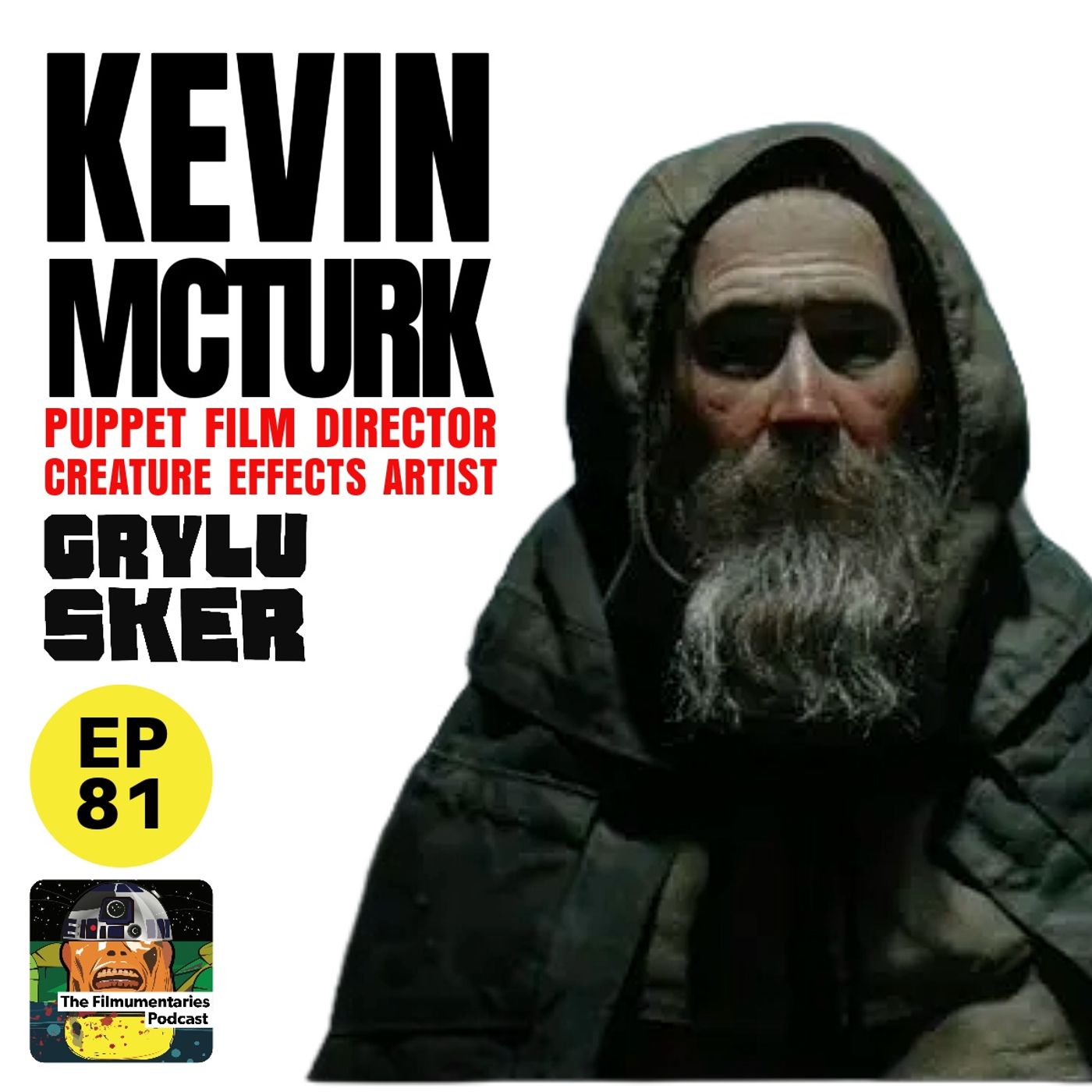
Well now is the time as Kevin has a project on Kickstarter as we speak. Kevin directs these amazing short films using puppetry and wonderfully atmospheric effects.
He’s a veteran of creature effects in movies like Batman Returns, Jurassic Park, Galaxy Quest and King Kong. However, he is, as I said also a director of these amazing short films. He started with The Narrative of Victor Karloch a victorian ghost story. Then there was The Mill at Caulder’s End in a similar vein. The one that I first spotted was his third film “The Haunted Swordsman”. It’s quite extraordinary. You’ll hear us talk about it in the interview.
Kevin’s latest project which is currently on Kickstarter is “Grylu Sker” an Icelandic folklore story. As of 25 July it has 18 days to go and is 75% funded. Do check it out.
During the interview Kevin’s connection went a few times. So when I was editing the podcast I got back in touch with Kevin to help me fill in the gaps. So you’ll hear me a couple of times, just clarifying what Kevin was saying. It shouldn’t be too distracting.
So here’s my interview with Puppet Film Director and Creature Effects Artist Kevin McTurk. I hope you enjoy it.
Grylu Sker - Kickstarter
The Spirit Cabinet
Other links
Return of the Jedi Timeline Book - Register your interest!
Filmumentaries Merch
Support the Podcast on Patreon
Linktree
This podcast is completely independent and made possible by listener support. If you’d like to help me keep making these episodes, you can join my Patreon community here: https://patreon.com/jamiebenning
Watch more on YouTube:
Check out the Filmumentaries YouTube channel for behind-the-scenes clips and extra content: https://youtube.com/filmumentaries
All my links
Transcript
Automatically generated, so expect the odd misheard name.
Welcome to episode eighty one of the Film Mementoris podcast. This is Jamie Benning here talking to you from my home in Outer London. It's officially the summer holidays. The kids are off school, which means, amongst other things, it's harder to work on my projects like this very podcast. If this is the first time you've listened to the podcast, the remit is all about preserving film history.
You can treat this and the eighty episode that came before it as an archive of film history that can be used to listen to your fun and entertainment, or as research material for your book or podcast or even essay. I just want to have an archive of conversations with these amazing group of people and artists that worked on these movies that I love so much. Anyway, thanks for joining me, and you are very welcome here. If you're a regular listener, thanks as always for joining me and also for your support. Thank you to the just over one hundred people of you that support the podcast via Patreon, dot com, forward slash Jamie Benning.
If you can spare just twelve dollars, you can support the podcast for an entire year. That's twenty four or more episodes because I do do extras now and again, so if you're in America, that's just fifty cents per episode, and I call that a bargain and it really would help me focus my time and resources on the podcast. There are several tiers to choose from on the Patreon page with several different perks, including videos and merchandise. You can also support the podcast by buying some merch at Filmmentaries dot creator, dash spring dot com. I'll add that in the show notes.
That includes t shirts, bags, bottles, and even socks Cozy. I'll leave the links for the patron and the shop in the show notes. As I said. You can also find me on Twitter at Jamie swb and on my profile there's a link tree to all the various sites I have, including my video channel, where you'll find hours of videos for you to watch, all for free, on films like Star Wars, The Umpire Strikes Back, which on the Jedi Jaws, Raiders of the Lost Art Back to the Future. It's probably someone forgetting, and some of my shorter form documentaries on there as well, as I said, all for free, so get them where you can.
Okay, So for this episode, the second one of July twenty twenty three, I spoke with puppet film director and creature effects artist Kevin McTurk. Kevin and I first connected on Facebook a couple of years ago, maybe even more years ago, maybe it was three years ago, and we've been trying to find a suitable time to have him on the podcast since then, and well now is the time, because Kevin has a project on Kickstarter as we speak. So Kevin directs these amazing short films using puppetry and wonderfully atmospheric effects and amazing voice artists. He's also a veteran of creature effects in movies like Batman Returns, Jurassic Park, Galaxy Quest, and King Kong. But he's also this director of these amazing short films.
As I said, he started with the narrative of Victor Carlock, a Victorian ghost story. Then there was the millet called as End, which was in the similar genre, similar vein. The one that I first spotted was his third film, The Haunted Swordsman. It's quite extraordinary. I didn't know what I was looking at originally.
You'll hear us talk about that in the interview. Kevin's latest which is As I said, currently on Kickstarter is called Kreelu Scare, but it's spelled g r y l U s k e r because it's an Icelandic folklore story. And as of today, as I'm recording this twenty fifth of July, as eighteen days to go, and I'm pleased to see that it's nearly seventy five percent funded. So do check it out. As I said, it's spelled g r y l U space s k e r.
See if you can help push it over the line and get it fully funded. During the interview, Kevin's connection went down a few times, so when I was editing the podcast, I got back in touch with Kevin to help me fill in the gaps. So you'll hear me a couple of times interjecting into the conversation, just clarifying what Kevin was saying. I didn't want to lose the recording. We didn't have time to rerecord a conversation, but I didn't want to lose the essence of what he was saying.
Shouldn't be too distracting. I'll just pop in a couple of times to tell you what bit what chunk was missing. So here's my interview with puppet film director and creature effects artist Kevin McTurk, and I'll be back at the end for a bit more jabbering on. I wanted to thank you so creating your podcast. When I came across it, it was it harkened back to Cineffects and sine Fantastique and all the magazines I grew up on, and I just wanted you're doing such a wonderful service, and You've interviewed the Titans and of the effects world, Ken Ralston, Dennis Muir and so many others, and I feel like I'm just such a small cog in the in the effects world and just a real behind the scenes person.
But I'm honored that I can speak to you today. You know, listen, I'm happy to have the Titans on there. I'm happy to have anybody that's involved in the industry who's work. Mayer And you know, when we connected on Facebook and you showed me your short films and I look back at you're the films that you worked on over the years, the big films. I just thought, you know, I've got to speak to this guy, because you're what you're doing shows that you have a passion for what you do.
And that's that's what really, you know, encourages me to talk to people like you. I just want to hear that, you know, that passionate interest, because what you sound like as much of a fan as as we are on the other side. So would you say that was true? I really do. I the whole reason to make these short films.
It's just it's sort of a bucket list of like favorite shots that I would love to see sequences, um. And we all grew up going through the ILM books and this is sort of like all these dream shots, like I'd love to do a cloud tank shot, or I'd love to do miniatures or um uh, you know, stop motion or any kind of um physical effects and creature effects. Um. And so this is my I've worked on a lot of films as a builder, and this was my chance to kind of return to my filmmaking roots. And and yeah, I try to pull off these shots.
Yeah, I want to get into those films a little bit later on in a conversation. What I want to know is where it began for you, Like what was the starting point? A lot of the people I speak to, you know, like we spoke spoke briefly before we started recording. You know, you mentioned I'd spoken to Ken Roused and Dennis Murrain and people like that. They have very similar origin stories.
You know, it was the Super eight era, it was Sydney Fantastic. What was it for you that sparked your imagination? This were definitely it. I would say that, you know, the three magazine The three magazines I looked over were CINEFANTASTICQ, Cineffects, and Cinemagic, and Cinemagic was just a guide for how to do effects for Super eight films. And and then I even I have a book Film Magic, and you can see that I I've this has seen a lot of love, yes, over the years.
This was one and it's written by so many luminaries. I mean there's there's um uh you know, there's there's a Craig Reardon article and here, And even if I wasn't making a film, I would be just reading this on on summer vacations and things like that. So, um, this was this was very pivotal in my education. And then um what happened was I'm from Pittsburgh, Pennsylvania, born and raised, and it's it's sort of the home of the birthplace of the zombie film. So George Romero and uh, you know Greg nick Taro and Tom Savini, UM, And what what happened was, uh, I would always have summer jobs UM with my best friend Chad Taylor, and we worked parlays on summer.
We worked as ice cream truck drivers. We worked as um in Blockbuster Video together. And it was the start of a summer. I was, I think starting films, but I was looking for a summer job. And we were at a comic book convention and there was Tom Savini signing his book.
And my friend nudged me and he said, why don't you ask Tom for a job. And I went over to his desk and he was signing this, which is this is the actual copy of Illusion, and here's this is the actual areas graphing it for me. And I asked him on this day if he was hiring, if he would take on an intern, if he was looking for an unpaid intern. I said the magic word free intern. And he was like, actually, I start a movie in two weeks.
Why don't you come to the shop and help me organize the shop for two weeks before the la guys arrived, and that film was Two Evil Eyes, which is an anthology film with George Ormro did one story and Dario Argento, the crazy Dario Argento, did another story. So it was a full education for that whole summer. I didn't get paid a dime, but Tom made sure I worked on all the world, making all the casting, and then I even got to go to set and just move things around and see how a set worked. And then the best education was when the two guys from LA arrived. They were Everett Burrell and Jean Foliage.
John has sadly passed away, but Everett had worked on Aliens, Everett stan Winston's, and John had worked at Grant Cannon was on Lost Boys, so they were working on These guys were just instant here to me and Everett, yeah, he said, the best advices get to LA, go to stan Winston's, ask to work for free, and see if they'll let you start out as an intern there and see if that would work. And that's exactly what I did. I drove out from Pittsburgh to Los Angeles, the five or six day drive, and I went to stands. It was just perfect time. John the supervisor said, we're actually hiring for Batman returns, So we'll take you on as an intern.
We'll see how you are. And after about two or three weeks I did start for free. But then two or three weeks they saw that I wasn't a crazy person and I was really into it, and my career started started there. You've reached that point there, But like what came before that? I know you went to Pennsylvania State University, didn't you'd studying film?
But then before that was there like a moment? Was it Super eight? You know? Was it making films your family that kind of spot the imagination? Yes, yes, My my dad owned a bell and how super eight, and he would he would bring it on family vacations and he tasked my older brother and sometimes my younger sister.
Mostly my older brother and I, Craig and I would have to make a film and we'd come up with the story. And usually it was an action film where I was the victim. I was usually getting like shot or thrown in a swimming pool or something. One of the films was called Drown and it was that was the plot, was me getting a pool and it had all the great kids Super eight things like a whole driving sequence where my brother's driving but it's a parked car, but we were trying to frame it, but he saw people walk by in the background and stuff like that, and so yes, we started doing that. There was a little a brief period before I went to Penn State.
I started taking classes in Pittsburgh at a place called Pittsburgh Filmmakers, which offered Super eight filmmaking classes, and that was also a crash course. The professor was a guy named Brady Lewis, fantastic teacher, and he showed us films. I remember we saw a film called Meshes of the Afternoon, which is an experiment mental film by Maya Darren. And that film it's a black and white nineteen thirties film, Yeah, thirties forties film. Incredible, just full of in camera effects too, and I highly recommend it's probably on YouTube, but meshing it's a very cool.
A lot of music videos, you know, stole from this, I would say, or you'll see a lot of effects in camera effects in this film. And that had a great impact on me too. And then of course, you know the films that were pivotal to me were I would say Alien, the first a line and Raiders, The Lost Far and Alien. We snuck I was I think twelve or thirteen, and we snuck in and when the chest burster scene happened, my friend Chris and I ran out of the We ran up the aisle and we were out in the lobby like trying to calm down. And then we were so thrilled but so terrified at the same time.
And then we we've made it back into the theater like twenty minutes later, and you know, the Alien was full grown and we didn't understand for for years what what happened? But um, how old were you then? What that film had a great what's that? How old were you then when you when you snuck into Alien? Um I was at seventy nine, so um, I was like twelve or or thirteen, and we would we would.
They were very strict in Pittsburgh about sneaking it like you. I remember I bought a ticket for Disney Walt Disney's Robin Hood and then would kind of wait by the water fountain and then like go ahead and see see that, and we got kicked out. Um. I actually saw Creep Show as well, and I was thirteen, and uh, that one I got caught and uh, you know, they did the flashlight and they're like, you know, So I didn't see all of Creep Show for some time either. Um, but U those films and then Raiders.
Of course. You know a lot of people say Star Wars, and Star Wars was massive for me, but Raiders I really fell in love with every aspect of I wanted to learn about editing, and I loved the stunts and I loved the effects, the creature, the melted Nazi, the ghosts. So that one I saw a thousand times, and that was that had such an impact on me. You mentioned editing of Raiders the Lost Out. Were you editing your Super break movies like in camera or was there a point where you had like a splicer at home and you were able to do that?
Yeah? I had this, I say so because the viewfinder was the view little viewer was so small, But yeah, I cut and did the tape splices. And we also back in high school, I was a big fan of rough Back She's the Lord of the Rings and a later fire Knife. But my friend in art class and I were big Backsheef fans, and we wanted to do a rotoscope sequence and we talked our high school art teacher into letting us spend the whole semester trying to rotoscope a sequence of like a wizard climbing a hill and then a dragon was going to come down, and we got we filmed my friend on a golf course with a robe, and then then you know, we traced all the paper. We just said we did it on paper, but we did a paper test and we had him walking.
We never even got to the dragon. We just kind of had him walking in the wind. But it was a blast. It was so much fun to try out rotoscoping and see how that worked. See is that there is something about that kind of combination between artistry and the technology that's available to you at the time, and also the sort of science behind it all as well.
And I think that's what's amazing about the people like you that work on these these movies, and you know, like you've made your own short movies as well, is that you're combining all of those elements. What you where would you say that that you got your biggest education? Was it from Penn State? Was it from Super eight? Was it from Tom Zavini?
Was it Stam Winston? Later on, I think yeah, Penn State. Um, it was a great um background in making short sight. I did a short film. I was very much into full metal jacket at the time, and I was like and in Penn State, I had access to a rock quarry.
Um, it was amazing. It was like an abandoned rock quarry and they let us film there. So we I had like some Army ROTC volunteers soldiers that were in their gear and they're running and we we actually did uh charges that went off and it was it was not UM, I don't recommend it, but we did um. You know. We we took black powder, which was and then we put it in in thirty five millimeter film containers and we put this these things called electric matches.
No, I shouldn't be recommending any of this, but it's uh. But we had to charges, you know, and then they were kind of buried in the dirt and we kind of remembered where they were and we h we had the charges go off. So I've definitely got a nice background, a film background at Penn State and then um, when I moved. But I'd say the greatest education I had was when I landed It Stands and I started on Batman Returns and which led right into Jurassic Park an interview with a vampire, and then later Congo and many others. That was the best education because I was involved in every aspect and in getting the dinosaurs from armature too.
I didn't I barely sculpted. I think I just pound, chopped clay and pounded clay onto the when you see the footage of like the giant t Rex and we're just chopping box after box of clay and hammering it on to and then the real sculptors Mike Tersik and Shannon Shay and many others, they would get on there and actually be doing a sculpting. So um, that was the best education for me. What was the first job you had? Then?
At stan Winston on Batman Returns, I arrived and the very first job was fitting the penguin suits onto the small small actors, the small person actors. So I remember we had Debbie Carrington who was an actress. She was in total recall. She was the machine gunning and she was in many small person roles over the years. And I think we had the old guy Felix who was cousin it on the Adams Family way back.
I think he was in a costume too, and we were just kind of preparing the backpacks and the inner structures that were inside the suits. And then the other job there was a penguin army of penguin puppets that were, you know, maybe two feet high or even larger. I think they were, you know, three feet high, and when they were the fur that was stitched down, it looked like a stuffed animal, a very sharp line between the white and the black. And one of the tasks many of us did was we had to Okay, so here's one of the points where Kevin's connection dropped out. So I got back in touch with him, and what he said was, quote, we would use dyed white and black chicken feathers to create a softer, naturalistic blend by breaking up or salt and peppering the edge with individual feathers.
Okay, back to Kevin chatting now. So it softened the two colors, and that was it. And then what was happening was while we were doing Batman Returns one of the first couple of weeks I was there. I looked over and there was a rolling cart with an object under a big beach towel, and I was like, what is that, and they said, that's our next film, And I went over and I looked under the towel. It was the scale model of the t Rex that Mike tersik, the maquette that eventually, you know, became the official maquette for Jurassic Park.
While that was really throwing and Jurassic Park a bit of an odd movie to work on as somebody who's doing practical stuff, because despite the fact there was plenty of practical effects and creature work in that in that film. Of course, this is the arrival, the real kind of full arrival of the digital world. Was that ever a concern sort of hovering above you, kind of worried about is my job going to continue? I still I still remember the Fateful Day, and everybody talks about it in all the documentaries about the day that they brought the islm foot footage and they they showed it to us in the display room, and I remember everybody, everybody kind of walking back out after where it's you know, it was like we were the baseball team that lost that, you know, we're all kind of walking out of we were all floored by it.
It was so amazing. But at the same time, you know, when we started testing the racks and it was you know, with the telemetry device and it was thrashing around. It was so powerful, and I mean the whole shop gathered and you know, they had to turn on the safety lights because it really was like a big, a big dangerous thing and we knew it was something special back then. Yeah, it was. It was really a wonderful experience to be there.
Yeah, it feels like there's certain moments in your life where you you know, drop a little flag and say this is a this is a moment, this is a milestone. That's surely one of those for you. But it looks you know, looking through your your list on IMDb, there's always I'm always intrigued by the sort of slightly more curious titles where you know, because you see you see like Fifth Hang, a Jurassic Part, Demolition Man, they see pulp fiction and it's like, well, that's interesting because you worked as a special effects assistant on that, but I can't imediately imagine what that might be. Was that for some of the injury detail and things, So that was um, that was I you know, I there was there was a really good run at Stan Winston's and uh, and then I got the oh, and I should I should back up for a sect because I had I did have when you were talking about planning the flag.
I just had this moment. The big moment for me on set was, um, I only got to puppets here, sort of one moment on Jurassic Park. But we myself, Dave, a guy named Dave Grasso, Eric Ostroff, three or four of us were all crammed inside that podium for the scene where the big baby t Rex hatches out of the egg, and so we were you know, it was so wild because we were on headsets and we're hearing we're hearing Steven Spielberg like start to you know, tell stand and Stan was on the headset next to it Stephen, So we hear Stephen through Stan's headset, and then Stan is kind of whispering when we should be cracking through the egg. And then we hear Jeff Goldblum right above us. We're right underneath that tower, and you know, he he would say, you know, life finds a way, and we had to be like out of the egg shell by the time he says life will find a way.
So it was really one of those surreal moments where you know, I can look back and think that was that was a weird place to be, you know, on the sound stage getting direction from both Stan and Biel word and you know, it was pretty wonderful. That's a that's a great scene. And no, that's fine. I kind of I want to carry and talking about this now because that's a kind of iconic scene and this one that people can immediately recall if they've seen Jurassic Park just the one time, you know, And it's one of those points where I think as a as a viewer back then, I always think it is that to call is that well? Probably the first time I watched, I wasn't even thinking that, But you know, the fifth time I was watching, I was thinking, is that practical?
Is that cgi? And to think that all you guys and girls are crammed in that podium kind of working away, you know, it reminds me of our friend Dave Berkley inside Jab of the Heart or below you know, Yoda kind of with all the other puppeteers kind of working away. Yeah, such a cool scene. And one of the things I'm curious about is Okay, you you've helped, you know, build some of this stuff, you've put it together. Is it there for the best route to take to have you guys puppeteer as well, rather than bringing in a you know, a performance artist or a or a puppeteer that has experience, Is it about to have the people that were kind of involved in the creation of it there.
I think I think it could be. It could go either way. I think it's definitely the builders have had their hands on the this puppet for so long that they really um know its movements and everything. That being said, I also know brilliant puppeteers out here who can take a and you know, inanimate inanimate object and really bring it to life in a way that's astounding. Like they really my friend Ron Binion, who is sort of the lead puppeteer on all my projects, also a guy named Eli Pressor.
They're both so insanely talented with really bringing a puppet to life, really knowing exactly the eye lines, like even though if it's a even though it's a very static figure, like they're like they're making the rib cage rise and you're like, that's a fiberglass rip there's how are they doing that? And all the neck movements and like I've I've built it, so I know it only does like an X y axis, but they add so much little, so many little nuances to it. So it's um, I'd say, it's it can go either way. Yeah, yeah. Jumping back then too, pulp fiction?
What was it? What was the shot during during that movie? So I was after stands. There was sort of a period of time where I was jumping from shop to shop to shop. So I was at Amalgamated Dynamics and I was at K and B Effects, and K and B would get like three movies at once.
So I think while we were doing In the Mouth of the Madness UM, which was the John Carpenter film, we also did pulp fiction. But I was involved on the UM Phil Lamar, the the African American guy who gets shot in the backseat accidentally right, um, I forget I forget his character name, but we made a dummy and I seemed the dummy. Uh, And I think that that was my only task. And so as I were get more shops, I really started getting pigeonholed, like in a good way to be a steamer. So foam seeming and silicon seeming and hiding.
So there's a whole art to it. A lot of people hate it, and uh but I really enjoyed. In England it's called scumbling where you you hide the seat. You know you're you're taking you're whipping up the foam. You know, you burn down the edges, and then you're taking the foam material, the same material the skin is made out of, and you're you're doing a like a pass over to hide the seam.
And there's an art to it because you don't want it to be too hot, you can't have it raise up like a speed bump, and you don't want it to sync down or to read. So there's a whole art's doing uh that and I really enjoyed it. It's very zen. And uh I did many movies over the years as a seamer and uh uh I really enjoyed it. Um.
But then I, you know, I wanted to start getting back into model building and um things like that. So yeah, and really enjoyed seeming for for many many years. That was a that's a job I had no idea about. You know, I didn't realize there was somebody who specialized in that but it's it's very niche, I'm sure, but um, you know, to be known as the guy that can do that for us and make sure that it isn't like you say, like a speedbump or like a dip and that fact is pretty um pre convincing that movie so of reimagining it now or remembering it now, Yeah, that was one of those some of those films we would be doing, like the three movies at the shop at the same time, so I'd be like jumping from that movie to Witer to um, you know, Mouth of Mannus, so that they were quite a blur.
Like especially it stands you would get one movie and you'd be on that movie for six to eight months or even Drassick was like a year, but you'd just be on one movie and then as the years go by, all of a sudden you're on two movies at once, or three movies at once, or you know, two movies in a commercial all at once. So it's it kind of has condensed over the years. And the giant um epic long movies, UM, they don't seem to happen as often. And I've noticed that the title of your job changes over the years as well as it does with many people's careers. Obviously.
I've spoken to a lot of v effects artists who my start off in a very tiny area and then they end up being a supervisor. I know. It's one of the one of the first films I could see that you worked as a key effects artist, UM, which I guess is step Up. Is one of the favorites of mine, which is Galaxy Quest, which I watched again recently. UM.
Yeah, what was that was? That was wonderful? That was Um? I worked on the Thermian. I actually was able to sculpt on the tentacles UM, which was a great opportunity.
Stand Um was very generous and he was he really wanted to see his employees kind of flourish. And you know if you if you stated your case, you would you know, he would give you a shot to do something. So I think I pushed to be a little more involved. And I again, I was kind of doing backup sculpting. There there were the lead sculptures, and then I was sculpting little you know, the massive tentacles down below, so it would be a group of us and then we the big moment on set was I puppeteered on the inside out pick Wizard like when it when it gets beamed up and then it's kind of shooting all sorts of um fluorescent die died fluid.
So we really, um, we really pushed the limit. That was the That was the trouble. I remember it was very um, super fluorescent and it was like a nightmare, Like the costume people were like freaking out because they were the stuff. You know, we wanted it died as like brightly fluorescent as possible, so we were using these very fluorescent dyes and I remember it was kind of randomly shooting everywhere, and they were concerned that we were you know, they had to quickly you know, clean off the dies. But yeah, it was it was a lot of fun.
Um Yeah, really a great time. I always think that movie kind of stands alone in a way because it manages to be science fiction, create characters that you love who are kind of related to of course to you know, the Star Trek cast that came before. But it manages to be serious and funny at the same time, and you care for the characters despite them being in these comedic situations. You know, I'm totally invested in the movies I'm watching it. Is it when you work on a film like that as opposed to a film that is kind of um like raw horror or action.
Are you having to sort of understand those comedic kind of sensibilities, do you think, because most of the time you're trying to avoid them, right, You're trying to avoid this thing from looking funny. Yeah, yeah, absolutely. When I reminded that, so, Crash McCreary was the concept artist, and I remember he was showing me he did a whole series of Alan Rickman, you know, possible concept of his final look, and they were ridiculous. You know, I think they had he had one concept and Crash could laugh so easy and fall over. He would fall on the ground laughing.
It was, uh, you could get him to laugh very easy, and he would he would physically fall on the ground and be laughing. And he showed a concept of Alan Rickman and he wanted something like either on his chin or his nose to constantly be wiggling, and they opted not to do it, but they thought, oh, maybe maybe have something so every shot when he's talking, something is you know, ridiculous happening. So um, yeah, the comedy stuff you know, we I guess, you know, we're just so concerned with you know, is the fluid pumping through and doing the right stuff at the right time, you know, I think that's our We we come at it with this serious angle and you know, hopefully the comedy will play off from there.
Yeah, one of the other big films, I think, you know, it looks certainly like a big step in your career. He's working on Ping Kong. What was the inspiration to try and get into what was it? Was it Lord of the Rings? It was I everybody had heard that Gino Asavito made them or Lord of the Rings.
He I worked with him on Demolition Man and Wolf, and then I didn't see him for many years. I know, he went off and he worked on Godzilla and maybe Species and Independence Day, and then he got the call to go work over there. So he went over and then I met Richard m Well how did this work out? So I saw a fellowship of the Ring and floored me, and I was like, I gotta get over there. I gotta figure out, you know, I want to work on the other films.
And I reached out to Gino and he said, well, we actually filmed all three, so we don't have the work right now, and I was kind of sad, but you know, I kept working and I was at Spectral Motion on Hellboy at that point, and Richard Taylor came out to Comic Con, and he comes out to Comic Con and is the most generous guy on the planet, and I caught up with him and you know, kind of stated my case that I would love to come work for him. And when I had heard about King Kong, I reached out to Gino again and Gino I said, now is the time, you know, try to reach out. And I got in touch with Richard and Richard said, well, we can't pay for you to come over. There's a job for you here, but you know, you have to pay your one way to get here, and you know you have to find your own place and everything, but there's a job waiting for you.
So I got out there and Richard, being the kind of boss he is, he was like, well, what do you want to do? What do you know what? And I said, I really love to do models, because I was starting to really do some model work at a place called New Deal Studio. And he said, well, do you want to work on the venture boat or do you want to work on crips and caves? And I was like crips and caves, and so I got to work a lot on We went out into actually down to the beaches and we took castings off the rocks.
They did this for Lord of the Rings. So we were kind of just doing a repeat of finding different rock patterns, doing a mold like actually on the rock on the beach and then bringing it back and then making hundreds of these foam rock versions and then you kind of cut them apart with like a fishing knife and you know, cluged them together with foam into these giant formations. And I was working again with Alan Lee was the concept illustrator, and he would come down and he would be drawing. I worked on the Kong Gate, the gates, that was one of the first tasks, and the stair the staircases, and Allan Lee, who's a brilliant illustrator. He did the Fairies book with Brian Froud and he is is this very soft spoken guy and he worked on all the movies and he was doing all the concept art at the same time, so we were kind of working shoulder shoulder and he was, so it's another you know, touchstone moment for me.
And when did you get the kind of idea or the bug to go back to your roots, as you know, in a way to make these short movies that I've really enjoyed watching. I have to say, we will talk about each of them in turn, but what gave you that kind of inspiration to go back and make movies again yourself? Thanks so much that that really means a lot. About two thousand and nine, I was I had heard about a film grant that Heather Henson, who's Jim Henson's youngest daughter, offered two filmmakers or a puppet film. And what I did, I was working at Amalgamated Dynamics at the time, and I m in my spare time.
I made a about a twenty five in maybe thirty inch tall figure and he was kind of a Christopher Lloyd looking Victorian figure, and I what I did is, yeah, put him together and then we shot like a little two minute concept of him kind of like lurking around going down some hallways with a lantern and you know, very hammer asked you know, cobwebs and a kind of hammer lighting. Mario Bava lighting and I mailed that off to Heather and I got approved for the grant. So I was off to the races and got aworded a grant from her and shot that and then that became the narrative of Victor Carlock, and then from there I started looking into Kickstarter for the next two films. Well, you said that you created this character that looked like Christopher Lloyd, but you got Christopher Lloyd involved as well.
How did that come about? I did? I did so at the same time, like right before I was, right before this puppet grant I started. I was listening to a lot of old time radio sort of like ghost stories, and I thought, I'll do a radio play that would be a lot of fun to do. And I heard about a charity that was a Halloween charity here in Los Angeles for site impaired kids, and it was like a Halloween event that catered to yeah, blind or near near blind people to kind of enjoy Halloween festivities.
And I thought, how about if they come in a theater and sit down and they hear this very sense around ghost story that's not too terrifying, and also maybe we can maybe we can do something with sense and we can have sent technology kind of come out at different times, and so I approached I thought, let's go for I'll go for Gold and try to reach out to Christopher Lloyd and I spoke to his manager and she thought it was a really idea and he got immediately back to me and he was like, I'll do it, and we recorded him and it was fantastic. And that was sort of the first version of the Victor Carlock character, and so I, you know, just previous and that was sort of like six months before the the Heather hens In grant, so I kind of had this character on the back burner.
And then as when I got the grant, I contacted him again and I was like, I have another project. It's not a charity, but would Christopher consider it? And he was. He was so easy going, he was just he was like, let's do it. And he came down and then UM cut to I'll jump away ahead to Haunted Swordsman.
I was just promoting. He came in for a life cast at Spectral for another project that was shooting in Spain. But I connected with him again. I said, I'm actually going to do a Samurai movie and do you mind saying like a word that you know, can I record you? Just helping to promote and then he was like, well, can I be in it?
And then I wasn't even expecting him to want to be in it, but he ended up playing a character in that one too, so he is. He was so wonderful to work with, and he came to the festival I played in Santa Barbara, which is like his hometown, so he came to the film there, and he's just such a sweet guy, very cool. And you got Elijah Wood in that the narrative of Victor Carloff as well. You know, he's got a very distinctive voice. And yes, Larry's quite quite a chunk of that that film.
How how did that come about? Was that another moment of serendipity. Yeah, that was a connection through Wetta because he came down and visited um Wellington during King Kong, right, and he kind of went out with a group of us, and then at Comic Con again. I saw him again at Comic Con and I, um, we were all going out for a beer and I mentioned that I was starting this puppet film and I'd love to talk to him about it. And I think it's it's very painless because it really is only we can kind of do the recording in it an hour or less.
I mean, it's very a very painless recording. And he was definitely on board to do that, and um, yeah he was. He was a joy to work with as well. Puppeteering. He's a kind of I was trying to think of a way to describe it.
It's not quite live action, it's not animation. You know, it's somewhere between its performance are But I always find there's something quite haunting and quite uncanny about puppet puppet work. You know. I remember being a kid in this puppet troop kind of visited my school and there were these muppet like characters, and I remember the kids just falling about laughing with this like big breasted woman jumping on a bed that you know, boobs are you know just how instantly you connect with these these characters. And I think your films do that really well.
And you know, I mentioned the word haunting, and your movies of course have that horror aspect to them. You know, there's even a character in the miller called as End that you know, immediately recalls Peter Cushing to me. You know those Hammer movies that I was so terrified of as a kid, and I'm a bit of a horror agnostic. Let's say it's the horror is not, you know, a genre that I will pick when I've got a free couple of hours. But you know, I still finding super intriguing towards So what is it about poppeteering that kind of attracts you so much?
I think I think it's all the things that you're talking about. I do think when it's um there is an uncanniness that is uh um. And there's such a magic too when it works so well, when when you're actually rolling the camera and the character comes into the shot and does something and it catches us, even the cameraman off guard, like how well we did it? And it could take five takes, it could take fifteen takes, but um it, when it hits, it's so amazing and uh yeah, all of us. You you, even though it's an expressions are fixed, uh you know, they're like a it's like a hard resin figure.
You you kind of instantly apply, you know, did it did it change expression? Did it do something? You know you kind of read into it and just the use of lighting. Uh, then Surf Mountain photographer. He is amazing at kind of capturing the lights so that we're, um, you know, we are really adding all these facets to a character that's really inanimate.
And then getting back you were you mentioned about you know, it's not quite animation, and we were talking about recording actors, and the one technique I was doing was I would record all the actors, cut it together like a radio play beforehand, so that the timing seemed accurate, and then we would do the playback on stage. So if they come in to a shot, um, they're they're whistening to the dialogue and they're they're reacting to even if it's a voiceover, they're kind of responding to how what the character is thinking? So and are they repeating that sort of abates him as well? To make sure well you don't I mean, you don't always have lip sync in your movies, do you. Some of the characters their mails don't move, but you know, somebody's mouth heering and they've got a guide track or the track that's going to be used in the final film from Christopher Lloyd or Elijah word, are they are they kind of saying that back to themselves as the take is being recorded.
Yeah, yeah, they Well, it's really interesting about the voice sync because the first film of the narrative, Victor Carlock, I, in my head, I treated it like a theatrical piece, and I had never had any intention for any mouth movement. And if you saw a puppeteer, that was fine. I thought, you know, we're just really watching the performance of the puppet and not getting you know, not wrapped up in the lip sync. And I received a lot of criticism that the mouth didn't move, and it kept me out of some film festivals. They said, oh, we really liked the look of the film, but it was disconcerting that the characters didn't their mouths didn't move.
So with future films I kind of leaned on I was going to have mostly narration and a few lines of dialogue that we would We would cg the jaw movement for Or all the way into the third film and Haunted Swordsman, I had an animatronic head that we would cut to and that could really emote and would have brow and job movement, eye movement, everything like that. And so it was really this it was this learning process for me of like what works for the puppets, Like they worked great if it's just narration, but if there is dialogue and you're staring at a static dollhead, people kind of two out a bit or you know, it's it's a it's a tougher um. Yeah, all the word you said that person had mentioned it was disconcerting, you know, and in a way it kind of in that film.
It adds to the kind of disconcerting nature of the film. For me, you know, it was kind of like, well, what's going on here? And I have to say, the first one I saw when I think we first connected about this time two years ago was the Haunted Toolsman, and I genuinely didn't know what I was looking at. For the first two minutes, I thought, is this CG? Is this CG?
Is this it's live action? What? And then like two or three minutes in, I was like, it's a puppet. I didn't realize that, you know, I had no idea, And then I was. I was completely drawn into the movie because, like you say, what you've managed to achieve with the you know, the atmospherics, the lighting, the characterization I think is phenomenal.
Really, you know, because I know these are these are small budget things. But like you say, even if like obviously the Samurai, the character is a great subject to choose because he's stoic and he's got that forward brown kind of thing, and you do think he's changing his face as as he's moving and whatnot. There are a couple of moments of course where he's in pain and you see like his teeth and things. Yeah, I have that character right here. This is wow.
So here he is hold and I'm going to be well, describe this for people just listening to the podcast as well. So Kevin's got a head in his hands of the yeah, of the samurai, just kind of clenching his teeth together in pain, that's all. Yeah, Yeah, this is sort of the attack head. So this was only used for about maybe three shots for the whole film, and it's just either him leaping or getting thrown against when he gets thrown against the wall by the giant. Uh, this is it.
And Lynn Watson makes these beautiful handmade wigs that are that are that are great? So? And who who's did the head the face? Is that your work? That?
No? No? That so my my really great friend Arian Houton. He's a Dutch sculptor and we both worked at Stan Winston's. I met him on Time Machine and he's gone on to do Oscar Nominee.
He did Wonder, the makeup for Wonder. Yeah, he's worked on Maleficent, and he's he did the first Ghostbusters Afterlife, and now he's on the he's on the current Ghostbusters. So he and I have been friends forever and he's sort of the go to sculptor for the main characters. So he's and on the very new film that I'm doing, the Icelandic one, he did the main character as well. So, um, there is something about that swordsman's face that he's just so I don't know, really draws you in, even though let you say it's he's got no expression other than the fixed expression on that occasional change.
I was totally drawn in. And that's what kind of tricked me when I was first watching it, because you know, I think the sound worked, the music score that you have, the you know, the atmospherics, the smoke of the lighting, cinematography and everything it looks. I mean, I thought, is this the first episode of a show or something? And I have to say, by the time we reached the end of that that film, The Haunted Swordsman, I was looking for episode two. It was a series that I wanted to see.
That's the that's the big big criticism is that it just ends. But but I ran out of money, so I had to like stop and uh that was that was it. But um, it's a compliment rather than a criticism. I have to say, oh yeah, now, I thank you so much. And it was, um yeah, going on early early on, we uh Tab Murphy, who's the writer I worked with on on the project.
Um, he and I just thought, okay, well we'll just not have the samurai say much and we'll have the severed head do all the talking. And so he was perfect and he, you know, sort of the wise cracking severed head. And so that was a great use of an animatronic head to do all the expressions and talking. And then you just cut to the very stoic samurai. So tell me, tell me about the new one.
Then the kick Start that you're about to launch, and we're gonna sync this episode so it gets out to all my listeners so that they can check out your kick Start. Tell me about that project and what it's about, and oh what are you hopeful? Fantastic? Yes, So the new one, Yeah, the new one. It has a tricky title, but it's called Grielou Scare and it's Icelandic word and it basically means the Witch's Island.
Grila is a very legendary famous witch of ice Icelandic folklore, and we're we're doing sort of a reimagining of that witch is origin story and along with it packed into a survival story. So it's a lost explorer shipwrecked on a uncharted island and encounters strange supernatural stuff. And so that was We kept it very basic and simple at first, and I worked with Tab Murphy again. I met Tab through we have a mutual friend, John Stark, and John brought Tab to a screening of Millet Calder's End when I had my Again the connection dropped here. Kevin was saying, quote, when I have my premier screening of the mill At called as end on the Jim Henson screenwriter, Tab Murphy approached me to ask if I was going to make another puppet film because he would love to work with me.
Back to Kevin and Tab wrote Grillas in this and among Disney Films, and so he's a very writer and he loves samurai movie. So we did Harned Swordsman together, and then I said, I want to do this explorer film next and set it in somewhere in the Arctic Sea in near Iceland. And we both love adventure movies like Revenant and Jeremiah Johnson and even like The Mad Max Fury Road, all these kind of movies, and so we wrote sort of a rough script. At the same time, at work, we were working with a music video director on a possible feature that's still in development and will happen down the road. But he works with York a lot on music on her music videos, and I said, I told him he was also a fan of Swordsman, and he said, will probably get you in touch with a few Icelandic people if you want to talk to people.
And actually I had just seen The Northman and I wanted to reach out to Sion, who is the co writer, and he's very well of giant literary person in Iceland, and he also is a lyricist. He wrote a few of my favorite York songs and he's h and he wrote The Northman with Robert Eggers, and so we he we showed a Sportsman. He loved it, and then he agreed to kind of come on board as sort of a co author. We basically sent our draft to him to really make it a true Icelandic story. So that was shown, brought in all of his vocalore ideas, and we kind of created this story from there.
So that's in a Nutchell, that's sort of how how Greelu Scare came about. And you know, we it has supernatural elements, it has um a lot of effects, and it has amazing puppetry again, and we went out and we shot a test of it of the explore a character just a few weeks ago, and that we're just cutting that together for the Kickstarter just to show a little proof of concept of what it looks like. I wanted to talk about um after Haunted Sortsman, I thought maybe I should really start thinking about changing up the way I approached the look of the puppet. And I started going down the road of maybe I should really mechanize the face a little more and do a foam skin. So I even this is this is sort of so this is sort of the Explorer head bring it in and this is because people might be just listening as well to the podcast.
So this is a fiberglass under skull that has like they're servos inside, and so it has a servo jaw, and then it would have servo eyebrows. I wasn't going to bother with I blinks. I was just going to do um brows that could either be like sympathetic or like determined. And I started going down this route, and I started doing test foam skins, and I was just not happy. It suddenly did not look like a proper It didn't look like the original puppets that I I created.
So this is so this is this is the explorer character. This is terrible, terrible for podcasts, but so well, this is I'll describe. There's a there's a hooded character with a with a beard. He looks like an intrepid explorer. He's got long beards kind of down to the top of his torso and got a whispy, whispy beard.
It's very cool, cool fingerless gloves. Um. So I went back, you know, when I started doing these foam skin tests and even silicone skin tests, I wasn't happy. It didn't have the look that I fell in love with on swordsmen where they're hard resin and even though we know they're we know they're a doll, you know. Um it's there's something about the look of this the way the way they're painted and the look of them that um, I was really happy with and I didn't want to like suddenly jinks the whole look of them and uh and change that.
So the good thing about this one is I can still have jaw movement because both pounters both have dense beards, So I'm able to actually cut um a lower jaw, almost like a control quist jaw, and have the lower jaw move under the beard because basically all the discussion will be you know, the beard, the beard kind of moving, and hopefully that'll all be hidden. So, um, I lucked out on this movie because everybody has big beards you'll have to stick to in movie. Now that's great because all you all you need is that everybody has to have a beard. Yeah, you need a suggestion that you of movement and then you buy into it as a viewer. I think, yeah, I meant, you know, George Lucas managed to make sis new or sing sing a song for Turn of Jed.
I would just what he says in that documentary, open and clothes, Open and clothes. I think something like that. That was it, Yeah, that was it. Yeah, And I um I with the advent of more three D printing, um, I'm maybe I'll actually scant. I can scan the heads now and I can do alternate prints of the heads with different expressions that we can manually change in the computer.
So we can grab the eyebrows and do a different expression and then print that head and paint that head. So um, so there'll be a lot of that, like swapping out heads, which I didn't have on Haunted Swordsman. Like the technology has since like twenty eighteen, twenty nineteen. Now I really have the ability to print faster and better heads with different expressions. And what's the what's the targe and what's the kind of length of time you're going to have the kickstart to running for it runs for thirty three days, and it is it's kind of ending.
It's kind of coinciding with San Diego Comic Con. So I'm hoping that some of that audience might catch at Tension before closes. It's going to be another fifteen minute film, fifteen to under twenty. I think I'll do two cuts of it. I think I'll do kind of a Festivals love a fifteen minute or shorter film.
They love a seven minute film, but if you're submitting to festivals fifteen, it'd better be like, really work for fifteen any more festivals start to not want to take on a twenty five minute long film. So in my head, I'm going to make aim for a fifteen minute film and then but also make an extended cut. Um that will probably be part of the kickstarter, like some extended scenes or some additional scenes that I could have on the blue ray, but not not for the fest of all cut. And what's the kind of end game for you with these with these short films? Is there I hope one day you'll be able to make a feature or is it just you just love the process of making these these movie fees, these short movies I love.
I love the process so much that um, I had many meetings with haunted swordsmen and many zooms. It kind of came out right at pandemic. So unfortunately the world tour that I was about to have, I was going to go to Amsterdam and Brussels and all these places and it just it all became zooms and uh. And then I did take a lot of zoom meetings with companies like Bad Robot and Legendary and many places, and they all enjoyed Haunted Swordsman, but there didn't seem to be a place for it too, you know, they weren't taking that show on UM. So for me, it's just the joy of like making another one.
And I was going to get to come back to Swordsman, but during kind of during the pandemic, I started thinking about this Explorer story and like a different tone. I think this one will be a little more dreamlike, a little more um existential UM. And as a lost Explorer, I love those stories kind of you know, a little more Bergman and Park Tarkovski and um those those kindsaker rather than you know, Swordsman I think of as more of a straight action UM film. So I kind of wanted to do a little more dreamlike. Uh.
You know, he's he he's beat up early in the film by by a sale mask hits him in the head, and he's kind of recovering from that and washes up on this beach. So he's his vision's bad and he's kind of seeing these things. And really I'm really thrilled because, yeah, Gino Asobto is contributing concert and to a creature that Phil Tippett will be animating. So I Phil contacted me. I sent him Haunted Swordsman and I told him I loved Mad God and then he wrote me back and said when can we work together?
And I was so floored. Fantastic. Yeah, yeah, it's so wonderful. And so basically I have to deliver it stop, a finished stop motion puppet up to him and the set pieces and then leave it in his capable hands and we'll go from there. But that's just a a dream come true for me.
That's like if if the film doesn't do any business at all, or just to go work with Phil on a stop motion shot would be a dream. So I'm over the moon about that and trying to give him something that I had two moments that were a possible stop motion moment, and when I told them the two, he was like, let's go with the weird creature one because the other one was like a stunt kind of thing, and he was like, no, no, no, let's do the creature. So I'm over the moon about that, and I will keep everyone posted on the progress of that puppets as it gets built. As a final question, then, Kevin, where can people see your stuff? Where can they find you on social media, etc?
Because I'm sure already there's plenty of people typing in your name on Google listening to this. Well, my website is the Spiritcabinet dot com. But I think if you during the Kickstarter, if you go to kickstarter dot com and you type in greelu scare, which is gr why lu and scare s k e R. I know I chose the I chose the top, but I wanted to be I wanted to choose the true nick name. And when I tell this to an Icelandic person, their eyes light up and they're like, that's really cool.
So I feel like I'm doing iceland justice if I if I give it the proper title. Um, we'll see if people just say, what's that Icelandic ghost story puppet film? They'll probably find it that way too. But yeah, it's uh, it's really scared um and Peter Peter Stormer has already recorded a voice for it, and I'm hoping to Uh, there's another actor that's very interested. But I can't announce it yet, but it will be very exciting.
Well, listen, Givin, it's been so good to finally talk to you. We've been trying to do this for a couple of years now, and I have to know, and you know what, I think your films are fantastic. You know, you're the work you've done in the movies that I love, I appreciate, and you know, I think it's amazing what a career you've had so far and so much more to come. But these these short films, they really do spark something in me that's kind of nostalgic and um that you know, I'm so looking forward to the new one. And I'm going to make sure that all those links are in the show though that people can confine them.
And yeah, I really appreciate your time today. Oh well, thanks, thank you Jamie so much. And your your podcasts are my favorite. I love listening to all of them and talk about getting that nostalgic buzz. I just love hearing all these stories and um, yeah, it really keeps me going.
Thanks man. Well, that's amazing. Well, if I if there's anything I can feedback to you, and you know, people that are creative like you. Then I'm and then I'm very very happy about it. Thanks so much for well.
I hope you enjoyed my chat there with Kevin McTurk. Thanks so much to Kevin for his time. He is a good egg, this guy, and I think we're going to be friends for a while. We are very similar interests in movies and hoping to catch up with him for dinner next time. We're in the States for our ongoing Joel's documentary, which is still happening.
Paddy and I are still chipping away. It's just trying to fit it in in these busy periods of work for us. Is very very difficult, but hopefully we'll get more done on the project in the coming months. So a quick reminder before we talk about next episode, do check out Kevin mcturk's Kickstarter GRIELU scare that's g r y l U s k e R or if you're just typing Kevin mucturk kickstarter. It does come up on via Google and it will take you to the kickstarter page for that project.
Do support it if you can. It's really important to support artists like this making this wonderful stuff, and you know you can get some good ease along the way as well if you support that project. Next up on the podcast, the first episode of August twenty twenty three, will be my conversation with long term Spielberg collaborator visual effects supervisor Pablo Hellman. Quite a coupe for this podcast, another high profile artist whose work I very much admire. That was a great conversation and I'm looking forward to getting that out to you.
Please support the podcast if you can on Patreon dot com, forward slash Jamie Benning. I know everyone is tightening their belts at the moment, and that goes for me. To mortgage is about to double. The car needs replacing because of the lower mission zone here in London. It's going to be an expensive year.
So anything you can do to help keep this podcast going would be gratefully received. Without your support, I'm not going to be able to continue, so your support is really really important to me. If you haven't already checked out the new book Return of the Jedi The Unauthorized Timeline by myself and my friend Justin Burger, then please go to Jedi Timeline dot com. If you love Star Wars movies and you love details then this is the book for you. It catalogs the entire production history of the film as well as the aftermath of its release, all the way up to the fourtieth anniversary.
So it includes things about the product, the pre production, the production, the post production, the toys, the games, the video games, home video releases. I mean, just crazy stuff. An Ewok court case, yeah, I know you need this book in your collection. Is currently on Amazon, but if you check on Jedi timeline dot com you'll be directed to the site that is relevant for your territory. Thanks for joining me for this episode, and I hope you can do so for the next episode of the Film Mementaries podcast



Similar episodes across the network
Matched by shared keywords.
-
Father Malone's Christmas Roundup - Batman Returns (1992)
1 shared keyword: batman
-
Special Report: Shari & Lamb Chop (2025)
1 shared keyword: puppetry
-
Father Malone's Weekly Roundup - Jurassic World Rebirth (2025), Miracle Mile (1988)
1 shared keyword: jurassic