
Season 1 · Episode 82
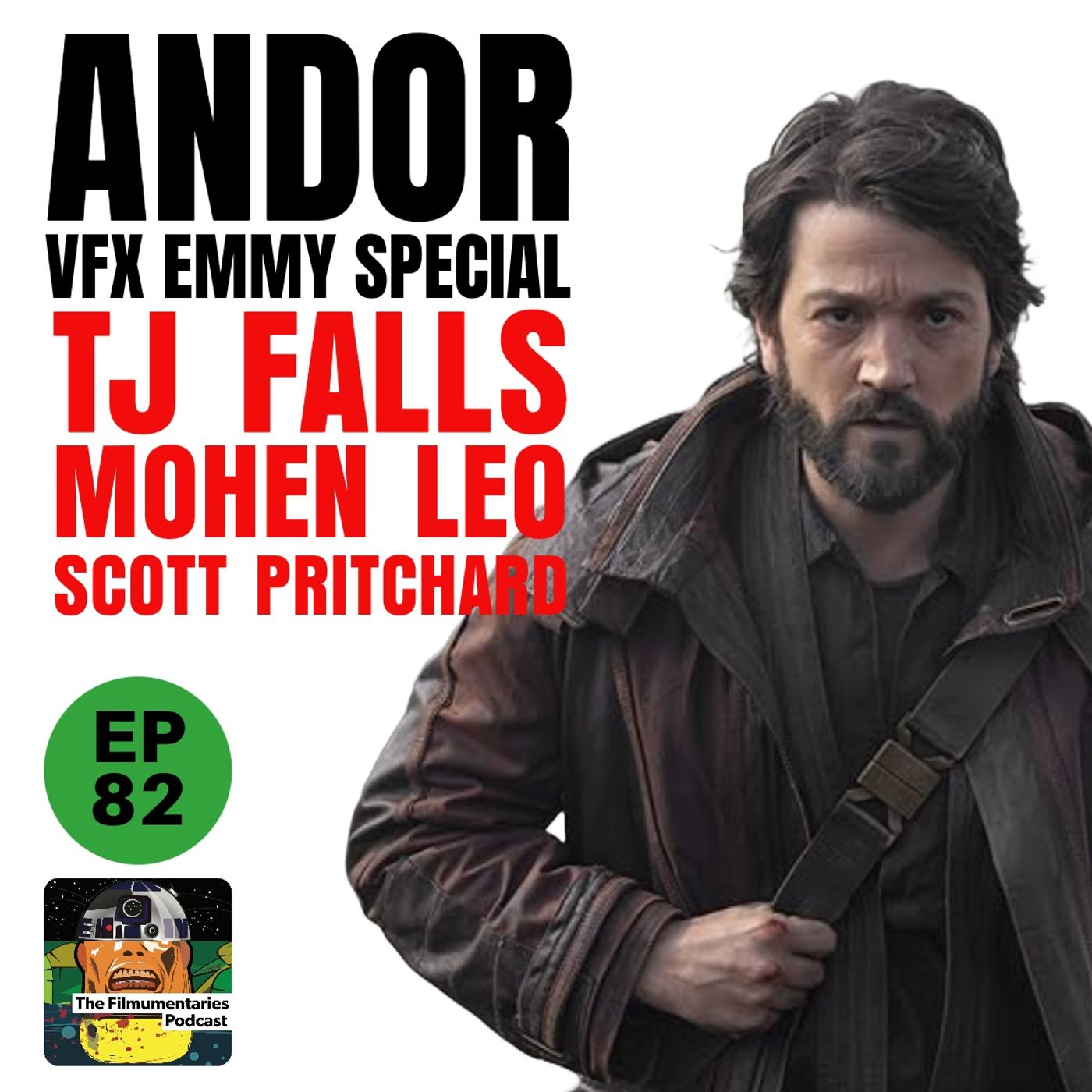
82 - Andor VFX Emmy Special - Mohen Leo, TJ Falls, Scott Pritchard
About this episode
Today is a small diversion from the usual. Rather than film history, I have three guests who are very much part of the film now, or TV now. These three gentlemen are at the forefront of VFX on Disney+’s Emmy award nominated show, Andor. Genuinely one of my favourite shows for a long time. So for this month, August 2023, there will be three episodes, all conversations with ILM VFX and Skywalker sound artists and technicians in celebration of their Emmy nominations.
Now if you are a regular listener to this podcast you’ll know that I hosted a panel at Star Wars celebration here in London back in May - I mention it to literally anyone that’ll listen. HAHA. On that panel were VFX experts Mohen Leo, TJ Falls and Scott Pritchard as well as special effects supervisor Richard Van Den Bergh. Now due to a complication backstage the panel was not recorded save for a few snippets that the ILM team shot.
So I dedicated a whole episode to Richard Van Den Bergh about his career in special effects. That was episode 80 . And while not an episode specifically about Andor, we did talk about the show a little. (do check it out)
Then very recently ILM got in touch and asked if I’d like to interview the three VFX guys on the podcast. They along with Richard have been nominated in the category of Outstanding Special Visual Effects In A Season Or A Movie. I immediately said yes and within 24 hours I was chatting with these wonderful artists again.
So here’s my conversation with Mohen Leo - Production VFX Supervisor, TJ Falls, VFX Producer and Scott Pritchard, ILM VFX supervisor…
Links
Return of the Jedi Timeline Book - Register your interest!
Etsy Shop - Buy your Jabba print here
Filmumentaries Merch
Support the Podcast on Patreon
Linktree
This podcast is completely independent and made possible by listener support. If you’d like to help me keep making these episodes, you can join my Patreon community here: https://patreon.com/jamiebenning
Watch more on YouTube:
Check out the Filmumentaries YouTube channel for behind-the-scenes clips and extra content: https://youtube.com/filmumentaries
All my links
Transcript
Automatically generated, so expect the odd misheard name.
Welcome to this special episode of the Film Mementaries Podcast, episode eighty two. In fact, today is a small diversion from the usual rather than film history. I have three guests who are very much part of the film Now or TV now. These three gentlemen are at the forefront of vfs for ILM and Lucasfilm at Disney Plus's Emmy Award nominated show, and or genuinely one of my favorite shows for a long time, not only my favorite Star Wars for a long time, but my favorite anything for a long time. So for this month, August twenty twenty three, there will be three episodes, and they'll all be conversations with ilmv Effs and Skywalker sound artists and technicians in celebration of their recent Emmy Award nominations.
More of that in a moment, but firstly, I just want to welcome you if you're a new listener. Despite being a little diversion, this is very much the same as you can expect from the other eighty one episodes. Essentially, it's a conversation with artists that I admire about their work, and if you're a regular listener, welcome back. Thanks for joining me again. If you do like my work, please consider donating twelve dollars or your country's currency equivalent to help pay for an entire year of episodes.
That's at least twenty four episodes, and honestly, it will most likely be more because sometimes I do bonus episodes as and when I get the opportunity like this one. Now, if you are a regular listen to the podcast, you'll know that I hosted a panel at STYLES celebration here in London back in May, and I mention it to literally anyone that will listen. And on that panel were VFX experts Moe and Leo, TJ Falls, Scott Pritchard, and special effects supervisor Richard Vandenberg. Now, due to some complication backstage, the panel was not recorded save for a few snippets that i LEM recorded for their internal use. So I've already dedicated an entire episode to Richard Vandenberg about his career in special effects.
That was episode eighty and while it wasn't an episode specifically about Andel, we did talk about the show a little, so you can check that one out. Just a couple of episodes back and then recently i LEM got in touch with me and asked if I'd like to interview the three VFX guys on the podcast. They, along with Richard, have been nominated in the category of Outstanding Special Visual Effects in a Season or a Movie twenty twenty three. I immediately, of course said yes, and within twenty four hours I was chatting with these three wonderful artists again. So here's my conversation with Mo and Leo Production vfect supervisor, t J Falls VFX producer, and Scott Pritchard ILM v effects supervisor.
And I'll be back at the end for a bit more jabbering on. Well, thanks for joining me, guys. I just want to congratulate you, first of all on the Emmy nomination. Must be really gratifying to see your work nominated and put in front of all your contemporaries and your colleagues and you know, a celebration of what you did. Thank you.
I really appreciate it. There's is it's it's it's really rewarding. It's also you know, a bit unexpected. We all do it, you know, for this moment in time, but to actually be acknowledged and have the work appreciated in the way it is is really gratifying. Really fulfilling, really nice.
It does mean though that you have to you know, up your game constantly, now, you know. Yeah, we of course had that wonderful afternoon or was it morning, I can't remember, back in May at Star Wars celebration where we had a thousand people turn up to come and listen to you guys talk about your work. Along with Richard Vandenburg, who did the special effects on this show. It was a great chance for the fans to come along and listen to sort of behind the scenes stories and to talk to you guys. We're going to go over much of the same material here because I you know, one of the regrets of that panel is that it wasn't recorded and we couldn't get it out in any other form.
So it's great that I've got the opportunity to talk to you again and we will cover some of the same ground. But I you know, I could talk about this all day, as I'm sure you're aware, but hopefully we'll be about an hour as well. Moment. Looking at the concept of and Or, it's not your typical Star Wars show, it doesn't have the typical tropes. There aren't really there aren't Jedi there aren't that many space battles as such.
Really we don't have light sabers. Did that impact on how you approached the effects work? You know? Was that freeing that you didn't have those big, flashy moments and you could have more subtlety in the show. How did that sort of guide your approach?
Yeah, I think it definitely didn't. Did have an effect on it in a way. It's an extension that both the work that we did on Rold one that both TJ and I had had worked on before with Tony Gilroy was the showrunner of and Or, and I think early on we had conversations about the aesthetic that that Toy was looking for for this for this show, you know, like back in twenty nineteen when we first talked about it, and I think to him as well, what was important was that everything had to feel grounded, had to feel sort of believable, because the story is not about larger than live figures. It's not about you know, people with superpowers and heavy fantasy elements, but really once again, like wrote one sort of more about you know, the the quote unquote normal people and their struggles, and so with that it was really important to him that everything felt sort of tangible and tactile and believable.
So I think more than we always try to sort of take inspiration from from the real world. But I think with this show, more than with some of the other Star Wars projects, we really try to anchor everything in something that would exist in reality. So on the one hand, when we're creating environments, we always try to have something we could shoot first, you know, not placing people in front of things that were entirely made up, but either having a set or for course, on quite often like London locations that we could basically take the director the DP could go there and actually find their angles, take advantage of the real light, the real weight of the architecture, and then sometimes we would still replace like eighty percent of the frame with visual effects ultimately later on.
But I think to give everything that that grounded feel, it's really important that the camera was always pointed at something that would provide the basis for what would eventually make out of it. Yeah, there is that really grounded field to the show. I often think of those the way that we kind of get the establishing shot on a on a new location. It's not like your typical style was wide shot. It's it's a kind has an everyday feel to it.
Like there's that opening shot with Cassian, that walkway, which I believe was shot in Essex, which is ten miles from where I am now, and we see the rain, we see his footsteps on the ground. We're sort of grounded into that moment. And then the work that was done on set and with the special effects is then backed up by you guys, TJ. Can you talk about how the special effects work and the on set work influenced your work? Absolutely did that in the spirit of the collaboration that the show provided, which was immense and I mean and everyone involved played such a pivotal role, which is also nice for us because we're interacting closely with every single department, and so with special effects, we were able to to build out and find the proper handoff between the practical and the digital so that we got just as much practical work in as we needed versus when our digital extensions would take over or effects would take over.
And that that opening, that opening shot is a good example because we had to have rain, we had to have when we had to have all these pieces that that you got somewhat on location, but we also needed to shoot elements. For so much of the work and the show we were relying simply on digital creations of elements, So working hand in hand with Richard and his team, we were able to get rain, fire, smoke, explosive. Everything that we needed that you see in the show essentially has some basis of practicality built into it, and being able to work hand in hand with somebody like that certainly helps make it very easy to understand whose responsibility is what, so that there isn't, you know, a preponderance of one department over another.
It's everybody working in concert together. I think. Also on that note, I think we were, on the one hand collective. We were saying at the start, let's try to do as much practical as we can. But eventually, I have to say, in some sequence we were even surprised ultimately how much well as possible product hold little we had to do impulst.
So, for example, in episode three, this to shootout in the abandoned factory with these giant metal pieces hanging from the Sumu had come crashing down, that was basically all done practically. They were ultimately like maybe two shots or so in the sequence were just for safety reasons. We had to shoot things in several layers where the actors were separate from the thing falling down. But other than that, like other than the blaster shots, but all of the interactions of these things swinging around and crashing down was done entirely practically in a real set and so fantastic fun and a lot of that was able to be achieved because it was planned as well. So again it is getting the departments together, so we had a good sense of the set and the space from lukeholl in the Art department and their team.
We previs the entire sequence with special effects, with production designed, with the director, with the DP, so that everybody knew to an absolute certainty what would happen that you get there on the day, and there's always the intangibility of real things happening. And it went off perfectly exactly what we wanted. And that's, you know, the way that it can all come together in a really, really good way. Yeah, the panel I asked Richard about that sequence and said, you know, how much work is here's and how much work is yours? And he said, well, you're gonna have to ask those guys and then moan when you said it was almost one hundred percent practical.
He decided it was his favorite sequence of the inter series, which amused me. Scott, we're sort of talking about, you know, these these practical elements and working with something to ground things on. You were in charge of the aerial unit as part of your job, and you did some some shooting and had you know, you come across when you're doing things practically, you come across those happy accidents that you might not happen to come across if you weren't doing them in that way. You went out to Lanzarotti, was it that you shot some of the ails? Yeah?
And what was the experience like in doing that? Who was incredible? I mean to go up in a helicopter with a stabilized camera on the front and go and shoot aerial plates is really something. And yeah, I mean happy accidents. We had.
The plan was that Ferris was going to be this overcast, slightly misty, bulky environment. We had a set of the Seris town itself built in Marlow and Backhure and just outside of London and yet predominantly fairly fairly overcast plates for that and then we also shot some reference photography up in Port eight Seaton, which is Dockyard Borthly Disctlantal oil rigs, and we had these incredible photographs of these huge oil rigs just looming out of this amazing mist and mok so that was definitely the kind of the desired aesthetic. Now, the Canary Islands is predominantly quite a sunny location, but we know that had been chosen because of the amazing volcanic red and black soil that's there in the Tin and Fire National Park Volcanic National Park as part of Manzarotti.
And we got the helicopter set up and we were due to go on a test flight and just to check that the weight of everything was okay, because when you hang a big, heavy camera off the nose of the helicopter, it just has to be They have to make sure that the balance is right in the back of the helicopter second fly property. So we went on a test flight, flew up into the mountains and suddenly it was just as incredible, foggy, misty backlits beautiful environment, and the camera operator and I just kind of turned into each other actually just shoot this son a ten minute test flight turned into like an hour and a half shoot and we shot I think I think we shot eighty percent of the shots that we were due to get over the next couple of days on that one shoot, and yeah, they were just beautiful.
It's great when you come across something like that where you wouldn't necessarily think that you know, you're going to get the results that you were intending to get. You know, is those happy accidents? Isn't it that you know, we assume don't happen in visual effects anymore, But of course they do because you're using each of the different disciplines of your job too as a tool to create the best environment that you can. We also saw in some of the press, I think later on and maybe in our panel as well, that you used some of the stagecraft technology, so the big LEDs, but not in the way that people would imagine. I think people need to be reminded, and I'm hoping you're going to do that in a moment, but people would need to be reminded that this isn't like a technology that's going to solve every problem, you know.
I recently spoke to Pablo Hellman, who worked on the Fableman's with Spielberg, you know, and they did some screencraft stuff or stagecraft stuff with the car scene. Can you talk a little bit about how you use that LED technology but in ways that people wouldn't necessarily expect. Sure, yeah, absolutely. And so for the stagecraft filled for this particular show, it was due to provide these environment extensions to the shadow of an embassy on Carsons. So the set and the set guys at Pinewood built this amazing set of the embassy and there were two main rooms in this set.
There was a dining room which had a lull straight wall with lots of windows in a line, and then there was also a part of rim which is a much more kind of intimately closed set where private conversations could be had, and that had a curved bench with a curved series of windows behind it. And what we did we had the rled walls where alongside both of those there were two walls. There was one which was a straight one and then one which curved around the windows. And the job of the stagecraft and content was basically to provide the correscent locations out of side, so the views out of the city. So we we developed four times a day for two views, one out of the dining room and one out of the parlor, and we could instantly switch between foggy night to rainy day to clear day, so it could alter depending on the time of day that was set up for the sequence.
But one of the key things that we had for Stage Crapical was that we could we have an iPad on set or can control a lot of the various elements of the content on screen, so we can shift different layers of the city around, We can adjust exposure and then color balance of the the content. So we work very very closely with the director of photography to make sure that that that is another you know, aesthetic element of the shot. So it's again it's it's it's it's something that the director of has, you know, a vested interest in, so you know, we we work very very closely with them just to make sure that that's got the right photographic look let's view through the camera. Yeah. Has it been difficult to kind of get directors of photography to kind of adopt this new technology?
Is there some sort of cynicism towards it or initial kind of oh this is too bright or this is too too difficult to work with it or is it is it a tool that they find easy to adapt to. I mean, philosophically, we're not, you know, we look for the right tool for the right challenge that we're trying to solve in the production. So it's not forcing tool sets on anybody. It's really going, well, well, here's a set, here's here's a scene that we have to achieve. What's the best way to do it?
And in this situation, stagecraft was absolutely the best option. So when it's discussed as a collaborative effort, again, it becomes a very simple conversation if here's what you get, here's here's what it is. But then it is inherently the DP conversation terms of lighting and the creative aspect. Yeah, but I have so far on both seasons that I have not had a TP ever turned down the opportunity to light with a led screen, just because they know how much more control it gives them, you know, And so because normally the alternative would have been that we would have had a big blue screen out there, which doesn't even function as a light source. So for daytime scenes where you want the majority of your light to be actually like daylight that comes in the LED screens are so much better.
The other thing to keep in mind is that that really over the last few years now all of the dps are working in a way where they have an operator standing next to them with an iPad that has full control over every single light that's in the set down to like blinking LED lights and giant sky pals and everything, and they'll just the their job now is to go like, Okay, make that one, you know, a ten percent darker, a little bit red over here, stop that blinking, And to then have another operator staying next to them and go like, oh, make the sky a little bit brighter and take that down. They're perfectly comfortable with that, So I think it did work out, really really want. Yeah, it's great that people are adopting those new methods.
One thing we've not really discussed, and maybe we should just take a couple of minutes to do so, is to kind of talk about your different role titles and how they interact with each other, because otherwise I'm just going to mess it up. It's fatter coming from you. So I'm I'm the bit of back supervisor on the studio side with with TJ. Being the VFX producer, and then Scott was the Island Visual Exports to the Island Visual Effects supervisor because we ultimately worked with mud Will vendors on the show, and so I'm I'm sort of overseeing the whole thing and I'm present on the shoot the whole time. Scott oversaw impost production, all of the work done by ILM okay okay TJ has to make sure it comes in on time and on budget.
Yeah, work through all the logistics, all the planning, and make sure that that everybody's working in concert together as well as the collaboration between all of our departments on the show side and and between you know everyone that works from our previous posts vendors, the third floor that we're using with Jen Kitchen who's our supervisor, through all of our vendors, so ILM, Hybrid scan Line, SOHO, the Effects and Rising Sun who all played a key component, as well as our in house team that was led by Mark Hutchings. So all of us were together feeding all of the creative pieces in Samoan, who then ensures that we've got a consistency over the twelve episodes of the show and that everything matches Tony's vision and it's a it's it's quite an undertaking, but that's why we need everybody to do their piece and their part, and we have partners like Scott, it becomes a very fulfilling and rather fun experience.
One other thing that I'm interested about in terms of the supervisor role is how you can kind of draw all of the threads together and create a kind of cohesive look and ensure there is a cohesive look. What kind of methods do you use to ensure that everyone is kind of on the same page. I mean, one of the things that on this show that has really helped the set. We've known, you know, Tony since Rogue one, and so I think that there is sort of a bit of a shorthand already with expectations and also got a trust where quite frequently he would just sort of describe in broad terms what he's after aesthetically and then allow us to sort of put something together and presentative. I think for me personally, it's also just the really close collaboration with the production designer, with Luke Hull, who's just been fantastic, and it's just been this really good collaboration and both on a practical side to say like, okay, well, how much set do we need to build?
How much can we then do digital extensions? How do we really spend our time and money wisely between the real things and the digital things, but then also making sure that all of those things fit together, that the aesthetic of the the digital extensions that we do is completely coherent with Luke's vision for all of the practical things that they're building and the locations that they're making. So it's a it's a really close collaboration there. And then with you know, working with people like like Scotland, the supervisors that the other vendors, it is talking i mean sometimes almost daily, you know, just going through things, going through reference inspirations, talking about you know, yeah, the the things that that because we also want to make sure that that then the vendors and the supervisors at each vendor bring their own ideas into it.
So often we're basically saying, hey, this is what we're after sort of in terms of the emotion of the scene, the aesthetics of the scene, but then giving them freedom to actually sort of expand on that as well. M Yeah, sorry, Scott, thought you were going to expand on that then, but you just nod his least fine, Yeah, absolutely, well absolutely, and that goes as well for my interactions with my crew wilds that you know you having having. I've been an Island London now for for nearly ten years, so I was part of the the initial team that kind of set up the studio and helped recruit a lot of the artists. So I know how much we foret I know firsthand how much work has gone into building the team there, and you have this incredible, you know, slate of creative talent there, and you know, it seems such a shame to basically sit there and go and tell them how to do, what to do and how to do it.
So I again, like mowing with with gives to me and the other vendors, you give them creative freedom to explore their own ideas as well and bring those ideas at the table because you've got this amazing team of creative brains there who might date of something that you never would have thought of. And it's always a really fun process to be surprised in our dailies review sessions was something that you you know, somebody who's just got I've done, I've done this, but then I've also done this and we heard quite a few moments like that on the show where there was, for instance, in the end sequence when we get into those close up shots of the Best Star, one of our artists actually put in some modular blocks which are very recognizable shades.
I never discussed this lip that I never got them to do this, but they were based on the original Beast Star trench from miniature that I LM in Valleyes in La did for the first Star Wars movie, and he just kind of snuck them into the background in a little kind of easter egg and that was just brilliant. So it is really enjoyment when people kind of bring those ideas, but in terms of those kind of are you gone, no, it's going to end. And I think ultimately that is what what makes this work shine the end is that it's better than any individual person could have come up with because it's it's a product of so many talented people bringing their their best together, you know, so and it is it's hundreds of artists you know, worldwide as well.
I mean it's Scott with Ilm had had had artists and in London as well as in Vancouver all part of this team. So it's it's getting you know, all of the cream of the crop that that work well with our individuals, vendor supervisors, but then can bring their their their specific talents to to show and uh and it's it's magical. How do you you know, talking about the kind of the desk star thing you mentioned there's Scott you know, how how much access do you have to kind of legacy assets? I guess is what I'm saying, Because of course we've got the number of movies, we've got the other TV shows that have existed. You've got to fit within that universe.
But obviously you want to bring something new to the project as well. How do you how do you go about finding that balance with the things you have access to but also giving enough creative license to your artists to allow them to bring something new. Absolutely, I mean we have we're very lucky to have, you know, all of that forty plus years of legacy of ILM. So we have what we call our backlot, which is basically a big digital model toy shop essentially that we can when we finish a show, we just package everything up and archive it. So we have a huge digital archive of all these cataloged vehicles and environments and assets that we put together for each show, so that they're all very well catalogs.
It's actually quite easy to find, you know, Oh do you remember that ship on a road board. Yes, we can go and find that and then bring it bring it back. So we've got bad aspect that we cantrol through all these different areas. And obviously we've got people public it. I'll goo that, you know, our Star Wars kind of more experts who we can just check and make sure that everything is is kind of period correct when we're dealing with the specific kind of timeline of the show.
And then also we've got we've got our our last martives as well the physical models that we're actually made, so you know, we've we've got you know, lazy reference for Cobra fields, you know, all of those miniatures that they can bring out their crates and you know, photograph whatever you need, you know, if you need a particular part. But you know, quite often we we have we i mean, we're all Star Wars fans ourselves. You know, we got the books, you know, of the of the literatures that we can kind of dive through those and find little bits and details of some of those because obviously, you know, one of the things that they show with the with the Spaceship work and the dust Star work is that we were trying to evoke that feeling of the miniature work that was done in the original trilogy.
So really hard to lean into that. I study. M Yeah, really felt like you guys now there in the show and in you know, in It's sort of predecessor, if you like Rogue One, it felt like, I don't know, it felt like it had that tangible feeling to it, like I could reach out and touch those models, whether they were models or whether they were you know, CG models. We talked, I talked about at the start and this show not having those kind of big sort of showcase moments, but of course there are some. You know, there are some in their moment The Eye of al Danny is hell of a sequence, and you know, I know from talking to you on the and or paneled it, you spent a very long time working on that sequence.
Where where do you draw inspiration for something like that? I think the phrase that you know, visual effects artists and supervisors may relish or worry about even is is like nothing I've ever seen before. There was the phrase we talked about the panel, Yeah, where do you begin what? Definitely, Yeah, it was definitely one of those one goals thrinking moments where the expectation from Tony was to to have something that that felt, you know, like fresh and stunning and beautiful. There were so early on and it's like, well before even principal photography started on the show, we started talking about that sequence because because it felt like one of the biggest design challenge as we had on the show, in particular, because it had to meet a number of criteria.
It had to still feel like plausible and grounded enough to fit overall in the show. You know, it could you couldn't suddenly have something that that felt magical or outlandisusly fantasy in the show. It had to look sort of mesmerizing and serene enough that you believed that a religious, sort of meditative festival could be based around that where people would watch it in silence as a you know, religious empinal. And then it had to still when you fly into it feel absolutely dead, being terrifying, like something that you could not safely fly a ship through. So we studied early on looking at all sorts of just like celestial phenomena from obviously like you know, meteor shooting stars, Aurora's just general like space photography.
And we started with with scanline and and yell with the supervisor there to do a tests, just visual tests, which initially we're actually probably slightly to sort of like maybe scientifically driven. And when we shoved the first to to to Tony, he was like, no, it is not quite what a picture and he sent us But this at first terrifying because we're sort of like out of the spectrumle what we expected Portntalist paintings of like of like skies, where like these skies were just like like not abstract but like basically Impressionist paintings of skies where skies will make up out of like tiny dots of different colors. And he was like like that, and we're like, oh my god, hope or an adjustifying in the sky.
And so so we basically started going like, okay, well it has to be basically meteors and it's like shooting stars effectively, and they have to burn out in different colors. But then how do we make this you know, like interesting and and esthetically pleasing. And one of the things which was interesting because it wasn't necessarily how it was intended to be read, was the event was called like the Eye of Aldani, and in Tony's mind it was really just more more or less that you know, like this opening wood form, like where they could fly out, or initially think they could fly out at the end. But we started looking at close up photographs of the human iris, and in particular, if you look at close ups of blue eyed you know, people like up close there are these like incredibly complex patterns of like various colors, like blue eyes have all of these greens and yellows and you know different, isn't that these really thin lines that sort of weave around each other.
So that actually became like a huge inspiration for the color palette and the and also just sort of the esthetic I think of it. And then lots and lots of iterations of you know, trying stuff out. And the thing is you start with sort of five six, seven test shots and get like versions going, and then suddenly there'll be one shot where you're like, oh, that one's good. So how do we get that feeling now into the other shots and into the other angles, and it's it's really an exploration process rather than like a straight line to a to an idea. I have to say you absolutely now that sequence.
I was sort of left, you know, mouth a gape kind of looking at it on my big screen. And talking of big screens, like I interview a lot of people who work in, you know, movies that end up in movie theaters. Your show, of course is not in movie theaters. But how do you go about reminding yourself of the scale on which people might be watching this because of course people at home now might have seventy eighty hundred inch screen. I mean, we we do review things on both like very large TVs here, and then ultimately there are multiple rounds of reviews, you know, with the with the colorist on like the most highly calibrated monitors you can have.
There are like high dynamic range reviews that we do because there will be a high dynamic rade release for the show as well. So by the time, by the time it goes out, we will have looked at every shot many, many, many times on different devices in different scenarios. But there are for example that on the other end, there are considerations where you go, well in a movie theater, you can rely on the fact that people are always going to be in a dark room, you know, so you can you can basically expose things differently where when you know that you're working for for streaming television, that has to be a consideration that that things have to be more readable when there's more ambient light as well.
In terms of finishing, you know, we we don't to finish only for a television type release. We finished everything in four K HDR. We we've gone through all the machinations to allow it to be viewed on any platform, And when we did the premiere for season one, we did it at the l Cappy Tan in Los Angeles on a movie theater screen, so you can you could project it on a screen and have the same experiences on your television at home. And while we should should need at it to be mindful, you know, for some of these these aspects of how the show was made, we aren't restrictive either. We want to make sure you've got the proper experience no matter what platformula.
And there is an element also just sort of future proofing in the sense that right now not everyone has a four K or in HDR TV, but do you want to show to still look good in ten years when more people do. Yeah, well, you know, if my local picture house has been showing every episode every Wednesday morning, I would have been straight down there buying tickets. Maybe maybe that's something we should think about in the future. One of the other big sequences, of course, was the Luthan's Lightsaber ship. Now, was that something that was mentioned in the script or is that something that came out of your work as as visual effects artists?
That? I mean just because definitely Scott can talk more about the execution of that, But conceptually that was actually a funny one because it happened pretty late in the in the writing process. And I just got a phone call from Tony one Saturday actually, and he was like, yeah, I feel like we don't have like we were missing shows that we need, like a good like space speed in here, you know, you're always disappointed and have that. And so he basically said, I'm thinking, you know something like you know where the ended up was end of episode eleven indutally was beginning of episode twelve, Lewis and leaving Saws Camp and effectively more or less running into like a police patrol. You know, and having to find a way to to fight his way out of that.
And he kind of left it at that, basically saying like, can you can you tell me what we can do because he knew that that, particularly at this point in the in the process, he couldn't just randomly add like a thing without some boundaries around it. And I was like, Okay, well, let me think about what we can do that is achievable in terms of how much time it will take to shoot, how much time it will take to execute, and how many new assets we're sort of bringing in. And one of the things that I had stumbled across was there was this ship, the Interdictor, with a giant dish on the front right that had been built for Solo but barely used in the movie. And I was like, oh, well, here's the thing that that we can you know, like make something out of that already exists but hasn't been hasn't really been used before.
I had just seen uh ad Astra, which is the Brad Pitt movie, which has this beautiful opening sequence which is sort of in the stratosphere, like on the edge of space and being in the atmosphere where they just really liked and we hadn't done in Star Wars as a location for US based belts, I thought that would be cool. And then for the weapons. The thing out of the conversation with Tony about Lutherans ship, one of the things he brought up earliest that he said, like, well, I kind of wanted to be like like James Bond's asked Martin, in the sense that it looks like a normal ship, but that has all of these hidden you know, hidden gadgets and weapon defense mechanisms in it. And so the double that that double beam weapon that came out of two things like in my mind where I early on while one of the things he asked Martin has is the blades that come out of the tires, you know, that can tread like cards that are caught next to it in a classic one, And so that's stuck about that kind of yeah, yeah, if it's something something we can do like that, like a weapon that goes out to the side.
And then the other thing that influenced that was a moment that I really liked at the end of Iron Man Too, where in the fight in the Japanese Garden, he has like a one off laser weapon that shoots out two beams and he does like a spin and all of the remaining people around and basically like are like cut down by it. And so I thought like, okay, let's try and pitch that we previoused it out and then I had to actually show it to pobble it. I'll go and go like can we do this? You know? Is this allowed in Star Wars as as a weapon?
Where are the boundaries? Like we've done like beam weapons before. You know, you can have a beam that basically is like a continuous beam, but it should be something that is like there's a limitation on a gyam, which is why you're saying like you have to like charge it up and then he can fire it. You know. So long, long story short, like a lot a lot of thoughts that went into it, but again it's sort of like evolved over time and it's got that execution of that shot.
Then just trying to make sure you know, it does fit in within within those boundaries you know visually and the and the way it moves and the way that weapon is utilized. It must be a sort of a difficult kind of tight rope to walk. Definitely, Yeah, I mean just the task of actually integrating the weapon into the ship's design in a way that, you know, like mol was saying about the Ashton Martin, you know, you could look at it and you'd never know that it's armed and teeth. So we had to figure out a way of actually hiding the cannons inside the ship's design and then allowing a way for them to deploy. Now, I'd always like the design of the in the Troy and the design of the spark and shields which had a kind of a notch cut and but they're steered through it.
So we had this kind of thought that we could basically bring the wings up to a kind of a vertical position where there's a notch out at the bottom of the wing through which the cannon would then kind of come out of all the wing kind of faull prow, which was chunky enough to allow, because the thing has to the cannon can't be a tiny kind of p futury type of thing. It has to be kind of a chunky that the body of it has to look like it's something you have to charge up for a barny seconds before are releasing the noor's blasted energy. So the main wing pivots were these big, solid cylindrical barrels which felt like they could pot place to put them on. So we have doors that opened on them and the cannon would then come through that.
That's yeah, that's like a lot of time just to kind of figure out the mechanics of how that would work plausibly. When you talked earlier moment you mentioned about you know, having these real locations that kind of anchor you at least, I mean obviously something like that that we've just talked about with the ship. You know, you've got this kind of open doors kind of situation and you're trying to work out the boundaries yourself. How important are those boundaries to have though with the with the kind of location work, because you know, I talked about that Coreton refinery, wasn't it in Essex? You know, which gives the whole thing an industrial look.
You also shot at the Barbicane and McLaren's f one site in Woking. How important is it to have those kind of grounded location shoots for you to kind of build upon. Yeah, I think it's I think it's it's really really valuable because everyone goes into shooting the shots with a clear intent of what one beta. So what we normally do is we'll do a location scout well before and so we'll go there with the directors, the DP of the production designers and take lots of photos, and then the production of this well actually with our input, work out how if we're going, for example, the McLaren building, which is a beautiful piece of architecture, how we transform that into a corus on spaceport, right. And so there's a bit of negotiation going on in terms of like, wow, we have to make sure that we actually keep enough of the logation to make it worth going there.
But then at the same time, aren't hamstrung that you can't make it feel like it's Star Wars. And so we basically agree early on and like, okay, what are the key angles that we're going to shoot in a location like that? Then the art like concept art will basically create paintovers of our photos and goli Okay, this is this is how it's going to look when it's all done. And then with that the director and the DP can actually go in there and go like, okay, I understand if I shoot this way, then we're keeping this and there's going to be space spaceship out of this window and you know all of those things, which is so so much better than than having someone should just into a blue screen and go like, yeah, you know, we'll both of the space ships there and you know, don't worry about it.
So sometimes it does create maybe not more work, but different work than ultimately in post production in Scotland talk about because obviously if you don't have a big blue screen there, there's a lot more roto, there's a lot more manual work to try and fit the digital and the the real together. I think ultimately you just still end up with something that feels more real. Oh absolutely, you know when you when you're able to a full plate gives you that initial starting block where you've got you know, you've got the quality at the light that's actually hitting the environment, You've got the light direction. You're already off to a great start. You know that that in order to make your digital extensions look real, you know, you're you you're already got a model that you can kind of work towards.
And actually, just going back to the theme of little happy accidents, one of the things that we noticed about the plate. One of the plates in the McClaren building was these beautiful reflections of that. They have a lake outside and the sun was hitting these this lake and then bouncing into the building and create these beautiful coustic reflections, moving shimmering reflections on some of the bridges and structures, and you know, we'd initially thought of that's you know, because we're getting we're removing most of the outside. You know, that's like, okay, that's something we're going to have to remove from the inside because how do you know, maybe you justify that. And then it kind of gradually kind of dawn well, maybe we could actually justify those by having something outside that actually causes that.
So we built a little moat that runs around the outside that you know, we just hit a bit of sunlight kind of just to sparkle for the little spark cause of the water. And that. Again, it's just little things that help tie what's going on in the plate with what's going on in the extension that you may not actually you know consciously, uh see, I'm kind of interpret but they all just help to kind of create this overall picture of everything just being this one photograph. Yeah, it does help you. You buy the situation.
Yeah, yeah, And I think that's that two things. They're one perfect example of things that that I would have never thought of. When we're on location shooting that, I was just like, oh god, these reflections put And so when when Scott in the team pitch that, I was like, oh my god, that's a brilliant idea and it's actually it's so much better and that it awful. It forces complexity into the digital environments that you otherwise wouldn't necessarily do, you know, Like it so often happens that even with just locations, like with like sky Eyes and and things like that, where you in your mind you go like, oh, yeah, when we're going to go there, it's going to be all like this kind of weather. Like in scene one in Scotland, there's a scene at the top of a mountain that where they're having a conversation.
And initially when this was written and when we're planning it, we're all like, yeah, it's going to be a great scene. You're going to have like these vistas of like Scotland in all directions. And then we showed up that morning and it was so foggy that you had like visibility of I don't know, like fifty feet or less, and so it's just like this big white soup. But the scene suddenly felt much more atmospheric, and it actually really helped the tone of the scene that it was sort of claustrophobic. And so I think it's things like that that are are fun because those are things that are kind of forced on you, but then ultimately make it feel more real because not everything is designed by someone by hand.
It's unexpected, certainly as an intimacy, doesn't it when you have that folk around? Sorry TJ. I was saying that the unexpected restrictions of the shoot. You know, so if we go in with a good basis of an understanding of a location, everybody on the production team knows what they're shooting, but you still are restricted by the location. You still have to get the right at camera angles.
You don't have a wall you can just remove to get a camera where you want it to be. You have to shoot within the location. But then for us as well, once once you have that plate, just as the Scott and moment of described with the water of McLaren, you have another restriction or something within to work that you perhaps had never expected and so it just allows everyone to think about things in a slightly different way and approach in a different way than if you only had a true blank canvas that then sometimes becomes too perfect. Yeah, and I think it's also like, ultimately, even for full CG shots on this show, we always held ourselves to the standard of, well, if you if you had to shoot this, how how would you actually shoot this?
Like would this be a helicopter shot, would it be a drawn shot, would it be a crane shot? And ultimately, if it felt like well, the shot that we're doing, like as a fall CG shot, wouldn't be achievable with a real camera, we said, well, let's not do that, you know, let's basically limit ourselves to things that where where it's a it's a choice. You know, there are other movies where you have cameras that fly through a key hall and you know, do all sorts of crazy things. But for our show, I think for that grounded feel, keeping even fall CG shots limited by the limitations of real cameras was actually really good. Yeah.
I really think in watching the show, you know, when when I LM invited me to come and do that panel, I had to watch the show again, because I haven't noticed the effects, you know, in the best possible way. Obviously, there are those key moments where you kind of you know it's an effect, but of course you're caught up in the story. But what struck me about and or stands out from other TV shows that I've seen in recent years, is all of the work that you've done is always driving the story, is always driving the character. It's never about showing off, it's never about showcasing a new technology. Is just serving the character and serving the story.
And that's that's the important thing here, isn't it Now? It really is, And I mean we had just under four thousand shots, so over the course of the series. It there's there's a lot of work in there. It's all there's a lot of invisible work, but there's a lot of big work. So we've got everything from from giant CG shots to to to simpler paint outs to extensions that become organic within the scene.
And it's it's the seamlessness that we're striving for. You don't want to notice the work. You want to be able to just experience the show. Haven't served the story and be able to enjoy it without noticing that that there's visual effects happening. Yeah, and we're often often sort of kind of restricted against if if something in the background became too it Hanson grabbing, you know, we just got like, let's take it out.
But we're not supposed to be looking there. We're supposed to be spooking at the actor. I'm kind of wondering now, like I'm thinking, you know, I was up at the South Bank the other day and I was thinking, you know this this has got a kind of curiscent feel to it. It's got the kind of barbicane concrete. You did.
All Right, you're wasted. We did a location break's actually yeah, Well, I'm just trying to keep my eyes out for you know, season two shooting, That's what I'm saying. But well, I guess my question really is, given that you've gone down that route of having those those physical known locations, is that kind of driving you to just keep that same aesthetic and for season two and not shooting in locations anymore because it's already defined those locations, or are you seeking out locations that further expand on the ideas that you had in season one. Yeah, we're definitely keeping that same philosophy going of of always anger shots in something real and something tangible, like we basically sort of isn't strictly true, but we always said like, well, let's try to have like the first you know, like like fifty feet in front of camera be real.
You know, like, let's have the things that people stand in that they interact with be real, and then we'll we'll augment around that, we'll build around that. But but that philosophy is definitely carrying on at season two as well. As a last question I just wanted to I'm just interested to kind of know about your interaction with the production designer Luke Hole that you've mentioned a couple of times. You know, fantastic work on this show. Obviously, he's building his sets down in buckingham shere and choosing locations and augmenting them with you know, certain builds.
Does does he then have a lot of work with you in terms of the post production like after the initial shooting, is is he with you at ILM looking over stuff or is his work done in the physical world. So we like TJ and I, after the the shoot finishes, we're actually co locating with editorial into production offices. So and that's where basically like we kept regularly checking in with Luke. Obviously, with season one, we knew that there would be a season two, so Luke was staying on through that period anyway, and we would basically just I would try to keep those you know, regular conversations with him going. So if we had work in progress, we would show it to him like once a week or so and go like, hey, you know, what, what do you think about where this is headed.
He still had a couple of concept artists going that would help out, you know, fill out blank spots where we h and and also then just work coming in again from from vendors, you know, and from from Scott's team. Uh, Like they'll do like a first pass layout of something, a first pass design, and then I would try to get that in front of Luke. We'd have a chat about it, and I think BJ and I like ninety percent of the time clicked really well. But I found it really incredibly useful to sort of get us get us input on it. Yeah, by design, I mean we have these people who have been so instrumental and and with the show for so long to be able to call on them as a resource through the post production period is immensely helpful, and it's and Luca is one of those key collaborators.
Now, I wouldn't normally ask this question on my podcast about you know, what's your favorite this that or the other. But as we're talking about an awards ceremony here and we're talking about your your nomination, could you each in turn just take a moment to tell me what your favorite shot is in the show, Even if it's not a shot that you worked on, I'd just I'd be interested to know, oddly, because it's it's not it's not a particularly like attention growing shot. I keep going back to. There's a shot which we shot at the barbeque, which is a very high wide shot of just seeing Clay I walk towards her meeting with Vell, like the secret meeting that they have there. And I love that shot because it uh to me it it embodies like a lot of what we hope to accomplish with with Corresson to make it feel at the same time like true to the prequels and like a fantasy it like insane Metropolis, but also like a real place.
And and it was one of those where we replaced probably eighty percent of the frame with CG and yet having shot that plate, I was so pleased at like it just all came together and it feels like a real place. And so that that's one of my favorite shots in the show. And probably a shot where you had to get rid of reflections from that lake below as well. Right, that that one, Now that one's kind of a right, it's a different shot. Okay, you're thinking the big, big white one.
Yeah, okay, yeah, yeah, I'll, i'll, I'll choose one of one of our all CG shots, which is a top down looks as we're establishing Corrosson, we travel over the over buildings and we see you know, essentially it's it's a New York type establisher It's it's a really fun I mean, we don't have a lot of establishing shots and in the show, it's that you know, as we've talked about, we we haven't put in an egregious number of shots. They all serve a purpose, they all have a reason, and and this establishers we as we bring us back in the Corrossant really is is to me kind of the embodiment of Big Star Wars in the grounded reality of the show, that that Tony had had pitched, and that that that Moen has been protecting, and that that's that's the type of establisher you'll see in any other major metropolitan city.
Establishing shot on any show. You can get it with helicopter. It takes you into the city and yet we're in our our our fantasy of Corressant and getting to experience the city like the locals would on any other television show. You seeing corson it. Just that's one that that that's really stands out to me.
M great, Scott, can I have too? Sure? Okay, I've always asking you before. I think there's two. There's there's the first shot in the space battle sequence where we'll see the the what was the original design for the starter store kind of Heath interview, and it was just such a beautifully executed shot with the with the so well realizing previous before but kind of on a slightly more personal though, I suppose my my my first jobs in the industry were actually as a model maker, so I was fortunate enough to catch the tail end of the model making era of visual effects.
So you know, it was so nice to be able to really lean into that aesthetic and very much you know that the Star Wars visual effects for the reason I got into this in the first place. So trying to make things look like the models that you know, I knew so well from from my my youth was a real pleasure to actually really try and dig into the details of that. And also for the the it was to be able to bring one of Colin Cantwell, who was the original, one of the very first production designers on Star Wars, to bring one of his creations to life. And you know, obviously Colin unfortunately died just in the you know world, we're just finishing off the show, so it was a lovely way to be able to kind of pay a little bit of tribute to him as well, because you know in the in the audio you could hear that the it says it's a camptwelve class ship.
So I thought that was a really nice tribute and lovely to be part of it as well. And then the other thing was it's not even an island sequence. Actually it is the Eye of Aldani. I think that was one of the most spectacular sequences that just completely blew me away. The plexity the detail of that just yeah, stunning, great, the good answer.
Yeah, I had that same moment with the Colin Campwell, you know design there, I sort of thought, oh, that's for me, you know, because I'm a huge nerve that goes way back. All right, Well, thank you so much guys for your time. It's great to see you again. I hope to see you again in the future. Maybe you know, we can talk about and or two the next time.
And you know, it always is a pleasure to talk to you. And you know what I love about you, guys, is you're just as enthusiastic on the inside as we are on the outside. So you know, the panel, this is the moment where I asked a thousand people to give you applause, but I'll just give you some myself. And good luck to you, Good luck to you. Thank you very much, so much, Jamie, you really appreciate it.
Well. I hope you enjoyed my conversation with Mohen, TJ and Scott there, and thanks so much to the folks at ILM for setting that up and making it all happen so quickly. Next up is another special episode in which I chat with Emmy nominated sound technicians and artists matthew Wood, David W. Collins, and in a separate interview, Daniel Dupree. They've been nominated for Obuwan Kenobi and for Mandalorian season three, and before August is over there will be a third episode.
So three episodes this month on the VFX of Mandalorian season three with Hal Hickl former guest and Grady Kofer, then coming up in September, October and November. As previously promised. For August, I have Spielberg and Scorsese vs. Master Pablo Hellman, then creature effects guru Tom Spener of Spener Designs, as well as ILM VFX artist Charmaine Chan and sound guru Max Smith. So plenty more to come.
Please continue to share this podcast on social media or what's left of it, and with your friends and colleagues. You know this is a small podcast. It's just me and my laptop, and you know I love for doing it, but your support would be really appreciated. Patreon dot com forward slash Jamie Benning. You can also check out my new book co authored with my friend Justin Berger.
It's called a Return of the Jedi, The Unauthorized timeline nineteen seventy six to twenty twenty three, and it's available on Amazon. You can also support the podcast by buying someone of for film Momentaries merch, including mugs, t shirts, bags, bottles At even Socks. There's also t shirts with inside Jabber and inside Jaws posters on them. You can buy one for your next film convention and you know you'll be the only one there with one on probably Please check out of the shop at Filmiamentaries dot creator, dash spring dot com. It's a long one, so I'll include that in the show notes.
There's also an etc. Shop Film Momentaries Etc. Shop where you can buy exclusive inside Jabber prints. Great to get signed by the puppeteers that worked on Jabba back in nineteen eighty two. I'll put the link of that in the show notes as well, and do remember to subscribe to the podcast, the YouTube channel, the Facebook page Film Mementaries on Instagram, you can follow me on Twitter at Jamie s wb and yeah, I think that's a full house.
I think thanks for joining me and I hope you can do so. For the next episode of the filmy Ementaries podcast,



Similar episodes across the network
Matched by shared keywords.
-
Lobster Man from Mars
1 shared keyword: tony