
Season 1 · Episode 83
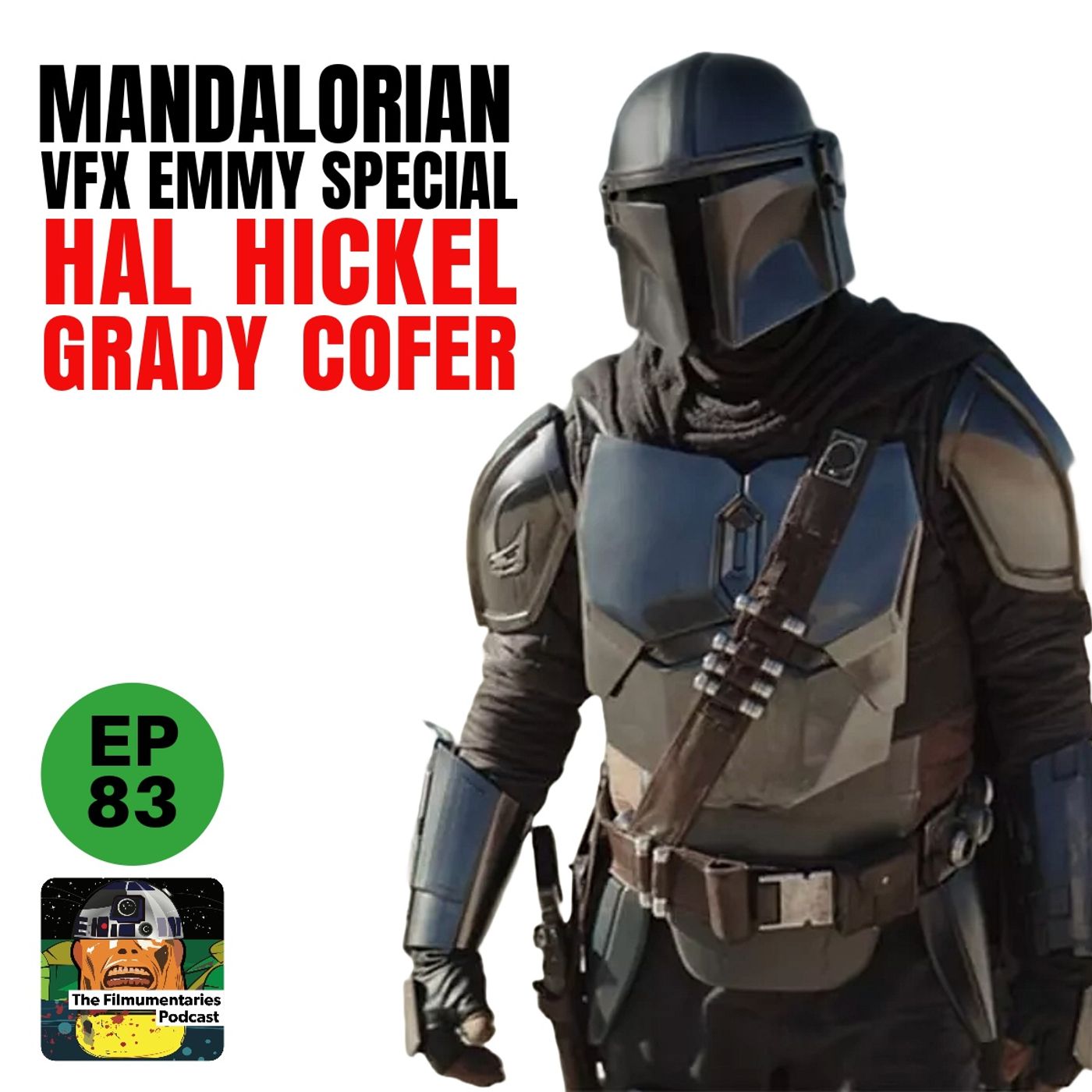
83 - Mandalorian VFX Emmy Special - Grady Cofer and Hal Hickel
About this episode
We chat about their work on the show, the balance of innovation and tradition, the use of certain tools of their trade and the collaborative nature of VFX work.
Links
Return of the Jedi Timeline Book - Register your interest!
Etsy Shop - Buy your Jabba print here
Filmumentaries Merch
Support the Podcast on Patreon
Linktree
This podcast is completely independent and made possible by listener support. If you’d like to help me keep making these episodes, you can join my Patreon community here: https://patreon.com/jamiebenning
Watch more on YouTube:
Check out the Filmumentaries YouTube channel for behind-the-scenes clips and extra content: https://youtube.com/filmumentaries
All my links
Transcript
Automatically generated, so expect the odd misheard name.
Welcome to this special Emmy nomination episode of the Film Ementary's podcast. This is Jamie Benning talking to you here not from my home, but from Budapest in Hungary. I'm currently out here working on the World Athletics. It's baking hot, but it's one of the cities I used to love coming to during my twenty years traveling the world with Formula One. It's good to be back.
So I hope you enjoyed my other special episode in which I spoke with three of the VF team that have now been nominated for their work on and Or. If you don't already know, it was available as a podcast and also as a video on the Film Mementary's YouTube channel, so do check it out. For this the second special Emmy Nominees episode, I got to speak with friend of the podcast and former guest VFX animation supervisor how Hiricle. You can check out episode sixty eight four that conversation. Along with Grady kofa production visual effects supervisor on Mandalorian's season three, we chat about their work on the show, the balance of innovation and tradition, the use of certain tools of their trade, and the collaborative nature of VF work.
So here's my conversation with how Hip Cole and Grady Kofer and I'll be back at the end for a bit more jabbering on. Well, thanks for joining me, guys. It's a pleasure to talk to people whose work I admire always, and I do admire your work. I'm a big fan of the shows you've worked on. And you know Helen and I've spoken before about his career.
Could you just explain to start with so people know who I'm talking to, because this will be in a video little audio version, who you are and what your job entails. Sure. Well, my name is Grady Koepher and I am the visual effects supervisor on the production side for The Mandalorian. And what that means is to try to capture that quickly is you are taking the stories that your filmmakers have have created, right, So John Favreau writes these wonderful scripts, and the first thing is you kind of go through all those scripts and you're trying to figure out how to tell this story visually and come up with different techniques visual effects techniques of course, the innovation techniques from how and in the best way to tell that story.
And then I'm working throughout pre production kind of developing, helping kind of develop those ideas, working with the virtual art department, previous team, and then of course we shoot the movie and then the real fund starts. Right then we go into post production and I oversaw that with a lot of a lot of vendors and present that work and collaborate with Favreau and Dave Filoni and Rick Fukiyama, the creative the creative team to to execute those shots great and how I'm Halico. I was the animation supervisor, So you know, sort of anything that moves, whether it's creatures, characters, droids, but also spaceships and other kinds of vehicles that that you know can't be built for real that we're doing in visual effects.
My team will execute that. And as Grady said, you know, we work with John to help tell his uh story and and figure out the best way to do that. And so you know, we're frequently asked to not just move things, but but figure out the best way to you know, frame them and what what shots to you know, how we design our shots to tell the story well. And so it gets into a lot of different areas, but it's simplest, it's you know, bringing things to life, and and that's sort of my department. And I want to give a shout out to Paul Kamina, who he and I kind of split duties across this season and in supervising the animation, So kudos to Paul as well.
Yeah, it's a very collaborative area that you work in. And but the show like this, you know, it's won an Emmy previously for its effects work and the audience the expectations grow and they hope that it will continue to improve, you know, story wise, character wise, visually, or you know, the audio everything, and fans have grown attached to characters and storylines and meeting those expectations and delivering a you know, a compelling story while still staying true to that sort of Star Wars essence must be a hell of a challenge. Okay, That's that's the key to all of this, right, because I think most people would agree this season was huge, right, It was pretty epic, and a lot of that just came from the kind of themes that John was exploring this time around.
They were kind of bigger themes, you know, rebirth and redemption and the reunification of all the Mandalorians and stuff. So these were really really big stories, and they did demand that the that the visual effects and the world building and the level of animation all kind of be elevated, right, be kind of taken to a new level. But the challenge, of course, is to do exactly that, to really kind of push the envelope, but keep the show grounded, keep it kind of honest to what true to what the Mandalorian has always been, and that is, yes, aiming for the highest level of visual effects and animation, but doing that while balancing with more kind of traditional kind of practical things. You know, the old school tricks that we grew up with, the animatronics and and you know, practical creature effects, model miniatures, all of those, all those really kind of charming, old school tricks that make things feel more i don't know, libd in and real and authentic.
They've kind of grounded and hit that that kind of nostalgic Star Wars feeling. M Yeah, I look at the sort of scale and scope of this show and it just seems to grow seasoned upon season, and you know, there are points where I kind of had to remind myself this is a TV show. You know, there's a star destroyed crashing there are you know, dozens of Mandalorians descending for that final battle there. I mean, it's just just got just about everything in this. You know, you go from environments with water and fire and lush greenery.
You know, within caves you have flying creatures, space battles, sabers and holograms. You must feel like you've got all the toys in your toy box there at times. Yeah, I mean, it's funny that a Mandalorian series is the first thing I worked on that was meant for the small screen. But that said, we've premier two of the seasons, season one and then this one, season three at the Al Capitan in LA and screened episodes on the big screen and they look great. I don't think we're doing anything differently.
I think that the main thing that I had to get used to on the show is that while the quality level is, the bar is just as high as anything I'd worked on before. And to be honest, if if people had come to I'm asking, or you know, any of our veterans kay asking for something less, I think people would really struggle with it. Anyways, how do we even do that, but still the thing that I really had to wrap my head around, even going back to season one, was the volume of the work. It's it's massive, It's double even the largest tentpole summer films. It's double that.
And we do the post production. I don't know, I think it is similar amount of time that we do a big film, but it's it's dorobably amount of work. So this scale is really something to contend with. Fortunately, I am as a great history and lucasfilm generally with managing huge visual effects project. They kind of pioneered that on the prequel films Star Wars Pick films.
Those before those films, visual effects projects had never come close to that many shots, and those films really taught us how to do really huge, complicated, shut up you know, programs like that, and it's only continued over the decades since. So that for me was with the volume itself, was one of the biggest challenges that it's only grown series upon, you know, first, you know, season one, season two, now season three, it's only gotten beater and all it. Sorry, well I was going to say, and all of that. I feel like John is a pretty good partner, you know, and not just because he's a very clever storyteller and he makes sure that the visuals that were creating are kind of in support of and that story that he wants to tell and enhancing that story experience.
But also because I can't feel like he's a bit of a fan of visual effects in general. You know, he's got he has lots of experience, he's he has great instincts about what works and what does and he's always interested in kind of the latest the latest tools. So that helps, right We in reviews and kind of collaborating with John and his team, we're very open about what what's achievable, what we you know, what we want to aim for, what's attainable. But we're definitely not afraid and certainly I Love isn't afraid of of of aiming. High Island's got that long history of you know, pushing the boundaries of the effects.
How does that kind of legacy kind of influence and bolster your your approach and mindset as a as a team. Working on you know, the late the Greatest TV show, well, I mean I feel like it's, uh, it's great to work on a show that does two things. It aims it wants the highest level of visual effects and animation, but it also kind of honors the great traditions, uh, you know, of the history of visual effects, So we kind of incorporate that a little bit into production, like whenever we're breaking down a sequence how it worked on a great great see you could talk about it the kind of the great finale at the end of the season where you have you have this this battle, the space battle happening up above Mandalor and all of these tie fighters and bombers are attacking a light cruiser and and I remember, how are you talking about the kinds of paths that that the actual tie fighters could take whenever they were shot as miniatures, and how that could inform kind of things we would do an animation.
So it's kind of nice to have in a way, not guardrails, but like parameters that are based on the way things were done in the past. And to me that when you watch it, knowing that these days how to do anything we want, but do you really want to it's kind of best sometimes to kind of on or to kind of live within that Star Wars world that you know that that we all grew up with. Yeah, yeah, we have We have loads of conversations about is it Star war Z E or not, And that can be have to do with just the simple design or something. You know, those conversations you're jailing with dud Chang and his group, between him and John, and but then you know, when it gets to our work designing shots or the way something's animated or framed or just used narratively or or you know, fits in the edit, there's a field thing.
There's kind of a style guide. But the fun part is we don't have to be religious about it, which ry to We always want to talk about it because it can be easy to sort of side slip into other you know something it feels like like just say a shot of a spaceship arriving at a planet, something simple like that. It can easily feel like Star Trek instead of Star Wars if you with it. And it can be as simple as what the camera moved, how the camera framed the ship as it passed by, or whatever. So we're always having those conversations.
And but like I said, we're we you know, John is perfectly game to trying new things, and so it's it's fun. You know, you this is not our work but if you think of Ludward Gorenson's music for the series, that was an example where John went, you know, took a risk and went completely a far afield of of what had been established previously and it and it works great. And so when in smaller ways in visual effects, we we test those ideas and boundaries all the time. But as Grady said, it's nice to have kind of a bedrock or or like you said, guardrails that I've an established universe and a feel, and we particularly I think we look at the original trilogy more than anything else in terms of, you know, vibe vibe wise.
But Kevin is this Grady say, he's a great partner. He's what I call a curious director. There's some directors who kind of don't want to know how the sausage, as they say, when it visible effects, because they feel like they'll they'll think too much about whether something's hard or easy or whatever, and they just want to be purely creative. I think, and that there I could see merit to that. But John is not like that.
He's a creative, curious director who is interested in processes, partly because he always wants to be improving them. So the most on screen that he can possibly get. Like if he wants to know if something is massively inefficient may look cool massively inefficient, then he knows that strowing resources away from five other things he may want to include in the series. And he's great that he's a great partner in that way, and we're constantly horse trading with him about you know, well this this is going to be really difficult execute this way, but if we did it this way, it probably looked just as good, and then I'll have the ability to do all these other things. And he's a great that way.
The efficiency is something that I often think about when I think about The Mandalorian because of you know, the big revelation, of course in series one was was stagecraft. These giant led screens that you could work with to kind of extend sets and shoot in camera, and you know, I think a lot of people assume that it saves a huge amount of time, but at the same time you've kind of had to flip the production workflows on their head and you have to have the effects ready before the live action is shot. How does that kind of influence your work and how how has that changed from season one through to season three, is there is there more use of stagecraft or less use or better use. I would say that we were a bit more selective this season.
I think it's one of those things where every season you you know you've learned something and this is, you know, full disclosure, this is my first first season on the show. It was Richard Bluff and did a fantastic job working with Howe in the first two. But there's a lot to glean from that experience, and John has picked up on those things too. So it meant that during pre production and working with the VAT when we're seeing early versions of environments were kind of flying through environments and you know in VR and stuff, often we'd say, you know what this is, this would be a great use of stagecraft technology, and I think so we try to be a bit more targeted. That didn't mean we did less of them.
We did about sixty loads. Some of them are duplicates, but it's quite a number of different environments. Some of my favorites are the ones that I think had were The most clever use of the technology took place in episode three. That was Isaac Chung's episode, which is you know, super hitchcocky and very deliberate, you know, like it was. Everything was very kind of planned out and working with it was Dean Kunbi who shot it, you know, who's brilliant.
So we there, you know, there's a it's very simple, right. There was the shot of Pershing when he's in his office space. Right, he's in his cubicle and he's just one a mini and you know, working in this kind of amnesty thing and he the we built, I think we had about six cubicles that were practical that we're in the foreground and that's on the volume floor and it's just a nice set. And then beyond that, now we're replicating those same qubis kind of into the volume wall and it's all virtual behind it. And we had we had actual characters kind of walking around.
We had a droid's kind of sliding around all live on the wall. It was all kind of trouberable action. But that it's such a great like the repetition of forms, seeing kind of geometric forms in the foreground that kind of go off into the distance. But when you're you're in there and you're in kind of a box and you've in things are more geometric you don't know it, you don't know where you are. It's pretty it's pretty immersive.
So anyway, there were many cases like that. Of course we did as a rule though we still do all all cockpit work in the volume, you know, especially with you know, Mando has shiny best guard, he's flying his shiny and one with the big canopy and stuff, it's pretty imperative that you shoot that with real time imagery for lighting and reflection. You just there's really no like blue screen just does not work for something like that. The the what was the hyperloop in episode six and Bryce's episode on the Planet a Plazer, we had a whole environment loaded up where we could travel through the hyperloop tube over that landscape and pretty much everything right that we we built the actual pot but it's all glass.
And then of course there's Mando with this shiny armor and it's just reflecting everything in that environment as they travel. And most of those shots were non effect shots, right, the nov effects needed, which which is great, Which means Jamie, that that all of the work that you've now preloaded, right, all the effort that you went into developing that environment, having the content team make it look as real very realistic and making it real time for the walls pays off. Now you're getting shots just like you're on a location and it's going right in your movie. That said, we got outside a lot this year. We didn't always just kind of jump in the volume when we could go somewhere, if we could go to a location, you know.
We we shot aerial footage in the over the Aisle of sky, you know, for the Kola Valla dog fight. We shot lots of plates and did a lot of kind data capture in in late Powell for that kind of opening sequence anyway, So it's a mixture for the vine workless year. Grady, you mentioned previous there, and I just wanted to direct the question to you how because previous has kind of changed the way the workflow of your business, you know, and how how flexible are those tools in terms of giving the director the flexibility to change something later on? I mean, do you go back to previous or does previous kind of get locked in and then you work on the kind of high res assets from that point or can you always return to previous if if you need to, you know, make amendments or redo a shot in a way that wasn't initially conceived that way.
Yeah, well, we're constantly sort of revising that process. We've been working with Third Floor all on the Manisters. They're great. One of the things that's I don't know unique, but unique to at least to my experience on this show is that, you know, most of the shows I've been on, Previous is focused on big visual effects, big technically complex sequences to sort of help solve those technical problems, whereas on Mandalorian so far that the task of Previous has been to previous the entire episode, because it's not just about at number one to figure out what needs to happen on the volume. Right.
That's one of the issues with it, because you need to pre plan obviously, because you're frontloading all that creation of the environments and stuff and then and yes, big visual effects sequences, but also just straight drama scenes. The reason being, John likes to kind of prototype the whole episode and get it all up and running in this rough form to evaluate just how it's working as a story, just purely as a filmmaking tool, not necessarily about solving technical problems. But what that means is that you know, the previous team, you know, they have to do everything in the episode, as they said, even straight talexies. So sometimes that means that a big, complex visual effects sequence that's maybe mostly CG like a dog fight in space or something like that, the previous might have to kind of just be not a placeholder but definitely not a blueprint for what comes later because they kind of need to get on with the rest of the episode, and so then it'll come to my team either ahead of shooting if if if there are a lot of questions that need to be answered, like a sequence like the turtle crocodile thing that attacks right right at the beginning of the season, that was a sequence where we needed to hammer away at that before shooting started.
Said they would know what stunt pieces to shoot, you know, all the live action stuff kind of surrounding the creature that are going to need to interact with it. We needed to know what the action was. We need to come up with things like the death roll, the big gator roll that it does, and things like that, so we would That was a situation where previous got it to a certain point and then we in animation kind of took it on and continued to kind of beat on it until shooting started and then went into a normal post production sort of mode. Then there are other sequences, like, for instance, something maybe happening like a dog fight in space or something where we kind of know what the interior cockpit pieces need to be, so we don't have to get the sequence perfect before shooting happen, and then we can continue to tweak and invent and polish some of the gags and things that happen in post production.
So it's kind of a whole mix. Personally, I prefer whenever possible to get the previous team to do revisions, whether it's ahead of shooting or even a little after, when we can. Again, sometimes they've had to move off onto the next episode or the next sequence or whatever and we kind of can't steer them back, and we take that on an atom. So it's a whole mix, but it's a good relationship. And actually what we're trying to do going forward is for Grady and I to have more sort of tight integration with previous at the outset to kind of steer that stuff so that it can be it can get much closer to what it's going to be before shooting happens, and there's less tin cream that has to happen later because ideally, you know, the previous does serve as a blueprint for everybody at least large issues, and so the closer you can get into that the better.
So it's you know, evolving over the seasons in terms of when and where we get involved directly with them versus them working directly with the episode director or John and then visual effects engaging later. We're engaging now from the very beginning, and so it's been kind of nice evolution over the course of the of the seasons, the evolution behind the scenes. Yeah, as you too as characters almost Yeah, the Mandalorian, you know, has these big, these big moments, but you know, with effects work, you're always wanting to serve the story. You always wanted to serve the character. Yet you have these massive moments, you know, with the like the dinosaur turtle thing that you mentioned, the shriek hawks.
You know, you've got the minds of mandalor scene, you've got that big final battle. How do you go about trying to find that balance between having these big wow moments but not for them to be kind of distracting to the story itself. Well, I think sometimes spectacle ten it that's all it is, and and everything is is kind of devoted to that scope and the visuals of kind of large scale epic shots and stuff you definitely can lose sight of character threads and kind of the more personal stuff. A lot of this kind of comes from John because he you know, he talks about when you kind of go large, but you always have to bring it back to something kind of personal, and of course that's that's always been Growgu, right like it Albeit, all it takes is one close up of Growgu and a little you know, a look or a sound, and you're back to the personal.
You're back to the relationship between Growgu and Mando or Grog and Bow. So I think some of it comes from shot design, you know, Like I remember this is episode four. It's it's Carl Weathers episode where you know, you have this young boy, this Mandalorian who's gonna you know, he's getting his helmet for the first time and he gets snatched by the giant eagle. And of course this is a big set piece. We've got jet packers kind of flying around chasing it, and you could it's very energetic, you know, and it's A, it's a, it's a there's a lot of great energy kind of in that scene.
I remember actually how kind of in some of the early reviews, like with with John you know, Paul Kavanaugh Showman, kind of early blocking and immediately John was like, where's the camera? Like how would you shoot? How are you shooting this? How would you shoot this? If you were shooting it for real?
You know, like what what what? What technology would you use? So the key was to kind of create kind of a like a cinematic language, you know, a visual style that felt real, that felt kind of cinematic. So we everything turned into air to air. It's like you know, helicopters following jet packers on long lenses.
We started doing uh, the head mounted cameras like little GoPro. It's like on pas Whistler, So, which is great. So you get you get scope, you get wired. All of a sudden, you cut him tight and now you're actually flying with pass Whistler, we do long lenses of the boy and the hand. So I really think it's about shark design and with you know, inside of a big set piece that kind of keeps you keeps the actual narrative and the character story alive even when the spectacle is so big.
Yeah, it grounds you, doesn't it. It gives you something to sort of tether yourself to subconsciously, probably for us as an audience, but great that that intention is there from from you guys behind the scenes. How some of the characters, of course in Mandalorian are expressionless. You know, there's therefore in your animation you have to create expression, You have to create emotion. How much of a challenge was that to find within your work on this show, Well, you know it's you imagine that we went through a whole sort of exercise in that regard on Rogue one sent back where we were doing k Toso and there was a desire at the outset of that project to explore a droid that might have facial expressions and which, if you think about it, isn't very star warsy because even the most anthropomorphic droids like c threep o their face off move And if you're going to go down that path, do you have to have a droid with very sophisticated facial movement to express anything?
You know, you can't just be eyebrows and you know, a mouth lent frown anyway, so we went to that whole thing and and it taught me a lot about how strong and important pantomime is and the kind of what it is about a performance that creates connects with the audience and creates emotion. And you know, obviously alent to because Koso is super funny and his comic timing was brilliant, and we didn't as funny as his face can be, he's got great expressions, we kind of didn't need it, especially if the audience never saw the footage of him and just saw ka to us. So anyway, so flies forward to Mandalorian. Yeah, I mean we have and this isn't even my department. We have lots of main characters who are faceless pretty much all including the main character, and but you know, we're frequently tasked with bringing sort of emotion and audience connection to things that that don't you know, have ordinary faces, or don't have faces at all.
I mean you look at r T D two or you know, in our in season three we had our five, who's mostly practical, of course, it must be said, but you know, there are times when we have to do him animated and do little dads with him and things. And you know, I feel like those kinds of droids, going all the way back to our t D two, are an awesome example of communicating the emotion and and you know, generating empathy with something that's completely an anthropomorphic, doesn't have a face, doesn't you know, arguably has an eye, but it doesn't bleak, and and you know, you can get tons of expression and emotion out of characters like that, even the little mousteroids that you can communicate fear, frustration, organisive things just with how they move in a little sounds that they make, which also plays an obviously a huge, huge role.
Yeah, I just wonder if you'll work because of the expression list characters of the Mandalorians, if your work in character animation has to be more amplified to kind of, you know, set the balance or not. I don't think so. It's funny, Like I said, I think most of it comes from body language, like you don't have to amp that up. You you can Alexa is going off, you don't have to amp that up. I don't think to a to a sort of the way you would with a with an animated like a cartoon ish character, where you kind of push those things and actually downplay other things, like the naturalism in those cases you downplay and the poses and things you really push and make kind of antic and I'll find we really have to do that.
We're still living in a live action world. There's there's all kinds of leverage you can pull to get, as I say, get generating empathy and understanding and an emotional connection with the audience without having to to sort of overdo it. M yeah, sure. Looking, you know, we talked about the sort of the changes that are made from season one to season three in terms of using the technology, using the tools at your disposal. It is some of that also about having you know, the time to kind of debrief at the end of a show's run and then making sure you've assembled the right team for the job as well.
Certainly. I mean, I think, you know, we learned every show we do, we learn something new from them, you know what. And and and you start having ideas about even while you're working on a show, you're like, oh, you know what, that's something really cool. We should file that away and the next time we do this, let's let's try that out. You know, there's there's always kind of new ideas and yeah, we and we're you know, it's all about the people right, working with with the right people, get finding the right collaborations every probably every season, and I wasn't on the first two.
There's been you know, some slightly new people that have kind of plugged into that. And that's great, right, new fresh perspectives. We get that naturally with with the episodic directors, you know, like you just have all of a sudden come someone comes in with you know, they're all they all want to work in the Star Wars universe, but they have their own history and experience and and and you know vision, and it's great and we learn from that, you know. So I think it's I do think that there's growth from season to season. But it isn't like we sit around and and and you know, say, okay, this didn't work, we didn't do this.
Let's let's let's reorganize and do it a different way. But hey, if there is a better way, And I think, like how I was saying earlier, John is kind of interested in that in process, you know, and he does it's like, hey, you know, what if that didn't work last year and or that was inefficient, as how I was saying, let's change it, you know, how can we do that better? Very I really enjoy getting to work with a whole slate of directors rather than just one on a project, because the relationship with directors is always enjoyable for me on projects. I always find that really interesting part of the job. And you get, you know, a whole crew of them on a season, which is pretty pretty neat.
Peter Ramsey was awesome to work with this year and this season. And Rick is always great. You know, He's gone from being sort of one of the directors to kind of running along with John this you know, SE's three and writing a lot on it, and and he's great. And it's always I really enjoy watching too, when directors come in who maybe their background hasn't really had anything to do with visual effects or Star Wars, he kind of stuff, and they have a really different sort of mode of working and thinking about things. But then John's always there to kind of mentor them in terms of that practices for interfacing with us and getting the best results and visual effects, and that's kind of kind of cool to watch.
The other thing I was gonna say is, and this goes back a few questions back. I think what you were talking about, you know, maintaining you know, when you've got big, big visual effects and you're trying to keep true to the story and the characters and not that. One of the things I'd like, at the risk of sounding like a suck up, one of the things I like about working with John and his dailies is he's got what I call feelings first dailies, which is that will play a sequence down for him to show him the latest animation or in gradist case, the latest comps and things and you know what's happening. And John will never start by saying, oh, you know that third shot in the contrast looked a little bit off, or that you know, they're weird about the thick or the creature that doesn't feel like it has weight.
Never starts there. He'll he'll have notes. He'll say, I've got some notes. Number one. He almost always defers to the episode director to see what they might have to say when when they're involved with that stuff, or Rick or Dave, Dave's on the call Feloni, which is almost always.
But then when John Jimpson, he always starts with how the sequence made him feel and of course by extension and how he expects it to make the audience feel, and whether it's achieving the stuff narratively, emotionally, you know, et cetera, that he intends it to have, and he'll we'll talk through all that stuff first, which, for one thing, I find it enormously educational for me, because start talking about visual effects, we started talking about story and the and whether there's clarity, whether it's hitting the emotional beats. All that stuff gets talked about first. Then we drill down into you know, that this shot doesn't quite look really yet, or that creature's movement isn't right or whatever.
We get we get to that stuff last at the conversation. We get to it. We get to it last. And I really like that because we're lending. I think it's emphasizing what is most important, right, how is this making his feel Let's not get into the weeds first, let's take ten back and talk about it.
And then I just I just really enjoy that. Also, getting he encourages, you know, sort of all departments to speak up. You know, it's it's perfectly okay for the editor or whoever to say to make a comment about a visual effect shot, and it's perfectly okay for us to propose a solution of hey, what if we combined these two shots, or what if we took this shot out and put this over here and it doesn't step on toes and it's done in respectful way and all that. But John just really encourages that kind of group communication in a in a structured way. It's not a freak but and I just enjoy that so much.
It's great, and I think it produces really good work. I really do. So. Yeah, leaving room for creativity seems to be something that you know, ILM has had from from the start in a way. You know, George employed people almost based on personality types, and it feels like there's still a bit of the essence of that still remaining.
Grady, you oversaw all of the vendors that you work with, because this is not just a NILM production. You work with other effects houses. How do you go about sort of pulling all of those threads together, making sure that it's a cohesive visual esthetic. Yeah, a lot of it is. Well, I'll say, just right from the start, a number of these facilities haven't working on Mandel from the beginning, so they they've learned, right, and they kind of know the brief a lot of them, So hybrid image engine, important looking pirates.
These are really ghost brilliant facilities that really really generated a great work this season. So that helps, I like as a you know, as a supervisor to because how it's talking about how we're so kind of privy to kind of the big story. Right it's not just about the shot. You know, we know we know when it gets down to the shot level, we know what we have to do to execute that. But I think even down to the to the artists, it helps to have kind of the big picture.
This is what this is what this story is about. This is the feeling we're trying you know that these are you know, these are the emotional notes we're wishing to hit. And we show a lot of artwork I love because it's you know, Doug Chang and his team they generate these beautiful kind of you know, concept are you know, dreams, you know, image scapes, so sharing a lot of that, so they kind of get the vibe. They're all kind of onboard. They know the brief.
That helps right now everyone's kind of working to that same goal. And then then then really it's it's being you know, having lots of good open reviews, sharing work. Sometimes it's like, hey, you know what, that looks great. I hope he was just doing something somewhere and I thought that looked really cool. I'm going to send it to you, you know what I mean.
Like in some cases, I've even had reviews right brought to Vendorous together and because they're maybe tackling something similar and they can kind of you know, collaborate or coordinate and problem solved together, team effort kind of stuff. Jamie, I think that that's kind of what that's what, doesn't m Yeah, it sounds like an excellent approach. One of the questions I always avoid in my podcast when I'm talking to people about their their careers. When Halen I spoke about his career, you know, from start to where it currently is, one of the questions I don't ask people is what is your favorite sequence? What is your favorite shot?
But we're here specifically today to talk about a specific show and the fact that you've been nominated for this Emmy, which is fantastic. So is there particular shot or sequence that you look at in season three and you think, wow, that that's my favorite sea. It might be a shot you didn't work on, it might be a shot that different vendor worked on, or it might be an animation that how worked on. Is there something for you, Grady that stands out there? Is?
I mean for me, you know, there's well, there are lots of shots. We went eight planets, tons of unique environments and stuff, but it's for me. It was all about Mandalora this season, and you know that that's something of course, the audience was really anticipating it, you know, just because they it's been talked about. You you knew we had to go back to Mandalora, to go to Living Waters, to be redeemed. So that's a big thing.
You know, anybody, you know, all of the fans of the animated show, of course they know the history of Mandalor and of course they saw the great the Purge, you know, and in the last season. So it was something we had to get. We just had to get it right pretty much at every level. And again, Doug Chang, they generated so much art for Mandalorian. It's just beautiful stuff, you know, like really just imagery that's very soulful and and that descent, that initial journey where you followed in and it's really interesting when you think about it, because it starts, you know, well up in space.
He's floating above and he's talking to you know, his son, and then you have the this blanket of this massive storm right and then underneath that that kind of reveals the landscape for the first time in the devastation and the we call it the trinititite, you know, like encrusted surface which used to be sand, all going all the way down into the mines, you know, going down into the sewers, finding the living waters. So if you were to map that out, and we did, like we have this kind of chart, we're just following this descent. And to John, it's not just a physical descent. He wanted it to be kind of psychological too, veried, imagistic, especially when we go underground. Wanted it to be very nightmarish.
So there was just a lot of very intentional design and development that went into us experiencing Mandalori and revealing that for the first time, you know, the ruins of Sundari. You know, that was a big shot. That's one of my all to say it, that's one of my favorite shots. Important looking pirates just killed it, you know, when you're seeing that domed city from above over over bows ship. So yeah, for me, there was that and you know, it's where all of the cylinders are firing at the same time.
I felt like the you know, all the filmmakers really knew exactly what they wanted to do. They got the tone just right, you know, walking through the through the through the minds, and through you know, through the sewers. Uh. Yeah, that's probably the most rewarding out out of this season for me, is kind of going back and it was probably the most daunting in the beginning, but the most rewarding ultimately great. And what about you how I was kind of going in the same place.
You know. Well, John brought Phil tip it into helped design particularly stuff around that that sort of mat player where the droid is with the mech spider thing and that whole sequence and what we see in that went through a bunch of changes there. There has some quite big changes, so it's tough and Paul. That was a sequence Paul headed up and h contributed some great ideas too, by the way, like when the head sort of pops off and crawls away back Spider mech that that was a contribution of Paul's some other things. But I just I like the design of the MAC.
I like the interior that feel designed. I like the creepiness of it, and it because it felt Star Wars but almost a little like it was almost we were expanding Star Wars a little bit in terms of what Star Wars can be. It's like, Star Wars isn't often horror, you know, it's the other things. It can be comedy, it can be you know, dramatic space opera, and I think, but it isn't often horror. And I felt like we were kind of dipping a toe into that world with just visually and everything and how creepy that Spider is and it grabs Mando and puts him in that thing.
And so I really dug all that stuff because I felt like we were kind of expanding what Star Wars could be and at least in a live action world a bit. And uh, and I just liked Phil's whole contribution to it and the whole creepy environments that he designed. They built. He built miniatures of them like six g L I think, so pretty big but dressed with all the weird little artifacts and objects and creepy things, and and it really gave a nice creepy touch to all that stuff. And John looked all of that, right, didn't he Just all of the weird totems that they had designed, and the creepy like it looks like a root and it almost looks like in trails on the floor.
You know, you don't know what's what's kind of mechanical or what's organic. It's just it's really cool creepy stuff. And we actually scandal a lot of those pieces from the miniatures and incorporated that into our three D scenes so we could kind of keep you know, we literally just took his models and kind of added Adam to the sharts. Well, for what it's worth, those two scenes that you've just mentioned are my two favorite scenes of the series as well, gotten written here down next to me. So yeah, no, thank you so much for your time today, and thanks for the work you do.
You know, people are sitting on this side of the screen and really enjoying what you've been doing these last few years with the TV shows. And let's hope there's plenty more where that came from, because yeah, we're ready to lap it up coming soon through a TV near you. Well. I hope you enjoyed my conversation with Hallan Brady. Big thanks to them and to IM for all organizing the interview.
Coming up next there will be a third and final special Emmy nominee episode in which I talked with some of the Skywalker sound artists and technicians, namely Danielle Dupree, Matthew Wood, and fellow podcaster and sound designer David W. Collins. That will be out before the end of this month August twenty twenty three. If you like the podcast, please consider supporting it. For just twelve dollars per year, you could help me produce a minimum of twenty four episodes, and I reckon that's pretty good value.
Such at film Mementaries dot creator, dash spring dot com. I'll put a link of that in the show notes. There's also an Etsy shop where you can buy exclusive inside Jabba the Hut prints. Remember who subscribe to the podcast? The YouTube channel, the Facebook page on Instagram, and I'm on Twitter at Jamie SWB.
All the others are film Mementories, but Twitter is Jamie s WB. And you kind of get stuck with what you started with on there and I think that's everything. So next month it will be my conversations. We have a VFX supervisor, Pablo Hellman, with the b fis Douglas Weir. I've also still got my conversations with sound wizard Max Smith and VFX artists Charmaine Chan.
So you've got plenty more episodes to come and several more in the pipeline. Thanks for joining me, and I hope you can do so for the next episode of the film Your Entries podcast



Similar episodes across the network
Matched by shared keywords.
-
Special Report: Beware Boiúna (2026)
1 shared keyword: vfx
-
Seasonal Differences, Shifting Fandom
1 shared keyword: the
-
Resident Evil - Kulture Meltdown
1 shared keyword: the