
About this episode
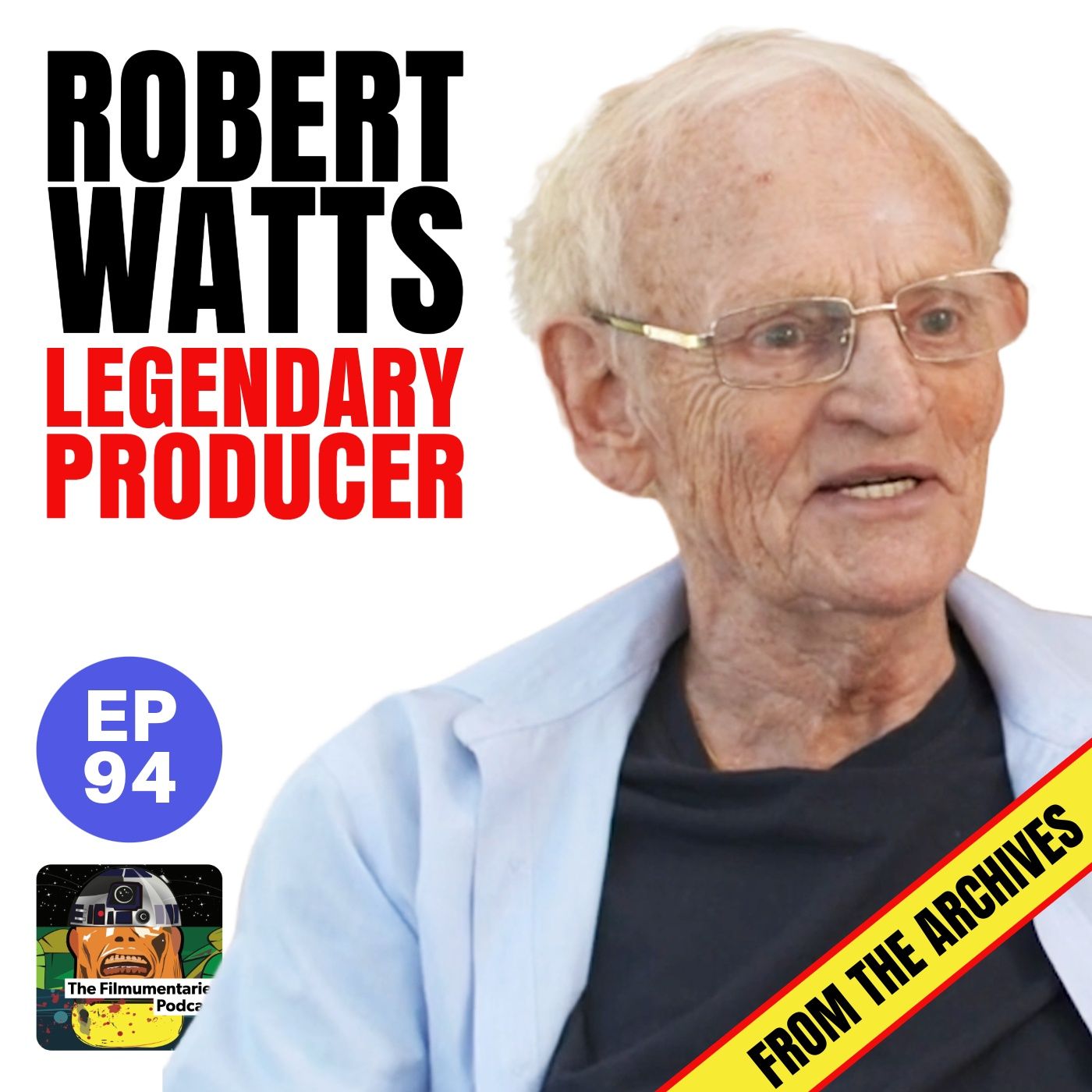
Its my interview with the legendary producer Robert Watts from back in July 2018.
My cameraman buddy Paddy and I visited Robert at his home, and a lovely home it was too. He was on such great form and just a delight to be with.
We arrived armed with some F1 signed caps from Hamilton and Vettel because a little birdy had told us he was a motorsport fan. And he was absolutely delighted. That little birdy was actually David Whitely, who is going to be a guest on this very podcast in the coming weeks.
It wasn’t of course ever intended to be a podcast, so you’ll hear my questions slightly off mic, but of course this is all about Robert and his work on 2001, Thunderball, Star Wars, Raiders, The Empire Strikes Back and Return of the Jedi etc, so I'm sure you can forgive some audio irregularities.
As the recording starts, Robert and I are talking about Stuart Freeborn and his creation of Yoda. You’ll also hear friend of the podcast Paddy Tyndall ask the occasional question. I hope you enjoy it.
All the links
This podcast is completely independent and made possible by listener support. If you’d like to help me keep making these episodes, you can join my Patreon community here: https://patreon.com/jamiebenning
Watch more on YouTube:
Check out the Filmumentaries YouTube channel for behind-the-scenes clips and extra content: https://youtube.com/filmumentaries
All my links
Transcript
Automatically generated, so expect the odd misheard name.
Weirding Way Media. Welcome to episode ninety four of the film We Mention this podcast. This is Jamie Benning speaking to you from my my very cold home here in southeast London. It's minus two here today, and I know that's not like super cold to some of you, but our houses here and not really built for this kind of weather, particularly this one. It's over one one hundred and twenty years old.
Anyway, I'm layered up, I have my hat on. I'm still not feeling great after four days in bed with the flu, still got this damn cough hanging around. But thankfully I'll have some great interviews to look forward to, including this one that I have for you today. It's from the archives. More on that in a moment.
I just wanted to thank you for joining me again or perhaps for the first time. If you'd like what you hear, please consider contributing twelve dollars or your currency equivalent to support an entire year of episodes. That's twenty four episodes or more. I do do bonus ones, as I've done in twenty twenty three, twenty twenty two and twenty twenty one, so that's about fifty cents per episode, and I'd say that was pretty good value. You can do that on patreon dot com forward slash Jamie Benning Jamie be double Nig.
There are several tiers to choose from with different perks, like early video versions of the podcast. Please take a moment to check it out and I'll leave that link in the show notes so that it's just a click away for you. Okay, So, as I said, this one is from the archives, but I've been wanting to put this out in podcast form for some time now. This is my interview with legendary producer Robert Watts from back in July twenty eighteen. My cameraman Buddy Paddy and I visited Robert at his home, and a lovely home it was too and he was on such good form and such a delight to be with.
We arrived armed with someir F one signed caps from Lewis Hamilton and Sebastian Vetl because a little birdied had told me that he was a motorsport fan and he was absolutely delighted. And that little Birdie was actually David Whiteley, friend of the podcast, who's going to be a guest on the podcast in the coming weeks. When we can get our chit together and actually organize a date. We've had a couple which I've had to cancel and things have changed, but we will get round to it. David, if you don't know, is a big Star Wars fan as well, and made a couple of documentaries, one the Galaxy that Britain built, and it was him who, as I said, introduced me to Roberts.
I'm very grateful to that. Thank you, David High and let's speak. So this wasn't ever, of course, intended to be a podcast, so you'll hear my questions slightly off camera, got off Mike, but of course this is all about Robert and his work on films like two thousand and one, Thunderball, Star Wars, Raiders and Pus Strikes Back to the Jedi. As we started the recording, Robert and I are just chatting about Stuart Freeborn for some reason, and his creation of Yoda. You're here friend of the podcast.
Paddy Tindall asked the occasional question again, as I said, some of these are a bit off, Mike, but I've kind of boosted them as much as I can. So here's my conversation with the amazing Robert Watts and I'll be back at the end for a bit more jabbering on. We had nowhere else to go. I remember going up to your Stuart's a crack and door on that one morning, a stupid crunt do anything album. He's still fiddling your arm with it.
We've got was success only I still look at that and he and he's alive in that film. Yes, Frank Oz was brilliant during the and it was so good that right across the road from where we were working Helstree Studios, was was ATV Studios that as it was then, and they were shooting them my picture over there, so he got a love he came to and Kerman came to set seen the picture. Yeah, and it was was just so easy. If I wanted to go over to torture Jim handshold Frank, I could just walk across the street and that studio. Now they make east Enders there, Hobly City, it's BBC.
I think, oh, I got the exterior set. There's some one day try and go another look at you. Could you do it for me? Of course? Now just up in the front, yep, that's it, thank you?
Okay, well, okay, so let's just start by asking you, how did you first enter the film industry. Well, I come from a day where there was still national service in the army and all those kinds of things, and I knew what I knew. I wanted to do this since I was a teenage boy. But I had grown up in the boarding school system in England, you know, prep school, boarding till thirteen and then searching into eighteen it and there were another school. And I said to my father when I was about fifteen, I said, Dad, I want to work in the film industry.
And he was a barrister, my father, and he took a look at me and said, Robert, that's not a proper job. And I went all right then, But I just left it at that and carried on, carried on, carried on, did my two years national service in the army, and then came out of that eventually. So I think in nineteen sixty I've now done all of that education, all of that behind me, and I'm on an outen path to go do my career, if you like. And that's when I got my first job, working as a runner on a film, which is the way you did it. Then there were no film schools.
And I got the job from somebody who my grandfather, who is a scriptwriter at Meaning Studios back in the day. He was now dead, but he wrote the greenplay for the role command Performance from of nineteen forty eight. It was called Scotterly Antarctic, starred John Mills. And he got this guy job, and in turn he got me a job that's hat worked. It was the kind of nepotistic situation aways and so I began and after a couple of bits of pieces runners on films, I got myself a permanent job with a company that made television commercials, which I suppose it is the nearest thing for film school that I could have gone through.
Because each of those little thirty second things, most of which are in black and white, the only color ones you'd made. It was if they were for cinema, because of television was all black and white. It was like a little Meaning film. And that I see is my film school. Two and a half years, two years plus just over two years working with this commercials company.
But it was while I was with them that I got membership of the union, which you had to because the whole industry was unionized. The union was called the Association of Cinematograph for Television and Allied Technicians the ACTT and and I got membership of that I could return to feature films, but in a union job. And I returned to feature films as a second assistant director on a film called Inside Out, which starred Robert Mitchell and Trevor Howard, black and white film made up at Elstreet Studios. And that was my kind of intro into the film industry as best I can describe. So how did you then end up on two thousand and one, a space Odyssey with the Master himself?
Well, I was now on on the way because I you know, after after the first film I did and ARGER didn't Other World and then ardered it number one. And then somebody at the studio said to me, I know I was doing a James Bond film and I was down in the Bahamas. The film was called Thunderball. I was a Sean Connery Bond and I got a phone call from Subbysha Stanley Kubrick wants to meet you, and he at that time was living in New York. And so I ended up with the second unit in the Bahamas.
So true traveled back Alouge. So I flew back to Lydiland via New York and went to meet Stanley Kubrick in his his apartments just off Central Park. And that's I don't know who actually pushed well gave me that one, but that's when I met Stanley Kubrick. And then he came to England and he asked me again, and so I went to work for him on two thousand and one Space Odyssey, which was a bit of a classic, unuseful film in itself, and it was very exciting to do it, and Kubrick was a fascinating director, I mean, lady hell. So my career was kind of alive here and so I did it Bond film.
Then I did two thousand and one The Space on the Sea, and then another Bonds film, which I have now. I am a location manager on the second one film in Japan and it was called He Only Lived Twice Sworn Collery. And my career is sort of advancing. And from there I went on to I'm trying to think you know where the moment occurred that I met George Lucas, because yes, I met Gary Kurtz. I met Gary Kurtz.
Where the hell did I meet Gary, I'll have to go back over my own notes subway sort of remember if some of these things. But I think Gary yes said said to George Lucas, you should you should meet Robert what was because he worked with you only told him to stand at Kuber blah blah blah. And I know Stanley Kubrick actually recommended me to tools Lucas. So you can't get a better recommendation than that. It's pretty good.
And so I went to work on The First Stars, which as far as it was concerned, it was just a small science fiction movie. Wasn't that big? And the stars of the film were alc Innis and Peter Cushing. The three Americans, Harrison fort carry Fish and Mark Hamill were unknown this then, and in a sense Peace Cushing and alec Ninnis pushed as the Stars enabled it to be made in England, but otherwise could get a few equity problems about bringing Americans in and so it covered all the bass. It was perfect, perfect structure for which to make this particular film.
So we set off to make it. We had no money, no time. Trader Centiary folks, they was such a hard time because I don't really believe you were ever going to make a pediat in it. Even though they were making it as cheaply as they could, it wasn't It was still money that they were probably ever going to see again. And so it was hard work.
But there's a bit of me that doesn't mind that. I don't mind being challenged because it's it's it gives me a kind of oop. You might say, kick up the ass if you were allowed to say, well, it's like that on a program like this, But it's and what was it the past? The job on the First Stars. On the First Stars, I was production supervisor, which actually is just a senior production manager, it is, And that was the job I came into.
Garry Curs was a producer, so I was basically running the show and putting it together. It was being made in England. We were using a British crew. George Lucas had never made a film himself, and we got technicians onto it. We'd all done big movies because George you ever had, and set about doing it, and it was a scramble.
I'd say, kick bollock and scramble all right, now, I've had to say it all this, and but we got there we got it made you, and that was it. And once he was finished shooting, the whole thing went back to the US for editing and all the optical effects, etc. And so as far as I'm pres my job was over then and I went carried on, carrying on whatever I did. And the next year when we film actually was opening Iris in the middle of Afghanistan of all fishes, with Peterbrook the director, making it very much an arthouse movie called Meetings with the Remarkable Men. I mean started Terrace Stamp, but most of the cast were kind of Peter's club of actors that were around him because he lived in Paris.
Then I know it still does control and it's still open. Irund's knocking on a bit because he's open than me. Well, I'm knocking on a bit. So I'm in the middle of carbood in Afghanistan. Well, I've got no communication to the back to the studio, studio based in Pinewood, in in in London.
I've got no communication, no telephone, nothing. The only thing I've got is a telex to communicate backwards and forwards. You know, there was no such as facts or a thing like that email or forget it. There wasn't anything like that, and so that's how we did it. I used to just operate through telex and let them know what we managed to do, et cetera, et cetera, and so I had and they would only communicate back to me with business, you know, matters concerning business, because it was telex.
So anyway, it stalls right and I'm there and I had no idea what had happened. And the way I signed out was you could buy Time and newsweat magazines, and that's why I kept in touch with the outside world. And one week I bought the Time magazine and there were eight pages of color pictures from stars and I went, oh wow. And there was a little fold down thing on the front coffee with the X ray fight really and I thought, wow, what happened? I read this Arscort, I was like, whoa, this is really taken off.
It was brilliant. And so we finished shooting in Afghanistan and I'll get back to London to England and I go back at Prime Studios and everybody said, oh, Robert, have you seen how that film Beauty is doing? Ourself? I'm beginning to understand because I hadn't seen it. My wife and kids had, but I hadn't because well, because I was an afghanis style that's why, and so well the rest is history in a sense.
But it was just the most amazing piece of box office phenomenon I think anybody had seen. And so I'll go back of that. Then started, there's a big success the sequel and I Strike Back is in the pipeline. You then called straight onto that to feel that same job. Basically, Basically, George had sensuous when we were making the first Stole.
He said, if it's the success, we'll make you more. So now we've got this mensia, so there's an inevitability about the Empire Strikes Back. So yes, I get a call back from Gary Kertz and and go back, but this time I'll get the job as associate producer. I don't get mented a different I think it was just slight upgrade in the sound of it. And so I went back to work on The Empire Strikes Back.
But we had more time unless it a squeeze on the budget. Was absolutely adamant. I was myself, but we mustn't because the first stars had done so phenomenally allow ourselves to just get flatulence with the money if you liked, because we could have done that, and that's not the way to work. You've still got to achieve yourself within the parameters and shoot, you know, a great movie for a price that is well hopefully grant for a great movie. And so we went off to do The Impire strikes Back with Irving Curson and directing, and back came Marke and Carrie and Harrison and actually between you and argues as three, I did the Past Struts Back.
I could it's the best of the three films. I think it's a brilliant piece of cinema. Crash of in Kershner. It was a super filmmaker. He'd done superb work.
And of course we weren't. We weren't facing all the problems are being squeeze shouted up by twentyth century folks. But so we went ahead and it was it was a huge again, a huge hit volume by strikes Back. Of course he went out to Norway for the big snow exteriors and Past strikes Back, yes, well, yes, yeah, Past strikes Back, where we start on shooting on what is supposed to be the ice planet. Hof sounds kind of Hof doesn't it hath and A Well I took off.
Really first job was to find the location to shoot this because Norman Ranald and I production designer, was it even you may have told a story once about how you got Harrison Ford to come and use the blizzard. See I'll tell you with that idea. Yes, So we found uh this location uh compatient Norway uh called Fincer f I n s a because well, difficult to find actually, because you know, we needed something that we've guaranteed snow therefore altitude where we couldn't be sort of alpine looking, so we had couldn't go anywhere near the Alps because they all enhanced classic up and down mountains. And and Fincer is brilliant because it's a plateau high up this shop. For example, Scott the Antarctic up there, uh, which about his trick to it and Talctic a lot of it there, and it's a it's a brilliant place where we found it, and I thought, yeah, I shall do it, we should do the side.
I loved it, and so we set off to start shooting. Anyway. You could only get in by railway. There was nowhere in winter you couldn't drive there. It was completely cut off roadwise, but the railway went throughge but on stage weather that we were about to have not anything the trains could go through.
And so we get up there and the first morning and we're going to start shooting, there's a raging blizzard outside. I've never seen anything more likely, and I look at I'll get it. We'll shoot. We could shoot these sas right with our backs to the hotel here and shoot this way with the torn trawn and stuff like that. But there's a limited amount we can do because this was a sequence, because we were going to shoot it in it it was a buzzard.
We're going to shoot it on the stage in l Street, and therefore it was never planned to be shot on location. And it was the only scene that had Harrison Ford in it, and so therefore I hadn't brought Harrison soon alway because I never intended to. And so I got on the phone to the studio and said, get Harrison on the next slide to our slow because I'm going to have to get him out to Fencer somehow. The only way I could get him up to Fencer was to use the snow cloud because the snow plow could actually go through this whether where the regular train couldn't. So I got permission to use the snow plow.
I got a bottle of Scotch whisky. I got the location manager and I said to him here, gave him the whisky. I said, go down in that snowplatter Oslo and bring Harrison Ford back whatever time. I don't care, I'll be waiting for you, so bring it back. So off he went, and the day went on, and the day came to a end, and the crew went to bed except Robert, who couldn't.
And I waited up and said, I can't remember what time it was. There was something like, I don't know, one o'clock in the morning. Finally the snowply or got snowplower. I was in Fincer and Harrison on board. There's drunk a lot of whiskey, and I'm going to ask him to work the next day.
And so it comes out. He storms into the hotel and he looks at me. He says, call by agent, But Harrison I did, and then he started laughing. I have to say a great spirit of the thing, and I explained the situation to him. I said, I hope you don't mind working tomorrow morning, strictly a negro of regulations.
And he said no, and he did, and he came out the next morning and a blizzard was still continuing, and the blizzard scene was shot in a real blizzard, which you couldn't count on doing that if you try it, you know, because that was the one scene I don't schedule for the studio because it can create a blizzard indoors, you know, using starpham, which you can't creation outdraws because of the depths. It worked, and then he did it, and blessed his hard he did it. I'll always say Harrison for that. That's great because you can tell as well. We can tell you oh yes, yes, we've got the torn trop to cut it out.
And Mark is lying marked body inside the torn trucks keeping warm cold. It was carker. It would be lovely. I remember because I was there, but we were literally just outside the hotel was behind to stay at the cameras here at the hotel side of the hotels here, which can go any further. And then you know, as as we were blessed somehow or other, the blizzard dropped and we went on completed all the other stuff that we're going to do.
We also completed this thing we were going to do in the studio, so we were not exactly a head of schedule. We went behind are you and I saved the stage need to stach you're a heroin sometimes sometimes so then uh, Raiders of the Lost Arc and over, yes, Raiders of the Lost Stock. Oh yeah, Well, we were finishing up the Empire strives back. We were shooting our shooting pickups back at I lem in in San Francisco, and I was on the stage one day. We're just doing these bits and pieces and unusual stuff, and George comes on the stage and he said, have a look at this, and he hands me this script and written on it just Raders of the Lost Store and I took it.
I took it. I shook it home that night. I read it, and I came in the next morning and he said to me, what do you think. I said, boy, it's a busy script, George, because it'd had everything. And he said, well, that's what I want to do next.
And Steve Spielberg's going to direct it. And I hadn't met Maden, and he said, I'd like you to go down to LA and meet Steepan because I've told him I'd like you to be on it, but obviously he'd like to meet you. So I did you. I went down and met Steven Spielberg and now it's the first time I met him, and it was crazy. And we set off to do Rangers of All Stalk, which was bassing film.
Actually, if I have to be honest to the six rooms I did with George, that's my scene for it. Of course, we went all the way around the world. I went with no more else as designer. I went around the world twice looking for locations twice around the world to find locations for that because it was so varied and or were. We made what turned out to be a hugely successful film.
And I also met Steven Spielberg, and I loved working with him. Very challenging, you know, he kind of asking for things. Can you do that? Robert said, won't let me think about it, But I always choused to say yes. I was started away, and but I liked that.
I liked, you know, I liked the sacts of being challenged, I said before, because it makes it makes the job more interesting. And so I remember seeing well The schedule for a start was very tight. It wasn't it. Oh yeah, I'll tell you about the schedule. Yeah, change for Rages.
I did the schedule for Rages, and I thought, well, I'll keep it as tight as as I can. But it was a complex film and different countries to rest of it, and I laid it out over twenty three weeks. I went down to La to see Stephen with it and showed it to I should look, see I've laid it out to over tready three weeks. I was shakings quite tight that, but I hope they are all right with that? And he looks you like that.
I don't think that amost time. I said, no, God take sup Anyway, I took seven weeks out of it, so it had been twenty three weeks and he went down to seventeen. And I'm really nervous now because Stephen, Well, let's put another piece into the puzzle here. Stephen had just made a film called nineteen forty one. Ah.
And what I always do if I go to work with somebody likest Stephen, I find somebody that I know well enough that I could ask them about him. And the assistant director of nineteen forty one. I'd worked with on him from Mexico a few years earlier, and so I rang him up and said, oh, Jerry, it looks like I'm going to work with Stephen Spiulberg. Was he like to work with all? Jerry said, oh God, Robert, she said, excuse, expect to go fifty percent over?
I said, no, oh, Cott is it? It was a nightmare. And when he aught it by I've got this in bye bye. Well. I made dad schedule.
I made it tight, point didn't Yeah, and then Steven made take six weeks sucually. Ah, I was like, but we came in two weeks under that nineteen forty one was went massively over over budget. It wasn't a flop that by this time, because it hadn't opened. It turned out to be a flop and all but Steven was had to prove something, you know, I over because that's what she Saisistant director Jerry had said to me, Oh, Robert, expect to go fifty percent over. I said, no, christ again, this complicated, he said, well, And so that was Stephen proving to everybody that he could do it.
This is why he did this amazing. I've never seen anybody move so fast on a very high It was a very complex story, very complex sense, complex characters, you know, complex action. It was a full brown action adventure movie. And some and I mean I'd be on the set, for example, and Stephen would be doing an incredibly complicationd crane shoss or something like that, and then after take what they're right, can't print move on next? I got to say, Stephen, You've got to do the second one.
It's what we call for naudience. It's always the insurance one. You've wan't you You can't just walk away after one take printed, move on? Particularly complexity. Yeah, here am I told you to Steven Spielberg art this, But I did because that's what he was like.
But he do it sort of for me and and but that's what it was like. You see, he was got, he was he was aloud to prove something. And so I say, we came in two weeks under that twenty three weeks, and I was blowed away. We finished shooting in Hawaii, the last location of the film and place, and I was there with you know, it was Frank Marshall and Kathy Kennedy who worked We still work with Stephen now we finished shooting. We're two weeks under schedule.
I can't believe it. And we flew straight from Hawaii to Las Vegas and literally just five days they're going to show. We had just went to have a lot of fun. One of the scenes and why it was at the opening it was it was it was basically him trick thing through right at the beginning, through the jungle, the titles. You know, yes, yes, that that paramount Mounsion there is actually in Hawaii one in that film.
And then it's when he you know, he goes through all that stuff inside the temper and then she comes out, you know, the ball rolling behind him and all that happened. He comes out and there's the Indians. Didn't you work the guinea pig to the ball? Let's put it this way before wall the set if you finished it, the ball was in position and the rest of it. We're on the set and Stephen says to me, hey, Robert, we're going to roll the ball.
You're going to run in front of it. We see what didn't looks like? So I go there. I've got my clipball in my hat, all the usual paraphernalia I have, and this ball. All right, this fiberglass showed exactly.
He was huge. And I'm running along in the balls covering the highway light that I get to the end and there's two by force across the end of the set. I could jump over them and then the ball came into a stop like that. And I said to Norwood Rails after it, you could stop tick when you said no, I think there's even a bit of footage that I've seen could be it's a bit dark, but yeah, somebody's running in front of the wall there. Yes, and well but Harrison did this, but you know it was it was slightly different because it wasn't dressed genius.
It was still but I knocked out film. It's a brilliant film. It's my first sea with Spielberg. And I did other films for him. I did obviously two more Indiana Jones and and I produced a couple of films for his company.
He rich was so and still chill friends. I think there's a brilliant director. He talks about Raiders, how he shot it quick and dirty. Doesn't he know I could still description? Oh god, absolutely right.
I actually did that sort of feature length making off of Raiders by getting all of the bits and bobs over the years and putting together into a DVD or would you I'd love to share that. I know you've you've talked about this many times before, but you appeared in a style was still as well be the Return of the Jederal. Well, yes, it's kind of brief, because I'm showing that two legged war craft a TSG device when chee back up pull this applied and to the guard. Well when you first cut to the insure of the pilots. We shot that on the great Blue screen on at ire l M and so we were there issue to the way without day and we just come to do that.
I had a couple of extras and just to put on the MILLIONI forces there doing the acts, no dialogue, and so somebody said, why don't you and Richard do it? Richard Mark and the director, So to Richard looked to be Richard for fun, so he did. We put on the costumes and did it. And but it's not me being thrown to the branch in like that. But yes, that's there's a brief.
That's my brine moment and it's only I guess that people will get you to sign that photograph the ones when he worked for two years half children before Oh read, I said, look, this job took me to but this job took me six years. These autographs fists are men. Yeah, but there must be an action figure. There is there is an action figure of me, of me and Richard markwin but pur us and pure of us. But they made they brought out a single one and then they put his firstograph on the package.
Well, I special cold complained you want to direct and say, then, looking back at this legacy of films, how does it make you feel when you look back at those films having the impact they've had on on the world. It makes you very proud. But it also makes me very grateful I somehow or other precare involved in them. And you know, it's a kind of legacy you for me in a way if I need for one, loose my grandkids cut it sud Ground four during there, I'm I'm thrilled, always fortunate to short, to be successful, but I never ever imagined being association Mega Mega hits amazing now to work with sluting names that I mean, credible, isn't it? Well?
You know I should not ride Lucas George Lucriste. Yeah, so we had a rough time on Stars, didn't they? I mean, and he was so under the cross. Did everything possible to try and how would happened? That's all we can do.
Was there ever a point where you thought this isn't going to be made? The first Stars? Or you've got the attitude? You said that you liked the challenge. Did you always know you were going to get?
I knew we'd get. I've never done a film Whi's got abandoned while on it, So it wasn't in my kind of repertoire, rickid. I never thought that way. I never thought that way. I just thought I was just got me ready to go.
We've got to do this and get it done. And it was unlike any other film I'd ever done, because what it was it was Star Wars. One last question, then, do what you did in the film industry? What do you what quality do you think you've got that enabled you to do what you did? Say successfully?
That's a real difficult one to answer. It really should be answered by somebody else or I will show it is from my point of view to work in this business because it's so tough, which is essential to have passion, and I feel that I had the passion to make it, but I also was I was able to put right pieces together, I guess, and it worked. So what else could I say? Fantastic? Yeah, it's interesting is that it's difficult to see it from the inside out.
Yeah, Well, thank you, my pleasure, garish pleasure. I think it all went well. I'm so great and for my brilliant presence. Well, I hope you enjoyed my conversation or rather interview there with Robert Watts. If you do want to see the video version of this, which is heavily edited down from this kind of raw footage, that's still available on vimeo on the film Momentary's Vimeo channel.
It's called Robert Watts a Life in Film and is interspersed, as you might expect, with clips and stills from the films that he's talking about. It's well worth checking out. You know. One of the best things I saw in twenty twenty three was a photo of Robert with Harrison Ford at the dial of Destiny premiere here in London. Robert in his wheelchair, Harrison leaning down, their foreheads touching in an embrace of respect and love for each other.
You could really see it, big smiles on both of their faces. It really actually brought me to tears when I saw that, and I did hear from a friend that Robert was absolutely buzzing after that happened. You know, when you work with people on these big projects, you kind of say goodbye to them, you know, after a number of years, and he worked on You think about it, all those Star Wars movies, all those Indiana Jones movies, those first three and then probably I don't know if they saw each other again, but they've got that kind of experience that they shared and it was so wonderful to see that sort of emotion pouring out of both of them. I'll post that on my social media so you can take another look.
Look out for the next episode of the podcast in late January twenty twenty four. Lots more on the way. I'm lining up stuff as we speak today. Thanks for joining me, and I hope you can do so. For the next episode of the Film Inventories podcast.



Similar episodes across the network
Matched by shared keywords.
-
Primetime - Kulture Meltdown
1 shared keyword: robert
-
Special Report: Claudio Fäh on Turbulence
1 shared keyword: producer
-
Marsha Posner Williams, Part 2 | Golden Girls, Hail to the Chief and Sherman Hemsley's Amen
1 shared keyword: producer