
About this episode
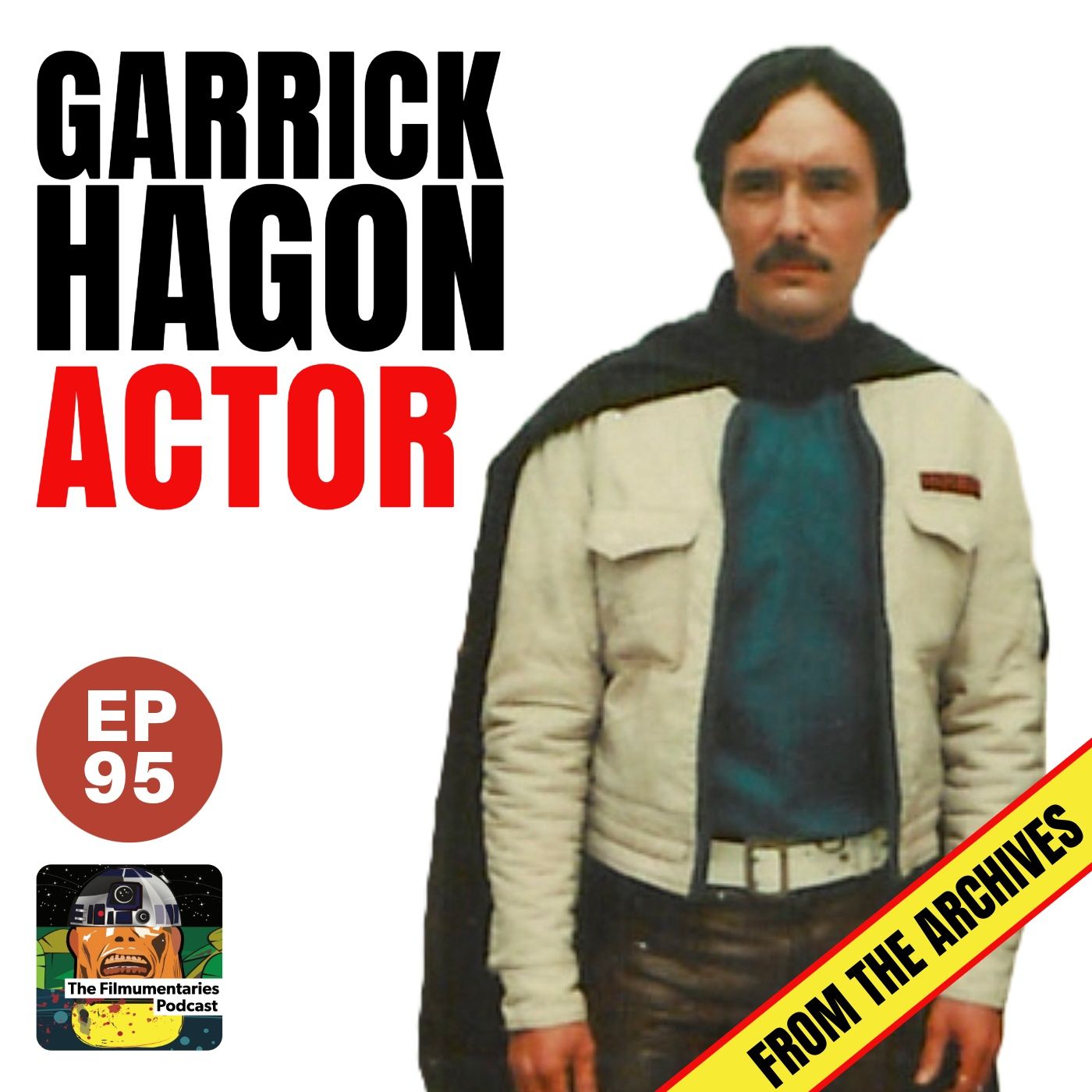
This is a conversation I had with actor Garrick Hagon back in 2015. If that name doesn’t ring a bell, how about Biggs Darklighter.
Yes, Garrick is well known for his mostly deleted scenes from Star Wars in which he plays Luke’s best pal. I’d met Garrick in the green room at a Star Wars Trilogy day at the BFI southbank earlier that year. I’d been invited there by my old mate Toby Phlipott, Jabba puppeteer and all round good guy.
Garrick and I got chatting about how I’d done an interview with Toby and created what turned out to be a very popular video from it. So I suggested we do the same. In fact both of those videos are still on my vimeo channel. So I’ll also link to that in the show notes.
As with all interviews, when making a video you often cut out certain bits that you don’t need. But with a podcast you can make it more long form. So that’s what I’ve done here. The interview was done over the phone, so it won’t sound as good as some of my more recent episodes. But it’s still definitely very listenable.
All the links
This podcast is completely independent and made possible by listener support. If you’d like to help me keep making these episodes, you can join my Patreon community here: https://patreon.com/jamiebenning
Watch more on YouTube:
Check out the Filmumentaries YouTube channel for behind-the-scenes clips and extra content: https://youtube.com/filmumentaries
All my links
Transcript
Automatically generated, so expect the odd misheard name.
Weird ing Way Media. Welcome to episode ninety five of The Filming Mentori's podcast. This is Jamie Benning speaking to you from cold and windy, very windy England. I hope you enjoyed episode ninety four, my conversation with legendary pretty Sir Robert Watts. That was such a good afternoon we spent with him.
I saw him again a couple of years later and he remembered our chat and lit up and he said, and yes, you brought me that wonderful Formula one cap and signed autograph. Oh oh, I was so grateful. It was so nice to see him again. Thank you for joining me again or perhaps for the first time. If you like what you hear in this podcast, please consider contributing twelve dollars or your currency equivalent to support an entire year of episodes.
That's at least twenty four episodes, because as regular listeners know, I do have bonus episodes from time to time, so it's about fifty cents per episode, and I'd say that was pretty good value. You can do that at patreon dot com forward slash Jamie Benning, who has several tiers to choose from with different perks like early video versions of the podcast if available, it depends on the Interviewee, please take a moment to check it out, and I'll leave a link in the show notes, so it's just to click away for you. Okay, this is another one from the archives, but as with the Robert Watts recording, I've been wanting to put this out in podcasts formed for a while too. This is a conversation I had with actor Garrick Hagan back in twenty fifteen.
Yeah, it was twenty fifteen. If that name doesn't ring a bell, how about BIG's dark Lighter. Yes. Garreck is well known for his mostly deleted scenes from Star Wars, in which he plays Luke's best pal. I met Garrek in the green room at a Star Wars trilogy screening at the BFI South Bank earlier that year.
I'd been invited there by my old mate Toby Philpott, Jabba puppeteer and all round good guy. Garrick and I got chatting about how I'd done an interview with Toby already and created what turned out to be a very popular video from it, so I suggested we do the same. In fact, both of those videos are still available on my Vimeo channel. That's inside Jabba and Blasted Bigs. Where Are You is the other one, and I'll also link to those in the show notes.
However, as with all interviews, when you make in a video, you often cut out certain bits you don't need. You might go off on tangents that don't aren't relevant to the video you're making. With a podcast, you can make it a more long form conversation, So that's what I've done here. The interview was done over the phone, so it won't sound as good as some of the more recent episodes, but it's still very listenable and I have done a bit of audio magic on it. So here's my interview with actor, voice over artist, audiobook reader and businessman Garreck Kagan.
And I'll be back at the end for a bit more jabbering on. So can you tell me how you got involved working on styles in the first place. Well, Star Wars was one of the films that came along in my early career. There I say that I went up for as an actor, so I got involved with Star Wars. Like most of the actors American and Canadian actors in London at the time, the young ones or youngish ones were called in to audition and it.
At that time we knew nothing about it, and the casting director, Irene Lamb, knew us from work that we'd done myself in films and television, and most of the others in the same way. So we all trooped in and I think all I was told was that I had to do most of the talking, which because probably mister Lucas wouldn't say very much, and that I think was the case until we got talking about a film that I'd done in Morocco in the desert, so it had some relevance, I think, to what George was going to do in Tunisia, or maybe he had already been there checking out locations. So it was a very run of the mill procedure going for an audition. I remember sitting in a cafe and so square, thinking, oh, well, I'm going up for some film.
It's called I don't even know whether we knew the title. Maybe we knew it was called The Star Wars. And I went along and met him, and apparently he was marking us unbeknownst to the actors. He was marking us on a lot rather like a report card, and I think I got a I must have had a fairly high mark guy by somebody, maybe Agnani Lamb told me eventually that it was with seven, but who knows. Whatever it was, it was an audition like many other auditions.
You meet the director, we didn't read, and I must have talked enough to be marked as number seven. From then on in it was just a question of getting the contract and getting the script. And it all started so obviously when you first ended up seeing a script, you must have been delighted to see that, you know, a big part in the film. You were one of the main protagonists. Yes, it was a good part.
And I when I first got the script, it was as puzzling to me as it was to many of the actors, really not being acquated with the characters and not really knowing what these robots meant. And actually I wasn't that familiar with science fiction, fantasy whatever myself at the time, So it was I was doing a classical play. I was doing something on television called The Lady of the Camellias, so it was quite different that I'd done a lot of classic theaters, so that the script was was quite new and different to me, and perhaps I knew I had a fairly good part, but I didn't realize how close I was to to Luke, or how how kind of part of the family of the original family I was until I met Mark in the wardrobe some weeks later, and then he said, you've got the best part.
You're you're my best friend. You've got the best part you die. And I thought, well that that's maybe questionable. On the other hand, it was great. We right immediately, we hugged each other and realized that, yeah, we're going to be a friendship on this picture.
It was then I suppose Biggs kind of came into focus. M and and you got all well with Mark, and you found him, you know, good to work with you. He always comes across a very enthusiastic young man back then, you know, and even now he's an enthusiastic older guy. But yeah, how did you find him then? Yeah, yeah, the same.
He's wonderful, giving and intelligent and quick. And I right right away felt, you know, kind of a warm relationship, like I said, And on the set, I was amazed at how much of a company leader he was, even at that energe in a way, welcoming us right away when we arrived in Tunisium, which was our first location. Coming into the hotel, I remember him coming up to our car. I suppose Anthony and Coo and I were together, and it was very welcoming and from then on in and was a friendly and kind of fun relationship. He was out of television, but he was incredibly quick and a depth at film and he was a good kind of guide as to the spirit of the film, I think.
But he was an amazing young leading player. I'm sure he didn't feel that he was a leading player but at that time, but he was. That's great, I guess coming from the soaps and things like that where it is quite as close knit family to like, because they're in each other's pockets. He's used to that, you know, fostering that environment. Maybe.
I'm sure that had an influence he was and he certainly knew his way around the film archive, if you like. He'd watched a lot of films being I think a lad in a military family and that's on his own, being able to watch a hell of a lot while in a different environment, so that he knew film very well. He was very knowledgeable. And the amazing thing is that the interviews i've seen in the short times i've met him at conventions since he's remains equally energetic and enthusiastic and friendly. Yeah, it's great.
Yeah he does. And so you flew out to Tunisia to start the filming. You all flew on the same plane, Is that right? Yeah, we did. We all met each other at that time, and right from then on it was like a little foreign adventure.
I'd been in Libya extensively, which is right next door, and or Morocco and then Libya, and so I knew a little bit of the Arab milieu, and I knew quite a bit of Arabic. Indeed, I was looking forward to putting it to use again. And I don't think Tony Anthony forrest Or Coup had been there. But it was all of a hell of an adventure. Ku was young, and I think she had she'd had quite a life up to then, but she was still very very young.
So we were very excited. I think we had quite a bit of a few days when we didn't appear on the set, so we had a a few doors to fool around in Gerba, which is where they put us uh before we traveled out to the set. You know where we stayed in the hotel in Gerba, and it was on the beach and there were facilities around two well in what I in our case to go horseback riding, which we we took advantage of. But maybe it wasn't a smart idea. I don't imagine the film company would have liked that.
I do like the image of you know, Luke Skywalker, big stark, lighter and a stormtrooper on horseback writing through the desert something. Well, we I think it was more or less along the beach because we were in the Gerba area, but it was a halm of a ride. We did have one and we just let the horses go. That was terribly dangerous and I think we would have been we we would have been putilized by Robert Watts or the company and oh it would have been terrible if anything it happened to Mark or any of us indeed, but fortunately we stayed on our horses. I'd been riding for a long time in the in the previous film in North in North Africa, and so I was up for it.
I'm not sure how much Anthony had done or Mark. Anyway, Thank god we all emerged and were able to film in this next day or two after that. Well a great adventure. I mean just the filming alone, What a great adventure. Were being in a place you know, you were familiar with it, but as you said, the others not so familiar.
Well great, what great adventure must have been. Well it was. It was all very exciting and new. I mean, of course you have you were surrounded by the models and and and pieces of this set. But and it's always an adventure going on a film set anyway, because you have a lot of new people to meet, the crew and the and the cash that you haven't met before.
And it's always a bit apprehensive. Sure, you're nervous because you're setting out on something you don't know what will happen, and you hope you're in control that you're never met. Yeah, I could imagine some of your Obviously, your longest scenes were cut from the movie. I remember being a kid, you know, looking through the story book and there be photos of you in there, and I think, hang on, I didn't see that in the film. So I think in that sense, despite the fact that you you know, you're the biggest part of your role was was deleted as it were.
I think you've always been a fan favorite because there's an intrigue to the character as well. You want to know more. You want to know more about the relationship between Luke and Diggs and how that developed. And it's nice to see that there's a you know, with the deleted scenes in if you if you've seen that people have edited them back in and things occasionally, if you look at it, there's a real sort of arc to your character and I think that's probably why you know you've remained one of the fan favorites. What do you think about that, Well, sure, there's a lot in that scene that explains why Mark leaves the farm and goes off to rebels, and there's a lot just in terms of character, in terms of the relationship of Mark with the gang at akerhad and to miss that is a gap to me and to a lot of people, a lot of the fans who meet me at conventions, you know, regret that the scene and that backstory is not there.
And there is an intrigue about it deleted scene because I feel you're they're finding something that perhaps other people haven't found. And certainly in terms of my exposure in the film, it would have been nice to have it there, And it's just as I'm very pleased that there have been releases of the deleted scene. It's a four minute scene that it was all or nothing really well. I think it would have been very hard to cut, and also I don't think there were many opportunities in the scene itself when the camera left. I think that we did it in two phases, and I think it would have been hard to cut it anyway, and there was too much in there.
There is quite a lot of information in there to cut it and put little pieces of this scene back. So all I can say is that I miss it. A lot of people miss it, but that was a decision that was made along the line, and I think Mark misses it too, or did and I don't know. There was a lot of discussion. There's been a lot of discussion about it over the years.
It feels to me like there's that scene with Luke and Han solo on the death Start where they're talking about rescuing the princess, and there's that kind of banter between them, and it's one of the only other scenes I think between you and Mark where there is that same kind of banter and that kind of you know, there's a feeling of genuine friendship there. So I think, you know, I think the film is lacking as far as its deletion is concerned. Yeah, I mean the old scripts, the early scripts, I think Biggs was either we see their kid brother or we see part of it twins. I can't remember some of the early scripts. He was younger than Mark Luke, and there is a buried history throughout the early scripts Biggess himself and the name Dark Lighter.
But there is what remained in the in the in the scene as we shot it was a friendship, that's basically, and the idea that there's kind of like an older brother that guides Mark towards is his destiny, if you like, towards uh, joining a rebel force and fighting for something that we both believe in. So there is some political significance, but it's it's it's not there on screen, it's it's in the in the beleded portion. So do you remember how you know, sort of felt when you think you saw the success of Star Wars and was there obviously a disappointment on your part just not you know, having that big part anymore. And do you think it adds. Do you think it's subsequent release as a deleted scene has had an effect on your career?
You know, is it giving you more exposure again do you think or well, it's certainly people who come to the conventions. Well, it hasn't affected me in any other way. I don't think in terms of my work, because you've got on to have working, you know, doesn't work. I work. Never, yeah, that my work is not involved anything to do with that in terms of except obviously just meeting fans around the world.
In fact, I've been very lucky to and not part of the the enjoyment is discussing the very things you're asking me, and most people have a question about it and how I felt. Of course, it's disappointment, but I was always involved in in my work here and elsewhere all around. I'd never kind of depended on my exposure in Star Wars. You know, I was immediately out of Star Wars and back when I was coming back from Tunisee, I was going straight into a television and so on. It's It's been fortunately a very nice kind of variety of work that I've had while I've been in London and before that in Canada, I would imagine as well.
That s you know, some of the pleasure comes from the actual process of or a lot of the pleasure comes from the actual process of doing it, rather than the end necessarily the end result. Well, absolutely, and the people you meet and the fun you have, and I've had a lot of first of all, let's say, as a direct result of whatever, all the interest in Star Wars and tremendous success and all that, has been travel and meeting very good friends around the world, and that's been a great pleasure. The excitement of being able to go to a different country when you're actually working on the film is terrific too. I've been. I've done films in China and Africa and Europe, all over Europe and America, in Canada, you know, So it's that is part of the enjoyment, seeing the countries and just living new experiences.
And were you living in London at the time, because obviously you then went on to work at Elstreet Studios for Star Wars in bourn Wood, and I think it was the year I was born, actually seventy six. It was the hottest summer on record in the UK. Do you remember anything about that? Time being there and were you yeah, as I said, were you living in London at the time, Yes, of course I was. Yeah.
I mean it was hot, but I've been in odder places. Gosh, I was filming in Morocco and when it was one hundred and twenty on the set that was really hot. In fact, they had us they makeup was still on camera when they were saying action and you had to film about twenty seconds before he started to sweat and going so that the heat didn't bother me. Although El Street wasn't terribly ir conditioned that we all sat outside and then rushed in for the cockpit scenes and sweated within the already orange suits, you know. But it was hot, and I suppose it was really hot on the crews who were matting these lights and so on.
But as actors, I think Billy Hoodkin split his up the back, maybe because of the size, so his was open at the back. But you know, we're often used to extreme heat or extremely difficult conditions shooting and then we get a break. I mean, we're not like all day as the crew was. But I remember that Paperents cracking the shortage, you know, the water kind of bands and so on like that. It was a tough summer, nothing like working in the desert and in Morocco and Libya in that heat.
Yeah, and as and you worked with Alec Guinness briefly before, is that right? Well, not briefly as a child, as a yeah, No, I had an incredibly lamentous start because Canada at that time was opening one of what became one of the most famous classical theaters in America, and certainly we had Alec Guinness come to Stratford, Ontario, having been asked by Tyron Guthrie, one of the greatest Shakespearean directors at that time. Guthrie and Guinness and Irene Worth, a wonderful company of Canadian actors who were just really getting used to an apron stage and doing Shakespeare on the world scene, if you like. It became so it was an incredible lucky break for a kid like myself. I went up to Stratford and there they were some of the most famous actors in the world, you know.
I played the Prince of Wales in Richard the Third. The first scene I had was a tremendous entrance stage by Tyron Guthrie, with flags dropping at my feet. And withdrawing leave me in the center of the stage and Guinness then kissing my hand. So that was my first encounter with Alec Guinness. Later I met him on the set in Tunisia and Tony Anthony Daniels introduced me again, saying missus.
Gay said, well, I actually met you before. I was in the third at Stratford, and I thought perhaps we might have a conversation about that and how time has gone by. And then all he said was, well, that was a long time ago, and it doesn't really but it discuss it. So we didn't touch on it, but it was certainly instrumental in a lot of Canadian actors' careers. That season at Stratford and working with Guinness was an incredible experience for all of us.
Yeah, and the theater became, as I say, one of the most famous Shakespearean theaters in the world. That's incredible. I know that Mark Hamill's often talked about, you know, being on set with Alec Guinness and saying, you know, he was one of these kind of movie heroes, so you would watch all the ealing comedies and everything, and yeah, I guess maybe being a kid and just being in the presence of somebody that you know, you've seen on a thirty foot screen must have been quite door well. And so yeah, as a kid, I don't think I would have been taken to any of those, right, So I didn't know this gigantic film presence or this wonderful craftsman, this wonderful actor. So all of that came later and rubag up as well, you know, So it was it was all in fact Alec Guinness.
I I'd originally got up to join the company as playing the page, and one I think Guinness and Guthrie got together and said it would probably be better if instead of that boy playing the page, he plays the Prince of Wales and the boy that's playing the Prince of Wales plays the page. So we had to switch around, which was hard on the boy that was playing the Prince of Wales originally. And so I was very lucky, and I think that suggestion might have come from Gidness himself, whatever it was, however it happened, I was grateful that that switch came and I actually played the Prince of Wales because it was quite a feather in my cap. All way through school, everybody was kind of impressed by that and it helped me in Canada.
I mean it started my career on television and stage and film in Canada. So I thought, you know, I've been I've been lucky. Yeah, basically I was lucky. I could have I played the page and never acted again. It's it's always the sign of a good actor, I think down down playing their their skill as an actor.
You know, you say you've been lucky. I mean, luck always is a part of it. But obviously you've got you know, amazing voice and amazing skills and that, and I you know, I do always enjoy seeing you in films. I recently watched Spy Game again, which I actually my then girlfriend was working in the building that they were shooting in London, in Senate House, So there's a so I've added significance that we were. I was visiting her one Saturday morning and you know, walked into Robert Redford and Bradley shooting his movie and really, yeah and well that that was a wonderful group of people.
And I just loved working on that with with Tony Scott and and Redford too, because we sat around that table. I was the head of the CIA. Is you know, and so we had to discuss that scene quite a bit because Robert had kind of, you know, you wanted it to present whose character we're in a certain way, and the scene was tricky for him, just the politics of the scene. And so there was a lot of discussion and we had a lot of chat sitting around this table. I think Tony took on all day just rehearsing it, talking about it, and it was it was a very inspiring director to miss Scott, miss him a very sad loss.
Isn't it here? Just one other thing about stars? You know when you first saw the final film? Just one other thing about stars? You know when you first saw the final film?
What was your reaction to I mean, I think at the time, there's there's also a lot of talk, isn't there about people saying they were working on some low rate science fiction for TV kind of movie and they didn't think it was going to amount to anything. Did you did you feel that sort of on set from the from the crew and you know, what was your reaction when you saw the finished film? Oh? Well, of course we were bowled over. It's just I mean we saw it as a cast and cruise showing I think on a Saturday.
It was absolutely mind blowing. And at that time I was it was uh admiration, a thrill mixed with disappointment because I realized then, you know, that how what a chunk had gone? And I was probably it had mixed feelings about my own personal involvement, but certainly the film itself was was mind blowing. And when I got reports from Hollywood when it was just first being shown over there, my friends said, get over here quick, it doesn't matter. You're you're in there and you're with one of the you know what's bound to be one of the biggest films, uh, certainly of the year and perhaps of all time.
Who knows but that. But I didn't, you know, and then just became another film, and the same the same way with the script when in when I was first got the script, I remember taking it to the BBC when I was working at the BBC's in that play that I and I thought, he said, I don't know really what's going on in this bit, but there it is. I'm going off tomorrow or the next day to Tianidisia and we'll see what happens. I didn't, and when I got there, there was a kind of feeling. We didn't really know how, you know, how gigantic it was.
It was a set, a job, and I think there was a bit of skepticism from some members of the crew. They didn't quite know what it would looked like in the end. No, it was a job and it looked exciting, and it certainly was exciting when we got on the set just to be there. It's very hard to remember your initial feelings when when you look back on your first days on the film, it always has an excitement. No matter what film you're working on, it as an excitement and you hope for the best.
I remember when we were going back, I start talking to maybe it was Alec Dennis's wife say, I said, I've said I've done three films. I think this is the third major film I've been involved with. I hope it is a success. Yeah, I think yeah. Because a lot of people are obviously very fixed on your role in Star Wars, but you've obviously I've read up on the films that you've been in.
I've seen you in many things as you know spar Reaching as that spy Game. Also you know Dr Who and things like that. What are the other things that you know make you most proud in your career. Do you think is that a question for a humble man like yourself to answer? Well, I mean, I'm I'm I hope, I'm proud of most of the things.
Just whatever I do, I try and do my best. But the always the very first film has had great, big impact, and that was I was doing two films, but I was starring in a film that God lost but just disappeared I've called Some kind of Hero, which was great. To lead a film and to play a Vietnam It was to me a very exciting time just to lead the company and do that film. But at the same time along came Charlton Heston with his offer to do Anthony and Cleopatra, so that I put you know, I asked the film that I was some kind of Hero director if I could go away and work at Charlton Heston for a couple of weeks, and he held his film Some kind of Hero, so that I could go and work at Charlton Heston in al in Spain and al Maria on Antony and Cleopatra, and to work with Heston and a company of fantastic English actors including Julian Glover, who became a friend who of course I met up from I meet up with again and Star Wars.
But to work with Heston on Anthony, a great Shakespearean script with wonderful actors, was a tremendous initiation for me. And Heston gave me every bit of screen time, advice, help and encouragement, et cetera that he could it. So that was a great beginning for me. And then to have the opportunity to work with wonderful directors like Richard Attenborough and Tony Scott and on and on and Tim Burton, Richard link Later is all exciting. I've been very privileged and I'm Paul Love and all these experiences there either not.
I haven't paid major parts in a lot of these films, but every film has been an education and an excitement, you know, tremendous. I feel a variety of stuff and I look back, you know, right from the very I think the very first film I did, I was in high high school. Yeah, and I did a film, a western in the frozen waste of northern Ontario in a shack that was so cold we kept the horses in the shack with us and with an act Lindsey Shantaff a b budget cea budget Phil But there I was getting killed again. I got killed again as a young kid on a farm being beaten up by these Western SuDS. But I have a lot of films that have added to this rich tapestry.
Have you ever thought about writing a book about your experiences or memoir? Well, people ask me that I should have, because what an old critic friend of mine said, don't write about yourself. And you know I did this, and then I did this, and then right about being on these kind of epic changes. I was very early staged, as in Tellivision. I had a very early radio show when I was eleven years old.
I took over from an American, a Canadian young man and called Peter Jennings, who became ABC anchor in New York and the very famous anchor man he was. And I took over from him at the age of eleven, and they had a radio show in Canada. But then I was in on early television in Toronto. Then I was in this the film. I keep talking about the message in Morocco and Libya for thirteen months, which was an incredible at that time before terrorism and took over.
It was had great binding, unifying force between the Arab world. It was the story of Muhammad as told as well as we could tell it. So we or the director and producer, gathered twenty six different nationalities, terrific actors and crew from all over the Arab world and the English world, led by Anthony Quinn and Irene Pappus. And I was on a film in a huge family. Oh, I can't tell you, maybe one hundred and fifty all together filming these gigantic epics.
One we did the message in Arabic and in English. I played the English obviously, So that was an incredible experience not to be repeated. I don't think it's ever been done since. To have two big films, four hour films in two different languages, classical Arabic and English. And then to be one of the early actors in the Chinese when I did a Chinese epic called the Opium War, and that was a great experience going working with the Chinese, famous Chinese director called Shishin.
And when they talk about film, I noticed this a huge documentary on one hundred famous films, and gosh, I'm connected with three or four of them, which is a great rivilege. That's fantastic. You certainly give me a list of films to watch that I've not seen. The message of the Opian you have to be dedicated to watch. Guys, most of the Muslims that I've encountered have seen one or either the Arabic with the US.
So if I say I played Amar, a lot of them respond favorably. Their eyes light up. And indeed, I just having spent so much time in the desert learning Arabic with the Bedouins, who were the Berbers, who were extras, sitting there riding my horse and had working with Quinn and and so on. It was terrific. And you returned to Tunisi, didn't you.
In two thousand and two, Gary Kurtz and Jason Joey, this we did. Gary Kurtz did an interview with me and the very same at the Little Masque at Marta where we shot the deleted scene, the famous deleted scene. So yes, Gary and I have done that. I've never seen the footage from that film, and presumably it's sitting somewhere, perhaps to be released in the future, because it contains interviews with a lot of the people involved with the film who are perhaps normally interviewed, and some of them passed on of course, so it's city there waiting perhaps to be released at some point. Yeah, it'd be nice to see that.
I did see some footage actually that has sort of been dug up from somewhere of you and Mark and Marcia and Lucas and George Lucas on the set back in seventy six in Tunisia, on that big scene of yours and I'd never seen before, and you're talking to somebody who's trawled every corner of the galaxy, as it were, to find these seas societies played. I saw a clip of that. Somebody said me, but in fact, you can't hear what we're saying, and I'm not a good enough lip reader, have been, and we're his head is down anyway, I'd love to be able to lip read and see what the instructions were getting from George real look pretty intense and then delightful, marsick, aren't in a great big smile delightful, But I we don't know what we're saying.
It would be very interesting to know. Yeah, I should get a liberating expert on the case. There and two final questions, and obviously you've had a number of action figures made of yourself that must be do you do you have? Do you own any? And is it a bit of a surreal experience?
Well, it's that's surreal. It's very material if if you like, I'm signing these things endless, endlessly, and I enjoy it and not so much. I haven't seen the big box with a wedge, and I not too many of those, but certainly there's the smaller models and the one the black series that's come out, all you know, fun design. And then they brought out the my costume from the deleted scene, which was even more dramatic because it's really a lovely kind of dashing costume. And so I'm lucky.
Yeah, I've got quite a run of figures they keep. I'm opening Lego Land in Denmark along with a Lego Huge I think the biggest Lego X wing in the world in at the end of this month. So I hope that Lego will also have models Lego little Lego bigs too. I think i'd had a little key ring Lego, but somebody paid it. The mustache I think it was Luke and they painted a mustache and called it bigs.
You know, Yes, it's quite a dashing have been terrific to sign and people love them. No, it is is a great costume. You know. I think you're probably I was trying to think you're one of three characters that has a cape. You know, there's Lando Coursi and Darth Vader in yourself except well exactly Mark, and I think that's one of the things that we did this go talk about in with George in the very first meeting with George and the cape business because indeed in Moracle we wore capes because and so did all the berbers.
There's protection and they may look hot, but on the other hand they protected from the sun. They're very good. And one final thing there, Eric, So you've had obviously great success with your audio books and your production company, and you've directed many audio books. Is that something that you started or when did you start that work? And is it something that you continue to do and enjoy Now.
I know we've talked about that, but I just want you to answer again if you well, the audio work developed out of most of the vocal work that I was doing in London. We started a company my friend Bill Ding Freese and I to produce little dramas because I'd been trained in radio drama in Toronto, which was a hotbed of good radio drama, and I'd been trained as a kid from the the ages we used to my early radio experience was a broke a duelry to fairyland and pharaueled at that time had a very nice connotation. We would go into a fairyland of adventure and we would do a show every Saturday morning. Take off our shoes, we wouldn't make a noise in the studio, and then the young actors would do it play for half an hour every Saturday morning for five or six months, and that was great training.
So that stayed with me, and so when I started this company about twenty fifteen years ago called the Story Circle with my friend Bill de Friese, we were doing little dramas in the studio that we adapted from what they called the point horror stories or went on and to other series. And as a result of these little dramas, we scripted it and did the sound effects and music, and they were very good and first scholastic. I then got Philip Pullman's our commissioned to do Philip Pullman's historic materials, and that put us on a different level because I worked with Philip and I had a huge cast of about thirty actors who played all the parts, and Philip the rated. So that was a great experience in audio and set my company, our company on to a different level.
And now I have worked with most of the major publishers producing for them, mainly single reads, but sometimes double reads, sometimes more enjoyed directing. I've worked with wonderful actors like Ian McCallen and all the way down. I've worked with terrific voice artists directing them and most of them seem to appreciate direction. I certainly enjoy it, and I've learned to edit the productions, so it's all this flowed. The Story Circle has done about one hundred and ninety productions and I'm now preparing for tomorrow.
I'm working with Mark Billiam, a wonderful author. I'm reading his own. I've worked with Earl Spencer, Diana Princess Diana's brother on his book, and so many others, Oh Joe and Collins, Lisley Phillips. I've had the privilege of meeting these actors that I probably wouldn't have worked with in the normal course of events, and so that has been a great filler of my time when I'm not acting. I've been able to do this and I've enjoyed the combination being able to act, being able to be a voice artist myself, read books and direct others, and enhance with readings if I can by helping and by directing and editing properly.
Most a lot of our stories have won awards. I've just been working with an actor called Nicholas Ball who's terrific and he has won five yearphones just in the last year on books we've been doing. So no, really, it's been terrific. I do I've not all about Alexander McCall smith or most of them Malva Matsway stories. That has been a great part of my life here and I've enjoyed every minute of it.
It's fantastic. Yeah, it sounds very you know, it's very worthwhile in enriching work, and I think it means a lot to a lot of people. Say yes, so I a limited audience, sure, but it's an expanding field in itself. We just had a huge meeting of the all the audiobook people in London practically, and the figures of the the weight at which audiobooks are becoming popular and selling is quite phenomenal. Yeah, I mean myself, you know, I do.
I do listen to audiobooks quite a lot because I fly a lot for my job. I work on Formula one Grand Prixx, so I'm off to Melbourne in a couple of weeks in Malaysia. So because I'm an editor as well, I'm working with screens all day. So the last thing I want to do is look at fine print in a book because I want to keep my sight. So I listened to a lot of audio books on planes, and I've definitely listened to your voice through the night on a long haul flight and it's no, it's a it's a really enjoyable way to experience you know.
Well, that's right. I yeah, I'm all for it. Keep listening, and I think you know, you're right, there's probably a huge comeback for books, given that you know, everybody's now got a phone or an MP three player that is capable of doing it. And no, I wish you wish all the best of the future that well, listen, it's been it's been great talking to you. Grek, I really do appreciate you taking some time out and helping me in from my little projects.
Yeah, and you know, let let me know how it goes and your work, which I sounds fascinating. I haven't even been able to to ask you about that. Yeah. No, it's a job that keeps me busy and keeps me, you know, entertained, and keeps the mortgage paid. And I don't you know, I think if you enjoy your work, it's great, isn't it your edit kicking?
So yeah, I go out to each rates and I head up to the department that looks after the highlights and the replays, and sometimes I direct and yeah, so each week I'll be meeting new people sometimes and there's a particular crew that travels around. But you know, we we employ locals as well. So and I'm one of those people that when I go to somewhere, I want to experience it. You know, I don't just go to the hotel bar and go back to bed. If I've got a few hours, I'll go and sight see, even if it's in the middle of the night, you know, I'll go and do something.
So now, very much on your site, what company do you do it for when I'm freelance myself, but I work for Formula one Management, who were the host broadcaster for all of the races. You see. So oh, I see. We've out there with a with a compound that we build and dismantle and move on chip on to the next location. So it's a bit of a circus really, but that but it's something I've been doing for a decade and a half now.
So wow. Yeah, Well I met out and they way to Mexico last year I met. I sat beside that Chap who was doing the same I think maybe he was presenting the Old Cross, but it was for company. I think it was called Day Okay, Dave, there's a channel, Dave, isn't there? Yeah yeah, yeah, yeah.
Anyway, I've been on a modest level, but he was there just for the weekend to cover the motocross. Yeah yeah, yeah. It's quite a small industry, you know. We all sort of crossover and know each other. And it's great because I've got friends around the world now, you know, I hadn't traveled a great deal before I did the job.
I'd been to America. I think I've been to a couple of places in Europe, but within a year I went to seventeen different countries. You know, I've repeated that's so yeah, you know I'm a lucky man too. Yeah, yeah, well thank god we both feel that way. That's great.
One thing I was going to ask you, actually, if you've got any photographs of yourself, you know, when you're a kid working on these Canadian productions or anything like that. Is there a do you know if there's anything around where that I could use maybe from my little documentary about you. Yeah, sure, I mean I certainly. Okay, if you wuldn't like boarding a couple of those on, that'd be great. Yeah, I'll do that.
I'll try. As a matter of fact, because I talked about the Richard the Third, I'll send you and in fact it might be interesting because I found it in Canada just when I was there last this summer. My sister had it. And I don't know why this photograph from Alec and just Alec Gettis and his inscription to me as a child something on the medu in Future played the King or something like that, because but anyway, I shall, I'll pull those in me uh in center stage as a kid. Great, Okay, yeah, I still claiming your words with pictures, you know, so it's yeah, sorry, yeah, okay, I'll do that momless all right, well listen, have a lovely weekend, and thanks taking the time out.
And yeah, I may drop you a couple of demos as to get you to clarify a couple of bits maybe or it's that's okay, but yeah, if you've got those photos, that would be wonderful. And of course i'll send you the final the final product, and let's let's yeah, you know, it's it's all. I'll send you one, yeah, Chris Charlton Hearson. Yeah, I'm marvelous. Okay, yeah, well that is as I said, Toby's one got two hundred thousand views.
And if there's anything you want me to buy on the credits, like your website or your production company logo or anything, then that's you know, that's fine. But any guy to help you, so yeah, yeah, all right, I'll send you. I'll send you my company website and also yeah, that would be good, that would be very good. Any exposures good, the exposure is good. Absolutely all right, okay, well, all the best to you, thank you, and to you.
Take care all right. The one the black series that's come out all you know, Bunty sign and then they brought out the my costume from the deleted scene, which was even more dramatic because it's really a lovely kind of dashing costume. And so I'm lucky. Yeah, I've got quite a run of figures they keep I'm opening Lego Land in Denmark along with a Lego huge I think the biggest in at the end of this month. So I hope that Lego will also have models Lego little Lego bigs too.
I think I've had a little key ring Lego but somebody paid it the mustache I think it was Luke and they patted a mustache and called it bigs. You know, it's quite a dashing have been terrific to sign and people love them. No, it is. It is a great costume, you know. I think you're probably I was trying to think you're one of three characters that as a cape.
You know, there's Lando Corisi and Darth Vader in yourself except well exactly Mark, And I think that's one of the things that we did this go talk about in with George. In the very first meeting with George and the cape business because indeed, in Morocco we wore capes because and so did all the burbers as protection. And they may look hot, but on the other hand they protected from the sun. They're very good. And one final thing there, Eric, So you've had obviously great success with your audio books and your production company and you've directed many audio books.
Is that something that you started or when did you start that work and is it something that you continue to do and enjoy now? Well, the audio work developed out of most of the vocal work that I was doing in London. We started a company, my friend Bill Dufries and I to produce little dramas because I'd been trained in radio drama in Toronto, which was a hotbed of good radio drama, and I'd been trained as a kid from the the ages we used to My early radio experience was a duelry to fairy land and pharaueled at that time had a very nice connotation. We would go into a fairyland of adventure and we would do a show every Saturday morning, take off our shoes, we wouldn't make a noise in the studio, and then the young actors would do it play for half an hour every Saturday morning for five or six months, and that was great training.
So that stayed with me. And so when I started this company about twenty fifteen years ago called the Story Circle with my friend Bill de Friese, we were doing little dramas and studio that we adapted from what they called the point horror stories or went on and to other series. And as a result of these little dramas, we scripted it and did the sound effects and music and they were very good and first Scholastic. I then got Philip Pullman's our commission to do Philip Pullman's historic materials, and that put us on a different level because I worked with Philip and I had a huge cast of about thirty actors who played all the parts, and Philip the rated. So that was a great experience in audio and set my company, our company, on to a different level.
And now I have worked with most of the major publishers, producing for them mainly single reads, but sometimes double reads, sometimes more. And I really enjoyed directing. I've worked with wonderful actors like Ian McCallen and all the way down. I've worked with terrific voice artists directing them and most of them seem to appreciate direction. I certainly enjoy it, and I've learned to edit the productions, so it's all this flowed.
The Story Circle has done about one hundred and ninety productions, and I'm now preparing for tomorrow. I'm working with Mark William, a wonderful author. I'm reading his own I've worked with Earl Spencer, Diana Princess Diana's brother on his book, and so many others, Oh Joe and Collins, Lislie Phillips. I've had the privilege of meeting these actors that I probably wouldn't have worked with in the normal course of events, so that has been a great filler of my time when I'm not acting. I've been able to do this, and I've enjoyed the combination being able to act, being able to be a voice artist myself, read books and direct others and enhance readings if I can by helping and by directing and editing properly.
Most a lot of our stories have won awards. I've just been working with an actor called Nicholas Ball who's terrific, and he has won five yearphones just in the last year. On books. We've been doing so no, really, it's been terrific. I do.
I've not all about Alexander mcaus Smith or most of them Marva Matsway stories. That has been a great part of my life here and I've enjoyed every minute of it. It's fantastic. Yeah, it sounds very you know, it's very worthwhile in enriching work, and I think it means a lot to a lot of people, say yes so I So there's a limited audience, sure, but it's an expanding field in itself. We just had a huge meeting of the all the audiobook people in London practically, and the figures of the the wait at which audiobooks are becoming popular and selling is quite phenomenal.
Yeah, I mean myself, you know, I do. I do listen to audiobooks quite a lot because I fly a lot for my job. I work on Formula one Grand Prixx, so I'm off to Melbourne in a couple of weeks in Malaysia. So because I'm an editor as well, I'm working with screens all day. So the last thing I want to do is look at fine print in a book because I want to keep my sight.
So I listened to a lot of audio books on planes and I've definitely listened to your voice through the night on a long haul flight and it's no, it's it's a really enjoyable way to experience. Well, that's right. I yeah, I'm all for it. Keep listening, and I think you know you're right. There's probably a huge comeback for audiobooks, given that you know, everybody's now got a phone or it's capable of doing it.
And no, I wish you wish all the best of the future that well, listen, it's been. It's been great talking to you, Grek. I really do appreciate you taking some time out helping me in from my little projects. All the best to you, Thank you, and to you take care. I hope you enjoyed my archival chat there with Garret Kagan, very much a proto version of the podcast from back in twenty fifteen.
Some of my first interviews were with him and Wolf Carla and Toby Philpot. I've got some very interesting guests coming up on the podcast, but I'm not sure in what order yet, so I'm going to leave that hanging for now, but rest assured there's plenty on the way. Remember to check out Patreon the t shirt shop, the Etsy shop, and the YouTube channel. Hitting subscribe. While you do, please also tell your friends about this podcast, and please also leave review on Apple Podcasts.
It will really help in getting this to more ears. I think my listenership has kind of hit ceiling at the moment. I'm sure there's more people that would love to listen to it, so I'd really appreciate you just spreading the word. I don't have a marketing budget, I barely have a budget, so your help is very, very gratefully received. Thanks for joining me, and I hope you can do so.
For the next episode of the Filmingmentaries podcast, We're Being Away Media



Similar episodes across the network
Matched by shared keywords.
-
Special Report: Ephemera (2026)
1 shared keyword: voiceover
-
NOISE JUNKIES - Spoken Word
1 shared keyword: audiobook
-
THE MONSTER MAKER by Ray Bradbury
1 shared keyword: audiobook