
Season 1 · Episode 96
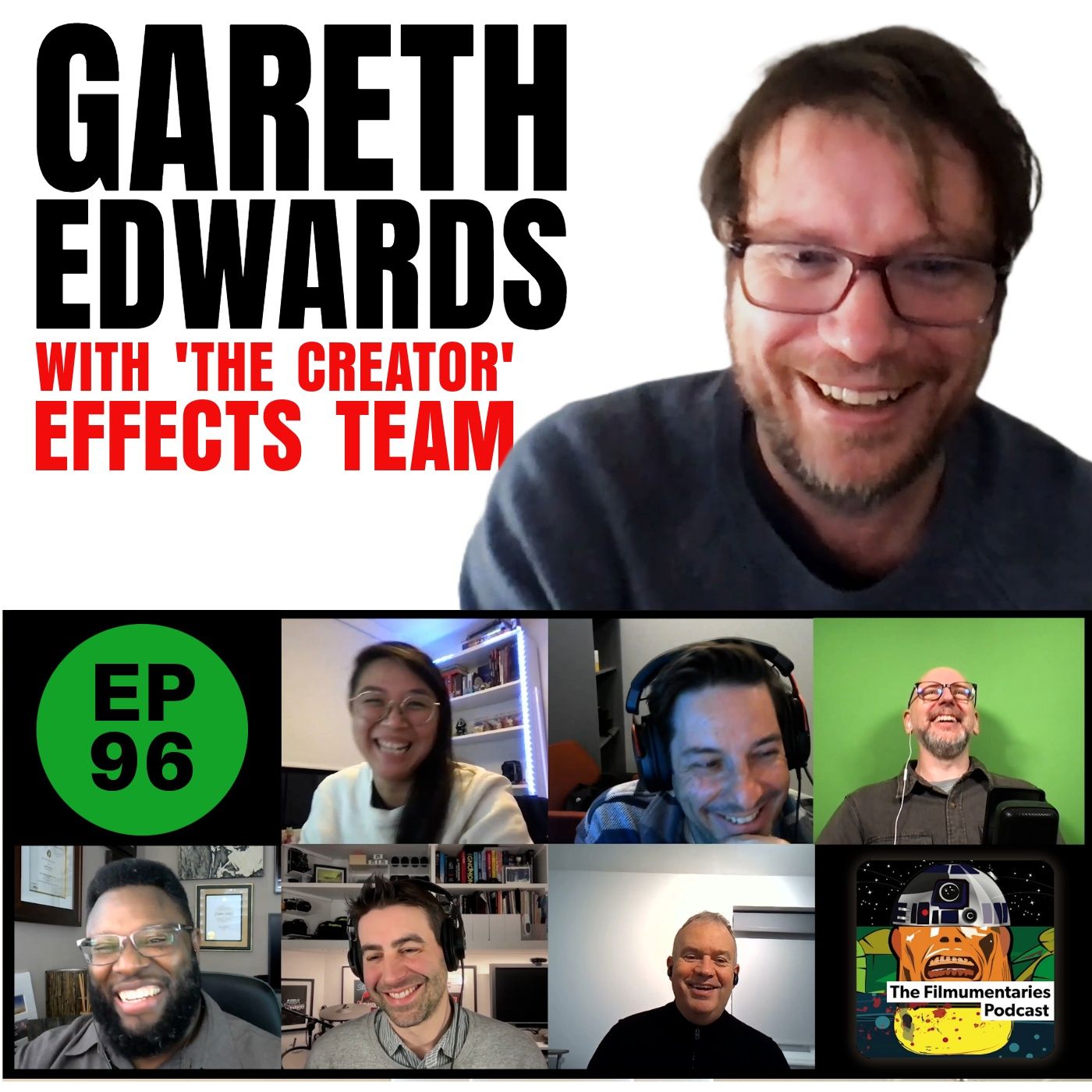
96 - The Creator - With Director Gareth Edwards and his Effects Team
About this episode
Well now we are back to some recent interviews, I can tell you I’ve been busy lining these up ready for 2024!
So… for the first, its a pretty big one, well it’s a very big one - Thanks to the lovely folks at ILM, I was given the chance to interview director Gareth Edwards and his FX crew on The Creator.
I’d be trying to get Gareth on via a mutual friend of ours but given Gareth is currently doing press about the nominations the film has received, so it was perfect timing.
So you’ll hear my conversion with Gareth along with VFX supervisors Jay Cooper, Ian Comley, Charmain Chan, Andrew Roberts and Jay Cooper as well as SFX supervisor Neil Corbould.
There is an exclusive video version of the podcast on the filmumentaries youtube channel so that you can see all of us talking while I paint the interviews with some of the VFX breakdown clips ILM kindly provided. So if you can, head over to youtube to check that out.
So, we talk about:
- Gareth’s unique shooting techniques that enable large scope on a relatively low budget. And also the now famous use of the pro-sumer camera.
- How the collaboration between the on-set crew and VFX teams is crucial for achieving seamless integration of practical and digital elements.
- How anchoring VFX work to practical elements in the frame enhances the realism and believability of the visual effects.
- How real-world locations can provide inspiration and add authenticity to the film's design and visual effects.
- How the future of filmmaking with VFX lies in finding innovative ways to combine practical and digital techniques and finding the best tools to make the pipeline more efficient.
- We finish by talking about award recognition and what it means to them.
All the links
This podcast is completely independent and made possible by listener support. If you’d like to help me keep making these episodes, you can join my Patreon community here: https://patreon.com/jamiebenning
Watch more on YouTube:
Check out the Filmumentaries YouTube channel for behind-the-scenes clips and extra content: https://youtube.com/filmumentaries
All my links
Transcript
Automatically generated, so expect the odd misheard name.
Weirding Way Media. Welcome to you, episode ninety seven of the Film Mementaries podcast. This is Jamie Benning here talking to you from my house in London. Thanks for joining me again or maybe for the first time. Either way, I appreciate you being here and if you enjoy it, please do spread the word about this little podcast.
I hope you enjoyed my archival interview episodes in December twenty twenty three, one with producer Robert Watts and the other with actor Garrick Hagen. Well, now we're back on to some more recent interviews. I can tell you I've been busy lining these up ready for twenty twenty four. So for the first it's a pretty big one. Well it's a very big one.
Thanks to the lovely folks at ILM, I was given the chance to interview director Gareth Edwards along with his effects crew on the creator. I've been trying to get Gareth on via a mutual friend of ours, but given that Gareth is currently doing press about the nominations the film has received, it was perfect timing. So you'll hear my conversation with Gareth along with VFX supervisors from ILM, Jay Cooper, Ian Colmley, Charmaine Chan, Andrew Roberts, and Jay Cooper, as well as special effects supervisor Neil Corbold. There is also an exclusive video version of the podcast on the Film Youmentary's YouTube channel with some behind the scenes clips from ILM. So maybe watch that because you can see all of us talking, you can see who's talking.
I paint some of those interviews with some of the VFX breakdown clips that ILM kindly provided, So if you can maybe have a listen to this, and if you enjoy it, head over to the YouTube channel and watch it again. So we talk about garris unique shooting techniques that enabled the large scope on a relatively low budget, and also about the famous use of the prosumer camera that they shot the film on, how the collaboration between on set crew and VFX teams is crucial for achieving a seamless integration of those practical and digital elements. We talk about anchoring vf's work to practical elements to enhance the realism and believability, how real world locations can also provide inspiration and authenticity to the film's design, and how the future filmmaking with VF lies in finding innovative ways to combine practical and digital techniques and finding the best tools to make the pipeline more efficient.
This film was shocked quite differently. Gareths approach was very different, very bold approach really, and the VFX pipelines had to be changed to kind of cope with that. So we talk about that as well in some depth, and then we finished by talking about some of the award recognition and what it means to them. So here's my conversation with Gareth Andrew, Jay Charmaine, Ian and Neil and I'll be back at the end for a bit more jabbering on Gareth, how did you manage to pitch this idea of shooting a big budget movie but the small part of the budget, the smallest part of the budget on the kind of the shooting the eNCA stuff and then saving the rest of the budget for the v effect. It's a very non traditional approach.
That was the plan. That was the plan. It went a little bit left field of that because of this thing called the pandemic. It wasn't quite straightforward is staying goerrilla the entire time because we had to have the pandemic police sometimes on set. Obviously, but yeah, no, Basically I always felt doing previous films.
I got very lucky. I did a very low budget guerrilla film as my first movie. It got me in the position of doing two massive, amazing opportunities in Hollywood's and I always felt there like a more sweet spot to be had where and you have to kind of the problem is if you just go for like, Okay, I'm going to do a mid budget movie, you become a kind of film that has the aspirations of being a blockbuster but has none of the budget and gets crippled very quickly. Or it's trying to be creative and artistic like an independent film, but it has to deliver this big box office so it can't even do that. So you can get completely trapped and not be either.
And so it felt like the most simplest way to explain it to everyone was, let's go gorilla. Let's go really indie with the shoot. And therefore, you know, if you get the crew down to a certain size, it's cheaper to fly anywhere in the world than it is to build a set, and so suddenly you can cherry pick all the greatest locations in the entire world for every single scene, and then you've got this problem of like, let's not build anything because we can't carry that stuff around with us. Let's just we'll have this big buffer, you know in theory for post production. So it was a bit like taking the safety net people normally have as backup during a movie and go making the film with that.
And our safety net was like the majority of the budget for post And did you ever consider using you know, like studio or those other techniques that have kind of emerged in the last few years, like the volume or was it always your intention to go in that sort of gorilla stuff that you described. We did use the stagecraft, which everyone knows more commonly as that thing they used on the Mandalorian, and so we did use a bit of that for two environments at the end of the movie that were in space, because it was impossible to find the real world equivalent. And you know, green screen I've done. I spent my whole my background as visual effects, so I spent most of my career dealing with green screen.
And I just think green screen is essentially taking a problem and just giving it to someone else in production. It's often seen as solving a problem like oh if we put a bit. If we paint this green, then we did it. We can tick that box, we can move on to the next scene. And it makes it hell on earth for the people in post that then have to figure out what the hell everything is.
They're basically saying, we don't want to make the film. You can make it at ILM later. And so that to me is like just off the table now in terms of an approach, unless you really really know is specifically what you want and you're not. You know, there are versions of it that work, but for this one, it really felt like we're not going to go there, and like, let's get real. Let's get a piece of footage for absolutely every V effecture in the film, and let's try and make it look as good as possible so that when you then replace elements of it, it's still a strong image from the start, if you know what I mean.
M H. And I've heard lots of talk, of course about the you know, the pro Sumer camera that you used and how that freed you up and how it was lightweight you could operate and things like that, but I'm interested to know, you know, what effect, what knock on effect does that have on the VFX departments because it's not the traditional kind of pipeline where you know, I guess on set V effects Andrew, you're used to having some sort of control over the environment. But here you've got Gareth, you know, operating himself. He's he's finding moments of improvisation, he's finding you know, he's reacting to those moments. What kind of challenges does that post for you?
Yeah, that framing that you would typically have where I know that is the background that is behind that's the space it's going to be behind Alphae and Joshua or Harun didn't really have that because Gareth would have these long takes where he's moving around and he's having them reset and he's hunting for that perfect angle to really capture that connection all that moment. So for me, it was trying to observe where Gareth was moving so that when he finished to take, he would hand the FX three to me and I would maybe shoot a tile to try and provide the effects with the background, also doing a round shot what we call a virtual background, where I end up just shooting three hundred and sixty degrees sort of tilting up and down and trying to create just a very high resolution sphere to be able to provide somewhat of material for background reconstruction and then shooting h der eyes.
But when John Nole spoke to me about joining the Creator, he did say, like, you're not gonna be able to get everything, and you do need to sort of let go be present, be available for Gareth, but also, you know, don't get in his way, like we'll be able to, you know, support you. It's going to be a little bit of a trust for that. You know, you just try and identify the main thing to get at any given scene, and that the rest of the team trusted they'll be able to pick up the rest of it. So there were some moments of anxiety when I'd see Gareth wandering around and from a close up suddenly we're a two shot and now we're looking the opposite direction. But it was just about trying to grab as much material as I could to hand off to the to the post team.
And what knock on effect does that have to you? Then Jay and and and mean, I was just gonna say, ninety percent of filmmaking it on this movie, don't get in Curt's way. I think maybe, maybe, maybe ninety five percent. Well, for one thing I wanted to sort of go back to you quickly is is the camera. And you know, you would have thought that there would have been more problems like that, there was going to throw up some huge issue about working on something as a prosumer.
But I I'd open up to everybody else. I felt like it was actually not that huge deal once we got over the problems of the specific lens. And you know, we as part of our process we have to profile every lens that we use so we're able to remove the distortion and match match the the artifacts of it. It's it. We we got back to sort of traditional filmmaking.
It could have just as easily been an area lexo or uh, you know, a traditional film back. So I think that's that was That was something that was really exciting and a little bit surprising. There wasn't a huge problem when it came to that, So, I mean we got to it was not something that we were like, oh man, this is we're gonna be We're gonna be fighting this the whole way through the show. Something something probably to point out is we weren't in any way trying to use a pursu would camera to sort of at the end, go, did we use the prosumer camera on a big Hollywood blockbuster. It was like, honestly, if the if you inverted the price tags and the ARI was four grand and the FX three was eighty thousand dollars, we would have paid eighty thousand dollars for the FX three.
It was it was so light it could shoot at twelve eight hundred isso, which suddenly meant you could use available light, and all our lighting equipment got way smaller and more battery operated. And those two things alone, and the color science had just suddenly gotten good on those cameras, because you know, you have to mess around a lot in post to get the loot, you know, to look like film and everything else. But some cameras, no matter how much you mess around, you can't get there. But they'd use the same sort of basically the same technology inside as they used in the Venice on their Fix three pretty much. So it felt very professional in that sense.
Yeah, and we weren't getting four K images off of that camera, so it's not even like there's a resolution component that was very different. I mean, listen, there there's there's always a camera that has war bells and whistles or war resolution, but in terms of what we needed and giving Gath the flexibility he wandered on sad it was a huge, huge wind definitely. I mean we're so used to Harry Alexa footage kind of maybe super pristine, but in a way this this had beautiful imperfections and I think that just went hand in hand with the very naturalistic scenes that you know, the intimate moments lady sifting rice through her fingers and it's just those little day to day moments, and there was something quite intimate I think about that sort of heavier style.
Look. Yeah, and I think you know, shooting is in the way that you did, it sort of invites those kind of happy accidents to happen again that maybe don't happen on shows of movies where it's very v effects driven with the pipeline kind of in the opposite direction. I mean, that was the that was the thing that was It's very different about this movie in general is and I can't speak to the specific shooting ratio, but huge amount of flexibility for Gareth and providing him a structure which he could shoot in every direction not be encumbered by a large footprint and set and have the flexibility of working without having to put his actors in a makeup chair, whether it was Alpha or a Roun or any of the extras.
That's the that's the that's the where we all joined hands and jumped to support that philosophy. So to give to free up the money to go to a bunch of different locations and also to give him like this huge amount of flexibility on the day, that's what we're endeavoring to support. Yeah. No, I've heard, you know, Gareth talk on the documentaries about you know, having this small crew, this gorilla style of shooting when you have special effects. We're talking of course about the tangible in camera physical effects.
Teams arrived, do you still come pretty more hands I mean, is there's still a huge bunch of you or did you manage to whittle that crew down to a smaller crew than usual. We sent two people to Thailand and then the rest were local crew. So and normally I travel with ten to sixteen containers full of equipment, and we traveled with one. It's very very well loaded. We picked some stuff up on the location as well, but it was very you know, I briefed Jonathan Bullet, who was on set supervisor, of the way Gareth likes to work and just just just do stuff, you know, put stuff in, don't wait to be asked to do it, to do stuff because he will shoot it.
If you're regular explosure up, Gareth will find it and film it and then just lots and lots and lots of smoke. Yeah, yeah, creating the atmosphere. And I guess a lot of what you do there on set and your team does on set that kind of informs the look of the movie for the visual effects team as well. Yeah, I think you know, Neo and his team putting in all the special effects that they did, whether it be the smoke or explosions like that, gave us such a grounded, you know reference, And for us it was, you know, just adding a bit more. It wasn't completely replacing it.
It was literally using that as our basis. And that's kind of I feel like the main theme throughout this whole project is we use a lot of whatever is already in plate photography and just either augment or you know, change and replace and extend things here and there. It's never a complete, just reword full visual effects. It's it's a mixture. It's a nice mixture of plate and CG.
One of the things that's kind of hard to do in visual effects is to have convincing explosions when you don't know what the explosions would look like on the days. It's not that we don't do it all the time. We do, but you when you have an anchor that is, oh, there's a flame pot and the tank battle sequence for example, yeah, going off, and we know that there's one other day, but we want them, how four of them? But we know what the color temperature is, we know the genemics of the smoke, we know that the we can infuse all these ideas that are already there. So it's it's as far as we're concerned, the more that you can do on the day, the better it is.
But as long as we have something in the frame to like key off of, that's really the jumping off point for us. So we get the color temperature of the smoke, the wind direction, the wind strength, the how long the you know, the fire is persistent before rules in the smoke. All of those things we're looking on as cues. It's not that we can't make those choices independently. It's just that if it's already been it's been expressed in the frame, we know there's a reality to it, we can we can recreate it.
Yeah, and I think if it's expressed in going Garret. Sorry now, I was just say when I used to do visual effects, I mainly relied on photo shop and I did a lot of like matte painting cheeks, like two and a half ty things for the effects. And I would say the predominantly the thing I was doing the most, because what you do is you get an image, some footage at someone's shot, and you're trying to make it look better than it did. And one of the things you start doing straight away is you start cutting out layers and then the main thing you do is you start creating what you'd call Z depth cues for those layers. And it's what lighting does on a set.
It's kind of like you're looking at a two D image, but it's tan your brain. This is far away, this is close, and that helps give you ideas a scale and all sorts, and so what you might call atmospherics or smoke is like such an important part of making a cinematic image, And in a funny way, if someone said, you've got to go shoot into the film, but you can't take a big light with you. You can either take a big light or a smoke crew. I would go through the smoke for every time because it's gonna It's the thing that tells you winsty when you look at an image, the relationship of everything in three dimensional space, and your brain really enjoys seeing that because it understands doesn't have to do any heavy lifting to understand it.
As sort of they're more pat like easy to you know, consume the images are that the more your brain enjoys watching them. It's sort of a weird thing to explain. But the smoke was in every single scene, every daddy. They got really good at it by the end. Yeah.
So as much as it's important for you to have that anchor to anchor your work to, it's important for the audience. Isn't it to have that anchoring as well, because you buy it a lot easier as as an audience member. I remember speaking to the crew that worked on and Or and they were saying that, you know, there was a shot of a dam in whales that doubled up as an imperial base or something, and they might have replaced ninety percent of that shot, but because they had something to anchor to, you know, it helped their work and it just helps the audience buy it all the better. I have to say. I think one of the things, one of the many things I've always enjoyed about your work, Garath, is the sense of scale that you're able to create.
And I wondered if by shooting those on location plates whether it kind of enable would you to be even bolder with scale than you would have if you'd have been creating the shop purely as a as a computer image. I think that may thing is you get so inspired when you're sat with a blank canvas, you know, and the concept artist or you know, the effects or whatever it is, and you've just got to start painting something. You can do the obvious thing like Okay, there's a really massive monolithic sci fi building in the distance. Okay, we never got to do that. Here's a sort of shape for that again, there's a four ground character.
Okay, there you go. Then everything in between is it's like, well what would that be? Is there a road? Is there a cliff edge? You know?
And you and it becomes really difficult to make all those details up, like and whatever you actually did, when you step out into the real world, you get like ten times more ideas for free. They're just there in real life. And and so every time it would shoot something that had to have the effects, which is nearly a shot, there was an ex otment to you know, if I close my eyes and someone said, what do you think we should do here, and you would picture the shot, and then you open them and you see where you really are, and you see what the light's doing and what the weather's done, and where the actor is. You suddenly go, oh, oh, I know it'd be way better, you know it, and it stops being so generic, Like it stops being this thing because it's sitting down, it was inspired by another shot from another movie, and it becomes your movie, like very unique to this moment and this situation.
I'd say the hardest thing was backing off because the thing that gives a lot of things scale is a reference to something you know the size of, and typically that's a person. And so if you're over the shoulder of someone, like if I'm over someone's shoulder and I'm trying to make something far away look big. It doesn't because the biggest thing in the frame is their head, and so things look really big when you get like, you know, three hundred meters back, and then there's this little figure in frame. But getting three hundred meters back means any old tourist could walk into shot, you know. And so so there was always like this thing we would do where we would shoot close up all their drama, if you want to call it that, and then we would go through all the same motions again but on the drone, and we sort of treated our drone like a camera crane.
So we had a drone crew and it was sort of hilarious if you ever listened to the footage because they recorded my voice. It was during COVID had a mask on, and they found that they could put a little microphone in the mask and listen, like so they could listen to what I was saying and me trying to translate or explain like low low left left, no, no, the other left. But we would get these shots and they were so exciting, Like as of the effects artist in the past, I would be seeing stuff unfold and go I would love to do this shot, do you know? I mean, like the way the sun is going, the way the mountains go, and you've got this late it's like there's this beautiful little playground just to imagine things inside of and and so it's sort of people talk about the world building in their film, and I think the biggest thing we did that, strangely, as absurd as this sounds, doesn't happen on these movies is go to the actual world to start building.
Like normally you're in a studio against green, but it's like when you stand in the real real world locations, there's so many clues and ideas and inspiration that you just like it's it's more about taking things away than it is like, oh God, what can I put there? You know? Maybe maybe I lem complete disagree now and contradict everything I just said. No, no, no. It's funny that in many ways a lot it's a travel film and there's a it's a serial.
There's so many one offs, and the one officer a mixed bag for visual effects because it's a huge amount of work for one shot, right, there's no efficiency of skill there. But it also does this amazing thing for the audience where you just keep on seeing new novel perspectives of this world, and it's informing your world in a way that it's not like, you know, I think a lot of films are organized, and I'm that I'm not. This is not a cut for them. It is dialogue, dialogue, dialogue, set piece and basically a playground, right, And so you see a lot of different views of the basically what environment. And Gareth's movie is traveling through these environments, and there's a there's a really there's always like sort of an these really enjoyable one offs where you see enough of them and then your head just sort of explodes with the idea of what this world is.
And there's a and this, if there's any magic trick that we're doing, is we're taking advantage of the fact that we've shown you so many interesting one off views of this world, some that don't even you don't even understand what they are. And there's a shot that I'm reminded of where Josh was traveling on the bus where there's there's enormous sort of forms like that are triangle looking things. I still don't want exactly what they are, but it's really cool looking. And then you're off it not explained, not part of the story and the sense of it, but you're just you want to see more and more of that world, and there's a level of engagement that comes with that. Yeah, And it's not just about the scale in the frame that I was talking about when I mentioned scale.
It's that you feel like it is a world, you know, you feel the expanse of it. But at the same time that scale never becomes overbearing. So you get those emotional scenes where the audience needs to lean in and feel empathy for the characters that we're learning about as we go through. And it feels to me, Gareth, that that was the ethos through all of the departments. You know.
It feels like the design, the production design, the acting, the characterization, all of it is important for those intimate scenes. You know, Like I think in the documentary you talk about how you kind of have more of an empathic response based on the design of the face of the simulants. Yeah, I would say, I mean, I can't agree with you, because you know, I always beat myself up that I should have done something different or better than I did it. But I would say the thing I would like to be true, whether it is or not is that when you're making a movie, you end up talking about things so many times, and you end up using similar words over and over and over, and then at the end of it, if you somehow could, like if you could basically have like a document that is a transcript of everything you said over those two years, I would love to think the two high score words are emotional and epic, Like it feels to me that was what we were always trying to do, like make it feel really epic and make it feel really emotional.
And I'm not saying we did that, but they're the two places I don't want to go just to one, you know, I mean, those are the two places I always think a film should try to get to the because film sort of does that better than I think a lot of the other art forms. They can achieve give you goosebumps and also make you cry, you know what I mean. So it's it's like they're my favorite films I was growing up. Did that, Yeah, I think, you know, sci fi is quite a crowded genre, and Gareth, I think we're roughly the same age. You know, it's very difficult to your twenty twenty three other film.
Yeah, absolutely, yeah, yeah, I just went bored very early. It's it's very difficult not to see nods to films that we kind of grew up with, and of course that inspired you. But you've created this world that somehow feels familiar. It also feels new, but more importantly, it feels right to me in some way. Like some of the technology looks clunky and annoying, you know, like the radio with a little light on it.
You think initially you see, why is that thing big? And then you look around you and you go, yeah, the world is full of stuff like that. Not everything is sleek and designed to perfection. That seems like something that again carries through the through the whole movie, whether it's the vehicles or the hand props or the costumes. It's not a question, there's a statement, but somebody can I'll say, I mean, Jay can take this over.
But basically we give a very early brief was imagine Apple, you know, the iPhone didn't win the handheld tech battle and it was won by the Sony Walkman early in the in the eighties. And then like so it's like kind of parallel universe in the way like where's it's what the future used to be when we were growing up, and so you guys did like loads of research into that as well. Yeah. Well, I mean, first that before we get too far into it, major kudos to James Klein, a production designer who you know, the movie does. The movie does not work without his contributions on the design front, who was with us from the beginning to really at the very end and was always jumping in and designing, and we were, you know, popping back and forth with him, trying even to the point where and I think this is very untraditional.
This movie is untraditional in many different ways, but one of the elements was very intraditional is we would give him rough renders which he would do overs with that would end up back in shots. There's no movie I've ever worked on where we're trying to straddle this world between art, concept world and individual effects as much as this one. But in regards to design, you know, we're the buzzwords that we kept on hearing from James and from Gareth were product design and how things fit into other things and these negative space and they're continually pushing in those degrees and we've had, you know, the touchstones of the design work where you know, the the game Boy and the Walkman and Gareth.
I don't know if I'm gonna real too much, but the number of pieces that you had collected from eBay that you then would podge podge and swish together to turn into other onset items, I don't know, that's a fun I mean, I think there was just really interesting to see how that all worked out together. Other you're not going to volt to the fact that you passed, but I think, yeah, basically it was the pandemic. I had too much time on my hands, and so I bought every single piece of tech off eBay that you could he with that guy bidding against me, right, yeah, from the eighties, and and then I think, I don't know what it was like three tons of eBay items went to Thailand something like that, Wow, like and twitchers and we would cover him in half.
So you take like a bit of a sony camera and then you would take like some old computer and like basically glue them together and then blend it and create a new looking sci fi device out of it. And it was like a poor man's way of just filling out all the props on the tables and filling out you know, all these environments with like crazy looking weird ship that we never explained. That's a very kind of Norman Reynolds approach. Sorry, it was a tree walking through the artwear house in Bangkok and seeing tables and tables of just sort of this old gear and kit that the art department would attached to a backpack or it would be some sort of a handheld device that again wasn't ever explained, but just became part of the tapestry of the world.
You'd see people wandering around carrying things and it really worked. Our team at I l M had such a blast though, like putting all these whether it be like you guys said, backpacks or TVs together, it was just you know, the smallest of objects and suddenly, you know, doing exactly what you guys did on set, practically sticking things together. Our team did the same thing and was like, totally, I want to put this anys you know, purple color in here and give it a bit of that orange accent as well, and you know, contrasting that was the shades of gray and that eighties vibe was very much live throughout all of the design. Of course, the first time I watched the movie, I just felt all of this. I didn't analyze it, you know, on second and third viewing, I'm looking out for things and trying to spot think as in testament to all of your work, you know, Neil, I couldn't tell whether that was they were real vehicles on the road and your team were controlling whether they were CGI and what what was your part in the puzzle and what was the VFFS part of the puzzle.
What were the sort of challenges you had on set, you know, to being you know, in a far flung place where maybe the movie industry doesn't necessarily go to. Did you find challenges there that were this is to you and Gareth, did you find challenges there that really meant that you had to improvise from data day? And it was really you know, like I say, we took a very minimal amount of equipment and then we just found whatever we could there as well and just and just made it work. And you know, because also Gareth shoots three sixty it was like trying to trying to keep out shot or or like Gara said, you know, we'd we'd we'd dressed the people up so they were in shot with the smoke machines and stuff like that.
So yeah, it was, it's it's it's a great way of working, I have to say. Yeah. I mean, even though we were augmenting, you know, huge sections, we were often keeping the windows and the views suits of the interiors, but the rest of the vehicles were often complete applacements. But it's it's that theme of real, real, real, real, be it real vehicles as a base, or actual plates containing amazing information or real props that inspired our artists. You know, we're we're totally up for this.
You know, it's give us that over a green screen and to show mains when that lit up our cruise people. He weren't on this project, wanted to be the thing that the thing that Gareth had it had hit Still a little bit mystified that we pulled it off is he had faith that we would sort of figure it out and made these really big swings. You know, sprinter vans on set which we're going to be deleted and you know, remove the engine bas or the same for the ambulance or I mean a half a dozen of other vehicles, and then us trying to figure out you working with James to trying to find which parts were absolutely necessary to hold on to to get that to work. That sort of puzzle, we had a lot of those. I mean that that's sort of a thread through the entire movie is making these really ambitious asks after it's been shot and having the confidence that we could sort of figure it out, and it was.
It was lucky for us that we had such an amazing well, an amazing painting, an amazing tracking team, and amazing compositing and lighting teams that were able to sort of contribute. We had to fight people to get them off the show. I mean, there's it's very rare that you have a project where there the visual facts artists team is so engaged that they they'll they'll spend more time than they're necessarily assigned to work on it. So it was just it was a rare treat in that regard. Yeah, I guess you're all in the industry to be you want to be challenged, you want to push on to the next level.
You don't want to be wallowing, you know, in the same doing things in the same way. Do you think that the way this movie was created will change people's minds on how a movie can be made they have the information. I don't know if they'll pick up the Briton. I mean, I just you know if I'm yeah, I mean a key ingredient, you know, And I think we feel this at least ilm side is Gareth in the equation. The fact he can size up a shot with with the knowledge in his mind of how that could come together, how that needs to come together, and then communicate it really, you know, clearly efficiently with us downstream, makes the world of difference.
I mean, I think other other filmmakers could pick up a similar style, but it's it's partnerships, you know, if if perhaps they're less VFX savvy but want to take the same approach, it's making sure that they have VFX core in their team so we can kind of pick up any slack and make sure we're having those discussions and can feed into, you know, some of those early decisions. So yes, I think it can be done. But I mean, you know, Gareth the d GA and you're all signed up for the next Gareth movie then right'ty s five? This is what I was going to say to you guys. You know, I look at you know, the film and I can see you know the kind of influences that you and I have grown up with.
And I can also see aspects of monsters in there, and I can see aspects of Rogue one in there, and I can see the scale of the Godzilla mooviy what's next? Is it a musical? Where are you going to go? Are you going to completely off pieced? Yeah?
It's a rom com black and white musical. Wards, Okay, looking forward to that one. I just wanted to go back briefly to talk about, you know, the way in which you shot this, because, as I said, I was talking to Phil Tippitt earlier and he was I was talking about how much planning he does in his work, and he says, sometimes I just build the armature of the thing, I build the miniature around it, and I just pick set about animating. And I've got an intention. If suddenly I think, actually this character should do this, I've got that ability as director and animator to take it in any direction I want to go.
And it seems to me that you have that same kind of approach in that you allow yourself enough room to to improvise. You know, people talk about that flow state, don't they? That sports people get when they're driving, you know, a racing drive around a racing circuit out and Senna famously talked about it, or Phil Tip Peoples talking about being in the zone? Is your zone Gareth like behind that viewfinder? Yeah, I can relate to that in the sense that so there's you know, what I thought the way you would make a film was when you were young, is what you did is you sort of got pen and paper and you start storyboarding, and you close your eyes, you try and picture what would be really cool shots, and then you basically show that to everybody and they go, got it.
And then you want at a time just go and get those shots and put it together. And that's that's kind of how some films are made, you know, and partly made. And I found that when I made my first film, I had to throw that whole idea out of the window because if we had so little money that if I started trying to say no, it has to be this car going this way against this thing, suddenly that would cost us ten grand to organize, you know. Instead, it was like, okay, let's just flag a car down on the side of the street that looks cool, and let's see if we can talk them into being in a film for an hour and things like that and so that. But that then teaches you because you get in the back of that car, you go down some of the road that you weren't picturing it, and obviously when you see things worse than you were picturing, you go no, no no, keep going no no no.
And then suddenly you'll see something better than you're picturing, or more interesting or unique than you're picturing, and you go, wait, weak stops up, spups up. Oh, they're cool, cool, okay, and you start like chucking the ingredients in front of camera. And again you need to have a plan slightly because the crew or everyone that's trying to help you, they just want to know what do we need to do right, So, like by having storyboards sometimes a concept are long long conversations planning things. It allows everyone to go, Okay, we need these ingredients nearby, and we need to chuck them in front of the lens like this. And then when they're chaotically going in front of the lens, that's when you get excited because you go, okay, it's not quite I always feelally bad.
I think my worst moments are when I've I've blocked a scene and it's two staged and it feels fake, you know what I mean. It feels like actors have been told to stand there and look at that thing. And I always come away from those situations or in the edit sweet look at them and go, oh god. It just feels like a movie too much. And when you have, you know, things that where it's a little bit out of controls, it always feels more realistic.
And I think in a science fiction film, anything that can add a layer of because basically, you go, how do you make this more realistic? And ILM might tell you, oh, we set the renders to this, you know, and we have extra texturing on there. And I think that's worth maybe three percent of the realism effect on the audience, but probably worth fifty percent and gets you way more of a win really fast. Is having naturalistic behavior and having a real location and real lighting and and so so like it's that's always what you're looking for, and it's the filmmaking is a fine line constant, like knife's edge between if you go so totally real it's boring. Real life is quite boring, you know what I mean.
It's it's security camera footage that no one ever wants to watch, right, But if you're totally totally contrived, it might be stunning and exciting, but it's you never believe it for a second, And so you're trying to dance between those two worlds. And what made this film so exciting for me is you know this, and they can't be robots because we don't have them in the world. We don't have flying cars, we don't have spaceships. But if we can shoot something in a really organic, naturalistic way where you're just so confused watching it going, but hang on that, hang on, how did they do this? And if you're familiar with filmmaking, you start to get wait, like some one of my favorite shots, things like where Alphie, the little AI robot kid, it's just chatting with the other kids in a village in like Cambodia, and they're just laughing and joking with each other.
And on a normal movie, that would be contrived. All those kids would be child actors, and it would cost and it'd all be dressed up in costume and it would feel really false. But we really went to a village in Cambodia, and we really had Madeline hang out with those kids and shot it without any like direction. I mean, just let them interact, and then we cherry picked the nice moments for the scene and stuff like that. And I love the fact that I've got Ilm at the other end of that, you know, and the other visual effects teams that worked on the movie.
But it's like knowing I was able to do a triple backflip because I knew that if I fell, or you know that il M was, there's this amazing safety net to catch me. And so it just made you more and more ambitious and more and more annoying to them because they kept succeeding. So it was like, Okay, let's try and make the fail. Let's try this instead next time. The next one's going to be brutalserving how organic Gareth was on set.
I really enjoyed just watching that, and then you know, tried to see, okay, what can I capture from that? But whether it was that moment when Madeline was chatting with the kids and then there were some dogs that were running down the pathway and some of the said pas wanted to show them off and Gareth was like, no, no, no, just let them through its Yeah, and so whether it was dogs or chicken or just or there was another conversation moment when some storm clouds started to roll in and so people started covering things up and we're thinking, okay, well we're going to shut down for a while, and character Gareth just kept on rolling. And this was a conversation between Ken Watanabe and a couple of the other insurgents where they were talking about does the child know what she's you know, what she's intended for?
And just that was a beautiful moment to observe where we just kept going and that this sort of light shower just went through, but it actually created some really interesting life and I really enjoyed just seeing that how Gareth just adapts and he's more of a yes and let's just see where we're at and go with it rather than trying to control the environment. I'll take full credit for that. But what really happened is I went up to the producers and went, it's about to be stilled. Can we can we film this tomorrow? And they're like nope, But that's that's a great thing, right.
You just captured the world the way it is, and especially because this is supposed to be you know, a sci fi futuristic robot film. We didn't have robots like you said, we don't have stimulants. We just had these amazing people in the village who were not even actors acting and they were just doing their usual normal selves. And you know, you specifically not telling them that they're going to be in into a robot or you know, putting someone in a tracksuit, I think made all the difference because they could just be themselves and that allowed us. You would never cast the woman who was going up the pathway in Nepal with the child as a robot if she was going to have to show with the wide stance and the water.
Yeah, exactly if she was gonna shop, She's not showing up in a casting session. It's never gonna You're never gonna put her in great pajamas. And that's that kind of thing, is I mean, that's that's kind of the that's kind of thing that that carries the day, like the naturalism of that moment and makes it sort of the specialist of the movie in many different ways. Of just Danny. I mean, these guys, these guys have all talked about how they were out of their comfort zone.
On the film, and I was too Like, for instance, that el when that storm came in, I so didn't want to film it, Like I really was, this is not this is such an important scene. We can't have all these storm rain coming down and it's not how I pictured it. And and everyone was like, we haven't got a choice, you know. I mean, these people go home tomorrow and blah blah, bah blah, you have to do it tonight. And the sun was setting.
We had about an hour or something as it was like nearly going to be a one take wonder, like we've got to do the whole scene in one take and just move around and find different angles and things like this. And I remember doing it as if I'd been stabbed in the stomach, like I was just so annoyed with myself and trying not to let it show in my interactions with people. But I was gutted because I've been dreaming about this because the pandemic, you had an extra year and a half to dream about every scene in this film. And I was like, ah, it's just not how I was picturing it. I was so annoyed with myself.
And it ended and I remember going up to Kerrie Hart, who was the producer on the film, and she was walking away from video village and I was ready with a bunch of excuses, go I'm so sorry, We'll do it again and blah blah blah, and she looked like tearful and she went that was amazing. I was like what, and she goes, that's the best scene that we've done. And I was like, you're kidding me, you know, And it's like and then you realize being being forced out of your comfort zone is a really good thing. In you go kicking and screaming, but you tend to do your best work when you're really not ready, or like when you because because a filmmaker can very easily start to create wolves and barriers and go and I want these people to tell those other people to go away, and I want everyone to you know, like you can.
You can make life easy for yourself, and then your films, I think, don't get quite as interesting and so so like with visual effects, like getting out of the comfort zone, getting a bit panicked, having some sleepless nights. Yeah you always come on. Yeah, on paper, on paper, this movie doesn't work for visual effects. If I'm if I'm completely candid, Like if you list out all the assets, if you list out all the shots, if you list out all of the the effects simulation, the number that comes back is way more than I think we had to spend. But it's the it's the fact that we started from a place of okay, well, we know that there's a we had sort of a common pot of money, and our goal was to sort of elevate everything up.
And Gareth is helping us drive where the what things are sort of hot, what things are colder, and where we can cheat, where we can not cheat, and techniques for well, we're only going to see this from one perspective, so we only just need it as a flat piece of art, and this thing is a lot more important, so we need to make sure we put more time to that. That's not how traditionally movies are made. Movies are made that everything is sort of on paper, has an equal weighting in terms of budget. If you're asked to build a robot, that's a certain dollar. If you have five of them, that's that is the same price times five.
Nope, we're not doing that. We're going to basically say our will make one common body. We'll make seven different heads. We'll do multiple paint schemes for the heads. They will send one tend one with Gareth wants a couple of other robots.
Well, we'll do is we'll turn off chirmine. You remember this, let's turn on a lens or turn off a lens. You know, things like that. We're we're in this world where we're trying to elevate and and find lots of cheats, and I think that's just really refreshing with for visual effects to be part of that game, because I think that's something that exists in the production is like on set a lot, you know, if you don't if you don't have the career for that day, then maybe you're on the ladder, if you don't have the Dolly, then maybe you're on a rickshaw. If you don't you know that there's always sort of a secondary backup plan and that's not something that we typically do in visual effects.
And it's something that I really loved about the project, is that we were trying to find places where we're doing that charming you. Maybe you want to speak about sort of our two d robots, like we had a we had backups for our backups. Yeah, one of our comp supervisors in Kids, he made this amazing set up a Nuke where we can literally track the people and render out based off of our robot kit straight out of Nuke. So we didn't have to go through the whole process of you know, creating its own bespoke model and then you know rigging it, animating it. You know, it was all done in two D and so we were able to hit so many of our background and mid ground robots that way without needing to go through the whole pipe.
So it was all about just finding quicker ways to be more efficient, and you know, we should be always aiming to do that. It's not you know, it shouldn't be a budget lad thing. It should be just something that you know, is the right moments use of right technology. There was like when like growing up and getting sin effects and things like that, which obviously I love, is that you feel this competition between companies that do visual effects kind of bragging about how much effort they've put into each shot, and it was like this arms race of effort, you know, and proprietary software was like one of the key words, right, like something no one else has. We only you got to come here for that, And there's this whole brag about how much effort has been put in, and I think a much I think, you know, better thing to applaud is how little effort went into a shot, you know, because if you can make someone believe that that truly happened, that fantastical event happened, and you did it very quickly and easily, that's actually a harder task than just throwing a million resources at it, you know.
And so like on what we were trying to do a lot was be clever, do minimum effort? Do you? I mean, like there's this whole theory of if you do. If you if you approach every shot as minimum with minimum effort possible, and you've still got loads of resources left for the ones that failed, you can then actually go the extra mile. But if you approach everything as maximum effort, about a third of the way through the movie, you're like, we're done, We're spent.
I'm really sorry, that's the end of it. And so so I think that mindset, like flipping that round was like super helpful because I get the sense that, well, you could tell me, at what point did you say, right, that's the shot we're locking that down as a shot, and that's going to the VFX team now to work on. Because I get the feeling you're not the kind of director who's going to say, dear ILM, please build me a entire three D town or city because I'm not sure where I'm going yet. You're specifically saying I want this shot augmented or you know, what's the ope of that? Is there an episode of that guy an idiot?
No, I don't think you're an idiot. What would happen is you'd have you know, you got basically filmmaking this a bunch of deadlines, right. You're not sitting there going, oh, maybe we'll do this, maybe we'll do that forever. Whatever. It's financial.
Someone spent a lot of money. They need their money back by this date. You know, that's how long you've got. And you work backwards from those deadlines. And I've got to feed ILM X number of shots a week for them to complete the film on time.
And so what tends to happen is you're never comfortable doing it. But it's like you got to give you got to turn over fifty shots on Friday, and it's like, oh my god, I don't even know five, you know what I mean, And so you basically have to sit and watch the film the cut you have and go, Okay, what do I feel most confident about? And you'd always go through and try and get it down. You eventually find fifty and then you'd have to go through and check the takes with it, all the best ones, because they can't if you change the take, that's like they've got to redo the whole thing. So a lot of your time in post production is doing that kind of thing.
I'd say a third of it is that, a third is actually editing, and a third is then giving feedback on visual effects and things. It's it's all consuming and like one day I'll do a little drama that doesn't involve any CG anything and it will be this, like beautiful. It's like, let's just pretend. Let's just pretend I noticed that you got you know, you've been there's a bunch of awards. We're in the awards season here, but there's nominations going on.
How important is it to you to get that recognition in terms of like a personal win, but also to kind of feel that you've you've done something new and you've done something different that was not from me. I take it. You can tell that. Am I going for it? I mean yeah, I mean absolutely.
On a personal level, it's it's a thrill and then some. But I think knowing what the team did, and that's you know, Global il M and the other partners outside of ILM who contributed special effects for this movie, you know, everyone truly pulled their hearts into it, you know, led by the vision that they could see in the in the plates from the outset. So I think to stand up and represent that amazing team, Yeah, that's that's the biggest fit. Nice. Well, I'm going to call it a day here, guys, because we've done nearly an hour.
But I just want to say thank you for your work. I love the movie. I genuinely think it's this generation's Blade Runner. I think people are going to be revisiting this film for another forty to fifty years and seeing the influence it's had on films that came afterwards. And I think around the course, that's more of the important than the awards.
I mean, honestly, for me, that's that's the most exciting part of it. I mean, the awards come a goal, but awards yeah, I'll take the awards. You need a background there. I'll meet you in forty years with them, and you can tell me when people funny like the movie and like Ridley, You're not going to be making small, intimate movies. You're going to be still making these huge epics.
Gareth, I'm sure. I don't know. It's a weird thing, because it is like you do go on a journey when you make a film, especially towards the end when things don't you know, we had an actor strike when this movie came out, and we couldn't even have a premiere with the actors, a big celebration. It was very strange and they couldn't do any press, and so so this is you start to then go why we do it? Like why do you make a film?
Like because it's so hard, it's two and a half years of absolute marathon, like where you do nothing but the movie, and you go, why do we do this? Why did we do this? And and I think, out of all the possible reasons, the one you mentioned, I e that when you're an old man, people still come up to you and talk about the film and an influence it had on them in some way, and you contributed to that cycle of filmmaking and inspiration that you know got you going. That's probably the ultimate accolade I will see in forty years if you're right. But I'll yeah that that is.
That's probably the best award you should get. I think that's a very nice line to end on there. Let's not Joe, it's the second best of what you can get. The Oscar is way that all right? That was even better?
Yeah, Well, I hope you enjoyed my conversation with the team from the creator there. I'm very pleased to see that their work is getting that recognition that we talked about at the end. There, Fingers firmly crossed for that Oscar. Thanks to Gareth Charmain, j Andrew, Ian and Neil and the folks at ILM for setting this up. Particularly Ian, Thank you Ian.
Ian's been looking after me for a while. Something else he's lined up for me in recent times I'll tell you about in a moment. Now. I often say this is a small podcast. It really is just me and my laptop and a guest or as you saw or heard multiple guests, this is not a side hustle.
This is work and it really doesn't earn me the sort of money for the amount of work and effort that it takes to make these episodes, from booking guests to research, interviewing, editing social media, it all takes time. But you know what, I love it, and I love the fact that some of you have supported me from the start, and your support vib Patreon is so important to me. There's currently one hundred and nine of you, I think supporting the podcast, so that's about seven percent of the people that listen regularly. And I know there are plenty of you listening because I get those stats. So if you do enjoy my work and you'd like it to continue, please think about pledging just twelve dollars for the entire year, not per month, for the entire year, and for that you'll help the production of at least twenty four episodes at least two a month.
Twelve dollars is what two coffees maybe two beers in New York or London, but it would really mean a lot to me. If you can't do that, please go and review it on leave a comment, subscribe, tell your friends, tell your friends in the industry. I know a lot of people I think my biggest listenership is still in Los Angeles actually, but there's people in Germany, Denmark, Japan, Holland, France, Canada. Yeah. So if I could get that kind of percentage up, say fifteen to twenty percent of you who listen could contribute that twelve dollars a year, then that would be amazing because I'd actually be be able to say no to other freelance work and focus my attention on the podcast.
You know, I'd love to be able to do three episodes a month or four episodes a month, because I just I love doing this work. Coming up on the podcasts, we have the return of my buddy, Charles Terrera, actor, director, writer and just brilliant person. Spent the day with him actually in Brighton this week. We went down there to see an event that was run by another friend, Waynims, in which he was interviewing Peter Sushitsky The Empire Strikes Back DP and of course he worked with Cronenberg and he worked with Polanski. I'm hoping to get him on the podcast.
Wayne is going to introduce me, so fingers crossed that. But yeah, Jarles is back for this. He was my second episode of this podcast but he's back because we sat together in his apartment in London. His a little flat there, and we did a movie commentary on our favorite movie. See if you can guess which film it is, it's probably Star Wars.
And then I spoke to helicopter stunpilot Fred North about his great new book that's out and we had a really nice chat, actually really good guy. And and and I've just interviewed someone who's been a hero of mine since I was five six years old, animator director frankly genius Phil tipp It, Phil tip It, on this little podcast. I don't know how I've managed to get from you know, no episodes to Phil tip It in a matter of a couple of years. It for three years now coming up though you'll have to wait for that particular episode until April, because that's going to be one hundredth episode. I wanted a big guest for that episode, and I've chosen that interview with Phil.
We did have some technical difficulties, but yeah, all salvaged, thankfully. There was a bad day there. I thought, oh no, the interviewers isn't complete, but no, all good. So that should be coming out in April, so please if you can join the Patreon Patreon dot com, forward slash Jamie Benning, subscribe on YouTube or on the podcast itself on whatever app you use, check out the YouTube channel, and just please spread the word. Thanks for joining me, and I hope you can do so again.
For the next episode of the Filmingmentars podcast, M Weird Being Way Media



Similar episodes across the network
Matched by shared keywords.
-
Special Report: Beware Boiúna (2026)
1 shared keyword: vfx
-
Seasonal Differences, Shifting Fandom
1 shared keyword: the
-
Resident Evil - Kulture Meltdown
1 shared keyword: the