
Season 1 · Episode 143
Ep 143 | The Farmer and the Shark — John Campopiano & Jim Beller (Jaws Doc)
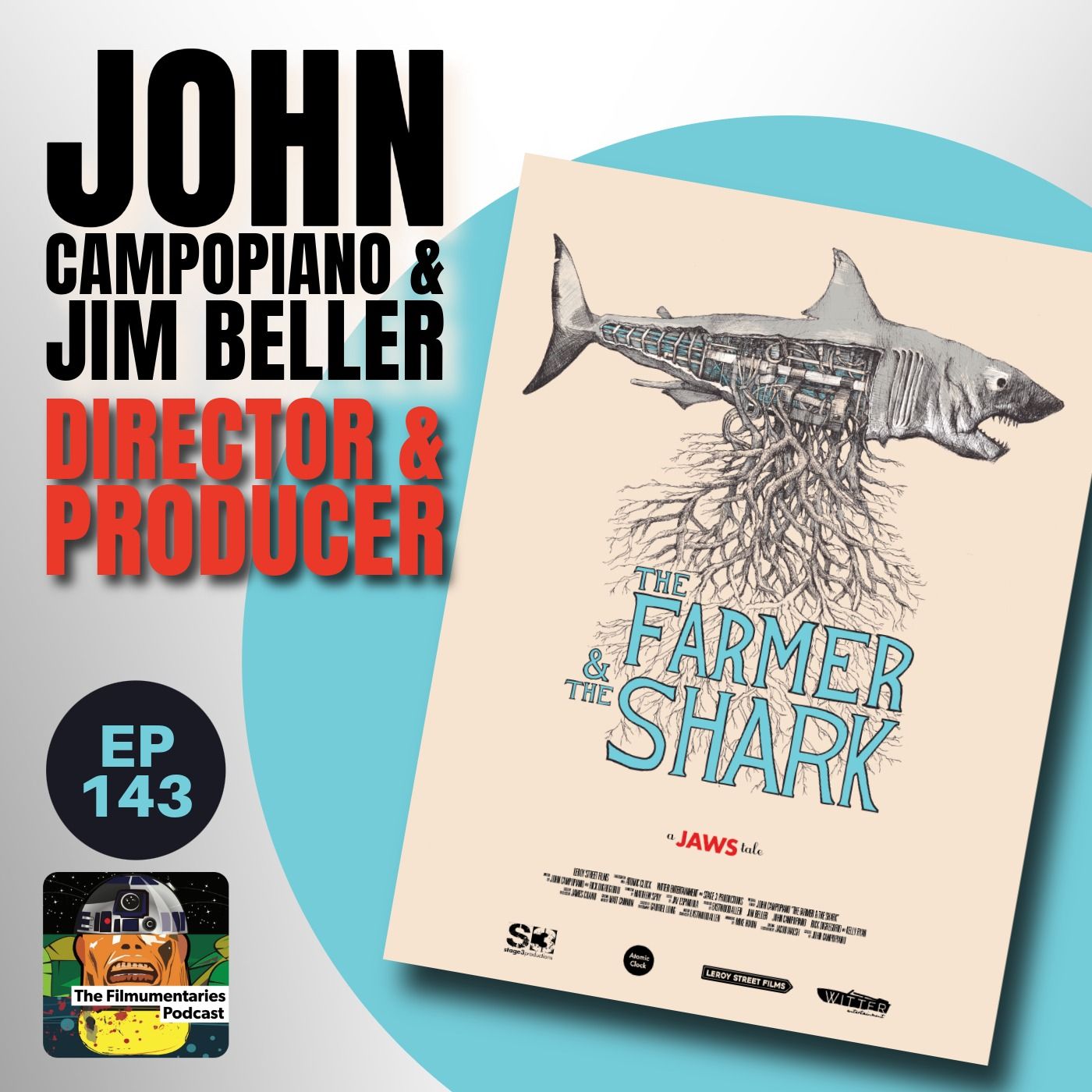
About this episode
From that small but unforgettable role, the documentary explores Craig’s life, his connection to the island, and how his story intersects with the legacy of Jaws.
John Campopiano is the director of the film and is known for documentaries including Unearthed & Untold: The Path to Pet Sematary and Pennywise: The Story of IT. Jim Beller is one of the producers of The Farmer and the Shark - former producer of my Inside Jaws - A Filmumentary and all round Jaws expert.
I should note that I haven’t seen the finished film yet, so this conversation focuses on the making of the documentary, how the project came together, why Craig Kingsbury’s story stood out, earning trust, and shaping a film around a real person whose life briefly intersected with a cinematic landmark. If you’re looking for a calm, thoughtful conversation about film history, storytelling, and the people behind the scenes, I hope this episode provides a welcome distraction. Guests
- John Campopiano — Director
- Jim Beller — Producer
- The Farmer and the Shark
- Jaws (1975)
This podcast is completely independent and made possible by listener support. If you’d like to help me keep making these episodes, you can join my Patreon community here: https://patreon.com/jamiebenning
Watch more on YouTube:
Check out the Filmumentaries YouTube channel for behind-the-scenes clips and extra content: https://youtube.com/filmumentaries
All my links
Transcript
Automatically generated, so expect the odd misheard name.
Weirding Way Media. Welcome to episode one hundred and forty three of The Film Youmentory's podcast. I'm Jamie Benning. I'm your host, and in this podcast I talk to people who work behind the scenes to bring films to life. Directors, editors, sound designers, sometimes author that have written books.
This week, I'm speaking to a director and producer duo who have brought a new story to life, a story about a film that we all know and love, but a story that we don't know that lies within the making of that film. So, with everything going on in the world at the moment, I hope you're okay, and I hope you're doing all right. I also hope this episode offers a calm and thoughtful distraction, a chance to step away from the noise for a moment and spend some time listening to people talk about filmmaking, creativity, and the stories that sit behind the films we love. In this episode, I'm joined by John Campo Piano and producer Jim Bella to talk about their new documentary The Farmer and the Shark. So the film centers on Craig Kingsbury, a farmer from Martha's vineyard who also appeared in Jaws, playing Ben Gardner, the local fisherman whose boat is famously discovered in the film with a big jump scare that you might remember.
It's a story that connects a real person, a real place, and one of the most iconic films ever made. John is the director of the film, Jim is the producer. As I said, John is known for other documentaries to do with films, including The Path to Pet's Symmetry and penny Wise The Story of It, which explore film history through the people and the circumstances behind the scenes. I should say up from that, I haven't seen this film yet, so this conversation is very much about the making of the documentary, how the project came together, why Craig's story stood out to them, and how they approach telling it, as well as some amazing finds that they've managed to uncover. If you enjoy the podcast and we like to support it, you can do some Patreon, Patreon, dot com, forward slash Jamie Benning.
Your support helps cover the time, the research, and the costs involved in producing these episodes. So it is just me. I am booking guests, I'm researching, I'm interviewing I'm editing, I'm doing all the social media. So if you want to support the podcast, is a link in the show notes. If you on support the podcast financially, please just share the link.
I really would love to get this out to more people. I think this is a great podcast final it just gets buried by all those big named celebrity ones. So here's my conversation with John Campo Piano and Jim Bella talking about the Farmer and the Shark, and I'll be back at the end for a bit more jabbring on, Jim. John, thanks so much for joining me. I was pleased to say that we finally got to meet in person this year on the Vineyards.
Jim, you and I go way back, way back ten or something. Yeah, I love my project that we did together. Yeah, it was great. I remember you contacted me saying, oh man, I've just seen your Raiders of the Lost Art project. Please do one on yours.
I can tell you everything, I can give you everything. You were the producer of that that film we mentioned super greatful. And we're great team doing it. It was just such a great team efforts. And John, you and I have known each other for a few years now, sort of through some kind of you know, mutual friends and things and contacts, but also great to see you on the vineyard.
It was just a it was a real kind of love in that that week there, that I had just so many people just there to celebrate the things that they love, and it was great to sort of soak up that atmosphere. You only saw you briefly, of course, but we got a quick picture quick. I know, I wish we spent more time together, but I know you were doing Yeah. I was there. I literally said hello to you.
We took a picture, I sipped a bottle of water. Joe came out, and then we went to see the Orca and just we didn't stop that week. But it was great. But in the meantime, you've been making this project. Well before then, you were making the project, but for some time.
How long has it been that you've been making this project together. I think we started twenty sixteen, twenty seventeen, Yeah, yeah, a long time, eight nine years. Yeah. And those projects kind of always evolve over time as you find new things out and people come and go in the teams that you're working with. But you've I think you've really focused in on a really interesting subject.
You know, it's Jaws adjacent. It's a Jaws tail in a way. I like that. It's like a Star Wars story kind of tag like Rogue one another Bomb, but the Farmer and the Shark about Craig Kingsbury, Like, when did it become apparent to you that A, this was a story to tell, B that you had enough material to do it and see that there would be an audience for it. Good question.
I'm going to start gym and you can take one of them. You can you can go, you can go, because it was your concept. So yeah, the original the original idea was to do a docu drama series, a much bigger project that looked at the many locals on the Vineyard that had an impact on Jaws, that maybe have had their stories told. And yeah, we shot forty forty five interviews over the of six seven years, and the project evolved and changed, and by twenty twenty four we sort of were almost really back to the drawing board. Knew that we wanted to produce something in time for the fiftieth knew that there was definitely stories within all the material that we shot, and yeah, I sort of had the idea I suppose of looking at Craig Kingsbury's story.
I mean, for my money, Craig is the epitome of a local who had an impact on the production, not just behind the camera, but in front of the camera has been Gardner. And so that's the first part of your question. The second question is interesting because I think you'll appreciate it as a documentary filmmaker yourself, that, Okay, we're looking at a body of material and we're looking at a new story of which we weren't originally thinking of when we shot that material. So it was sort of like square peg, round hole of Okay, how can we take this existing material and craft in into something different? And so we went back to the interview transcripts and we just said, okay, what do we have?
What do we still need? We had I think five or six shoot dates after that that were focused specifically on Craig. And the third question of how did we know there would be an audience? I think we could just assume that if it's Jaws, they will come. And so we we felt we had a unique story and we can get into more of that later, but we hit the ground running and what eighteen months later, Jim, we had a finished film.
Yeah, incredibly, it was. It went by so fast. It was really amazing. And Jim, you've worked We've worked on a bunch of documentary projects as an advisor you. I wrote the book with Matt Taylor, I mean your your When I think of Jaws fans, I think of Jim Beller, I mean Jaws collected dot com and all of that going way back.
I mean that was the first time I discovered you and your expertise. Must at some point feel like, you know, you've topped out on what you know about Jaws and what you could maybe find out in the future. It feels like there's been so many documentary there's been so many books, you know, we've we've heard podcasts as well talking about the making of Jaws. For you, it must have been exciting to find that there was still stories to be told. That's what really interested me.
We were, you know, like like John said, we've been working on this for a while and it's a different concept that originally we were thinking of. It was, you know, a mini series kind of thing, but making of while doing like we'd film actors being these people while in between it would be the real people talk and something like that, and then you know, just it just fell apart. It just was you know, and so we were like, well, you know, John was like we were just talking. We were like, it's a shame because we have all this great stuff that people never heard before, like these interviews and these new stories and these new photos and film footage, especially film foltage eighteen milimeter of footage eight milimeter footash I'm sorry, and and uh sixteen milimeter footage that we found later.
But anyway, so I I thought when John John was like, he just called me one day and goes, I think I have an idea. What do you think? And he knew I knew Kristin Henshaw very well. So he goes, which is Craig Kingsbury's daughter, and he you know, told me the idea and I was like, oh my god, that's brilliant because that's never been told before and it's a fresh new look at a different more than this other project that we were working on. This is really different and that what that's what really drew me to it.
And I just was like, yes, yes, we have to do this. So as John said, we just started boom yeah and we got in touch with Kristin to make you know she was all for it. She was like, oh my god, she was so hon she was so great. She was fantastic with John, especially with all of her archive stuff she kept. She has so much stuff that you'll see in the documentary.
Yeah, I'm really looking forward to seeing it. But that that stuff must must be really tantalizing for you as well, John, because I know you've worked doing archive work as well. Just finding something that you know nobody else has seen outside of those four walls of that house. What was that moment like when she said, oh, I've got some millimeter footage and I've got some photos and all of that kind of stuff. I mean, what's that feeling inside of you?
As an archive It's like a kid in Christmas morning in a way, you know. And we had interviewed Kristen back when the project was making the Monster, so I knew that she had a lot of stuff. I knew that she was sort of the de facto family historian. I knew I had a copy of her book already Craig Kingsbury talking, so I sort of knew broadly what she probably had. And then it was when we went over and did the first shoot day with her that you walk into her home and it's like a living museum.
I mean family photos that day, one hundred years back, hanging on the wall, boxes and boxes of stuff. And you've probably encountered this in your own work that sometimes you encounter people that are resistant and maybe don't want to share. Kristen is an open book and whatever we needed, she supplied it and then some so, you know, eight millimeter footage photos, documents, audio VHS recordings. I came home with boxes of stuff that I had to digitize and send off to get scanned. And you know, it made the world a difference.
I don't really know that we could have done it without Kristin. Well, when I first called her, I said, Kristin, you know, we want to tell your dad's story and would you be open to some of the more salacious stories about him. You know, he was a complicated guy. He was not a stranger to a jail cell. And she said, she said, you know, she said, my mother used to say that we all have skeletons in our closet and once in a while you've got to take them out and dance with them.
So I knew just as a storyteller, like, oh yeah, okay, this this, this is going to be good, you know, And so we just went This dock is loaded with archive, not just from the Kingsbury family but of Jaws as well. Stuff nobody has seen before. Photographs, sixteen millimeters footage, eight millimeter footage. It's gonna wow people. But my last point about that, Jamie, is that it's almost like a fool's errand to make a Jaws documentary and try to find archive nobody has seen with absolutely been so well documented in almost every medium that exists.
So it's a challenge for sure, and we were very fortunate, you know, we found some gold people are excited. To see because I think the only new material behind the scenes that I've seen of Jaws in any time in recent decades is in Laurent's new documentary. There's just that little bit more of that footage of Steven's. I think it is well, you know, for me, I'm like, oh, there's Joe and he's wearing that jacket and it's that same photo, you know, And there is something amazing when you find those things because it is a bit like time travel, isn't it. Going back and being able to look at what life was like on the on the set and on the island, and what's unique about Jaws and has always been unique.
And if there are people listening that don't already know this, that is that when Sharry Roads, or or when Joe Alves first scouted Martha's vineyard and then Stephen agreed on it, and then Sharry Roads went over there, the casting director to cast all these lovocals, which is just not a thing you do with a movie generally, But it's left this kind of legacy of memories and history on the island. I mean, aside from the fact that you can walk down the main street in Edgartown and it feels like you're in the movie. That doesn't happen anywhere else either. But it's unique in that regard, isn't it, because you've you've got that kind of tight knit community there. I was filming some stuff, just walking up the road quietly.
Every day somebody came up to me and said, Oh, I was in the movie. I was, you know, my father was in the movie, or my mother was in the movie. Oh this guy and the diner. You were in the movie, Sir, weren't you. And it's just whenever you go to the island, it just surrounds you, doesn't it.
That stuff. But to be able to find enough material to do this story about this one man, to tell his life story, because I'm assuming it's his life story as well as his involvement in Jaws, it's just I think it's an amazing thing you've done for the island history as well. I appreciate that. I think the people on the vineyards seem to be excited. We just had our third Yeah.
I was just going to ask you've had a few down there now, Yeah, we've had three, I think a forthcoming in the new year, and they've all sold out. And what's great Jim can speak to this too, is that, you know, people don't just show up to watch the film and participate in the Q and A. They show up to also tell their Craig story, because everybody Craig story. And then you're like, time that one could have been in the movie. Well, you know, actually not.
I mean it's one of those things where you know, I've always thought about doc films and archives as like archival institutions, as inherently incomplete. Yes, a documentary is an incomplete document You're never going to capture all of it. Kristen's book is is case in point, because there isn't a wasted sentence in that book. It is chock full of stories from Craig about Craig, and we could have made a ten hour long documentary, but that was, you know, would never have been the goal. So it's it's, uh, yeah, it's there's there's so much stuff out there, and I think that the people in the vineyards seem thrilled and excited about it.
And do you feel like you've got closer to understanding the man himself? Because you know, even in the film, you immediately know he's quite a formidable guy. He's a tall guy. You know, when he speaks to Drefus that first time, Hello there, fella, or whatever he says, and then you know you wish your mother had never met your father or whatever the line is, you know a better than I did. You do get a sense that he's a formidable guy.
And of course he's an integral character, integral part of the movie as well. You know, even Stephen going back and shooting that extra stuff with the head coming out and all of that stuff with Bengana. But did you feel like in doing this, Jim, that you got a real kind of better sense of the man himself and what he represented. Yeah, definitely, because unfortunately I never got to meet him. I wish I really did.
When did he pass away? He passed away? God, I was living in New York City at the time. I think around two thousand. When was John?
Yeah, yeah, I was in New York at the time, So I never got to meet him. That's why I was so fortunate to meet his daughter, Kristen. We've been good friends ever since for years. But doing this documentary also, like I've always thought, you know, Robert Shaw's character because he's based you know Godlie has always said, and Steven Spielberg's always said, it's like, that's Quinn's character. So Robert Shaw would follow him around and listen to how he talked and his lines that it was saying.
Karl Garley would write down some of the lines and put in the movie. But when I finally heard him really talk, because I've seen little snippets of him talking before, but in this documentary, what John and the other guy's captured for me when I was watching it for the first time, I was like, my god, it sounds like Robert Shaw. Sounds just like him. And I was always wondering because you know, Robert Shaw had you know, he's from Ireland and he its this Irish accent, you know, British accent a time or whatever. But this for Quins, I always thought it was odd, it was different.
But when you hear there's a section of this documentary that I told John that it's just that's Quinn. Oh my god, that's what you can really see it and that's what he used. Robert Shaw used that, and you'll see it in the documentary. It's it's just so I was happy to see that because I never really got to meet the guy. But seeing this documentary, all this footage that Kristen lent us for it, I got to feel like I kind of knew.
M H at the met and talking of talking of that footage, how much new stuff on like on set did you find or on location? I guess we could say did you find? Oh, how would you quantify it? Jim? I mean.
Are we talking about the minutes? Were talking minutes? Minutes? Yeah, minutes, I mean maybe maybe thirty minutes of footage from the South that nobody has seen before, all in the dock. But yeah, yeah, it's it's photos also photo and film footage, the film footage.
It's a funny story. We we were actually John had the cut. We had, he had a cut. He was cutting the movie together with his editor, just working with his people, and we found out that I knew someone who had film footage that from a news a local news station and from when they were there in seventy four and they shot some stuff and I was floored. I was like, and I sent it to John and I was like, and especially as a certain part of the dock with Joe, actually I won't ruin it.
I won't spoil it. But a certain part of the doc that Joe explains something, and now we have the actual footage that we never thought. I was like, what did we got to get this? We got to use this? So John really fell through.
It was like he really worked his butt off getting it. And this was what throughout four weeks or three. Weeks, so we're like weeks away from the Vineyard week. The very Yeah, so we had the recut. It was like, we got to get this and work it out.
And John worked as magic and got it for the top and no one's ever seen before from local film news station. That's cool. I'm going to be there on Martha's Vindey in seventy four filming color. Yeah. Color.
And this is eight mil or sixteen mil. This sixteen this is. Sixteen Oh my good? Yeah, oh good. In terms of photos, maybe one hundred photos no one's ever seen before.
Yeah, wow, and all things you've never seen before. Like I mean, obviously we've seen hundreds, and obviously you did a lot of worked in with with Matt doing the Vineyard books. I was shocked as how much more we found. I was just like I thought, you know, once we did the book, I was like, Okay, that's it. It's done.
After the book came out originally, then people started, oh I have photos. Why we did a second version. Now Matt did another version of the updated version with more but so it's like it's like never ending. It's incredible that how many. And photos not just down the Vineyard, but photos from southern California when they were building the sharks and getting them ready to send.
To Brilliant to the East Coast. So both Matty and the team and everyone roy Albergarsen all those guys. Yeah, yeah, yes, great in that in the you know, yes, yes great, it's yeah. So photos, No, no one's ever seen before, never been anywhere. Except an attic.
They've been in an attic for fifty years. Yeah. It's just mind boggling, isn't it. All it takes sometimes is just timing, right, you know, for these things to happen, you just have to be in the right place at the right time. I've spoken to the right person and suddenly something new comes to Like it's like, you know, when I speak to some of the prop store guys, you know, they'll they'll tell the story that, oh, yeah, somebody was using this Princess Leah ceremonial costume as a fancy dress outfit and it was in a suitcase for forty years and someone's loft.
You know, you think, where are these people hiding? And this is the stuff that keeps me up at night, honestly, Like thinking of that footage. You know, it's like with the Shining. I know, there's like forty hours of footage of the Shining just up here in London, just ten miles from me, just sitting on shelves in sixteen milk Hans. I think something's happening with them at the moment.
But for years I was just like, please, somebody just digitize them before they you know, corrode and disappear forever. And that's the other thing, isn't it. You know, you've got this footage, You've got to handle it with some serious care because that's been sitting in a dusty old box for months and film does the grade over time? Did it did it still have its color or had it gone purples? Often?
It did with that it was. No pink, no fading. I mean, it's it's been in an archive, right, a local archive, so it's it's been in you know, primary conditions. Yeah. Yeah, great.
With another footage that I got from the woman on Martha's vineyard that is like eight milimeters footage from her family. Yeah, and and what's his name? Also this other email meter footage of his family taking a vacation on Martha's vineyard. It would it would be like you can see from State Beach where the Fourth of July scene was out there, you can see them right there filming the kind of thing. Wow, I'm just just looking on the web pit guys.
This see how I can buy this documentary because I need to re order it right now. I mean, you know, to your point about being kept up at night, I mean, I totally agree. I think, like and with Jaws, what's interesting has always been interesting to me is that, you know, because it was filmed in such a high profile touristy spot, you had people from all around the world on vacation in that chunk that they were there filming. There could be reels in Japan that we don't know about. There could be I mean, you know, it's so it's exciting frustrating, like all at the same time, you know, because I want to find it all.
But but no, I think I think with this project, I think people to Jim's point too, I think people will feel like they've gotten to know Craig a bit. And we had a private screening with Kristin and her family before we had the first Vineyard screening, and we went over to her house and her grandkids were there, Craig's great grandkids, and we all watched it and there were a lot of tears, and I just remember Kristen saying, like I felt like he was alive again. Oh wow, that's amazing. Well, that's I mean that really is job, isn't it. I mean, forget about the Jaws fans.
I mean, you treat the family happy, and you've you've you've recreated you know, a wonderful memory for those people. For his family to feel like he was there and he was alive for a moment, that that is fantastic. And on that too. That's what I really love about this documentary. That's different from all the other documentaries.
This one has a lot of heart. You really once the you're over watching it, you're like, wow. I mean, we've got some great reviews, people in the audience online saying, oh my god, I had no idea. How much like heart this hand. It's like a different type.
It's not just a making of Jaws documentary. It's like different and it's it's so different because intertwined, like it is the making of the movie, but also how involved he was in his history and on the island. An island movie. It's a Martha's Vinie Island movie. Really yeah.
And it's a historical document, isn't it Now. It's a hit historical document for the island and for people in the future. You mentioned like when you did the book Jim, like, and you released it, you know, people going, oh, I've got more photos any of these screenings, has anybody come forward and said, oh, actually I've got something you might want or has it just been more kind of you know, stories, verbal stories that they were telling. I think it's more verbal stories, right, John, Yeah, I would say so. Yeah, we haven't really found any new archives since it.
Yeah, finished, But it's great that it can kick start those memories from people and then you can you know, it enriches the whole thing, doesn't it as well? But I imagine as well that with the documentary, as I know from cutting many things down over the years, that you've probably got a ton of material and interviews, particularly with the fact that it was a different project to begin with. Do you have any plans for like a physical release of the film in the future where you could have extras and things as well. Yeah, I mean that's the goal. You know.
Now we're sort of turning our sides to distribution. Yeah, now that the summer of the fiftieth is over and we've finished the grade and the mix and it's really done done. Uh so, yeah, we want to do physical media, you know, streaming, you know, we'll see what the future holds in terms of all the other material. Yeah, I mean there's probably more documentaries in that material. I won't be the one to work on them, because you know, this has been a long time coming.
But we've given a lot of the raw interviews to the Martha's Indian Museum so to add to their oral history collection. So make them available to anybody that wants to go and see them and use them. And they've they've been a great help to this documentary. Also, We've got to tell that, oh sure really really have great They really helped us out a lot with with John, especially with our five stuff about Craig that you know, Kristen didn't have that he needed, and the Martha's Indian Museum was fantastic. Yeah, big shout outs to them, big shoge.
And I imagine that you hope one day to get this in front of Steven himself as well. H We're working on it, gone, No, we do, I mean, we certainly do. I mean, you know, yeah, we would love to show it to Stephen and get his thoughts. We'd love to maybe have it play at the Academy Museum sometime in the next coming year. While their exhibit is still going.
So it's been a busy summer. But I think this is just the beginning of the little journey for this film. Yeah. How many contributors are in it in the end, you think, can you name a few of them that we might recognize? Jim, you want to take that one, Greg Nicotio, he helped out, Joe, Joe helped We got some stuff from Joe.
Who else you mentioned? Carl definitely, Parl's in it. Yeah, Jeff Kramer is in it. They're good. Yeah.
Yeah. For Sherry Rhodes is in it actually too, right. Yeah. Audio archive and video archive of her fantastic you're talking about not just yeah, yeah, great video archive of herschel West mm hm. Yes.
Also people that have since passed since we interviewed them, like Michael Chapman, Tom Joyner, Yeah, and people that just haven't really had their stories told. You know, Chris Crawford, you know, pilot of the Orca, Jennifer Parkinson, who was one of the very few female special effects crew members. Her husband, John Parkinson, owned the Popeye, which was a boat that he ran a lot of his special effects out of working with Lynn Murphy and those folks and some islanders, just local people that weren't a part of Jaws, but maybe knew Craig, maybe knew some of his infamous stories. So there's yeah, there's a lot of I think people, like Jim said, will feel refreshed. There's not a lot of ground being tread again that has been seen in other films a.
Little bit, a little bit. To tell the story, you kind of have to not extreme like all these other docs over the years. Yeah, same basic story, you know. Yeah, and there's certainly been some sort of sensationalism with the story behind Jaws. Everybody you know talks about how the shark wasn't working and all of that stuff, and I guess that is part of its law.
But there is also for me, you know, in making the Joe documentary at the moment, is that we want to tell the story that, yeah, it didn't work all the time because they put a huge mechanical shark in the sea. You know, this is a huge endeavor, endeavor, and they rushed it where you know, they didn't have the time for it and all of that stuff. But I still think those people always, you know, should be rewarded for their endeavor. You know, it's a different generation, isn't it of people that just went out there and did those things. I don't know if it's something just about that post war generation, you know.
Another person, yeah, Kevin, Yeah, he's got some stories. Yeah, Charlie Blair yeah. Or hees is he in there as well? We interviewed him for the previous project. There's not much crossover, I guess, yeah, yeah.
Yeah, no, unfortunately not what maybe fifteen fifteen eighteen characters? Great and Craig. Craig's omni present through the whole thing, you know, which is which was the goal, you know, And. He does talk about the movie. He talks about Steven Spielberg to the Shark, you know, which the shark that no one's ever heard from him before.
Great. Great, So you've you've sort of settled some old sort of law as well, like because there's there's a lot of rumors surrounding all of this stuff. But it's nice to have words from, you know, people that are on the ground at the time. So what can fans do to support you or to look for more information about the film, because obviously, as Jaws nuts, we're all raring to see this, and I know there's still work to be done with distribution and everything, but is there anything we can do to follow the path in the meantime? Go ahead, John, All right, Well, we get a website going and we also have posters for sale.
The post is great to say, really nice artwork. Yeah, there's limited edition posters that we have that we're going to put on hopefully soon on the website, and I'll be promoting it on my Jows collector pages on Facebook and so let fans know and other collectors know to pick one up if they want. Yeah, I just keep on talking about I mean, we're trying to just keep keep it going and it does come out, right, John, I. Mean, yeah, yep. No, the farmer on the shark dot com is a good spot.
Jim and I are pretty active and vocal about it on our personal social media pages. So once there's news to share, we'll definitely make sure. Yeah, that is some from the Hilltops. And you know, I'll be happy to help in any way. I can send me whatever you like, I can send it to my little corner of the Internet as well.
Always happy to help because I know I know what you've been through, you know, in doing this, and I know, just even if it was a straightforward project, it would have been a hell of a thing to do, you know. But I know there's been ups and downs. It's been a bit of a roller coaster for everyone involved. So the fact that you've done this and you've got to this point, I mean huge congratulations. And I can already tell from the way you talk about it and the passion that you put into it that I'm going to be an audience member that certainly enjoys it and loves it and will buy it on on physical media as well.
So thank you from this side, thanks for having us on. Great to see you guys. There was John Campo Piano and Jim Bella talking about their documentary The Farmer and the Shark, which hopefully is going to get a released soon. You'll find more information about the film and the show notes via their website and their social media, so look out for details about screenings and release dates. If you enjoy the Filmmentaries podcast, please consider sharing this episode, leaving review or, as I said before in the intro, supporting the show on Patreon, Patreon, dot com, forward slash Jamie Benning.
It really does help keep the podcast going. So a little bit news about the YouTube channel. I did manage to get to the point where I get four thousand hours of listening time, which means I can monetize the channel, and in just over a month I've earned six pounds. But if you were to watch each podcast episode or listen to each podcast episode on YouTube, that might help boost that. So just have a think about what best you can do to support the podcast, and I would really really appreciate it.
You can find more of my work at formulamentaries dot com. There's also a link tree on the show notes which will link to all of my bits and bobs, including my articles for ILM and Skywalk, sound merchandise, the YouTube channel, the latest episode of the podcast, even my Vimeo channel which is still knocking around somewhere. But take a look, share, get involved, send me a question, tell me anything, ask me anything. So just a guest happy to hear from you all. If you're part of the Patreon crew, then there is a chat on there where you can get involved a bit more.
One other quick thing just before we go, Paddy and I are still planning to go out to LA should the US not descend into civil war anytime soon. He's looking pretty scary out there at the moment. We have got Dean Candy lined up for an interview, We're talking to Lea Thompson. We're also still talking to Spielberg's team trying to convince them that our project is worthwhile, and I've got a couple of other guests lined up out there as well. This costs us quite a lot of money.
I think each time we spend about five grand when we go, because there's flights, accommodation, car higher, kit higher. So anything you can do to help would be gratefully received. If you go and go fund me and search for Joe Alves, there's one specifically for the la trip, and there's one for the overall project. So if you're feeling generous, I'd really appreciate your help. Even if it was just like ten dollars ten pounds, then it does make a difference.
It really does, because if one hundred of you do that, then we can really make this a possibility. Otherwise, this comes out of my holiday fund no holiday with the wife and kids this year, because this is where my money is going again, So any help will be greatly appreciated. Thanks very much for listening. Take care, and I hope you can join me again for the next episode of the Film Mementaries podcast. We are getting Way Media m HM.



Similar episodes across the network
Matched by shared keywords.
-
Seasonal Differences, Shifting Fandom
2 shared keywords: and, the
-
Required Viewing 04: Jaws
2 shared keywords: jaws, shark
-
Linus O'Brien - Unsung Cinema
2 shared keywords: john, the