
Season 1 · Episode 151
Ep 151 | Ian Hunter - VFX Supervisor on Cameron, Burton and more
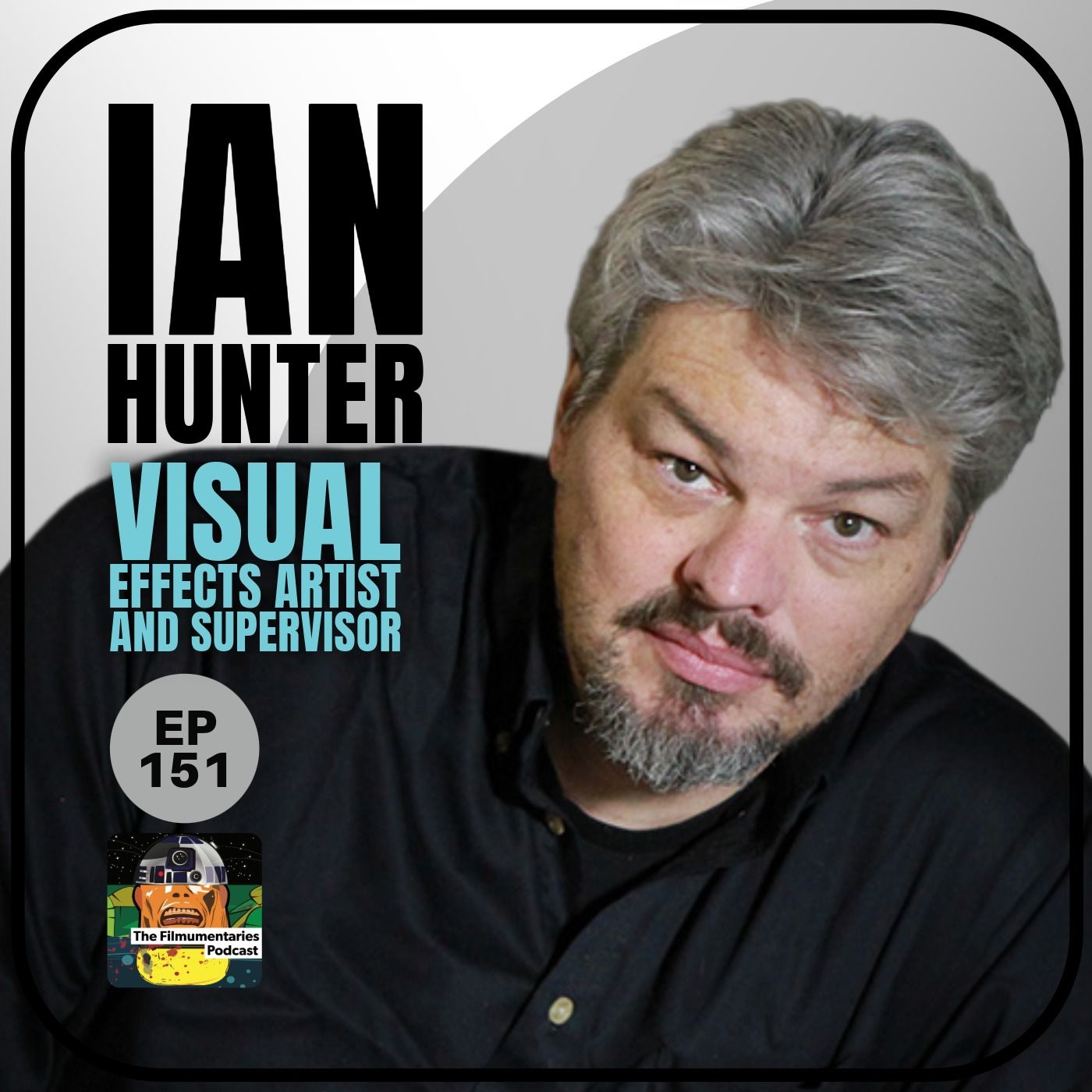
About this episode
Ian grew up surrounded by art. His father painted oils and acrylics, played music and did pastel portraits, and encouraged his three sons to make things — even when those things destroyed the materials he'd given them. The moment that really clicked, Ian recalls, was being handed a model kit as a kid and taking to it immediately. That creative instinct only grew stronger. In high school, he and his brothers were making Super 8 films, scratching laser effects onto the film with a pin and blowing up overloaded resistors for explosions. One of those films required them to fake-rob a local bank — and the encounter that followed, with the surprisingly enthusiastic vice president of the Monrovia Wells Fargo, led to a meeting with the mother of Rick Baker, whose work Ian had recently encountered in a traveling special effects exhibition and been completely floored by.
After drifting away from an aerospace course at Cal Poly Pomona and working in an acid bath plastics factory, Ian answered a classified ad looking for model makers — and on the strength of a modest portfolio, was hired the same day. His first feature was The Abyss. He and fellow model maker Jim McGee built the flooded engine room of the Montana submarine with almost no direction beyond James Cameron's bare-bones description, and shipped it to South Carolina having never seen a frame of the live action. The production was not without its disasters — Ian found himself entangled in the notorious wax crane fiasco, and talks about the valuable early lesson of knowing when to call something out before it goes wrong.
From there, a friend pointed him toward Boss Film, Richard Edlund's company in Marina del Rey, where a chance encounter with departing model supervisor Mark Stetson changed everything. What was supposed to be a one-week favour on a music video turned into six years. Working with Stetson took Ian from being a junior model maker building things in isolation to visiting sets, talking directly with directors, and understanding that miniature work only succeeds when it becomes invisible — just more shots in a movie, telling the story rather than showing off the technique.
Among the projects from that period, Ian talks at length about Total Recall — including the behind-the-scenes chaos of a scale miscommunication on the final day of shooting, a scene involving a little person that nobody had accounted for, and the moment he glued a Coke can to a model building because they were running out of time. That Coke can, dressed up and shot from the front, made it into the finished film. So did one in Waterworld. And Inception. And Interstellar. And, after the story apparently got around, director Fede Álvarez greeted Ian on Alien: Romulus by asking exactly where he was planning to hide it.
Ian built the suburb for Edward Scissorhands — deliberately making it more bland and mundane than real life — and talks about one of his proudest in-camera shots: the final view through the bedroom window and out over the snow-dusted neighbourhood, achieved with a 1:24 scale model and real snow shakers on the night. On Batman Returns he built the Penguin's zoo, and describes receiving one of his all-time favourite compliments from Tim Burton — who, after watching a pyrotechnics test, asked simply: "Where did you shoot this?" Not realising he was looking at a miniature. The zoo also gave Ian one of his best examples of a happy accident: a polar bear sculpture that was supposed to explode but instead toppled slowly sideways with flames coming out of its feet. Tim Burton loved it. The entire subsequent engineering challenge was figuring out how to recreate the mistake.
On the X-Files movie, Ian and his partner Matthew Gratzner built a collapsing federal building on a tight budget, referencing Oklahoma City bombing photographs for the detail of damaged concrete and exposed floors. The late Roger Ebert reviewed the finished film and said the sequence should have been cut — because it was too reminiscent of real tragedy. Ian reflects on that as a marker: they'd gotten past the technique and into the emotion.
The conversation turns to Christopher Nolan, with whom Ian has worked across multiple films. Ian describes Nolan as collaborative but definitive, someone who discusses a shot in depth and then tells you exactly what he wants. He talks about the liberation Nolan offered on Interstellar when he told the crew to stop following the previs — pre-vis is just a guy at a computer on a Friday trying to get the shot out the door, Nolan told them; if you can see a better angle, do that instead. The result was that the miniature crew started shooting faster, and a number of shots that had been planned as digital moved across to the physical side. Ian also describes the meticulous sun-angle calculation that went into matching the Inception hospital sequence — setting up models in a parking lot at a precisely calculated skewed angle to hit the exact quality of light that had been captured in Calgary on a specific date.
On First Man with Damien Chazelle, Ian had drawn storyboards before the first meeting proposing a documentary approach — cameras attached to the spacecraft, nothing sweeping or cinematic, everything either very close or very wide as if shot from another ship. Chazelle walked in and described exactly the same idea. They spent twenty minutes together going through the sequence, working to an animatic cut to music, and Ian went off and shot it. That shorthand — that moment of being in sync before the conversation has really started — is something Ian describes as central to how he has survived in an industry where so many practical effects houses have not. He's a model maker, yes. But more than that, he's a filmmaker.
This podcast is completely independent and made possible by listener support. If you’d like to help me keep making these episodes, you can join my Patreon community here: https://patreon.com/jamiebenning
Watch more on YouTube:
Check out the Filmumentaries YouTube channel for behind-the-scenes clips and extra content: https://youtube.com/filmumentaries
All my links
Transcript
Automatically generated, so expect the odd misheard name.
Weird Being Way Media. Welcome to episode one hundred and fifty one of the Filmiamentories podcast. This is Me as usual, Jamie Benning here sitting in my little office at home with just my laptop and my microphone. And in this episode I chat with model maker, VFX supervisor and filmmaker Ian Hunter, a legend in the industry, about his career that spans some of the most technically ambitious and visually inventive films ever made. From the flooded reactor tanks of James Cameron's The Abyss to the surface of Mars in total recall.
Ian grew up in Monrovia, California, and his parents would give him and his brother's model kits just to get them out of their hair, and inavertently launched at least one of those kids into a forty year career in Hollywood. We hear about stealing his dad's German black velvet to make a starfield in the garden shed after seeing Star Wars, making Super eight movies in high school, and the genuinely draw dropping story of walking into a Wells Fargo bank to fake Robert for a school film and coming face to face with a relation of another Hollywood legend. Ian talks about drifting away from an aerospace path at cow poly Pomona and stumbling into the movie business fire a classified ad, swapping one job involving plastics, chemicals, and toxic fumes for another, Landing on the ABYSS, working under the mentorship of the legendary model supervisor Mark Stets and the Boss Films, and the long road that would eventually take him to some of cinema's most celebrated practical effects sequences.
It's been a long time coming this interview. I've been wanting to talk to Ian for some time now, and I'm really glad that we did it. It's such a cool guy to speak to. He's got a great attitude, he's very articulate. I think you're going to enjoy this one.
So sit back, make a cup of tea, and here's my interview with Ian Hunter, and I'll be back at the end for a bit more jabbering on. Ian. Thanks so much for joining me. It's a pleasure to have you here. I always like to ask people like where it all be a I mean, were you building stuff as a kid, and do you remember the first time that you built something?
And it really kind of clicked for you. Yeah. I was very fortunate looking back that I had parents who were artists. My father especially was an artist who was a trained interior decorator. He was a musician.
He painted in oils and acrylics, he did pastel portraits. And I had two older brothers, and so he always encouraged us to do art and gave us things to do project wise, and I think at some point, which was very formative later on in my career, was we were doing art. I have these brothers who I always wanted to stick with them to do these hobbies. At some point my father gave us all model kits to build, and I think that was mainly to get us out of his hair. So I took to the model building right away at a very young age, and then encouraged to do drawing and building our you know stuff on her own.
We're always you know, told, you know, to go out and play and you know, make things. And we'd steal my dad's paint STERI sticks and make Roman swords and stuff like that. And and then eventually he used to paint black velvet paintings, these beautiful black velvet paintings, not concase it ors fighting bulls, but usually like the head of Christ. That was his favorite thing was Maxiwan Seatau dying in Agony and and so so he had this expensive black velvet, and my my brother's older brothers and I watched Star Wars and one of them said, you know, I'm gonna do my own space opera. So we built some spaceship models and then we got my dad's really expensive German black velvet, hung it in the garden shed and punched holes in it and backled it to be a starfield.
So it was a beautiful starfield, but it was useless to do any more painting on. But but my father and my mother likes saw that we had, you know, potential in terms of being creative kids, and sort of forgave us for ruining everything that they gave us. But yeah, that was the best thing, was to have a set of parents who were understanding and encouraging and kind of dropped us on. Yeah. I often sort of talk about how I think we're kids are all instinctively kind of creative and sometimes destructive, but then you learn about creating as well through that, I think, But sometimes that's kind of sort of bash out of us in school, particularly in secondary school, where people start to hone in what your skills are and what you need to do to achieve a career, and often the arts aren't kind of a popular choice in schools.
It certainly wasn't the choice in my school particularly. Did you find that as you went, as you grew older, as you went to high school, that you were able to kind of continue these these hobbies and and sort of start to form them in your head in a way that could be an actual career in the future. Well, funny enough, I also had a great interest in aerospace aviation, so I always thought, you know, I took this sort of more advanced classes when I when I was going through it would be elementary school. Here. I took some tests and they're like, oh, these are IQ tests, aren't they?
Like, yes, they are. So I was I was sort of pushed into the more advanced classes, and I thought I was going to go into aerospace more but near the end of that. So it sort of makes sense because you know, visual effects, you're doing a lot of sort of on the fly engineering and things, but aerospace would have been much more formative or restrictive. But one thing it did happen, which I thought was very funny, is for extra credit in some of these classes, we would make Super eight movies. That's how far back I'm going on Super eight film.
And and so the teachers at our school also encouraged us to be creative, to like, you know, throw these things in there. So it was it was great growing up. I grew up in Monrovia, California, and it was great because not only were my parents supportive, but once we got to school, they were supportive also to let us do these things. And one interesting moment was this also affected my later desire to get into the movie business. Was we were making a movie trying to explain the Fourth Amendment of the Constitution of the United States, which is unlawful search and seizure.
And so we went to We're high school kids, you know, pimply faced high school kids, and we went to the local Wells Fargo bank in Monrovia, and we were going to rob the bank that was part of the Super eight movie. And so we show up there and I said, you know, guys, we should probably tell them that we're just high school students and we're faking robbing the bank, not actually robbing the bank. They said, do you think that'd be a problem. They said, yeah, it could be a problem. They might not take ninely to us attempting to rob the bank, even though we're simulating it.
So we go into the Wells Fargo and we go up to the teller and I'm of course they push me up because I'm the oldest looking one, and they say. I say to her, Hi, we're from the high school. We're making a little movie, super eight movie, and we're simulating a bank robbery, and so we just want to know if we have permission to rob your bank. And she gets all very weirded out, nervous and shakingly, grabs the phone and calls somebody, and then she says, the vice president of the bank's going to come over and talk to you. Like okay, So we all walk over to her in a big cluster of nervous looking kids looking down at the ground, and this woman comes up who is super excited.
She's an older woman with glasses in her hair up and she's super excited. She's like, are you from the high school? Yeah, you guys are making a movie, like absolutely, yeah, yeah, what do you want to do? Well, we want to fake like we're robbing the bank. Oh that sounds really fun.
Like she's enthusiastic about the whole thing. And I said, yeah, do you mind? He says, oh, no, I love. I love when kids make movies. You know, my son makes movies.
I said, really, who's your son? And she said, oh, my son's Rick Baker. He does make up effects. And no way. And I was so on the floor.
Come on, it was a hero of mine. Still A yeah, of course, so amazing. Uh, you know, you know, going from mom to the teachers. Now even the bank vice president of Wells Spargo encourages us to make movies. So that was a that was a great moment.
We got extra credit and everything. That is crazy. I mean, what are the odds of those of your world crashing into. I mean, that's just bizarre, isn't it. But how wonderful that it all started to link up for you at this point.
It sounds like you know, you've you've been through the kind of Star Wars phage and now into you make can your movies and making it on Super eight. You know, it's such a great way because. You've got the camera in your hand, you're responsible for the film, you've got to get it developed, so there's time to sort of percolate as well while you're waiting for it to be developed. Then when you get it back, you've got to edit it yourself, if you want to do that, or were you just doing it all in camera? We were trying to do in camera, but also when we came when it came back, of course, for the lasers, we had to get in there with magnifying glass and a pin and you know, scratch the scratch the image.
And then we were doing things like we knew that if you overamped electric resistors, like if you had like a you know, say a twelve old resistor and you you end it with house current, it would explode. So we would often do our explosions by literally shooting resistors exploding and giving us, you know, explosions. I'm black that we could can't be it was it was, yeah, we were really trying anything we could just to make these things better. Yeah, I mean that approach of being well, that sort of linear destructive approach and that nature of film having to you know, scratch it. On the film.
Oh that scratch wasn't a great scratch. Well, we're stuck with it now, and I mean, it's it's kind of a great discipline and a great way to start. But I imagine, I'm sure we'll talk about it later when we get there. But I imagine in many ways, you do things in reverse in the real world. You you sort of designed the shot first and then reverse engineer, whereas you know, when you're starting out, of course, you just you're just using whatever you've got and you're you're sort of making it up on the fly.
But did did you did that connection to to Rick go any further? Not until years and years later. I mean we we would work on movies that he worked on, but never together. My specialty was miniatures and it went off that direction and you know business of course creature effects. So yeah, well we worked on the same films, but but not not directly.
The only in fact, the time when it finally happened was you know, Rick sort of retired and he and he closed down his studio and I still had a studio in Silmar, California at the time, so we needed a forklift, so went over and bought his forklift. So for a while I was using his forklift. That's hopefully some magic was coming off of that. Did you ever have the opportunity to say you met his mum once? Oh?
Absolutely, I took care to tell them the whole story. Something else. I hate going off on a tagent about Rick. But years ago this also sort of got me into the business. Was or or drove me to be in the business.
Was There was a moving museum exhibit of special effects that was at our local Los Angeles Museum of Science and Industry, and it traveled around the country and they had different displayed models. They had some stuff from Masters of the Universe, and they had the makeups from Masters Universe. And the other thing that really impressed me was a matte painting from the Birds that Albert Whitlock had done, and it was nice, very small. My dad had been a painter, so to look at that and sort of see what the approach he took. He actually painted the it in different focuses, so where the where the live action was going to be composited in that was in focus, but as you got further back it got softer and more out of focus.
H and just amazing stuff. And so I'm looking at the makeups for Masters Universe and they were nice, and I'm not you know, I'm not gonna knock them, but but they looked like makeups you would find in a in a movie. Yeah. And then sort of often a corner in the dark, like not really part of the central display was a case, and I'm like, what is in there? So I walked over the case and it was the back was to us as we walked up, and I came around the corner and in the case was Rick Baker's head from American Werewolf in London.
And this didn't look like a makeup. This looked like a taxidermied animal. I mean the quality that the difference between what had gone into making this rubber monster with yak hair or whatever look real and look believable and look, you know, even static look frightening. Just there's just the the world of difference in terms of of of the input of the artist to you know, to create this piece. I mean, he get you know, used the same techniques, use this same you know methods a lot of times you use the same people.
But the but the quality, the sort of personal input that he put exhibited and that well really impressed me. And it was the kind of thing that my father, growing up again with my brothers. You know, we're all artists. You know. He always said that you should be your own worst critic.
Like other people will tell you how bad you are. But if you're harder on yourself, if you if you strive to like do better the next time than you did the last time, you know, no one can get to you because you're always going to be judging your own work and trying to to do better. And so I I was just so impressed by his work and always wanted to sort of like know that if I'm going to make the effort, I might as well try to put the best effort out and and and have something that's gonna, you know, sort of last if you will. Yes, yeah, yeah, yeah, Now that is an amazing sequence in that movie. I mean, it sort of still scares me to this day.
I think I've talked about it before on this podcast, but I watched it in circumstances where I shouldn't have been watching it as a kid. I'd me and my sister had recorded it off the TV. My dad was out washing the car, so there was like this double scariness, double jeopardy going on. But what. Was the kind of shift from Okay, so this could be a career.
Then, and how did you go and finally enter the industry. Well, so I remember back I wanted to be an aerospace guy. So I yeah, actually attended cal poly Pomona, which is a technical school in lot in California, and was taking aerospace and long and short of it was, I ended up dropping out of school. I had financial difficulties, I had difficulty getting my core classes, and so it was just not really working out. Attended for about a year and a half, but it but it wasn't working out.
And this is the this is the funniest thing, because so I never thought I'd actually be able to get into the business. But I was working at a place where I was making out of plastic acid baths. If you imagine, you know, you're doing photochemical etching on circuit boards, okay, and that acid has to go into a chemical resistant bath. So the tubs that we that they're made from polyethylene plastics. So I'm working in plastics, I'm working in chemicals.
I'm working and like welding all this stuff together, toxic fumes everywhere, and I just couldn't stand like working with plastics, chemicals and toxic fumes. So I said, I got to get out of here. I got to find, you know, a way to get out of this job. So I actually got a newspaper and there was a small ad in the in the classified sections looking for model makers. And I had done some model making.
I've been monitoring all model making all my life. And so I called the phone number and they said, oh, yeah, come on down, you know, interview We're we're desperately looking for model makers. So I quit the acid bath factory that day and drove down to get interviewed, and the guy's like, oh, you know, what have you done. I showed him my resume, which wasn't very impressive, and I showed him some pictures of some models I made, and he said, great, you're you're you can start tomorrow. So I'm like so excited.
I was going to work in the movies now building models. And of course I traded working with plastics, chemicals and toxic fumes to work in a place that has plastics, chemicals and toxic fumes. So but it was but it was exciting stuff. And so I'm working away and the guy next to or this girl next to me, she's working and I said you know, I'm a model maker. What do you do?
And she says, I'm a student at cal Arts, which is a local school that trains animators and filmmakers. That's nice, you know, not necessarily professional momo maker, but at least a student. And then the guy next to me has got blonde hair and blue eyes, and I said, I'm a model maker. What have you done? What have you been as a model maker?
And he says, I'm Dmitri. I'm a ballet nswer from Russia and I've just landed here and they were hiring anyone off the street. It turns out, so I was not very special. So I sort of like felt crestfallen because I'm like, oh man, you know, I'm just anybody. But it was fortunate because the movie that I was working on, I was building what we call wet for wet models, and it was for the movie The Abyss.
So yes, my first big feature happened to be Jane Scammeron's The Abyss, which is like a great movie in my opinion. Yeah, yeah, it's a fine film. Yeah, it doesn't get much. There's not much talk about The Abyss these days from maybe from a sort of visual effects perspective in as much as you know, you've got the water snake thing, and it's sort of a precursor to terminate it to and therefore Jurassic Park. But there's some great work in that film in terms of effects, and some really good performances as well.
I remember getting that on VHS and then finding like the director's cut on laser disc, and I love that film. Yeah, that's a great film. Yeah, I agree. So what what what we're working on? Specifically on the Abyss.
So, so the company I was working for was called wonder Works, which was run by a guy named Brick Price, and we were working on the wet for wet models, which meant that any model that was actually going to be put in the water, we were working on that. And I specifically built at the beginning of the movie, the Montana, the Ohio class submarine you know, hits the rocks and floods, and so me and one other model maker named Jim mcgeechee built the engine room which gets flooded. And that was the thing, and that was, you know, that was my introduction to the movie business. And I remember to this day. The instructions were very simple.
It was directly from James Caermon, and he said, it's fit scale. It's ten feet long, five feet wide, three feet tall, nuclear submarine engine room, and there has to be a path down the middle that looks like people could run out. And that was the instruction. So I drew the thing. I designed it.
I looked up and it was very hard back then because the internet wasn't as robust as it is today. You know, pictures of what the atomic engine looks like in aular submarine, and kind of finagled that into the space and Jim and I built that and we got pretty much no direction other than that description I gave you. And built it and then we shipped it out to South Carolina where they shot the movie in a abandoned atomic reactor, if I remember. Correctly, Yeah, yeah, that's right. Yeah.
And what's funny is that I used to work at a hobby shop in Pasadena, California. It was a train store called the Original whistle Stop, and occasionally people would come in and this one guy named Jim, older guy would talk to me about how he's proud about his son because his son was a model maker and he worked in the movies, and he'd described all the things he worked on, and eventually I found out that Jim's son was a guy named Pat McClung. And Pat McClung was a model builder and model and supervisor and he actually worked on aliens and then he was the he was the guy at the other end in South Carolina that I was sending the model to that was running in the shop for the ABYSS. And so later when Pat became a supervisor, we were able to work together.
But it was kind of fun to sort of hear about Pat from Jim when I was just a clerk at a hobby shop and then eventually make that connection again professionally. Yeah, he's a great model maker, isn't he Pat. He's done some wonderful stuff over the years. So, yeah, you're in the industry then, like you've made it in by this point. I mean, what was kind of striking to you in terms of what you had to achieve or maybe even the speed at which you had to achieve it.
I mean, was there anything that really sticks out to you that you know you're in there. Obviously you're enthusiastic and you're no doubt putting in the hours, but was there anything that really struck you that was different to your expectations. Well, actually, back to the Abyss for a moment. The thing that was right away the lesson was you come in running. You know, it's like you get here's the instructions, go oh, where's my bench?
You got to build it, so you know, it's sort of a you just have to like make do and figure it out as you go, which was goes back to our Super eight days and playing with my brothers and trying to figure out things on the fly. So the success and there's also success and tragedy at the same time, and that success was building this engine room, shipping it off, and then finding out a year or so later from Pat like oh yeah, that was a good model where we really liked it and that really worked well. But on the flip side, that same movie, there was this notorious crane. I don't know if you about that know about that, but there's a scene where the crane gets pulled off of the Benthic Explorer the ship and it goes into the water and there was another group building the crane and the guy decided he would make it out of wax so it could crush.
It's like, yeah, we can make out a wax and it can crush. And the aforementioned Jimmygeechee was on that team and the guy was going to build the thing out of wax, and Jim said, I'm quitting. I'm going to go work at Disney, because Jim said, wax floats, so you can't like expect this crane to go into the water and just not up to the surface. So sort of like a car accident where people are you know, pumping on the chest of the victim trying to get to revive them. I got kind of drawn into the crane fiasco and had to help finish this crane model to get it out the door.
So I had my head hand involved in this crane which we all know knew was not going to work, but got it out the door. So at the same time I'm doing the engine room, which was, you know, sort of a success, I'm also working on the crane, which was not a success and had to be replaced eventually. That was a great lesson on like humility, I guess, but also also sort of like standing up a little bit and and and calling things out that aren't going to work. And I think I found throughout my career. I'm not necessarily good.
I'm not necessarily the guy that knows the right thing to do. But if somebody tells me the wrong thing, I'll pick that out like I can. That's my my mutant power. Like everybody has like a you know, like a useless X men mutant power, my mutant power is is to sniff out the mistakes and and eventually, if something doesn't sound wrong to me, I guess that that's the right thing. So that's that's that's been useful throughout my career to sort of make sure that we're uh steered in the right direction by identifying the mistakes.
And talking of sort of steering in the right direction. I'm always wondering some of these earlier movies, were you kind of privy to seeing some of the on set footage from principal photography whilst you were working on these effects, so that you could hopefully kind of match the look and make it make it. A sort of cohesive thing. Because I often have spoken to people that worked in the effects and they're sort of isolated sometimes from from the bigger picture. They're just so focused on their one shot or their one sequence, but on the Abyss for instance, did you have the chance to see some of the photography.
Not on the abyss again, as you know, very junior model maker at the time, Yes, and just got the thing done and shipped out and never really heard until later I talked to Pat about how it went at the other end. But fortunately for me, after I got the engine room done and after the crane went out the door. And I'm always very adamant about like making sure to complete the thing I'm working on, you know, because I feel for the people that I'm working for, you know, at least I can I can complete this task. I'm not going to quit in the middle of a job, despite the pain of the of the of the crane. But then a friend of mine said, oh, you got to come over to Boss.
They've got a project going and they're and they're paying better. So this is Boss Film, which is in Maria del Ray, California at the time, and that was Richard Edlin's company, And so I went over and interviewed and was very fortunate that I was again hired on the spot to work on a commercial. And uh, the late Dave Jones was was running the shop at the time, and Boss had been run by a guy named Mark Stetson for a while, and uh, he had worked at eeg'd worked on Star Trek and Blade Runner and these other you know shows, and saw can sort of an awe of him a bit. But he was transitioning out. He was going to start his own company.
So I was working at Boss. I got hired and at some point and this really worked out in my favor, I was working on this project. It was the abandoned Back to the Future film that Boss was working on, and Mark came over with David Jones's permission and asked if I had worked for him for a week on a music video, and that one week turned into six years. So I lucked out, sort of fell over backwards into the abyss and then I've sort of got taken by under Mark Swing to work with him, and that's where things started changing in terms of like being a little bit more responsibility and going back to your point about seeing the footage, you know, getting to work with Mark and go to set and see live action and talk directly to the director about what he wanted to see in his vision, and really getting much more cognizant of how much you need to match what is being shot live action and with the miniature, so that our work becomes just more shots in the movie, you know, more storytelling and less spectacle, if that makes sense, yes, yeah, yeah, And then working with direct or directors of photography who specialize in miniature work, who are you know, it's a very that's a very difficult position because you have to be able to match the lighting of live action but in our specialized manners because we're shooting a high speed you know, it has to boost the light levels.
We have to like stop down, et cetera, et cetera. And so to see that level of you know, sort of concentration commitment to get it right again sort of impressed upon me the need to up my game a little bit, to work better, not just build nice, nice models, but to actually create scenes and create shots that are telling story. Yeah. Yeah, Just going back one minute, did you say an abandoned Back to the Future film? Why don't I know about that?
That's the part we cut out. No, this is true. So, so Boss was doing a film for Universal and it was the Back of the Future ride and it was big, I think it was a sixty five millimere large format work and we built a cave. We had a t Rex. The camera was a Snorkel lens that was supposed to be the point of view from the inside the Dolorean flying in different time zone.
So there you go, like very quickly from. Time you go, you go, remember the ride the world, yeah. For the ride, and then you end up like an alternate, alternate future where there's like dirigibles and things like that and a ton of work done, just everything. And then I think eventually, though conceptually, I think the Universal folks were like, it's not we don't want to do this time jumping things so much as much as we want to just sort of have you flying through the twenty fifteen version of you know, of the future. Yeah, So so eventually that was that was abandoned.
And mass Illusion, which was I think it was Mass Illusion, which was Doug Trumple's company back East, ended up doing the actual ride film that you see in the in the theme park. So yeah, so that was other lesson. It's like you can go down this route and you can spend all this time and effort, and you know, none of us were not putting our best effort forward to build and shoot, and then your creative folks decide, you know, well let's let's abandon this and let's go with something else entirely. Yeah, yeah, there is a hell of a lesson to take, yes, because you realize, right, and it's and it's difficult then to have well for some people, I'm sure it would be difficult to then have enthusiasm for the next job, you know, but you have to kind of pick yourself up and brush yourself off and start again.
I mean, we're all, you know, as much as we you know, uh, chronologically are adults. You know, we're all still little kids at heart, you know, drawing little you know, crayon pictures or whatever, and you know, we want to be padded on the head. And when you pick pick that up and you crumple it up and throw it away, that's how you feel emotionally that your your best efforts are being wasted and it's hard to get that enthusiasm again. But fortunately for me, I was Mark took me from that that projects and I did a really terrible music video with him. It was really awful.
And but then the next job, this is what enticed me to go work for his Mark. I went to over his house and he's at his desk and he's like, you look at this, and he opens the drawer and there were these amazing Steve Bird drawings of Mars from from Total Recall. And that's what I said, Okay, he says, you want to work on this. I said, yeah, I do so, so he drew me in and we got to work on Total Recall, which off and on was over a year's worth of work. Really well, because they were shooting in Mexico and there's this one scene where they needed background plates they needed they were still doing a rear projection at the time, and so we had to build a miniature and shoot the background for these background plates so they could have them on set while they were shooting live action.
So we did that, and then we took a break from Total Recall and we did I think Dick Tracy and some other movies in there, and then we came back to Total Recall to do all the exteriors. So that was like a very busy period and you know, like again it's like, oh, I just happened to be working on this Total Recall and Dick Tracy and all these other shows that Mark was able to run with us. So I was very felt again very fortunate that he took me under his wing and he gave me a lot of responsibility, and I sort of quickly moved up from being just a junior model maker to like a lead model maker, and then eventually to actually what we called a crew chief, which was a guy that ran the particular project.
So while I was just a model maker on Total Reach Call, I actually it was the lead model maker on the bridge for Dick Tracy. And then eventually they started giving me full projects to run, which meant I would be the lead model maker, but I'd have a team of people below me to run the project. I would imagine doing all of this the kind of early work like you mentioned total recall there, am I Is this a bad memory of mine? Or do do I have a memory deep embedded in from a commentary or an article that I read about using coke cans? I knew it would come up?
Is this is this one? Is this one that that comes up all the time? Because I've definitely heard this. Listen, we don't have to cover it. No, no, no, I wanted to.
I want to talk. I want to I want to confess about the cocte. So we're working on, like I said, off and on over a year working on total recall. We're building all these amazing models. It's like very hard work to build these canyons and these miniatures, and there were really small scale miniatures to get this vastness of Mars out there.
And after all this time, we had a model and it was kind of a goofy shot. So it's one of the last shots we did, and it's when the atmosphere has come over Mars and the people walk out for the first time and take a breath in the new air of Mars. And so we built this miniature, and somehow along the way, the communication was that we were building a quarter inch to the foot, which is forty eighth scale, and somehow they thought they were getting a quarter scale model, which would be much bigger, much much bigger. So to sort of scramble to make it slightly bigger, we took these models, which are all spaceship or space building models, and we started gluing on bigger scale like doors and windows and railings that were whatever to them to make to boost their scale appearance on camera without actually physically making bigger models, if that makes sense.
And remember the shot because they were using RP again. So they've got a window that's blown out, and people walk out and take a breath, and it's all rear projection inside of our miniature. And we kept shooting it, and we'd do it like three or four times, and I'm again just a model maker, but they kept getting the scale of the people wrong because as soon as the second person walked out, it looked like their head was hitting the top of the window. So they keep shooting it and keep getting the wrong scale, and finally I had to mention this to them, you know, raise my voice and I said, you do know the first person walking out is a little person, like what it's like, Well, you know in the movie there's a there's a there's a prostitute, and she's a little person.
So she's she's she's not normal height. She's like, oh, she's shorter. And they said, oh right, So you're scaling the projection the wrong scale based on the first appearance, which is this little person walk out. So they finally adjusted the scale of the projection to match her height, and that you know, worked out from there anyway, back to the coke can. So we built these things and I'm scrambling to like, you know, we're going to shoot an hour, so I'm scrambling to put some detail on there.
And I finally took some coke cans and I made like a series of propane tanks on the top of a model building. But from the front I detailed with hatches and ladders and rivets and everything, so it looked completely legitimate from the front, but from the back you could tell there were cokecans. You can see where you'd cook your drink from. And after a year working on this movie, that's the day that they sent an electronic press kit, a camera and this woman to interview us about building models for this movie. And here we are, you know, scrambling get this thing done.
She walks in. The first thing she sees is the back of these coke cans with where you take your drink. It's like, oh, so are every one of these models made like from coke cans and popsicle sticks and egg cartons? Like Jesus, lady, this is artwork. You just joined time.
Again, you know, cressball, like you know, wind knocked it out of me and just horrible feeling. So the last shot we're doing is where Arnold says to Rachel Ticket and like you'll kiss me before I wake up, and you see the vastness of Mars, And I just literally took a coke can, hit it with some gray auto primer and stuck it in the middle of the set, right out right out broad daylight. If you will on set, and if you watch the movie to this day, if you know where to look, which is to the right of screenwright of our old tip, it's there. And since then I've been I always try to put you know, quote unquote easter eggs into the movies, and the coke can became a very popular one. There's a coke can in water World, there's a coke can in Inception, there's a water or there's a coke can in Interstellar.
Sounds like you should have got yourself some sponsorship. He Well, the trick is you can't actually tell it's a coke cane. That's that's became a challenge was how to integrate this shape of this detail without being obvious. But the thing is, it's like somehow that got around, maybe because I was boasting too much about it. But we went to work on Alien Romulus and Fetti Alvarez, the director, came to meet with me, and he had talked to Pat McClung, and the first thing he said was like, so, where are you gonna put the coke can?
Like, ah, they know, they know my trick. Now I feel bad bringing it up. No, it's great, It is great. It's such a great little story. It's a really it's a stress reliever because you're here, we are trying to do this like serious stuff and trying to be good at what we're doing, and and you know, a commitment to storytelling.
But sometimes at the end of the day, you just gotta you know, relieve a little bit, so you gotta throw some jokes in there so you know, like its famously I think in the Star Wars Rebel blockhead Runner, if you look in the cockpit, there's like a pin up, you know. Yeah. And and the other one I think of is Ken Ralston putting the potato in the asteroid field and right put putting a Nike sneaker in the battle in Return of the Jedi, because it was just like nobody's going to see it, and it's a lot quicker than building another model. That's part of your job is to know shortcuts as well. Right is to know what the camera is able to perceive and the audience is able to perceive.
And you've got to work to time, you've got work to budget, and no doubt, there are many other things that should have been simple and end up getting incredibly complex and eating through your your schedule. So you do have to be able to adapt, don't you. Yeah, and Mark taught me a couple of you know, not hard and fast rules, but he said, you know, basically, ninety percent of what we do doesn't end up on screen in terms of like being perceived. But if we don't do it, you're going to tell that it's not there. And it's I like to call it the connective tissue.
Like we did a shot for this movie called The Shadow, and we build a bunch of city streets and we're lighting it and setting it up, and we're going in on taking soapy water and I'm spraying the street to get it weted down. And then he went outside into the parking lot and he comes back and he's got a coffee cup full of just gravel and dirt that was in the parking lot, and he starts throwing it into the gutters and brushing it in with a little brush, and he gives me the copy. He says, you know, do this because it's the thing. You know, you don't perceive a lot of trash and destrous and the imperfection of the world because we just sort of take it for granted. But if we don't put it into the movie, we don't put it in the model, we don't put it in the dressing, then your mind subconsciously knows there's something missing, something not quite right.
Yeah, there's a feeling, isn't there. You can't put your finger on, but it just isn't right. Yeah. Yeah, when you're working. For a director like let's say, is a bit of a flight going on in the background there.
Yes, there is, By the way, I have pet pigs. All right, well, it just adds a bit of ambiance. It's all good. No, no, all good? What was I going to say?
Let me just gather my thoughts. Yeah, let me see walk outside it maybe. The moment, good sound effects going on here? Tell me when you're happy? Oh yeah, we're good.
Yeah, So tell me what it's like working for a director like Tim Burton, who has a you know, he has a certain a particular understanding of miniatures and animation and what looks good on film, and was he somebody who would come in and kind of scrutinize your work. Did he have his hands on on all of that film, the live action as well as the model stuff. So yeah, he very much is involved in all aspects in terms of the design and look of the movie. In this particular case, I worked on Batman Returns and then also Edwards Scissorhands, and Edwards His MS for Me is one of my favorites. Actually.
I liked the movie a lot, and we actually built not only just a suburb, but the most mundane, boring suburb you could have possibly imagine. They actually made the houses more bland than they really were in real life. So we got to duplicate the suburb that they've had in Florida in miniature, and it was fun for me to to sort of make something interesting out of something so boring. And I think that was you know, I could see his you know, upbringing and the desire and like seeing seeing the world that he must have lived in, because you know, he's a local kid too, to soun California and trying to find something more mysterious and interesting, which is you know, the Scissorhands castle. So I didn't work on the castle model that was a guy named Dana Yursitcher worked on that.
But but but we built the neighborhood and that was that was a lot of fun and sort of one of my again prouder shots I was involved with was in the movie Went on a Rider as a as an older woman. She's a grandma and she's talking to her grandchild about Scissorhands and it's snowing outside and we know that's Edward up up at the house and you go through the bedroom window and out over the neighborhood and that's an in camera shot. That's our twenty four scale model outside the window of the set with real you know, snowshakers doing it. And again it's this very simple, straightforward technique but very effective and kind of charming that we could pull that off. But he, you know, we Rick Heinrich is our director and they were I guess friends at cal Arts again, so Rick, we were actually directly talking to Rick more often about the work and with Bo Welch on Batman returns, Uh, Tim wouldn't come down personally to see what we were doing.
But certainly his hand is in the Zoo for Batman Returns, which I got to build and had a lot of fun doing nothing, nothing like building something and then blowing it up. Yeah, but do you know what always worries me about that? It's not I mean, it's one thing to spend all this time on something and blow it up and see it destroyed. Which you know that there's you know, if if it works, great, my concern would be what if it doesn't blow up? Quite right?
Ah? Yeah, So that actually happened to us, strangely enough. So we were building that model and and people say, you know, don't you feel bad about building all this model for all this time and all the effort these guys put in, and then you're gonna destroy it? And I said, well, but it's a piece of performance art. Really, I mean we're intending to blow it up.
I feel bad if we don't destroy it. I mean, it's reason to exist was to get white doubt. So on on the Zoo model, there was a polar bear on top of the penguin enclosure and we did a test and oh, by the way, I got one of the greatest compliments from Tim Burton, I have to say, let me talk about myself. We did it. We did a test because we wanted to show the explosions, and so we took a some steel decks and we set up a snowy field and we put tree models that we built and we planted these mortars inside, and we shot it at high speed, showing explosions going off as if the penguin rockets are hitting the zoo and blowing it up.
And we got done, and we sent the test in for them to review to make sure they were going in the right direction. And Tim Burton's response was, where did you shoot this? Not the bottle looks good or those weren't really well in scale, just where did you shoot this? And I said, okay, we've done our job, because he thinks looking at a real shot. So we moved, you know, we move on there.
So anyway, we're building the the penguin layer, and we got this polar bear on top. This guy named Tully Summers sculpted this beautiful polar bear with its claws out, looking really scary, and it's made of a plastic resin and the late Jovis Gosol was doing our pyro and he put a bomb inside of it for a test. We put a bomb inside it, and it was going to explode. It was going to blow up and shatter in a million pieces. So we rolled a camera, high speed camera, hit the button.
The bomb doesn't go off, just the little pack of like for the flames. So instead of it blowing up into a thousand pieces, it just stupidly fell over and flames came out in the back of its feet. Right, So we're thinking, oh, that's a failure. Oh Christ, well, we'll do it again tomorrow. We'll do it again.
Fail pular bear falls over, flame came out its feet. Tim Burton loved it. He said, oh, that looks fantastic, that's really funny. Do it again. And suddenly we had to figure out how to recreate the why it went wrong?
Right, what do we do? Like, so it was actually a much bigger engineering issue to figure out how to make it fall over and the flames come out its feet and you know, do a forensic evaluation of what we did to sort of recreate the mistake over and over again. But that was that, you know, that's a happy accident we sort of call them, which is where you do something like that and it doesn't work, but it actually results with something that was better than you had intended. Yeah, that's so that's a really key part of what love about practical effects, I think is those accidents and those things you discover by accident which don't necessarily happen in the computer. I mean, I'm sure they sometimes do, because you'll get a rendering issue or something.
But with practical you're sort. Of, you know, in the world of physics and chemistry, and sometimes that is unpredictable and you just have to kind of adapt. I think that's what I've always loved about that side of movie making. Yeah, with the working with Chris Nolan in the past, you know, it is often the case where we're building a you I want to call it a sandbox, but we're building a simulation, and so we're gonna we're gonna try to build most of the of the conditions that will cause the simulation occur. But it's a real simulation.
It's an actual physical event going on. And then we become more like documentarians. We're setting up cameras, we're shooting this. We have an intention in general of what's going to happen, but there are things that are going to happen just by the nature of the explosions and the physics like you described, and so we're going to record that and we're going to get those results that are just by their nature, you know, much more realistic and much more dramatic, if you will. But you're right, people working in you know, digital animation, it takes a lot of thinking and a lot of planning and a lot of forethought to design that randomness, if you will, into the animation and be cognizant of it.
In the physical world, you know, that comes naturally. So I think, you know, there's a lot of people that say, oh, CG these days isn't as good, you know as it was back and whatever, And I'm like, no, it's actually great. But bad CG is bad CG. You know, it's like good CG is like in in this decipherable from real life if it's really good. Yeah, and bad CG is bad.
But you know, bad physical effects still are are there's still something to them. It's still a real thing you're seeing. So yeah, I don't you know, I'm not a I'm not a much of a PRACTI practitioner in CG, but I'm not a guy who knocks CG. I knowin the fact that digital effects in terms of compositing, in terms of smoothing, in terms of you know, using morphing tools to correct uh, in terms of ad doing augmentation. I think, you know, from a physical guy like, oh my god, Cg's great.
You know you can you can you know, leave the rods in and paint them out. You know, just yes, those are the pluses. Yeah. I mean, like you said, you only really notice CG bad CG when it is bad. You don't notice when it's good.
You just, you know, you just buy. I mean, there are so many films now that have obviously but digital effec that people wouldn't even know was a digital effect. You know, maybe there's just one thing that stood out to them on a character or something, because those are the things that we look at every day. We look at people, we look. At animals, and I think people are very good at, you know, identifying when something kind of feels fake.
Although I've been to the cinema with some of my friends and I've said, wow, I didn't quite buy that X y Z and They're like, really, why, you know, they don't see it, So, you know, there are people like me who do pick over these things a bit more, and obviously people like you who have a have an eye for its part of your your well, it's part of your X Men super skills. They're your superhero skills. But what do you think, like going back to some of those early movies that you worked on, what do you think really kind of separated the good from the bad at that time? Because there are some of those movies that still really stand up and there are others that really don't. And obviously that could be for budgetary and scheduling and for time reasons whatever, But was there anything that you kind of really honed in on which could really sell the miniature that you were building.
Yeah. It's funny a lot of model makers that come to us and they show us their work and they were very proud of like an X Wing they may have built, or they you know, here's a studio scale model. By the way, I can studio scale. I hate it because we actually build things to a scale. So we're you know, like we're gonna build this in six We're gonna build this in twenty fourth or whatever.
And so when people say studio scales, like no, we actually make them a specific size. But yeah, right. But one of the things we always emphasize to them is it's like, stop looking at someone else's version of real life, and you'll stop looking at like pictures of models built for movies, which can be fantastic, but you should go to the source. You should go to the prototype, which is real life. So we did a movie called Pitch Black, and my partner Matthew Grats and design the spaceship, and I storyboarded this crash sequence at the beginning of the movie.
But for the spaceship, we you know, referenced freight trains and see one thirty hercules, transport planes and items like that to look for the kind of detail, the kind of discoloration and age that you would expect to find on an industrial piece of machinery and apply that real world analog to the miniatures that we were building to give them that real world feel. And again, sort of another backhanded compliment we got was we worked on the on the X Files movie and that was one of my favorite projects we ever did. And there's a near the beginning of the movie, there's a federal building that explodes and blows up as a bomb inside the basement and it collapses. And so we built the model. There wasn't a huge budget for it, so we had to be very careful figuring out how to shoot it, which was shoot it in the sequence that was going to be destroyed because it actually it's predisastered.
It's already got damage. To it, pre disasted. So the wall is already missing, the wall, the floors are already damaged and everything. But the way it's cut together is you go from a live action shot of a fireball going off, and then you cut to a miniature insert of the wall collapsing, and then you cut to the wide shot and the wall is sort of already fallen and the fireballs come up, exposing this predisastered building that's on fine. So by being very careful in the edit, we were able to pull this off and fool people into thinking they'd actually seen the whole building collapse, when in fact it's just done very cleverly in the edit.
But we referenced the Oklahoma City bombing photographs in quite a bit in terms of like the detail on the walls and the floors and everything that sort of showed how it came down and the late Roger Ebert, in his review of the movie said the scene with the exploding federal building should have been left out of the movie because it was so reminiscent of what happened in Oklahoma City. And again, he's not saying this effect, he's not saying the model. He's saying that scene. So we've gotten past the technique and we've gotten into the emotion. And you know, that's the thing that we're always trying to do, is what is going to get to the audience.
You know, when I read a script, I'll pick out shots, So this is going to go on the trailer. This is going to go on the trailer. And of course it's a lot of stuff that we get to work on. We never see any of the money, but I can usually pick out like, oh, this this shot is going to be in the trailer because that's what they're going to use to sell people to get to the movie to see it. Yeah, But but trying to trying to trying to figure out what that that emotional element is that's going to sell it and going to get to people, I think is an important thing.
I mean, I had nothing to do with it, but it was impressed me. Quite a bit in the dark night when they flipped that truck over. And to see that in imax, you know, five stories tall and the truck flipping over it is it's an amazing shot and it's it's very strict for a very simple but but it's very impactful. M hmm. Yeah.
Yeah. I mean you're all filmmakers at the end of the day, right, You've all got to think like a filmmaker, but you've also got to think as the audience and what would the audience want to see, and would they buy and. All of those things. But well, working for Chris Nolan, I would imagine that that took things to another level in many ways because he's a very particular filmmak. His his ethos of course, is you know, if you can do it in camera, then do it in the camera.
Was that something that kind of delighted you as a prospect when you first worked for him? Yeah, I mean I think it was. You know, it was a long We've been working a long time and our part my partner Matthew and Shannon Gan's you know, been doing a lot of movies and we're always trying to do a good job because Matthew would say, you know, the money goes away, but we're always going to be what's going to be left is the work we did. So we just you know, always tried to go in on the day to do the best work. And working with Chris, Chris is how to put it, he's collaborative and then he wants to hear from you how to do something and what you might want to do.
But he's also a director because at the at the end of the conversation he will then tell you what he wants to do. And for my guys, we've you know, my guys that my my crew, the crew that I've had in the past, you know, we kind of hone down to the to the specific guys who are sort of in the same thought process and work ethic that we are, which is try you do your best job or try to like bring your your A team, your a game, if you will. And and for them it was great too, because now they've got somebody who really appreciates what they're doing. You know, that was really they felt more inclined to put more effort in and try to do it right knowing that they have a director who's appreciating that effort.
So for all of us. You know. My again, my other partner, Shannon Gans would say, at the beginning of a job, we'd have a little prep rally or prep talk pep talk, and she would say, you know, bring your a game, because he does and he's trusting us to do the best job that we can and we've got to like do it, and we've got to respect someone who is believing in this, you know, especially believes in doing it physically, when there's a world of people just sort of deflecting to CG. And again, like I said, I like CG. I'm not knocking CG, but there's a laziness sometimes to filmmakers who just likes eh, you know.
We'll just see it as a fix. Yeah, yeah, exactly. Well I don't know what I want back there, so we'll just put a green stream up and eventually we'll figure it out. Versus somebody who's like clearly understands what how this all works and clearly can can tell you what he wants to see and knows that. That's the other thing about him is that when we would shoot any of these scenes, any of these shots, they're a full length you know, the car, the batmobile hitting the garbage truck is all a full length a series of shots.
Or the hospital collapsing in inception, you know, is you know, from beginning to end is the whole sequence because he cuts, he edits these miniature of visual effect shots into his movie as he would edit any other shot. You know, he picks the moments, or he cuts back to it, whatever he wants to do. He doesn't want to be restricted by us just shooting inserts. He wants a full sequence so that he has the flexibility to cut it in as if he was shooting at live action. And that's something too, which is now we have to make sure that the work, you know, the shot works beginning to end on inception.
You know, we had I think four cameras and or actually five he had he added another camera, and that whole sequence of explosions in real time was five it was like five seconds, but we were shooting sixty fps, so we're getting, you know, fifteen seconds of running footage that he's able to cut as as needed. So that's something that it raises the bar for us to be able to make sure that our work is able to sustain itself for that amount of time. And there's always something happening, and it's you know, not screwing up at some point in the middle of the sequence or whatever. Yeah, but really refreshing to have someone who's who who knows what we're doing, you know, he and I would discuss frame rates.
You know, most directors have no clue as to what speed you should a miniature at, but based on the scale, you know, you want to go to particular frame rates. So it was great to converse with somebody who knows the business, knows the particulars in and outs of this particular niche of effects, and then is able to give you really direct answers as to what he wants to see. M and how on those Nolan movies. I mean I spoke to Nathan Crowley on this podcast a couple of years ago. Do you have much interaction with Nathan as production designer when you're when you're doing work on the Mayland movies.
Uh, yeah, quite a bit. Nathan and I have worked also on First Man, and and he's he's very involved again not just doing the live action, but but uh involved in the miniature effects also because that's going to be part of this movie. And uh, fortunately for for me, I think, you know, having worked with them a few times, there's a certain level like of trust and shorthand we were able to meet and go over things, and he's able to sort of hand some of that off to me, and as long as I keep checking in with him and make sure it's it's up to his standards, we're able to move along. And again that's one of those things you know, for the conceptions of For instance, they built the big set in Calgary, Canada of the Fortress Hospital.
It wasn't the full hospital, but it was like the tower and a couple of floors. So I went up there and photograph the heck out of it and use that information to build a miniature so that we were matching the paint color and the aging and texture and everything else. And we actually calculated the sun angle on the day that we did our photography so that we would match the lighting that was in Canada on that day, so that it was set up in our parking lot in a very weird skewed angle. But that was very specific, so that we could shoot a specific time of day on a specific date just to get the lighting to match. And that's the kind of attention to detail and care that we wanted to apply so that our shots interact with the live actions.
And then that's another sequence where they started with a live action explosion, then they cut to the wide shots, which is our miniature, and we just want to make sure that it's a good match so that the audience isn't taken out of the movie, but it's just caught up in the in the drama. It's so important to have that kind of crossover between the arments just to better each other's work. But I mean that obviously wasn't always the case. You know, sometimes you're just hunkered down essentially in a dark room and just doing your bit. But what what does it take for that to happen?
And is that a transition you felt that has happened in more recent years where people begin to understand what tools are best for what shot and that they all interact together. Does it take somebody like Chris Nolan to kind of push that or Damian Chazelle or does it feel like, yeah, does it feel like there was a transition at some point in terms of your career where that was more more prevalence. Yeah, that's I think the you know, I would say the modern directors. But you know these these directors like Damien and Chris and I'm going to go back to even we work a lot with a director named David Towey that want to get more involved and want to be part of the visual effects process also because they know it's part of their movie too and not just turn it over to somebody else.
That's where you get the collaboration, and that's where you get the comfort zone of them accepting that you're not trying to like go into this basement and work on your own and be separate from them. You know, you're actually trying to be part of the film that you're you know, we we've wasn't mean as much as my partner Matthew Ratsner, but we've shot a lot for Martin Scorsese and while there were visual effects work involved, we actually shot a lot of live action for him too, because he you know, he has a long editing period and he'll identify like inserts or Martha Schumacher. His editor will say, you know, oh, we need this shot or we need this shot, and there's we're the last guy standing with a camera that's a running.
So we'll get a lot of list of inserts to do or shots to do, and we'll end up doing them and of course doing our dartest to match the style and lighting that had been done in the live action. And so there's this trust at that point, like, oh, these guys can handle this part of it. So they're not just the effects guys. They're actually, like you said earlier, filmmakers who are part of the process. And whether it's inserts or whether it's explosions, or whether it's you know, mister French driving into the trailer in The Departed, if we're just miniature shot, you know, we're there as part of the filmmaking.
Yeah, yeah, it must be. So I love that approach by Scorsese. And I mean even Spielberg does that, I hear. I mean he did it way back when in Jaws. You know, he would watch screenings again, we need one more jump scale.
Let's get some wood and a hose and a hammer and make it look like the shots burstings through the hull of the boat, you know. And Scorsese's obviously taken that kind of early filmmaking ethos with him as well, and having that trusted partner in Filma just saying hang on, Marty, we need this, you know, and then you having the opportunity to shoot those things. That's very cool. I mean, I love I think that people just have this assumption that you know, a film is shot, then it goes into post production and there's it's a one way street. But being able to have that two way street must be so important to fully realize the film that the director wants.
And that one other sort of nice moment, at least secret or for the sequence for us was on Interstellar, where we used a director of photographer named Tim Angulo, and I've worked with Tim for years and years and he shot Dark Knight, worked for us and so forth. And when we're on Interstellar, we had pre Viz you know, CG animation done in Maya to work with, and we were able to take all the camera moves digital camera moves and translate those into moves that we could use our motion control rig and so we are very carefully frame accurately following these Previz shots and we shot for maybe a week that way on the ship of the Endurance and Chris Nolan's looking at the footage and we got the note back from him.
He asked, well, are we following the previs and we said, oh, absolutely, frame accurately, we're following the previs. And he said, stop doing that. Like what he said, previz is some guy at a computer on a Friday trying to get the shot out the door. He's not there, he doesn't have the model in front of him, it's not lit, so he's just trying to figure it out on his own what to do. But if the point of the shot is to see the engines light up or the ship dock or whatever the case is, if you guys are there and you see a better angle or a better speed, or a better move that tells the story better than what is in the previs, is do that instead.
And that was a great like sort of liberation for us because now we could actually use our skills as filmmakers, you know, and my camera operator could actually operate a camera, and my DP could actually light a scene. And it turned out that we were actually shooting faster by using that approach, and many of the shots that we're gonna at one time we're going to be digital in Interstellar shifted over to the miniature side, So it increased our shot count because we were able to shoot at a better rate, and that was just, you know, great for us because now we've got more work in the movie, and you know, he's more satisfied, I hope with the work that was coming out. It's nice that he's put that trust in you.
And clearly he often works with the same, more similar crew because you know, you want to carry that kind of shorthand forward. Always talk about that on this podcast. I work in live TV, and just walking onto a job where I recognize everybody and I've worked with them before, you know you're going to have hopefully a good time because you know that how each other works, and you know you've sort of finished these other sentences. And it's so important in something like movie making, isn't it to have that shorthand you know. I've been fortunate to work on a couple of Coen Brothers movies, and they were when they were together, they were like that, you know, finishing each other's sentences and sort of being very in sync in terms of their direction.
When I read the script for First Man, I had a meeting and I drew some storyboards just off the fly of like the spaceships and the docking scenes and stuff like that, and and I thought it should be more of a documentary style, like as if we're attaching the cameras to the space ships, so we'd only see it as if there was a actual NASA technician put a camera on the ship, and that's how you would see everything. So would never there'd never be any kind of Star Wars flying through space shots. It'd always be like a documentary style and either very tight on the ship or very wide as if you're looking at it from another spaceship or a satellite or something. And the first time he meet Damien, he comes in and the first thing he says is, so I want this to be like a documentary.
I want to imagine that we're attaching the cameras to the spaceships, and so we'd never see anything other than like really close right on the spaceship, or very wide as if you're seeing it from another spaceship. But never never anything like a Star Wars flying through shot. Right, And I book the book open. I said, you mean like this, and I'm showing you my storyboards. He's like, yeah, like this one, this one's too wide, this one's you know, not tight enough, you know.
But we immediately were in sync in terms of like what the style was going to be for the photography, and I think that was great that we were able to establish that because he was busy making the movie. We were shooting that in Georgia, Atlanta, Georgia, and so I had my own stage and we built the models and we set them up to photograph them. And before we started photographing all the scenes, I got maybe a twenty minute meeting with him where he was able to sit down and go through the sequence with me in very very detailed matter. He did an animatic showing exactly what he wanted and it was all cut to a piece of music that had been written. So most of the of the sequence is not just shots, but it's actually shots played to music and timed to music.
And once we had that, you know, that meeting, and we established that we had the style that he wanted, it was up to me to take it and just go and shoot it. And I felt again really good that we're able to come up with this shorthand approach and match the style be wanted, and be able to be trusted to you turned over the work to without having to have him set on our shoulder all the time, because we were doing exactly what we had discussed. That must be such a relief for a director to be able to do that, because there's so much going on for a director every day. To have him to scrutinize everything in every department must be utterly exhausting. But you're right, You're absolutely right those how important that feeling is that you get from those shots they in motion, that that invokes, you know, that isolation and the claustrophobia of it all.
And you know that wouldn't have worked if you'd have had big, sweeping, balletic two thousand and one type shots all the time, or flybys, Star Wars fly bys like you say, But no, I think that's a great movie. I saw that in Imax when it came out. Was that twenty eighteen? Uh yeah, yeah, I think it was twenty eighteen. I don't know if I saw an Imax or just a very big screen, but I remember it's one of those films that I really felt sort of enveloped me.
You know, I didn't even think about looking at my watch. I was just totally engraced by it. One of the things I was going to ask you about because about twenty eighteen that LED technology started to emerge in the industry, I think Mandalorian obviously being one of the big proponents of that. But did you shot some of the miniatures, didn't you against large scale LEDs, didn't you? Yeah, there was a handful of shots in First Man that we're done on the LED screen, the majority of it because it's deep space and when you're actually you know, in deep space, if you're being Frontlet or whatever sielot by the sun, it actually blows out of stars, so you're actually almost always in black.
So we shot those in a more traditional most control method where we put velvet up and velvet over the model mover and shot that. In your shed with your brothers. Yeah, yes, with the holes punched out, So we did. We did most of the shots that way. But there's a handful of shots where they get to close to the moon, which we're done on the LED screen, but also one the LED screen in addition to the screen had a key light on a robot arm so it could actually move over.
So there's a shot where the sun has come up and sort of glances over the surface of the Apollo Capsule, and those particular shots we did against the LED screen, you know, so it's in camera, and I think the led screen method is fantastic. I'm, you know, coming from rear projection in front projection. You know, I'm sort of like, oh, this is just a everybody thinks this amazing, Like, well, it is amazing, but it's it's the same technique, just a better method. But I'm a big proponent of it. And when we did that, we were in Stuttgart doing something called the Sparks.
It was a Sparks Festival, which is of visual effects and computer graphics animation festival, and we're presenting first man and Michelle, who was the VFXX producer, explains everything shot in the led screen and everything, and one of the questions was, well, wasn't that more expensive than if we shot against the green screen? And she said, no, it's less expensive actually, And that's the things like that's well, that's when you finally get to producers when you say it's less expensive, because they don't want to. They don't they don't care about the technique. They don't care about like how much it's better for the filmmaker or whatever. They just want to know if what the cost of ramifications are and when you understand that, you know, it can be less expensive because it's mostly in camera and you can, you know, sort of move on.
The trick, of course, is you have to plan, you have to pre render your grounds and or for it to work. So you need directors who are able to articulate and come up with that plan of action. That's the tricky thing is, you know, getting somebody to commit to what they're going to see and put out there. Yeah, it's a really good point. What when you're working with like Damian and Chris Obviously they're both very visual directors and they want that authenticity of the physical in camera shot where possible?
Where does that divide between aesthetics and physics come though with those directors because obviously they're trying to recreate something that you know, we can really buy and it's not in a fantasy world necessarily. I mean obviously interstella obviously goes into that as well. But you know, where does that divine happen though? That aesthetic versus physics? I think difficult.
It's a difficult question with a different answer. I think the aesthetic always wins out. You just have to convince the esthetic that it's that it appears to be physically driven, that appears to be realistic, that it yeah, yeah, But going back to what you'd said about, you know, the spaceship shots in First Man, you know, we're we're taking the cameras to them where we're just sticking too close to it as if you were there. But it's still about the isolation. It's still about the you know, strapping yourself into a tin can and going up to space.
So you still have to get that emotion across. And one of the sort of cheets that we used on your Interstellar was, well, we put Canada arms on the space ship, on the Endurance, and so you can't really see them, but imagine you know those Canada arms which they used on the Space Shuttle, which was these manipulator arms. And so if you were a director of photography and you actually could go into space and you actually have Canada arm available to you that you could stick a camera on, you would think this was the greatest crane in the world, that you could do anything you want in space with it. So we use that as an excuse to stick the camera away from the model a little bit and be able to move it as if it was on a Canada arm because that's what a DP would have done, and justify wider shots as needed or moves as needed.
So there's they're not radical moves, you know, they're all they're all within the I don't know ten meters of travel in scale that this arm could have traveled. So you know, our emotion control moves are relatively small, but they still feel realistic because that's what that crane could have done. And and but but to answer your question, yeah, I think the aesthetic ways are wins out over the the realism. But you want to make it feel realistic to get the audience to buy it. M And what dictates the scale in which you make a model and photograph model?
I mean imagine it's a whole bunch of things. But you know, if you take, for instance, first Man, where you've got is it the Gemini, isn't it that that was like what six scale or something? Then the Satin five is like one thirtieth scale, And then you've got an aircraft that rocket plane as well. I mean, they're not interacting with each other necessarily, so they don't have to be the same scale. So how do you decide is it based on the shot the closeness of the camera.
Is it based on having a more realistic weight to it and therefore making it bigger. What are those what's the sort of criteria there? Yeah, it's it's it's what its function is going to be and how close you get the Apollo we actually didn't get up end up building the Germany capsule. That was a full scale prop that was shot against the led screen. But we built the Apollo and the lunar module in the command module, which is the part they went to the Moon with, and we actually built the third stage of the rocket also where they where the doors open and the ship comes out, where it's sort of containing the lunar module.
So those were built in a pretty large scale, mostly because we were going to be putting the camera quite close to the surface and we wanted the detail to hold up and be able to hold focus on that. And then, as you mentioned, the Saturn, which is this incredibly tall rocket with its gantry, was built in a smaller scale because that would be we would tend to see that almost always in wide full frame shots. One of my favorite shots we did actually for that was near the end after they cut the movie together, we came back and we shot the reveal of the Saturn rocket when it's leaving the assembly building and it goes out into the sunlight, and we actually set that up in a parking lot in the sun and then we took a crane with some black flags to flag off the sun and then instead of moving the model, we actually pulled the crane back and the flags revealed the sunlight hitting it, and that's part and that was composited with a real shot done inside the real vehicle assembly building.
So that was a nice sort of just very simple, majestic shot of the of the Saturn reveal on Interstellar. We would have gone maybe slightly bigger on the Endurance spaceship, but the size of that which was still fourteen feet across this fifteenth scale, was dictated by the height of my stage, so you know, I needed to be able to shoot it in my stage and put Blacker at it. So I sort of like guests or estimated the biggest I could build that model and still be able to shoot it within the confines of my space. But if you're doing something where it has to get destroyed or uh, you know, fire or whatever, then you go much bigger for the range of spaceship and Interstellar that gets destroyed that not to ruin it for rame when it has never seen the movie.
Matt Damon is on board. That was a fit scale model, quite a bit bigger, and and we shot that outdoors with a high speed camera and you know, did pyro for it. So that was that was dictated by the action, which was the destruction. Everything else we were able to do with the smaller model. Mmmm, that makes sense.
Now, get your trumpet ready because you're going to have to blow your own trumpet now. To answer this question, what what? Why do you think you survived the industry when so many other physical model making shops kind of fell by the wayside. I mean, what was it that really gave you longevity? Do you think?
Okay, Well, way back when we were we worked on a movie called The Arrival, not Arrival, the Arrival, Yeah, with Charlie Sheen. It was directed, written directed by a filmmaker named David Towey. And I worked with him a few times and. He he did Pitch Black and yeah. Exactly, yeah, and Kron was a writic.
So on Pitch Black he came to us and this is a great moment. He came to us. He'd just written a script, rewritten the script from some of the guys scripts, and he came to me and Matthew Gratzer, my partner, and we sat down at a table, just the three of us, and we were talking about the opening scene, and he was talking about how he didn't have a lot of money, but he wanted to do this crash and I knew he knew movies, so I said, well, what if we try it like Foreign Correspondent, where we do it mostly from the end side, Like we're inside the spaceship and we're actually subjective to the crash event outside once in a while, but for the most part we're inside. The glass breaks and things fall apart, and we're actually in there when it happens.
And he said, yeah, I love that idea. So he started rewriting the scene to be more you know, Foreign Correspondent esque in terms of like seeing it from the inside, and Matthew and I had a design off where we both designed the spaceship, and then David picked Matthew's version, which was this train in space, The idea being that like it's long and it's a train, but then you start letting go containers trying to lighten up the load, and some of those containers are full of people, but you don't care, because you know it's about saving your own skin. And so I started doing the storyboards for this sequence based on our discussions around that table. So here we got the design. Here we're getting the storyboards.
We're working on. They're coming out of hundred ratsner and the studio set the storyboards and designs out to other people to build to get bids. And so we find out that they're bidding other people to do the work, and we have a meeting at the studio and David's sitting there at the table with us, and they're like, Okay, we love you guys, you know great work. We love the boards and everything. We know you did some fine work for him on the bit on the Arrival, but we're just going to have other people, like look at getting us bids on doing this work.
And too, he stands up in the middle of this meeting and says, you guys don't understand. These guys just aren't model makers. They're filmmakers. And I thought that was such a great moment for him to, like, you know, like, don't you get it? Like, it's not just you know, this isn't a this isn't a rental house where you rent c stands.
You know, we're part of casting process as much, which is you want the right actor or the right dp, you want the right effects people doing the work. And so I don't know if if you know, if that's part of it is the is the dedication to like trying to be part of the filmmaking and trying to be part of the storytelling and and being more than just the guy that like delivers you know, the tank or whatever. You know, Like, I think that's part of the reason why you know, I'm occasionally still get called upon to do this kind of work is because I'm a filmmaker and I want to be story telling that story with them and being intrinsic to that narrative. That is a brilliant answer and one that I hadn't really considered, like the casting of an effects house.
I think that's and the artists within. I think that's a really nice way to put it. I feel like I could talk to you for you know, many many hours. We've reached the hour and a half point now, I think that would I think that would be a really nice closing point there. But what I do want to ask is just one final question.
We'll see where it goes. If not, we'll kind of end it there. You've worked on so many cool movies. You've been involved in so many great sequences. I'm not going to ask you which one is your favorite.
Don't don't worry. I hate that podcasting question. What I was going to ask you was, you know, what what are you working on now? You talk about being a filmmakerself, of course, what about directing yourself? You know, is that something that's that's been on the cards and been in your mind for years?
Yeah? I actually it has, one of you would funny you would ask, Yeah, I've really always wanted to be a director. I actually, you know, luked out getting into the movie business and then immediately wanted to become a director. And you know, I've directed shorts, I've directed commercials. I got to ill Sean Bean, which was a fun, wonderful thing to have in my resumes.
Director of the scene with him getting getting killed. So got that. What was what was that? Oh? That was the film.
It's called Don't Say a Word, And it's an actual, uh kind of nice thriller with Michael Douglas and Sean We're looking for a jewel. Huh into that that open grave and the grave collapses on him and uh. Huh, I saw that it didn't. Wasn't Britney Murphy in that? Yes, yes, And yeah, you just.
Opened up a memory there for me. Yeah, but uh but but yeah, Sean Bean falls into the pit and uh. And Gary Fleet of the directors like, so, I want to bury him live, and how are you gonna do it? And I said, We're gonna bury him alive. That's how we're gonna do So that that's an outstanding one, you know, not that anyone but to me, And you know, doing dramas is sometimes harder than doing the fantasy or the science fiction movie, because you're you're suspension of disbelief when you're watching a fantasy is or superhero movie is like you expect that.
But to pull off something in a drama and not take people out of the movie is a very difficult process and very difficult exercise. And so I'm always proud of those movies when we're able to pull that sort of work off. Yeah, I mean I was a few years ago. I was up to directing a movie. It was a low budget science fiction movie.
We were four weeks from starting pre production. The money got pulled, so that was very h took the wind out of my sales, so to speak. But I'm still pursuing that, still trying to get into that position. Because of that, you know, we're we're entrusted to do the these shots, these scenes from directors. And I've always joke and he said, there's only of all the directors I've worked with, I can only count on one hand the number of directors I have respect for, and two a number of brothers.
So so so if you know, if they can do it, you know I can do it. And and it's a little bit arrogant, but it also I think through the years having work with them and having you know, like in the damienes l moment, you know like, oh, this is how he wants to shoot it, presenting that and like he's agreeing that, you know, yeah, that's how he wants to do it, and he's giving me that input. That means I'm I'm in tune with what the story is. And I remember being at a table read for a pretty big movie and we're reading the script and this is. I mean, I was like visual effects art director on the movie, and so I'm not even sitting at the real table.
I'm sitting at the kids table. But there were these questions coming up from the director and from other people like this, and I'm looking at the script, I said, but it says right here, like oh my god. I realized they aren't seeing the movie playing in their head as a movie when they read the script. They're not taking the words and translating that visually. And I am am like, okay, but you're in charge of the visual media and you don't have it.
So at that point I realized, you know, I do have it, and and through the years having work with people, I do have the ability to do that. So It's always been something I wanted to do, which is direct and I'm still pursuing that to this day. Well, I wish you the best to lie and it's been so cool talking to you. Like I said, I feel like we could talk for another couple of hours. Probably maybe we need a part two of this little you.
Know, maybe we can everything post posts, stats and and pre Nolan. But yeah, we did, we did. There's a lot of movies in there. I mean, yeah, all right, well listen if you're willing to commit for part two. So am I.
Okay, Yeah, sounds good. Yeah, I would love to do that. I think there's a lot more people I could mention, and I'd love to talk about those films I'd worked on in the past. So that was my conversation with Ian Hunter. This one of the most thoughtful and articular people I've spoken to about what it actually means to work in practical effects and the effects at the highest level, not just building things, but thinking like a filmmaker and reading the story and understanding what the audience needs to feel like.
He said, they aren't just model makers, they're filmmakers. We barely scratched the surface. Of course, as we said, there are entire chapters of Ian's career we didn't get into. And he's already agreed to come back on for part two as you heard, and I can't wait, so looking forward to that until then. If you enjoy this episode, please do subscribe, leave a review, and share it with anyone else you think might love it.
If you want to support the podcast, because it is just me and my laptop and my mic and a guest, I've got no big marketing budget, I've got no producer, i've got no editor. I'm doing everything myself. So if you enjoy it, I'd really appreciate your support. And that could just be like twelve dollars for one year. You'd be contributing to those twenty four episodes.
In terms of the time it takes and the effort it takes for me to do those things. And I really want to keep doing this, but I have to make an income from it, so Patreon dot com, forward slash Jamie Benning, and I'd really appreciate that. If you can't do anything monetarily, as I said, just please share, go on YouTube, comment, tell me what you think of the episodes. Let's get a conversation going. Let me know who else you'd like to hear on the podcast.
I'll try my best to get those guests as well if I agree that they would be interesting. So thanks for joining me, and I hope you can do so for the next episode of the film you Mentories podcast M Weird Being Way Media



Similar episodes across the network
Matched by shared keywords.
-
Special Report: Beware Boiúna (2026)
1 shared keyword: vfx
-
Seasonal Differences, Shifting Fandom
1 shared keyword: the
-
Resident Evil - Kulture Meltdown
1 shared keyword: the