
Season 1 · Episode 150
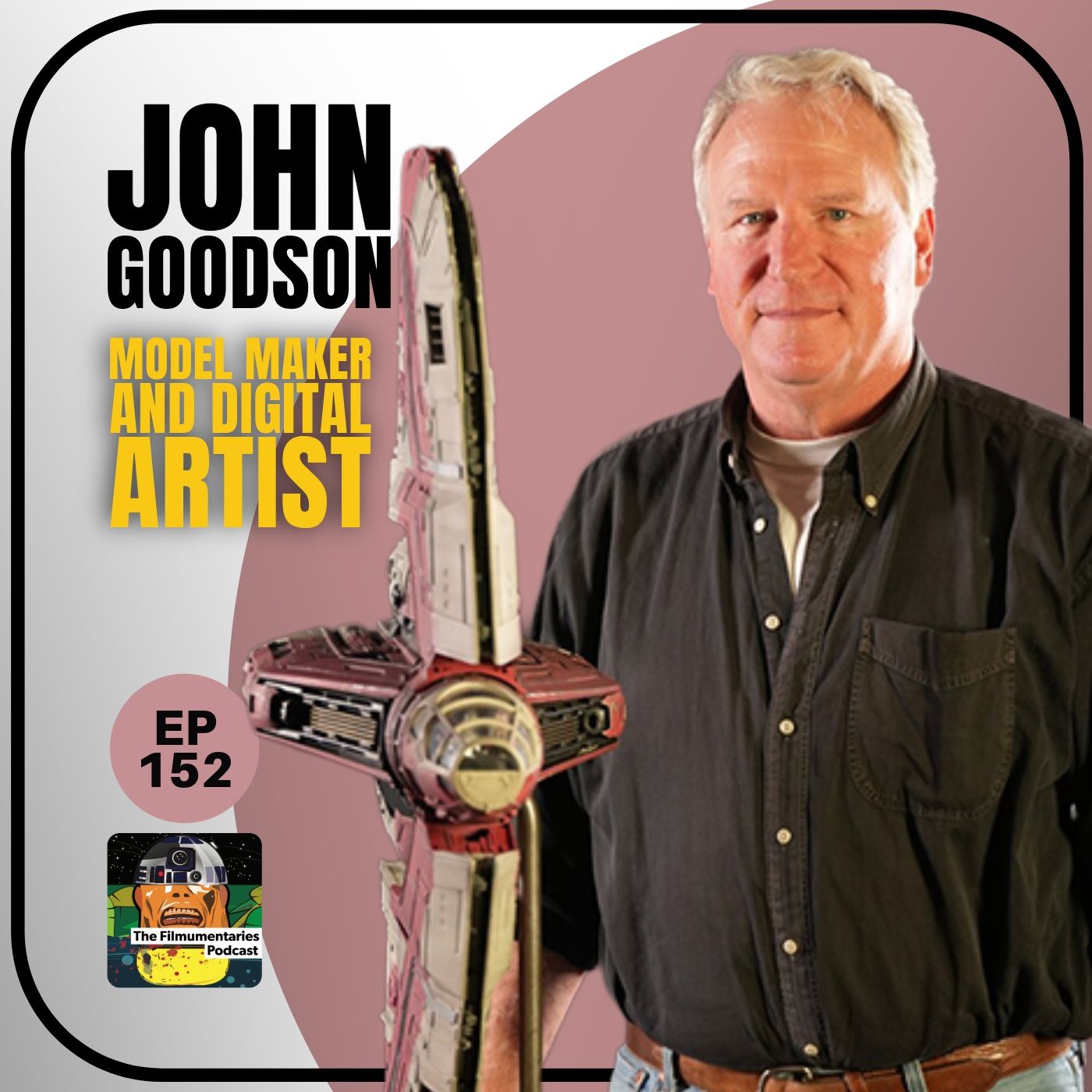
Ep 152 | John Goodson - Model Maker and Digital Artist
About this episode
John Goodson is a model maker and digital artist who spent more than three decades at ILM. His credits span The Rocketeer, Star Trek: First Contact, the Star Wars prequel trilogy, Rogue One, and most recently The Mandalorian and Grogu. In this first of two episodes, I talk to John about his lifelong obsession with spacecraft and model-making, how he got to ILM, what the model shop was like at its peak, and the craft philosophy that has defined his career. In this episode:
- Growing up obsessed with Lost in Space, Star Log, and the making-of books that shaped his ambitions
- Writing letters to ILM at age 14 — and getting politely told to stop
- How a childhood friendship and a homemade recreation of the Battle of Hoth eventually led to his first visit to ILM
- The advice that sent him back to finish school — and why it was the right call
- Getting hired for one week on Body Wars and spending the first three days hiding in the model shop hoping nobody would notice
- What the ILM model shop culture was like at its peak, and what he absorbed from Bill George, Lorne Peterson, Larry Tan, and the rest of that team
- The 18-foot Titanic model for Ghostbusters II and learning to just start building
- The 33-foot Hindenburg for The Rocketeer — eight months of construction, a night shoot at a decommissioned Air Force base, kerosene running out of the holes, and a cherry picker at 25 feet
- The pasta trick, pancake syrup, and other unexpected materials that found their way into ILM shots
- Watching the digital wave arrive and feeling like parts of the machine were being taken away
- The transition to digital model-making and eventually finding his footing with Mari
- What it felt like to return to physical model-making for The Mandalorian — and what was hardest about working without the model shop around him
- The mechanical language of spacecraft: why weathering works, what Star Crash got wrong, and the disposable camera exercise that taught a kit-bash class to see the real world differently
- How the Razor Crest started as a 3D-printed assembly that couldn't survive construction — and what he did about it
This podcast is completely independent and made possible by listener support. If you’d like to help me keep making these episodes, you can join my Patreon community here: https://patreon.com/jamiebenning
Watch more on YouTube:
Check out the Filmumentaries YouTube channel for behind-the-scenes clips and extra content: https://youtube.com/filmumentaries
All my links
Transcript
Automatically generated, so expect the odd misheard name.
Weird Being Way Media. Welcome to episode one hundred and fifty two of the Formiamentary's podcast. This is Jamie Benning talking to you here from my house in London, England. It's the twenty eighth of July and this is the first episode for a little while. So firstly an apology.
Things just got a bit crazy around with work and family and fiftieth birthdays and then had a few health things going on, so yeah, so it's just it just slipped past me. I just couldn't find the time to get the podcast edited and uploaded. But the good news is this is a great episode. If you're a first time listener, welcome. The podcast is dedicated to preserving film history the stories behind the scenes, and you can treat this in the one hundred and fifty one episodes before it as an archive of entertainment and research.
I hope you find it enjoyable. For the regular listeners, thank you as always for joining me and for your continued support. A special shout out to the wonderful people supporting the podcast via Patreon, Patreon, dot com, forward slash Jamie Benning, your support is absolutely crucial and keeping this podcast going. Let's say going strong. I'm aiming for at least another fifty patrons to make this financially viable.
So if you love the podcast, and I know there are people that love it, there's plenty of you out there listening and would like to buy me a pint or a coffee if we met, consider doing the equivalent of that by supporting the podcast for about twelve dollars for a whole year. That will be twenty four episodes. You can look at the other tears and patron as well and see what kind of suits you If you can't support the podcast in that way, you can go and grab some exclusive merch. I'll put the link in the show notes. And if neither of those is your thing, you can still support the podcast by sharing it, liking it, subscribing, leaving a review, commenting on the YouTube version.
This is just me. You know. This is a small, dependent podcast and it thrives on your help in spreading the word. Now, for this episode, I had the pleasure of speaking with John Goodson. John is a model maker and a digital artist who spent more than three decades at ILM.
It's recently working on Mandaloriin and Grogo. But you worked on Star Treks and Star Wars prequels and Rogue one and Transformers, a whole bunch of stuff, and we talk about his sort of childhood obsessions with Lost in Space and Staralog magazine and how a friendship formed which eventually led him to ILM's door, and the first terrifying few days in the model shop, which he goes into some detail about. And also there's a great story about a decommissioned Air Force base, a thirty three foot Zeppelin model, some kerosene and a cherry picker. Yeah, and the disaster that ensued. This, by the way, is part one of two.
John is in a situation where he can't always get a good connection at the moment, so we actually lost the call connection and couldn't get it reestablished the night that we did this, And he's agreed to come back on and talk more about the later work as well. So you're here right at the end there you'll just hear him stop talking mid sentence, but hopefully it's tantalizing enough to want to listen to part two when that comes along. So here's part one of my conversation with John Goodson, and I'll be back at the end for a bit more jabbering on John. Actually, I'm going to just bring up before we start. I actually met you very briefly at Skywalker Ranch in twenty twenty three.
I was being given a tour by one Max Smith and Lawn Peterson, Yeah, and Lorn and you. You were surprised to see Lawn. I think you were in the middle of shipping stuff out of the archive. Maybe there was some museum stuff involved, but I think at that point he said, oh, you should get John on the podcast. And it's only taken us two years.
But yeah, Well, I met the ranch pretty much every single day, and Laurren would just appear and I'm like, why don't you tell me you're coming, you know. So I was surprised when he just yeah, that was really sweet of him. I said I was coming, and I'd interviewed him a couple of times, and he said, oh, I'll come and I'll give you a tour, you know, and he just turned up. And it was great. Yeah, it's very good, right, John, Thanks so much for joining me.
I love your work. I love to speak to people's work I really admire. But I also want to sort of go back to the beginning and find out like where this was all sparked from. Did you live in a kind of creative household, were you a creative kid? Where was that kind of first spark of imagination to end to the industry?
The thing? Okay, so the thing I remember clearly was when I was about three years old, there was an episode of Lost in Space called the Derelict that came on, and it had the Jupiter two gets taken into this giant alien spacecraft and once it's inside, it was all dark and kind of creepy and the Jupiter too basically filled frame and that made such an impression on me when I was really little, And that's the first thing like that that I can recall. Then the other thing was that somebody gave us a three page color flyer about the Saturn fire rocket. Is that was when the Moon missions. You know, that was all sort of and that was all coming together and those were really intriguing.
And then my dad was in the Air Force and he was a surgeon. My mother was a homemaker, but she did paintings for the sculpture, so that there was that window into you can make stuff, you know, And so we moved to this we were on Air Force Base and the next door in the was a fighter pilot. He got me watching Star Trek. And somebody got me a copy of the book The Making a Star Trek, and I was five or six, and so I got right away this stuff wasn't real, you know, but there was an industry where people did this stuff, and I thought that was fascinating, and so I remember space In nineteen ninety nine, I begged my grandmother. We were in a grocery store and there was star Log I think was issue number seven, and it had a picture of X winging the Tie Fighter on the cover.
It was that promotional shot that used all the time. And I didn't know what Star Wars was, but there were pictures in there of Brian Johnson and Nick Alder with the Eagle spacecraft models from nineteen ninety nine, and that was what I wanted because it was there wasn't much reference available. You didn't find pictures where you saw people relative to the miniatures, and here these guys were holding these three different sizes of Eagles, and I was just that was I had to have it. So she bought it for me, and then in there with the story about this movie called Star Wars and I thought, this looks really interesting. So I was there opening day and saw it, and then it was in the theater, and back then the movies would stand theaters for like a year, and I think I saw thirty one times in a year.
And I would start writing letters to Island, going, hey, I want to come and work for you guys. They'd write me back then, thank you for your inquiry. Your letter's on file. You don't need to write us anymore. And so, you know, I was fourteen years old, but so that was kind of where it all really got gone.
And in the back of the art of books that came out back then, and again there wasn't that much reference information. The art of books were gold because they had photographs of the models, the matte paintings, costumes, artwork, and in the back there were bios of a lot of the people that worked on them. And in this bios a lot of it was theory, either architecture or industrial arts. And so that was kind of how taylored by college curriculum. I went to in c State, the School Design, and you know, frankly, that was really interesting, but the stuff I was doing school design didn't really.
Changed any of that much in terms of what I wanted to do in terms of building marbles. So that was how they got gone. So and then it led to a job at Ilanic. It sounds like you didn't have a chance, really, John, I knew what. I wanted to do very clearly.
I knew what I wanted to do. It was just well in my dad bless him, he's a surgeon. Yeah, and it sounds like you had the right influences there from your parents as well. You know, you've got the kind of artistic side, you've got the technical side. It's sort of approaching you from both sides, and you've got that perfect combination of engineer and artists.
But how did you then? You know, having the intention to get into that field is one thing, and being knocked back, of course, is something that often happens when you write letters to these companies. How did you sort of end up at ILM? What was that story? So?
I went to high school with the fullen name Tony Hudson, and Tony and I we kind of recreated the Hath the Walker battle. So he built a big snow set in my one of my bedroom and we had a folding picnic table, and that whole top of that was snow. We had another table behind it there was snow, so we could stand up between the tables to do the animation. And I built three different sized walkers, and the walkers they made a poster, paper, cardboard, and mattboard because paper was the medium I could afford to work in. But one of the walkers was about the size of the film.
It was about twenty two inches, and there was a nine inch and there was a really tiny one which I still have. And we made a little beam splitter so we could add in lasers and things like that. And so we did that stuff together. And you know, at that point, I was like seventh grade or something like that, and we both said, you know, if either one of us gets to Island, we got to let the other guy know. Well.
A few years later, it was been about eighty five, I think Tony got hired in the creature shop, and so I came out, spent five weeks and stayed on Tony's couch and went to work with him pretty much every day. And I got this spend an hour with Greg Jean, and Greg Jean was the model supervisor and close encounters nineteen forty one. He worked on most of Kris Nolan's movies until his passing about three years ago. But he's big in Star Trek and Greg was a huge model, script prop artwork collector. Huge.
Greg had two houses that were side by side with two car garages. The yards were full, the houses were full, the garages were full. There was a van in the driveway. This full. And he had five storage units.
I mean it was and when you looked at and it was piles of stuff, but I mean when you look at it's like, is that the original. Of this or that? Oh yeah, that's it. It was unbelievable. And so I got an hour with Greg.
He was working on batteries not included at ILM at the time. Got an hour of Steve Gowing, hour with Charlie Bailey, power with Isojung, and an hour with Warren Peterson. And you know, they're all really great. There wasn't a job at the time, but Greg said, he goes, you know, I had a year left in school. He goes, go back and finish school.
This is going to be here when you get back. So I did, and that was good advice. And Greg was a really good mentor all through my career at a lovely human being, one of the nicest people I've ever met and always supportive, and he helped get me into the academy. He got me connected with Paramount, so I was restoring what Star Trek stuff they still have. So over the years has been a number of things I've done for them, but he was just a great influence.
But that was really good advice. So back in finished school and then moved back out here without a job and got here and got hired to come in for a week on Body Worse, which was like Star to Wars, but you get miniaturized and put into the human body. And so in that week kind of segued into about thirty one years as an employee of Lucasfilm. So you joined the Model shop there in the kind of in the peak of its influence in a way. I mean, you're working alongside Bill George and on peaceing and like you said, you know you contemporaries in Greg Gene as well.
What was the culture of that shop like at the time, and you know, what did you absorb from those people that still kind of informs the way you were today. I learned so much from those folks, and it was really interesting. The model shop was a great place to be because people shared what they knew, and we had so many people from so many different backgrounds, and all those different things combine. I mean, it's alchemy, all these things combined to make magic, you know. And you know, people literally came from such random and different backgrounds and all of that played into it.
Everybody's life experience played into it, and people were very sharing and you just learned constantly. And I always had this vision in my head that I've got this thing. It's like a quiver. You put arrows into it, but it actually hangs under my arm and you would learn something, you'd put that in your quiver, you know, and you're constantly feeding this thing. And when I got to ILM, I thought I knew how to paint.
I did not know how to paint. And I got there and I was really perplexed because they used this hideous paint called railroad colors, and everything was kind of matt and ugly, and I was like, this stuff is terrible. That was because of blue screen, you couldn't have reflective surfaces and so and by working then environment with people like Bill and Lauren, Larry, Tan and Steve and all those guys. By osmosis, you learn, you start, you get a sense of what things are supposed to look like, you know how what level of texture does it have or need to have to look good on film. And so just by the process of being immersed in that environment and working with all these incredibly talented people, you learned how to develop that look.
And it was one of the things the Model Shop was so wonderful because it was all about problem solving and that was what made it really interesting. But you also worked with such a wonderful group of people. And what I think is really interesting is the Model Shop still gets together on a regular basis. We see each other more than once a year, you know, and that is something that Model Shop has been disbanded for like fifteen or sixteen years, and essentially it's this big extended family, you know. And I am so thankful for all of that.
Yeah, I've seen some of those fighttoes that to get together, as they always looks like there's so much well, you've got so much shed experience. You just got this kind of shared language language with each other. You can see that there's love between all of you and admiration for each other's work, and it looks like a really friendly environment. But when you first walked in there, I mean, you're in this place you've dreamed of being. What was the first thing you were tasked with doing?
And did you feel nervous? Did you feel like I'm up to this was? What was that first day? Like? Oh?
Spirit shitless? I mean, you know, I got there Larry Tan, Larry Tam was too week started was doing the Body Worst ride. And so I got there in the morning and I went into reception and Larry came down and met me, and he said, okay, wait down here, Jeff ma'am will come and get you. I had met Jeff when i'd been there previously at eighty six, when I was there visiting staying with Tony. So this was August of eighty eight.
So I sat in the lobby and Jeff never materialized, and it got to be lunchtime, and here came Larry trotting through the front office and he goes, did Jeff not come down? He goes, no, I never saw him. He goes, well, come with me, so he just follow me. So I start following Larry and he goes, I'm going to give me to Steve. Golly.
Steve hats rookies, just so you know, and I'm like great. So he takes me in the wood shop and there's Steve, and Steve hands me this piece of paper with the miniaturization platform and he goes Bill disk and he walked out. I don't know where the bathroom is, I don't know how to get back out of the building. I don't know where anything is, you know. I'm standing in the wood shop by myself, and I'm like okay.
So I walked out in the hall and I saw Dennis barn where I recognized from seeing him on making of you know, and I said, can you can you point me to the model shop, said Natal. He took me up to the model shop and I went in and Bill George was in there. So Bill and I talked for a minute and I said, we're going to make this thing. He goes, well, why don't you sit? Here was Eric Christensen's old desk.
Eric Eric was not there anymore. So I sat at Eric's desk and for three days I tried to be the invisible man, because I thought if they figure out him in here, they got to throw me out. So I started building the miniaturization platform, but as quietly and as visibly as I could. And on the third day, I think I was going to use the restaurant. I ran into Jeff in the hall and goes, hey, was I supposed to talk to you?
I'm like, yeah, do I work here? And goes oh, yeah, yeah you're working here? Like okay, good. So for three days I had no idea if it was really there or not. So that was the beginning.
Wow, baptism of fire. Steve really sort of druped you in there and just said single swim. Was that was that very Steve? Yeah? Yeah, kind of.
I mean I know Steve really well. I see Steve pretty regularly, so you know, he's just it was just like Bourne said he where Larry said he he hates rookies, and I was like, okay, give me the drawing. If he walked out, I'm like okay, and I I have no idea what to do. I don't know where to go, you know, but I was able to do it, so it all worked out. Yeah.
And I'm sure being so keen and so young as well, that you were putting in the hours. I mentioned, oh, yeah. Well, I mean it was a dream come true to be there. Like I said, I tried to be invisible for those for three days because I thought, if they figure out I'm here, they're gonna throw me out, and I don't want to leave, you know. So it was you know, when I actually had a job, I was like this, that was incredible.
I mean, I mean I couldn't believe it. You know, here are all these people, because you know, there wasn't that much making up stuff. When Star Wars came along, there was a lot more of that. Not that there was that much of it, but that sort of stuff wound up on regular television. There were these specials where it's all about the making of Star Wars.
So these were these guys I was watching. They were showing all these instinct and here I was in the same space with them. It. I mean, I still don't believe it. I was sitting there.
The other night, I took my daughter to the premiere of Mandalorian and I went to that. I mean, I'm living on this ship. I don't have a great wardrobe. I wore a Sampedro t shirt that had the walker and one of the cargo cranes here and it says I am your father. That's why I were the premiere.
I also didn't expect to be doing kind of like fifteen minutes where you get there, get this text and we'll send you to the press and photo. Ay. I'm like, I didn't come dressed for that, so wound up doing it. But I was there when the movie ended, you know. John Fiber came out at the beginning and spoke to everybody, and and and the credits were rolling, and I saw my credit go by, And it doesn't seem real that I'm in the film business.
And it's been thirty six years, but it still doesn't seem real. It's such a dream come true, it really is. It's just I am thankful for every did of it, you know, and I'm so aware of how lucky I was. Yeah, yeah, Do you remember that first moment of seeing your work on the screen? Oh, that was mine?
Do you remember There's a strange thing that goes on with that where I always have a disconnect because I see this stuff on screen, I'm like, that can't be the one I built. I mean's just something there's some magical intermediary process that happens, and one on screen is something different. I still get that vibe. But yeah, it's cool. I mean, it was funny the Manda movie.
It was really gratifying to see that ship on screen because we really get to see it. And you know, we went from a model shop of you know, a model shop covered around between forty and sixty people, and we ballooned up to something like one hundred and ten during phanom Menace, and a model like that would have involved you know, thirty maybe forty people because you had you know, sculptors, electricians, mold makers, painters, you know, all these different things. And now it's me and Dan Petrescu putting these things together. Every time we do it, I'm like, I don't know how we're doing this. I don't know how we're pulling it off.
So yeah, it's it's pretty interesting, but it's kind of sad too because I miss I miss those people. I missed that. I miss getting to work together like that a lot. You know, that was what and that's why we also get together because we really we really integrated as a group and it you know, and you really those relationships mean a tremendous amount, and I miss getting to work with him Larry Tan. Larry's the guy that hired me.
Larry. Actually I asked Larry if he come and helped us some on Mando, and he came in for a couple of weeks and helped us out with some things. And that was fantastic because Larry had not worked on a he hadn't worked on film in twenty five years, so that was really sweet having him there. So wow, yeah, great to bring into that experience, you know, working together. As you say, I mean, yeah, that's the thing when you're working on these jobs that can be quite intense.
Having you know, just good people around you such a difference. As I work in live TV and it can be very stressful. You know, I work on Formula one, so I have, like you know, there could be five hundred million people watching a race, and if I do something wrong, everybody sees it. So having good people around you to support you and kind of you keep you kind of level, is so important, is there. Did you feel that when you first arrived at ILM that you were you surprised by the amount of or the lack of time that you had to work on things, because obviously there's a deadline.
You've got to get this this model finished. Was that a surprise to you, as having been somebody who was a hobbyist up to that point. I don't. I don't remember it being really I mean, I remember the first big thing that I did was I was going to build a model of the Titanic for Ghostbusters too, and the model was eighteen feet long, m and I was hesitant to get started. I did a full sized drawing of it, you know, and I kept messling with the drawing stuff from Bill.
George said, you know, you got to actually build it. You gotta stop doing this, you gotta build it. So I had, because I was says in it to do it. And once it got going, it was great, you know, no problem. But yeah, I mean yeah, and film work is such a different animal, and you know the production needs, especially when you get on stage.
I mean, my god, you realize that, you know, they're paying stage mental, they're paying for the lighting package, epe grips, everybody, all those people are there, and when they're waiting on you all that money, there's a taxi meter at the front of the thing that's spending at an incredible rate. And if they're waiting on you, you don't see that, and so it was amazing to me something could happen on stage in twenty minutes that could have taken two or three days in the shop. But there there's an intensity to it. You're literally shaking because you're operating. It's pure adrenaline.
You're such a high speed. And it was funny. A few years back, Paul Houston and I wound up doing something for the Agent Carter series from Marvel, and it was a couple of DC threes, Yeah, and it was two shots, one of them on the ground and snow so them. We're just monogram kits I bought and we put it in baking soad on a four by four sheep and we'd move it five degrees, photograph at each you know, each one of those increments. And then we had another one that we hung on wires, whereas on fishing line they had motors in it.
It was a flying shot and you know, trying to puppeteer this thing. You know, we went from being this company that had the the state of the art must control equipment to Paul and Arrow down there, he's got a handheld camera. We got a model hanging on fishing line trying to make it look like it's gently turning, which doesn't just turn you start to do anything to it starts wiggling into it, all this stuff. And he said, I can't believe it's come to this. I'm like, I know, it's pathetic, but he said, and look around, nobody's in a hurry.
Everybody on the stage was just kind of hanging out. It's like we're so used to when you're on stage, you're on fire, and he's like, nobody here. This is not that. It's not the culture anymore, you know, it's very different. So and we got the shot and it was just it was just kind of I thought, this is this is pitiful fishing line and handheld camera.
Really, So it's been great to go back and do their TV show. Yeah, well and have John build these most control cameras and so we kind of have that the capability. Again. The thing is when that taxi meets is taking along, as you said, it just has to get done, doesn't it Like live TV that I work in. I'm amazed we get on air sometimes.
You know, there can be so much planning and so many sort of obstacles and then all of a sudden it's like, oh, we've got ten minutes and bam we're on air and it's everyone's firing on all cylinders. Somehow it just comes together. Was there ever a time, and you don't have to say a specific time, but was there ever a time where you know, you really felt like it didn't come together? Yeah? There are a couple.
Rocketeer was one where, Yeah, that. Story just interested to know because you know, I think we just assume that everyone is always you know, always gets there in the end, but sometimes it just doesn't happen. Things do sort of for down around you don't. We did get there in the end, but so this was an interesting story if you ever heard. So there was a thirty three foot model of the Hindenburg which was called the Luxembourg in the film, and we had it took about eight months and it was a you know, Steve Gay was doing that and I think Arakila and Mike Fulmer and it was a huge project to build it.
And then Larry Tannet and Richard Miller and I came in and did the skinning of it. Because it was a wooden quarter inch apple ply plywood that was laser cut for the internal framework. So there's this complete framework inside of it, and then that was covered with like black cheese cloth, black fish net, and then on top of that we used this aerial called solar text and it's a synthetic fabric in its heat train. So you know, Larry and Richard would stand either into the zeppelin and I would give one of them this two foot roll of stuff and we'd roll it out, and we cut off about a forty foot length of it and then had a clear film on it, and I would walk that off depending on which direction I went.
When I got the end of that, I had a massive static charge on me, so I would zapp either Larry or Richard. They knew it was coming and there's nothing they could do. They couldn't put it in. But so we skinned this thing and then I painted it. Took a week to paint it, and I'm a fullick on scaffolding with a bank skun running back and forth painting this thing.
It's like a tractor trailer trailer, you know, not quite that big, but big. And then we took it out to an Air Force base that's local here, that was decommissioned and we had an unobstructed skyline and the thing they had filmed live action elements of the tier and his girlfriend running from the bad guy on top of the zeppelin, and so it's exploding right behind him. So starting at the nose that's going towards the tail. When they get to the tail, Howard Hughes flies over in a pit care and auto gyro and they jump onto the rope ladder and fly away as the back of the zeppelin explodes and it crashes. So they'd already filmed the live action of all that stuff.
So now we have the model. So we took it out there and they were going to load ten bombs in it. There were kerosene and black powder, and there were six openings in the bottom of that model where it connected to a dolly we could drive it around with just to move it. And we said before we were going to take lunch or dinner, whatever is. It's like two am the night shut We said to the power guys before you guys loaded up with pyro.
When you pick it up, let us come and close the bottom. Oh yeah, yeah, So we break for the meal. We come back. It's twenty five feet in the air. It's got ten black powder and kerosene bombs in it.
There's kerosene running out of the holes, and now we got to go up there and iron and we're using the irons that are plugged in iron the bottom shut and so you know, we go to the cherry picker and the Bob Finley Senior he comes by and he goes, if she flashes five second light for the explosion, I'm like, oh. And then Dave parent who's driving the cherry picker, I mean, goes. Flashes a five second land cherry picker. And I'm like, well, what are we gonna do? And he goes, well, we jump and I'm like, and what it blows up and falls on us, and he goes, uh, oh, they gave us these Nomac suits that put your face in your hands, you know, because you don't need those.
And we went up and there's a picture of me in Cineffects magazine with the iron, like just with this mortified look on my face, ironing this thing shut. And there's literally kerosene running out in the holes, and I think Charlie Bailey and one of the teamsters was in the other picker. So we got it all sealed up, didn't blow up. We get back down. Now you got about ninety people out there.
You got fans, smoke, blowers, lights, all this equipment, and I think we had six high speed cameras and every one of those cameras you have to get a speed call off O, because shoot three hundred a second. And once you get all six speed calls action, then you know. So they went through all that, we'll do this. We'll turn on the fan, the smoke lower, all this, blah blah blah. We'll get the speed calls and on action.
It will go one through ten, and when it gets to ten, there's a guy whose own job is to push a button that'll cut the two cables and we'll fall out a frame. So okay, everybody gets going, fans, smoke, going, action, speed and boom and it goes one and ten and the guy cuts the cable and it falls out of frame and it blows up on the ground and in fifteen seconds. I think it took eight months to build it. In fifteen seconds, it is this charred rubble pile that iron I stuck into a dumpster the size of a desk. The next day, I mean, it's gone.
And that was the climax of the movie. And it's gone, and I said, I was standing next to Dicky Dova. Dicky is one of our hands. Dickie's dad was a vaudelt performer named Ben Dova, and his dad had been on the Hindenburg when it came over on that last flight. His dad actually shot color film during that last flight and Dicky.
There's footage of Dickey on his mom's shoulders when the Henderburg arrivdal. Dicky was there when it blew out, and his dad survived. But I'm standing next to Dicky and the thing goes boom boom, falls on the ground, blows up, and I turned around Dickie, I said, is that what was supposed to happen? He goes, oh, I don't think so. I don't think so.
So that night, that's journal the next day mid front page. Why visual effects cost so much money? And I don't know if they ever sorted out exactly what went wrong. But a second Zeppelin got built in about six weeks with three ships going around the clock, and that's the one that's in the film. So you know, there's one of those places where it didn't go as planned.
They were able to recover, you know, and it worked, but what a what a stressful evening and it was just that realization it's gone and we did not get the got and we only had one so you know, that was a gamble usually built three for pipes. So yeah, anyway, that's one of those. Time, right, yeah, yeah, lessons lent. Yeah. Yeah.
It was a you know, and not everything worked and that's part of the price that says, you know, it's experimentation, especially pyro, you know, because I always treated like a science experiment. You don't know what's going to happen, so that was always fun to try different stuff. And Howie weed Camp with a really good idea and that was using pasta in pyro stuff because it comes to all kinds of interesting shapes you paint it and during the explosion you can't tell what it is, but it's great debris and it really is you know, really responds to the shockwave brings them all up. So that was a really great thing, you know, but it's all experimentation, and that was the cool thing. You know, you're doing stuff, you're using materials in ways that weren't ended, you know, and wild ideas.
Ever, we were doing Fire in the Sky and that was an alien abduction movie with DB's swinging. Yep, there's dB swinging. But they had an alien spacecraft, and the way it was described it was you were looking at the bottom of the characters looking up at the bottom of it, and it's these islands of black with lava flowing between them, and at a certain point, the lava of the islands kind of go away from the center and exposed in the middle of it, and a shaft of light. Comes down and take it away. So we had a model of the spaceship that's about three feet in diameter, which was basically it looked like a big mushroom cap kindo and it was a clear plastic one.
And then over the top of the clear it used bondo and put kind of a shell over it. There's about a quarter it's thick, and then went back with drimal tools and carved all these rivulets in it that emitted from the top down the sides and from the bottom towards the top. And then inside of it we had color gels and we had polarizing gels. And I've been down on the set for Star Trek the Next Generation and they had all these flat panel monitors and I was with my Kakuda and I said, you have Bill George, and I said, how does this work? We pulled one of them out and it's literally this polarizing FuMB that's printed on plastic.
And then if you take a polarizing wheel, when those when the polar polarity lines up and goes in and out of line, it causes animation. So they had all these different samples of different things that would create move So having seen that, I put that inside the saucer and they were about I think there were like one hundred. There are one hundred and twenty lights, six cooling fans, nine spinning polarizing discs, and a thing called the salad bowl in the bottom that had polarizing film in it. So all this stuff is turning in there, and it made the lava appear to come down from the top. It was animated and come up from the bottom.
And so for the shot where he looks up and gets sucked into the bottom of it, we took some of this ripple plex that's like used for shower doors and heated it up on the vacuum form and made it into kind of a dome shape and it was four feet square. Then on top of that we put pancake syrup. Then on top of that we took styrofoam bead foam and cut it into thin, like sixteenth inch sections and painted that with black temporary hairspray, and those were the islands where the rivulets, you know, And we'd bottom line this thing, and then we had we would right before we would shoot, we had silk. That was it. We laid silk.
They were like silk strands that were about four inches wide and they all intersected over the center of it. But when you poured the pancake shirt over, it became transparent. We stuck the bead foam islands on top of that, and right before we'd shoot, spray it with ab smoke, and that's you've got this. I don't know if you use it anymore, but it was two components. Spray the first component on it, and right before you shoot, spray the second army, and you get this really low hanging smoke smoldering, and it's like if you see Terminator one, you see Schwarzenegger at one point it's sort of drifting around on his head, and that's what it is, as ap smoke.
So that gave us this really interesting low lying smoke, and then when we went to film, we had about five or six people around it. Everybody would grab one of these silk things and then we'd spray it with acetone so the islands would dissolve. And at the same time we'd pull the silks and ride on the pancakes and all the islands would leave from the center and expose that. So it was this crazy setup, but you know, it gave us what we're looking for. But you know, it's all experimentation, you know, it was really it's you know, that was the fun part.
You're always coming up with wild ideas and look when we'd bid stuff and it's like, wow, we think said take sixty six weeks. I'm like, we don't know how we're going to do it exactly, but we think it will take this long, you know. But it was always Steve Golly always referred to it as swag scientific wild ass guests. Yeah, that's great. Yeah, So.
It really is a science experiment, isn't it. Every time? That's the attitude I always come across with people that worked to ILM was sure, we'll do it. We don't know how, but we'll find a way, whatever way that turns out being, and it might be something that you then taken to the next show, or it might be something you never do again. Yeah, oh yeah.
I mean there are a lot of things. All those experiences, they don't all build towards something, but a lot of them contribute, you know, and that was the cool thing. Everybody's different experience really helped. When you blend out, blended it all together, you got really stuff from it. And I remember as people were getting poached and going to computer graphics that you know, prior to that, I felt like we had this amazing machine and you could plug in a drawing on one end of it and you're going to get something out of the other end of it.
And then as people started going away, I was like, you know, they're taking parts of the machine away and it's not going to work as well. And it was really it was very difficult. And then I went to computer graphics, so but it was an inevitable It was kind of like the model shop was not the direction things were going, you know, that was very apparent. The digital thing was picking up steam and that was where all the emphasis was. And there's still you know, still room for using miniatures and things like that.
But I think a lot of productions the comfort level because they don't know practical comfort level is to, you know, have it be a digital solution, and you know, practical people have less experience with it, and it is sort of unpredictable, but you know, the results tend to be pretty pretty good. Did you did you really feel that kind of tiede of the you know, the digital wave coming towards you, and did you feel that you had to be kind of agile and move into that direction because that if you wanted to stay in the industry, that's where you needed to go. Yeah. At ILM, it was like I always think about the never ending story of the great nothing that's coming, and that's what it felt like. It was like, you know what, And there were a couple of times we were really close to being shut down, you know, and one of the things that saved us at one point was you had a commercial division, and commercial the response there so fast you turn around us.
What is so quick that without the model shop we couldn't have done those And so that was one time that saved us. And then ultimately, I think really what it came down to was there was less and less work for the model shop. But I think also George wanted to remove any kind of a crutch that the model shop provided and forced computer graphics that next step, you know, and that was pretty hard, you know, it was very difficult some people. Some people were retired at that point, some people didn't make the transition, and it was it's pretty bleak. I mean, Light Magic Season two kind of covers a lot of that, and you know, and it's it was sad, you know, and I wanted one into computer graphics.
It was just it was an adaptation because if you didn't, you weren't going to be working anywhere. Mm hmm. When when you sort of came back to making models later on, I think obviously the Mandalorian was one of those you returned to that physical what what what felt different to you and what kind of came back immediately? Well, I never stopped building stuff, so that was always I was always doing things in computer graphics. And there were things that would come up at ILM where I do Minish look, but not that often.
But it was different, you know, the biggest thing was not having the model shop and not having all the people. You know, it was a different world. It's just kind of a low type thing. You know. I worked with one other guy primarily and Dan, and that that's that's it.
That that was That was the hardest part, you know, not having that camaraderie, not having that, you know, and it I was really sad that somebody didn't step in and acquire the model shop because you had this talent pool that was phenomenal and I thought this this hastened to it, you know, I mean, but nobody did it just it was allowed to just dissolve, you know, And that was that was very sad. So, you know, and the other thing, it's different. Technology changed spot so information, you know, is you're getting it as getting it as email and you're getting digital vender's things like that, and that's a different animal. And then a lot of the design work has done digitally too, so elements to it or were different, but then so much of it was very much the stay mm hmm.
And I guess you've also got that you've lost that kind of library of objects as well in the model shop, whether it's a tool or whether it's you know, a model or an area you went to because I know, I need this thing, and I know that's over there in that corner. All of that's gone. Well, that physical library. Yeah, I mean, and that's that's way and more of a challenge all the time because materials go away. I mean the other the day, I went to a hobby shop here in the LA area and all in one of us brass wire and they're like, oh, we're having trouble getting it from a distributor.
I'm like, what I mean, brass wire? And you know, and the K and S is a brand of metal materials. They make contens of tubing and it's telescoping tubeings and rods and square tubes and all kind of stuff. And I noticed that those racks which you'll see in hardware stores, a lot of them either they're not restocking you altogether gone. And I went the other day to buy some solvent, which I've been using since I've been in the business.
And I went to a plastic shop I really like down here in southern California, and I bought a bunch of styrene and said, I need some this particular product. They said, we can't sell to you. And I said, what, we can't sell that type of solvent in La County And I'm like, but you're a plastics fabrication facility. I mean, you can't operate without it. And they said, we're Vegas and buying it and bringing it back because they can't get it locally.
So materials way constant. You know, the type of primer that you like goes away. I mean you name it railroad colors, which was the primary pengus that I that's been out of production now for I don't know, maybe sixteen twenty years. So you know, you have to adapt and try and find other stuff to do the job with. And that's that's front.
A guy talked to me the other day. He works in a fabrication facility where they make looseite and it's large, large loose objects. Plexiglass was a type of plastic they used, and I can't recall the name of it, but they would vacuum form the part. Then they would use the vacuum forms and cast the leo site into that and the loose sit wouldn't interact with this plastic, and it was their primary means of doing this. That plastic is no longer manufactured and there's not a substitute, and he is scrambling to try and figure out how they can make these parts because they have to be baked in an autoclave and any other plastic will blend into the plexiglass.
They wind up combined where it's this other material to do that, and they don't have a solution at this point. I don't know what they're going to do. But that's a constant that the materials keep changing in its air quality or environmental reasons. And you know, if it's really good, if it works great, it's really bad, it's carcinogenic, or it's toxic or you know, we're both and so you know, those things keep going, and so that substitution process, it gets harder and harder to do the same things. Now.
Yeah, we often talk about, you know, new technologies. Really hear much discussion now in the outside world about the technology kind of being left behind. It's really an interesting subject, I think, because it you know, one element of that chain is removed and suddenly you can't do the thing that you know you can do quickly, let's say, because it no longer exists. Well, it even goes on with the newer technology. Because I was reading something the other day that in the past, for fighting forest fires, the four services reached out to the military and they've gotten next military aircraft to do the fire mantions and that sort of thing.
And then I read they said, the limitation is not the hours on the aircraft anymore. It will probably be software that will make it so. But the plane can't fly. And so it's really interesting that the obsopleuscence of this yeah, makes the plane not usable anymore, and we run into it all the time with equipment, and it was that was the thing. So I thought was interesting was I went and talked to a tenth grade class and I said, you're you're all going to work in an environment where you're going to use computers.
And it's interesting because periodically you're going to get new hardware and there will be changes that will happen. It's like when you get in their phone. Now your printer doesn't work and you can't you know, all these different things don't function, so it requires buying all new stuff. And I said, so you'll have to adjust to the new hardware, But I said the software will change way more frequently than that, and you will have to continue to relearn how to do the same job with new software because it doesn't stay static for long. You know, it's always transitioning.
So it's interesting that you know, materials go away, but then also support for a lot of these things it doesn't exist, and it doesn't take very long for come ups. And like you're in the business as well, and so I carry on, said I just said, carry on. I like my old fashioned stuff that doesn't have software, but you know, it just works. Yeah, yeah, talking about like it just working. You you've also on the other side of your job.
You've got to create these spacecraft, for instance, that actually look like they function as a real vehicle. I think you've talked before. I've heard you an interview're talking before about the mechanical language you kind of have to instill in these items, like how you how'd you go about doing that? Is it a feeling thing? Is it looking at references?
Is it a combination of a bunch of things? But how do you sort of you know, I think of like the ship in ah Soka. I think you were at celebration here in London with that model, weren't you. I know I was with it at celebration Anaheim was Anaheim? Yeah, okay, yeah, But I think of that ship in terms of you know, it's got sort of mechanical movement in it, and it's another sort of way for us as the audience to just buy it.
There's something about a spaceship that you can just buy. Whether it's like a snow speeder that's using a flap to turn to bank or whatever. You know, you just there's those little kind of tricks. Is that something you just learn over time or do you Is that something you really study hard? Well?
I think I think really a lot of artists are really good observers, and so you pay attention to a lot of deep And it was funny because one of the folks was working on an issue on one film and they had these vehicles and he was doing design work and the vehicles were cargo vessels, but the whole top of them was flat and there was anything up there. And he said, I don't know what to do. I don't know what to put up here. And I said, you know, if you think about it, it's a cargo vessel. If I had a cargo vessel it had a flat top on it, I would put containers on top of it.
I put something use that surface. And I said, why don't you come up with like a track system that goes up there. That implies and you don't have to actually execute it at all. But if you do it in a logical manner, it makes sense. That'll telegraph, it'll read, and that's where you know, if you look at I remember like transformers.
You know, it was funny when we did the first film. We did them without any damage or weathering or anything like that, and when they're rendered they look like big computer graphics things. But going back in and putting the metal scrapes and the oil leaks and all those things on it, all those real world cues helped convince you that this thing is functional than it's real. And I always say that the job in visual effects is lit liars, And if we've done our job well enough, you don't realize you've been lied to. But you know, conveying all those real world elements, that's why weathering is so important, you know, with vehicles and things, because that convinces you it's real.
It also helps to find the scale every one of those things. Anything you can do, it gives you an advantage in terms of making it more realistic, giving it a level of texture that reads like a real thing. You know, an implying mechanical language. I love how the falcon is covered in model kit parts and you don't know what any of it does, but the way it's put on there, it implies that there's a function to it. It looks like it does something.
And there was a film called Star Crash that came out right at the same time as Star Wars came out shortly after the first Star Wars, and they made spaceships but it looked like they've covered them in glue and then rolled them through a vat of model kit parts and that was it. And it's like, it so doesn't work because there was no sensitivity to kind of trying to create a mechanic mechanical language that makes there's a certain charm to it, but it doesn't look real. Yeah. So yeah, it's that it's a thing of taking it in the real world, putting into these fictional things and using them to convince you that it's real. Well, we did a kip Bash class and it was interesting because people thought we gave them some basic shapes model kep parks and some people just blewed stuff all over it.
And then Keith London was in charge of the Model Stop and said, let's do this. Let's give them all a camera, those camera and have them go out and photographics the mechanical language. And that was such a great ideeah. And that was such a good thing to point them towards because it gave them something go out in the real world and photographs out of the garbage. You know, is that all the hydraulic cylinders, all that stuff, that's mechanical language that's after So that was really interesting, you know, to try and kind of get that idea across.
But I love things like the falcon, all that stuff's on it. You don't know what it does, but it sure looks like it does something important. Yeah, and you mentioned weathering there, and what interests me about that is that how much did you find that that change between film and digital, like what the camera would sell to the audience as weathering. Did you have to change those techniques when you moved from from film to digital. In terms of the projection medium.
Yeah, it was terrifying because you know before for a Phantom Menace, that was the first thing we shot digitally and you could, you know, put a piece of black tape on what we are rule of thumb was you know, unforcas try a little bit. That's what film sees, plows your eye, and that's what TVCs, you know. And then digital came on the scene, like, oh my god, that piece of black tape is obviously a piece of black tape. And it was Yeah, there was a learning curve there for sure. Who adjusted that because it was very different, you know, fields seemed like you could everything digital and you know the thing that at first it was really difficult for me doing the computer graphics thing, and I don't know if I ever got all that good at it.
But we switched to a paint software called Mari, and Mari allowed you to paint in layers of materials, and that was such a huge advantage. And I remember painting the y wing and the ewing on Rogue one. It was fantastic because you could go in and I could have a layer that was you know, rushed aluminum. I could have a layer that was called clay, which I used a rename is primer. Then I had a layer that was you know, to my gloss car paint, and I could sit there and do scratches on the surface that exposed the metal, exposed some of the primer, and then you had the car paint on top of it, way better than doing it as a practical model.
For me, I was like, this is amazing. I could do greasy handprints because there was an oil material and all you have to do is go find a photograph of a fingerprint or handprint and if it was black and white, whatever was white was that material. So you'd have the whole shit black and have these handprints on it. It's time to oil material and now you've got whaly fingerprints. I mean, it was easy, so it it was better than the real thing.
So that was really really cool. I love that. So it was too bad. That was right the time I left, you know, it was right when it got really and I finally connected with them. Wow, this is amazing.
You're out. But then you've since come back making models. I mean, like, talk to me about the Razor cres because it's sort of you know, in the public eye and under scrutiny at the moment with the new film in Imax there. But the Razorcrest started out for the TV series of course, The Mandadorian And didn't that correct me if I'm wrong, But didn't that start out as a three D printed assembly and then it wasn't kind of like strong enough, so you had to sort of revert back to kind of original mold making techniques. And yet how the couple of things going on it was I think that the main body was like fifty two pieces, so fifty two prints, and they were all done fairly quickly, and they're all you know, build lines.
They're all done differently. These things have got built lines running in different directions all over it, and I'm going to skin it and aluminum. Every one of those built lines is going to read right through the aluminum, so they can't be there. And so it was a question I had to put it all together, dem all the gaps, and then keep spraying at with sandable primer and standing it to get rid of the build lines. And by the time you get through doing all that, starting to lose detail.
Things are starting to go away. And it was just a byproduct of that being the process. And a three D print like that is not strong enough to take out on stage in my opinion, and you need to cut out mounta doors and things. You've got to have doors that are basically invisible. You have left right, top, bottom, front back typically, and the three D print you can't drill it.
It would shatter, you know, And so you can't use the material that was coming out of the hole. You can't cut it out and reuse that door. And then they were going to print them. I'm like, they won't be flat. I guarantee they won't be flat.
So once it was all cleaned up, seamed and primed, then I made a big two part mold of it and I recast it into proxy fiberglass. Well, I hope you enjoy Part one of my conversation with John there. As I said, we got cut off midflow, which is frustrating but also a good sign. It means there's plenty more to come. And Part two is being recorded in the next couple of weeks, and I'm looking forward to getting to know the Razor Crest build and all the proper detail behind that and the latest techniques that he was using, along with all the techniques that he's learned over his career.
Coming up on the podcast, I've got some great guests, including a composer a very very big film series if you like more of the first two anyway, I actually met him whilst working on my Joe Al's documentary. He's actually married to somebody that was in Jaws too, who we interviewed. More details on that later. Keep the support coming, I do need you. Thanks for joining me and I hope you can do so far.
The next episode of the film Thementaries podcast We are Tingaway Media



Similar episodes across the network
Matched by shared keywords.
-
The Mandalorian and Grogu (2026) — "The old protect the young and the young protect the old. This is the way."
3 shared keywords: grogu, lucasfilm, mandalorian
-
Special Report: The Mandalorian and Grogu (2026)
2 shared keywords: grogu, lucasfilm
-
Father Malone's Weekly Roundup - The Mandalorian & Grogu (2026)
2 shared keywords: grogu, mandalorian