
About this episode
Starring Lily Tomlin, Jane Fonda, Sally Fields, and Rita Moreno, the four play a real-life group of women who bond over their shared love of Tom Brady and make it a point to be at the 2017 Super Bowl in Houston. From one mishap to another, it's a comedy in the vein of The Hangover but with more heart and a whole lot more Guy Fieri.
For more episodes of the Kulturecast along with many more podcasts that are guaranteed to be your new favorite audio obsession, check out Weirding Way Media at weirdingwaymedia.com.
———
The Kulturecast is a film and culture podcast from Weirding Way Media, hosted by Chris Stachiw, the Doctor of Podcasting, alongside a rotating table of guest co-hosts. Each week digs into where film and culture meet — and how each one bends the other. Now home to sub-feeds including Required Viewing: A 360° Film Study with Dr. David D. Perlmutter.
New episodes weekly.
Subscribe on Apple Podcasts → https://podcasts.apple.com/us/podcast/the-kulturecast/id931361376
Spotify → https://open.spotify.com/show/5wjxip9XVYapYuY12yEaGY.
Back the show: https://www.patreon.com/cw/kulturecast
Transcript
Automatically generated, so expect the odd misheard name.
So this show doesn't have an opening. This is just the way I normally do it. But we kind of normally are having a conversation before I record, So I don't know, I'm trying to figure out. I guess in my mind right, this movie is not something that I had ever seen before. Obviously it's important movie.
I think we would all agree. But to open this podcast, could a movie like this be made today the way that this movie was made then? Or do you think it would call was a stir? What part would cause stir? I don't know.
I mean it kind of caused a stir the end, didn't it in eighty I mean, M yeah, I mean I think you're causing a different stir. Now. Maybe I think you can make a line from nine to five to Bridesmaids, like, uh, you know, you have to pinball a little bit to get there. But I think that may have been the probably the closest thing to kind of what this movie was, except for the fact that Bride'smaids no longer cares about making a movie about something like this movie was trying to make. Jane Fonda wanted to make a movie about the nine to five movement, which was a labor movement and literally said, I want to make a movie about the nine to five movement.
And she was Jane Fonda, so she got to kind of do whatever she wanted and then she got to put you know, Lily Tomlin and Dolly Parton into it. Yeah. So on this episode of the Culture Cast, I am joined by the hosts of Eighties TV Ladies, which is a podcast that you can find the weirding Way Media Network. I'm going to let them introduce the show that they're that they have, but I am joined by Susan Lambert and Sharon Johnson Well to be here with you, Chris, So thanks for having Sharon tell me a little bit about Eighties TV Ladies because a lot of the time Susan talks about it, and or Susan's emissary, Richard had him talks about it. He's every time Richard comes on, he's like, and my wife's show.
So, Susan, what if my listeners have never listened to to y'all's show, which is a shame. If they haven't, what could they expect to hear if they go and listen to Eighties TV Ladies. We're a podcast looking at female driven TV shows in the nineteen eighties. We both it was a formative time, I think in both our lives as well, and we're looking back at some of those TV shows to see how to see how they they shaped us as well as how we how they shape us now perhaps, And also they're just shows that are fun and really entertaining, and thus far with the ones that we've been going back and watching and covering have held up surprisingly well. I wasn't sure what to expect when we went first back to do a little bit of a rewatch, but I was very pleasantly surprised.
So that's what the show is about. So, starting with Sharon and then you Susan, tell my audience a little bit about y'all's backgrounds of where you guys come from professionally, and then obviously that kind of informed the show a little bit. But since the first time I've actually ever spoken with Sharon, then Susan and I have talked extensively about the show. What is both of y'all's backgrounds. My background is a little bit more eclectic, I think than Susan's is, and that after graduating from college with a business degree, I worked in banking for about ten years mostly in HR, decided I didn't want to do that anymore and thought I would see if I could find someplace within the entertainment industry that I might find to be to work for me it.
After a few years, I ended up for a while working at captioning company as a captioning editor. I worked at a small production company that made TV movies, this was in the nineties, before then landing a position as an executive assistant at the Walt Disney Company, where I worked for several senior executives over the time that I was there. So that's so. I've always been, as long as I can remember, an avid TV watcher, and I you know, I very fondly remember the time with three networks when I would basically know what was on every night during every time slot. It was impossible to watch it all, but it was not impossible at least for me to know what was on.
That, for better or worse, is no longer the case. But nevertheless, I still try to watch and consume as much TV as I can, as well as movies as well. I'm a big movie fan as well. What about you? What about you, Susan?
Like, like we said, we've talked a lot, but you're also muted, by the way, so before you go, before you go, I was those like, before you go, be careful. Yeah. No, we've talked before obviously a lot, but I've never had you on the show. So but I've had Richard on. Richard has been here a lot, so for I don't know, Richard is my husband, Richard had him.
I first want to say thank you for having us on the show, but also thank you because you were one of the first people I called because rich was coming onto your show and I was listening to your show and Mike Mike White Show, the Projection Booth and the Culture Cast and um, and so when I wanted to do a podcast, I was like, do you think Chris and Michael talk to me? And you did. You guys were very helpful and gave me some good advice to get started, and then we ended up sort of working closer together by me joining the weirding Way Media Network, which is really exciting. It was really helpful to us, and so I'm really grateful to you. So thank you.
Wow. I was not expecting to hear so many spoken about so effusively. I appreciated I mean, if you have all this experience, why not put it to good use to work with other people who want to create their own shows and stuff like that. I mean, it's a shame to know what you're doing and not be able to help other people who want to do the same thing. It's it's not that hard, but it is.
So don't anybody else do a podcast? Please? It's hard to do it right, y'all would y'all would agree? I'm sure it's hard to do right. It is a lot of work.
It's fun, and I think Sharon and are both like a little surprised at actually how much fun we're having doing it. That it hasn't gotten like too. I mean, certainly there are moments, would like doing three weeks in a row or something that, or two interviews back to back, that we get a little like tired and bley eyed and tongue tied. But but it's really fun. I'm really looking forward to our next season, which we're already planning and finishing our first season.
It's just been really exciting. But that's not what you asked me. You asked me where I'm from, what I do, and how I got here. But I do like the hustle of self promotion. I'm not gonna you know, you gotta shake the trees exactly.
I grew up in Georgia and outside of Atlanta, Decatur, Georgia and UM. I also was very informed by movies and television and started in high school getting really interested in how movies and television were made because and that became something I got very very interested in doing. Oddly enough, m very much behind the scenes gal for theater and music and you know band uh. And then and then a friend of mine, Eddie Pittman, who's works in animation. Now he worked on Phineas and Bourb and several other Podmer shows and Disney shows.
But the time he was just this we you know, this kid making Super eight films. And he was like, do you want to come help me? And I was like, yes, I do. And so I got to make Super eight movies with Eddie Pittman, and and then I decided to go to film school. So I came out to California to USC University of Southern California to go to film school and did did got my undergraduate degree.
Was out doing camera work for about a year and a half because that's what I was getting hired doing and then I was like, I really want to concentrate on writing and directing. So I went back to grad school and got my graduate degree from USC and did a lot of writing in the Hollywood world, both indie and some studio Like actually, my first I was just reminded the other day that my first paid writing gig was for Dan Curtis Productions, who was the producer of Dark Shadows with Kate Jackson. And it was this past that time. He was sort of developing TV movies and I wrote it a TV movie script, but it did not go forward. But it was my first paid job and it was really neat and he took me seriously as a young writer.
That was really exciting anyway. And then I just sort of bounced around doing a lot of indie work, really tended to move towards the edges of things rather than like I want to go as much as I love studio stuff, you know, in some ways I wish that I had grown up in the streaming era and the error of really easy accessibility to creating indie content which we're in now, because I you know, sort of it took a long time for me to realize that what I wanted was a little bit off the norm, and so I just like making. I get to now make kind of whatever I want. So I developed a lot of theater projects. I write a lot of theater projects.
And I also developed now podcasts and some movies and TV. And uh, yeah that's me, I think, And I guess. The last question before we get to the movie is how did y'all meet? So we met through a mutual friend. I met Brittany in line for many hours to watch the first showing of the Star Wars trilogy, the original trilogy, and she was just about to start film school.
We kept in touch, and at some point I met Susan through Brittany, and we've been we've known each other ever since. Sadly, Brittany passed away about twenty years ago, but Susan and I have kept in touch. Yeah, it makes me really like I just am so nostalgic and fond and happy and sad that we met through Brittany and my friend Brittany Taylor, who I met a little bit later when we were both at film school together, and we came sort of pretty much best friends at film school, and then I threw Brittany and met Sharon, and so it is really kind of amazing that we've known each other for a long long time and and been friends a long long time, and you know, and and it was, you know, it's hard to lose a friend pretty young.
Um, and so it's it's weirdly um kind of bonding in a way. Yeah, you know, and yeah, so but I better sweet, right, but we were you know, there's no one that knows tele more television than Sharon, Like Sharon is always watching and now podcasts. And then so when I was, I was like, I wan't do this crazy podcast. Who would it? Would sit down and talk television with me?
Um, I knew that Sharon both listened to a lot of podcasts and just knew way more television than even than I even I knew, and so I was like, hey, that that would be really fun. And so it was. It was an inspired moment and it's uh been great. Fun. Seems to be fun.
You guys are getting pretty good traction so far, which is good. But I think the space is in need of more unique voices than just a bunch of what's the term, middle aged white guys, because that's what a lot of podcasting is and it's just it's just like anything else. And I think there I love that there are more voices, and I love that people are coming up with great show ideas every day and they're executing on them successfully too, like y'all show. So but speaking of old white men that need to be taken down, let's talk about let's talk about Colin Higgins is a nineteen eighty classic nine to five twentieth Century Fox presents attribute to anyone who has ever been overworked, underpaid, and pushed to the edge by an ungrateful boss.
They arrive promptly at nine because if they're not on time, they know they'll get the sack. But before they begin the daily grind, the boss takes his cup black. They remember each date, make sure he's not late, and keep everything organized. They reserve tables for brunch or a three martini lunch while they dine on burghers and fries. They listen to all his problems.
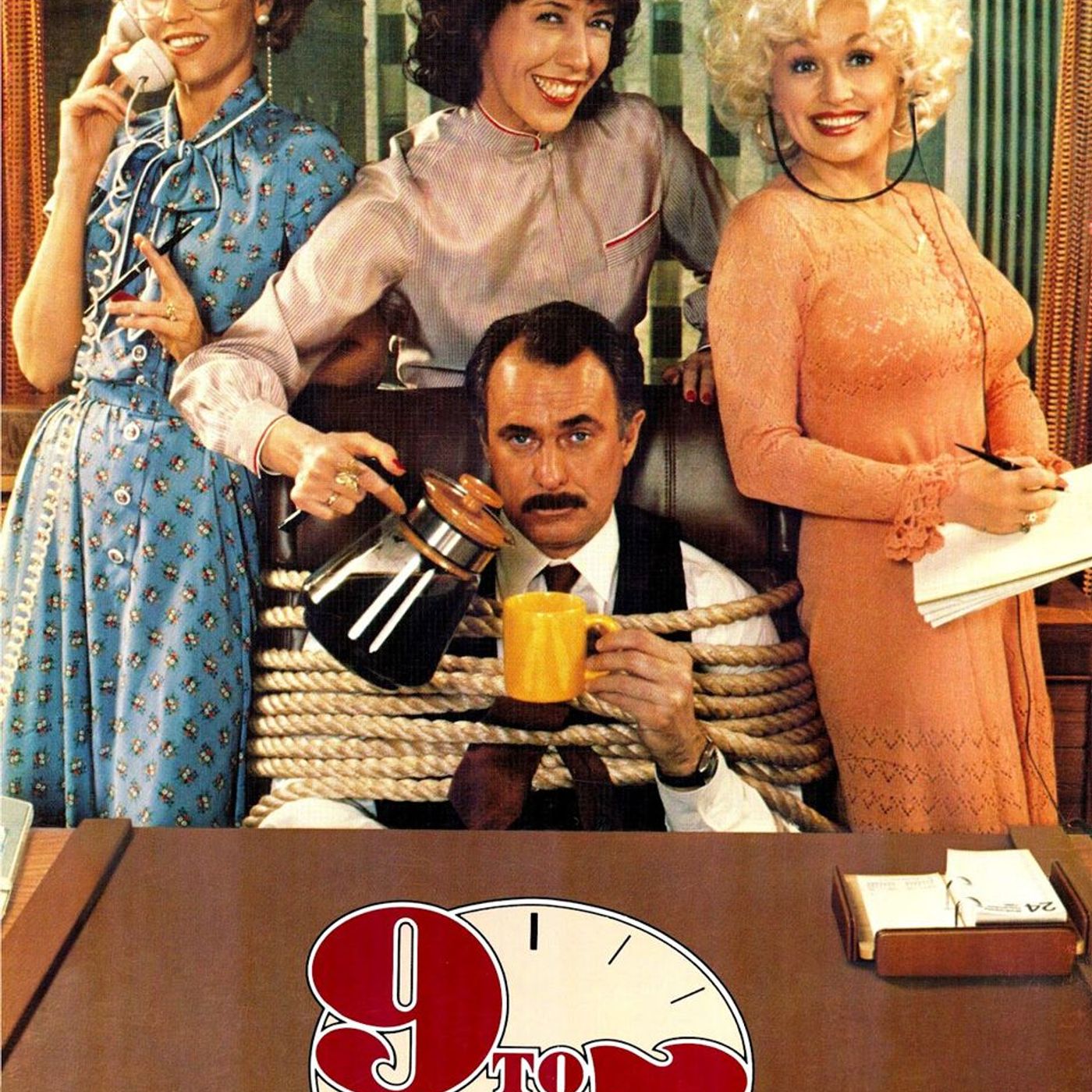
They do their best to please, and even if they run the show, he gets paid for their ideas, and so long as he's alive from nine to five, they'll take it all they can. But what will go on when the light finally dawgs that it's time to get back at that man. Jane fond Lily Tomlin, and Dolly Parton nine to five. So it is directed by Colin Higgins, and it stars Jane Fonda, Lily Tomlin, and Dolly Parton, along with some other people. We'll talk about them, but the three of them are the most important, and the three of them play businesswomen at a consolidated company where Dabney Coleman is just being an asshole and riding them all consistently for differing reasons.
Dolly Parton is secretary and he's always trying to have sex with her. Lily Tomlin he's always just talking down to and Jane fondam not even sure he cares about her character because she's not given a lot to do with him, thankfully, because of the amount of time that she the amount of time that Lily Tomlin and Dolly Partner hassled by Dabney Coleman. But if you kind of understand what the setup is, you can kind of understand where this movie is going. Obviously, we're gonna be talking spoiler because this movie came out in nineteen eighty, but I will turn it over to Sharon. First, Sharon, when was the first time you saw Nine to five and what did you think rewatching it?
For this episode, Well, I first saw nine to five in nineteen eighty when it was released, and I when I rewatched it, I was surprised at just how much I remembered, because I haven't seen the movie in decades probably, But as I sat there watching it, not only did I thoroughly enjoy it, but I also really knew pretty intimately, pretty well what was going to happen, what was happening in the movie. Yeah, it's it's a great movie. It's really a great movie, right yere susan Um. I also saw it when it came out in theaters. This thing there used to be these things called malls, and the malls had theaters in them, and then you used to go all together and sit down when a big auditorium of a movie theater and watch a movie with a big crowd of people.
Uh and uh. It was a really exciting way to see a movie. Um. And though I was surprised how much I did not remember about this movie, I remembered the movie pretty fondly. Definitely remembered the song, Definitely remembered the three of them.
Um, I forgot some big giant story points like the fantasy sequences I completely forgot about, which are a huge part of the movie. Y uh and uh. But I do remember the feeling that there really hadn't been anything like this movie, um with you know, a giant studio comedy starring arguably three of the most you know, sort of biggest stars, whether in music or in film, like Jane Fonda had two Academy Awards I think at this point. Uh and and uh um and so it was really kind of a phenomenal, as I remember it being like a huge hit and just kind of in you know, that was just it was just there. And movies lingered for a long time too, so if a movie was successful, it would play for months and months in the movie theaters.
Um and uh and sort of you know anyway, So that's what I remember about it. When it came out, I was pretty young, but I definitely saw it and enjoyed it. So I had never seen it before because you're a baby, that's I mean, I watched movies, you know. I watched Harry and Tonto, which is older than this movie. You know, it's I Will Chris.
Had you heard of it before? Yeah, I mean i'd heard, I'd heard of it. I've obviously heard the song. My wife is a huge fan of Dully Parton, so and I mean I knew the setup because again the setup, now, the setup is rather ununique in modern times. We've seen movies like even I think, Susan, when you and I talked last week, I said something the effected like, this is essentially Horrible Bosses in a lot of ways, you know, a better version of that, obviously, because that movie has its own issues.
I think this is a much more important movie than Horrible Bosses. There's a lot less here that is needing to be played for comedy constantly, because that movie is like a joke fest and a gag fest all the way. But I didn't know kind of some of the places this movie was going to go. But again I knew it was all about, you know, the three main characters dealing with their asshole boss who they just can't stand for obvious reasons. Because Dabney Coleman, I'm not sure there's a better actor in the eighties playing a shit heel better than Dabney Coleman.
It was great, Yeah, he's I mean from Hot to Trot to Modern Problems to Beverly Hillbillies to this. I mean, he's just all over the place in the eighties and nineties. And he's a great actor obviously, But the setup, like I said, is not now. It is kind of just a boiler plate, I guess. But what makes this movie worth watching now now and what obviously made it worth watching then is the three lead performances of Jane Fonda, Lily Tomlin, and Dolly Parton.
And it's funny. I was talking with my wife and I was like, you know, Jane Fonda and Lily Tomlin, obviously now for a different age group of audiences, are known for working together in the show on Netflix, Grayson Frankie, which has been extremely successful for the both of them. So it's really funny to see them now, you know, in eighty working together and then having seen I think the first two or three seasons of Grayson Frankie, how their working relationship has now changed and matured as they've matured together. And it's interesting to see all of that kind of starting here and finding out that Dolly Parton's the first time I've seen her and anything she's a really good actress. Not that I doubted it, but there is an expectation when someone is good at one aspect of entertainment that they may not be able to carry that over into something else.
Clearly not the case with Dolly Parton. She I think outshines everybody in the movie. I mean, not intentionally on her part or anything. I think it's just unintentional because when Dolly Parton walks into the room, she commands the room. I'm not saying Lily Tomlin and Jane Fonda don't, but they don't have the presence that Dolly Parton does.
And I think that obviously it's twenty twenty two, Dolly Parton still has as big of a presence now as she ever has, probably bigger. Even so, it's just a testament to the people who made this movie and worked on this movie that we're still talking about this movie. And I think this movie still has a lot to offer in well four contemporary audiences. I guess, well, And it's interesting because this was Dolly Parton's first movie, right, Like, that's just crazy, and she's so like natural, she's all she's like. I think when you're saying that she's better she is more natural in that role, right than Jane Fonda is in hers, and even Lily Tomlin is in hers, like Jane kind of playing herself though, right, yeah, yeah, but it comes across so well, right, right, Jane Fonda is playing a character yeah right again type, yeah, almost against type, and Lily Tomlin is also playing a character a little more in type, but definitely whereas Dolly Parton is playing herself.
If she was a secretary and not a singer, yeah, her name could be Dolly Parton in the movie, like Dolly Rhodes could be her name, and I'd be like, yeah, okay. I think I think when you have someone who's as a kind of classic as Dolly Pardon, it almost benefits the screenwriters to just say just kind of do you because that's what everybody knows, And even if that's kind of a cop out, it totally works. And so it's not a cop out. If she wasn't good, I don't think, you know, everybody like, well, you should have cast somebody else. But because she's so good, it's like, oh, please more Dolly Parton, just give us more of that.
Yeah, And I think it was like that when Jane Fonder was trying because Jane Fonda was instrumental in casting the other two roles. She had wanted to work with Lily Tomlin, and so I think she was thinking of Lily Tomlin first. But she she talks about seeing Dolly Parton somewhere and seeing with her nails um and thinking, oh, that's the secretary, right, that's the the you know, m Violet note which I get confused by their names. In Viola's Lily Tomlin, Uh, Dolly Parton is oh my gosh, I can't. Yes.
Yes, nice southern name too, yes, and so it fits they like certainly that character in some ways feels like it was written for Dolly Parton to play yeah, which I think it was kind of sou But it's just so interesting because Dolly Parton, while being kind of a hugely successful and an approaching iconic country star, she was a country music star. She was not like, oh, let's put her in the movies. She had done television, she'd done some television specials. I think, uhum and stuff. But I think that, you know, we think of Dolly Parton now we know that she has survived and thrived and become this stunning icon of both almost like the kind of of performer that doesn't exist anymore, right, Yeah, yes, not that could exist now.
I mean I maybe a close a close contemporary example might be someone like Beyonce, just based on like the reach and I mean philanthropy again, like but again, Dolly Parton is like a hyper philanthropist too, which is which not a thing. I mean, it is a thing now, but like you said, Susan, not in the way that it's not in the way that people are anymore like Dolly. I don't I don't know how many performers exist anymore like Dolly Parton. It's a short list and it's getting shorter every year, unfortunately. Yeah, because I mean, and so it was pretty amazing to put her, you know, at the I just still remember, like, oh, these are huge stars all together.
Right. It was an all star cast, and even though again Dolly Parton hadn't done a movie, she was so well known as a performer, um, you know that it did feel like she was They're equal, which is kind of interesting because again, Jane Fonda had a movie career that was pretty frigging incredible, um, just so, and would go on to continue her movie career. But this was sort of interesting that this was I think one of the movies that she one of the first movies she developed with her own production company. So anyway, they're they're all really fun. I mean the best part of this movie is the three of them, right, and when they were working together or they're in scenes even just two, like you know, when they're in scenes between two of each of them, it's all thought like you just want more of them.
Uh and and even going off with that, and Daphney Coleman is pretty great, pretty great playing a complete dude, Yeah, comes naturally to him, very naturally. But even so with regard to Davney Coleman, it's just based on conversations I've had with women who who worked in offices during that time. I don't think he was that unusual. I don't think his behavior was that unusual. Sadly, and even to this day, there you know, there are still women like Lily Tomlin's character who are the one that trains all the people that go on to be her bosses.
Someday, many of them still men because they're not valued or they get they're they're perceived as though we can't take her out of that job because who would do it. Well, you know that's not fair necessarily, but no, I marveled at how very well drawn each of those three women's characters were. The office dynamics, um just all of it, head to toe was just was a revelation when I watched at this time, because back when it first came out, I wasn't thinking in terms of thinking of movies or television shows in this way. I just either liked it or I didn't. And I knew that I really loved this movie because I've seen it many times, even as I said it's been a while, um it, I just knew that it worked on some level, on many levels, and and and really loved it well.
And to your point shared, I mean, movies come out like this now, but they're not entertaining there there. You know it's like a it's a serious look at it, or you know it's it's a drama, or and I know that Jane Fonda said she wanted this movie to be a drama. I'm not sure we'd be talking about it now if it had been. I think something about the usage of comedy to defuse the immediate kind of ickiness of what we're talking about helps a lot, but because I know Jane Fonda is like, I would have preferred this movie be a drama, and I'm sure the actual nine to five movement would have preferred if this movie had been a drama. But the fact that it's not a drama and it still manages to be successful is impressive because, like you said, Sharon, I mean, if I had seen this movie in nineteen eighty, I probably would have been like, yeah, this is good, but I don't like the importance of it wouldn't have resonated.
Because again, even when y'all saw it in the eighties, that was you weren't working nine to five. The women that were working nine to five saw this and went, holy shit, somebody gets it and they understand and we're not. I mean, we are being ignored, but we're not being ignored as much as we thought we were. And hopefully, and obviously and clearly something like this did help inasmuch as it could help. I mean, again, nobody was expecting this movie to change the world, but it brought light to something that was important, which is the people in the office who are being overlooked for whatever reason, because there's it's you know, it's not just the female characters in this movie too, we have you see the entire office as being abused by by the upper management, which you know, obviously, like you said, Sharon, still going on today.
That has not stopped, and that will never stop no matter how many movies, songs and TV shows that talk about how terrible it is. Terrible bosses will exist forever. But to see a revenge fantasy played out in such a you know, kind of frank way outside of the dream sequences, which I was not a huge fan of, Um, yeah, I think this movie it still resonates, but those dream sequences really are out of place, or like the fantasy sequences, they're very high place for it. I completely disagree. That's fair.
I kindly figured as much this may be like the one the one spot where I may be kind of in a different corner here, because for me it was it kind of ground the movie to a halt only because and I get that they were using it as an opportunity to show that there were going to be things happening to him, possibly that they were dreaming about doing. But they went on just a little too long each one, and like back to back to back, like break them up. Throughout the movie or something, because like putting them back to back to back just like grinds the movie movie to a halt. But but I'm wrong. I could be wrong.
That's my opinion. I'm curious, Sharon, what what was kind of your take on on the on those scenes, because like for me, it just kind of stops the movie in his tracks, I absolutely loved fantasy sequences, um it, you know, they were each of them was to me, very entertaining, very much in character for each of the three women. Um very different as a result. Um I I just I love them. I I still feel that they fit perfectly into this movie and it in some ways it really helps with what comes next.
Right, Yeah, that's a big part of it. Yeah, for sure. That's a hard that's a hard part I have about those is like I know that he then gets poisoned with the rat poison. They even do the shot actually yeah, but then they have the scene with Jane fond Up pointing the gun at him like in the dream sequence. I mean, and then you have Dolly Pardon hog tying him like in the dream sequence.
It's just I don't, I don't. I just feel like they go on a little too long, which I but I think one of one of the things that they pointing out those two things that happened, that the sequences then happened in the course of the story, and perhaps that may have informed what they did. They had fantasies about this, and then the next thing they know, they're kind of acting it out. Um. Honestly, I never really thought that through.
I just know that I enjoyed them, and I felt that they reson They resonated with me. I mean, who hasn't had a fantasy or two if you've had an awful boss about what you would do if you had, if you had the opportunity. I guess I figured most audiences would be able to to uh to to understand that that thought, that thought patterned. Well. Okay, all right, So a couple of things I have to say, which is, um, I'm going to can ride the middle right.
Okay. However, UM, I actually think that they they are sort of they helped set the tone of the movie that we're in because it starts off it's a weird tone, and it's and and and I'm gonna say that Colin Higgins is his directly responsible for this. Um. Of course, I mean he like and and Colin Higgins wrote the film Harold and maud so talking about something that is sort of absurd and dark and funny and weird, right like, uh, and then and then also wrote and directed right before, fairly right before this foul Play, one of my favorite Chevy Chase movies. Um and uh, have you seen foul Play?
Chris? Nope, Okay, we'll see if you saw a foul play, some of this might make sense. Okay, that's fair, that's I mean again, it's a tonally mixed movie. It's a dramedy. It's not it's a it's a dramedy.
I would say if you made this movie today, they would probably lean they would probably lean harder on the drama, because that's that's that's the new comedy way of doing things, at least with stuff like this, is to really lean on the drama but give the comedy some time. But I think it would be more of a dramedy now, probably in the vein of like I don't want to say, Judd Apatow, but I don't know what I mean. I think that's the way you would do it now as well, Like you said, Bright, Paul Fish, so yeah, um, and but I do think that they that again, they were heading towards this pretty egregious move or three by the ladies. So I think the fantasy sequences are there to absurd the movie up so that when when when Lily Tomlin actually when like when James Bonda thinks she's killed him, and then when uh, um, she steal No, it's Lily Tomlin and thinks who kills Lily tom Toman thinks she's given him rat poison?
Yeah, because she was high or drunken. And then it's basically like and again we're spoiling here. She's gonna steal his corpse from the hospital. So and then from there they realize they don't, but then they're getting blackmailed, and so then they basically end up shooting at him and in the office, in the office, they're discharging a gun in their office several times. Yeah, they're right.
Several times. They're tying him up, and then they're basically kidnapping him and taking him back to his home and keeping him basically hog tied, poor weak right in like a gimp suit essentially without a mask. Yes, and he's like suspended from the ceiling on like yeah, well that's what they do. If he gets out of line or if he tries to r that's there there because he's stronger than they are. So they have to have some white they have to have some mechanisms.
And again, kind of brilliant because they set it up with Jane Fonda fixing her garage door opener because she's a one with kids and god, I don't know, and she and she likes smoking weed too, which I loved the scene with the three of them smoking grass together only because it was one joint and like, I mean, come on now, holy yeah, I mean I love movies in the seventies and eighties and the way they portray marijuana because it's it always is just so it's so foreign and strange and new and exciting one joint, like Jesus Christ. Then it was still, yeah, you know, not as mainstream if you will, as it is now. And so it was this and a dangerous thing to do. Yeah, you're talking about watching Dolly Parton smoke and joint.
A country superstar smoking a joint was radical. Yeah, um, you know, maybe not so much for Lily Tomlin. You're probably like, ye, Lily Tomlin as like this this is a Saturday afternoon from me. But so they go to a crazy place with this movie and the acts that the women and the characters are going to do in this movie against their boss, and so not only I think is that like he's got to be the worst boss and be completely deserving of the treatment that he's going to get later in the movie. But those fantasy sequences completely break you out of reality long enough that they're also saying this movie is absurd and it is a fantasy and welcome to the party.
So but I agree they go on too long, particularly and this is maybe in light of sort of the world of gun violence that we are very aware of right now, but the Jane Fonda with the gun goes on too long. At her shooting him, I had completely forgot like shooting at him at your point blank range, missing him, but like she could have shot him, and that felt whoa, that feels like a step too far. It steps becoming fun revenge fantasy when all of a sudden people are using a gun. It's fun when Lily Tomlin is, you know, going to roast him over a fire and Dolly Parton is tying him up like that's fun. I guess she doesn't.
She's not the one roam over fire, Lily Tomlin's the is the snow white fantasy, Yes, but those are fun. And yeah, then that Jane Fonda one is just kind of like she's just gonna murder you, Like all right, sure, I supposed to be like Annie Oakley, right, I mean she's kind of dressed up. Yeah, and it works, But I think to your to both of your points, like the idea that they use these fantasy moments to break up an otherwise kind of serious movie. Again, the kind of if I if I look at it that way, I totally understand why they're in there. I just I think, now they wouldn't do it that way.
Probably it would be something else. The tone is really and it's in that weird late seventies early eighties tone where I think they just didn't know how to mix, like how to do a dramedy like and so. And it was also again this was this was a comedy that just was kind of shot in a really realistic way in some ways other than the fantasy sequences, particularly the opening of the movie, the title sequence and the song and you know, the song feels like a documentary about going to work in New York, like it's it's so the look of the show feels like late seventies, but the comedy tone of the show feels like early eighties. Um and the and the beginning of that eighties sort of heightened office comedy, surreal almost elements.
Uh So, I don't know that that's where I think this. I think it totally works for this movie. But uh and it worked for Foul Play, which is a bonkers movie in some ways, like even more bonkers than this, but has a similar look in that it's got a more sort of realistic palette to the film, but the comedy is and the events of that movie are like just crazy. I couldn't even I couldn't even try to capsize it for you. Well, well, and that's and that's the thing about this movie.
Like, like we mentioned, there's a moment where they're going to the morgue to steal a dead body, you know, and they're they're they're keeping him in his house for six weeks. Like that's a that's absurd and ridiculous, and it works only I think, yeah, I think you know, I think you're right, Sharon. It brings it around to make it really like the real but I hadn't thought about it taking that realism and do and breaking up the realism because then it works. Then I completely understand why they're doing it, because that is the inflection point of the movie. Really is that marijuana scene, because everything that happens afterwards is very different.
It's not that the stakes are higher, because you know that once the weird absurd step starts happening, the stakes haveentially essentially kind of disappeared almost because there's like, once the movie says, all right, this is what's going to happen, but you know the characters are going to figure out a way to deal with it. It's not the same as watching these three women being abused by their boss. It's it's that it's the playing out of the fantasy, and so the stakes kind of get transformed. But actually, yeah, I mean, other than them being a little long, like if they hadn't been there, the movie might have felt even stranger, like the tone, the tone throughout may have been even more of a hard hill for most people to get over, especially in the eighties.
I mean, and when you go into it, go ahead, When you go into it knowing that it's supposed to be a comedy. It's easy. It's I think it was easier for the audience to put up with what was happening in the first act of the movie, because think about you've got this, You've got Lily Tomlin, who this man is basically trying to make her sleep with him. It's not great, which it essentially could be considered great. Um, Lily Tomlin, who whose character has been used and abused by this company, and they refuse to promote her, They refused to give her what she's what she's due, what she's worked for, what she's earned.
Granted, Jane Bond is kind of, you know, the our eyes and ears to a certain set of the audience because she's the one coming in new and seeing all of what's going on here. Not to mention the way all the other women are treating Dorillie because they all think that she's sleeping with the boss. There's a lot of not so pleasant stuff going on in the first act of this movie. But then when you hit that button and it goes over to the absurd, starting with the corpse heist and after I think starting with the fantasy elements. Yeah, start of the fantasy, then the corpse heist, and now you're in a completely different situation and what comes next with what's happening to you feel you certainly feel that that Dabney Coleman's just kind of deserves what's happening to him.
And then meanwhile, they're using their power for good and not for evil, to make things better for all, not for just themselves, but for all their coworkers too. I think all of those things together are what make the movie work at the end of the day. For me, oh, I was gonna say, it's it's you know, one of my favorite sequences is them in the car with the body and the trunk, because it's just like I could watch that movie all day. I could watch the three of them on a caper in a car trying to get away with something um but also the the why when they finally go, Okay, here's our plan. When they finally have a plan, which is Okay, we've gotten ourselves into a lot of trouble.
Now we have to figure out how to dick ourselves out. Then then again you're like, okay, so now they have a plan, and now they're working together to fix the office and to make it seem like he's still around, and you know, it's basically Remington Steel at that point, gosh, just right, come up, pretty much, we're gonna do all the work. He's there somewhere, there's a fake boss running around and so um. But so i I'm I'm really excited about that, and I'm I'm also like really find that the tone finds itself after those fantasy sequences weirdly because and I think again it's that weird thing of like the fantasy sequencers are so so over the top that then when we get into stuff that's pretty whacked out, it's not that and we've sort of given little hints of what's to come right right, Well, there's animated characters in this movie.
I mean there's a point, there's a point where Lily Tomlin is interacting with like an animated fucking rabbit and like a deer and a bird. So but again, like there's a there is another movie here, right, there's a movie here that isn't that doesn't get made and not made, but it's totally different. But that there's that moment where they're having that you know, the marijuana smoke and they're they're sitting there and then what would you do and what would you if if they had, I would have killed him. I would kill him. I would kill him.
And that's it. No fantasy sequences, it's a completely different movie. And it's again, I don't think that they could get away with I don't think if this movie had the fantasy sequences, they wouldn't do the corpse heist, or have Dabney Coleman, you know, suspended from the ceiling. It just wouldn't. It wouldn't play.
You'd be like, what tone is this then? So I think they made that conscious choice clearly to just be like, all right, cards on the table, this movie's silly. But they waited like a half an hour for you to understand that it's silly, because I mean, there's characters in the office that are like depressing to think about. Like I know that Barney Miller's Barney Miller's own Peggy Pope, who shows up in six episodes of Barney Miller. She's great as like another character that you know could have been in on what they're doing.
Thankfully she's not, because she ends up benefiting from all the good that they're doing. But in another kind of movie, that could have been one of the characters that's on the journey with them, you know. And then you have the character of Roz, who is the you know, I guess the one person in the office who actually likes Dabney Coleman. I guess so. And she plays the kind of sycophant that refuses to not eavesdrop on her own, you know, coworkers.
But it's interesting because in another movie, those characters would have had more to do, there would have been more going. They almost stopped doing anything at the office after that point. You don't see what's going on at the office. And that's obviously the huge that's the huge punchline at the end of the movie is, well, they made the office better. Everybody thought the office is going to be burning down because he's not there, but they have taken the office and upped everything, the productivities up thirty percent or something to that effect.
But there's a different movie in there, and I'm glad that this is not that movie because it works better. But you know, if somebody made this movie now, they may not even make a comedy. They may just strip all the fun parts out and just do a drama. But yeah, because it's revenge fantasy, movie. This movie doesn't have to be a comedy, like it doesn't have to be a comedy.
No, And like you said, Horrible Bosses, which is a comedy, which is a comedy though, which is a comedy. I'm trying to think if there's something else. But you know, I like books, so I'm just going to bring in the book I found about nine forward by Jane Fonda, with a forward by Jane Fonda. It's called Working nine to five, a women's movement, a labor union, and the iconic movie, and is literally about how the women's movement and women going into the work place and facing all of this discrimination and facing all of these harsh working conditions that were really impactful on them helped them to form basically a labor union, which I didn't realize. I mean, that's literally I was completely unaware there was a nine to five movement that was very political labor movement that was about workers' rights that benefited everybody, but was really organized and push forward by women and women working in sort of those office pools and doing all the work of companies.
And then that Jane Fonda knew one of the women that was fundamental to that movement and so was hearing about all the things and was like, well, that's what I want to make a movie about. So I'm gonna can I read a little bit? Yeah, So she gets Collins to come in, come on board, and she basically brought the team, the creative team to meet with members of the Workers Group. And they gathered a group of thirty or forty women in their Cleveland offices, and after introductions, Higgins posed a question that somehow we never thought to ask in all our years of recruitment lunches. Have you ever fantasized about killing your boss?
At first, there was silence, then nervous giggles. Finally, one woman raised her hand. She imagined pulverizing her boss in a coffee grinder, she said, allowing the grounds to drip into the carat, and then well drinking him. Where was that in this movie? The lad Oh my god?
And then one after one women basically then began to chime in with their own dreams of revenge. That's where the fantasy sequences came from. Fucking dark. That first one's real dark. That parcel overising him and turning him into coffee.
I mean, can you imagine? That's another different. That's a different kind of movie. Yeah, that is that. So that was like, I don't know if either one of you have ever heard of a film called Office Killer.
It's a Cindy Sherman film, Cindy Sherman The Artist. It's kind of a revenge fantasy in the way that this is, but it is a it's a horror movie essentially. It's it's um, oh god, it's Carol Kane playing kind of the Jane Fonda character but a little bit more kind of neuvish and reserved, and she gets revenge on all the people she works with, including Molly Ringwald and Jane Triple Horn a couple other people. But it's kind of it has those same kind of the revenge fantasy beats, but it's a completely different story. You know.
It's it's a it's a horror movie. It's it's pretty grotesque. It's pretty gross, frankly. And this, I mean again, that's the grinding your boss to coffee or whatever the hell they're talking like, I mean this christ who really hated your boss and I probably deserved it. I'm sure he deserves I was going to say, And then she's the way he didn't.
Yeah, like, that's a pretty long drawn out and very specific fantasy, right, I mean, hey, just just like there's those you know, those stories of of the you know when when you when you're a warrior and you kill the other warrior, take their scalp or something, that's the same idea to drink your boss. I guess, all right, absorb his power. So there there isn't isn't swimming with Sharks the movie? Have you seen Swimming with Sharks? That not Spacey being a terrible boss?
And I think that he gets kidnapped or something like I forget what happens in that, but I think it is the Yeah, I think, right, yeah, yeah, he's the kid that's working like kidnaps him or he gets kidnapped. I don't know. The bad boss gets kidnapped and I know that. So there I was like, oh that's interesting, And I was like, oh, what what other movies are like this movie? Anyway?
But back to the comedy elements of it, the less coffee grinding. So now that she's just shooting him with a shotgun, maybe it's just you know, too far. Then when you pull back a little bit, it seems reasonable. But I never really thought about the fact though, that about how um awful the first part of the movie is. And and if you had, if you or nor had I thought about you know, I thought of other movies.
It really blended the seriousness of what's going on in this the first half of this movie with what happens next. I have not seen foul play. Um. I don't think it sounds vaguely familiar, but I don't think I've seen it. Um, But I really can't think of anything else.
It's done that as well, except maybe it's gonna say office space, but that's really not quite the same in that it's you know, Lundberg is not a great boss, but he's not the evil incarnate that they make Dabney Coleman's character out to be in this movie. So any it just blending the tone, if you will, across the series as of the first part and then the fantasy in the middle, and then you know what happens and then kind of mix after that. Yeah, like it's pretty serious at the beginning, then you get these wacky fantasies and then you end up with this mix of both of them. As you can tinue down. So I just a trigger or see if I can trigger anything.
Here's foul Play, because again, I don't think you can completely understand this movie, and certainly not what comes next without understanding that Colin Higgins made Foul Play, starring Chevy Chase and Goldie Hawn. And here's the one line description. A shy San Franciscan librarian and a bumbling cop fall in love as they saw the crime involving Albinos, dwarves and the Catholic Church. I mean, I'm game as Chevy Chase. I mean, there were a few actors who had as good of a career in the late seventies and mid eighties as Chevy Chase, at least comedic actors.
I've seen all of zero Goldie han movies, so really, Oh, I might have to do a whole run I've never seen. I don't think I've seen what's the what's the movie where she's in the military, Oh, Benjamin, Yeah, never seen that. Also, I'm a gun. I think that's an eighties movie and a lost TV show. Yeah, I look great.
Igot about the TV show? Oh my gosh, yea. We always forget about the TV show, but we don't anymore. Yeah, it was a I hope y'all don't because that's well, that's the thing. That's that was the entry point for this movie for the three of us to talk about it is there is and there was a nine to five TV show which is a straight comedy, right it is, Well here's the funny thing.
So yes and no like everything okay, nine to five TV show inspired by the movie, basically remaking the movie in a lot of ways sitcom. But the first two years and again I've only watched one episode because it's hard to find, uh is. Because we're gonna have to cover this on on eighties TV ladies A. I thought it ran for one season. I barely remember it existed, so I did not remember this show from childhood at all.
It ran for five seasons, which was insane to remember. Oh my god, it u and the first season is does have a more realistic tone than a traditional sitcom, I would say, but the last three is like a really bad sitcom. And the characters are great that the actors. It's got an interesting cast a cash shift almost every season. Um, but the original cast is uh Rachel Dennison, who is Dolly Parton's sister who basically plays the Dolly Parton part because if you can't get Dolly Parton, I guess you just get her sister.
And it's kind of the only thing that she's really ever done on network television as far as I could see. But she's pretty good. She's not bad. It's just so weird that little stunt, little stunt casting. He's like, oh, Dolly Parton.
And then Rita Moreno, who's freaking awesome playing Violet uh and uh, and Valerie Curtain playing Judy, so it's such a so Rita Morne is playing the Lily Tomlin character, that makes that makes sense, and Valerie Curtin is basically playing the Jane Fonda character. Jane Fonda produced the show, but then she and the sort of showrunner left because I think that somebody said we got to go in this direction and she's like, Nope, that's not the show because by the time the later seasons come, it's not it's not about women running the office. It's not even about the women. It's about this boss, this male boss who's not that bad and who's really just trying to get work done and keeps getting interrupted by these crazy women with their crazy plans, and you're like, what has happened.
You missed the idea completely. They have completely gone. I think the original thing started that way and then and then they just just got crept over into Oh, it's just a wacky workplace comedy, and that boss is just harried, that male boss by all these crazy women with plans, and you're like, way to lose sight of the original movie by like a country mile. Jeesuuise, Well, think about this weird franchise, right. It hasn't had a sequel, but it launched a five season TV show, and then of course the song is forever embedded.
I think you knew the song, right, Yeah? The song? I mean the song. The song has shown up in other things enough that I think everybody knows the song. And I mean again, it's Dolly Parton.
You know, I'm just gonna this is the only Dolly Parton song I know. Let me just say that, like, you know, they're probably others, you know that, you just don't know that they're Dolly Parton's, right. Oh, I know she's written a lot of I know she wrote a lot. She was a prolific writer. Who I think she is.
Dolly Parton is the one who said, you know the smartest thing I ever did was turning what it was one of the Whitney Houston songs. Right, she wrote a song for Whitney Houston. It's like I'm cashing checks forever. And I didn't even sing the damn thing, like you know what, Well, she didn't write to sang that. Yeah, she didn't sang the Dolly parton song I Will Always Love You.
Dolly had recorded it years before and it was Kevin Coston. So we're getting off track. Kevin Costa thought, oh, this should be in this should be in the movie, and Whitney should sing it. That's how that came about. But getting back to the nine to five song, just again, as a little aside, Dolly was um uh inducted into the UM Rock and Roll Hall of Fame.
They did the concert this weekend or a weekend before, and I seen her remember seeing a clip of you know, because they do sort of a tribute content. You know, other artists sang their songs. Pretty sure, they sang nine to five. Pretty sure they sang nine to five on stage at that UM that induction ceremony. That's how indebtable that that forty year old, forty plus year old song is it's amazing.
So I'm gonna like basically, okay, so here's uh the I Will Always Love You, which is Whitney. We got to go back to Bodyguard right like um because again God Parton wrote that song which is and was a hit and you know and was one of the things that made her hit. But she wrote it as a as a breakup song with the guy that had sort of made her who had a TV show right um, and she was sort of his girl singer and they they were, you know, basic a variety show and he was like, stay with me for five years and then whatever, and she was like, yeah, I gotta go now. Um. So she wrote this song basically saying I love you, but I gotta go.
That's what the song is about, is breaking up with her manager basically or her TV partner, guy who gave her her first shot on TV. She was already musician and doing stuff. Um, and he said, okay, I'll let you out of your contract, but I get to produce the song. Um uh. And then Whitney Houston.
So the best thing she ever did was say, yes, you can use my song for the Bodyguard and someone else can sing it. Yeah, because it did become a heat light. But I mean, come on, you've you've heard the song, Joe Lene, Yeah, of course I have, no, you know what. You're right, I have heard that song and that you know what, I like that song more than nine to five because I've heard that song a lot more. You're right.
I hadn't even thought about it, and right, damn, Jane fond it so now I'm not remembering and then all about songs, I'm now remembering that Jane Fonda was listening to the song two Doors Down while she was thinking about the Nine to five movie, and that's what made her think of Dolly Parton for the role um which is again, it may not be a song you remember, but you probably if you heard it and you go, oh yeah, two doors down, they're laughing and drinking and having a party. Two doors that's a that's a that's I've never heard that song, and I've heard it about. I've heard it broken up with and then here's this party and decides to get back in the game. Uh, it's a great song. So they were working on a sequel as recently as twenty eighteen, UM, and then in twenty nineteen, I guess they all kind of said, well, we're not working on it anymore.
But they were talking about in twenty eighteen a modern day setting with them reprise Yeah, yes, which would have been I would have been interesting, I think. I mean, there's a lot, there's a lot that can be said. I mean, I mean, the work world is well at three years on from twenty nineteen is a fucking different place completely. But then in twenty nineteen, I think it could have been an interesting movie. But I would have had a lot of interesting things to say and some I could see that trailer for that movie that never happened, you know, like I could see it like you got three stars, right, right?
But yeah, now even more so, frankly, yeah, yeah, I mean it's hocus pocus too, right, Like in a lot of way, hopefully it would be better and more totally consistent with the characters. But but that's but that's kind of a strange thing about this is, like you mentioned, Sharon, the song is so well known, there was a TV show, These actresses are still working today, and yet there was no sequel. Nobody said, whoa, there's nine to five is a known thing, you know. Obviously, Dolly Parton is on Grayson Frankie or she was towards the end of the show, which I somebody hadn't have been like, you guys, need to do it now, if you're going to do it. But I kind of wonder, you know, why they never followed through with the project, because this that it would have It would have been an interesting movie, to say the least, at least with just the three of them on screen together.
Again, I think, and again go ahead? Was it there at that time? There wasn't this propensity to make sequels out of every successful movie, So I haven't feeling that had a lot to do with it, and they all probably went off doing their own thing. Um, Jane Fonda went off and made more movies. I think on Golden Pond came out about the time that the TV show came out, and certainly Lily Tomlin and Dolly Parton also went off and did other things, So that that probably has a lot to do with it.
The timing of it. If it had come out maybe five ten years or later, maybe there probably would have been more of a push to do more. But yeah, I think there weren't a lot of sequels to comedy, Like you know what, I'm saying this was the beginning of like Star Wars. There was you know, like there was sequels to sort of more genre stuff. But it was really hard, I think for people to kind of just it wasn't just can we keep going with this?
In every movie that you did, they all sort of felt like one off and then and then it was like the beginning of Oh, we're just gonna if it's hit, there's a two right coming. Well, not to mention the fact that I would imagine that there were executives somewhere saying, well, we've already done that movie with those gals, Why would we need to do that again? Why would you make another movie with three women in the w Yeah I can't. I would imagine that that was part of the equation as well. Yeah, well, and I mean to be fair, we're launching a Police Squad, a little little limited podcast series, and we talked about Airplane, the the original za Z movie, and we touched a little bit on the sequel, which they're not involved with none Zucker Abram Zucker not involved with that sequel at all.
We talked a little bit about it, but I think we kind of Mike White and Mark Begley and I came to this kind of conclusion that the three of us are kind of coming to now, which is like comedy movies I don't even think need sequels anyways. It's kind of this weird thing where if I think about sequels to comedies, for the most part, in the grand genre, if you look at the genre holistically, most comedy sequels are just doing the same thing the first movie did, often to really diminishing returns, and like just even into the second movie, I mean like Anchorman two, My God, Like just using a contemporary example, I don't think any but he's going, oh, I love that second Anchor man, Like why does why does this exist?
And I nine to five probably would have may have felt the same way. If they had made it right after that first movie came out. I doubt any of the original cast would have been there. Nothing like it would have been. It would have been in the shell of its former self, like the TV show.
Well, and here's the thing, so that so Jane Fonda is in the middle of like arguably like the most incredible run of very diverse movies like so, uh, you know, so seventy eight she does Coming Home, she starts in Coming Home Comes a Horseman, California Suite. That's all in nineteen seventy eight, nineteen seventy nine, China Syndrome, The Electric Horseman, another giant hit movie, both of those so and then nineteen eighty nine to five, nineteen eighty one on Golden Pond. I mean, like, holy crap, just that run of movies, Like She's one of the biggest movies differs in the world because all these movies are hits, all these movies are critical successes as well, like not to mention her workout taped and her philanthropy and her anti Vietnam War protesting.
Yeah, like everybody asked me, like, how do you find time in the day to do all this work, Chris, How does Jane Fonda find time in the day to exist and be? Well, she just got arrested what last year? This year? Climate climate? Yeah, like on the steps of the Supreme Court, I think, or some something in Washington, because I remember, like Jane Fonda has been arrested.
It's like, all right, Jane Vond has been arrested before so plenty of times. I don't know how Jane Fonda has time to do anything, given how prolific she has been just as a force for good out of the industry. Yeah, and again turned out to be pretty right. I would be inclined to agree with you. I mean because I remember also the time when Jane Fonda was hated for her anti Vietnam stance, of course, and hated very, very like for decades.
Um. But but then we also want to talk about Lili Thomas because I thought when I was rewatching, I was like, well, so she was a star because of thinkum. For some reason, I thought the incredible Shrinking Woman had happened before nine to five but happened after. Um. But I also wasn't it it was Nashville, Yes, yeah, yeah, in terms of in terms of film, but remember she was on Laughing too.
She had the um the operator character. I think that's for most people on it first came to know her a little bit, and then she did all kinds of things after that. Well, And I also thought that this her. She had a huge stage success with the one woman show, The Search for Signs of Intelligent intelligent life in the Universe. I can't even say it, where she played all these characters and as well, and that I was like, I do again just assumed was before the ninety five movie, but it was not.
It came after, which is really interesting. So she co wrote that show with her partner Jane Wagner. I think that's right. Um, it was like off Broadway or Broadway, but it was big hit and then there was a movie made out of it later. But Tomlin, for a lot of people my age, they don't even know that they know Lily Tomlin.
They just know her as Miss Frizzle from The Magic school Bus, which is mind blowing for someone my age to realize that, because I mean I was watching that as a kid, like when it was coming out in the in the mid nineties, and to think about the voice of missus Frizzle and it says, oh right, it's Lily Tomlin. Like to think about that, there's there are not stars like Jane Fonda, Lily Tomlin, and Dolly Parton anymore, because Lily Tomlin self made off Broadway, Broadway comedian made good, made really good, Dolly Parton country Western singer made beyond good, and saying with Jane Fonda, and that those three don't exist anymore, not the way that they did then. And I think a lot of it goes back to you kind of mentioned, Sharon, there were three TV channels.
There aren't anymore now, so there's an everybody birth of content constantly, and everybody and any kind of person can be important now. So maybe it's a good thing they don't exist that way anymore, because we can all get in on being important and helping out in ways that we can. But they paved the way for the rest of us and for I think obviously a large amount of women working in the industry. They have a lot of really positive things I'm sure to say about the effect that Nine to five and other movies made in that time period had on their careers. I happen to be talking to two of them right now.
Yes, yeah, I mean I think that I was probably a little young to recognize Nine to five as a force of this is you know, this is revolutionary for me. I understand this. I knew my mom was a working mom and a scientist and was being facing a ton of sexism, most of which she kept from us at that time. Um, and we only found out later like oh, yeah, you're you know, her boss took her name off papers that were published that she should have had her name on, and her you know, and her boss wouldn't let her leave fifteen minutes early so that she could go take classes to get her graduate degree, even though she's like, I'll work through lunch, you know, like um, which is insane, infuriating andiating. Um.
So, but we didn't know those stories then, she I did, wasn't unaware you know that that that she did not share that with us at the time. Um. But I know those stories now, and I know what felt like, um the stories that I know from just starting just working jobs, particularly in the industry. But even before that, like when I was when I decided to go back to grad school, I knew I didn't need a little bit of money, U show. I just went and got a job at City Court Private Banking as the front sceptionist.
And it was ridiculous, like you're just I mean, thankfully I did not face like what Dolly Parton faced, but I did face a lot of the other stuff where you're just like, okay, they just I'm just invisible, and that you know. I sort of saw enough of it and certainly experienced a lot of sexism in the film industry. But I'm thinking about like office work jobs, which I had kind of before I went into the film industry, as I kind of avoided office work. When I started film industry, I was like, I'm not going to work. I was afraid of getting stuck.
At the time that I stepped into Hollywood. One of the ways in was to work in development, and a lot of women ended up working in development. And what I would what I could perceive from, you know, still a little bit of the outside coming out of film school, was that development was a place to get stuck, right, You get stuck being a very important person in development, but you were not going to rise up from there. And so I was very much like if and I also knew that I'm a people pleaser, particularly more then than I am now, but I was like, oh, I want to do a good job and I would get stuck just again sort of in that situation. I was very mindful when I was starting, and I wanted to really focus on writing and directing and being a filmmaker.
That in my early days I basically chose. I basically was like, Okay, my day job is going to be not in the industry, and I went and worked for an organization called Children of the Night, which was a rescue facility and hotline and outreach for kids who have been sexually victimized and were basically team prostitute, and so it was completely outside in some ways of that world. A. I could work overnight because if I worked the hotline, I would work overnight, and that when I could write and take meetings during the day. So it's sort of a great way to sort of do both jobs.
But also it was sort of so removed that it also felt like, Oh, I'm having life experience and doing something good that feels real and important while I'm you know, pitching shows, you know and stuff to Hollywood. It was weird dichotomy, but I was very It was so much out of I don't want to get stuck in an office job in Hollywood because it's not what I wanted, and it felt really easy to get stuck there. Anyway, Again, we've gone to a dark place. Well, I mean again, it's it's the real life implications of where the story comes from, right, I mean, that's just that's the problem with the reality of it is the reality is very hard to talk about comedically. There's nothing funny about it, you know, which is why I think the movie resonates so well, because it's not preachy.
It's but see, you're totally aware that this is actually happening to women, and you're totally aware that workplace is not a humane place and that we have to like, that's really what it's about, is this place welcoming to people and people's lives. And I think as soon as in particular women stepped into that workforce and they were treated so poorly, it also became like, wait, we shouldn't live like this, This should not be okay, and it helped move forward a labor movement that really did put you know, that's the importance of unions and labor movements is to make our lives better by putting restrictions on what a company can ask a worker to do and put up with right. And I think the wish fulfillment of the movie is something that resonated not just with women but with men who hasn't had a boss that you would have fantasies about, maybe not necessarily grinding them up and drinking their but nevertheless you would have probably shooting them yeah about something that somebody would like to have happened to them.
And then the idea that someone comes along in some way, shape or form to make your work life better and that the good guys win at the end. Who doesn't like that? Who doesn't want that to be the end of the story. Um So, I think it resonated with just about anybody who worked, because no matter what, there's there's always issues problems, because there's people everywhere and everything's not perfect. So I think that's one of the reasons why the movie So the is so good, so resonant, and even today, um in terms of the stories in the storyline in it, and how well how well received it is well and and you know it's it might be a weird connection, but Sharon, you mentioned it.
You know, when men think about revenge fantasies, at least someone my age. When I think of getting revenge on your boss, there's one thing that I think of, and it's stone cold Steve Austin. And I'm not joking, but that was what he traded on in the nineties. That's all I was trading on, was you hate your boss, I hate my boss. I can go punch my boss in the face and drop them with a stone cold stunner.
But you can't. But you can live vicariously through me. And it's it's just as simple as that, though, And that is what again, even if you take the labor movement thing out of this, that's what this story is. That's what nine to five is. What would you do if you could stick it to your boss?
And I think that the biggest success of this movie is not Oh, they lock him up and they're hi whatever. It's the fact that by the end of the movie, when Sterling, hated of all fucking people, shows up, he goes, Oh, hey, they're doing such a good job. You're out of here. You're doing such a good job, you're being promoted. And the fact that that is kind of the punchline of the movie is that if given the opportunity to be their own bosses, not only do they do a good job, they do a better job than he does, and they actually make a difference in the workplace.
And a movie in twenty twenty two wouldn't would not have that at the end, That would not be the punchline, that would not be what the movie is driving at. And the fact that the movie actually says no, the important part of this is that they want to make the workplace better, and by the end of it, they do. The fact that that is where the movie kind of hangs its hat at the end of the film, I think is probably for me, the biggest success is that the movie actually does have something to say, and it's not just all we're taking revenge on our boss. It's like, no, we're gonna do better than him, and they'll see it, and we'll see it. And even though we don't get any credit for it, which obviously doesn't feel great, at least the boss is gone, which is well, ostensibly what they were trying to do anyways.
And there's literally a line when they're they've gotten health houses, they're doing this stuff, and they're realizing they're going to have to keep it up for a while, and they're like, well, if we're going to do this, we might as we might as well do something good around here, right, And that's when they start implementing, you know, time shifting for workstations, and they start implementing like programs to help people with mental health and alcoholism, daycare, daycare and you know, and livelihoods. And I love that they send the sort of the bad gal, but the woman that's sighting on the side of white supremacy. They're like well, we gotta get her out of her because she'll tell on us. She'll figure it out.
So we're going to send her to learn a language. And they send her off to learn a language, and she comes back with more skills. Their revenge on her is to give her more skills for her work, right. I even the revenge on Dabney Coleman is that he gets a better job and he's gone to go and try to harass other people. But then they try to spend it by saying, oh, in Brazil, where right in the jungle, and you will be kidnapped later.
But I also think that's where they pay off part of those revenge fantasies set up beforehand where he has no say. He tries to talk back to his big boss, but the big boss isn't listening and basically forces this promotion on him and that he is going to have to do something he doesn't want to do, which is very much what he was doing to his underlings. Is what he gets done to him at the end. So he it's you know, it's not only like, oh, he's out of there, it's that there's a little bit of a now you know what it's like to be told what to do even when you don't want to, and you have to do it to keep your job, and um, and so I thought that was an interesting twist. I didn't you, like, really okay?
And I do think that just movie structurally, there was a little it was a little bit of sort of a X machina where it comes where this character that we have not heard of in the entire movie, that's the head of the company, the missing head of the company, because Dabney Coleman already has a boss and so but then he had to have another boss that was even bigger, who was going to come in at the last minute and just be like, this is great, You're doing a great job. And then he's like, well, I can't talk about this, so Jane, you know. So Lilylin finally gets a little bit of do which is great, but a little bit like if they had, like they don't solve their own problem necessarily, right, they're about to get they're about to be in big trouble before the giant, big, giant cool boss shows up who thinks everything's great and it's like, sure, daycare helps our productivity.
I think at the end of the day, what would happen in the sequel, is that that guy would be like, Oh, we're making a lot of money, now, why don't we cut some of these programs that cost us something. We're going to cut that daycare, it cost us something. We'll make more money when we cut it. Profits before people. That's all we care about.
It Away sort of ends up that way. But what a great performance from Sterling Hayden to just come in for one scene and you know, kind of steal the show. Fantastic, He is fantastic. But it is a little day a sex machina. E yes it is.
But here's the funny thing. So as part of the franchise of nine to five that we don't even notice. This is the interesting thing about this. You hadn't heard of this movie even heard of it. I didn't know.
I'm you know, I'm schooling myself up on some of these television but Sharon I were unaware of a nine to five TV show that ran in the eighties for five years. I also was like, wow, I wonder if this this should be a great musical. It already is. It was. It's it's also a musical of course, been on Broadway that tours that is going on a big giant tour right now.
They just had a big like in twenty nineteen, I think pre pandemic in the before times, there was a sort of a big revival in the UK, and that is the production that's sort of touring now a version of that, but it's also being done all like like Sharon, I just we could go see it next month, Like in really down by the Lax Airport, there's like some theater doing a production of nine to five the music and h and so of course I had to go see if I could find it. M I won't. You know, it's not supposed to be there. But there is a production on YouTube recording of the Broadway show, which is insane because you shouldn't be on there YouTube. But yeah, but Susan, come on, we know YouTube doesn't care.
Well, it was very helpful to me because I got to wadge it and they they actually made some adjustments to the book in the musical and it's a much better uh and and and sort of a little more complete of an ending that involves them a little more. They get rid of the middle boss and so there's just hit you know, the Dabney Coleman character and um, and then the big boss out there who didn't does show up, but it's a little more they adjusted. I was like, oh okay, then they sort of they tweaked it up a little bit so solved a few problems. Wouldn't the better ending have been to when Dabney Coleman is summarily sent away to the ending that would have I think that the tweet that would have worked. And maybe this is what they do in the musical what did not have worked to have Lily Tomlin be promoted and that maybe that's what alleviates Okay, yeah, that maybe alleviates some of the problems in the movie with it feeling like data sex money.
In my memory, that's what happens to her. But they don't do they like, they don't really appecially give her the job. It's like, hey, good jobs, like okay, and then they take him away. No, in the musical, she gets promoted. She's now running the office.
They also are more involved. They're about to um, they actually step up again spoiler for the musical. Um, they're being blackmailed right and then he's about to give it up somehow. They're about to give it up, and then Lily Toma just SUPs up and go, well, actually, here's what happened. We actually kidnapped him.
We did this whole thing. She totally confesses that they were involved, and then the sterling hailing character doesn't believe them. It's like, that's so funny. You're funny. Girls are funny and uh, and then it's like, but this is what but you know, and then there, but what's happening here with this?
You know, why why am I making more money? You know? And then they go on with that and he gets you know, hauled away. But Lily Tomlin was definitely promoted by the end of the show. Yeah, it's just you know, they have the little kind of the text over the overlay at the end where it's like, yeah, you know, and she was promoted, and Judy left and Dorley became Dolly Parton I guess, yeah literally, and then yeah, you know, Davney Coleman gets kidnapped in the Amazon.
It felt like it felt like some of that could have been better fleshed out actually in the movie and not left to just the you know, the final credit to Crawl or I guess whatever you would call it kind of a classic movie. Yeah, yeah, that's what it's like, Animal House, right, you know, anyway to be a senator. Yeah, it's like it's the same thing. I just I'm invested enough in these characters where I would have preferred to see a little bit more of the successes that they get out of what they spend all of the movie doing. And that's what I think is a little bit underwritten that you would do differently.
Now is what each of these characters, how they each grow or learn. Like Jane Fonda comes in as a divorcee who didn't work and who is fairly naive and you know, protected but her you know, her husband left her for his secretary, and so she's stepping into the workforce for the first time, which happened to a lot of women in the seventies and eighties for sure. And and so she is the new person. She's our she's our audience eyes that bring us into this world. And and she has to be the newbie.
And um and then and then over the course, she she's really got the arc, which is then she she sort of comes into her own. She originally wants her husband back, and then by the end when he shows up, Um, she's not. She doesn't want him back. She wants her, She wants she has come into her own person and is developing her sort of her own interests and stuff. But it's pretty light.
It's pretty light. And and Dolly Parton does not have an arc, that's what you're saying, Like, no, I don't think anybody's gone off to do a country singer, like we never saw her. That's the joke, Like that's the that's the game, the game. It's like similar, Yes, it was, Dolly p Yeah, it's like an airplane. It's like an airplane right where Kareem abdul it's not Kareem abdul Jabar until it literally just is Kareem abdul Jabbar.
It's like wait wait. In that movie it works better because the absurdity of the comedy there, but here it's like wait, wait, wait what Like if your guys call it at the end, you might as well have given us something in the middle, right, Yeah, yeah, because she was southern. She's a southern country western singer. Okay, yeah, but you're like, but she wasn't didn't seem all that interested in that during the movie. Nope, uh and uh.
And then and then so are they supposed to be the same characters in the show. Are they supposed to be the same characters from the movie show? Yeah, in the show they're violot, they're you know, same in the TV show, including the boss is Heart. Yeah that's hard. However, when they do when they shift over, I don't know exactly when during the series, but at some point they literally start calling the boss is Coleman was in Dadney Coleman.
I think apparently they're like, we need a new character, little don't remind people the movie. No, no continuity needed in the eighties, and and you know what, I do appreciate a time and a place where we didn't have to worry about continuity all the time because Peggy Pope played six different characters on Barney Miller. So well that was the thing. You just like, it was just like it was like guest stars could be in in the same show, playing multiple characters, and they could be on many different shows, right exactly. Yeah, there were just like there were three Cagnies on Cagney and Nicy, and they didn't even you know, never addressed it.
Yeah, I didn't even know that. Yes, listen to our podcast. We out of way learn more about that. Yeah, so let's let's let's bring this episode home. So Sharon, give me your final thoughts on nine to five.
Well, as I said before, I in doing a rewatch found it to be as entertaining, as fun as resonant as I did when I first saw it. To my surprise, you just never know with older movies, what's what you're going to get out of it? Um. As a it's I just think it's a lot of fun. And yes, there there probably are some things that that could have um maybe some things that I wish that they have done differently.
But at the end of the day, I think it does what it intended to do, which was entertain and give you a little bit to think about along the way, especially if you've been unfortunate enough to have a mister heart or mister heart ish kind of person as a boss in your life. Um, if it were to be I mean, you know, as we've been talking about possibly sequels or remakes, if it were to be remade again, I hope that they would still make it a comedy. I don't know that I would want to see it as just a straight up drama. Um, but that's just me. I think it's a terrific movie for then and for now, for really just any time.
Um and sadly because sadly, even to this day, things are better for women, but they we still have we still have a long way to go for a little bit of work equity by you, Susan Well, I'm going to say that I agree with Sharon that the comedy is just key here. It was this was this. We didn't really talk that it was instrumental I think for women in comedy, um and uh, and those three women. The other thing I would say is go on and watch all of their stuff. Um.
Now, Dolly Parton follows this movie up with we didn't get to talk about it, The Best Little Hour House in Texas, which is a complete train wreck, but I love that based on a musical which I love and have directed. But that's a that's a story for another day. Um. But dive down into Dolly Parton, find out what she's written, find out what she was in, and I think you'll be very surprised at what an incredible talent all of these women are. Lily Tomlin follows up this movie with just an incredible career.
I think the top for me is all of me, and though like many favorites, and then Jane Fonda just again, her film career is pretty unprecedented. And I don't think these women get their due, and I don't think this movie gets its due because it's that funny women movie that's so Richard, that was a Richard is m right there at the end, I invoking the energy of Richard, Right there's this funny women movie. Will I will agree with everything both of you all have said, and I would go one step further. As someone who identifies as bisexual, I know that if nine to five got made today, Lily Tomlin's character would be gay because Lily Tomlin is gay, and she wasn't allowed to be outwardly or open gay. At least in this movie she was, though, I mean she's playing a divorce so there's no husband there to have to kind of write around anyways.
But if this movie were to be made today, I think it, like you said, Sharon, I think the comedy would be what would sing. I don't know how much drama they would throw into it, because you know, that's a harder thing to do, to make a serious movie funny or a funny movie serious. I mean, either way, it's not going to be easy, but I think it would be a thing worth doing. I think making something more of this, maybe not nine to five, but another movie tackling the more contemporary office issues that are still around that will never go away. And you know, you could you don't have to have it with just three female characters.
It could be you know, a POC character, a LGBTQ character, and then you know, I guess you could have a Jane Fonda esque character who is the audience's eyes and ears. That would be the way to do it now because you would be able to hit on even more things, even more issues, actually talking about a diverse workplace, which I'm not saying this movie doesn't talk about that, but it's not the point of this movie. Yeah, this movie's Yeah, this movie has. The diversity quotation is rather low, but that's not the point of this movie. It's more about women writ large.
So you know, I think that would be the way to do it now. But to both of your points, this movie still works today. It has its issues, but most movies do. And yeah, to your point, Susan, like, it's unfortunate that it's just remembered as the Funny Women movie with that one Dolly Parton song. But hey, if you live near Dollywood, you can go to a theme park that Dolly Parton is actively involved.
And so I don't think the movie slowed down their careers clearly thankfully. And yeah, it just I kind of disappointed myself for it taking the song for me to watch this movie. Because I've told Susan this before, I will say it out loud again. The person that I look up to the most, at least in a business setting, is my wife, who is much more professional than I am. And so I know how much this movie paved the way for society to start acting like it should as opposed to acting in its own self interest working in the interest of everyone.
So these kinds of movies are important, and yeah, they can be entertaining and fun, which also helps helps the message when it's not just, you know, a snoozefest, because if it was a drama, it probably would have been just based on what they were talking about, because movies have come out since that our kind of snooze fest that are so serious. So so until the next time I had the two of y'all on or one of you or However, Sharon, where could people find you on the Internet should they be looking. You can find me, of course at the Eighties tv Ladies podcast website, and my handle on Twitter is at SJA Eighties tvl by you, Susan, I am at Twitter at least for now, putting at Susan Lambert at Susan Lambert and you can obviously reach both of us at Eighties tv Ladies dot com and Eighties tv Ladies is the handle for all of our social media too, and so we get those messages too if you're trying to reach us.
And if Twitter goes down, I guess we'll be on Instagram. So I think, I think you mean when Twitter goes down, the boat is burning right now and it's heading for the waterfall and he's just striking matches. Got some dynamite geiste. Yeah, it's crazy. I think I'm really my my So, I'm gonna give my most hopeful prediction, which will never come through, which is he will take it so much it'll become a complete disaster, no one will want it, and the federal government will step in and give him for for some tax relief and a little bit of like criminal Liability pass he'll just hand it off to the federal government.
It will become the first social media publicity and uh and and will be a use for good and all for free, like a Internet library of social media. That's what I want to happen. Twitter. Wow, I don't know how I feel about the federal government having all my tweets though, you know they already have cell phone I mean cell phone stuff. It would come with regulations.
Yeah, you can't sure, but they said they can't take your cell phone data without needing it. Also, listen, we need all sorts of digital regulations for sure. Beyond that's beyond this thing. Yeah, maybe maybe they're not allowed to keep like basically tell the government what you're checking out of the library. So it's the same kind of thing.
We should set it up. It could even be disverse and those you know whatever. All I'm saying is we need a public utility on the Internet that is for people that will be there in a way that is, you know again, just emergency broadcasting alone. Twitter could become that. That's true.
That's where I go when there an earthquake happens. I don't go anywhere but Twitter. If there's some breaking news happening. I go to Twitter, and that's what I'm gonna miss. And I'm also gonna miss finding diverse voices out there that I would just follow, whether it's from science to accessibility and disability, to um people of color or you know, you know people a scientists of color that I really only found through Twitter and appreciate being able to follow those voices and hear that point of view.
It's been kind of life changing for me. So I will be very sad, but you know, it's change. It's just I fucking hate social media. So I'm okay with it all go away. Yeah, like, let Elon burn it down.
I think it's I think it's like a lot of things, a little goes a long way. It absolutely has some advantages, it has a whole bunch of disadvantages. But um, actually I just created my tv Ladies Twitter handle. I actually had three Twitter accounts before that. I canceled the day that I heard he was taking over or that he was going to buy Twitter.
I didn't wait for the sale to go through to actually happen, and I really don't miss it at all, But I thought anyway. Sharon was one of those protesters who protested the Vietnam War in the earlies the mid sixties. I wait until the seventies to protest, could not. I don't blame you, like I don't blame you. If I could get rid of Twitter, I would and I probably will.
But to Susan's point, like good and bad, So you can find me on Twitter if you want. But Weirdingway Media dot com is where you can find this show in nineteen additional shows or eighteen additional shows, including like Susan and Sharon have mentioned eighties TV ladies, but you should go check out because middle of your first season, so and I know what I know what's coming for the second season, but I'm not going to say anything, but I'm excited. So that's where you can find this show and that show and all the other shows that I work on. And yeah, as for everything else, Patreon dot com, slash culture cast if you want to, but hey, just listen, like rate and review on iTunes where you find this show or wherever you find the show, just like rate and review because that's what helps out the most.
Susan Sharon thank you both so much for joining me and for saying, hey, let's why don't you watch a movie you've never seen. Thank you, Chris. This has been awesome. I'm glad you guys enjoyed it, and we'll catch you on the next episode.



Similar episodes across the network
Matched by shared keywords.
-
Talking 9 to 5: The TV Series with The Kulturecast's Chris Stachiw
2 shared keywords: 9 to 5, jane fonda
-
Striking 9 to 5: Union Strong with WGA Strike Captain Katherine DiSavino
2 shared keywords: 9 to 5, jane fonda
-
Special Report: Peter M. Hoffman on Karmic Winds
1 shared keyword: dolly parton