
Full episode
NOISE JUNKIES - Slave To The Rhythm (Concept Album series)
About this episode
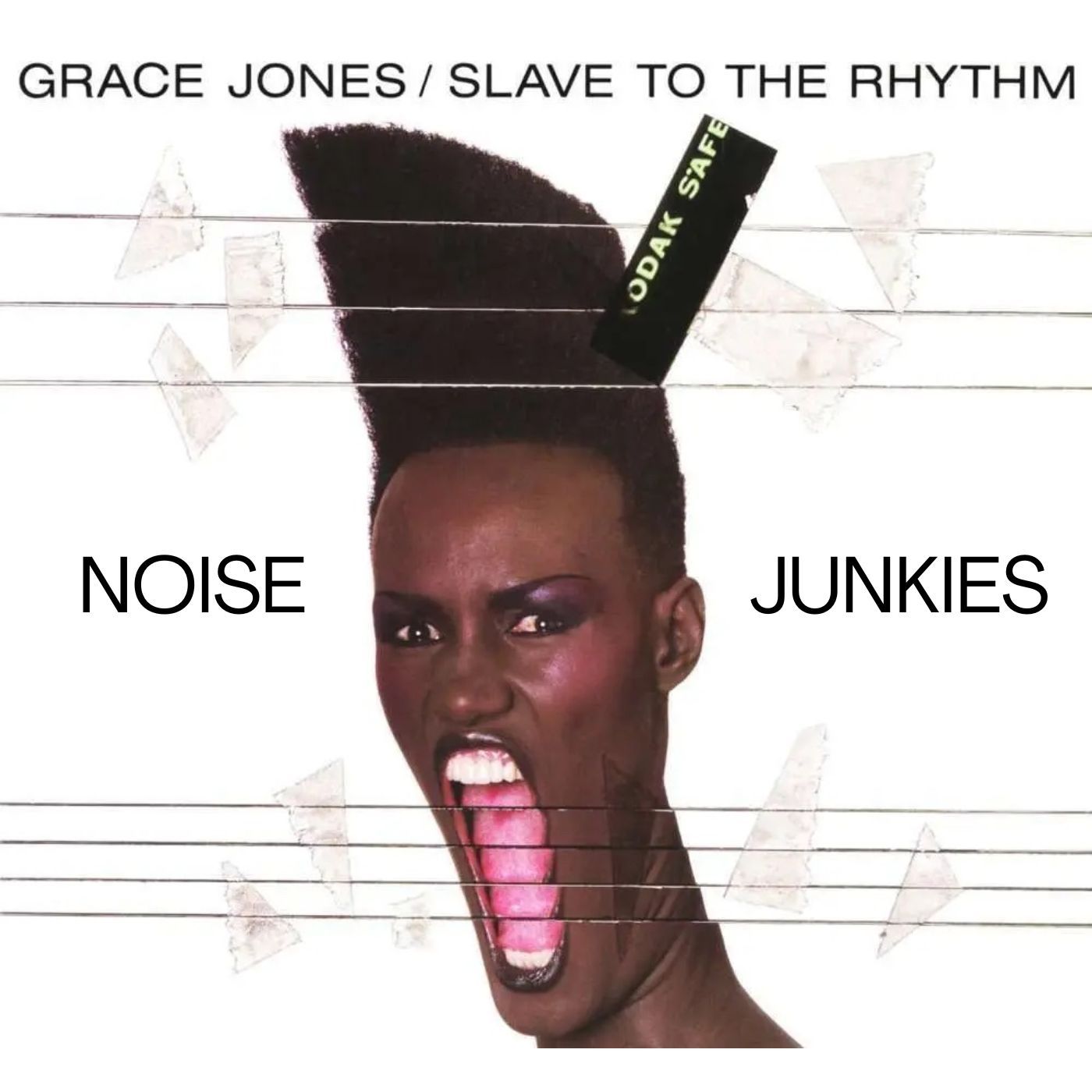
Join HP as he dives into the singular experience that is: Slave To The Rhythm by Grace Jones.
JUNKIES
Father Malone: FatherMalone.com
HP: hpmusicplace.bandcamp.com
Heather Drain: https://www.mondoheather.com/
SPOTIFY PLAYLIST
https://open.spotify.com/playlist/41WOUEcd1woCbGo1NehHUI?si=78eebdba23564af7
Transcript
Automatically generated, so expect the odd misheard name.
Weird. I listen to a lot of music. There always seems to be another rabbit hole for me to dig into, another artist to discover, or a subgenre of music to obsess over. But there's a special place in my collection and my heart for those singular, unique albums that are in a class all their own. Speaking of the much maligned, often misunderstood concept album, tonight, I'd love to share with you one of my favorite concept albums, discussing its origin and production and delve into why it's held such a hold on me for so long.
Join me as I dive into the singular experience that is Slave to the Rhythm by Grace Jones. Hello, listeners to another special episode of Noise Junkies. I'm hp I've always been a sucker for a concept album. Ziggy Startist Tommy the Lamb lies down on Broadway. I love when the album format can expand to encompass other ways of telling a story.
Slave to the Rhythm, while not necessarily adhering to the template of more traditional concept albums, has nevertheless earned a place as one of the most fascinating concept albums I have in my collection. I first heard about Slave to the Rhythm while listening to a BBC Radio two documentary on legendary producer Trevor Horn. Among his career highlights in the eighties were such classics as ABC's Lexicon of Love and Frankie Goes to Hollywood's Welcome to the Pleasure Dome. A good portion of this BBC documentary was focused on Horn's production work around Slave to the Rhythm. The more I heard about it, the more I was compelled to seek it out for myself.
After the smashed success of Welcome to the Pleasure Dome, Horn started preparing for its follow up. The demo for Slave to the Rhythm was earmarked for the next release. It was written by keyboardist Simon Darlow and Bruce Woolley, who was a co writer of video Killed the Radio Star, which was a big hit for Horn's band, The Buckles. However, the recording of the Frankie demo did not go well and the band could not muster much enthusiasm for it. In this form, it was a much different song than the one it would ultimately become faster and more stomping, but all was not lost.
ZTT labelhead Chris Blackwell liked the title and made two crucial suggestions that he felt might rescue the song from the trash heap. First, Blackwell offered that they should go with a different feel and rhythm for the song. He suggested it be recast as a go go track. Go Go was an offshoot of funk that originated in Washington, d C. And started gaining popularity in underground circles around this time.
It focused on syncopated rhythm patterns and call response with the live audience. Probably the most popular go Go song in terms of notoriety and chart position was nineteen eighty eight's de Butt, written and performed by the band EU for the soundtrack to Spike Lee's film School Days. The second suggestion Blackwell gave to Horn was that the song should go to Grace Jones, another artist on the ZTT label. Grace Jones is a legend that needs no introduction, singer actress, fashion icon force of nature. I'm not sure where I first became aware of Jones.
It might have been the music video for her cover of the Police's Demolition Man, or from her role in the Conan the Barbarian sequel Conan the Destroyer. Suppose you set your heart on somebody, what would you do to get him, grab him and take him. You grab him and take him, take him like that. Either way, there was absolutely no one like her. Hell, there's no one like her even now.
Beautiful, intimidating, androgyno ist, tough, she was so poised and self possessed in whatever arena she chose to appear in. She even starred with Adam Ant in an eighties Honta scooter commercial. Din Grice, I come on, Adam, I can't. It's easy. I've never written one.
It's quick. I've never written anything ever. It's fun. I don't even. Try onto scooters.
They're everything but ordinary. It's sexy. I'll take it. I'll take you. Grace Jones seemed to be everywhere around this time, but it never felt like she sold out.
Jones owned everything she said and did no excuses. After recording the nineteen eighty two album Living My Life, Jones focused much more heavily on her acting, appearing in both the aforementioned Conan the Destroyer and A View to a Kill. Going toe to toe with Roger Moore as Bond Henchwoman may Day Slave to the Rhythm would mark her return to music after a hiatus of almost three years, but before Grace Jones entered the studio, it was up to Trevor Horn and Company to reinvent the song for her. Horn and engineer Steven Lipson decamped to New York, ostensibly to rewrite and record the track with top studio musicians. It must be said that Trevor Horn, though brilliant and inventive, was thoroughly unconventional in his approach to production.
In the case of the New York session for Slave, Horn and his team arrived in New York with no real idea what they were going to record, or even what Go Go really meant. Lipson has described Horn's production approach as quote knitting fog. Through a combination of recording the studio musicians and subsequently remixing the tune in a marathon, eleventh hour session in their hotel room, they finally had their new Go Go version of the track. Later, they further experimented with the song, recording yet another faster version that hewed closer to the original Frankie demo. There were now two terrific versions of the song, the slower, slinkier Go Go version from the New York sessions and the reworked faster version.
Grace Jones was summoned to the studio to record her vocals Over the next several weeks. She added her unique stamp to both versions, but by Lipson's reckoning, Jones only spent around ten hours in the studio doing her parts. It was now almost a year after the recording of the original Frankie Demo. Horn and company had very little to show for their album in the making, beyond two versions of the same song, What's Worse Now? Jones was out of her contract with the label, it would not be available for any additional work.
How could Trevor Horn fashion an entire album from such limited material. His solution was sheer brilliance. Horn would make the record an album length contemplation of the song itself, and by extension, Grace Jones, a concept album that encompassed all of the various attempts at recording the song, running parallel with a spoken meditation on Grace Jones described as a biography in the album's liner notes. Interspersed with the music was an interview Jones had done with journalist Paul Morley. What did you want to be?
Seventeen? Not broad? And what was the first thing you did to alter that sit situation of being bored. I floated on the cloud like we will do. I suppose not all of us, and then what.
A lucky ones. I don't think I ever came down from that class. It was wonderful, alongside a recitation from a book by French graphic designer Jean Paul Good. Good had worked with Jones on all aspects of her image, including her album covers, music videos, and live performances. The two were also romantically linked, sharing a son named Paulo born in nineteen seventy nine.
The actor hired to do the voiceover recitation for the album was none other than Ian McShane, best known for playing Al Sweeringen in the HBO series Deadwood. Hi, Your Singer's blood is sensed to the depth of sound, lacerations echo in the mouths, open erotic sky, who had danced together, the lost trenses of rhythm, and an imploring immobility, Ladies and gentlemen, Miss Grace Jones. The rest of the album consisted of interludes where the song was repeatedly deconstructed and reassembled. Horn and his collaborators used the most cutting edge samplers available at the time to resample elements from both the fast and slow versions of the song into a cohesive journey through the persona of Grace Jones.
The faster driving version of Slave opens the album, retitled Jones The Rhythm in Horn's Hands. The electronic dance song takes on an almost operatic feel at times, imperfectly sets the stage for the rest of the album. To the highlight of the album was the final track, titled Ladies and Gentlemen, Miss Grace Jones. This is basically the final form of the go go version of the song and served as an appropriate finale. Chris Blackwell was right.
The beat is absolutely infectious, and there's a sleekness to the whole production that gleams like polished glass. Jones's vocals are a perfect match to the material. She sings with an unmistakable authority. When she sings, the listener can't help but be drawn in. Bill Boo in a sentime, how about by the Pats, be strong, Hey.
I'm the chain games. Never saw me shut, keep keep it up, never saw me a shout Come on, be bit, Read to the river, Dan, to the river. Well in the river, to the river up. When the final notes ring out on this album, the listener has truly been taken on a journey, not only through aspects of Grace Jones's personality, but through the very song itself. But started out as a desperation moved by Horn to fight his way through a problem, instead ended up as a creative triumph.
His ingenuity, his willingness to risk it all in pursuit of a particular vision is remarkable and key to many of his most enduring productions. The album was a critical and commercial success, eventually being certified platinum worldwide. It remains one of Grace Jones's signature songs and is a mainstay in her live performances even today. In twenty twelve, Grace Jones made headlines when she performed the song for Queen Elizabeth's Diamond Jubilee concert. She hula hooped for the entire song.
I've even seen a concert clip from June twenty twenty four where she performed the same stunt during the entirety of the song, which served as her closing number. She hula hooped for more than than twelve minutes straight. Not bad for a seventy six year old. I've been listening to this album for close to seventeen years now, and I still find it mesmerizing. The music nerd in me loves how the song is repeatedly broken down and built back up, revealing the individual parts that comprise its dense production.
It seems like I hear new things every time I listen to it. The wannabe musician producer in me is still in awe of Trevor Horne's courage and resourcefulness in turning a seemingly impossible situation into a triumph. And although the big single can be enjoyed on its own as part of a playlist, like many great concept albums, I find it most satisfying to take the full journey from the first note to the last as it was intended. Without hyperbole, I can confidently make the claim that Slave to the Rhythm is unlike any other album I own. So there you have it.
Thank you for indulging me once again. When I'm not listening to music, you can find me in other areas of the weirding Way media network. I'm the co host of the Night Mister Walter is a taxi podcast which discusses all things taxi. I'm also an occasional Culture Cast guest with Christashu. I also have a bandcampsite hpmusicplace dot bandcamp dot com.
You can check that out as well. As always, please feel free to write us, rate US, review us. We'd love to hear from you in any manner you choose. Once again, thanks for listening and we'll see you again next time
More from Noise Junkies
Similar episodes across the network
Matched by shared keywords.
-
1980s Fall TV Previews: TV Guide, Crazy Network Specials, and Saturday Morning Nostalgia
1 shared keyword: abc
-
Special Report: Boy George and Culture Club (2025)
1 shared keyword: grace jones
-
Murder Under Glass
1 shared keyword: abc