
Season 1 · Episode 113
113 - Kevin Jenkins - Production Designer - Star Wars - Jurassic World
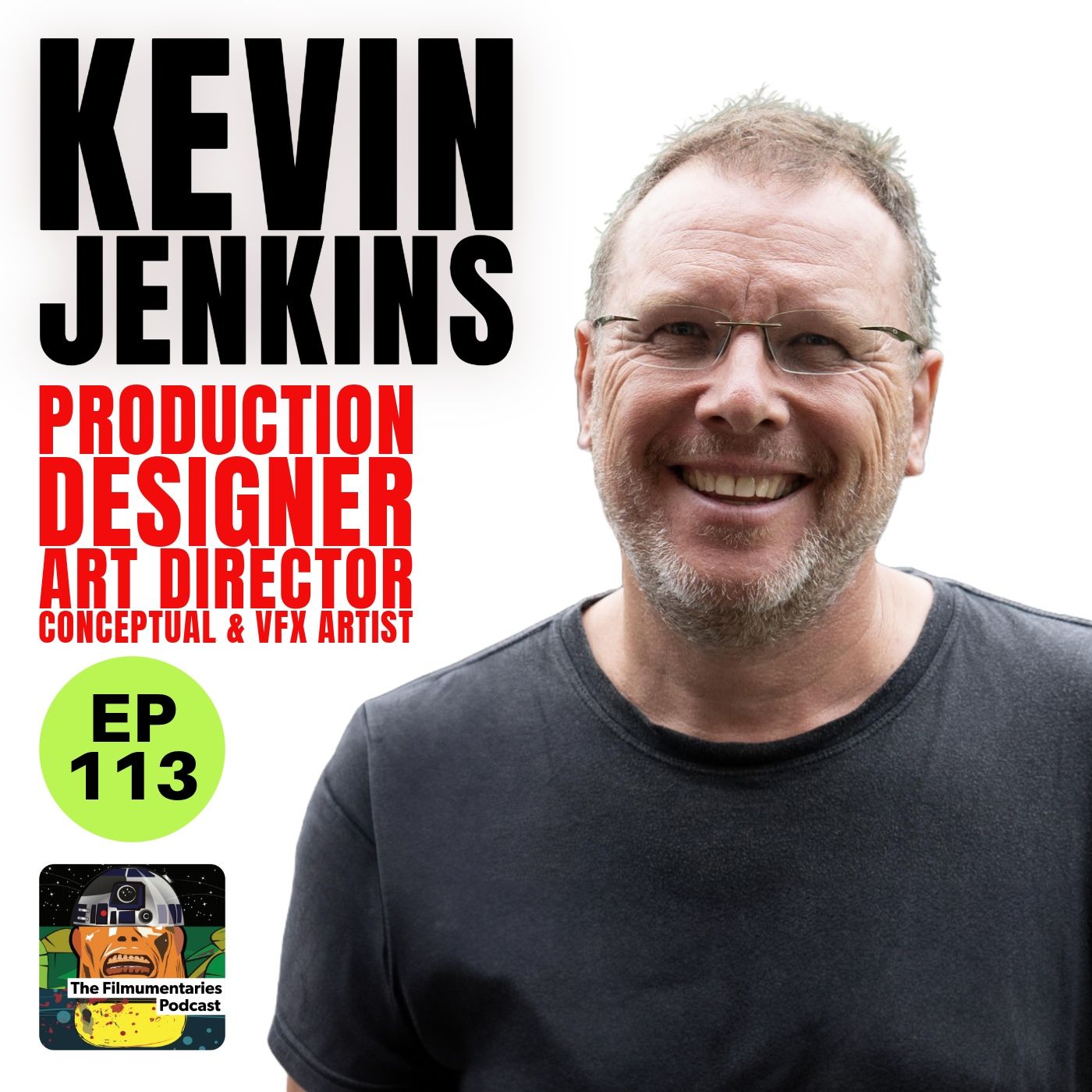
About this episode
We swap stories about our childhood movie experiences and the films that got under our skin—like Jaws, Star Wars, and Close Encounters of the Third Kind. We talk about how these films not only shaped Kevin's tastes but ignited a passion for storytelling and artistry that's stuck with him.
Kevin and I get into the risks filmmakers took back then. We touch on the balance between practical effects and digital tech, and why having a passionate, collaborative team is crucial to making something memorable. There's a bit on the commercialization of genres and how fandom sometimes gets too caught up in nostalgia, missing out on new, original stories.
We also cover how filmmaking has evolved with technology, especially for artists like Kevin, who transitioned from traditional illustration to digital tools. Kevin shares insights on how tech influences collaboration and creativity on set. He walks me through the role of a concept artist, the problem-solving and idea generation that goes into projects like World War Z and Edge of Tomorrow—highlighting the creative process behind creature designs and visual effects.
Kevin opens up about the challenge of finding the right design and the nuances of working within big franchises. He talks about the essential collaboration between art and costume departments to build a cohesive visual world. Finally, Kevin shares his ambition to work on a historical epic.
All the links
This podcast is completely independent and made possible by listener support. If you’d like to help me keep making these episodes, you can join my Patreon community here: https://patreon.com/jamiebenning
Watch more on YouTube:
Check out the Filmumentaries YouTube channel for behind-the-scenes clips and extra content: https://youtube.com/filmumentaries
All my links
Transcript
Automatically generated, so expect the odd misheard name.
Weird betting Way Media. Welcome to episode one hundred and thirteen of the Film You Mentari's podcast. This is your host, Jamie Benning. If this is your first time listening, get ready for a great behind the scenes chat between me and my guest. And for regular listeners and all my patron supporters.
Thank you for sticking around. Your support makes each episode possible. Who really does. If you like what you hear today, please consider supporting the podcast for just twelve dollars for one year. That's basically like fifty cents per episode, and it would make a huge difference to me.
It'd be great if I could build up my Patreon following. It means that I could do this as my work. You know, this is a lot of work to do. It's work that I love, but yeah, if you like it, it'd be great if I could build up my Patreon following. It means that I could do this as my work.
You know, this is a lot of work to do. It's work that I love, but yeah, if you like it, consider helping pay for it if you can. Okay, So today it's my conversation with production designer Kevin Jenkins. Kevin started as a concept designer, and during his career he's helped craft some of the most visually memorable elements in franchises like Jurassic Park, Drassic World, and Start. Kevin and I talked about the films that shaped his childhood and early career, the impact of technology on the evolution of filmmaking, and the changing landscape of fandom over the years, as well as the collaborative nature of his work, the unique difficulties in maintaining the esthetic continuity of those iconic franchises that I mentioned, and we also delve into some of his lesser known work on films like The Edge of Tomorrow and World War Z, Kevin having had a big influence on certain aspects of the look of those films.
So, without further ado, here's my conversation with Kevin Jenkins, production designer, and I'll be back at the end for a bit more jabbering on Kevin, What was the first film that caught your attention as a kid? Were Were you weregoer as a child? Yes, I saw there's a series of films because you know, I'm I'm. I was born at the end of the sixties, and I remember the seventies and it's kind of strange yellow codo chrome world. And there's a whole bunch of films that I know I saw at the cinema because some of them I still have the ticket stubs for some of them, the programs for and they have almost should we say, shaped my either love of film and my hope and want to have worked in it.
I remember seeing this is an eclectic bunch. Now, the films that I would say defined my journey forward were everything from Warlords from Atlantis because you know, because back in the day fantasy and sci fi was a bit cheesy and crap, to be honest with you, I grew up watching you know, sort of black and white movies like you know, Flash Gordon and all that kind of stuff. So Walls of Atlantis because it kind of I thought it was going to be harrow House and it wasn't. Is because I loved Land the Time Forgotten that had been on TV, and Wallads of Atlantis came out. And then there are films like I remember at the cinema seeing The Spy Who Loved Me and the Parachute Opening as Rod mol Squid over the Age that was hugely defining because it wasn't a certificate that anyone understood.
I saw Jaws first time round in the cinema opening week as a kid, and there's certain scenes from that that are burnt in my brain from the ABC Southampton, and I remember even where I sat at those times. I remember opening week of Star Wars, which was February seventy eight. It was a Wednesday night, and I remember seeing that close Encounters of the Third Kind, the Black Hole. I was often just dumped at the cinema like we were as kids, and then sort of off you go, and so I I would eat up as much genre as I could, but genre was far and few between back then, and so that kind of world really defined me because as a kid, all we had on TV pretty much for my love was you know, you know, Star Trek was on on a Tuesday night, and then there was Space nineteen ninety nine, and you know, and and of course, like a lot of people that maybe you've spoken to from an artistic point of view, Star Wars was a huge shifting point where for the first time, what we had read in books like Foundation and other things had finally actually for the first time, looked like science fiction.
Because the only other films, because I'm actually saying another film that my mum dumped me at was two thousand and one, which for a seven year old was like, what the hell am I sitting through? Probably the most Now I think it's the perfect film, but at the time, probably the most boring experience of my life. And so but you know, then then I sit back and I go, my god, I'm glad I saw it, you know, and all those kind of things. And so so my lean back then was heavily genre. But that's because I could always draw and always wanted to be an artist, and the route and path to film and a career was just like, how the hell do you do that?
And so in a strange way, my initial thought was to be like a book jacket illustrator or something, because of Chris Foss and a lot of other artists that I was buying books for in the in the you know, when I was about ten years old, and just buying them the covers, to be honest with you, And so that's kind of the mix of storytelling that I was involved in. I suppose storytelling, film books, that sort of thing, and even radio I you know, I still have the tapes ups test from when I recorded Hitchhikers when it was on you know, and it was released about five or six times, but I would stay up late on whatever it was on Radio four and stuff, and so all those things is like you you really had to unlike now where there's a complete gut of genre and fandom.
It was almost like an underground system where you had to hunt out what was you know, should we say my interest? You know, obviously as I got older, I got interested in all films and all design and all sorts of things. But initially it was sparked by imagination. Did this sort of love of going to the cinema and loving this genre stuff sort of go hand in hand with the development of your artistry? Were you coming home and drawing the things that you'd seen and writing about the things that you're.
Trying kind of my level art. I've still got the picture upstairs in the loft, which is I literally almost copilar Frank Rozetta painting, which my teacher would upset by. If you know Frank Rozetta's work, you. Know that the fantasy. And then the strange way I was using because I've never seen art like that, and how to draw and copy it.
So so it was, as I say, it was always an influence in the sense that I would buy books and things like. You know, I had those original Frazetta books that they did in the Block one four that came out in the seventies, and I would just copy them. It's quite strange. And you know, when you're that age, you don't really have a path, you just have a passion. And so it's just kind of and I think my drawing passion wasn't quite linked to my film passion.
I would go and see all sorts of movies many many times, you know, you know, whether it be Time Bandits or whether it be Raiders, Due and Close Encounters. God. You know Richard Harris in what was that Orca Killer? Well filmed he did anyway, But you know, whatever came out that felt like it was adventurous, I would. I would go for the Killer Whale movie that was Orca.
Wasn't it? Was it? It just called Orca. I can't remember that it was the Jaws rip off that Richard Harris did. I think that was a Benchley story as well, wasn't it.
It might have been. I just remember not caring because of a strange way. After Stars, there was an Italian rip off of styles called The Humanoid that was utter Tosh. But yeah, again it's like, well you wait threes for the next Tianced Picture film where you go see the utter Tosh. And also the naivety of it all back then was a lot more digestible.
You didn't just kind of let it wash over your head. It's a real testament to those movies that you're talking about, the you know, closely Counters Jaws styles, all those things, that how good they are and how well they've stood the test of time, because I think, you know, they're often blamed. They're often blamed in a way of you know, oh it's the start of the blockbuster revolution and we don't get our movies anymore. But but so difficult to make that good. I love The Godfather, I love Barry Lindon, and I love films that these are some of my favorite films.
But what I mean is it's like I yearned for a two thousand and one to try and be made now or and what I mean by that is is the you know, obviously Interstellar was should we say, I suppose for Nolan's self tribute to you know, to thousand and one in the inner way. But also like when I think about films like Close Encounters and it's it's I kind of think about this often. I don't quite know how films like that could even be made now acres. Close Encounters is like one of the most selfish films about how he literally goes, I love aliens, I'm going to go and live with them and dump my family and kids at the end of it, which is an insane premise for a movie. But yeah, but also in a strange way, one of the things that seems very different now is we've spread out into streaming and movies and all sorts of things like that and different ways of entertaining through YouTube.
Is just that the strange perception shift in my opinion of the Hollywood star and what is a movie star, because in a strange way, the world was a bit smaller back then and there was just this amazing you know, as I go back and watch some of these films, you just look at some of the casts and you kind of go like, God, how did you pull that off? And you know, and just and it's very it's just a different tone, a different era. But there's a whole bunch of films that were made now that were just I think very I think very bold for the time when people just took massive swings, especially end of the late seventies through the eighties. As we were talking earlier, going to see Predator again on the big screen last night, it's just like, I don't know how that film would get greenlit now as a standalone film if someone went into They've got an alien movie, and there's a guy and we're going to hire a musterley guy and he's going to run around in a jungle and stick mud on him, and you know.
And what I mean is is like you look at those eras of the seventies, eighties in the early nineties and you just think, good god, it's almost like being with music in the eighties. I think bloody hell. To be alive at that time when creativity was pushing through a commercial system, to come out like that at that quality level, that's the thing I find amazing, because you know, the studio system is a studio system. You have to go and ask for money. Films aren't made for charity.
They're made for money. We work in the film business. But to think that that there was the cloud direct to Talent, Faith and those those those films came to us, and what's really weird is we're kind of still riffing off them. Now. Yeah, there's a faith is the word, isn't it?
I mean another word that springs to mind talking about those early movies is the risk, you know, the risk that they were taking. You know, Joe Alves is a friend of mine. I'm actually making a documentary on Joe Alves and his production design and in fact, Kevin, I'd love to interview you for the documentary at some point if possible. But just that idea of you know, Okay, Stephen, let's build a thirty five foot shark and put it in the real ocean, you know, just like what studio now will go, Okay, here's an X million dollars to go and do it. It's quite strength again, even watching Predator last night on the Big As, I say, a film I've seen hundreds of times, but film I hadn't seen on the film on the screen since I saw it when it was first released in eighty seven.
And what was quite astounding was it's hard to describe. What I mean is the way that projects were made back then we found other ways to make them through, sometimes reasons of money, sometimes reasons of safety, sometimes reasons of this and that, which I completely understand. But it's quite astounding to see all those people literally blown up and put on fire and thrown from left to right, and to see it all and it feels so authentic in a strange way. And processes have as a filmmaker myself, some process as we do have shift massively in a positive direction. And I would say a whole bunch of processes have shifted massively in a direction that I think don't necessarily So we say they they add, but they don't necessarily make better.
I think is the best way I can say it, because you know, because there are hoops that that that in this modern age we have to jump through that they would never have to jumped through, you know, even filming, even filming on a jungle, that's like going to film in the middle of the Atlantic Ocean, like when they did Jaws off the coast. You know, these are people try to find ways around doing difficult things. Now it's quite astounding through the sixties, seventies, eighties, nineties that they just did bonkers things and go no, We're going to go and stand in the desert with David Lynch in film June and everyone's going to practically fall over through heat stroke or something. And then you know, going to the jungle wherever they you know, where they shop, Predator all other things we we it's a kind of to make it safer.
We do tend to film things in a very different way. But I do feel that compromise has allowed authenticity to be gone, as we found, should we say, what our easier paths to make it have made lesser results sometimes on screen. Do you think then that with the advances in technology, with things like you know what Ireland called stagecraft, the Big Volume and things like that, and these real time engines, do you think there's going to be a point where, you know, that authenticity kind of joins up with technology and we see things again. I think that are perhaps more believable. I think, again, going back to your point talking about Joe saying I'm going to build a thirty five foot shark or thirty twenty five foot shark and make it, and that's the process.
The film business is now much larger than it ever was, and there's a lot of conflicting interests about sometimes sort of should we say, some things are made and promoted in a way that's not quite correct for the job. But people have interests to be able to kind of promote them because they, I don't know, let's be honest, generate income, generate certain ownability to certain sort of parts of the process, things like that. And so I think where still as a business trying to work out where technology sits comfortably, because it's quite quite strange. I've come from both sides of the spectrum. I've come, you know, I've had a career in v Effects, ILM, Framestore, leading in sort of you know, quite harp in both of those companies.
I've had a career in book jackets and games and all sorts of things. And I've had a career as a production designer that's freelancer. And so the honest truth is you can make a film completely faithfully the way that you made Jaws, and you have Jaws, and I would say that Jaws holds up today almost as perfect as ever, apart from a number of handful of shots that I could probably say is five four or five shots that just look like complete crap. But the strength of the story takes you through it and you forgive it. But you could correct a few things, of course you could, but you know, generally that's fine.
Or you can have fun movies that do a version of that deep Blue Sea. And I don't believe the shark's even there, even though it's fun to see Samuel L. Jackson being eaten, and the films are you know, what shall we say, you know a bit of a dirty luxury, And there's been a lot of shark movie since because it's quite cheap to make shots in CG. Not necessarily the water sims, but basically. But I would also say that has anyone done a better job Jaws since nineteen seventy four, I would argue not.
And so when people say they can do things, yes, I suppose. What I'm saying is you can do anything. You can do it practically and you can do it digitally. But I think it comes down to is like how well do you actually do the whole thing? Because it's like, it's very interesting the way that technology is at the moment, because in a funny way, as someone that keeps has to keep up with a trend of where we all are and what we see and everything else like that.
You know, I can honestly say that I don't think i've been you know, the last time I was truly blown away by something that was a technology twist that made me go, oh my god, I've never seen that before was probably Davy Jones, and that was like sixteen seventeen years ago now, and I think that's when, shall we say, the perfect combination of care, love, time, money plate Whether it's achievable now in the current class, I don't know, but all those things added together to do the job it should have been done, which is basically brilliant storytelling, fantastic performance, fantastic visual effects, complementing not taking over or even though it was so prominent, it was all very much in service of the film rather than shall we say, you know, kind of doing other things.
It's very interesting, I mean, you know, and so technology, technology doesn't necessarily always make things better or cheaper. Sometimes it's you know, it's again, it's always a balance. But that balance comes through what people I don't think realize when they kind of go and they see movies, is that it's always a magic combination of events. A director, a producer, studio, money, a production designer, the will, the passion, the time, and sometimes it's like a perfect storm that gives you those magic moments such as Jaws or Davy Jones or other great moments you can think of. And other times it's just a rush to get it out and things go wrong or things aren't perfect.
It's it's I know if it sounds like I'm sort of moving around a bit, but it's not a black and white answer. Ever, No it's not. And I think one of the other elements you know, that is often talked about that didn't really exist with those movies that we've been talking about from the seventies and eighties is the sort of the fandom side of things, where you know, and so much expectation is to be managed. You know, nobody was sitting at home going, oh, I hope they make a good shark movie. If they don't make a good shark, no.
It's actually impact, you know, you would go and get your In a strange way. I would only know what movie was coming out by previews at the movie theater, so you'd actually go early to go and see previews and go, oh my god, is it from the Harrison Fortney's wearing a hat and there's snakes in it. That's awesome. I'm going to go and see that. And so there was that.
Plus also, I think what's very strange probably for people to realize now is how how low down the food chain fandom was in the seventies and eighties. If I I went to school saying that I like to draw spaceships or something, I would probably get punched and beaten up. I remember I probably did, actually because it was a very it was a very kind of almost like, oh, you're a nerd, you're a geek, get out of here. You know. It's like, you know, if you seen the film Weird Science that literally tells the truth, That's what it was like.
It was almost like, I know, it sounds strange. It was like coming out almostly, you know, I don't like football, I'm going to draw a spaceship. And and I think what's happened now is genre and has been so commercialized with expectation to live in these things. It's quite interesting because obviously, as you know, I, you know, I do a lot of I've done a lot of lucasfilm projects, and people sort of it's like what's your favorite you know, what do you want to see next? All this kind of stuff, and it's like, and I have to remind people that, you know, I saw it first time around in seventy seven, and I saw it in eighty and I saw it in eighty three.
I personally like to see new and interesting and different, which is how I grew up not knowing the difference between you know, Startchut the motion picture God that was dull looked pretty Ratha Khan. Wow, that's the story. And so as far as like things go, it's like, I never need to see Luke Skar Walker ever again, as long as I live. What I mean is I did that in seventy seven and eighty in eighty three, that story's being told. I do not need to.
We now almost in fandom live in the past rather than look to the future. The future is almost scary to people and they can't accept it. It is very strange, whereas growing up in the seventies and eighties I had to accept the future all the time. And even knowing back then because I've still got all my comics and magazines from that era, people say the same thing. MPUs tracks back, what is this crap?
This would never have happened. Oh this is dull, he's not his father, you know whatever, And so fandom hasn't really changed. But I think what as in they'd like to moan about everything we all did, Yeah it wasn't right. I think what has changed is the ability to accept the new. Because if we hadn't had that ability to accept new through the seventies into the eighties, we wouldn't have had in the nineties, we wouldn't have seen our total recalls, our Starship Troopers.
We wouldn't have seen I don't know, even things like RoboCop and even Bukaroo Banzai or Space Hunder three D eventually the forbidden zone. What I mean is people tried things and they weren't they weren't attacked for it. Some of it was successful, all like now, but some of it wasn't. But everyone was just kind of like, yeah, that's a lesser version of Star Wars, but it wasn't like that's not as good as Star Wars. Space Hunter rubbish, it's like I hate everybody, you must all die, just like it was never any of that thought process, and like people now put films on pedestals that quite frankly, you know, the thing Bond.
Nobody saw it Blade Runner. I saw Blade Runner opening weekend with my brother in Bournemouth ABC and there must have been three other people and a dog in there, and I walked out as a fourteen year old going, that was probably the most attractive, boring dirge I've ever seen in my life, because I was used to seeing Harrison ford A's hand solo and everybody has this rose tinted glasses that this classic was born. It wasn't. It was VHS that basically found it, and it's been retroactively two thousand and one. Actually wasn't really very well seen when it first came out, you know, And so I think what's very strange is that was the beginning of a reaction in fandom to push an opinion forward that quite frankly, it seems more important than the actual thing.
If if that's a polite way of saying it, do you know what I mean? It's like kind of yeah, I don't know. I just watched things and go oh that was good or that was rubbish, and I don't feel the need to go and scream to anybody about it. I just kind of I just. Also, it's important isn't it, I think, to be able to have experimentation in film?
And I wonder how we. Get away from derivative films. You know, so many films and so many TV shows now are leaning on the films that we're talking about. Still, is there a way to kind of escape those shackles? I wonder.
I mean, what's very interesting is, because my daughter reads a lot of books, is what used to be people purchasing and turning many many books into movies and being the sort of the full process. And even even if they weren't taking the book, you can you know, you can tell, you know, I can. I can point out exactly where Star Wars is ripped off from. I can point to the sections in Foundation and Dune and the Lensman series. You can even find the names of half the people, planets and stuff.
But we sort of the faith in storytelling seems to have been diminished to give you kind of a comfortable, comfortable version of storytelling sometimes and if anybody tries anything different, it really upsets people, and so and a lot of times we try it and it's kind of covered up by memory, I suppose, is the best way to describe it, you know, which is what I mean is it's like basically homages to previous things rather than letting the story works. It is a fascinating time. I don't quite know why everyone's very scared of story telling originality. Mm hmmm. Just just rewinding back when what was your first sort of moment breaking into the industry.
Because you're an illustrator, I know you worked on like book covers, like you say, and I saw some of your game covers, some of which I knew quite well. Actually, I worked for Formula one, by the way, as part of my freelance work. So when I saw it. Challenge, I did one called Overdrive. I did another Formula one one as all of the streamers for Virgin Interactive.
And I'm sure I didn't know. Yeah, But then you you transitioned from that into the film industry. How did that come about? I And again I liken this to what people are feeling about AI at the moment. There are massive shifts that happened creatively over time.
And the massive shift that I was involved with was learning how to paint raw or illustrate airbrush, and that's how I started my training and my career. But then can desktop publishing and Photoshop one point zero came in, and that fundamentally shifted the paradigm so massively to those that could use Photoshop and those couldn't. So some of the best artists I've ever seen in my entire life just died out with in the space of five years because they couldn't move over to using the new tools. Three D and I'll be honest with you, the first five years of my three D two D career in you know, even though I was working quite successfully, I'll be honest with you, it took all the fun out of being an illustrator because you literally were just making a little there.
And the other problem was you tend to accept because the computer's done it, it's really cool that you think it's amazing because you've learned a technique that's generated the amazing. But actually it's it's a bit ship when you look at it back and you kind of go, you know, I remember I sort of did some as I transitioned into learning three D software and photoshop, and I decided to not do an airbrush illustration for an advertising client and to try to do it in the computer. Old piece of sopha called sculpt three D in photoshop and I handed it over, thinking I've made this amazing thing is technically it was so hard to do, and they just phoned up and they just said, goo fie, this is absolute crap.
It's really the worst illustration we've ever seen. I can't believe we hired you. This is not like your work. And it made me realize that you can get blindsided by computers and you can literally get enamored by the technique, which is kind of where we are with AI the you know, the ultimate Russian Roulette wheel of regeneration. And so what happened was I got a bit bored doing freelance illustration and a friend of mine who was on the same agency as me that did book jackets and he'd done something like the ben Elton covers, like popcorn and stuff like that.
In a friend of mine, Paul literally sort of hinged me because the other thing is working at home, you sort go mad on your own after a while and you kind of go, I hate this. And so he pinged me and said, look, I've managed to get a job texturing that doing the Lord of the Rings movie, and I'm going to go to New Zealand. And that left an opening frame store that because someone else moved in that position and someone else moved on. And then I literally did some two D photoshop three D early camera projection samples and sent them off to them and they go, how did you do that? And I kind of had an interview and got in as one of the One of the first texture painters on was the Walking with Dinosaurs TV series, doing sort of sea monsters, and back then it was so rare to find digital artists that could really do three D and two D, and so I started there and I did a short time working for sadly passed away now Mike Milne, who headed up the team of Walking with Dinosaurs.
I did a series that, but then moved very quickly into digital environment work on film production on Jonathan Frake's Thunderbirds. It was the nicest planet Earth. No one could take anything away from Jonathan Frakes, one of the best directors I've ever worked for, absolutely, you know, just in amusing time and yeah, and then just basically kind of like moved on into digital environment work and doing shots. And that was when, again I would like to call that possibly compared to today, which is much more factory almost based in scale. It was like probably the golden age of visual effects, where how to do things like a tree was actually really hard and almost like a problem to be solved, like mountain climbing and climbing everest.
And now you can do anything, literally anything. But you know, when I was first doing three D and two D and Matt painting, and even that was at the time when Matt painting was transitioning from glass and I was one of only about three or four mat painters in London at the time. Now there's hundreds all over the place. But it was you can do it, by the way, No, I never did. No.
I mean I obviously I could paint normally, but working for Framestore, which was a digital film company, it was literally they were in a cusp of trying to promote new things, and so I have thought about having to go. I've tried most old school things on the films I've done, but glass map painting is particular at that. Quite sadly, there's hardly anybody that has the ability and knowledge to probably even have a go now, let alone the time and money, because there are certain things that look I wanted to be in the film business through people like Chris or Chris Evans and Frank Gordaz and Mike pangrats here and all those artists at I l M. But in a strange way, it's a double edged sword. Some things are better in a certain respect to be done in the computer because they are more straightforward.
But I will still say that when I look at some of those old mate paintings, I have to say that I kind of even sometimes look at you know, even in Star Wars, and you look at some of the matte paintings in many films through the day, and in fact there was one in Predator when they were crossing the bridge and before Billy Pups estin. I kind of prefer them. I think there's a certain there's a certain thing that I love about them. Where they chant, there is a charm. But also I will say, in some other respects the painterly loose aspect to them because it was all shot on film, film grain, very raw back then.
In some cases I'd actually say they work better than a completely clean digital thing. It depends what you're trying to achieve. I mean, not of films have to be photorealistic in art, but you know, it's. I was chatting to Jet Green just the other day, who you know, work with Frank and Mike Chris, And she's still painting now, and she is living in Maui and she's working for a little gallery and painting still. And she was saying that some of her paintings are like six foot by four foot and people are saying to her like, oh, from a distance, it looks amazing and folk realistic, but when I get up close, it's quite rough.
And she was like, shit, I'm still Matte painting, you know, I'm still because obviously with some of those early Mate paintings, you only had to do what you needed to do for the camera at the time, and that yeah, but. No, you just said the most important thing in film business, which is everything you do is for the shot, the camera and exactly what you need, no more, no less, and in a funny way sometimes and that was the mantra of all filmmaking. But digital provides a flexibility for people to change their minds a bit like a bit by the way the people use photoshop. I always remember talking to certain people the way that we use photoshops still now. I used to use photoshop when there were no layers and just revert, and no one do.
And even now I don't use adjustment layers where people you know, it's a bit. It's not do or die. It's just like, that's what I want to achieve, and I don't wither or change my mind. That's what we're trying to do. And so I think the more we introduce tools that create doubt, sometimes they do provide better options, but other times they produce a multiple of indecision and sometimes you know, and I think, you know, that's another interesting aspect of I think there's many things that have affected the film business in the sense that there is more choice, and in some respects it's made better films, and in other respects, I think it's made worse films because sometimes it all depends on the person and their clarity of their vision or what they need or And here's the interesting thing I think about the film business is like literally everybody works completely differently.
Everybody the way I work, the way other designers work, the way the way that Doug Lyonon works, compared to the way that Ryan Johnson works. It's all chalk and cheese, and so there's no right or wrong. That's what I find very fascinating about the business. But I will I do think that sometimes some films that we have made in the last fifteen years would never have probably been possible thirty years ago. And that's not just because the technology wasn't there, because I think the chaos would not have been allowed.
Yeah, yeah, yeah, I wonder about that kind of the way technology has kind of driven us apart to certain extense. Like one of the things that Jet was saying is that when she first worked to Ilem in the in the optical era, she was in the same room as Mike pangrats here and Chris Evans and Frank ord As, and then when they went to digital, they were in a booth and they were isolated from each other, so she couldn't sort of lean back and say, hey, Mike, does this shadow look right on this? On this one of the reason, it's one of the reasons why I moved on from visual effects, because it went from being very small teams. If I think of the size of teams I worked on doing either Superman Returns or Alien Versus Predator or other see, whatever the film was, they were very small teams, and we took ownership over big chunks and you crafted them together.
And the difference now, I think is through the necessity of scale and speed, is that those teams have now become shall we say, like car plants. They've been kind of you know, so we say factory rise in a way. That's and I think one of the things is that I almost realized that for me personally, visual effects was becoming an inslea solo hobby again like I was, even though you worked in a big company, much like when I was a freelance illustrator rather than a collaborator. And so that's why I kind of gravitated to when I first met or when I first started accidentally creating London's versus the effects art department, which was to try to meet and work with directors and other production designers to try to kind of choose a be more creative and collaborative because the effects was on the cusp of turning into a larger thing.
Because like when I joined Framestore, I think there was only like sixty people in film or even less or less maybe thirty eight or something, I don't know, not very many, and as I said, everybody was like it was like everybody was a maradonna aetheld no football, but anyway, everyone was a Maradona or a Pela or something like that. And now, like everything naturally, the scale of things means that you have to kind of find a way of the system to equalize things, and that can be across the board. But that to me was less interesting to other people. It's interesting, but actually less interesting to stop a working that way, And so I kind of then switched into doing concept art on what was the project that we accidentally did.
There was something happened. There was some downtime at frame Store. We were in between shows because back then, if like if we did two films a year, it was considered, you know, a really busy year, and I remember there was this three or four month gap between projects, and in that time, working with William Sargent, who ran Framestore at the time, was just to kind of go, well, let's just to see if we can, I don't know, change the perception. And so I started doing some some conceptual art just to try to help on projects. And then what happened was the art was taken by the VFX supervisor down on set on Prince of Persia to a production design called Wolf Kroger, who did Blood and the Edge and lots of very cool films, and he was doing Princes of Persia, and they needed someone to work out how to do this very complex at the time sand room sequence where Jay gillenall sort of slides down sands as a whole thing collapses at the end.
And so because I knew obviously THEFS Matt painting digital environments, I just started doing concept art and Wolf asked me to go down. So I spent about six weeks in the art department with Wolf Kroger and some art directors, and all of a sudden my eyes were opened, but like, oh wow, this is the real film business, more real in the sense, the real version of the film business, not the digital version of the film business. And I got the absolute bug for being kind of shall we say, on set and the being at the beginning of the creativity point. And so I took that back and then finished that sequence and then sort of and then continue the people that studios at that point, at least the point people in visu effects would then push me onto either directors or to other producers, and I would sort of develop things.
And that's kind of how I started my art direction career. I often think about like concept artists versus like a production designer art director. Where As a concept artist, you've got this sort of obviously, you've got the restrictions and the remit of you know, the art department telling you what they're looking for, but you don't have to think about physical construction necessarily when you're doing that concept art. Kind of because everything business comes a bit I mean, obviously there's imagination, storytelling, and you can do anything you want with money these days, but it all depends on again what the director and everybody wants. And what's very unusual is when I started doing conceptual art, most production designers could actually you know, like I sat next to Stuart Craig who did this best sublime pencil.
Normal Reynolds could draw, John Barry could draw. Many of them were exquisite draftsmen. And I don't mean draftsmen in the technical sense. I mean in the rendering sense and stuff, whether it be Pence or the Ken Adam version. But now I'm almost, in a funny way, slightly alone in kind of I'm one of the few that I find can actually draw and communicate in this way now because the system has sort of slightly changed a lot, and so what inspired me was when I was working with these production designers was they just do a little thumb there as something like that, and you would then go away and do that.
And I've had to change even the way I concept when I work with directors now because the scale of productions these days, in the speed, I obviously need to work with some concept artists as well, because there's not enough time in the day to do everything. But also there's a massive misnomer of what even concept art even is. The word is loosely used to just about anybody that does a digital painting these days, and that's not really what concept artists do. All the concept I would say ninety five percent of the concept artists I see are probably illustrators and the five percent that are concept artists are concept artists, but people don't really know the difference. So, you know, concept artists solve design problems and create ideas, and there's a whole illustration decide that's almost replaced what book jackets were, which is doing lovely keyframe art of a castle on a bill.
It's you know, you know, and also because it's kind of it was never done this way. If you think that all of these amazing films and even I will use the word Star Wars, you know there was art done to help as the illustrations in the process. People have become very use to concept dark now, but really, up until about ten twelve years ago, it was just a kind of like it like, it was not that much a part of the process. All the big films that we all love from a massive original design point of view for the last fifty years up until about two thousand and ten, are they any concept up? You know, it was like, you know, a few drawings here or draftsmen there, and a few bits in the corner and stuff like that.
But now there's volumes of like almost over indulgence in just producing art for art's sake now that no one ever looks at. It's quite funny. It does make me laugh the amount that you know, God, I can tell the amount of pieces we've done on Star Wars projects that no one's ever seen. Yeah, when you're doing that sort of concept work for something like I don't know, Rogue one or Edge of Tomorrow, you did some creatd design and stuff on that, didn't you. Is that getting critiqued amongst your colleagues or is it just your boss that's kind of critiquing and coming back at you.
It sort of worked very differently, Like Edge Tomorrow is an interesting one because Christafaria, who was the head of visual effects that Warner Brothers at the time, brought me on even before the production designer, Oli Shahl was on to meet Doug Lyman and do some work and I did about eight weeks before him, and that the problem they had was very specific back then, because again visual effects was expensive and complicated, and they said, we have an exosuit problem and we have an alien problem. And so I spent eighteen months almost you know, I was communicating and working with Oli Shaw, but mostly with Nick Davis, who was the VFX suit via Doug Lyman, which was like, solve the problem of these two fundamental things, and solved the problem of the exo suit, and then that went off and became the exosuit and got manufactured, and then spent about eighteen months solving the alien And that was very different to the way things happened now.
There were two projects that had that very particular, most independent way of working. The other one was World War Z which was when I first met Mark Foster and we did a pitch to him and they literally said, oh, we've got this. I've read the book and you know it's cool. How are you doing it? And say, yeah, we got zombies, but we don't really know what to do with them.
And so what was very interesting was coming up with that original. So we say zombie idea, which because I remember after working for about eight or nine weeks and I said to Mark Foster, I don't think I can come up with a zombie because they're just dead people. And it was like, oh shit, well just Paramount making a lot of a lot of and so I said, but maybe we can come up with something with lots of zombies and he said, what do you mean? And we had this two bits of footage at the time. One of them was some rats pouring out of a door because of something because again this is pre YouTube, so yeah, or YouTube was different then.
And then the second one was an old frame store ad of them making a Guinness castle of men to get a pint of beer, an ad that was very famous I think in the early two thousands, and so that became the seed to go, what if we make a fluiding body of zombies, and that was how all the design concept art went. So the poster, which is actually zombie bodies pulling a helicopter down, is actually some of the concept ut we did to kind of explain the process. But I remember the very first meeting when we actually thought we had an idea, and Colin Wilson, who was the producer at the time, came round and they brought Mark round and I just printed out literally it was like after doing that five weeks work, I think we had like five paintings and so all I did and they were all trying to use the inspiration of turning a wave or a real flood that replacing that with them bodies, which is what we did, and they were all just black and white.
And because only had five, we just got the art department the plot of printer that they used to do all the spreadsheets on massively at Frame Storm, and we just printed them out about like kind of eight foot wine. So they walked to the room there was just these five massive pictures, which was to fill the void of not having any other ideas. But it worked because they saw it theatrically and they both went, oh my god, we've never seen this before, you know, because it was like body like a crest of a wave or sploshing up on top of each other and stuff, and they saw the potential of it, and so I stayed. It was very frustrating on one level, brilliant on another. Worked with eighteen months with Mark and was brought into all sorts of strange meetings I've never thought i'd be brought into to kind of go would they have done this?
And what's the end going to be? And that was another story. But frustratingly, never got any credit for it because I worked for a VFX vendor who didn't even do the VFX. And one of my big frustrations back at that time was not being recognized for the amount of design work done on some of those shows back then when you're calling large aspects to the story. And yeah, well, I have to say both those examples, you just go WORLDZ and Edge of Tomorrow.
World was in the trailer where you see that sort of fluid wave. Of zombies trying to climb up a ball or something. That was the moment in the theater watching the trailer when my friend and I turned to each other and I said, not for me because I hate zombie movies, because it looked terrifying. And he turned to me and said, fuck yeah, I mean. Yeah, but but but none of that was ever as a written thing.
You know, the idea that the was was added to it. And that's the same almost like in a strange way for the mimics in in Edge of Tomorrow, whereas in the art department that was. A brilliant design. By the way, I don't know how much was that your original concept, do. You know what it reminded me of.
I've got a thousand versions of that mimic all over the place, and it became a combination of people just just leaning, just bouncing over each other to get to the end. But where it, where it truly came from, was see I can always bring out the where it all came from, which other people can't, because I was there it all came from. And so even though many people had to go at bits and bobs at them, what changed that was because again it was draw Alien of the Week and we did this and then there was this one piece of reference that was found on Vimeo of a commercial and it was like a piece of sound reference mixed with early CG and it was like this small cube and it had this almost pumping soundtrack that would make these I was like the project like air noises here and there air and this cube literally then shot out tendrils to the music that almost like spikes, and it kind of and and that became the initial violence of their motion, mixed with a sculptor that had been making sculptures of lions and things made out of tires, and so literally we kind of combined the two to make this kind of I can only describe it as this exploding noise of black rubber, which is what the this is.
You know, I've got written here. I just went sorry to interject, I've got written here. It reminds me of when a tire bursts in Formula one. Yeah, firstly, and the second thing it reminds me of is if a helicopter crashes and the rotors start digging into the ground and like terrifyingly coming out you liking black Hawk down the beginning. And again, you know, Nick Davis was the VFX suit did a wonderful job taking that on forwards.
But all those initial conception points were done when I started that art department of Frame store and actually moted these ideas and did the early artwork just like we did on World War Z, but then started the journey that other people should we say, built upon. But that's how those are all that because again it was just written mimic and at that time everyone was going, oh, draw a creature, and we had all sorts of things. We had hexagon creatures, we had oh god, literally, as I said, I've got a thousand versions of a mimic and a folder nine hundred and thirty six or something. But that film doesn't get as much love as it should. I think.
I think complicated film in the sense that I remember. I mean, it's got five titles. I can't remember which one they actually released anymore. We started when it was called We Mortals Are, Then it was the book All You Need Is Kill, Then it was Anyway, and. Then the marketing when all lived, I repeat, didn't it.
But even the film had a journey to find the film, you know, And so you know, it was a very very hard film to make, and I think even Doug Lymon's gone on record saying it was a very difficult film. It was a very difficult film for us to come up with. The Exo Suit and then the Alien and it was a difficult film across the board to make and find in the edit because having a time loop is like almost impossible to shoot basically, and also in a funny way, even Tom Cruise accepting a role that had to go through a journey because Tom Cruise in all Tom Cruise films is being Tom Cruise and he had to almost we say, be a bit rubbish and a bit of a jerk at the beginning and learn how to be Tom Cruise, which I think also naturally fought against the process as we were making it.
So I think there's many versions of why that was, and so you know, he becomes Tom Cruise again through that, but I think that through the edit a huge thing to find and it was a very very complicated. It's a bit like my understanding is that I think Douglheimer had a difficult time making The Born Identity as well, which is just like sometimes it's got to push through it. And I think that Edge of Tomorrow is one of those films that we just had to push through, like what was he was the same as. Well when you arrived working on Rogue One, I mean. Did work so I actually I was.
I was on the Force Awakens as an art director. Oh you're on the Force Awakens. Yes, so I'll start that again. So basically how I got to that point was I the journey is that I, through my Frame Store art department, ended up being invited to go and work with Rick Carter, Steven Spielbert's production designer on Warhorse. Steve and I became close friends, and I worked in Rick's office, and that gave me a strange access to a world I didn't know, which was meeting Kathy, working with Yanish commits, and having curries every day lunch with them because Rick had become obsessed with curries at that time, being an American and being introduced to British carry And so when and after that, I did some work with Rick independently on Lincoln, helped solve some or promote some ideas of some dream sequence stuff.
And one thing Rick talked to me was a huge amount about story and film production as well as the design. And then what happened was when Force Awakens started, I literally got a mail from Rick going, Oh, I know you're at Frame Store, but if you know any other artists that want to come and help us on Star Wars. That would be wonderful. It's like, oh God. So then I kind of ended up talking to ILM, resigned from Frame Stall, which was a very difficult wrench at the time because I created their art partment, moved over and started up ILM London.
But instead of working a tall at ILM for my whole time I was there, I was asked by bad Robot to go on to set as an art director on The Force Awakens and pretty much started day one on trying to solve the third act stuff for Rick. While they were trying to solve that, Darren was trying to solve the first act, Rick was trying to solve the location, and he just went, we've got this problem. Can you read the script and break down the third act and put the pieces together? Because again the problem was time. We were, you know, as all films are running out of time.
Everyone thinks that, you know, films are like train timetables. They work perfectly, they're just utter chaos, like making a painting where you think you have an idea and then you scrape it off and start again because it didn't quite work. And so I then started working on the third act sets, which were all of the oscillator stuff, all of the hand solo stuff at the end, anything involving the First Order Empire world. And so I kind of broke down initially from JJ's scripts what we needed because what most people maybe don't know about some projects is you do enough to get the first act going, have a good idea of the second act, and then while they're filming the first act, you're working on the third act.
It's because it's time and so, and in this case, presented back the third actor JJ and started working on how all those sets would work and designs and combination of concept, art direction, all that kind of stuff, and I then pretty much stayed. I was the only Lucasfilm employee from the art side to be on Pinewood stage for the shooting of the three trilogy films, and sort of I was the through line for those for those three films. Moving from Art director, I was the first Lucasfilm Design supervisor because I fought for and created that title with lots of many items with them, and that was asking for recognition of the amount of design work that was done on the Last Jedi. And then became the production designer on the Rise of Skywalker.
Yeah, but we're working on a Star Wars movie and they talked about like you saw it in February seventy eight when you were a kid. Was it a kind of dream come true to work on something like that or does it feel your I mean, I guess the question I'm asking is, you know you've got this sort of ability to solve a problem of an alien on the you know, the Edge of Tomorrow. But with the Star Wars movie, you're already kind of hemmed into a certain extent in your by Norman Reynolds and Ralph McCrory and Joe. Johnson English time period you've done. It was very difficult on the Aco Life because there was no time period to riff off off.
But I think what's interesting is, look, I had never drawn even an X Wing fighter before I worked on Star Wars, so I came at it with very I was not a fan art, you know, I'd like, you know, love them original movies, and came at it as a design problem and then realized how hard it is and what I think people must know, because what's really strange is, even now in my career, getting people to see past the amount of Star Wars I've done is quite difficult. But from a design point of view, Star Wars is actually the hardest subject to try to do, especially whether you can or cannot draw, because it is literally like trying to work in the style of a famous artist that has no rules or explanations and is literally done on hunches.
And so people think it's very easy and done on rails. But I will say this about nearly every other production. If I did a film on ancient Rome, or if I did a film on castles or horror, I can go and buy a book on Gothic architecture, or I can look at castles, or I can go to a country house, or I can buy a lawyer's office contemporary book. And then that's how our direction works. You build the story there.
I can honestly say that there is nothing for Star Wars, and there is, you know, there was nothing when we did it, in the sense that literally we had to kind of try to figure it out based upon what had gone For how do you be new when you need to hold onto the old? And so from a design point of view, it's incredibly difficult, and many people, both concept artists and from other perspectives fail massively. It's very very hard to keep on the rails and and on that respect, it's incredibly challenging and rewarding because it's incredibly creative. But people think that it's given to you and you kind of just as a designer, girgl I'll just stick a thing there. But what they don't know is that as one of the should we say, the actual conceptual designers of modern Star Wars since twenty thirteen, I actually have to come up with all of it on the projects that I do, and so, you know, and it's really hard because there are no books.
Mcquarie has been milked to death. You can't use it anymore. It's gone, it's you know, and so you have to work out where else to get your ideas from, but make them still look like an artist that sadly has passed away, that never drew any of these things after nineteen eighty two. Yeah, yeah, and you're right, there is a sort of there's almost a feeling where you can say that doesn't look like Star Wars, that doesn't look like Star Wars. Doesn't You don't have those problems when you're doing a gothic castle or a or a twenties New York Street or a eighteen nineties London it is or it isn't.
But Star Wars is that but with no guidebook and everyone just come with this doesn't feel right, and then someone has to go, well, I'll try, I'll do this to make it feel right. It is incredibly difficult, and the one thing I do find frustrating is being judged upon Star Wars as if it's like kind of I don't know, easy, and to be. Honest, as a template in place there was. Zero, there is nothing, and it's really really really hard. Yeah, it's the sort of the difference between having like this esthetic continuity in this particularly those sequel films to the original films and the prequels.
But verse is like like you say, historical accuracy on something like you know, like you say like a Castle movie orl I mean they close their own challenges, right, but everything closes its own challenge. But fundamentally, as I said, you know, and I'm not belittling any other production design of finding, I mean, all production design is hard, but I'm just saying that certain large scale visual effects problems. It's not visual effects blockbusters that involve huge amounts of creativity if you want it to make it original, are in literally, as an artist that draws, it's the hardest subject. And even to say, why does Star Wars look different to every other sci fi? Because here's my example, we made Star Wars, I believe look like Star Wars through hill or high water on the projects I've done, and everyone thinks it looks like Star Wars.
But if I didn't have to work that hard, it could look like generic mush sci fi movie on any other channel number five. Because now we are not in an era of the late seventies and eighties where if I quote you, Star Wars, Alien eighty four, June Flash, Gordon Tron, Blade Runner, all those films how are completely individually designed with an identifiable world building process that I don't I have not seen the like of since that time. And now a lot of sci fi just looks like sci fi, and AI exacerbates that sort of detailed ms none look but Star Wars, so it doesn't look like that still looks like Star Wars. And so that is the trick of trying to even design those projects for Lucasfilm, which is to keep it away from because I know all those other subjects I've been designed on them, and you know, and even you know, and I would say that most sci fi these days struggle to find its own identity.
Well, working on the Acolyte, then pose is sort of another layer of problems because you're trying to make it look like Star Wars, but you're going into an era of Star Wars that's yet to be seen. What kind of things did you kind of lean into on that? I mean, obviously I sawt like from my perspective, I see inspiration from like but the early Buck Rogers, the sort of serials and stuff that feels like. Yeah, so again, I kind of Again, we had this discussion earlier about people really struggling to accept new and needing comfort food to move forward, and I had to kind of make it feel like there was an era of comfort food. But frankly, I had nothing to work with.
The only thing I did lay so or I did have, was some of the sets that they had made in the prequels, you know, One Room in particular. But I also, because of the directors show a decision to want to use completely practical sets, I aged it in the way that I'd aged Jurassic and Star Wars and other films. I've been on very heavily to try to give it a sort of a much more in my opinion, a much more kind of worn used version of what it was. And so but leaving that one design that was from another project, everything else kind of you know, had to go off and sort of go, this is completely new city but or new look, and we've got to make it not feel like the sequels and the prequels because they're a different time period.
And I did that mostly with a lot of color, which probably made people know. So the one thing, you know, I banned a whole bunch of colors and where you know I and that was a conscious decision because if I had used gray and black and white and brown, because like you know, current Star Wars seems to have a lot of you know, the you know, the most important planet in the galaxy seems to be Tatooine, which was not the most important planet when we started in ninety seventy seven. And you know, all of that war era is those gray military colors, the very stark because like two thousand and one is essentially a rip off of Sorry, Star Wars is essentially a two thousand and one pastiche with dirt, and so all the white and black sets with dirt, and so I just basically had to make a conscious decision to avoid all of those and to try to see how far I could push the color and get the dops on board with that and see how that would kind of go.
And it was. It was also a very challenging show for a number of reasons that the time period and the shooting over in winter and where we were and all sorts of production issues that kind of should we say, made it a sort of you know, just a real juggle to try to try to keep it all going. Well. When you're working on a show like that or any of the films that we've talked about, how closely are you working with a costume department, Because often think that, you know, the setting has to interact with the costuming and it has to work with it and it has to not be jarring. But they're two sort of separate departments.
I know they're under the art department still. But well, sometimes that worked not at all. Apart from the high that's cool, Okay, we're doing a Red Storm drooper, but on the Akoli with Jennifer and her team. There was a lot of communication because again at again what what what is quite fascinating about that project was if you took out the lightsabers and the Jedi robes, there's no Star Wars in the whole project fundamental, And so she almost had the same problem. So her corusount was her Jedi outfits and my coron cross out and everything else was new, and so she would get an idea of what colors were coming up in the sets and things like that to be able to kind of try to help kind of guide some of her costume choices and stuff.
So rather than work together, it's more like in form because we're all working so far, so hard and so long that really it's more like you get a request and you just basically show people and you just kind of go, this is where we are. You know, can you change it? That's going to be yellow? You know, and the way you know, generally it works. Apart from you know, there was there was only one thing that really popped up was where there was a misunderstanding about how long the corridors had been made for.
When the Namoidian puppet that had come back out from walking through the ship and they had these hats that were very tall, and we've worked out the head and the hats would even fit in the corridor, and it was like, can you make the set taller? It's like, can you give me half a million dollars, you know, let's make the hat smaller. You know, So it's just a part from that. You communicate as best as you can at the time. Yeah, we were talking earlier when we were about just the sort of complexities and the time frame and everything else.
I think people don't understand what an unwieldy beast these big productions are. You know, I've worked on big live TV productions and I'm amazed sometimes we get on air, you. Know, no, no, And I think that's the apparent thing is like it kind of you know, we're not sat around drinking coffee for a year trying to work it out. It is like it's like, you know, the only analogy I can use is almost from day one is the art department, because production design and the art department is very misunderstood and what it actually does. And without any art department or production designer, yes you could make a project, but it would have no through line at all.
And it would be literally without the art department, you don't even know where the location is. Without the art department, you don't have a set. Without the art department, you don't have a look for anything, because every things starts there at that core. And in a strange way, I do feel over the last ten or fifteen years that kind of you know, as movies have got more complex to make, sometimes everyone's taken a bit of a stab at the art department and the production designer roles and try to have a bit of a land grab with you know, you know, I don't know other departments. Well, this is a concept that we did of a castle, which is what we're going to do.
It's like that does not fit in our world because, in a strange way, the production designer is one of the few people that has the constant through line with the director to understand the nuances of the story of why, for example, Ryan wanted a throne room with a red curtain in the Last Jedi Do you know what I mean? It's like, you know, that conversation happened to a few of us because it was part of the whole story concept and so you know, and other people will go well, I'll just do agree when it's like, no, it can't be, it has to be this, and there's very specific reasons and so, you know, and that's one of the issues as a production designer where kind of you know, other departments, whether it be you know, SFA or you know, visual effects obviously want the information and art department feeds, but sometimes does its own thing and can be very very frustrating because it can dilute the overall story vision, which sometimes when you're doing and it's not really particularly anybody's fault, sometimes the scale of the projects is just so enormous that you don't get to design everything.
Now. Luckily, being an ex concept VFX artist on Jurassic like you know, with Colin he you know, I work. You know, we designed the dinosaurs in the art department because we wanted them to look right on the sets. So I would sit there and with Zebrush and Colin and we'd be pulling around giganotus, sore heads and all sorts of things. And that was a complete, you know, through line of the art department all the way through, working with a very wonderful Dave Victory VFX supervisor on that one.
But you know, and other times it can be, Oh, I've just been to the cinema and I don't know where that third act thing came from. And it can be quite interesting or frustrating, or sometimes it's better, sometimes it's But what I mean is is, like again, nobody really understands the art department. It's a very complex subject from production design, art department and even the politics of film sort of discussion. Yeah, because it can. It's a very difficult subject, and I'm trying to find the right words to from one perspective might seem very straightforward, but I also know I've been on the other side of the fence and seen the other perspective.
Is what I'm saying, So it's a balanced conversation. This is a very difficult subject to talk about. Yeah, definitely. One of the nice quotes I got from Joe Alves was he was talking to Rod Serling one day saying, how do you come up with these ideas with the Twilight Zone and Nightgol You're amazing, And he said, Joe, I just write the words, you make them happen. And I really like that because the production to design and art design departments are kind of misunderstood and I think you know when you look at it in in that sense, when Joe took those galley sheets of Benchley's book for Jaws and drew the first images from those words, I mean, that's the first time somebody has expressed visually.
The production designers I've worked and been inspired by have been ones that want to and I'm going to use the word people can miss through this is being controlling. I want to use the word protect the vision, because I sign onto a project for a long time and my job is to help bring the fruition of them, of the design and the management and the production of that process visually through to when I'm off the show. And our film business works in weird ways now, where again, twenty years ago, you'd be a production designer, you'd work on the show, and then you'd come to the end of production, and then it'd be edited and released. Now we have a post production period where all sorts of things can change and be redesigned and be redone and that can be quite it can be quite hard sometimes to get enough done to help those other processes.
Is because again, production timescales have come down from three years to one year now, and you know, or two years or something for a massive film, and it all goes to I think, if we're not careful, dilute some things. And I've been very lucky on the two projects I've done to do as much as the post production conceptual work as the pre production conceptual work, because you know, all of the ship's vehicles and sort of you know, the environments and the Acolyte were all developed in the art department, and I would say the same for Jurassic as well, where literally there were no unanswered questions. Now, of course, the director has complete prerogative to go, Yeah, we had a great care but Bloody hated his work and I wanted to change that in post That's fair enough, I get that.
But if the relationship works, then it's good. Then I think the production designer's job is to design the production may involve. You know, I have experience of designing creatures. I've experienced designing spaceships. I've experienced of designing all the post production and stuff.
But we're now slightly splintered, and I do wish that one thing was a bit true, which is I wish visual effects understand the understood production and the art department a bit better, and I do realize I wish the art department understood v effects a bit better, because they are two very different worlds that do not understand each other very well. What do you think the key is then, to moving in that direction? Is there any steps that can be taken? I actually don't think there is a solution, and I think it's too complicated because because art departments are set up very differently to visual effects facilities. Visual effects facilities are companies.
Art departments are an individual group of artists brought together for a project, and so they just they all most fundamentally don't even work in the same way. So in a bit of ex facility, everybody uses the pipeline and the piece of software that flows through to give you a result. In an art department, you don't want to limit people. So I don't care whether we make a model a white model. I don't care whether we make a play play model.
I don't care whether it's made out of paper mache and toilet rolls. I don't care whether they use AutoCAD vector works maya L la la. That's the problem where there's little conformity in the art department, and because it will always be that way to be able to function, because the one thing an art department can do more than anything I've ever seen is solve a problem in an insanely small amount of time and still deliver. And I've like any other business I've seen, film production, because of the nature of its gorilla workforce, is incredibly flexible, and so some of the things like for Giviing example, we were working on Jurassic we were shut down because of COVID. Like everybody else.
We were the first show back out of COVID, and I'm still on the bond stage and Colin came up and it was like, Colin, I've got a plan B because I don't think we're going to be going to Malta. And that plan B is to turn this set around that you're stooding now, which was the underground Dyna Market, into another piece. Because what you were doing in Mortar, which was when the raptors escaped before they chased Chris Pratt, was actually all to happen in a town square. We couldn't go to the town square, and the VFX costs were so enormous to recreate the town square. We decided to go, well, let's take the set we have, and over the course of three weeks we'll make a completely new world which became an underground boat yard or a boatyard that looked out to the sea and so and that was done in a matter of three weeks from start scratch.
And that's what I mean is the power of the ability to change a massive set, the size of the Bond stage into something new is where the power of the art department really lies. Yeah, having a very flexible workforce, and. Yeah, once you've got the stuff, you can use that workforce to make miracles incredibly quickly. Is there a particular director you've worked with where you really feel like it was a meeting of minds, like you almost can finish each other's sentences, and so. Love like that.
I do like to think that As an artist, I tried to have a relationship with directors through drawing, which is giving one that way once. So I'm very comfortable because some artists kind of don't let people look over their shoulders and they kind of going, I'll share the drawing when I'm done. I'm very happy to have a director sit next to me and we'll just sketch together and draw and doodle and stuff and so, and they all seem to have appreciated that in different regards. But most of the directors I've worked for in a finding way. My job is to pick their brains and to try to realize their vision and be in sync with them.
And I'd like to think I have reasonably good relationships with all the directors I worked with, But it is always a puzzle because it's a bit like it is. I suppose the closest one, well, the closest too that I was able to kind of almost slightly predict how they're going to be was Ryan. And what I mean is is do artwork that I probably knew was going to get through based upon his sensibilities. You're always looking for that synchronicity. It's not something necessarily not your job to find.
Yeah, so not the beginning of the show, but from the middle of the show to the end. I was able to do designs that kind of responded to his description without him needing to say too much, and I go, oh, you need one of these for your story. There we go. Because part of it is to try and do something that kind of doesn't take away from the story, that enhances the story. But it doesn't bring attention to it self and as it needs to bring attention to itself.
And then the other one was the same, was a little bit with with getting to it, and again it comes from familiarity of knowing someone was working with Colin on Graassic, where you know, through the middle of a production it will be a kind of yeah, he's going to go for that one, and then everyone Ali go no, I do know Colin were doing that, and it's kind of but most of it is a case of educated guessing based upon understanding people's needs and the wet and their sensibilities and their like size. Fuf have you got? I mean, you've worked in so many different genres and periods. Is there a particular genre or period that you kind of would love to get your teeth into from a. Design Well, I've worked on most of them at different periods, but not as a production designer.
I would adore to do a historical epic because, in a funny way, is a designer. And I always talking to my agent about this, Why are you turning that down? Keev? Because I gravitate to subjects that infuse me to want to design on them, and so I'm naturally an artist and want to do things that have a little bit of fired my imagination. So you know, as a kid that grew up reading Asterix books, then God give me a Roman temple, I'd fall over and have great fun.
And so I've barely scratched the surface I think of. You know, I've done a lot of genre because my natural sensibilities and v effects and concept art and art direction have kind of done that. But to be honest with you, and it's really weird because even within genre you do a lot of subject because like within Jurassic and like Star Wars, it's like Jurassic literally had it was like Raids of the Lost Ark and about twenty other films put together because it had everything, you know, planes crashing, dinosaurs, multa streets, history, modern labhaps buildings. It was everything, And so you know, it's really weird. I tend to veer towards genre, but I don't mean genre in a science fiction fantasies, and so I mean genre in a kind of I think my preferences, even if it's contemporary, to have something that has something to kind of create rather than recreate solely.
If that makes sense, I'm not the right person to find a country house and put scatter cushions in the corner. I want that to be the end. I think that's our outpoint. Not to take away from those designers. What I mean is, it's just not where my passions lie.
And I think I can do those jobs, but my passion is to I think I will get the best out of me, and so would a director if I'm able to kind of help them realize things that have something I'm passionate about as well. And that always comes from the script and the story. So whenever I read a script, I'm always looking for something to go, oh, I've never never done that before, you know, and I'd love to do that. So it's a hard one because I can only refer to old films because you don't know what new films are going to come and so, you know, I mean, I'd love to have, I don't know, made a Fall of the Roman Empire. I'd love to have made a Close Encounter, which is a contemporary genre of project because it has a bit of both, do you know what I mean?
And I'd love to have made a Yeah, there's all sorts of films like that that I kind of you know, am sort of fascinated by, Whereas I also know that, you know, as much as I love the firm, I'm not quite sure what I would bring to a project like that, if that makes sense, even though it will be a challenge in a different way that maybe one day I'll be excited about. I don't know. It's a hard one. I hope you enjoyed my conversation there with Kevin Jenkins. It was great to get those insights into the you know, the difficulties of continuing that legacy for certain franchises, particularly when people seem to think that you can just take an unused Ralph macquarie design from the archive and just go with that.
You know, the vast majority of what Kevin and his team created was from the ground up in those in those sequel movies, no easy task. Coming up on the podcast, you'll hear my chat with Bill George Fifex's supervisor art director, worked for ILM, worked for Amblin on Jurassic Park, Back to the Future too, so many more great films. I've just been plowing through his drawings recently, and God, they're just mesmerizing. And I'm chatting to him later today. Actually, so that'd be an episode coming out soon.
I also have my interview with ex ILM I'm assistant Marie Anne Infield, as well as my upcoming interview with sound professional Victoria Sampson. I rewatched the Making Waves documentary about sound that was out from a few years ago. Victoria's briefly in that as well. I'd recommend you watch that as well. It's very good and Walter Merch is in their Mark Mangenie's in their few of the people that I've had in the podcast, So look out for that sound related episode coming up soon.
Also look out for some exciting news from me on Halloween. I can't wait for you to see. I can't wait to tell people what I've been doing in the background here. But Halloween you should see something from me that maybe you don't expect, but you should enjoy it. I hope you enjoy I Remember you can follow Film yourmentaries on Instagram, threads, Facebook as quote Film Yourmentaries and on Twitter or x as Jamie s w B.
Remember to hit the link tree link in the show notes if you want to find links to my Return of the Jedi book by an inside jabber T shirt or subscribe to the YouTube channel or find the Patreon page. It's all there. It's all in that link tree in the show notes. Thanks for joining me and I hope you can do so. For the next episode of the Film We Mentors podcast



Similar episodes across the network
Matched by shared keywords.
-
Inside Scoop with Patrick Hinds: Golden Girls, True Crime, and TV Magic
2 shared keywords: nostalgia, storytelling
-
Special Report: Mark Edlitz on Movies Go Fourth
2 shared keywords: nostalgia, storytelling
-
Special Report: The Power of Grayskull (2017)
2 shared keywords: fandom, nostalgia