
Season 1 · Episode 114
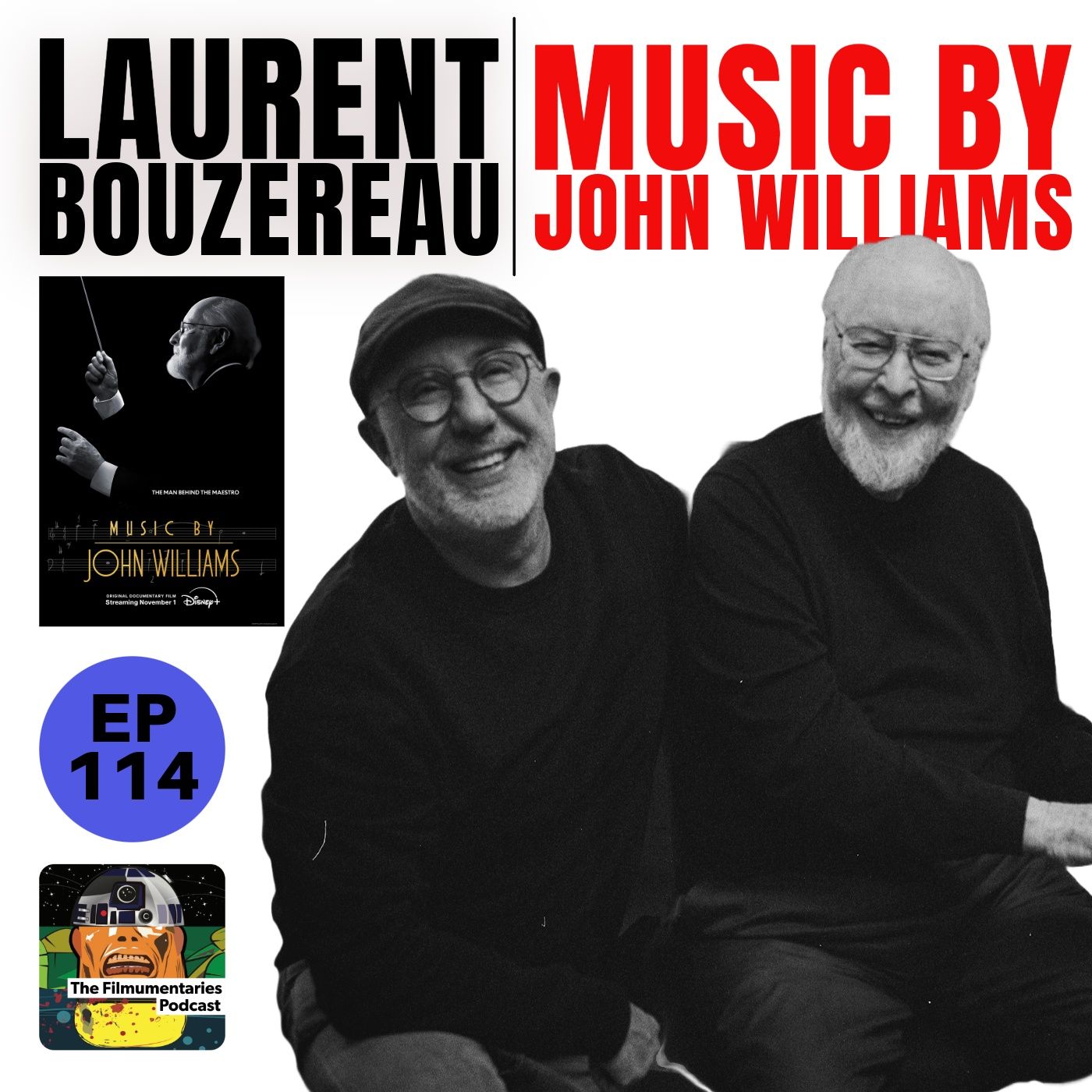
114 - Laurent Bouzereau - Director of "Music By John Williams"
About this episode
‘Music by John Williams’ is available on Disney+ and in cinemas for limited release.
UK Screenings of the film
Slimer Article at ILM.com
All the links
This podcast is completely independent and made possible by listener support. If you’d like to help me keep making these episodes, you can join my Patreon community here: https://patreon.com/jamiebenning
Watch more on YouTube:
Check out the Filmumentaries YouTube channel for behind-the-scenes clips and extra content: https://youtube.com/filmumentaries
All my links
Transcript
Automatically generated, so expect the odd misheard name.
Weirding Way Media. Welcome to episode one hundred and fourteen of the Filmmentaries podcast. This is your host, Jamie Benning. Blame me, it's November already. I'm just off the back of some very busy work and straight into recordings some more confident stations for the podcast.
Thanks to all of you who sent nice messages about my first article for ILM that still sounds like a weird sentence to say, that was published on Halloween. The article is about Slimmer in Ghostbusters, specifically looking at the Slimmer from Ghostbusters Too, which still resides at Lucasfilm's base at the Presidio in San Francisco. I saw it when I was there, this big animatronic lump green Lump. ILM and Skywalker Sound approached me back in August to join a group of writers they were gathering, and of course I jumped at the opportunity. Actually, I was on holiday at the time and I was sat by the pool at the villa that we'd rented coming up with ideas for articles.
I pitched I think it was eighteen ideas that spanned the decades of ILM and Skywalker Sound, and they basically said yes, to all of them, so I'm going to be busy, but good busy. If you miss the article, I'll put the link in the show notes. I still can't quite believe it. It's all very exciting, but look out for another article from me written for ILM in January twenty twenty five. I've already started working on it a quick thanks to the one hundred and ninety three of you that support the podcast by a Patreon.
I still can't break that two hundred barrier. I lost a couple of you this last month. I appreciate your support. Patreon, dot com, forward slash Jamie Benning, and for just twelve dollars for the entire year, you will help support the creation of at least twenty four episodes, usually more because I do bonus episodes. As you know, if you listen to the podcast regularly and as an extra bonus, you'll get an AD free version of the podcast if you do sign up on any tier.
There are multiple different tiers which you can choose from, but all of you get an AD free podcast. Others there's merch and there's early video versions of the podcast too, so please check it out. I do really need your support. If I'm going to continue this Patreon dot com forward slash Jamie Benning. All right, So for this episode number one hundred and fourteen, you'll hear my conversation with director and let's face it, behind the scenes god, Laurent Bousero.
I managed to find the press people at Disney and they kindly offered me thirty minutes Laurent to talk about his wonderful new documentary Music by John Williams, which is available right now on Disney Plus and in cinemas for a limited release. I watched it on Disney Plus on the first of November, the day it came out, and I was immediately keen to speak to Laurent about his film and his process. So here's my conversation with Laurent Bouzerat, and I'll be back at the end for a bit more jabbering on. But he's more than just a composer. He's just a brilliant guy who really understands the relationship between pictures and.
Sound is the perfect marriage between old classics and modern pop. He's both. To me. He's an incredible musical scholar of every style that exists. How does he do it?
The winner is John Williams for further on John Billions to job, John Williams, John Williams, forty eating John Williams. He's always in a process of discovery. It starts with what he experiences watching the film and then going to the piano and writing. The music comes from the sky and develops en. It's the purest form of art I've ever experienced from any human being.
Thanks for joining me today. We'll dive in as we've only got half an hour here. I must say, Laurn, I'm a huge admirer of your work. Those behind the scenes documentaries of yours going back to the nineties, I think I've seen them all. I thought i'd seen them are until I checked out your IMDb yesterday when I'm doing some more research.
There's more for me to watch, but that your latest film Music by John Williams. Oh I had me crying within about two and a half minutes, I think, and it had me laughing and smiling throughout and happy tears. So thank you for making such a wonderful film. First of all, well, now you know how I feel, because that was pretty much me throughout the whole production, and and and you know, at one point I was we were cutting and I had producers that and I looked around and everybody had a smile on their faces. And I've always in my tears of joy, and so I really feel that we tapped into something that I think, you know, it's not true for all generations, but definitely for mine.
And obviously, as you used. Him to to hint yours, is that he really scored the story of our lives. And I think that his music conjures and taps into things that were part of our awakening to move is to music, even because you know, I discovered his music because I lived in France like about six months after the movies came out in America, so I would fantasize by listening to the soundtracks. And so I was introduced into most of my favorite films through music first, and which is a really interesting thing that I've shared with John And that made me hopefully a good candidate to direct this film, because my relationship to his music was very, very much the first impression I got of a lot of films that then went on to become my favorites and everybody's favorites.
Yeah, I'm a little bit younger than you, but I had that similar experience where to experience those films again, having seen them maybe in the cinema, I was to listen to the soundtrack. There was no other way to consume those movies Star Wars for me, and I has been around all my life. Really. I was born in seventy six, so I don't remember any time before that, and he really has been the soundtrack to so many generations as well. You know, my kids know him from Harry Potter.
It's incredible that span of that career. I was trying to think if there's been a musical artist that's had that span, and I thought, oh, the Rolling Stones, I'll hang on. They were formed in sixty two. John's been doing music since fifty two, so he even surpasses them. Incredible.
Yeah, no, it's incredible, not only as he transcended time with audiences, but also with filmmakers. You know, it's very rare also that new generations of filmmakers who you know, essentially mey, grew up on a different type of cinema. I'm not surprised that all of the. So gone movie brats of the seventies loved John because they're very classically trained. But you know, the next generation really grew up on MTV and.
On commercials and that's where the training was and for those filmmakers, and then coming full circle with the new Star Wars films, to still embrace him a regardless of age, you know, makes him and the music timeless really. And Johnny is quite a private person. I've always gathered that from interviews with him, or you know, the snippets of interviews you would see over the years. He sort of lets his work do the talking. Was it difficult to convince john to get involved despite your your connections and your your back catalog of fantastic films.
Yeah, it was difficult, and it couldn't have done it without Steven Spielberg at the forefront. You know, when when I was involved with working on his naneieth birthday, John that is Stephen not yet that he. I said to Steven, you know, between Steven's archive, Mine Lucasfilm, Kathy Kennedy and Frank Marshall, you know, I said, you know, it's insane a man of off we have, and we must do a documentary on John this and and and Stephen approached him and he said yes. And then there was some resistance and even In a discussion that I had was John about the film. You know, he sort of said, you know, nobody really cares about me, and I know what he means by that, and but I said, you know, John, that's not true.
But you know, the big goal here is not for the film to be about you, but to be about your music and to be about your musicians and and and that was a big factor, I think, And of course the fact that I've known him thirty years and and he's very comfortable with me, and I with him, you know, in the same way that I'm very comfortable with Steven and I always have been, even if you know, they'll tell me of at times you know, we're done, you know, and asking too many questions. You had too many questions, you know. And it's in the film because that's very much part of my process with them, Like it's like, oh my, you know that guy again. But you know, I come from a really good place. I come from a very much curiosity and respect and and I never asked John, I tried a question, a personal question.
I always came at it through music, and I think he really appreciated that because I, even though I'm not a musician, I would say that I was trying to at least, you know, speak his language. And that was a big, big, I think, a big factor because after one or two sessions we did, I would bump into him an ambulance because. I'm always there, and he said, what are we doing our next thing? I'm like, oh my god, you're you're really enjoying that, right, and we did, you know, I mean, those moments with him at the piano, the moment's backstage of Hollywood Bowl, the moments in Tanglewood are unforgettable for me as a you know, someone who is pretty much the first audience to my own films. And I just loved it.
And I was really hoping that this film would would appeal to people. But you know, I sort of claim that this film is yes for people like you and I who love his films and generations, but I think it's also who people. Were not born yet. You know, what would we give to have that sort of a document on Mozart of Beethoven, you know, and I really feel he belongs with them, and to have allowed cameras into his process and the filmmaker, you know, inevitably it is subjective, you know, I bring a lot of my own bethos to that, and hopefully it mirrors that of many people. But I think he's exceptional and very courageous of him.
It's not something he likes to do. He's very much someone who loves to look ahead, not so much behind. And and I taught myself several times in my relationship with him where I would want to talk about my favorite soundtracks like Towering. Inferno Earth, and he would like go like, oh, you know, stop right now, time out. So it's it's interesting that he got into it.
And just like Steven himself, you know, he he gives they they both once they commit to something that really give you the tools to succeed. You know, I had no doubt that once and I would, you know, jam, I would go in and really talk to him privately. And this is what needs to happen in order to do a film like this. You know, this is not just a sit down interview and and and then we're done, you know, but you know, sort of really molding the whole, uh, the few events who wanted to cover and and also who else was going to talk and so it was a real collaboration. And as we know, he's a great conductor, so I followed his guidance.
It is fantastic those moments of him at the piano. In fact, that's the thing that was the first moment I kind of got tears in my eyes. It wasn't like a big moment of swelling music. It was him at the piano. The simplicity of it, and the playfulness and the childlike quality when he holds his hand up and he's playing with his left hand and he's looking at you, and you can you can tell how dedicated he is, but how playfully it still is.
And also what a nice relationship you two have that really comes across in the film. Oh thank you. Well, you know, I think it's those moments, as I said, were so precious. And you know, it was interesting because one thing that you know, when we're doing sort of a list of things, and I wanted to accomplish one of them that I had heard of that was, you know, sort of a famous thing, was the history of the five notes from Close Encounters, and had said to him, you know, wouldn't be great if you play the different variations, because I know you have them. He shows them in the film.
He's like, no, I'm not doing that because and that was such a lesson to me also as a filmmaker. He said, you know, the Close Encounters is a masterpiece. And we zeroed in on those five notes, and and giving the audience whomever, even if it's one or two, you know, giving them a sort of doubt about about what ended up being in the film is almost betraying, sort of like you know, my words not his, you know, sort of like showing a different mona Lisa and said, instead of the one that was ultimately chosen. And people are going, oh my gosh, it would have been so much better. Well, you destroy something that is really part of John's sculpture and part of a great film.
But what he gave me instead, he said, he said, but trust me, I will give you something. And and I I just sort of let him do this incredible demonstration at the piano comparing notes to grammar and and to words and and and that was a million times you know, more insightful than anything else I could have come up with. So so, like I said. You know, being in his hands or the fact I was making the film didn't mean like just Q and a kind of thing. It was really a process and one where he was trying to understand me as much as was trying to understand him, and and what this needed to be and and and for that, I think it shows in the film, as you said, you know that there was an exchange and one that could be you know, he says it, you know, I asked too many questions and you have a thing.
But you know, he said with. Such affection that we still get to the result, you know. Yeah, yeah, talking of those five notes, I'm making a documentary about Joe Alves, the production designer, the work on those encounters. Yeah, Oh my god. I like to talk to him all the time.
Yeah, I love. Yeah, Joe's great. We went out to La two March is running Mark twenty two March twenty three. I'm trying to do it in my spare time, either side of my job and my life and everything. But I had Joe at the piano at one point.
He just was trying to find those five notes, because of course he designed the board and everything, the lights moving around, and it's amazing when you hear the right five notes, nothing else is a possibility. That's the great thing about John's music. There's such an inevitability to it somehow it feels complete to us. And whether it asks that question like those five notes do, or whether it's you know, like raise theme, it just feels like it's always belonged, doesn't it. Yeah, No, for sure, And there is I think, as JJ always says, there's an inevitability about what he does and his scores that that you feel like that's the way it should be.
And and and you know, uh, for. I think it comes from he is constant yearning to learn, you know, someone who is a constant student of music and art and and is extremely deep you know, and and quotes you know, even if even if I don't say it flatly in the film, but he quotes right man enough, he quotes a lot of you know, people or that because he has that that much is language has been is being uh formed by his admiration for the classic the classic composers. So so there is that that thing there that that is uh and also a true understanding of the role of music in a film, which is in the case of Star Wars, you know, entering that bizarre world right off the bad robots that talk, and and and the giant Chewbacca and I mean on paper of course looked ridiculous, was barely uh you know, agreed upon while I'm filming, and and still a challenge in the cutting room.
Well, you know, the thing that brought us to this world was George, you know, but but John is the first, you know, after the galaxy far far away, like boom, you. Know, that's that's that, and it's it's. A music that's like you know, corn Gold, It's like, you know, you know, that kind of swash buckling kind of adventure, and we relate to that. And so the relatability that that we feel towards music is really what are Max those movies complete? And hey, you know Stephen says, you know, John here is his rewrite artist.
You know, you capture those moments really well. I think, you know, whether it's for George, whether it's for Stephen when they first hear that score and that feeling you get, there's that lovely moment where you see the countdown on the big screen and the orchestra already. Oh, that's quite a big emotional moment I think for the viewer because you sort of imagine what it must have felt like to hear that for the first time. Put against the film that you'd shot, you know, if you were George or Stephen, And well, yeah, I think you carried that off really really well in the edit. No, for sure, and thank you for that because you know, the thing that I hope the viewer can appreciate is that.
Making Star Wars was tough. Yeah, I didn't know what they had. So the music is either really gonna make or break this film, right, And same thing with Jars when Stephen suffers through and now we can laugh about at it. You know, the Shark wasn't working and all that stuff, but we're talking about and I'm making a film on jobs right now. You know, this was really dramatic.
I mean, I mean, as you know, you'll see the stories in there that have never been spoken of before that literally we were again, you know, I think superficially. You know, we've all said, oh, the Shark wasn't working and they went over a budget and all that. You know, that feels like something you hear about so many movies. But this was going to literally potentially destroy a man's career, you know, and potentially destroyer. Studio, you know, when ant of money.
But so I really. Think that. The trust that Steven had in John's vision for his score, which was, as we explained, completely the opposite. Of what he had imagined. It really X for sort of like this gud thing that you have about collaborators, and the film is a collaboration, you know.
And it's really important to underline that. And and and Steven and George and and Brian de Palmer. You know, he's not in the film, but I've spoken to him a lot about John and and all that, you know, recognize that. Yeah. Yeah.
One of the other things, of course I love about your films and this film as well, is the wonderful archive footage that you managed to find. Seeing some of that stuff that I've seen before but remastered in four K and looking kind of Christine is one of that archive that lucasfilm, and as you said, Steven's archive as well. It must have been a real treat for you to dig through. Yeah, it is a treatment. At the same time, you know, I realized a lot of it had been seen before, as you mentioned, shown by me or in other.
There's that BBC show from way back, wasn't there as well? Yeah, And the thing is is to use this stuff in a way that feeds your story and not at illustration. You know, this is not a coffee table book. You know, it really has a story. So you really try to uh find illustration that will feel novel, even to people we may have already seen them.
So so so. That was a real, uh, you know, a real dance, because how do you tell a story of someone who has lived close to a hundred and has been making and has been making music since the age of five, you know, I mean it's it's it's really hard and and you know, trying to find that chronological kind of thing, be a little more time thematic, and be out of sequence. You know. That's why you know a lot of people fought me on uh incorporating uh Branford Marcella is talking about catch Me if you can and the cantina at the beginning of john career when he's talking about jazz, and I'm like. No, no, no, that it makes sense, you know, totally makes sense.
But it's a bold move in yeah, in the kind of continuity that people usually expect, you know, and it texts you out a bit, but you know you have to be I really feel that that gives the audience alert. Oh my god, if they're talking about catch me if you can. Now they may bring up something else, you know, So there's a real uh, it's very you know, I write a very strong script and and and we of course digress from it. But I come in with, you know, a shell, a skeleton that is really a reflection of my vision and the story I want to tell, and then tuk to the editors to tell me I'm wrong, and then my producers. But for the most part, I can defend things and and I can also adjust easily because it's just so I'm so struck sure that if you go like this, I'm like, I totally know.
What you're talking about, you know, So it works both ways. And I have to say on this film particularly, you know, all the voices were heard and were part of a real sense of family around around the film, but around John, everyone involved had had a real connection to him professionally. Whether it's of course Stephen George and everyone interviewed, but Kathy Kennedy and Frank Marshall, Ron Howard and his team, you know, a Steven's producers. You know, all those people have been part of John's world in a sense, and so it was kind of great for me to come up with the idea of making the film with Steven, you know, but then sort of build a sort of family spirit around it. Yeah.
Yeah, And I guess it could have been a hell of a challenge for you to work out which films to spotlight or which music to spotlight, because there's just so much of it. But what I felt you never fell into the greatest hits kind of trap with it. Yeah that was tempting, trust me, because it's like, it's not that it was tempting as much as it was definitely something I was really much, very much afraid of. Is I don't want this to feel like a hit parade of his hits, you know, Nor did I want, because I know. John's reputation is impeccable.
You know, I didn't expect, you know, any one like challenging, you know, like you would if you were doing a film on Bernard Herman, you know, Hitchcock's composer, you'd have, you know, the voices of Hitchcock saying, well, I fired it. I fired him, you know from torn Curtain, and it was. Impossible to work with. I mean, there's none of that, But I at the same time, I just want to make sure it didn't feel like, you know, also a vanity project. You know that that would have felt also like sort of you know, not right.
So I wanted every single if we were gonna mention even iconic scores, you know, that there would be a story attached to them. You know, that was the rule. It's like, you know, even if you're listing you know, uh, several historical movies. He steal makes a comment about his love for history and how that was challenged when he worked with Oliver Stone, you know, and so there was really a lot of drama if I may, you know, within each of the sort of segments, even if at times it may have felt it could have been more, you know, just a listing, and I didn't want that. Was there ever a temptation to go longer than the feature and make it a series or were you kind of locked into the feature idea of the bat No.
That was really up to me. Again, you know, in concert, pun intended with my partners, But I really I have to tell you, I was coming off of doing Fade Down Away and I sat through it at the Contein Festival, and that movie was super tight. Was an hour and thirty eight minutes. I think and seeing those films, those documentary films with an audience, you really get a sense that they need to live within an hour and forty minutes kind of. And I have to tell you the greatest compliments I receive my work is that really rigorous goal to be under an hour and forty five minutes, because I think it sort of forces you to have a through line.
It forces you to be mindful of the. Audience, you know, capacity for a storytelling, and be aware that in today's world, you know, you know, around Oscar time, the biggest complaint you hear from every one, filmmakers and audience alike, is that films are too. Long, you know. And and I think you benefit as a filmmaker from saying, you know, this is my this is my goal, you know, and and uh and and I just I just stuck to it. And you know, I feel that within uh the script that I wrote originally, I know exactly how it clocks out is very very close to the very first rough rough cut what under was under two hours?
You know? Will you hit all of the sweet spots for me? I have to say, I really I really enjoyed the film, and I'm I'm so grateful that it was you that took this on because you know you were you were definitely the man for the job. Oh, thank you so much. That's that's super kind of you.
Well. I hope you enjoyed my conversation with Laurent I certainly did. Thanks to the folks at Disney Press for lining that one up. And a reminder to all of you listening that music by John Williams is available on Disney Plus and in some cinemas for a limited release, so go check it out. Coming up on the podcast, I have conversations with VFX camera operator Mari Anne Infield, concept and production designer John Bell, Mega styles collector Gus Lopez.
I've just booked him in. Also have Colin Campwell's widow Sierra, to talk about the new Colin Campwell site that friend of the podcast, Brad Cook has cooked up with Sierra. I've also just booked VFX guru Jeff Oakan plus my friend friend of the podcast and patron, Nigel Smith. He's a cinema expert. I've done one of his walks Cinema Walks in London, which was great.
Also just booked director Phil Hawkins, a name you may recognize so lots going on here at Filmumentary's HQ. I will be out of commission in a couple of weeks after some pretty major surgery I'm having to have. But I've banked up enough episodes to make sure there's no interruption in the normal proceedings. So while I'm bedridden, feel free to listen to the episodes I'll be putting out, and also do let me know if there's any TV series or podcasts that you'd recommend. I'm going to need some things to distract me from the post surgery pain.
I've been told I'm going to feel pretty terrible for two weeks. Anyway, Thanks for joining me, and I hope you can do so. For the next episode of the Filmumentaries podcast, we are taking away Media H



Similar episodes across the network
Matched by shared keywords.
-
Linus O'Brien - Unsung Cinema
2 shared keywords: john, the
-
Special Report: Mye Hoang on 25 Cats from Qatar (2025)
2 shared keywords: documentary, filmmaking
-
Special Report: David Kittredge on Boorman and the Devil (2025)
2 shared keywords: documentary, filmmaking