
Season 1 · Episode 115
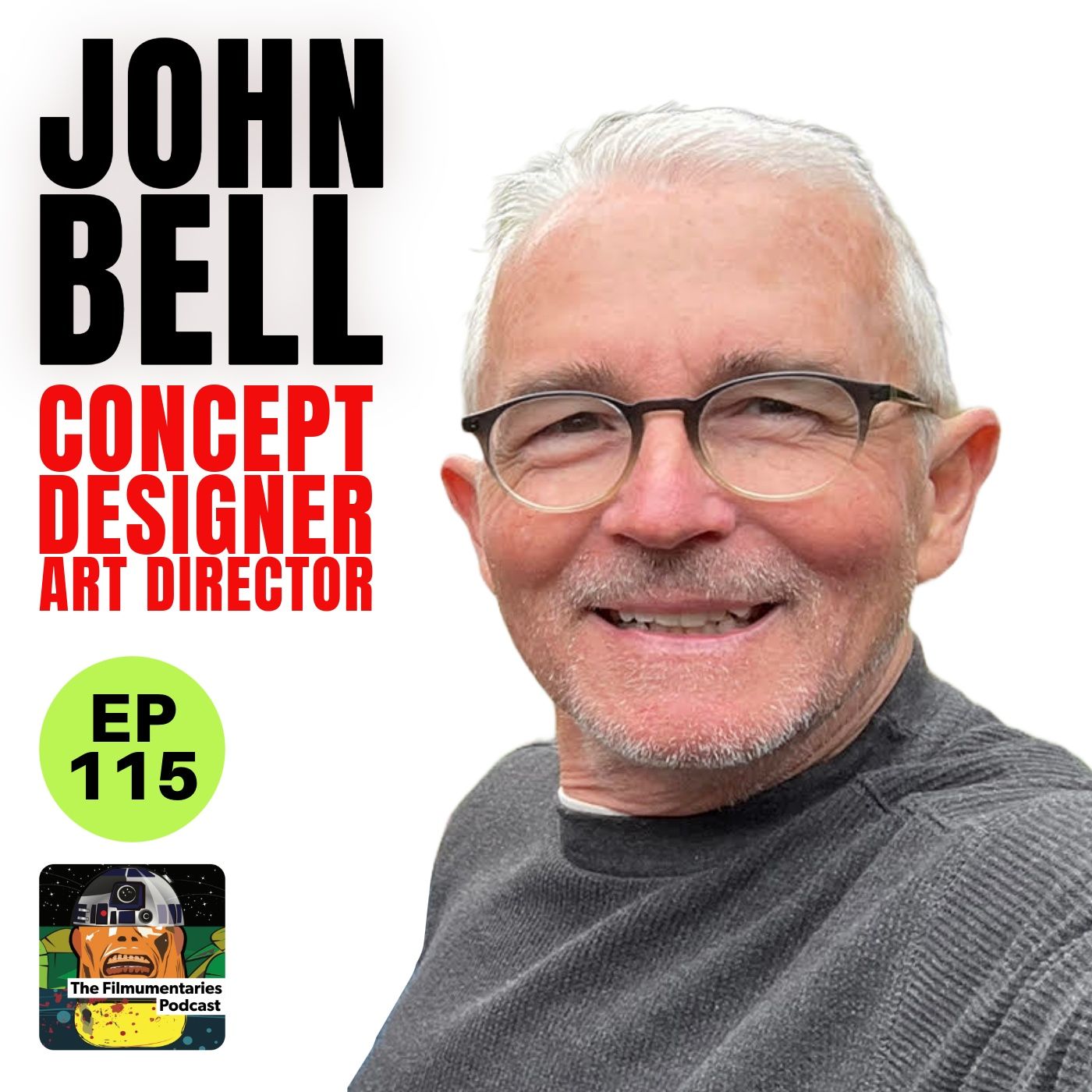
115 - John Bell - Concept Designer and Art Director - BTTF II, Jurassic Park, Antz etc

About this episode
John’s work has left a significant mark on cinema. In our conversation, John takes us back to the early days of his career, when he transitioned from designing cars at General Motors to creating video game concepts at Atari, before finally finding his way into the film industry. He shares the story of how a speculative portfolio sent to ILM eventually opened the door to a career that included working alongside legends like Nilo Rodis-Jamero and Ken Ralston.
We talk in depth about his work on Back to the Future II, where he imagined a future Hill Valley steeped in a mix of Americana and 1980s aesthetics, and Jurassic Park, where he brought bold, colorful designs to vehicles, props, and even the park’s iconic branding. John also reflects on how collaboration is at the heart of filmmaking, with directors like Steven Spielberg and production designers like Rick Carter encouraging his input while shaping the look and feel of these projects. We also cover his time working on Antz at DreamWorks, where he stepped into the role of production designer for the first time, and Rango, ILM’s first animated feature.
Throughout, John shares his approach to balancing creativity and problem-solving, and the importance of pulling inspiration from both his surroundings and his past experiences. It’s a wide-ranging discussion that touches on everything from the challenges of designing for science fiction, fantasy, and animation to how the industry has changed over the years. I hope you enjoy it.
All the links
John Bell Studio
This podcast is completely independent and made possible by listener support. If you’d like to help me keep making these episodes, you can join my Patreon community here: https://patreon.com/jamiebenning
Watch more on YouTube:
Check out the Filmumentaries YouTube channel for behind-the-scenes clips and extra content: https://youtube.com/filmumentaries
All my links
Transcript
Automatically generated, so expect the odd misheard name.
Weirding Way Media. Welcome to episode one hundred and fifteen of the Film Youmentari's podcast. This is your host Jamie Benning talking to you here from the UK. We're at the moment as I look out of the window, it's bloody snowing. Didn't expect that morning.
Before we get started, I just wanted to give you a little report on a much warmer, sunnier day just last week in November twenty twenty four, so I was invited to attend the memorial of producer Robert Watts, who I had previously interviewed at his house in East Sussex in twenty eighteen. I made a film from that called Robert Watts, A Life in Film, which is still available to watch on my Vimeo channel, by the way, and I also repurposed that interview as episode ninety four of this podcast. I stayed in touch with Robert a little bit since then and would occasionally see him at filmfairs and signings, and I was really touched to be invited along. The day itself was a gorgeous sunny day down at Wadhurst Castle in East Sussex, attended by many members of his family as well as close friends and colleagues, and I felt really honored to have been invited.
It could easily have been a somber day, you know, the loss of a giant in the industry, of father, uncle, friend, but it was instead a heartfelt celebration of Robert's life and career delight. I saw a few familiar faces there too, three of whom recognized me from our previous encounters. Producer and writer Evil Powell stepped up to tell those gathered about how they worked together on Stanley Kubrick's two thousand and one, A Space Odyssey when they were both young men, and a wonderful story of another connection they had via property in West London. It was really, it really was a beautiful little tale that Evil told amusing had everyone laughing, and there was a bit of sort of a wow moment at the end.
And there's just something about those stories of seemingly random connection that somehow appear to just be more than happenstance, and they transcend into something else and particularly resonant on such a special memorial day for Robert. Evil's stories reminded us. I guess that we're all connected to each other of varying degrees, some unbelievable degrees in this case. Oh. As a side note, Evil was the subject of my film Evil Power the Beginning, as well as episode twenty two of this podcast, And it was really nice to see him again and meet his partner and have a chat about things and cinema as a whole, and yeah, like spending time in Evils company.
And we agreed that we'd go on a lunch at some point, maybe when it warms up a little bit. Walter Merch was also there, and before we entered the hall, we were standing outside in the sun and I was able to say hello to Walter and remind him who I was, and he just said, yeah, of course, and we just started chatting like two old friends. Once we got in. He was the second person to talk. He talked about his relationship with Robert on returned to OZ.
Robert had stepped in as producer as the two previous producers had been fired under different circumstances, and Walter finished by saying that he wished Robert had been his producer all along because he knows that there would have been far fewer problems because Robert was just so formidable and so capable. Though He did start with a message from George Lucas, who he chatted to the night before, which was a nice for many who were attending. Both of those gents echoed each other's sentiments about Robert as an incredibly capable producer, wonderful collaborator, and couldn't have anything but nice things to say about Robert. Just some fun stories amongst those anecdotes from Walter, and from George Walter, by the way, he's coming back on the podcast next year when his new book Suddenly Something Clicked is released.
I asked Walter what the title was, and I just loved the little dramatic pause, the finger in the air, and then that wonderful voice of his soddenly something cloaked. I wish I could do an impression of him. I've tried. It doesn't really work. Next up was Robert's biographer, who chose excerpts from her interviews with several of Robert's collaborators, including Carrie Fisher, who said that Robert always felt like the grown up of the group.
She said that it was like he had the reins and it was nice for somebody like her who was so young at the time nineteen. I think she was on Star Wars, that there was somebody pulling the reins and really in charge of the situation. Roberts and Mechis, who again talked to Robert's brilliant abilities as a producer. They worked together on Who Framed Roger Rabbit, which was particularly grueling for Robert and for all of those that worked on it. I'm actually reading a very good book about that at the moment, Pulling a Rabbit out of the Hat, The Making of Roger Rabbit by Ross Anderson.
It's so detailed. I'm only like fifty pages in, but it's so detailed, setting the whole stage for what was going on in the industry and with animation. Really was a seminal film in many ways. I look forward to finding out more about it on the screen. We also watched a dedication from his close friend and fellow producer Jim Bloom, as well as Nick Mayley and Roger Christian.
Jim's message was particularly emotional and really resonated with the gathered friends and family. They were clearly very close right up until the end. I sent an email to Jim once I got home, just to let him know how much his message had resonated with family and friends and got a big reaction and a round of applause as well. He was very pleased to hear that we're going to hopefully have a catch up at some point soon as well. My friend David Whiteley did a great job of hosting and keeping everyone and everything together.
In fact, he set the tone for the day in his introduction. You know this was to be a celebration of Robert's life, and that's exactly what it was. David also put together a wonderful short video about Robert, using some excerpts from documentaries including mine and his, as well as many stills that I hadn't seen before that charted Robert's career. We then ate, drank and told stories for several hours, and I was particularly grateful to David and to Sue, Robert's former carer, for the invite, and to Robert's family as well for embracing me from the offset and letting me get there early and set up, help set up the room and offer support before guests arrived. A really nice bunch of people.
I had some very nice conversations that day and some funny stories about Robert, and it was nice to be part of what was a very special day. What a lovely bunch of people. Oh and I meant to say that. After I chatted to Walter and Evire, as we went to sit down at the table, I also spotted another familiar face, and it was a wolf, Carla from Raiders of the Lost Arc. He was the subject of my first episode of this podcast, which, by the way, I think you can only get on YouTube now, as the episode went missing.
When I moved over to my current provider, I'd interviewed him back in twenty twelve. It must have been for Raiding the Lost Arc my film Yourmentary. Anyway, I sort of saw him and I reintroduced myself to him, but he has a memory like an elephant. He recognized me and immediately and continued to shake my hand, saying Jamie, Jamie, Jamie. Wow.
He says, you know, I only just listened to our interview last week and it was great, and the vox pops the comments below were just marvelous. He proceeded to pull up a screen grab of the comment on his phone, grabbing me by the shoulder and thanking me again and saying he was really pleased to see that I'd got over one hundred episodes. Just a very very sweet man. Of course, as I told him, the pleasure was all mine. And I wish I could do his wonderful German voice some justice, but I'll spare you again another impersonation.
Couldn't do Water, can't do Wolf either. But we had a nice catch up, and he told me he remembered the first time he met Robert Watts. He said, we're at sea for the scenes with Captain Katanga's boat and the submarine, and we had to take a smaller boat out and when it came time for me to transfer to the big boat, I put my arms up and Robert just thrust me up out of the boat like he was a strong man and like I was a baby. But ye know, Wolf's a big guy. He's, you know, six foot plus and he's strong looking.
He said, like there was nothing to it, and he was really surprised. And then when his feet landed he was greeted by Robert's big smile. He was very strong. He went on to finish. Jeremy Bullock's family were there, of course.
He and Robert were half brothers, Julian Glover, Paul Blake and Paul Freeman were also there. I just was looking around the room kind of going, there's three Indiana Jones villains in attendance here. But you know, the bigger part of that is that they were all friends of his, and they all clearly loved Robert a great deal, and it meant a lot for them to be there. Anyway, it was a lovely, celebratory day, and I really felt like Robert's passion that he talked about to me, you know, in his enthusiasm and his warmth was with us on that day. There was I don't know, it was quite emotional, honestly, the sun coming through the window and just sorts of smiles, tears, hugs.
It really was lovely to be there. So I'll just finished by saying thank you to Robert for this episode number one hundred and fifteen. I'm talking to John Bell, a concept artist and art director whose career has spanned some of the most memorable films of the last four decades, from Star Trek, The Voyage Home to Jurassic Park and Back to the Future two and three. John's work has definitely left a significant mark on cinema. You know, I was looking through his website and just some of those drawings, which I'll talk about throughout the podcast.
As I'm looking at them and talking to John just they just kind of blown me away. How he's such a talented artist and he has such a good eye for creating a reality. And in our conversation, John takes us back to the early days of his career, where he transitioned from designing cars at GM to creating video game concepts for Atari, before finally finding his way into the film industry, and he shares the story of how a speculative portfolio sent to ILM eventually opened the door to a career that included working alongside legends like Nelo Rhodis, jamiro and Ken Rouston. And it was Neilo that put me in touch with John. Actually, I asked Nelo who else should I interview?
He said, Oh, You've got interviewed John Bell. You've got interview him. He's such a sweet guy, he's so talented, he's wonderful, and he's a great friend. And I couldn't agree more with Nelo's assessment. John is an absolute sweetheart.
I really enjoyed chatting to him. He's just so gentle and kind and yeah, we had a really nice conversation. We talked about his work on Back to the Future two, where he imagined you know, a futuristic Hill Valley steeped in the mix of Americana and nineteen eighties yet futuristic aesthetics, as well as Jurassic Park, where he brought his you know, bold and colorful designs of vehicles, props, and even the park's iconic branding that was him. John also reflects on how collaboration is the heart of filmmaking, particularly with directors like Steven Spielberg and his production designer friend Rick Carter, who he owes a lot to you know, encouraging his input whilst shaping the look and feel of those projects.
We also cover some of his time working on Ants at DreamWorks, where he stepped up to the role of production designer for the first time, and Rango ILM's first animated feature, and throughout John shares his approach to balancing that creativity and that problem solving with the importance of pulling inspiration from both his surroundings and you know, and his past experiences working for those those big firms like GM and Atari. It's a wide ranging discussion and we touch on everything from the challenges of designing for science fiction and then fantasy and then animation, to how the industry has changed over the years. And well, let's just say that here's my conversation. I've waffled enough with designer John Bell, and I'll be back at the end for a bit more jabbering on.
John, How did you first get into the industry? What was your path? The whole big question? Yeah, I mean, we can rewind it way back, but I think I'll just started where. See, it was nineteen eighty four, eighty five, and I was working at Atari Games down in Sunny Vale, and the company, you know, had really peaked in eighty two, so I was catching it at the tail end of it, and so I wasn't very happy there, but I knew I wanted to stay in the Bay Area.
I really liked the Bay Area at the time, and so I just looked up I remember, Oh, well, I known Lucas has some shop up here, Industrial ad Magic. I'll just find their number in the phone book and get an address and send them, you know some slides, you know, some from a slide sheet. I think there was twenty slides in a slide sheet and a resume, which wasn't much at the time. You know, I had only worked at GM before Atari. So I sent it up and I didn't hear anything for quite a while, and actually it was in like seven eight months, and so I thought, well, I studied as a car designer, maybe I'll go back into car design.
This is like summer of nineteen eighty five, early summer, and so I started looking around and Ford had had a studio down in southern California and it was being run by a next teacher from Art Center. We contacted them and he said, yeah, come on down, show me what you got. So I went on down, didn't go anywhere. I come back, you take them. I don't know what I'm going to do now.
Out of the blue, Ileen called and my wife at the time no longer married her. She says, hey, John, somebody on the phone had I ELM wants to talk to you, And I thought she was putting me on. He said he yeah, yeah, yeah. She goes no really, So I go over and get on the phone. And this woman, Pam Marcott, she was working with Neilo at the time.
I think she was like a production assistant or something. She said, Nila wants to talk to you. Can you come on up? I said, when is the woe to come up today? I'm supposed to be Antari, but sure, I'll come on.
And you were aware of Nilo at this time, well, yeah. From those from the books with he and those work in it, you know. So I was just staggering that he was actually had any amount of interest in me. So I went on up and I met him, and he showed me around and and and heired me. He said, okay, you know that what should have maybe come on and do some storyboards for us.
Well that was on Howard the Duck, and I had never done any storyboards, and in my slidesheet I included like a six panel storyboard for this LaserDisc project that Atari was doing, and it kind of started out abstractly, but it revealed this demonic clown at the end. And Neil said, out of all your stuff, that's what hit me the most because I liked the way you told a story and then you had to reveal compelling reveal at the end. So he said, here's a script for Howard the Duck. Read it. Start storyboarding, you know, And I'm ed before but met was giving it a shot, and after a month he said, I know you can do this, but for some reason, you're not able to do it.
I'm sorry, I'm gonna have to let you go. Right. So there must have been hot to take. Oh my gosh. After a month, yeah, he said, just you know, study comic books.
We study you know, other artists who do storyboards, and I know you can do this. I was, yeah, yeah, I'm sure i can do it. I'm sure I can do it. I'll do that. Neilo, thanks for the opportunity.
And I didn't study at all. I was so down. And so later that summer, I mean that ended in August, and so I was walking around Palo Alto and a friend of mine was coming the other direction and he was starting a educational toy company in Palo Alto. It's John and he knew me from Atari days. Why don't you come work for me?
I got nothing else going on. Sure, So I started working for him, and about three months after that, Ulo called back. I couldn't believe it. He has John, I'm I'll have more time for you. Comeray worked on start Trek with me.
That's kind of typical of Neilo to sort of almost blame himself for not giving you enough time and you know, giving you enough of his focus. But great that he saw that ability in you and then found a place to put it. Unbelievable, just really unbelievable. So that's how I got A long story short, that's how I got into working in the film business. So that worked for Atari.
That was purely designed based as well, was it? Yeah? Yeah, And I started working in there. I was working in Detroit at the time, nineteen eighty one eighty two, and a fellow student from Arch Center called me out of the blue. I knew him, but we really were close friends.
But he says, how's working at GM? And I wasn't very happy with it, And he said, and I asked, how's going with Atari? And he says, hey, should come on out. We'll give you a you know, we'll fly you out and at least you have that. I mean, even if you don't get a job, at least have a trip to San Francisco.
We'll have a good time. Yeah, So that's what happened. So I was got the job at Atari, and I was working for an advanced concept group and like I said, I was working on a video disc project and because they were huge. They were huge around that time, weren't they. Atari were just oh my god, yeah, eight thirty yeah, giant.
Yeah. They were trying to do these video disc arcade games. Right. It was kind of a really high concept thing. So it was a group of about thirty people working on this thing, and then Atari started going downhill and they cut out this whole all thirty people except me, my boss, and my boss girlfriend.
H So, looking back then, what do you think that was that Atari managed to lose hold of you know what? What was the reason? Was it because there were other companies coming up and using all the lessons that Atari had learned and kind of undercutting them? Or what was the mistake that Atari made? Do you think looking back?
I think they rushed out products because they were doing those cartridge games twenty six hundred. K and then the seventy eight hundred later yeah. Yeah, and so I think they bought a license to do the ET game yeah from Ambulance Universal, and that just tanked big time, and I think they put so much money into it, but it just disrupted everything beyond that. And then you know, public opinion saw these ET games and went Atari, They're doing trash over there. Yeah, you know, let's.
Look at somebody else's like a commodore. Let's look at Apple, which was just starting to maybe become a talking point for people. Yeah, there's a good documentary about that atari Et game where those guys try and dig it up. Well, yea, Luckily I was away from that, you know, I was on a whole different group. Amazing though, that the companies like that can have these huge peaks and then have that massive disappointment.
But when you joined back with I l M. I guess what was that eighty five, eighty six, eighty six was it? Yeah, for Star Trek, the Voyage Home, right, Yeah, they were at their peak almost then. I mean they've continued to peak since then, but that was a big time because that's when we're kind of post Star Wars. They're taking on all those other projects from other directors.
Yeah. Yeah, there is no other effects house going on, and there weren't even really any effects artists. You know, there was Neil o Joe, Ron Cobb, sid Mead, but he was really a film concept artist, although he'd done work on Blade Runner. Besides those people, you know, he could probably count ten and the most I were doing the type of job at the time. So yeah, I just locked up.
I called, you know, I called that phone book number at the right time, and Neilo took a campbell on me and got me in there. There really a big stroke of luck. And what what was your work on Star Trek like? Taught me through those sort of early weeks arriving back where you wanted to be. Those were fun because it was Neilo had physically moved out of c building into another building behind the main student the main stages, and so was it was Neilo and Phil Norwood were in that building.
Neilo was working on Star Trek, Phil was working on Phil was working on I think he just wrapped up Kun, so you might have been taken a break or something. I don't really remember. But then Dave Carson was over in the main building. So I come back. I'm working with Neilo in this in this back building, and the creature shop was right behind us, and the creature shop they were still working on Howard the dock.
Opened the door and there's forty people sticking feathers on latex heads and feet and kings. It was a burilla trip. Wow. But Neilo had me start with some really simple storyboards, you know, enterprise going left to right, right to left, bird of prey shots, things like that. So just some really fairly simple stuff.
And if I wasn't grasping what he was looking for, he would literally like draw right on top of what I was doing, give me notes. Yeah, you know. But after a few weeks he started giving me more things. There are a couple of props that needed to be designed, so I started designing a few of those. And he was looking at my storyboards one day and he sits down and I'm expecting him to just draw all over them again, and he says, can I have a piece of tissue paper?
I'm going to put that down on top so I don't ruin your drawing. And I looked at phil Nora and if I must be getting better because he's not drawing right on top of. My That's that's when you realize you're being complimented for your work. I've been complimented. But I guess for a film like Star Trek, you're kind of trying to blend, you know, realism with a sort of sci fi aesthetic.
Obviously it has to sort of read as real all of that stuff within that universe was that. Did you have to go back and study the other movies, the TV series or anything like that. I was pretty familiar with those, you know, the TV series from the sixties and then all the theater releases. I was really familiar with someone. I really enjoyed it.
I actually liked the Star Trek more than I like Star Wars, so he it was fun to be a part of that. And again, you know, the more I showed improve me with the boards, Nilo started saying, Hey, we need a prop for this, We need a prop for that. Can you give me some designs for those? So that was good. I mean, he really did live up to his word about giving me time, his time to educate me and bring me on and to help me get better.
And I know Nelo's talked to me previously about how on the early days of Empire, like he was sort of siloed off from Ralph macquariem from Joe Johnston, and then they would bring their ideas to the table at some point, you know, whether it's days or weeks later, and then decide if it was right or wrong, or if it was going in the right direction or not. Were you kind of left to your own devices to a certain extent. I know you said Neilo would draw on top of things, but was that a frequent daily thing or was that you know, you wouldn't wait for a couple of weeks and came back. No, we were. We were there in the same room the whole time, the three on, Nelo and myself, and so, you know, as I was producing things, we'd put him up on the wall and he'd you know, he'd make notes about what he liked or what he didn't like.
And then I you know, I didn't have a direct connection to ken Ralston yet, but as eighty six drew on, Neilo and Phil were trying to create their own ip in the in in the area, so he was kind of handing me off to ken Ralston, and I actually physically ended up moving back into the main building. So in the main building art department, it was myself and Dave Carson, and then other people joined us. Dave Lowry came in because Willows started to perk up. Yeah, yeah, I've got I'm just looking up to my other money to hear because I'm I've been looking on your wonderful website John Bell dot Studio, and you know, coming across some of the the fantastic artwork you've done over they is. I can see Willows here with about Mortar and some of the other characters.
I just I love those sort of concept studies, those like he Is because you're you're not only designing spaceships and designing props, hand props and scenery and things, you're also designing costume here. This is your job covers so many remits, doesn't it. There was a thing, you know, back then again there were so few people who were doing this time, and the other film companies would come to ILM and give me your ideas, you know of costume, ships and vehicles and props and riatures and everything. So you had to be really versatile to be able to do, you know, the Enterprise one month and then the next months here doing you know, some fantasy character from some fantasy land. Was it difficult to make that kind of adjustment being in that Star Trek world to then having to go to this kind of fantasy, more grounded kind of world.
It was? It was, Yeah, I guess you sort of surround because you're surrounding yourself with all this Star Trek stuff and you're building the world. Once that's taken down and you start putting up the Willow stuff, the world kind of changes around you. I guess, yeah, absolutely, Yeah, they have a lot of good reference books a time. I mean, the art deperment would just be filled with stacks of reference books, you know, from Africa and South America and you know, Nordic regions and everywhere under the sun.
And so you just start looking through this stuff and getting ideas and then putting those into your drawings and George would come in. It was funny because George would come in, you know, we'd have everything on the wall farm and he'd come in and he'd say hi, you know, kind of a group hello, and he'd walk over to the wall and he'd look at it and he'd pick up a red marker and he'd kick tick tick the marker down. Next week. That was it. That's all the conversation you needed.
Yeah, I've seen those, like those videos of George on the prequels, just highlighting areas that are the effects or put across through something or a stamp saying love or dislike or whatever. Yeah, but was that wasn't that production designer was Alan Cameron on Willow wasn't it was? Yeah, so was he working alongside you as well, coming in and visiting and giving you direction? He did. I remember him being there, I don't.
I don't remember how many times he was in the art department there, but I do remember getting introduced to him at some point along with Ron Howard. Yeah, and me growing up watching the Andy Griffith Show. I didn't want to walk in and go don't say opy, don't say op. It's it's a hard thing to resist, is that when you see somebody who you know so well, they have no idea who you are, of course, but you. Know, yeah, exactly was in the room at the time too, really, oh wow, because he had done a lot of beautiful, highly detailed pen pencil drawings, costumes and characters, you know, beautiful stuff.
Yeah, God, I love his stuff. So I did a bit of a deep dive on his work that he did for Hoderovsky for Unmade Dune, and there's some incredible illustrations. There's a guy who's got like a Google drive and every time he finds something mentioned somewhere, he chucks it in this Google drive, and there's just some incredible stuff in that film. You know, the whole European flavor. You know that he brings to to the world too, that you know here in the US, you don't get his kind of locked into certain traditions and yeahs word again dry inspiration.
But he's coming from a whole different universe. Yeah. When when you ended up working on Back to the Future Too for Robert Zemeckis, Nilo kind of said to me that one of the things that you always admired about your work was the sort of understand your understanding of Americana, just being able to sort of draw in traditional American imagery but put a new twist on it. Would you say, that's pretty accurate? I again, you know, he he handed that project to me, I'll beknownst to me at the time.
Yeah, he said to me, he said, I didn't know anything about America. Then he said, I just I couldn't do it. Yeah. So I started doing some early drawings for that because we had no script at the time. I was also nineteen eighty.
Six and wow early Yeah. Yeah, Neilo or Patty Blow, one of the producers, came in and said, yeah, we don't have a script. We know we're going to twenty fifteen. Just start coming up with some ideas on what, you know, Hill Valley could be, what hoverboards could be, what yeah, people were doing in twenty fifteen. And so I came up with about like thirty sketches over the next month or so, and we sent a slidesheet down to Samkas and then we didn't hear anything because he jumped on to Hull framed Roger Rabbit.
Of course, Yeah, which was all consuming, I'm sure, yeah. Oh yeah. So we didn't get back on Back to the Future until it. I mean, just that remit of you know, let's try and visualize what Hill Valley would look like in the future. Yeah, it's a it's a pretty open remit right there.
But I again, looking up through some of those some of those drawings and paintings you made, you know, of the of the hover boards and you know, the characters in those in those great kind of eighties inspired costumes and the eighties cafe and all that stuff. That stuff is like a lot of your word, John has really stuck in the hearts and minds of people. You know. When I think of Back to the Future too, I think of the hoverboards, I think of the eighties cafe, you know, I think of those those crazy costumes with all of the detailing on them and the gloves and all that stuff. Yeah, it's pretty remarkable that, you know, we're talking about that film in twenty twenty four.
Yeah, it's wild. I still get an email occasionally about helpboards, some guy from Kent over in England. Yeah, that's where I am now, the three are now, Yeah. He's sent me. He sent me some replica hoverboards that he has made, right, and he wanted me to sign a couple of the discs that are on the bottom of the Holvey.
All right, I wonder who that was. Yeah, I mean, well, I'm sort of London but on the edge of Kent. I was born in Kent, so, Mike, the town I'm living in right now is supposedly Kent but also London, so it's a bit of a weird mix. Yeah. I'll have to his niece, Dominic.
Dominic niece, Cup, I can send you an Instagram link. Yeah, that'd be cool. Yeah, Yeah, it'd be cool to see. That's That's the amazing thing, isn't it about when you've done work on movies like this, that the fans then taking it to kind of the next level of appreciation. I mean, the fans.
I'm always blown away by what fans are able to produce. Yeah, I know, it's remarkable. I mean they were producing the full sized taxis, you know, and the Deloreans. You know how many Back to the Future Gloreans are there out there, There's so many. Yeah.
Yeah. I interviewed Kevin Pike a couple of times actually, and I know he's he's kind of made almost a career of going to conventions and chatting to people about his work on those movies. Yeah, yeah, you're right. Yeah, but a lot of that inspiration that I when I started doing drawings for Hill Valley for twenty fifteen, I was really enamored by you know this magazine, ID magazine, Yeah, in the eighties. Yeah, I found a couple of those, and I started looking at the graphics, Neville Brody graphics and all this really cool stuff that wasn't in American culture at the time, but I really found it really engaging and exciting, and so I was trying to infuse all that into this Americana Hill Valley.
And I guess as well, one of your other jobs in designing a future is to avoid what other people have done. With their version of the future light sid Me did with Blade Runner for example. Yeah, and we knew that Hill Valley was a suburb, and in my thinking, I was thinking, well, the big cities are going to have one view on what the future is or you know, technology and how it produces itself in a big city, But in the suburbs. The suburbs are always about being optimistic and colorful and bucolic. And so that's really where I stuck with that in my head.
And one again when I saw those all those costumes and you know, ravers and everything in ID magazine and went, that's it right there. Yeah. Great, being able to know where to look to find that stuff. That can be the challenge because you can I know with somebody as I'm an editor, you know by trade, and just trying to pick a music track to edit with that kind of represents what you can spend weeks just going down a rabbit hole of trying to find the right track. You know.
I'm trying to edit something at the moment too, for a trailer for a Kickstarter and I think we've trained changed the track about four times now for the last few weeks. But just I guess just having that sort of repository of things that you can refer to, whether it's those art books at Lucasfilm or whether it's you know, your magazines that you've collected yourself, because you never know when something is going to become relevant. That's right, that's right. Yeah, And you know that's the great thing that the internet doesn't do. That was great about bookstores and record stores because you could go in.
You know, I'm sure I found those ID magazines just by mistake. They can accident. Yeah, you know, I was probably looking for something else and I glanced around. I went, oh, what's that? You know where on the internet you can't do that.
You don't have a collective view like in a record store. I'm going in to look for Captain Twins, but I find you know, dead can dance something. Oh that looks interesting, and how I'm gonna check that out? Yeah, stumbling across something that you wouldn't you wouldn't necessarily do with a kind of targeted internet search. Yeah.
Yeah. With Google you kind of have to prompt it get you into that zone and then you might find something. But it's shit, it's not the same. Yeah, I'm still trying to make a documentary about Joe Alves, the production designer on Jaws, Close Encounter, Escape from New York and a bunch of stuff, you know. And he talked to me about how back in his day, to find Devil's Tower, he drove three thousand miles around the States, you know.
He said, these days you'd just go to Google and you just find or you'd create it in v effects, right, you know. But to find something iconic or you know, to find something that fits the remit of the job, yeah, is a real challenge. But those those designs for Back to the Future too, I would I would sort of regard them was really culturally resonant, you know that. I there's they're They're just sort of embedded in my generation's minds. I'm sure those designs.
And you went on to did you get you've got a nomination for that an Academy? I did? Did you win a bathter? Yeah? We Brits know what we're looking at you, that's right.
Yeah. Did you did you come to the ceremony for that or was it delivered in the in the male? I didn't came in the mail. But my girlfriend at the time was Joanna Johnston really costume was hire. Yeah.
So after the film was done, we got in There was going to be a big VFX show at a museum in Tokyo, and Ken Ralston came in and said, Hey, John, you want to go to Japan? I said yeah, I said, when are we going? He goes, No, I'm not going. You're going to go? Do you want to bring somebody?
Let him know because you're going in two days? Wow. Well I called Joanna and actually Joanna and I went over there and the show over. There, and I'm sure fell in love with Japan, like everyone who goes there does. Oh yeah, you go to the Yakijabra and you're just overwhelmed by all the color and sounds.
Yeah, yeah, fantastic. I used to I work for Formula One quite a bit freelance doing television productions. So I've been doing that twenty five years now, and Japan was one of the few places because I'm now remote and my work's remote since COVID, It's one of the few places Japan that I really really miss going to because, you know, over the years, you just saw everything sort of homogenize, you know, like Budapest went from this, you know, Eastern Bloc country to now having Chanel stores and McDonald's and Starbucks and everything when you go to Japan. Okay, it does have some of that stuff, but it's the culture is so different there and it's just so I don't know, it's kind of overwhelming. From Yeah, I love it.
I love that though. I love just being stuck in a place, like in a village in Japan and just trying to figure my way around and. Yeah, yeah exactly. Yeah, well that's so exciting. Yeah, had a good time there.
Oh yeah, who was fun? It's fine? And did the conference? Did the thing happen in Japan? Like with the visit?
Did you go this big exhibition as well? Yeah, we went to this exhibition we had. It was run by this guy named mister Hata Jta, and he had us on a full junket all around Tokyo. He's taken us here and he's taken us there, and he he had an interpreter for us, and it's like we had three days in Tokyo, we had three more days in Kyoto. So who was fantastic?
What's some lifetime experience. Yeah? I went about eight times to Japan, and I feel so fortunate to have been able to do that and go to Kyoto and Tokyo and Kyoto Hiroshima, and yeah, it's crazy crazy. It's one of the places my kids like. When I talk about my travels, my kids like, Dad, when are you going to take us?
You know, the answer is when Dad wins the lottery. In a Formula one. Did you watch the series Drive to Survive? Yeah, well, we're kind of directly involved in that as much as we provide a lot of the footage and the team radio and all of that stuff. Obviously they make a drama around it, and of course that's been massive for the US market.
I mean I love it. Yeah, look forward to it every year. Oh good, Yeah, because it's funny like when I used to do Formula one. Say back in two thousand and seven, we used to go to Indianapolis and you go out in the town in the city and have dinner, and you get chatted to some locals and they say, why are you here in your sell Formula one? I had one woman said to me once, is that a cream?
And I had no idea it was going on because Indianapolis wouldn't advertise the F one race outside of its four walls. Pretty much because the indie brand was too big, you know. Yeah, but once we moved to Austin and now we're in Vegas and Miami. You know, there's talk of New York and Chicago and all sorts of other places. So yeah, it's that show has done done a huge service for.
For not only the technology of the cars, but the cinematography is so stunning. Yeah, yeah, yeah, it's really nicely shot. It's there's also the f One movie coming out next year, which has got Brad Pitt in it, and that we've been seeing some of that being shot for the last couple of years. It could be interesting because you know, motorsport fans are very particular about their sport, and all other attempts at a motorsport film have not really been good. I mean, Ford versus Ferrari was good.
Why I enjoyed that, But I really liked the one with Niki Lauder and James Hunt. Yes, that was good, even more rush that was Ron Hacken as well, wasn't it. Yeah that was good. But then you had ones like Driven By, you know, with Stallone, and they were just they were just a joke. You mentioned Ken Rauston in there.
That was it Back to the Future where you first got to work with Ken. Yeah. Well, yeah, for the most part, had there was a couple where they were doing it was an Eddie Murphy movie. A Golden Child or something Golden Child. Thank You, And I think I did like three storyboards for it, right, And Ken hadn't worked with me, so he was skeptical, who's this kid working with me now?
And so I had to kind of prove myself and I got to do a little bit of that on Star Trek. But then really we really connected on the Back to the Future films. Yeah. Yeah, yeah, you mentioned before we started recording that. You know, Ken has got a great sort of cynical sense of humor and he's a fun guy to be around.
Yeah. He's a real love hate relationship with the whole industry. Yeah. I love doing this, I love creating, but god, some of the decisions that get made. Yeah.
Yeah, I definitely got that kind of impression from him. He keeps that smile on his face there. He doesn't does big blue eyes. Yeah, years straight. Through You definitely did you you know, when you first got working into ilem and let's say you're you know, we're in what nineteen eighty seven eighty eight.
Now with Back to the Future, at this point, are you still kind of going back to those those books with Nilo's drawings and Joe's drawings to draw inspiration or is there enough around you going on that you know you're in your own world by that time. I think there, I'm sure I went back and I was still looking at those books and you know, those books, Sid and Mobius, those guys. But you know, you kind of have to just transition, you know, after Back to the Future films, I was moving on to the Rocketeer. Yeah, you've gone now twenty fifteen in the future and Back to the Future three have gone back to the wild West, and now Ricketeer, I'm going to the nineteen thirties. Yeah, So you kind of have to be a chameleon and be able to just kind of jump from one to one, from the one to the new.
But that's what's great about doing the work that you do, is that you do get to experience all those different eras. Yeah, and invent any eraror you know, in the case of Back to the Future too, and each one it's. A different education. You know, you're learning, you know, do you all of a sudden, I'm diving deep into nineteen thirties and Dave Steven's comic book, which is so great, but then all the other things around around the comic book that may bringing Los Angeles to life. Yeah, that's a film I used to love actually years ago.
I haven't seen it for a very long time. The Rocketeer, I should revisit that again. Yeah, I love the feel of that film. There's something quite singular about that. That was Joe Johnston, wasn't it.
Yeah? Well that Yeah, What was it like working with Joe, you know directing this time? Well, I was kind of I was kind of kept at ar, was leanked a little bit from Joe. Was really Ken and Joe had such a relationship. Yeah, that it was really those two going back and forth.
I mean I spoke to Joe a few times, but it was really through Ken. You know. If anything, it wasn't just me and Joe in a room at one time. It would always be me, Joe and Ken in the room or in dailies with the whole team at that point. Yeah.
So your design process and the sort of length through engagement on the film, I mean it starts quite early. I would imagine because you're trying to conceive of things. That's part of your job. But also I guess at certain points in productions they're like, oh, John, we just need this one other thing, you know, and you're there to kind of pounce as and when needed. Yeah.
Absolutely, Yeah, the beginning is the most fun because at that point, you know, the script has not been visualized really at all, So you're reading the sequences and you're making your notes about what you think is going to be an effects shot, and then you go back once you've gone through the whole script, start going back and then doing drawings of what you think the camera or could be to tell that story at that moment. Mm hmm. So that's fun. And you know, it's really fun when you do those first drawings and they don't change, because so many times they do change over time, either budget or the script has changed or whatever. But it's fun when that first little drawing on the xerox paper is in the theater and you're looking at it, you're you don't getting a rush of people reacting to it.
Yeah, Yeah, that's very cool. What was that trying to remember the name of the productions James on rocketeer. Oh, James bissel change, I've never known how to pronounce it. Yeah, Yeah, that was what I was going to ask, not necessarily about James, but just being in the in the screening room perhaps looking at dailies. How much is the sort of live action element or did you get to see the live action elements coming back to then inform your your your next designs for future scenes.
They were most know, there are mostly just compleates for the effects. You know, we'd look at those and then there'd be a discussion or we'd look at the story aboard about you know, the racketeer is going to travel this way or that way or whatever he's doing in the shop or the airplane in the shot. So it's that kind of process. Very cool though, to sort of come up with the first images from a script because you're starting it going down a roads. You know, you're starting that truck down road that where it can't be stopped almost because once you've established that look, everything is derived from that.
So there's some responsibility there, but also something quite vigorating about that. I would think it is, Yeah, you know, because you're becoming a cinematographer at that point. Yeah, Oh, you know, a low angles can be really great for this hero shot, or this big wide shot is going to be great for setting the stage of the environment that we're going until. Yeah. I guess there's multiple disciplines there, right, because you're sort of you're directing your editing in a way as well, because you're thinking about how shots will go together to a certain extent if they visually read, write, and things like that.
Yeah, So did you ever Were you ever attracted to the idea of directing. I wasn't, no, because I had by that time, I had kind of seen what it takes to really be a director and to have that ownership over so much information. But it was funny. I was working on Starship Troopers with Phil and I had all these storyboards and he goes, John, do you ever want to be a director? I think he could be a director.
That's too much responsibility. I guess as well. Back, yeah, right, but I guess as well. In Phil's mind, he's thinking about maybe I could be a director as well, you know, because he went off to do the second one of that, didn't he the Starship Troopers two? Yeah, Yeah, we'll get back to Starship Troopers because I want to talk a little bit about you know how sometimes things don't always gel, because I believe some of your work on Starship Troopers, you know, there was some sort of disagreements within that.
But just want to go back sort of chronologically, if you like, because the next sort of big tempole movie I see your name against the course was Jurassic Park. Classic Park is just this enormous movie. I mean, even today you can watch that movie and it feels fresh, and it feels new, and those shots look great. I mean, that t rex attack I think is probably one of the most compelling visual effects sequences, yeah, ever put on film. I mean, it just still looks incredible.
How is it possible that still looks like incredible remarkable? Yeah. And then but then looking at your drawings, John, I can see those shots in your early drawings. You know, you can see the rain and the color and the color escape and the framing and you know, the truck there. Tell me when we you first brought on to Jurassic Park, and were you aware of this kind of size of the project from day one?
I was, and I was actually after I finished up Rocketeer, I talked to ILM management and I said, you know, I think I want to take some time off this summer figure out what I want to do next. Because as an art director at ILM, you kind of reach a ceiling. You're not going to be made a supervisor. So am I going to just stay at this level? Or do I want to try to become a production designer for a live action film or something.
So I've taken some time off. Joanna was doing Far and Away up in Montana, so that I haven't been to Montana in a long time. So I went up there and spent some time up there, and out of the blue, Rick Carter calls me. Now, Rick really brought me on to start back to the future too. He said, yesked ILM back in eighty eight, can we borrow Johns for a couple of weeks, you know, have him come down and work in the art department.
It's a couple of weeks turned into like four or five months. So I owe a lot to Nilo and I also an awful lot to Rick Carter as well. So now nineteen ninety one summer, get a call from Rick Carter at the Hotel John. I'm working on this film Jurassic Park. I want you to come down and work on it be an art director on it.
I said, okay, well, when when do you need me down there? I mean I'd just come into montanaly five days ago. He says, can you come down next week? We'll I was open to had some time off this summer. Okay, well when can you come down?
So we negotiated that i'd come down in like early September, and so I went down there and he brought me into the art department. They'd already done so much work on it. So just look at what we've done so far, and go round the art department, get familiar with people and what's been done, and then just give me your take on it. You know, redescript and look at what's been done, but then put it aside and just give me your take on what you think this film is. Right.
So that's yeah. He was so generous with giving me that leeway to just say, here, what do you think of it? I think, yeah, I can imagine a situation where you've got so many people working, making so many rendering, so many drawings and paintings that you kind of can't see the wood for the trees, and you need somebody like you who has this kind of you know, ability to create a world that is readable, because that is one of the challenges, isn't it with making any film is everything has to look like it belongs in that world that's being created. But at the same time it has to be believable. But at the same time, it can't be homogeneous in a way that feels like it's a small world.
You have to still make the world feel big. Yeah, And so the things that I was seeing, I wasn't seeing, you know, because I knew it was going to be like a theme park, and for me, going to theme parks, all I remember it was all the color. Yeah, and so for me, I was trying to introduce a lot more colorless names. That's why the vehicles look like they do, especially more you know. It's so it's pretty garish and bold, but.
Yeah, it's cool. It's such a cool design though, and you know it really it really sort of tracks the eye, does that I'm looking at your sketch now notes as well, it says John Hammond's Jurassic Park, which I've not noticed for in the designs. Well, that was the thing. When I was reading the script, I kept, you know, John Hammond has created this thing. I think he'd have a big enough ego where he'd want to have his name on things like Disney now yeah, yeah, yeah right.
So so. Yeah, that's why I put in John Hammond. Yeah, and the interior and the goggles and you know, the night vision goggles and all of that is all your design. Yeah, it goes back to my training as a car designer and product design your back at Art Center College. Did it feel like you'd sort of come full circle at that point, like bringing in some of that that knowledge that was that was buried, you know when you had to go and do starships and witches and wizards and all sorts of other things and superheroes and now you're back to cars.
Yeah, and you know the car the paint jobs are really bold. Paint jobs is an extension of when I was a teenager. I was going to drag races, right, and I ended up designing paint jobs for funny cars in risk cars, so and you know they were that was in the seventies, So all those colors are really bold and graphic, and so yeah, Jurassic Park Explorers an extension of me designing funny cars as a fifteen year old. That would never have occurred to me. But now you say, I can really see it.
I used to have a top Trump's game with all the drag cars on there and all the designs, and I used to realize so yeah, yeah, So where did you grow up then, John New Jersey? Right? Okay, yeah, about fifteen miles west of Manhattan. Yeah, yeah, with all Montclair And was there a drag strip near there? Then there was what about forty five minutes away?
Right, so we'd hound my father take a Sunday Sunday there's going to be you know, the Blue Bax versus Johnerald Jen please take us. That was a big sport then, right, It had a real following. Yeah it did. Yeah, I still stay somebody engaged with it, I know. But in Jurassic So you're designing, you know, hand props, you're designing vehicles.
But also that that unfinished room at the end for the for the sort of climactic moment in the film again another iconic shot as the banner's falling down. That banner was designed by you, right, yeah, the kind of unfinished room. What was your inspiration for that particular scene. For that room? Well, that room actually came about.
That was a budgetary thing and Rick Carter because Stephen wanted that whole inside to be finished, right the park is opening tomorrow morning and everything has to be done. But they realized the budget wasn't going to allow for that. So Rick, in his genius, says, well, why don't I make it look like it's still under construction that hasn't been finished. Yet, amazing, which which is such an important story element. Isn't it there because they're testing this place out?
Yeah? Great? Yeah, yeah, yeah, So that's how that that image that color sketch came about. It was really trying to represent what Rick had in mind. Yeah, yeah, so such a such a cool design.
And then I see, like the the kind of backlit shot of the Raptor coming through the door in one of the storyboards you did on that. I mean, again, that's that. Are you trying to when you're when you're doing storyboards, are you are you sat with Stephen and Rick or are you kind of looking at Spielberg's style and kind of trying to think how would he shoot this? Well? For that for that Raptor scene, Dave Lowry was also working on that scene and so we're bouncing drawings back and forth a lot.
But as far as some of the other scenes, yeah, would be I'd be sitting at the table, Steven would be sitting across from me, and Rick would be sitting off to my left or right and safer. When the when the raptor is going to attack the kids in the kitchen, Rick would lay out a big blueprint of how he saw this whole layout of the building being and he'd say, you know, we're thinking about the kids come in this way, they're going to go around here, then they're going to go through this door and into the back into the kitchen, and blah blah blah. And so Steven would go, okay, I need some pay and a pen, and he'd we'd give him a paper and a pen, and he's sitting across from me and he's starting to draw.
Well, his drawings you are pretty much like stick figures, like you know, Lexus in the background, she's here and there. There's not a lot of information. I have to interpret what he's doing mirrored from the other side. Make more a little bit more detailed drawings so I can go back later on and finish them up. And so we'd be like at that, going back and forth for like a couple of two hours.
Wow, and at some point at certain points, Steven go, Okay, I'm kind of stuck here, but his mind is like a projector, you know, he's figuring out shot to shot to shot shot, and so he, you know, he'll say I kind of got stuck here, and then Rick will throw up an idea, and then maybe I'll throw up an idea, and Steven would either go, yes, I like that, or he'd go, no, that's not going to I know we're I need to eventually go, but that moment's not going to get me in there. So we got to come up with something else, and then we'll be back to this rushed drawing and I'm trying to keep track of him. Afterwards, Rick comes up to Giz, I don't know how you did that. You were flipping what he was doing and making more detailed drawings at the same time.
It's crazy. I know I did it either, But. All of those all of those skills that were, you know, behind you had built up to that point where you could achieve something like that. I think that was several people I've spoken to. Ilm actually said that One of the things that surprised them about working there was the speed at which you had to do your work.
You did Yeah, you had to make decisions. There was no waffling back and forth. Oh you know that's screwhead on that boot or that belt. Yeah, can we work on that a little bit more. Now.
Ken was great with saying, if they're looking at that, they're looking at the wrong thing. He was great at making a decision yeah and move on. Yeah. And Nilo also talked about how, you know, if he was creating a spaceship, you'd do it kind of rough because he knew the lawn Peterson and all those guys in the model shop would be the people detailing it all. You know, I'm looking at the design of like the embryo container the can from Jurassic Park here that you did do you you know, it's a fairly sort of rough sketch of how it will work, but it informs you of how it's going to work because you can see the little vial there in the little holder and its circular and everything.
When you pass that on to the department, the prop department and the production design department, are they coming back to you and saying, well, John, does what does this mean? Does this mean that? Or are they just going with it and making their own interpretation of it. That when they're good, they just go with it, right Like for that barbosol can. Yeah, that was one sketch I did.
I didn't do any other sketch. Wow. I never even colored it in. But we took it down the model shop and they said, okay, we'll have you. You know, we'll show you something in a day or so.
See, they'd call you and you'd go back down and you'd look down and go, yeah, that looks great. You've made the thing. Yeah, you've made the thing I designed. Yeah, that must be very cool seeing those sort of final products. If you like that, you've that you've designed and thought through, and then they've added their own little twist of things as well, and suddenly it's a real thing.
That's what's That's what I feel, and I know I'm in the minority. Is missing with concept art these days, because you look at the sketches that Neili and Joe are doing too for Start for Star Wars, and those don't have they've got some detail, but they definitely allow. For Lauren Peterson in the model shop to have some ownership as well. Definitely, nowadays concept art looks like a file finished rendering out of the film. Yeah, with all those intricacies.
Yeah yeah, all you're doing is you're handing it off to the to the next department and they have no ownership to it. They just say, okay, I'll get that done for you. Mm hmmmm, I'll three D print it or whatever. Yeah. Yeah, yeah, which is kind of sad, isn't it.
It is just looking across your stuff on Jurassic Key. You know, we talked about the can and the cars, and you know, the goggles and the banner, and then there's the cage from the opening sequence that you designed as well, the sort of the science lab room and you know that we can see a sketch of people on computers looking at molecules and things and the entrance to the park. I mean, your your your fingerprints are all over this film. People. I think people sometimes disregard the collaborative nature of filmmaking.
Yes Spielberg is the director. Yes, Rick Carr is a production designer. But you know you as you as a concept designer and industrial design or whatever your title was on that movie, that your fingerprints are all over it. Yeah. Again, you know that goes back to Rick being generous person he was, because he said he did on Back to the Future too.
Also just said, give me your take on this, what's it going to be? And it still has to get approval from Stephen, but for him to give me that leeway to run with it, you know. Yeah, I owe so much to him and just was talking to him yesterday. Oh yeah, hey, I still love the guy. Nice see with Neil.
L Yeah, yeah, well he said the same about you as I said before he recorded. He's you know, he's got a lot of love for you and your work. And he obviously he loves his work and he you know, people know his particular input into the film industry and into culture. But when he knows he can't do the job, he's happy to step back and give it to somebody like you who can. But like Neilo in many ways, I you know, I said to him, there's no sort of distinct Nilo style, and it's the same with you, John, there's no distinct.
I couldn't say, oh, you know what, we're doing a dinosaur move. You know, he's good with dinosaurs. It's John, you know, he could, or yeah, he could create us a theme park because he's done theme parks before. But your work is just so broad. Do you think have you ever sort of considered how people perceive your talent or where your talent lies.
Is it because people hire you because you have this breadth of understanding and ability, or do you think they have in mind, you know, your previous projects. Yeah, I think it's I think it's really you know, what did you do for me lately? Kind of mentality? You know, and I think we talked about a little bit before, is you have to really be kind of a chameleon. You have to be able to shift time periods and really re educate yourself.
It's a constant re education. And for me, I always liked the variety of things want to I got burnt out at GM because you know, I'm drawing a car again and again and again and again. I love drawing cars. But you know, there is guys sitting next to me on either side of me that had been doing it for thirty four years. I'm thinking, I don't want to be in this in thirty and forty years.
I don't know a lot of them do, but something I need more variety. There is something quite empowering about knowing what you don't want to do, you know, or what you don't want to end up doing. I had the same feeling when I started working. I had a government job in London here when I first left school, and I was looking around again at the people that were just about to retire, who work there all their lives, and I immediately knew, that is not what I want to do. You know.
I want to travel, I want to see things, and I want to do you know, a broad range of things. When you when you went onto the sequel for Jurassic Park, The Lost World, did you did your role expand were you able to kind of developed things further now the first movie. No, because I was art director co art director on the first one with Jim tea Garden, Jim handle everything that was going on over in Kawai. And then on the second film, Rick again called me down to work on it. But I have keen down that at that point just as a concept artist, one of you know, several concept artists on the show, so my you know, my role was more limited.
They knew that I could do vehicles, so that was really my main input on the film was doing vehicles and some props, but for the most part it was just vehicles. I think I was on it for only a I know, maybe a few months. Jurassic the first one, I was on for like a year. And a half. What did you think of the final result when you saw that first film on this big screen for the first time.
Oh my gosh, I was blown away. It was just remarkable because you know, you're you're sitting in a theater with people who hadn't you know, they don't know all the behind the scenes stuff that went on to get you to that point. So to hear the reactions and their gasps and they're oh my gosh, you know, and all their emotional reactions, that's a real thrill. And again seeing storyboards that actually didn't change up to the big screen. That was again, there was such a big thrill.
Yeah, very cool to have that initial idea and just see it fully rendered in all of its glory. I mean, I still I still remember going to see that movie. I think I was like sixteen seventeen at the time, and it was the first time I'd been in the cinema and kind of just gone, oh shit, you know, the sound, the vision that everything has just like kind of pinned me to my seat in that kind of cliche way that people talk about, but it actually happened, you know. I remember like letting go of the seat and I've been I've been kind of gripping it through that t Rex scene. Yeah, it's very cool.
I'm you know, I still haven't convinced my kids to watch it with me. Actually, no, one of my kids watched it with me and said that was pretty good. Actually, now, when you saw I as a teenager, did you go with somebodies? I did. I was at school and a bunch of us went down, about six or eight of us went down to the local cinema and saw it.
And you know, I've never I've never been like a horror movie guy, And in some way, Jurassic Park is a horror movie. There are some pretty, you know, pretty heavy moments in there. I remember looking across at a younger kid just thinking I hope he's okay, you know, because this is pretty intense for me. Yeah, yeah, yeah, very cool. It's funny.
I'm doing another podcast episode in a few weeks with a friend of mine who does some tours around London. Of like some of the old cinemas, the old theaters really And I put a question out to some of my followers about what's the kind of cinema experience you remember the most, and so many of them have come back to say Jurassic Park. I feel it's a generational thing, is one, I'm sure, because most of my listeners are sort of forty five to sixty, I guess. But also I think, you know, it's just such a moment in cinema history where the you know, it was turned up to eleven at that point, wasn't it. You know, all the oh, the digital age really took hold right there.
Yeah, absolutely, the start of kind of where we are now, I guess. So, I mean Starship Hoopers kind of falls into that category as well, because Paul Verhoven, you know, Phil Tippett wanted to render these these giant spider like aliens, and you know, it was a combination of practical and CGI again a successful move in terms of its you know, vision being rendered. But you worked on that movie in what capacity. I did again the concept artists. Yeah, I was brought in.
Phil actually got me involved with the project and I was doing storyboards. I was designing a lot of a lot of peripheral stuff. There was, you know, a lot of like some of the helmet design there were some graphics like arm bands and flags and yeah, you know, things that kind of filled out the world, filled out university space and things like that, some early ship designs. But then I got in Jim Martin. I think he ended up doing some of the more finished designs the ships for the film, and that, you know, I got reacquainted with with Cameron, the production designer, Alan Cameron, Alan Cameron, Yes, And I reminded him, I said, I remember working with you and Willow and for some reason we just didn't hit it off on Starship Trooper.
I mean, he always kept me off to the side, Hey can you do this? We need something for that. So I don't know what it was, but it didn't Gell. But the funnest part was doing storyboards with another artist named Jacomo and Paul Verhoven. You know, his personality is a really big, outgoing personality and Phil at the time was a big, outgoing personality with a lot of passion, and so they'd come into the storyboard room, they'd be talking about a scene and they're just like yelling at each other.
No, it can't be like that is going to be like an and then he's going to go like this. Literally, before you know, one of them is down on the floor, you know, was the other one standing over with them, just pretending to banet him or something. And you're quietly sketching this in the background. So that was probably the littlet vivid memory from working on that film. Yeah, so much fun.
I look at the films you worked on in that sort of period in the nineties. You know, Men in Black as well, another film that had so many sort of fun, well comedic kind of elements as well. Yeah, and like. You said, with the Starship troop of stuff, some of those designs that kind of flesh out the world. They're those things that viewers often take for granted.
You know, they don't know why they're buying or not buying a location or a costume or a character or a setting or whatever it is. But it's your work that's contributing to that in subtle ways. Obviously, sometimes it needs to be a big dramatic thing, like the gates in Jurassic Park, but other times it can just be an insignia or something like that. Is that work that you relish as well, the kind of the minute stuff. Yeah, I do because I like kind of telling the story that you don't hear in the script, but just by gathering the images around.
I really like SEP dressers because of that. You know, they're going to put the correct radio in the corner, or the lamp or you know, the upholstery on a chairs just right. You know, they're just making all those decisions that really make that space believable and gives you more insight into the character that you're connecting with. Yeah, because we do it in real life, don't we. If we walk in somebody's house, we're immediately making these hundreds of judgments about their choice of wallpaper and carpet and sofa and picture frames, and well I do anyway.
Maybe I'm too judgmental, but we do do that, you know, and that's what creates the picture of we have in our mind of somebody's personality and how they express themselves. Yeah. So those things must be really important for the cast as well, to kind of fill their character fleshed out and their surroundings flesh. Yeah. I think so that's why I enjoyed doing you know, like on Jurassic I did some costume ideas for the film.
They didn't particularly follow them that closely, but it was fun just to give an idea of what the kids might have been into. Like I think I put a baseball cap on Les and at the time in the book or in the film, she was the younger and rulder, and so I gave him, you know, I went back to my drag racing world and they gave him a down the Snake Prodowned T shirt. And I gave somebody I think or Da La Soul. I gave somebody. No, I gave somebody else, Nedri.
I gave Nedri a stock car T shirt to wear, and I gave I gave the boy. I gave him a Da La Soul T shirt. Then nice, he's kind of old enough to be into hip hop. Yeah, yeah, because I'm back to the future, isn't there somebody with a Frankie goes to Hollywood like oh yeah, yeah, yeah. It's just those little things that puts them in their place, and you know, you know what kind of kid that is, because it's amazing, isn't it.
You know, if you see somebody with a T shirt on, whether it's your team's T shirt, or it's your band, your favorite bands T shirt. You start, you start working out who this person is. Are they like me? And you identify with them? Those things can be quite subtle in a movie.
But my goodness, they really helped, don't they. Yeah? I think so. I think so. I look as well, like I'm aware we're just going over the hour here, so I'll only keep you another fifteen minutes or so.
But this is great. I'm lucky. Then I see the film Ants in nineteen ninety eight working for dream Works? Am I right in thinking that A Bug's Life was almost released almost exactly the same. Time Bugs Life Crushed?
I love dance though, what a weird cast? Woody Allen, Christopher Walking, Yeah, Jennifer Lopez, Gene Hackman, Yeah. Sylvester Sharon Stone, Yeah, Sharon Stone. Any Glover was in there as well, I think. Yeah, what was Katzenberg thinking?
Yeah? Yeah? But yeah your work on that then? Were you more sort of productions? Yeah?
Yeah, And I wasn't sure I could be a production as I am, but it made my emergency called a Rick carter Rick. They want me a bit of production, as I may think I can do it? He goes, hey, what's the worst to do? They just fire you? Yeah, you're right, Okay, I'll take it.
So I met with Stephen and Katzenberg and they brought me on board. So it was fun to you know, any chance I had to work with Steven again was going to be exciting because he was kind of the antithesis of George because he would just be this fan of ideas and very collaborative, you know, be very open to me saying me being comfortable enough to say what about this part or what about that part? And then him either saying yes or no to it, but at least he was open to a conversation. Yeah, yeah, that's very really great. Zamechas was like that too.
Yeah, I've heard that about Zamechis as well. Who did I listen? I listened to an interview with him with Mark maron the other night, actually on his podcast, and he's talking about his new movie, and I think, you know, in speaking to Joe Als as well, he was very complimentary about Stephen in that way where initially in his early career, you know, when he worked with him on Sugarland Express, you know, he said, I feel like I'm stealing from you, you're giving me all these ideas, and Joe said, that's what we do. You know, if you like it, we'll do it. If you don't, we'll find something else.
But yeah, he kept that open throughout his career. It sounds like, yeah. It's told me so it's one of my best ideas of somebody else's. Yeah, that's great. How great to be able to acknowledge the importance of other people's input and all of those things.
But working on ants is that? Is that your first sort of full fledged animation at this point? So yeah, what what sort of challenges does that pose against a live action. Well, you know, with with live action, you know, you'll go to a set and you know, the trees are already there in the grass and the sky with the sky is with with animation, everything has to be conceived. There is has to be designed and created.
So that's a big challenge. You know, there's a lot of elements that have to go into it. Again to make a world very believable or you know, suspend believes, you know, a hard hand level world. Yeah, and you have to kind of buy that world quite quickly because it is alien to the world that we're in now. Whereas you say, like a tree in our world, we go, oh, that isn't that's a tree.
And you see a tree in Jurassic Park and it's a tree. But you know, to see those elements in a fully three D rendered animation, you know, it's quite those. I like those designs of the ants because they're so bold, because you know, in many ways, you don't immediately go, oh, that's an ant, or you go, oh, that's some kind of in Oh, okay, they're ants, right, because we're not used to seeing ants with eyelids and you know, antenna that curl up and and emote and all of those things. Yeah, I think I still have an affection for that film. Actually, it's kind of disappeared a little bit, like I don't feel like it's held in the sort of control sphere.
Like my kids probably wouldn't know what that movie is the wrong generation, but maybe I should show them. It was always a second and fully you know, CG animated feature. So yeah, right, Roy's story was the one before that, and Hants came out before Bud's life. Yeah, but Ants we had three directors, so that was a challenge too, because as a production designer or art director, you're always trying to tap into their sensibility luck with it, and so when you've got three, I mean it's hard enough sometimes with one, but with three, it's a real challenge. Yeah.
And then the tone that they were really looking for. They wanted the world to be very oppressive and monochromatic. And that was another thing that sent the audience to bugs life because Bud's life was you know, magenta and blue and bream. And and cute and round and bubbly and yeah, yeah, colorful. Yeah, yeah, maybe that speaks to where I was in my life at that point then that I preferreds.
Yeah. And then and then you were back with Stephen Spielberg on AI artificial intelligence, doing some characteristic visuals and things. Again trying to create a future world who doesn't exist, not leaning on what had come before and all of that stuff, and another big challenge, I'm sure. Yeah, there was a lot of different things. I was doing some storyboarding on that, and then I was really doing a lot and the how's that section called where the robot Fair where the people were cheering to see the robots get dismanaged?
Yeah, yeah, yeah, the fun Fair I think it was called. You know, I haven't seen that film in a long time, but I keep meaning to revisit it because I hear that it's aged fantastically and it gets better with age. Oh, I'm going to watch it and then too. Yeah, I think it's called The Flesh Fair. I can't remember.
Yes, yeah, something like that. Yeah, there was, you know, I got to design some motorcycles and some hire balloons and some characters and yeah, so there's a variety of stuff again, and you know, worker with Stephen was fun. Yeah, having that two way street again. I hope you know that you were able to come up with ideas and offer ideas that that must be one of the most sort of happy making things in your career in the in the sense that you know, you can create these amazing designs, but you work with so many people that were willing to have your input and respect your artistry. Really.
Yeah, I mean all the way back to working at ILM originally was the lack of ego. You know, people would just be so open, Oh, John, that's a good idea, or hey, Steven, that's a great idea. You know, Bob or whoever it was. They would just you know, take those ideas and make it a collaborative effort. It makes it that much richer.
Yeah, and all for the betterment of the film or the show as you often called it itself, because once you remove ego, you make room for all of that collaboration, don't you. I mean, I've worked I've worked in live TV for many years, and there are some egos there that definitely put walls in front of making a good TV program, I can tell you. Yeah. I do want to talk to you at some point as well about Rango, because ILM have actually invited me to start writing art calls about their history. I've just written one about Ghostbusters too, which is coming out on Halloween, my first article, and then I'm gonna be writing another article about their animation kind of Wing and Rango of course, was there.
Another fun project? Yeah, so much fun with with ILM doing their first fully CG animated feature was just a blast, you know, And I love. The design of that. Again, I'd never seen anything like that, just that kind of You've got that wonderful kind of wild West grungy kind of used feel, but also just the character himself, you know, it's just such a wonderful design and just so evocative as soon as I think, as soon as I see that word, I can conjure that character in that world so quickly. Yeah, I think.
I think the directive for Johnny Depp was that he's kind of like Don Nott in the What's a Something Gunslinger of the West did some Western film back in the sixties, and I think that was the leaping off point for China Depp to kind of tap into down knots of the sixties. Was it the Shakiest Gun in the West. Shakiest Gun in the West? Yeah, I remember. Yeah, I'm starting to do a little bit of research already.
And was Gore Rabinsky one of those directors in which you could kind of work with collaboratively and have a two way street. Yeah, he was. When he came in and presented the film. You know, he put up storyboards for the whole film up in the Island Art department, and they had nailed down so much of the story. You know, nothing was changing.
It was just ilm just needed to pretty much execute designed some things still, but really execute on these characters that Crash had created. Yeah. Yeah, No, it's a cool film. I definitely I'm going to be watching that multiple times in the next few weeks. Yeah, so that was once so again I got to design some cars, I got to design some architecture, a lot of storyboards.
You know, that was really fun. And when you're working on something like what any of these movies that we've talked about, are you not only pouring through magazines and books but going out in the real world and taking inspiration from from what's there. You know, maybe in this case, going to like a junk yard or something for Rango to get some of that kind of you know. Oh yeah, there's there's stiff being pulled from my parents' house back in New Jersey. You know, some some things like shovels that they have, rusty shovels and farm equipment and things.
Yeah, yeah, that was pulling from. And then I've always been a lover of old Westerns and the Southwest, so I'm well versed in a lot of trips down to the Southwest and taking pictures. And Neilo told me long time ago, said the best designers are the ones of the best memories. So I try to keep that in the back of my head. It's a good line.
You're not gonna know when you see a certain cloud formation that you might be able to turn that into an enemy for a film or a game or something. Or might see a beautiful color accommodation on a bird. You might be able to use that for a character somewhere. Yeah, it must be difficult not to exhaust yourself visually with all of this input going in through your eyes and into your brain every day, all day. And I mean, how do you kind of do you still enjoy drawing just as a as a fun pursuit without that necessarily an end game.
Oh yeah, I still create my own artwork for myself. I have an Instagram page with just my paintings on paintings are our images, kind of abstract images of the Southwest. And so yeah, I still enjoy that. And even now if I'm working on a like I'm working on a video game project, and I still start with pencil and paper, and then once I get it to a point where I think I like it, I'll kind of tighten up the drawing, scan it into the computer, and then do the finished work in Photoshop. You mentioned games because you you ended up working in games later on in your career.
That that was Anilo did the same, Actually didn't he He went to ea, and yeah, so I was working at and shook things up a bit while he was there. He did me, Yeah, you certainly did. Yeah. So, yeah, the games thing is is a whole different beast, you know. It's Yeah, they don't have the hierarchy, the clean hierarchy of a film.
It's a little more Oh you know, Kenny did something over here and Erld did something over there and kind of throw it together. Is that something you enjoyed though? Workings? It pays the bills. It pays the bills.
That's that's a good enough answering that. Yeah. I mean, it can't all be amazing. It can't. You know, some some of the games have been really fun to work on, and then some of the other ones, like Okay, why are we doing this?
Yeah? Can you please make a decision? You know, we're halfway through the budget and we're halfway through the schedule. Where's our main hero? Yeah?
Right, blimey. Yeah, yeah, it sounds a lot more chaotic than even live TV sounds, yeah, or live TV is in my world? Yeah, well yeah, no, it's it's I'm glad you mentioned your Instagram page because I started following you a few few weeks back. And I've really been enjoying going through and just looking at your artwork and on your website as well, which is John bell dot Studio where people can see some of your work. I saw that you had some really cool back to the Future stickers available for a time, which have sadly, sadly sold out now that I've found them.
Yeah, well, if I can find any around here, I'll send them over to you. You're very kind. You're very kind. Well listen, John, It's it's been such a pleasure to talk to you and absolutely talk to you about all these amazing films you've worked on. And I just I've loved the last week or so just pouring through so much of your artwork and coming to realize, you know, just what an amazing artist you are.
Well, thank you so much. I really appreciate the time. You know. It was really fun coming down memory road and having some good laughs about what's been done in the past. Yeah, and I'm sure we could have done another hour quite easily.
Yeah, and some things we didn't cover, but yeah, it was fun, definitely fun. And when I do these interviews, I have not really questions, I have topics, I have talking points and One of the things I was supposed to ask John was some questions that you guys had put to him my patrons. I'd asked you on Patreon if you had any questions for John, and you came forward with some questions, and I totally forgot about it. So I contacted John again and asked if he was around for the next couple of days. Unfortunately, he was busy working on a project, but he did find some time to record his answers to those questions and send them to me, So here they are.
It's nice to. Hear the question from or the statement from Duncan figureto Yeah, I'm glad he discovered me online and that he liked that the drawings looked handmade rather than interchangeable and digital and homogenized I think were some of the words he used. So yeah, I try to I try to do as much actual drawing before I get into doing something finished. So that's how I'm answering that the question from David Ale was Having worked as a designer illustrator in films, video games, graphic design, et cetera, do you find that they call that they all call for a broadly similar set of skills or do they require different approaches now? They pretty much anything from film, games, graphic design, I go through the same process.
It's all about trying to create images that support the story that the director or directors are trying to achieve. And what I do a lot of times is try to find some before I even do any drawings, is try to find reference images that I think speak to what the feeling, the tone is that the director is looking for. And once I can get them to kind of funnel in and focus in on a particular reference image, then I can start drawing and be more productive for them, and I can save the production some time and money, which is always important to do when you're doing concept art for a project. The second question from David Ayling had to do with contact and working with Bob's mechis, and Bob was really great to work with, much like Steven, very collaborative.
He always had a ton of ideas that he wanted to express, but he was always open to having the people around them express their ideas as well. So it's very unique, you know, I've only had that experience with a couple directors, but Bob was definitely a lot of fun to work with on contact and again getting to reconnect and be with Rick Carter and Ed Verrow on that show. Was was a good time. Yeah, designing that whole fourth dimensional or being part of that fourth dimensional voyage at the end of the film that was that was very exciting. I really really enjoyed working on that part.
Well. I hope you enjoyed my conversation with John Bell there. Thank you of course to John for his time and for Neilo for putting us in touch. John's and another of those people who is just so easy to chat with, and it just it went from you know, started off as an interview and just ended up just being a nice conversation. I feel like there's so much more we could talk about, but maybe that could be another time.
And like I said, I'll hopefully be speaking to him again soon, because, as I mentioned in the conversation, my next article for ILAM is going to be about their animation wings history, So I hope to chat to John again soon. You know, he worked on rang Go, their first animated feature. Look out for that particular article in the New Year the early New Year twenty twenty five. If you didn't see it already, do check out my first article all about the animatronics using Ghostbusters to focusing on that ugly little spud Slimer. I'll put the link in the show notes.
Honestly feel very privileged to have been able to write something for ILM dot com, and I'm hoping that there'll be many more to come, right, I just wanted to say this, So for three years now, I've been working away on this podcast by myself, building a community of listeners. Obviously, I made the return of the Jedi Timeline book with Justin Berger, which by the way, is still available on Amazon. Go and buy. It's twenty dollars twenty quid something like that. I've hosted that panel at Star Celebration about and Or, and I've recently been asked, as I said just a minute ago, to write these articles for ILM and Skywalk Sound.
And people seem to think that Film we Mentors is my main source of income. But despite all that work, you might be surprised to know this, It is only about eight percent of my income. The rest is through my regular job, freelance TV work that I've been doing for twenty plus years. And sadly, you know the industry is struggling a little bit at the moment, so that work is drying up a bit too, So as a sort of plea, I wonder if I could encourage you to support the podcast from just twelve dollars for an entire year. That would be twenty four episodes at least, plus bonus episodes, and you get certain perks depending on the tier, but the minimum is twelve pounds for the twelve dollars sorry for the year, And it really would make a big difference to me.
You know. I know, for instance, that over six thousand people listen to the podcast last month, and that generates about sixty dollars in advertising, maybe even less. But if just ten percent of you supported the podcast via Patreon, that would make a huge difference. If you've ever considered buying me a pint or a coffee, well, twelve dollars is not too far off that, and it would really make a massive change to how much time and effort I can focus on the podcast. I'm not going to go into it anymore, but if you like what I do, I really really really would appreciate if you could support it.
I know that you have your outgoings, you have your Netflix and your Prime and your Disney Plus, but those are massive corporations. You know. I'm one guy trying to make I'm trying to get to a point where i make a living out of doing this kind of thing, and I'd really appreciate it. If you can't do that, please just leave a review on Apple Podcasts. It would make a massive difference if this got to more people, because if I get over that ten thousand listeners, that's when advertisers come on board and it starts generating a bit of money.
But I'm still a ways off that at the moment. But with your help, I'm sure we can do it. Join the Patreon. Even if you join the free part of the Patreon, you can be part of, you know, the behind the scenes stories. You can find out what's coming up next.
I'll be asking questions and I'll read out your answers in future episodes. So yeah, do just get involved. Get involved with the podcast. I'd really appreciate it. Thank you.
Coming up in future episodes, you'll hear my conversations with ILM camera operator Marian Infield. She keeps getting pushed down the pecking order because I keep getting other interviews that come in that just seem a bit more prescient. Marion's interview is a great one, but it's one that can hold for a while. Now. There'll also be cinema historian and tour guide and pal of mine Nigel Smith, the long term partner of Colin Cantwell, Yes, that Colin Cantwell.
Sierra Dahl is also on the podcast to talk about the new website and if your patron do check out the most recent email i'sent. There's a little offer in there related to Colincantwell dot com and the things you can buy on there. I've released it to everybody else in a couple of weeks or so. There's also sound professional Vicky Sampson who's worked on over one hundred films. I'm going to talk to her today.
Also, I'm talking today with Gus Lopez, the Super Star Wars collector, is part of that Saga Museum endeavor with a few other collectors, including former guest Steve sand Sweet. I've also just been put in contact with direct to Alex Cox. Yeah, Alex Cox, Movie Drome Sid and Nancy repo Man, and I'm going to interview him next year the latter part of the year regarding his final film, which is currently on a Kickstarter. That's very cool. My friend Danny put me in touch with him.
Quite excited about that because Movie Drome really sort of informed my love of cinema, his introductions and that sort of special curation that they did in that series. If you're a britt you know what I'm talking about. If you're a bit of a certain age. If not, just look up Movie Drome Alex Cox. I'm sure there's some stuff on YouTube.
I'm also working on getting production designer Rick Carter, as mentioned in this episode, a colleague of John's, as well as a long list that I have with i Lem and Skywalker sound alumni. I've also just been put in touch with a location manager, a role that I'm eager to find out more about. That's what I love about this podcast, just going into their world for a moment of finding out more about their jobs and a new respect for what they do. So yeah, plenty more to come, Keep the support coming, keep sharing, keep telling people about the podcast. Thanks for joining me, and I hope you can do so for the next episode of the Film Yourmentaries podcast.
The Film Yourmentari's podcast is produced, edited, researched by Jamie Benning interviews are by Jamie Benning. Music is by Michael Hewitt Brown of mb Music, EMBE Music dot co dot uk. And thank you to weirding Way Media for letting me be part of their podcast collective, weirding Way Media y



Similar episodes across the network
Matched by shared keywords.
-
Primetime - Kulture Meltdown
1 shared keyword: to
-
Seasonal Differences, Shifting Fandom
1 shared keyword: the
-
Resident Evil - Kulture Meltdown
1 shared keyword: the