
Season 1 · Episode 116
116 - Nigel Smith - Cinema Historian and Tour Guide

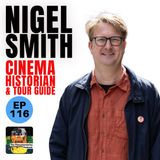
About this episode
- Nigel’s early love of cinema, sparked by watching Superman II as a child.
- The evolution of his passion from movies to the buildings that housed them.
- The rich history of London’s cinema culture, including iconic locations like the West End’s movie palaces and quirky cinemas like the Prince Charles.
- Fascinating discoveries from Nigel’s research, such as a Camden cinema run by a medium who let spirits dictate the programming.
- The enduring importance of community in cinema-going, from bustling matinees of the past to modern film clubs like Tufnell Park Film Club.
Links and Recommendations:
- Learn about Nigel’s walking tours: Memory Palaces
- Visit the Cinema Museum in London: cinemamuseum.org.uk
- Explore the Kent Museum of the Moving Image: kentmomi.org
All my links
This podcast is completely independent and made possible by listener support. If you’d like to help me keep making these episodes, you can join my Patreon community here: https://patreon.com/jamiebenning
Watch more on YouTube:
Check out the Filmumentaries YouTube channel for behind-the-scenes clips and extra content: https://youtube.com/filmumentaries
All my links
Transcript
Automatically generated, so expect the odd misheard name.
Weirding Way Media. Welcome to episode one hundred and sixteen of the Film Youventories podcast. I'm your host, Jamie Benning, coming to you from a now Chilean damp uk. I won't keep you long. I've just had some pretty major dental three teeth taken out, two wisdom teeth, and the pain is pretty awful, so I'll jump straight in.
This week, I'm joined by my friend and cinema historian Nigel Smith. Nigel is the creator of Memory Palaces, a website project dedicated to preserving the history of London cinemas, whether still standing or long lost. Through his research website and walking tours, he's built a fascinating story about the evolution of cinema going in London over the past century. Nigel and I go back quite a few years. We were connected by my Inside Jaws formumentary.
Nigel is a Jaws and nut too, but this time it was my turn to sit down and ask him some proper questions. We talked about his early love of cinema, how watching Superman two as a four year old sparked his long life passion. Amazing, how many things we have in common. Really, we're almost exactly the same age and how that developed into his deep interest in cinema. From West End movie palaces to forgotten news real cinemas, Nigel's work covers the architectural and cultural history hidden in plain sight.
We discuss his walking tours, which I've had the pleasure of joining, where he blends his personal memories with historical anecdotes. He also tells us about some of the quirky discoveries in this conversation, like a Camden cinema that was once run by a self proclaimed medium. Nigel has an incredible ability to connect the dots between people, places and films, and our conversation is a lovely reminder why cinemas remained such an important part of our cultural fabric. So here's my chat with Nigel Smith, cinema historian, and I'll be back at the end for a bit more jabbering on Nigel. I've been on your walk, you know, with friends as well.
We talk about films pretty much all the time when we meet up. Now it's now it's my turn to ask you some questions. What was it that sparked your interest in in cinema as a kid, and then what sparked your interest in cinemas as an adult. I think as a kid, my dad, you know, loves movies, not to the same degree that you and I love movies, but you know, we would watch old movies on TV, and you know, and I'm talking when I'm three or four, I guess, and I remember the you know, the Johnny Weiesmuller Tarzan movies being on TV a lot, and my dad getting nostalgic watching those and a lot of Westerns. And again my dad would buy me comics when I was very young.
I suspect also as a bit of nostalgia for himself. The one that I latched onto immediately was was Superman. The first film that I ever saw at the cinema was Superman two. So I would have. Been four years old.
So my dad took me along to that, and I know the exact day it was, you know, the date in May nineteen eighty one, because it was the day of the f A Cup final. My dad missed watching the football on the telly to take me to the cinema. And it must have had, you know, a profound impact on me, because you know, even at four years old, I remember, you know what one of the trailers was the Ray Harryhausen Clash of the Titans with the Pegasus, the flying Horse and the little mechanical bird, and that was it really, you know, once I saw that, all of those movies. I mean, you and I are the same age, so e t I remember going to see at the cinema Return of the Jedi. Return of the Jedi was the first Star Wars film that I saw at the cinema.
I actually saw Return of the Jedi before I saw Empire. I filled in the story with Empire with the little fifteen minute book and cassette. Yes, with the pretend actors. Yeah like that. Yeah, it wasn't really Harrison and Mark and carry.
It was some sound alikes. You got a little arty duty making a little sound when you have to turn the page. So yeah. Ever since then was deep into movies, but particularly you know, growing up those types of those types of movies, Superman, Star Wars, Indianma Jones, all of those, and then cinemas themselves. In terms of what I do now with these walking tours and my website, that really the spark of that was sort of about twelve years ago.
I live in Islington in North London and Islington had some sort of art film festival, you know, run by the council, and one of the events was a walking tour from one end of Holloway Road to the other. And for those of you not don't you know listening, you don't know North London, Holloway Road is a very long main road, shops, pubs, restaurants and quite grubby, you know, it's not I would say a destination street, you know for visitors in London. But this walk was led by this an artist called Sam Nightingale, and he'd done this amazing project called Islington's Lost Cinemas, and he had a large format camera, you know with the the I get what I can what they call but you know the sort of the slot, the things that he's slot in, the plates, the plates, the plates, and the little hood you know over him he would take he took these.
He did this photo series where he would take these photographs of buildings in the locations where there had been cinemas. And this walking tour was pointing these out, accompanied by his photographs, and what amazed me was a just how many there were, you know, I don't know. Holloway Road is a mile or so long. And I felt like, but there must have been ten, all within close proximity to each other, and you know, and the fact that they weren't really there anymore or there were little fragments. So when I started thinking about doing walking tours, I was like, I've got to do I really want to do something similar similar to that and that.
So I've been doing the walking tours for a couple of years now and do more and more of the mex boring more parts of London. And what is so fascinating about it is for a lot of people, it's very relatable. Most people, very few people have never been to the cinema in their lives, and particularly you know, if I do the tour that I do in the West End, the one that you've been on, you know, people have been to those cinemas, you know, so so people come with their memories as well. So that's the website that I have is called it is called Memory Palaces, and and that was that was you know, it was a deliberate, deliberate name because it's so evocative. Yeah, yeah, I love doing that walk with you and the bunch of people that came along that day, because it's really interactive as well.
You let people sort of tell their stories as well as you telling your stories and your knowledge about each of those movie palaces. People are able to say, oh, I remember seeing you know, the Fugitive in here, and you know, you might have a fact about that premiere or something, which is great. And I felt like it was a really nice way to sort of meet like minded people as well. Yeah, definitely, I mean it's really nice. On that West End tour, we finish at Picture House Central, which is you know, it's a really nice cinema in central London.
It's got a really great bar and cafe, and I always encourage people to sort of stick around for a cup of tea or a drink afterwards. And I've got a few little artifacts related to the cinemas that I've scoured on eBay that I show people afterwards, and people share their stories, and particularly the story of the cinema that sort of seems to generate the most stories on that West End tour is the is the Prince Charles, which is, you know, one of London's most best loved cinemas. I don't know if it was the group that you were on, but there was a guy there who remembered being taken as a teenager by his slightly older sister to see Man You. Well, yes, yes, that was the tour I was on. Yeah, yeah, and then this I did it, did it recently and there's a guy on the tour he remembered going.
He was a student in London and he went to the Prince Charles Cinema. They'd often do these all night screenings and but he only wanted to see al Pacino Scarface, which was at four am. Sorry, he stayed a full night at home and then and then gone to the cinema at four am to watch the Scarface. And when people talk about I've never done it all night, I don't know if you have, but it's struggle etic. But when people have told me about the all night it seems like three four am it's when people start really losing their minds and sort of drifting exactly exactly that.
So to turn up sort of fresh, ready to see al Pacino Scarface at four am, I thought was pretty funny. Yeah, there's always that talk is though about you know, you get out of cinema what you take in kind of thing. And you know, I've certainly changed my opinion on films through throughout the years as my life has changed, I've gone from really disliking movie to almost having it in my top five. You know, really what's what's Blade Runner was one that when I first saw, I just don't think as a kid, I understood what was going on and why it wasn't a Harrison Ford kind of Indiana Jones exactly. Yeah, I think I thought the same, although I still feel a little bit similar.
About I can't imagine how I would be if I had seen the a film for the first time at four am. I mean, goodness knows what's going on in your mind? You know, you're probably hungry, You're you're sort of tired, hallucinating. Going back to what you were saying about Superman two, though, that was one of my first movies one, it's my first movie memory really in minute. I saw that in a cinema graves End where I grew up in Dartford in Kent, and I remember queuing up in a really long queue.
I mean it was only four or five, I guess, but I remember queuing up under some scaffolding. It's funny. I don't have huge memories of the of the film. Maybe a couple of memories about Zod and was there walking on water in that movie at one point or something? It's the water, isn't Is there some guys fishing and the peers?
I think there is either is. Yes, you're right, Yeah, they come out, they come out water. Yeah. Yeah, I remember talking to my grandparents about that afterwards. But you know, I I sort of fell in love with cinema around that same age as you, you know, and then seeing Return of the Jedi kind of later on an Empire just before that, as I think it was a re release of Empire.
I think I was four when I first saw it. I tell people that Empire was the first film I saw, but actually it was The Rescuers. I really yeah. My sister tells me this, but I don't have no memory of it. Yeah I remember, I.
Mean obviously those Disney re releases. I definitely saw White Dwarf at the cinema. I've very vividly roomed that. And you've got a Disney short. I think that was a Winnie the Pooh short before the movie.
Actually I still have. I brought it with me actually today I've got my first My dad has kept my ticket, no way, he kept this is I mean, we're on screen, so I can show you that people. Yes, but I'm showing Jamie my first ever cinema ticket. So there's the date, the ninth of May nineteen eighty one. So my dad must have known.
He must have had a premonission I was going to kind of become a movie nerd. Yeah, because he in the scrap book. Then I know. Interesting you said eighty one, because I always wondered when it was out over it was at the sort of first release month. It must have been, I see what it was.
Yeah. When you when you do these these walks and you know you're you're a historian and you like to research. I mean part of researching for me is just finding out that kind of information I didn't know beforehand, you know, in accumulating that knowledge. Is there something about the kind of the movie palaces in for instance, in that West End walk that you were surprised by that you kind of that jumped out at you, that you kind of latched onto. Yeah.
I think what's interesting about researching cinemas is when I first so the first tour cinema history walking tour that I I designed and did was in Islington so close to where I live, and it's quite interesting because there's a lot of Victorian you know, the early cinema related there. There were music halls there, so you know, there were films being shown there before we had something that you might think of as cinema. And as I started thinking about doing more tools, I was worried that am I essentially going to be telling the same story every time, but just in a different location. And thankfully so far that has not been the case at all. So the story in Easlington is very much the story of the early days of cinema from the eighteen nineties, and there's some wonderful cinemas or buildings.
Cinemas are still in existence there, plus a very famous cinema called The Screen on the Green. And then I did a tour in Acton in West London and that really only became populous as an area much in the twentieth century, So that was really a story about this sort of these big cinemas being built in the nineteen thirties, and then in the West End in central London it's very much Hollywood studios building these showcase cinemas, which was completely. New to me. I don't think I knew that the Empire Leicester Square was built by MGM, and there are cinemas in the West End that were built by Paramount, by Fox and so on. So that's been that's the sort of stuff that's really fascinating.
And then thinking about the wider context, I guess though there are buildings you walk past it you wouldn't even know had been a cinema, but you see things on that tour that we did together. You know, there's a building that used to be a news cinema because that was the thing which there were cinemas that just showed newsreels or early art house cinemas for instance. I'm doing my next tour that the newest tour will be Camden Town's Lost Cinemas, so a bit of North London. And the most amazing nugget that I've discovered there is there is an odio cinema in Camden now, but for a while that was an independent cinema called the Parkway Cinema and it was run by a guy who sounds pretty eccentric called Peter Walker.
And I think he put a haulage driver or something before he you know, he had no background in film, but he was a medium, right, And he said, I've read these articles where he's talking about his motivation for opening a cinema was really so he could promote clevodcy and a medium, and you know these great quotes about yeah, I really program, you know, it's what the spirits tell me from the other side is really dominating. But he ran the cinema. He really wanted to bring a bit of sort of old time glamour back to cinemas. And this is sort of in the eighties and nineties. He would dress in a tuxedo every night, welcome everybody individually, say goodbye to them, and really made a sense of occasion.
And I suppose that's another thing that's interesting to me, is you really, as you researched these cinemas, how the industry has changed over the years. Because by the eight you know, we went we started, You and I started going to the cinema as kids, when cinema was in the doldrums. You know, we were competing with the HS. We loved it. We didn't know that cinema was in a terrible state, but it was.
Yeah, and it comes in cycles, that doesn't it. Because I think about, you know, my local pitch House closed after being renovated five years ago, which are very recently, which is a shame I got. I got an email from them yesterday, you know, doing an exit survey saying why did you leave? As well? You close?
The cinema closed, and I haven't got another one close by. But it does come in cycles that as well. But if you ever got a kind of idea of the kind of attendance numbers of some of the the periods that you kind of look at, you know, going back to kind of the fifties, like when our parents would have been going to the cinemas in the sixties, I guess I was always told by my dad that, you know, you would barely be able to get a seat in there on a Saturday morning to go and see the matinees. You'd see a double feature perhaps, and it was just part of a weekend for people. Yeah.
Do you ever get any idea of attendance numbers? Absolutely, And I think it is one of the that is one of the threads that sort of goes through all of these stories, so I often so the peak year for cinema going in this country in Britain was nineteen forty six, really and I often ask people, anybody want to guess what the ticket sales were in Britain in nineteen forty six, And unless you've got a cinema historian on the tour, which occasionally happens, yeah, nobody can guess. And by point of comparison, I think like last year at the UK box office, ticket sales was probably something like one hundred and eighty million, let's say, so that's on average people are going to the cinema twice a year nineteen forty six.
I can't remember, do you know? Do you know the answer? Or no? One point six billion? Whoa adjusted for inflation or no?
No, that's numbers, that's numbers. That's numbers of people, numbers of people. Right, number of tickets sold one point six billion. To the population of the time as well, exactly. And when you hit you hit the nail on the head when you were talking about your Dan's experience, because going to the pictures cinema going was habitual.
You just went indiscriminately of what was on. It was just a thing you did. And as I say, I mean in Acton in West London on the tour there they had at one end of the high Street fifteen hundred seat Odeon and at the other end of the High Street a five minute walk another cinema, Dominion, another fifteen hundred seat, and that is in just a sort of a suburban residential area. So yeah, they were packed and people were going week in week out. Some of the cinemas would change the program twice a week.
I think. One of the things that's really fascinating in the West End in central London is that. And obviously we're talking of the days of celluloid film film being shown from film prints. There's only a finite number of them. Films were shown in the West End for months before they were shown elsewhere in the country.
Yeah, quite often, and that was true. That was true when we were growing up as well. So you would go to the cinema in the West End to see something some of these big road show movies, sound of Music, that sort of thing, sat Pacific. I mean, they were shown for months and you would book your tickets in advance at the box office. They would be posted to you in an envelope.
It was like going to the theater, but a lot more affordable, and especially back there in nineteen forties and fifties, this time when we're talking about it was an affordable luxury, yeah for people, so you could aought to go, yeah, week in week out. I mean, it's not necessarily an affordable luxury these days. Quite often, No, if you've got kids, you have to get a babysitter. You might go out for the evening, you might have a meal beforehand, you might go to the cinema as well. You're talking about a few hundred quid, a couple of hundred quid.
Whereas you would have packed your kids off to the Saturday morning matinee that you're talking about again, and hundreds and hundreds of kids week in, week out. And the thing I'd love about those and you know they went onto the seventies, early eighties, even that they would show these cereals that were made in the nineteen thirties still had an audience for those, Yeah, the Looney Tunes cartoons made in the nineteen forties. And I kind of love that as well, you kind of inadvertent me, these kids were really also getting an amazing cinema history lesson. Yeah, And like those people were talking about earlier, that might go to the Prince Charles Cinema for an all nighter kids then could spend it all do an all day almost.
My dad used to tell me that sometimes the film would start again, you go, oh, I've seen this, and then and then leave or stay, just depending on what you wanted to do. Yeah, and a lot of them advertised like obviously as part of the reason I look at a load of old adverts what's showing and you, especially earlier on you see this advert. Cinemas advertise themselves of having what they call continuous performance, essentially back to back, and you just the idea is it all that you just rock up if you want to come in the middle and see the end afterwards fight. So yeah, people just stayed all day. As well as doing your walks, which I recommend to people where else if people are visiting London or visiting in the UK, they're particular places that are worth going in terms of doing research or you know, museums.
We've both been to that museum in Deal. You can mention that as well. There's a great yea. The Deal, for those of whose English geography is not great, is a lovely little coastal town in Kent on the south coast, and there's a museum there the Kent Museum of the Moving Image, and it was set up by somebody who was involved in in a much loved museum in London called the Museum of the Moving Image, which was a wonderful place when I was a young teenager. Sadly no longer no longer there, so that's a great place.
The Cinema Museum. London does have a cinema museum. It's just slightly eccentric place. It does an amazing programming, great events, great screenings, and it's not really a museum in the traditional sets, but there's a lot of artifacts that you get to see if you go to something there. But sadly we don't have anything really in this country that rivals the cinematat from says or you know, I think Jummy has got about eight dedicated film so we don't really have.
We because there is as well. For me, there's a there's a huge kind of black hole with regards to British cinema really. I mean I watched that series Real Britannia, which was a kind that John Spira did, which was the kind of easy Riders Raging Balls of the UK. I think he described it as at the time but I do feel like there's a huge gap in our movie history. I think that the Museum of the Moving Images is a great sort of insight into into some of those things that I just had no clue about.
You know, films that obviously we know, like you know, the ealing comedies obviously are a big thing because they probably because they exported well, yeah, you know, and it's their popularity is sort of come back around. But yeah, I always feel like there should be more, more, more resources out there, more books on British cinema history. Is have you ever been tempted to write a book? I have not been tempted to write a book. The website, So this website that I launched recently, Memory Palaces, is a The ambition of it is to tell the story of over one hundred years of cinema going in London via one hundred buildings I've identified that are still visible that either are or have been cinemas, telling individual stories about each of those and I would like to think that may have book potential.
I think in the future it would be lovely, you know, nicely illustrated. Other than that, I've not been I've not been tempted sadly. Is there a particular cinema that kind of stands out to you as the one you would go to as a preference. I mean, the reason I asked it again this is because you know, there were two up until very recently, there were two cinemas here in Bromley where I live. There there's a View Cinema, which is one of those you know, go down five escalators underground into you know, this dark dungeon where they sell nothing but ice cream and sweets, and you go into one of the screens which are pretty large, and you sit on a like a lazy boy chair and all that.
It's very comfortable. But there's also the Picture House, you know, which was renovated back to its deco former glory. The screens were smaller, the sound probably wasn't as good as the View, But it's the cinema that I would support as a preference because it felt like that there was a more discerning kind of audience going there, less likely to have, you know, a bit of a fight about somebody pulling a phone out. Well it just didn't happen now ultimately, But is there some way you pick that fits all of those criteria for you. Yeah, there's a few.
So the cinema that has sort of become my local is the Curson in Camden, which is quite a new cinema. It only opened a few years ago and it's quite eccentric because they've built the cinema underneath the functioning railway arches, so you do get a bit of a rumble occasionally while you're watching a movie. The entrances to each screen are outdoors, so you go and buy your ticket and then you have to walk outdoors. Sundy was moaning to me about this the other day because they need a toilet during the film and it was raining and they go and then somebody has to let you back in. Just some architectural quirk to the building itself, then, is.
It, Yeah, because each screen is under a different arch Yeah. But it's what I love about it a I mean, I can walk to it, so that's great. It is well programmed, you know, it shows the sort of films that I like. It's got quite a few screens. It's probably got five screens, I think.
But it's also each auditorium is only about thirty seats, which is quite common for these sorts of you know kind of boutique cinemas, but it's really well proportioned, so you don't feel like you're in a small auditorium. You feel like you're getting a big screen experience. So that is a cinema that I frequent, you know, probably most regularly. Also walking to the other way, there is an Odeon, you know, multiplex, but that is in a beautiful the odeon Holloway Road. That is a ninety that was built in the nineteen thirties, the Gomont It would have been you know, a couple of thousand seats.
Yeah, I think he's probably got nine screens, all in the same all in the same building, and that has been luxed, so that means, you know, the Odeon of put in their nice reclining seats. So some stuff I go to see there, and actually I was thinking about it being expensive. Odion in the last couple of years have introduced you know, quite affordable six you know tickets on certain days of the week and at certain times, which is great. I do tend to go to see the big blockbuster movies. I do like the BFI Imax, which I think claims to be the biggest screen in possibly Europe, certainly in the country.
We recently saw the Superman dock there, the Christopher Reve Dock. Yeah, yes, we did. I will be going to see Gladiator two there this afternoon. Oh very nice. Yeah, I need to find some time to do that.
Yeah. Maybe where are we Friday? Yeah, I need to do that. And I feel like I haven't been to see a big kind of blockbuster new blockbuster. And you know, I saw a Terminator and Terminator two of the Imax fairly recently and that documentary we just mentioned.
But yeah, I feel like I need a good sort of blockbuster experience. One of my most memorable recent recent life cinema memories was seeing the new Batman film, the Rob Patson Matt Reeves Batman film. Yeah, and I think it was probably one of the first big movies that I saw after Lockdown and saw that a packed Imax, and I really liked the film. But it was a really thrilling experience to see it with a huge audience. So that's what I liked.
And then I think my sort of if I could go to one cinema, you know, only go to one cinema for ever, restricted to one of the curs and Mayfair, which I don't visit that regularly because it's not geographically particularly convenient to me, but it was, you know, it was origins from the nineteen thirties. It was redesigned in the nineteen sixties. It's got two screens, but the main auditorium feels big, and it feels quite luxurious, and there's something you really unique about it architecturally. It's a very distinctive cinema. So that's one that I absolutely I love in Central Lomon.
I kind of love it whenever you get a cinema where it has curtains though open and there's just something about the presentation and masking the top and bottom of the screen and all of that stuff, all of the sort of old school stuff that you would have seen where where there was a dedicated projectionist and a you know, like a more discerning staff there. Not masking the screen is one of my real pet weaves, because, especially with digital projection, you do sometimes feel like you are watching a bit a big TV, and as you say, anything that can make the whole experience feel more theatrical is a great thing. And definitely curtains, Definitely, there are not enough cinemas with curtains. There's a lovely little cinema I went to in also in Kent, in Sandwich, which is a beautiful medieval town called the Empire.
Tiny one screen cinema has curtains though, you know, I remember having curtains and we were just visiting and that movie Wicked Little Letters with Olivia Coleman and Jesse Buckley were showing and it was packed and it was just a lovely experience and the whole Actually you brought your ticket and it was just like that little paper ticket that I showed you, you know from nineteen eighty one. You know, they just put in the effort to make it feel something that's different from just watching at home. And I do think, seriously think, you know, the survival off cinema has to be it being an experience that is something distinctive. You know, we're never going to go back to that time of it being something people do week in week out.
But if it's affordable and feel special, and the movies, of course, you know, I think hopefully some of them will continue to thrive. Yeah, that was going to be one of my questions about what can be done to kind of keep people in the cinemas or bring them back to the cinemas. I mean, I feel that there that sense of sort of community that you just described in that Sandwich cinema, you know, with maybe the town coming together to watch that release. Always I always like those stories or those traveling you know, cinemas in big expandable vans that go up into the outer hebrides and things like that. I think just that idea of bringing people together.
And you know, I remember many cinema experiences in the in the nineties when I could go on my own, you know, without my parents or with my friends that is, and we'd always bump into other kids that we knew. You know, there I always be groups of us in that canmmunity, and that cinema was another town away. I'd have to get the train of the bus to Graves End. But the community aspect for me feels important. I mean, you have that sort of community aspect with your film club.
That's right, film club that's been a long running, well known film club. That's an important thing, isn't it, just to sort of engage with people in your local community that are like minded. I mean, the amazing thing about the film club is so me and my friend Wayn Goodham started that twelve years ago and it's just an upstairs room of a pub, you know, with a pretty mediocre projector and a blue roy player. You know, it's basic. But what's been great.
What is great is majority of people come to that are walking there. You know, it is a local community. It is people in the twenties, it is people in their eighties, and they trust what we show and that is actually for some people an habitual thing they come whatever. So that is lovely. And there also are some really good community cinemas.
The reason I did a walk in Acton in West London is friends of mine are involved in setting up a community cinema there called Act One, and that's a true community cinema that offers, you know, a really great film programming two screens, but there's a lot of other stuff that happens there. It's in an old library, so it's got this great old sort of lounge area and people have board game nights there and that that cinema, you know, it's primary purposes a cinema, but it's become a community focal point and that definitely exists. And then you I love that you reminded me that you know that the cinemas in the outer hebrides. I think it's called the screen machine. I actually yeah, I follow it on social media and occasionally, like it breaks down and there's like you see these messages like so no film tonight because you know the van or the huge lorry is broken.
Yeah, and you really feel like the heartbreak. What it must be like, yeah to not have it come and yeah visit. Because there'd be huge events to look forward to for people living in those sort of remote areas. I mean, I always find cinema is an event to look forward to. And I love going to the cinema on my own.
I love going with friends. I love going with you because we always have a nice chat before and afterwards about things. But I think also one of the things that I was always engaged about, certainly in my sort of early teens and up until now, is that the fact that there was a sort of thriving British film industry. And you know, I've been lucky enough to sort of interact with many people that were part of that industry, particularly those that worked on being American films that were brought over here, and I think if there's a lack of that, if there's a lack of films being made in this country, the sort of engagement does kind of disappear a little bit, you know. I, as we spoke about just beforehand, I went to Robert What's kind of memorial Remembrance Day funeral yesterday and it was really touched by how many members of his extended family were there.
And remember being taken to premieres at Leicester Square and seeing Princess Diane, you know, Prince Charles and and how sort of they weren't necessarily movie fans, but they were kind of drawn into it via Robert's enthusiasm for his for his job. So I think just having personnel that work in the industry in our communities is something that, you know, I think we need in this country. I need to keep that going totally. I mean a couple of things on that, Like one of the things I love about doing the research, especially in the of the West End, is the premiere the photos you see at these premieres and royal events. And you'll remember on the West End tour what's now the View in Leicester Square, but it was the Water Cinema.
It reopened in the nineties with the Fugitive and there's this ridiculous picture, one of my favorite picts I've ever seen with Clint Eastwood. Harrison Ford must have been he was there the opening and then he must have been doing press in Europe. So there's Clint Eastwood Princess Diana and then some boak in a full on bugs bunny. And we need to find that bloke, I know, I know. That would be amazing.
And I was looking when Empire Strikes Back opened in Left Square there was this big thing Empire Day. Yeah, yeah, with the jeeps and all sorts of stuff. Yeah, stormtroopers on jeeps. But the shots, the press photographs of the party afterwards at one of the big hotels are just wonderful. And you just see these sorts of different generations of British stars interacting with you know, young Carriage Fisher looking gray and Alec Guinness is there, and these behind the scenes photos of all of that stuff are are absolutely tremendous.
They are beautiful and they're really beauty. You know, they're beautiful photographs. You know you would I could imagine having a really nice set of five frame because there's such charismatic faces. You know that my one of my favorite Star Wars Picks is the one when they're in the they're in a diner. Have you seen that one?
Then there's Harris I think Harrison Ford not having a carry fish, are just in a diner looking so relaxed. Mark's in like a funky T shirt. Yeah, and they just look like pals. I think Harrison might even have a cigarette on or something. Yeah, like pals hanging out.
Those premiere photos for Empire have just got that sort of sense of yeah, just feel candid and relaxed and warm. Yeah. I love that whole era, particularly the Empire strikes back here because Carrie renting a house that belonged to Eric Idol in John's Wood. I wrote a little article on it, and one night they had a party where Carrie was I think she was in a room upstairs and Eric told her to come down. She said why and he said, well, the rolling Stones are here.
And the rolling Stones came down, and there's like one I think there's one picture that's got Harrison who's laughing his head off. Mark is in a set of flares laughing as well. And I think maybe Eric Idol's in the doorway with like a with like a gold disc or something. They were all drinking booze that they brought back from Tunisia after doing for Brian and I just love the sort of confluence of all those different worlds and I think I think there might even I think George Harrison was even there one of those nights as well. Well.
He's obviously with he's very close with the pythons. Yeah, yeah, more than like and again yeah, like the the there's a great photo that you'll that I show on the West End tour. You'll remember with the Queen shaking hands with Marilyn Monroe. Yeah, so you've got Hollywood Royalty a British royal. There were the same age.
You know, they were months apart. And again at that was a premiere of not a Monroe film, but she was here filming Prince and Showgirl, and that's what you just invited. There was just a glamour to press photos These days on the red carpet are quite boring. Yeah, you know, yeah, And I think each of those eras sort of has its feel, doesn't it, because of the equipment that was being used to photograph them, you know, the particular cameras or the lights or the fashion of the time. I think we're now in a period where sort of everything's sort of homogenized a bit too much.
Is just to get this sort of you know, beige smear of a style. You know. I think it's worth pointing out, Nigel, sort of your website your walks where people can find more information about those, because honestly, to all listeners I really recommend them. It's a really wonderful way to spend the morning or an afternoon on those walks with Nigel. And the website is.
The website is Memory Palaces, memory palaces. Dot co dot uk. So that has got information about all of the walks which you can buy tickets for them, and that is where I am starting to tell this history of cinemas and cinema going in London. Brilliant. Well, thank I appreciate your time today, Nigel.
You know, I'm kind of guided that I'm not coming to see Gladiator to you this afternoon with you, but we'll find another time to go and see something soon. And they were creeping towards the end of the year already, aren't we, So maybe we'll plan something for January. I'm sure there will be something, some revival that we want to see or something new. Definitely great, look forward to it and thanks so much for asking me on the podcast day, but I already appreciate it. Oh great to have you.
Well. I hope you enjoyed my chat there with Niew. Thanks tonight for giving his time. Be sure to check out memory Palaces dot co dot uk. Why not buy one of his guided tours as a gift for one of your loved ones or for yourself.
I just think you know, experience gifts are the way to go these days. Let's cluttering up the world with items. Look out for an interview with yours truly on Nigel's Memory Palaces website soon right, I'm heading back towards the Painkillers. I'll be back with you later this month for the second episode in December twenty twenty four. Take care of yourselves.
Thanks for joining me and I hope that you can do so again for the next episode of the Filmingamentaries podcast Weird Being Way Media



Similar episodes across the network
Matched by shared keywords.
-
Episode 26: I'm Chevy Chase and You're Not (2025)
1 shared keyword: community
-
Special Report: Julie Wyman on The Tallest Dwarf (2025)
1 shared keyword: community
-
Special Report: Ego Fest X
1 shared keyword: community