
Season 1 · Episode 121
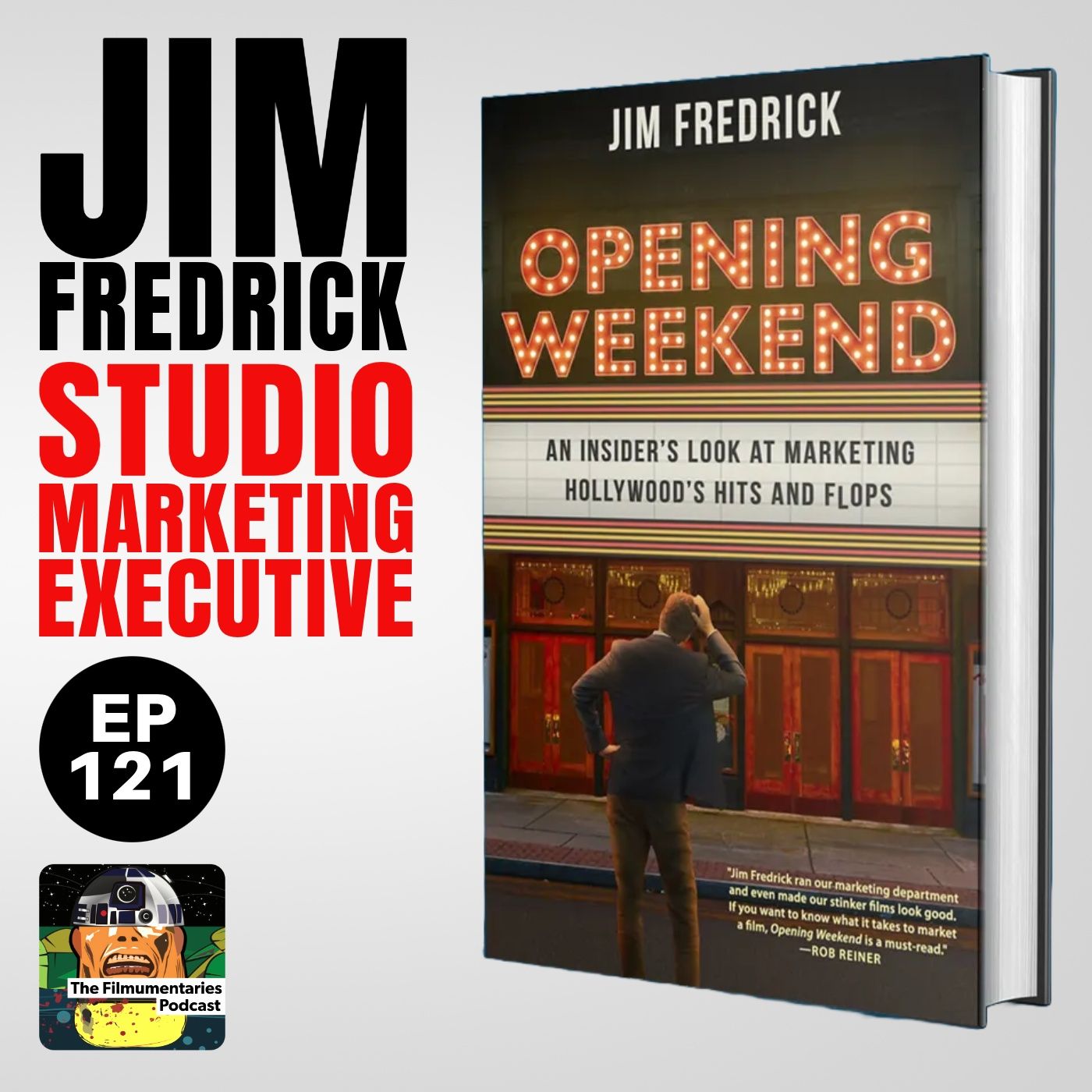
121 - Marketing Hollywood's Hits and Flops with Jim Fredrick
About this episode
Jim's book - Opening Weekend is available here!
Shawshank Redemption Trailer
All my links
This podcast is completely independent and made possible by listener support. If you’d like to help me keep making these episodes, you can join my Patreon community here: https://patreon.com/jamiebenning
Watch more on YouTube:
Check out the Filmumentaries YouTube channel for behind-the-scenes clips and extra content: https://youtube.com/filmumentaries
All my links
Transcript
Automatically generated, so expect the odd misheard name.
Weirding Way Media. Welcome to episode one hundred and twenty one of the Filmmentaries podcast. I'm Jamie Benning, your host for the next hour or so. If you're new here, welcome, You've got a great conversation ahead of you, plus plenty more in the back catalog to dig into. If you're a returning listener, thanks for coming back and the special Thanks as always to my patrons.
Your support keeps this podcast running and if you'd like to help it keep going for just twelve dollars a year, less than a couple of I don't know, takeaway coffees, you can support the show and get access to ad free episodes. Just head over to patreon dot com forward slash Jamie Benning. That's Jamie ben And if you can't support the show in that way, no worries. But if you could leave a quick five star review on Apple Podcasts, or subscribe and comment on some of the YouTube videos, that would be great. Now onto today's guest, Jim Frederick.
Jim has spent decades in Hollywood marketing, shaping how we experience films before we decide to step foot into a cinema screening. If you've ever been drawn in by a movie trailer. There's a good chance he had a hand in it. His new book, Opening Weekend and Insiders Look at Marketing Hollywood's Hits and Flops pulls back the curtain on how films are sold to audiences. From oscar winners to box office bombs.
It's amazing how much those two things can have in common. Actually, and in our chat, Jim shares how he stumbled into the world of trailer making, what goes into crafting an effective teaser trailer, and the challenges of selling films that didn't quite fit into the Hollywood mold, in particular The Shawshank Redemption, which famously flopped on release but went on to become one of the most beloved films of all time thanks to a strong DVD release. We also get into his work on Harry Potter, the late Stanley Kubrick's Eyes Wide Shut, and the fine art of making a bad film look good. So here's my conversation with Jim Frederick and as always, I'll be back at the end for a bit more jabbering on. Jim.
I appreciate you joining me. I loved your book Opening Weekend. It starts very trailer, like with that cold opener, cold opening where you get fired from your job. But let's go back. I want to talk about what first inspired you to enter the film industry and was there a particular moment.
Was there a particular movie that did that. Yeah, I'm afraid I'm in a very large group when it comes to Star Wars being very influential, certainly in my generation of executives out there. I wondered I had no interest in the film business when I was I think I was twenty one actually when I first saw Star Wars and came staggering out of the theater into the blinding daylight of it as a Matt May I went all by myself for some reason, which I find I think it's kind of confounding. But you know, I started out being very interested interested in sports, played sports year round, not much interest in film, and saw Star Wars and it instantly rocked my world. I was just blown away.
Of how I could feel like I was in a galaxy far far away. You know, it is very true, and it really had a profound impact. I changed, you know, my course of action in school immediately, and much to the horror of my parents, I grew up in a small suburb south of La called in Anaheim, California, and basically I had, you know, no connections at all in the movie business. And I went to college at UC Santa Cruz, which not known for its film school at all. I just wanted to kind of get away, like a lot of young people do get away from home.
I can't say I learned a lot there, I know, which is ironic as I currently am a professor at Chatman University, which is a mile away from Anaheim and currently has the fourth ranked film school in the world. So I did not have that experience that my students are having now. But just the opportunity to be creative was enough, I think. But I came out of my college years again not having a real I didn't know exactly what I wanted to do other than be in the film industry. That I just I love the feeling of it.
I love the creativity. I think most most of my students and most of my peers when I was in college automatically think of directing. I think because it's it's it seems like, okay, I'm in charge. I could do whatever I want. There are all at tours but I gravitated in a kind of roundabout way, like most entertainment careers are are not direct.
You want to be a brain surge, and you have a pretty direct path as far as education and experience. The entertainment business not quite so direct. And I lucked out into my very first job, which was at a optical house, which was a name for a special effects company back then when there were no computers, and so, you know, is the bottom of the barrel for sure. Not a very glamorous job, not a very glamorous part of Hollywood. But it allowed me to you know know where the studios were located, to pick up film, to handle film with a good old fashioned movieola, yeah, you know, which was a very scary looking editing machine, one of the very first of its kind, and just kind of gave me a real film one oh one education while I starved to death like most entertainment careers as well.
I tell my students this quite often, be prepared to starve and struggle and then be treated poorly. Frankly, you don't get a lot of respect, you don't get a lot of out of boys. It's tough, and I think it does act as kind of a weaning situation. It kind of weans out the week, and you've got to have a passion for it. And that's that's what my first job taught me.
I just kept I enjoyed it every day, even though it was pretty pretty terrible. I made I think I made one hundred dollars a week, which is barely enough to survive frankly. So that's how I kind of entered into it and started my career in the business out of college. And I don't know if i'm Jamie if I'm telling you more than you want to know here. But it's all good.
It's all good. I mean, obviously I've read the book, but I want to be able to communicate as much as possible to the listeners because I want them to go and read the book as well. Because, as I said to you before we hit record here, it gave me an insight into a part of the industry that I had some idea of. But I think there are a lot of misconceptions around publicity and trailers and posters and who makes them and is it done in house is it via an agency? And it really did give me an insight that I really wasn't aware of because there is this misconception that trailers.
Well, let's just say you ended up working for a for an agency that made trailers, right, Yeah. I mean I was as ignorant as you were, prayer to reading the book at the time. I didn't know what a trailer where it came from. I certainly knew what previews were, coming attractions, that sort of thing, but that was it. I didn't know you could make a living out of it.
I didn't know what that consisted of. So I had oddly gone from this very archaic business of making special effects using movie film. That's what Cinema Research did, which was the company I started with, and then after about a year and a half of that, I went to a company called Digital Productions, which was ironically the first coming of computer generated imagery. It was started by gatnamed John Whitney and really paved the way for computer generated effects. The company primarily made car commercials, but they also created twenty minutes for a sci fi film called The Last Starfighter, which is a very forgettable film.
There's a lot of love for that film out there, you know. Well, that's one of the reasons to love it, I think it is. It was a real groundbreaker as far as introducing CG you know, to to feature film, and the company basically shut down to work on that film with all these prey computers going. It was the dead opposite of where I had just come from cinema research. So that was kind of fun to see that happening, and I progressed my editing skills.
I started actually cutting film together to do show reels, you know, nothing fancy at all, just just kind of messing around with music, and you know, I'm a big music fan, so that was kind of fun to bring that into the editing process. All of a sudden, there's something happening in me. Anyway, that found an outlet in editing, and that led to my introduction into the trailer business. A friend of mine said, who worked in the in the business, you should you should take your post production skills and go to this company called Intralink, which was run by this incredible guy, my mentor, Anthony Goldschmidt, one of the original not only trailer companies, but they also did movie posters. And it was very unusual back then for agencies, boutique agencies, ad agencies like Interlink to combine the two and Anthony was just this you know, renaissance man who was an artist, a Yale graduate student, so he certainly had the skills there.
He also had the money. He came from great wealth, so he took the family fortune and started his career in Hollywood. And he was also easily the greatest sale I'd ever met to this day. I mean, he could sell you anything. So he had these multiple skills, great financial mind as well.
I mean, I've never met a guy in the business to this day who had all of these various skills and brought them all together into a company. And of course, naturally the company became incredibly profitable and successful. And so into this world came very you know, a guy from southern California, but in the suburb part far far from Hollywood, you know, into this pretty high, high flying company with this czar, with this creative genius. Geniuses overused plenty in Hollywood, but it really applied to Anthony. And he was also very intimidating, and you know, very Madison Avenue wore a three piece suit every day in English, English made suit.
You know, he was quite something and very inspiring. And ultimately I came in as the guy who would be what was called the finisher where the trailers would be edited and put together, and I would take that and then use interpositive negative, go to the optical house to have it finished, create the soundtracks for the sound mix, and make them into deliverable trailers that would four thousand copies would go out nationwide in America. Quite a step up from from making show rules for the previous company. Now now, now I want to be clear. You know, I was just on the post production side of this, but here I am, you know, standing behind these professional editors, watching them edit clips together for the first time, seeing where all that came from, and learning, you know, just by watching and certainly by being by watching Anthony at were creatively come up with these ideas.
A lot of ideas with Anthony were not found in the movie itself. He would create ideas outside the film. That was one of the things that the studio kind of liked, that they had a movie that was say, lacking. And visual, you know, pizazz, and it looked bad. The performances weren't good.
Boy, You've got to figure out another way to get people in the theater without completely lying and cheating. But there is this misconception. Isn't there that trailers are just kind of the best bits of a movie smushed together. But you know, your approach was about trying to create something interesting, something fresh, and find something within those trailers to kind of encourage people to come to see the movie, because that's what this is all about. You have to be persuasive in those two minutes.
You bet, you bet? I mean, you said it very well. You need to take a two hour movie and make a two minute movie out of it that needs to be, as you said, persuasive. You're absolutely right. It is a huge misconception that you take the best scenes, whatever those might be, and slap some music on it and get it out the door.
Boy, is that not true. You certainly want to be aware of the scenes that have power and impact. Certainly, if you're working on a comedy, you want to find the funny bits. But you know, if you slam all the funny stuff and try to land twelve jokes in a two minute trailer, you're going to fail most often, and it's way better to try to find two or three jokes and really work it and all the while suggesting to the viewer, yeah, this looks funny. But in the trailer, you need to do more than just make them laugh as they're watching the You need to add that other element that says, yeah, I'm willing to part with my fifteen dollars.
You go to a movie theater and or or by a subscription to Netflix, you know, streaming and theatrical. We could talk about that later if you want. But the trailer. The trailer art hasn't changed that much, even with streaming through the years until now, other than the way they're made and the way they're certainly the way they're distributed, that has changed quite a bit. Yeah, because when you were doing this, you were you were still handling film, right.
There's a kind of there's a there's a destructive process to this in many respects. I mean, I know from I edit myself, and I've edited trailers for my stuff and for friends stuff, and I work in live TV, so I'm making teaser trailers and you know, scizzor wheels and things like that. I know how easy is for an intention in a trailer to kind of unravel suddenly, Like you think you've got the great, perfect music, you've got all the shots in the play, and then you just realize it isn't quite doing what you want it to do, and you kind of have to start over and go through the woods, you know, through this dark period, and then you come back around and suddenly things start to click into place. But to do that with film itself, rather than me on my final cut or premiere or avid or whatever is that must have been quite a different challenge.
We've become terribly spoiled by that, and our clients have become terribly spoiled by that. As far as. Getting multiple trailers to choose from, and having multiple vendors working on your on your piece, and to distribute more than one trailer has become the norm. Back back when I started on my very first trailer, which was for the color Purple, I basically went into Anthony's office one day after I don't want to say becoming bored with my job. I still got a lot out of it.
One of my side duties was to create main titles, you know, the beginning main title sequence for films, and did that for Robert Redford and Ridley Scott and a bunch of those films. Those were fun, Jack Nicholson, that was fun to work with these guys. But one day, I went into Anthony's office and I said, listen, you know, I noticed we got the color purple in He says, yeah, it's you know, it's kind of. Good news bad news. Spielberg typically only supplied us with black and white photographs that they shot.
Gordon Parks, a very famous filmmaker and photographer, was hired by Spielberg to shoot these gorgeous black and white photos on the set as a still photographer. And they they sent us a bunch of photos and a piece of music, one piece of music written by Quincy Tuincy Jones. Yeah, and God bless you just passed. And but he sent this beautiful que and he had done the score and it was producing the movie. And that's all we got.
But and so Anthony said, well, there's very little we can do with this other than have you, Jim go away and shoot maybe zooms on these black and white photos, you know, zoom into certain parts of the photograph, shoot them in the correct aspect ratio, you know, one five, and you know, and do a little music montage to this beautiful piece of music a Steven Spielberg film. And that's it. So this was definitely what's called a teaser, the very first piece of advertising that that happened, sometimes a year in advance, sometimes six months in advance, depending upon the movie. And so I went downstairs with the with the Movieola, which was a terrifying machine that can tear tear fingers off your hands very easily.
And I that was the first piece that I edited. And I told Anthony as a way to persuade him, I said, listen, you know you're already paying me, so you're saving money. I'll work after dinner. You know, once the real editors go home, the staff editors go home, they won't be the wiser and oldest. Quietly cut this thing and see if you like it.
If you don't like it, you don't like it, I get it, and you can, you know, bring on a more experienced editor to do this. But I think I can do this. I'm shooting the stuff anyway. Give me a chance. And he did.
And the end of the story is the teaser, as discussed as I just explained it to you, never saw the light of day. But Spielberg finally relented and delivered us some clips of the cast. You know, so Oprah Winfrey is there and will be Goldberg and Danny Glover and you know, little little i DS and the trailer became a very, i think, very boring, a teaser trailer that basically had a narrator, which today everybody hates, but you know, a great, big voiced narrator saying the cast talking about the pedigree of Alice Walker's book and the course from director Steven Spielberg brings you, you know, very very emotional, the music very emotional. And that was the first piece I ever edited. It did, like I said, didn't make the didn't make it, but it proved to Anthony that I could do it, and it got me out of post production and into becoming a trailer editor.
Yeah. Amazing to take quite a ballsy move, really, Jim, to approach this final. I've done terribly balls these foolish things in my career, Jamie, and and most often they don't work. That was one fortunate that it did work. You talk about and Anthony was very he he was a guy that would give you a chance.
It wasn't just his show. You know, good on him. But you talk about that kind of gut feeling throughout the book where you have this gut feeling about how to market a film because the kind of reins are handed to you at the agencies. You know, to a certain extent. Obviously you have the film distributor, might be at Warner Brothers, Sony, whoever, Paramount, whoever.
They have a say, but they're putting their trust in you. And what amazes me really is that those departments didn't exist within the film companies to begin with, and why they were outsourced, because you would think that marketing is such an important pie can make or break a film in many ways. You know, people say, oh, yeah, it was a great movie, but it just didn't get out there because it wasn't marketed well or marketing often gets the blame. So what do you think the reason is that it is an external thing rather than being an internal decony. It's not all the time, I will say.
There there are studios like Warner Brothers where I worked for twelve years. Yeah, we had our own in house. Mainly is a way to save money. Yeah, the best films never went in house because the best editors worked for a lot more money at agencies like Intralink and Aspect Ratio and Kaleidoscope and other famous. Vendors.
And so that's one of the reasons why most studios didn't want to invest the money in it. Oddly enough, and this is kind of segueing chronologically, the job I had after becoming a trailer editor at Interlink, and I was there for quite a while. I was there for eight years, which is a long lifespan in the movie business. And I was hired by a company called Castle Rock Entertainment, which was just established by Rob Reiner Alan Horn, who is arguably the most successful studio head of all time as far if you're counting dollars and cents, there's no question he is. He was the head of Warner brother for ten years, and they had a Disney for the last ten years, and.
Three other partners. And they came to me and said, we'd like you to We'd like you to be our head of marketing, to which I say, marketing, what's that? You know? I'm a trailer editor. I don't know the first thing about publicity, media, buying, research, distribution, promotion, all the other elements that make up a marketing, film, marketing campaign.
Creative advertising was my one and only area of expertise. But they said because I had been working with them as a client, and they had just made their first film, which was When Harry Met Sally, was their very first film. They had just enough money to make that film and Lo and Behold, and it, oddly enough, did not open very well, but was one of those films that never dropped a percentage point every week. It just kept on going because it was so good, it was so popular, and it ultimately made a huge profit and allowed them to establish this company called castle Rock Entertainment. So they called me and said, we're we're reinvesting our fortunes.
We're going to be making about four films a year. Our films will be distributed by Columbia Pictures, but we castle Rock, will own the negative and we will pay for the prints and advertising. And we want to start up a small little marketing arm and we want you to head it because we like you and we think you do good work. You know, I was at the time working on the trailer for Misery, this was their next film. And then also.
City Slickers had just started a pre production, so you know, they needed to get up and running. They saw me as an in house We were just talking about in house. Well, here's a little production company, Calca Rock, who wanted to kind of create materials that they could be more involved with with myself. And so my only other bold move Jamie that I made was I went to these guys when it came to negotiating my contract, and I said, Okay, I'm gonna I think we should do this two ways. You could pay me half my salary.
I'll be your in house trailer editor. I'll cut all your trailers most of your television commercials. You'll save a million dollars in vendor fees per movie. They heard that, Yes, then you pay me my other fifty percent to be an executive, to to learn research, to learn media bank, to become a you know, to become someone like but also obviously developed the posters and all of that stuff. And they were perfectly fine with that.
Martin Schaeffer, the partner who was most involved in the film side of things, had plenty of experience in marketing. He was perfectly happy for me to sit sit in my little, dark, cubbyhole of a room cutting trailers for the Shawshank Redemption and Misery and City Slickers and Malice and a bunch of other you know. A few good men was a big hit for us at Calsle Rocks. So things worked out great. It was the greatest job I ever had.
I had more freedom than I've ever had. I could do whatever I want and nobody telling me. They were very hands off. And on the other side, I'd lift my head out of the out of the cubby hole, out of the dark after eight hours of cutting material and learn a thing or two from Martin about media buying and and and things like that. So it was the greatest job I ever had.
But back to the original question about White on studios, have you know in house trailer arms? Here's one that did you know? It was really, as far as I know, the only time where the head of marketing would cut trailers. It was kind of foolish of them to hire somebody with just one set of skills. I think.
Yeah. But in terms of the you talked about the money saving side of it. What what the other advantages of having it in house, because I would imagine that having an external agency doing it, you know, gives fresh eyes on a project that you know, you're already deep into in the production of the film. But if you're doing it in house, do you still get that same advantage? No, it was, it was It was it was.
It was a faulty situation regarding objectivity. Now, I cut every trailer while it was a Castle Rock and I was there for nine years and that must have been fifty movies roughly. But I would never, ever just do the TV campaign myself, because what's nice about the trailer is it not only is it the first piece of advertising that goes out to the public and to the consumer, it really establishes your strategy. So I was able to establish how I thought we should sell X movie. Had the partners with me, Yes, we agree with you, this is the way to go.
Went to the filmmakers, Yeah, I like this, go for it, let's do it. And then I would hire two or three one two or three other agencies to work in concert with me on the TV campaign, which is where the real money goes trailer production out in trailer placement, that's relatively cheap, but when it comes to buying ad time on American Idol or an NFL football game, you're talking about millions of dollars. So you don't try to save money when it comes to television campaigns, particularly the Workhorse, which is a thirty second TV commercial. And to this day, i'd say, that's still even with all the digital platforms we have, coming up with a short, pithy, effective TV commercial is still the workhorse of the industry and all established by that first trailer.
Yeah, from the spread, not that you're just doing cutdowns of the trailer. You're definitely going to try to find different audiences with different kinds of messaging, and those spots should look different. And by having not just one person cutting that, but several others, to your point, gives you much more objectivity. It's how it should be done. And then you get into research, which is a subject we should definitely talk about because it's massively important.
Yeah, there was that thing you said about the National Research Group where they warned that, you know, you shouldn't convert their results into box office but of course that's exactly what studios did. It's exactly what studios do. They can't help themselves. They want to know, they want to be able to, you know, guide their filmmakers and not that get them having two high expectations, which is another big part of our business that not many people are aware of of how to manage expectations. I mean, it's a it's a key to life isn't it.
It's certainly the key to movie marketing. Yeah. So yeah, everyone is watching for that failure or success. Both of them make the news. As I think you said in the book, and I I know I know a group of people that make They do studies on the kind of the fans space for kind of franchise movies and let studios know if this is working off that's working.
It seems to me that when you were working in the industry, particularly in that sort of sweet spot of the nineties when I was a big cinema gooer then going three times a week, films were being made, and then the marketing side of it, the publicity side of it, whether it's the trailer, the post how it's you know, the message that's first put out there. That was a that was something that was done not after the film was made, but it was done after the film went into production, whereas now it seems that films go in production having a marketing strategy sort of you know, top loaded for or front loaded. Yeah, to that point is kind of jumping way ahead. Now. The last jobs in the business.
I had my own company once I was done with my studio, executed a career. I established my own my own company, which was basically to make trailers. My first love. Kind of went back to the well with the thing I enjoyed the most, and one of the more enjoyable projects I would have was the creation of what's called a rippo mattic or a sizzle reel or a mood reel. They have different names, but they're all doing the same thing.
You're creating a piece of You're creating a trailer for a movie that doesn't exist. Yet from other movies. Yeah, so I a producer or a studio would send me the script saying we're thinking of making this movie, why don't you show Why didn't you create a trailer. That sells it? And they did this for lots of reasons, sometime to get financing, sometimes to course cast.
I did one that tried to get h Dwayne Johnson. Interested used a lot in foreign sales, you know, to get money early on at interest from different countries. That was another lots of lots of uses. Another one was to show studios out of market of film. You know.
I was witnessed to the the rippomatic for the social network when I was at Sony, So, which is kind of a funny story. You know, Dave David Fincher refused to turn over the film to Sony. He didn't trust them, he didn't like their marketing. I don't know why, but he didn't turn it over to them. And Amy Pascal said to the marketing department at Columbia, Sony being you know, owning Columbia, go off and make a social network ripplematic and show David were good.
And that was the purpose of that one. And I'm telling you, the ripplematic that they created was the best I've ever seen. It was actually better than the final trailer that you're made. You know. And he hated it, but it got him to turn over the film, you know, he said, boy, you guys obviously don't know what you're doing.
You need the full film obviously here it is. So it worked. Yeah. Yeah, So you know, that's an odd case where you're kind of that's the head of the snake rather than the end of the marketing. You know, the end of the snake, the marketing occurs, and I love that.
I you know, I think you really kind of help develop the movie even by cutting a trailer that shows people, wow, this is what you could have this is what you could market. Absolutely, it feels like that. It's definitely a two way street there because you're, as we've said, you're setting the tone, and I'm sure that must feedback in some way because it sets the expectations of the movie. I love that. I love that line that that mantrat Castle Rock make the best movies possible, whether they make money or not, for stories you believe in, because that was very rare at the time to have that kind of mantra.
I mean it never it will never exist again. Yeah. Yeah. But they had, you know, their own financing. They had Rob Reiner, who was the hit machine at the time.
He had made seven consecutive hit movies, pretty unprecedented as far as I know. So they had they kind of had an ace in the hole, and they had a lot of experience. And they had one other thing too. Castle Rock was a unique company in that they also made television shows. And I wasn't involved with the television end of things, but you know, they ended up creating a pretty successful sitcom that made them a lot of money.
It was called Seinfeld and also didn't start off very hot, but. It was too good. It was too good to be denied, yeh, and that that paid for a lot of films at our place, the success of that TV show. Yeah, so you rightly acknowledge that in the book. Yeah, it's important to make that acknowledgment because that must have given some some freedom for that mantra to continue to exist.
Well. Yeah, most most big studios had libraries that they can get money out of, you know that basically feed the Beast, and Castle Ruck didn't have much of a library. You know, we started from scratch with no movies and slowly built it up. But yeah, we need our movie. There was more pressure on our films to succeed financially, and yet here are these guys and it's kind of a I think an interesting story.
The thing that kind of created this mantra of we're just going to follow our gut was Rob Briner's film The Princess Bride, which they they had made as a group. It was a Fox film. They were very unhappy with the way it was handled at Fox. The movie did not do well, I believe it or not, did not do financially. You know.
It at course. Ended up being a huge, you know hit over over the course of many, many, many years, but it was the inspiration for Castle Rocky. They said, we you know, we see at studios, how this isn't working there? As William Goldman said, nobody knows anything. And William Goldman, obviously, you know, ironically, was a consultant to Castle Rock.
And here's the. Guy that writes the ultimate line about making movies in Hollywood. Nobody knows anything. There's no form just next to me here. Yeah, it's the greatest book ever written about Hollywood.
You know, it's just of course he's a great writer anyway. But yeah, you know, it was ironic that he was the consulting these guys saying, you know, follow your gut, because you know, even when the great moguls were working, they were hardly right every time. So you might as well follow your your gut, not depend on outside research so much. And the screenplay is the thing, you know, that matters most. And that was a pretty good track record that Castle Rock had there.
Over that period of eight or so years that you were there. There there was a good one or two big hits each year. Yeah. One of them that wasn't a hit was a movie called The shash Ank Redemption, which most people have seen by now, and there's been number one on IMDb for god only knows how long. I mean to think.
That that's above The Godfather and China Town and Gossip Black. It's mind blowing to me. But I had the great fortune and then misfortune of trying to open that film and the book for those you know who haven't read it, and I hope read it. The book kind of is a case steady format, you know, where I talk about all of these films that I market and how each film is really different. Each film has its own stories, each film has its own challenges, and so the Shawshank Redemption chapter is a classic example.
And what I use in my classroom every semester is it failed. It failed to get movie audiences in theaters opening weekend branted. It started very slowly on only thirty three screens, but even at that number, it didn't attract enough interest at the theaters to. Make it a hit movie. It took years of cable play, It took a couple of years of incredible.
DVD sales. Yep, that was where I first saw it. Yeah, and it took Academy, you know, Academy nominations. We got seven Academy nominations in a year that we won none because Forrest Gump and Pulp Fiction were against us. That's tough.
That's a tough break is a tough year. It's like being the second fastest man in the world behind Hussein Bowl. You know, you could have had the goal, but he was there. Yeah, we picked the wrong year to open it, I guess. But nevertheless, you know, it was I would say my favorite trailer to edit, just because the film had so many wonderful moments.
It was certainly a challenge. Ye, not that I wanted a challenge like that, but. Yeah, the audience isn't clear, is it for that film? Straight away? You know it's not a guy's movie.
It's not a date movie, right, a woman's movie, it's not a teenage movie. There isn't a kind of box you can easily put it. One female role in the whole and it's not a very savory one and it lasts about fifteen seconds. Yeah, prison, dark, claustrophobic, no movie stars, no director. This was Frank darra Bunce very first, you know, real big film that he wrote, just a lot of title that was blamed in the press for it not opening, which I'm more than happy to let them take the blame for that, but I have to be also, you know, to blame for not figuring out a way to get people to go.
I mean it's something I really posed to my students and ask them, so. Why was this a failure? What would you have done? You know what kind of strategy? You know, Stephen King wrote the book?
Should we have used from even King? So we've used his name. Well, there's a little problem with that. Ya. This is not a horror movie.
It's scary, Yeah, it's violent. Ye, it's R rated, which, by the way, are three more negatives challenges in opening this movie, so you can see there's a mountain of you know, hurdles we had to climb and we couldn't figure out a. Way to do it. And that's also one of the exciting things about. This business that I always loved is is you know, you're not working in a vacuum.
You're working as a team. You're trying to figure out a way to succeed, kind of like winning the Super Bowl or the World Cup. You know, you've got to figure out a way to overcome the obstacles and achieve something. And and money was there for you to use, and it's really exciting. And so when Friday Night hits, you know immediately if you succeeded or failed, And so your weekend is either happy or it's miserable based on that.
Did your perception change after shawshank redemption that maybe it's not all about that opening weekend and that success can be found further down the line, or is it you still need to hit those numbers? Of course, it took years. For me to It's just so rare for a film to find success after it hasn't opened. That's one reason why I name my book opening Weekend. So much depends on that opening weekend.
The vast majority of films that don't open, they disappear. The shelf life of a film, particularly theatrically, is very short when you think about other products out there. You know, it just you got one shot to really grab people. And when I'm talking about this, I'm not talking so much about art house films. I'm talking more about big movies with big budgets and big media buys.
Yeah. The other one that springs to mind, which wasn't a movie that you worked on, but I recently heard Ridley Scott talking about Blade Runner, and of course we all know that story that it wasn't brave well, and he's I think Ridley said, he's got on his wall the Pauline Kale review that slated it, just to remind him never to take notice of reviews. But you know, it took with that film. It took you know, somebody wanting to screen the movie and they couldn't find the original negative and they accidentally sent the work print out which didn't have the voice over on and had a few different shots. And that's how it got this whole new lease of life and the director's cut and all of that.
I mean, it's amazing that these films can find their way out of, you know, out of that swamp. Is there a film that you feel that you worked on that you feel should have had that moment in the spotlight but didn't quite make it? For one? We well, certain, yeah, is it now? Did it ultimately find its audience and find its notoriety?
Of course it has, you know people, it's blood, it's interesting most of them. I'm going off on a tangent, so forgive me on that. It's you know, I make sure I show Shawshank to my students on a big screen. Most of them have never seen it and they certainly, of course had never seen it on a movie on a giant movie screen. And the power that that film has, and it is not an entirely pleasant experience.
I mean, the first twenty minutes you want to take the gas pipe, it is brutal. And then of course the famous scene on the rooftop, yes, you know, changes the whole trajectory of that. I'll never forget. Something abums now thinking about it, you. Know, I've well this.
I was sitting in the theater the first time I ever saw the film. I was in with Rob was sitting next to me, Alan Horne was to my right, and there were two other executives from Castle Rock. We were the first people to see this. Film, and it was exactly the way you see it. Nothing changed about this film at all.
Puting the title. And after the rooftop scene, Rob turns to me and he says, I'm so glad I didn't direct this. And I thought, and it's taken me years to understand you what do you mean by that? And I think it just had to do with Frank wrote an unbelievable screenplay and directed this scene so perfectly. That only the writer could could do that.
It was done perfectly, And there was a point where Rob was offered this film to direct, So I think all of those you know, and he, you know, Frank wouldn't allow for it. He wouldn't take the money and run. He insisted on directing it. So I think all of those factors came into that moment where we were all just blown away by this scene. And of course the movie takes off from there and becomes this kind of great mystery thriller, drama, mance in a way of bromance, you know, so many wonderful things.
He sort of nurtured it into existence that film. I'm trying to think, let's see movies that should have done better that didn't. You know, there's plenty of them, really, you know, Ridley, really Scott. Let's since we were talking about Realley Scott, I worked. I did the campaign for match stick Men, which wasn't which wasn't an all out failure, but let's let's face it, it's you know, kind of a goofy comedy with Nicholas Cage.
Is not what Ridley's known for, you know, Thelman Louise certainly is. It has its moments of comedy. But it was a very quirky movie and a really good one, and I think really entertaining. Hard hard one to market because the Ridley name actually probably hurt us in the end. If it's not a typical Ridley movie, is it, So therefore it doesn't fit into what people are expecting.
There are other films that did better than they should have. One is a movie that I worked on called Kangaroo Jack was produced by Jerry Bruckheimer. Had its own kind of incredible backstory where the film started out as one thing, an R rated sex romp about two guys in the outback chasing after you know, fifty thousand dollars of mob money in a kangaroo's jacket pocket, you know. But it was Randy Man, it was. It was R rated for sure.
You know. There's scenes of a model and a wet teash I have all kinds of And then the test screening was dreadful. It was just dreadful. But I had hired a company to hire to cut a teaser. This company worked for Jerry Bruckheimer exclusively.
They were very good used to cheating. There's a scene in the film that had it's like a dream sequence where the kangaroo knocks out one of the leads Jerry O'Connell I believe, and he has this dream where the kangaroo is talking to him and starts rapping. And it was the one scene that tested well in an otherwise disastrous test, screaming, and we took that scene and it became the teaser. So all of a sudden, you'd have an R rated sex ront that's become a PG family movie with a talking kangaroo who raps, And what happened was a long storre p. It's short is that teaser became the inspiration for Jerry Bruckheimer to go to Alan Horn and say, I think we got to retool this movie completely.
Please give me fifteen million dollars to go make more talking kangaroo scenes with the computer. And that's exactly what Allen said. Okay, because we're already in for seventy million, what's another fifteen And we had a teaser that could at least say, look, this works, this is marketable. We got the test results, we have the audience reaction to prove it, and that gave everybody confidence to go back and really remake the movie, and it. Ended up opening and doing extremely well.
Wow, there's that two way street we were talking about. The still Way Street. Yeah. One of the other bits I was absolutely fascinated with in your book is your your entry into the Kubrick world with eyes Wide shut. You know, Kubrick had just passed away at the very end of production and you were brought on to work on the campaign, you know, asking yourself, you know, what would Stanley do, because of course you can't go down the typical route kind of jazzing something up and making It's not not that you're doing that all the time, but like you say, with kangaro Jack, you did, but you have to sort of stick to a Kubrickian feel.
But coming over here to the UK, staying, you know, working at his house, staying in the door Chester, I mean, that must have been quite a surreal period of time for you. Yeah, it was. It was my favorite experience in my career, without question, just because of how unique it was, of how much frankly, of how much stress I was feeling. I really felt an obligation not to my studio, yeah, but to the filmmaker and his legacy. And I was like you probably a huge Kubrick fan, and when he died it was a loss for cinema.
Yeah, and not only for Warner Brothers, for all of us. And I really took that personally, and I knew I had my studio had my back, you know, Bob Daily and Terry Semmel sent me over there because I knew how to edit and the estate wouldn't allow. And Tom Cruise, who had a big hand in the post mortem of the post production. Of it all. Yeah, it was just it was a week spent in Albans, Saint Albans, outside of London, and it was my first time to think to England for openers, and yeah, it was.
It was really very emotional, obviously, you know, I watched the film for the very first time and not many people in the country, in the world had seen it, and watched it in his old garage on a projector with his family sitting around me, and very emotional. As you can imagine. Typical When I say typical Stanley Kubrick movie, it was. It didn't look like anything else. It still doesn't.
I think it's gaining popularity. It's gaining this more eyeballs I'm hearing now it's a Christmas movie. Oh yeah, yeah, that it's become. You know, something people watch at Christmas time for reasons I don't quite understand, but I love it. Yeah, well, if I think you know, even though it's probably one of his least successful, not just monetarily, but just just least successful movies, it's still an amazing movie in many ways because he's always and I think you mentioned this in the book, he's always able to create an atmosphere that feels like nobody else, you know, nobody else can create that atmosphere, and it feels like a sort of parallel universe or I agree, I can't quite explain it, but it's for those two hours, you're just in a different world.
Yeah. And it turns off some people and it turns on others. It's very interesting. Yeah, but it was you know, I really looked at it as my job was very unusual for that film, other than, of course, the circumstances made it unusual for me to actually go there and do the work with the with the editor, and and to come back with two trailers, as it turns out, two teasers really both sixty seconds, a couple of TV spots I had to do a poster, and I had to do them the way Stanley would have done them, because I'm sure you know this in the book. He did all of his ad campaigns.
He was maybe the only director who really. Had the leverage and the gall and the talent to create really memorable ads for his films. And there's a reason studios take over the marketing and the creative and the trailer making and the poster design and don't leave it to the director. There are two very, very different skills. And as you alluded to about my career, you need distance, you need objectivity, and it's impossible, except for Stanley, to to market your own movie.
It just is impossible because you're so involved and in love, deeply in love with your work. You've spent years and years and years developing it, and when it comes to creating a message to get people interested in it's a different skill set. And so but I went, I went to England and stepped in Stanley's shoes. And really I had seen all of his campaigns, all of his films. I knew what he I don't want to say I knew what he would have done.
But I took that as my mantra for the week is do it like Stanley would have done it. If you know you're not going to have a narrator telling you everything, there's not going to be rapid fire MTV cutting styles. You know, the commercial side of it wasn't the goal. The artistic representation was. The side was the goal.
And so when I went back with the materials, I was worried, you know, but I shouldn't been because Terry Semmel, in particular, the chief executive Warners, was very close to Stanley and he had to know that I wouldn't come back with anything that was inappropriate to his memory and to his legacy. And they weren't. They were very artsy and odd, and you know, the studio was worried. Yeah, but they shouldn't have been. The movie opened, and it did.
It did a little better than you than you think it did, probably, I mean, of course it also had two of the biggest movie stars in the world. Yes, yeah, it was massive at the time. I remember seeing at the cinema. There was There's a couple of things I wanted to say to you about this, this experience. A.
I'm glad that that was your first experience in the UK, because it couldn't have been more British in a way, you know, staying in stanley stately home and staying in the door ches to having toast and coffee and oh. The best coffee I've ever had in my life, and the best breakfast. It was just lovely. The other thing is you mentioned the huge country table in the Kubrick's kitchen. Did you know that that is actually the table that Jack sits at in the Shining No.
Yeah, you know, a lot of good. In I only found this out a couple of weeks ago. There's a guy who's just done a short documentary about some of the offices they used for some of the set because they ran out of set space at Elstreet and they used some of the offices, and so Katerina mentioned Stanley's daughter. Christiana's daughter mentioned that, you know, when people come over for a meal, she always says, you know, this was where Jack sat, and people just kind of go quiet for a moment. It's kind of strange that an object can kind of hold that power something that was just a regular table.
But nice and nice to know that it's got a life that goes on. Oh, I had lots of Yeah, I had a few. I mean, it's in the book. I almost want all of you to go to go read the book so you can read the little anecdotes and stories, so I won't I won't borrow you by telling them on your on your show here. But yeah, it was very personal experience, and it's nice when that happens, you know.
It was just even though it was a difficult time of grieving. Yeah, it was very special to be there, you know, and it was it was my favorite chapter to write by far. Yeah, wonderful memory. Yeah, it really comes across how much how important that is to you. My kids won't let me get away with not talking about Harry Potter.
It's been part of my life for the last nineteen years. I think me too, you know, all the different iterations the books and the movies and the Lego games and now the new HBO series it's on its way. But it must have been very cool for you to be kind of a ground zero with a movie a franchise that big, where you could push through that door and see those amazing sets that Leaveston that marked It feels like that marked a very different chapter in your career. Yeah, you know, it's Harry Potter will stand out I market under expectations, you know, the obviously, and I'll back up just a couple of steps here because your listeners might want to be curious of how you know, there's three people at Warner Brothers that do what I do back then, and we would be assigned movies.
So obviously, when Harry Potter was greenlit at Warner Brothers, the three of us were just like me, please pick me, you know, because obviously the book was just then becoming a phenomenon, and it was obvious that Warner Brothers was gonna spend, spend, spend, and do everything they could to make this a franchise. As long as JK. Rowling was writing the books, we were hopeful that this would be a franchise because this was also a time where Alan Horn kind of decided this is the future right now of the film business and maybe this is good news bad news time. But were franchises really paid the bills at the studios. They were the profit generation entity at a movie studio.
So when it came time for Harry Potter, I was chosen probably because I had two small daughters. I was a young father, you know, and I'm certainly familiar with the books, had been reading them to my kids, so I was very excited about that. But with it came this massive a mountain of expectation. You know, when you have a book that was this popular, you hope the movie is a wonderful adaptation. You hope the filmmakers can do justice to or try to match, or at least hope to match the imagination of millions.
And I think that in the adaptation world, that's a real high bar, and it's not met every time. So the pressure of Chris Columbus and David Hayman, the producer who was with it from from day one, and to my mind is really it should be given the most credit, aside from JK. Rowling of course for casting the film and hiring Stuart Craig. And you know, I do. I am very proud of the way Warner Brothers has has executed these films.
I think they've done a wonderful job. And I'm limiting it it limiting it to the books, not necessarily Fantastic Beasts, which I really haven't followed. I don't know how these I don't know how the HBO show will go. I know it's going to be very difficult to do a good job as these various directors did, which is also unusual, and you don't have one director leading the charge, where you hire different directors to bring their own sensibilities, whether it's Alfonso Koran on Azkaban. I mean, that movie is just just different than the others.
Even though there's Hogwarts, there's the kids, Yeah they're getting older. A lot of similarities in all the films, obviously all the sets and the characters, but different ways of telling stories, you know. And that was the key for me as we progressed after the first one opened, which was glorious and broke all the records and it's nirvana for a marketer like me. That's what you always want to say, is hey, I open this movie to the biggest gross opening weekend of all time. That's what we are all striving for, to be honest, not necessarily to win Oscars and things like that, because it's more of the movie that does that, but opening weekend is ours to brag about or to commiserate over.
And after Sorcerers opened, the mantra for me became how do I keep this fresh? How do I keep doing what these directors are doing is really making different movies and not the redundant, not repeating, trying to take advantage of what's new, what's new in Goblet of Fire, what's new, and you know all the Chamber of Secrets and so forth. So that that was my goal in creating the all the trailers and the TV commercials and all the posters. It was. It was great fun.
I'm really fortunate to be involved in this at all. And uh yeah again, like I said, and I want to say something else too about that is because of David Hayman and because of the way Warner Brothers managed and worked together with all these disparate directors. You know, there was not a lot of drama ever. You know, now, granted when you have success, there's not a lot of drama, but there's still incredible stress and high expectations to keep climbing those the as markers, you know, until it's making a you know, a billion dollars worldwide. So it was very gratifying to do that.
And yeah, I'm really proud of the campaign. You know, I didn't think we gave away the store in the domestic campaign at all. I think, you know, we I used to have terrible fights, frankly with our international group who had a different set of circumstances, where in Europe and Asia they didn't have the benefit of television as much television budgets, television spots. They had to sell the films differently and posters that had more in them, which I always really hated and took offense that they wouldn't use my poster. And it's taken me a few years to get over myself and realized they had their own marketing issues that they dealt with in their way.
And I'm really happy with the way we dealt with our marketing issues in the States. We've skipped a stone across the the you know, the surface layer of your career. There's so much more to your career in this book. Opening Weekend and Insiders look at marketing Hollywood's hits and flops. But I just want to finish by asking you a couple of questions.
They're kind of annoying podcasting type finishing questions. But is there a trailer yours or somebody else's that you really feel absolutely nails what a trailer should do? Yeah, there is. I didn't do it, my colleague did, and one of my mentors, a man named Joel Wayne, who worked at Warner Brothers for twenty five years in my job in creative advertising. He was there long before I got there, so he would end up doing campaigns for thirty five movies a year, which is it's on you know right now.
Most of my people that work in my business maybe work on one or two a year. Yeah, that'll give you an idea of his skill and talent. But Joel created a teaser that I have aped several times, and it. Was for Twister. Oh yeah, very first Twister, and the teaser for Twister and again a Steven Spielberg a produced film.
Yes, so he had limited footage seeing a little you know, this is the Steven Spielberg. How you deal with him is he only gives you so much, so you don't give away too much. You know. So that the teaser for Twister, oddly enough, used black a black screen as a graphic device, and did a lot with sound. Yeah he's coming back to me now.
Yeah. And so because Joel only had a limited amounts of footage to use, he kept you in the cellar while the storm was going on outside, and by cutting to black and having a shaky light and a scream of a young girl who was in jeopardy and really put you in the storm for a teaser trailer. And I totally ripped that off, I mean lately rip that off for a teaser I did for The Perfect Storm, right, yeah, you know, and I almost felt guilty, But I think Joel took it very well and it has an homage to him. So those are you know that the teaser for the Twister is to me very groundbreaking at what it didn't show. You, Yes, and it worked.
Yeah, just I think one of my favorites is still probably the original Alien trailer with that siren sound that Terry rawlings. Oh you know, it's just so atmospheric and it kind of puts you on edge and then it ends you like what is this thing? You know? It starts off with that egg and everything, and it's kind of freaky. And one of the great copy lines of any poster of all time in space no one can hear you screams, you know, written by a guy named Steve Frankfort, who is a very famous advertising Madison Avenue advertising guy.
Right right, and the final question wanting to end on a negative note, but I've noticed in trailers of recent times. I've been to see a lot of movies with my kids, recently Wicked and Mohana, to name a couple, and all of the trailers beforehand seemed to have this template of a big kind of drum sound, don't dun them, like almost like a heartbeat, and then it like it's just every trailer. There were like six of them, and every single trailer had them. What has happened to the conceptual trailers? Why?
Why do you think we've gone down? The originality gone? You mean, yeah, we've got another hour. Tell you anecdote. I'll tell you a little anecdote.
In my day, there was a there was a trailer for half A. So Jack Nicholson portrayed half A. Any Debato directed it, Yes, And there was a piece of music they scored for the half A trailer. It actually was so good it ended up on the sound track album. And consequently that music cue was used in at least twenty trailers.
So a trailer would come up for some usually a drama of course, because it was your action movie. I used it in a trailer for City Hall, which was starred Al Pacino and did no business. But so to answer your. Question, yeah, there are there are tricks that become very popular by trailer editors, by studio executives. Oh it worked for that, let's use it here, you know that kind of thing, because it worked.
I think they think it brings good, good luck and good baggage to it. It obviously worked for that film. Why shouldn't it work for us? And our movie isn't as good, So let's fall on this little stunt song. And music is massively important, whether it's music or sound effects like you're talking about.
You know, I've been hearing a lot, not so much recently like you have. You're talking about this kind of I know exactly what you're talking about. This percussive, yeah, crescendo. Yes, And. We're just coming out of a period where the Gravity score is finally going away.
But Gravity had a certain kind of sound in the soundtrack that was aped by trailer makers everywhere. Is the Is this the kind of take a famous track and make an echoee kind of low five vessels? That's that's yet another thing is repurposing, you know, famous songs and having them rescore. That's that's become a real popular go to. So it's it's nothing new, Jamie.
You don't have to get through this period. Something else will come along to take its place. And you'll hear that a dozen times too. So it's just kind of the nature I think of the trailer making business. Where this happens.
Yeah, yeah, I apologize from all of us out here in Hollywood. For Yeah, I'm looking forward to a day when I don't hit one of those trailers. But no, I have to say, as I said before, I love the book and I really implore people to go and read it because it is a unique insight I've never read. You know. I've interviewed people that have made title sequences, I've interviewed people who are editors movie editors, but I've never read a book or interviewed anybody that's worked on the side of publicity and creative marketing.
And it's Yeah, it's just fascinating because it's I love, like you. I have that bug of putting shots together and putting it together with music and trying to make something, trying to create a feeling. I've been doing it today. I've been trying to make a new documentary trailer that for a thing I'm working on, and there's nothing there's no better feeling than when something just clicks and you feel it. It's an instinctive thing and you get those goosebumps like I was talking about earlier.
But yeah, thank you for your time, Jim, and I really appreciate it. My pleasure. Thanks for having me. I hope you enjoyed my conversation there with Jim Frederick. It's always fascinating to hear from someone who's spent their career shaping how films are kind of presented to us and marketed to us.
So thank you Jim for your time. Really enjoyed that conversation. And it's always great when I have to revisit these to go and edit them, how much I enjoy listening back to them as well. So yeah, thanks for your time, Jim, and everybody go out and buy his book, Opening Weekend by Jim Frederick. I loved hearing his insights on what makes a great trailer, how test screenings can be both a blessing and a curse, and the behind the scenes story of shawshank Redemption is great.
It's slow climbed her success, and of course that idea of cutting the teaser trailer for eyes wide shut under the shadow of Kubrick's legacy at pressure, but also what a great opportunity that was and what a great time Jim had doing that. You can read more about that story, and there is more in the book obviously, so head out now and by Opening Weekend by Jim Frederick. Now, before I go, a few quick reminders. If you're a fan of behind the scenes film history I hope you are, I mean you're listening to this podcast, then you can check out my book Return of the Jedi, The Unauthorized Timeline. I co authored that with Justin Berger.
He made also an Unauthorized Empire Timeline book as well, So head over to Jedi Timeline dot com for all the details, or you can go to Amazon in your region and search for Jedi Timeline and Benning B. E wn Ing my name and you'll find that. Also, if you're a fan of Star Wars design legend Colin Campwell's work, then there's still some limited stock of signed photos from the late designer available at Colincamptwell dot com and if you use the Code Film Film you'll get fifty percent off while they last. You know, Colin passed away a couple of years ago. These are very finite in what is left.
So if you want the chance of owning a signed photograph of one of Collin's designs, visit Colincamwell dot com and film for fifteen percent off. If you want to support the podcast, you can do that via Patreon dot com, forward slash Jamie Benning. As I said in the intro, you can also now grab some call film Mementary's merch. Check out my store. It's Filmumentaries dot creator, dash spring dot com.
Yes, it's back. That's T shirts, hoodies, mugs, stickers. There's some call designs on there. They're going to be growing over the coming months as well. There's a very cool etb good one that you can get as a bag, as a hoodie, as a T shirt, as a mug.
That is a original design by my friend Pete Starling. And there'll be more coming too. If you like this episode, do me a favor, subscribe, share it with a fellow film fan, and leave a review if you can. It really helps get the podcast out to more people. I saw a thread recently on Facebook, people saying I'll bring back Cineffex in a way.
I'd like to think the stuff that I'm doing is the next best thing. Hopefully you've been keeping abreast of my articles that I've been writing for ILM dot com. There's some more coming in the future and for skysound dot com Skywalker Sound, and I hope that feels the sort of the void that Cineffex has left for a lot of you. Right, that's it for now, Thanks for tuning in, and I'll catch you next time for a bit more film chat and of course a bit more jabbering on in the next episode of the Film Youmentaries podcast. We are Pekauai Media h



Similar episodes across the network
Matched by shared keywords.
-
Justine Nelson - Unsung Cinema
1 shared keyword: rock
-
REWIND: A Different World | Looking Back at the 80s Hit with Writer Niceole Levy
1 shared keyword: hollywood
-
Father Malone's Weekly Guest Spot - Escape from New York - The Projection Booth
1 shared keyword: harry