
Season 1 · Episode 126
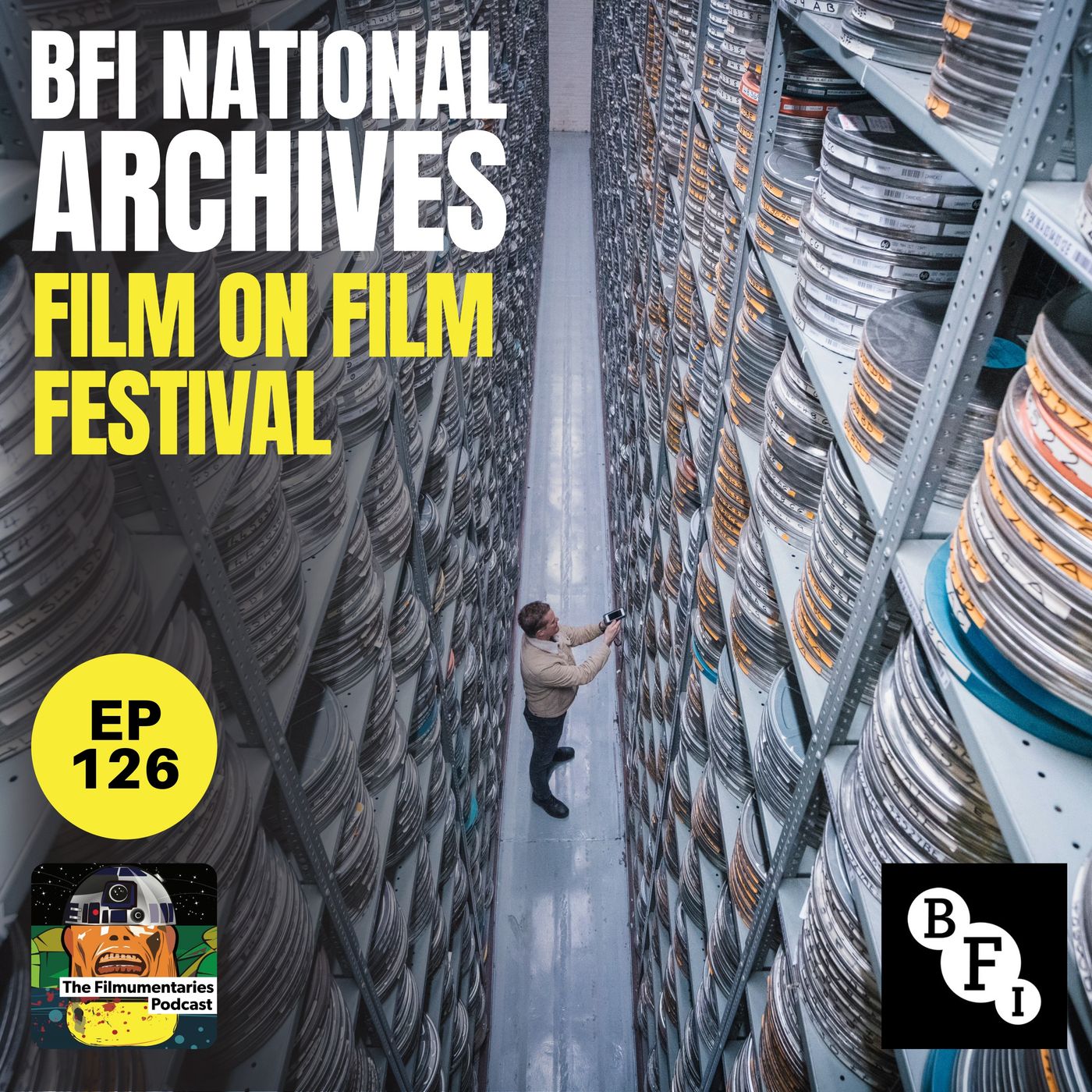
126 - Inside the BFI National Archives - Film on Film Festival - Special Episode

About this episode
For this early release of the podcast, I’m taking you behind the scenes at the BFI National Archive in Berkhamsted. The reason for the early drop? Tickets for the BFI’s excellent Film on Film Festival go on sale to the public tomorrow, 9th May 2025, and I wanted to give you a bit of insight into what makes this event so special. The Film on Film Festival runs from the 12th to the 15th of June and is dedicated entirely to screenings on physical film – from 35mm to 16mm, and even nitrate. It’s a rare opportunity to experience films as they were originally shown, in all their analogue glory. While at the archive, I spoke with several of the experts who help make the festival possible and who work daily to preserve the history of cinema. You’ll hear from:
- James Bell – Senior Curator of Fiction and Programme Director, Film on Film Festival
- Chris Stenner – Film Laboratory Lead
- Sonia Genaitay – Curatorial Archivist
- Martin Coffill – Projectionist and QC
- David Jones – Film Scanning Lead
BFI Film on Film
All my links
This podcast is completely independent and made possible by listener support. If you’d like to help me keep making these episodes, you can join my Patreon community here: https://patreon.com/jamiebenning
Watch more on YouTube:
Check out the Filmumentaries YouTube channel for behind-the-scenes clips and extra content: https://youtube.com/filmumentaries
All my links
Transcript
Automatically generated, so expect the odd misheard name.
Hello, and welcome to episode one hundred and twenty six of the Film You Mentori's podcast. I'm Jamie Benning, your host. Now you may have noticed that this episode is out a little early. Well there's a good reason for that, and taking you inside the BFI National Archive in Birkhamsted, a place where film history is not only preserved, but actively projected and printed and celebrated. And furthermore, it relates directly to the BFI Film on Film Festival, and the tickets for that are available to the public as from tomorrow, the ninth of May twenty twenty five.
So that's that's why this episode is out early. The Brilliant Film on Film Festival runs from the twelfth to the fifteenth of June. It's a rare event that champions the unique experience of watching films on physical film that could be night rate, thirty five mil, sixteen mil, and just about everything else in between, rather than the digital convenience we're so used to. So during my time at the Archive, I spoke to several of the experts who make the festival and the preservation of the materials that are at the festival possible. So I sat down with James Bell, the Senior Curator of Fiction at BFI National Archive and Programme director of the Film and Film Festival, the Archives, Chris Stenna, film Laboratory Lead, Sonya Jenete Curatorial Archivist, Martin Kofi, projectionist and QC.
And David Jones, the film scanning lead who ensures that these rare titles are digitally preserved before they disappear. Altogether, I want to say a huge thanks to Kieran Webb and to Sarah Bemmon for organizing this fantastic day. It was a genuine privilege, it really was to get behind the scenes with the people who quite literally keep film history running through the projectors. And yeah, I had a wonderful day and just so grateful for this experience. You know, this podcast has given me some real pinch me moments visiting Skywalko Ranch and Lucasfilm last year, interviewing heroes of mine like Walter Merch and Lawn Peterson, Ken Rauston, And this was another one of those moments, another pinch me moment, standing there in the archives kind of taking it all in, surrounded by all of this passion for film and with all of this equipment and all of this history.
So here's the several conversations I had at the BFI National Archives and I'll be back at the end for a bit more jabbering on. Hi. I'm James Bell. I'm Curator of Fiction in the Berfin National Archive and also program director of the Film and Film Festival. So talking about the festival, specifically the film on Film Festival, what is it that attracts people to this festival?
Do you think, in this age where we've got films available to us at the touch of a button, why a people coming to the theater specifically to see films on Selly Lloyd it's the. Real distinctive aspect of coming to some Well, there are so many reasons, but it's that when you come to see a film print, it's like a live performance in a way. Every screening of a film print is a unique moment, and I think poor respond to that now almost because of the ubiquity and the way that we can access things so easily. The specialness the uniqueness of that experience isn't there In that way? When you come to see a film print, you know that there's there's something happening light in front of you.
When we talk about the festival. I've often talked about the kind of human chain that's involved in putting on this festival, but putting on any film print. There's the archivists who've preserved the film initially at the archive, the curators who've selected them, the drivers who've driven them down. Then the projectionists who you know, who's screened them. And I think when you go and see the screening of a print, and in this festival, you're kind of aware of that aspect, there's so much more to it than pressing a button and starting the DCP up, etc.
You know. And then every time you watch a film print, there's a subtle change. There's the sense of the flicker that's happening in front of your eyes, the movement, the sense of that. But also they'll be small, maybe imperceptible, hopefully no big tears or anything. There'll be something happening to that print in that moment.
So I think people are responding to that and wanting something unique and in a particular place, happening here and there only you know, happening in front of you in that kind of live way. So I think the festival's tapped into that. I don't know, if it's a post pandemic thing in particular, maybe it's that's part of it, but it's also just in this age of ubiquity and superabundance of digital as you say you can access, you can't access all of the films in the festival, and that's probably something we can say. So it's two things. I think there's that there's also that many of the films in the program are familiar.
You know, we're opening it with perhaps the most kind of emblematically blockbuster, culture changing film with Star Wars, but that's only been viewable for years in the special edition versions. Okay, even if you had a VHS of it, you can see a version of it, of the original nineteen seventy seven CR or the post Empire stracks back version, but you're still not seeing that version. You're still not seeing what was there, and and in the quality that you get from an original print. So they're seeing films you're familiar with, but with the with the differing experience, a different kind of esthetic experience that there is from watching a print, and that is that's true. So you know, we've got two thousand and one on an imax seventeen more print.
That's a film that people will be familiar with, but we've never screened that particular print, a new print that Christopher Nolan oversaw at the BFI Imax Twin Peaks again, you know. So there are all these titles that people be familiar with, but there's a different experience of watching it on a print. And then there are those films that just aren't available in other contexts. So it's something weald about the last festival. It's the same with this one too.
There's this assumption now that you know so much is available online through legal or otherwise means, but not everything. We know. There are things in the archive that aren't online, that haven't been scanned and made available. So there are some things that only can be seen on prints and archival prints. There are examples of that through the festival.
Then there are things like and We've got I shot Andy Warhol in the program Mary Heron's film. It's not that the materials are scarce in the way that they are with a very rare print that we hold, we hold few of, but the film has been there have been rights issues that have kept it from any home video for years and years. It's not on any streaming platform, so it's unavailable in other forms as well, and it has to be seen on this print here. So I think there are lots of reasons that attract people. Yeah to it, and I think there's that communal aspect as well, isn't there Just there's nothing quite like seeing watching a film.
I mean, when I saw Jaws, the print that you have here from film on film in twenty twenty three, I've seen that film probably hundreds of times. I made a future length documentary about it, so I've seen it many many times over and over again. I've seen it with audiences. I've seen it at the Imax, but I'd never seen it on film before. And seeing it on film with an audience and in some cases people that had never seen the film before at all, just that communal aspect, sort of bouncing off each other's emotions.
There's this kind of energy in the room you just don't get. I don't think by watching something at home, even if you're with your friends. I mean, I've seen comedies at home that I've not found particularly funny, but then I'm with an audience and I'm kind of laughing at the people laughing at it, and then that bounces back to you and you get this kind of reflective thing between people as well. And I think I think that's what the festival does great. Is it just gathers enthusiasts together in a place, but also giving people the first chance to see a film that they know but on the big screen for the first time.
Definitely. I think going back to that thing I was saying about it being a live event, Yeah, there's focusing of attention on the moment in watching that knowing you're watching the print, you know that the print is going through the projector at that moment you're watching it live. Everybody is doing that. That adds to the kind of intensity of focus in that communal moment. I was talking about the human chain that's involved in putting on film prints.
I think, you know, this festival, there's that sense of community of shared enthusiasts around seeing film on film. But we're building on the work that's been done by lots of other smaller collectives programming groups. We're working in this festival with Lost Reels who it's like a you know, Jeff Badger who runs that has put on a number of events where he selects archival titles that rarely seen, So we kind of want to acknowledge that there's that sense of around the exhibiting and putting on of film prints. There's a sense of community that exists there the cinema as community and the groups that are evolved in that in a way that maybe you don't get with the quite in the same way with digital projections.
There's something extra and. That brings people together. So is that communal moment when you're in the cinema itself and as you say, you're all watching something and there's the sense of the live thing, but more broadly a kind of revival and interest in seeing films on films the networks that have grown up over the last few years to really sustain that. There's a real sense of community around that. That's that's been really great, I think, and leads to you know, made lots of friends through that, and then it comes you know, you meet people with shared interests and shared enthusiasms and i shared desire to see this grow and thrive.
Just in terms of the selection of the films, I mean, how do you go through their process of deciding what's going to be on the program. I mean it's a. It's a real eclectic mix of films and some are prints that have just been recently struck again, they are archival prints. As you said, there's seventy millimeters prints as well. What what is the starting point for something like film on film?
The starting point is it's it's led by the curators of the beer Fy National Archive. So I think that's what is quite distinctive about the programming of the festival. It's led by people who've got real expertise and knowledge of the collections of the beer Fin National Archive, you know, So it's it starts from them and make them the various curators across the team making suggestions of things they think or of interest. Sometimes they're like particular personal passions of theirs. But then behind that, there's what's interesting about this festival is we want to show interesting films.
But then there's the particular materials, the particular formats, the particular prints that are involved in in that, and the interest that kind of as well, Above and beyond the film itself, there's the interest in what stock is on what format it is. So you know, there's a title in here. We've got slightly Scarlet Allan Dwess. It's a fascinating film in so many ways. It's a kind of mid fifties technicolor film noir, shot by John Alton, great noir noir cinematographer, written by writer who wrote the number of Douglas cert films.
So it's got that meloderm aspect, so it's fascinating all those levels as well. It's also shot in superscope, which was a rare, kind of rarely screened today, a competitor that sprang up in the wake of cinema scope. But so the chance to see an original super scope print projected is of interest in itself, above and beyond the film, So there are those aspects too. We've got a. Program of Yan schwank Meyer shorts here and Jess Stewart, the curator of the animation curator in the archive.
Part of the select the interest in selecting those was that they're they're on a particularly stock that was common in Eastern Europe at the time, that has a particular color palette and effect when you see it. So there are those extra aspects to it that you know, above and beyond the films themselves, and the wanting to bring those two audiences. There's all the you know, the kind of unique and each of these screenings has different aspects like that, I suppose, and I quite want to foreground those aspects too. I mean, Star Wars is the ultimate one in this way too. You know, there's the film, but then there's also we can show it on an original release IB technicolor print, which was uniquely made for the British release.
So the technical labs at the time in Rome and in la had closed, but in London the technical lab was still open, and so the release prints of Star Wars in seventy seven were in Britain uniquely produced on these Technicolor prints that have meant over time they haven't faded, unlike the Eastman color and other prints that were least internationally. So kind of focusing the attention on those those particular archive stories and the kind of the life story of some of these prints as well, you know, yeah, I think those are those were the stories we looked for. So let's find the interesting films, but let's also find the things about how we can spotlight different formats or you know, different film stocks, or just even just things films where we know they've been they've had a particular life story to them.
You've got a couple of Kubrick movies. Is that about always sort of maintaining these relationships with personal archives as well? Is because I know Jan Harlan very close to to Stanley obviously his brother in law deals with a lot of that stuff. Is that Is that an important thing to you to always kind of foster these relationships with those private collections as well. This was a discussion that we had had.
The Kubrick State came to us to say that on the in the house just outside Saint Albans where the family still live, there were a number of prints that were kept on the on site. And what we're the two we're screening are I think they're kind of complimentary titles too early things. We've got his very first short film, Day of the Fight, So this is on thirty five milim shot in the early fifties, and it's the story of boxers getting ready, box getting ready for a fight. But it's told this kind of noir ish voice over. And then we've also got The Killing, which is his third feature.
I suppose he first one he disavowed, didn't he, But this was again it's got this no voiceover. So the two actually work quite well together. And their their. Prints, they're quite unique obviously from coming from from you know, Kubrick's own personal collection. The killing is this quite high contrast print.
It's interesting to understand, like what was it produced for? But Kubrick kept it on site. Jan Harlem, I hope will come and introduce them both and we'll talk a bit more about how Kubrick watched films at home. You know what the process was. But he absolutely kept things for various different reasons.
But he would keep things. He would have got these prints for different reasons in that you know, meticulously controlled way. I suppose that he oversaw all of his releases, but that's the story. You know, the films are the films, but these are unique objects in that they we know Kubrick watched them, and there's there's kind of a thrill in watching these things, are knowing he once looked upon these What was his response to grading of this film? Or when you know, when did when was day of the fight?
When did he watch this? Did he keep this as a kind of particular cherish memento because this was his first film and all of those things, as you're watching it, you know, as well as being drawn into the film itself, you're kind of drawn into that story. You're reminded of those things at different points. And if there's a scratch, how. Did that happen?
When the when in the intervening decades did that happen? There's those kind of aspects to it too. I also think, you know, the there's obviously the story behind these prints, and there's the want and the need for you to screen them, but there's also on the flip side of that coin is the need to make sure they're preserved and they're looked after. How do you strike that balance between making sure it's preserved and kept forever but also being able to screen it at the same time. What are some of the challenges you face in doing that?
Yeah, I mean we do. We are strict on that and there are certain titles that we wouldn't scream if there I mean to take for example, in the last festival, we screened The Swimmer by the Perrys Frank Canilla and A Perry, and we took the decision that there were shrinkage issues with the print, we could screen it one more time. We wouldn't screen that again. It would be too damaging to the print. We'll keep it preserve preservation purposes.
We had a similar issue this time again with the Frank Canel and a Perry title. Actually, there's a film called Last Summer which is one of those missing really kind of great but completely missing films of the New Hollywood era, and it's ninety sixty nine, but it's not available many home video format. It's been very rare until now. The only public screenings of it have been from a sixteen mil print for years have been a sixteen mil print kept in Melbourne by a collector I believe. But that presented an issue.
Were we being reckless in screening one of the prints we had? So did some research and understood that there are other prints in preservation and before going ahead with the screening which we're presenting with lost reels, actually made sure we made a preservation scan so we've got that for, you know, to preserve it. So there are those kind of those kind of decisions are always there and assessing whether whether it's the right thing to do to present something, to project something, does it present potentially a risk to the material? Is that risk something? Is it material that's held elsewhere?
Are we you know, we'd always check that. The biggest thing I suppose in that regard is the nitrate titles, so you know, night pretends particular challenges. The BFI South Bank NMFTY one Cinema in particular is the only place in Britain that can screen nitrate publicly, really the only place in Europe. I think there's one other place festival in Serbia that projects night Rate two, but infrequently. So it's because there are real challenges to do so they're obviously, you know, we have there's all the equipment at the South Bank to protect people in the event of fire, but the princes themselves are fragile.
These are all prints from pre nineteen fifty one, when nitrate was phased out, and it's not just the case of us the others looking through the collection saying, oh, we have a nitrate print of that, let's do that. There are all sorts of particular issues because of the age of the print, because of the fragility of the material itself, and because of the risks of running prints that have too much shrinkage rather through the projectors. That mean, once that initial selection is made, there are all sorts of call checks and material checks that have to be done before we can understand if it is actually projectable, and we wouldn't obviously put material at risk that we felt wasn't you know, for the reasons of the risk and material, but also the actual risks risks of projecting it.
So the hit rate is quite low. So to actually find a projectable nitro print in the collection is exciting, and we've got a good selection this time, I think, including what we believe is the oldest film print ever projected to British audiences in a Shannonderlou from nineteen twenty nine original release print from twenty nine. So yeah, that's exciting. Wow, it's the full range, isn't it. I Mean, that's a great thing about this festival, is it can it came to so many different tastes, you know, from like you said, the blockbuster in Star Wars and all the way to a film from nineteen twenty nine.
It must be fascinating to be curating this collection of films and having the chance to sort of preview them all. Is there one that particularly stands out to you that you want to see with an audience? I really want to see. I'm excited to see that we're screening is one of the special presentations on the Friday night is Ernst Lubrich's The Student, Prince and Old Heidelberg, which is it's one of the great silent films, I think really in that lubit it's got the Lubitch touch all over it. It's witty and lively and funny.
We're presenting it with a live sync score. So Carl Davis, the great composer, did a school, made a score for an orchestral score which was recorded and it was last performed with orchestra and to the film in Britain in the late nineties. Hasn't been screened since. But we're showing it from a print which we're taking from the Photoplay collection. Actually that worked with the BFI's Kevin Brownlow and Patrick Stanbury's company.
But we're presenting it with a live synced score. So this is the recorded score sync to the print, which has its own challenges, but it's just you know, I think that's going to be wonderful. So we're doing it as a tribute to Carl Davis and it's so I'm really excited for that to see how we surmount those technical challenges, which we will, but also to see that film with an audience, you know, because it's it's bizarrely one of the great Silent films, but again isn't on Blu ray, isn't available for whatever reason, and one I know will be exciting to see with an audience. So there's that last Summer as well. I'm really excited to screen because it's just it's such a rarity and you know, you'd think it's from nineteen sixty nine, it's a it's a Hollywood studio production.
How has it gone quite so missing in those years? You know, we might understand if there's a you know, an older film from from Silent Are in particular where there are scarce materials issues, to think of something from the late sixties that's gone missing, you know is and so to present that back as well, I think you'll be really exciting. Yeah. I think it's unique festival because in a world where we're used to streamers and different platforms, I think there was a belief that you'll always be able to find that movie that you want on one of those platforms, and as we know, there are films that just aren't on there. I remember talking to Doug Weir about when Get Carter came out and it you know, he said it could well be the last physical release of that film.
So I think there are more more people kind of curating their collections. Now, do you think that the festival and the interest in certain films in that festival might drive a preservation of a film for a future release by the BFI. Potentially? Potentially, Yeah, I mean there's always I'm trying to think of examples in the program, but yeah, potentially. I mean the hope is you present something that I'm not saying that we went with them want to do preservation work on it.
But you know, there are titles, British titles in the program that have you know, that have perhaps not had the audience that they really, you know. Could could have. There's a film actually just thinking of one there, Clyde Brooks on Approval, which is the only film that he directed based on a play. That is. Lindsay Anderson called it the funniest British film ever made, and it's it's brilliant.
It's kind of Oscar Wilde meets lou Bitch comedy of marriage and with all of that wit to it, it's one of it is, as you know, wouldn't disagree with Lindsay Anderson. It's one of the great British comedies and it's I think it's you know, it's celebrated in among some but it's not quite got the reputation it could have. Whether it leads to further be if I work, time will tell. But even if it just brings brings it back to audiences and gets it positioned in a different way, you know and seeing as seen as more than a curio, then yeah, absolutely the festival can do The festival can do that, and I hope it does. I noticed as well.
I think I mentioned at the top that there's a couple of thirty five million to meet. The princes that have newly struck princes are's. I think Local Hero is one of those. What what is the sort of reasoning behind having a new print as opposed to having an archival print of a movie. Well, there is a number.
I mean, there are a number of new prints in the festival, and I think it's important to say that the BFA's commitment to film on film is both exhibiting it screening archival prints, it's also about producing new prints as well. So local hero is one of them. We've also got the round Up, Niklas Yanksho film Strong Room, a film by Vernon Seaw British b movie from the early sixties that Tarantino, Edgar Wright Scorsese have been championing recently. So we've made a new print of that. I Walked With a Zombie.
There's there's new new film prints of some films by the Grierson sisters, thirties documentary films, British documentary films. So there's that ongoing commitment from the BFI to actually making new materials, making new print materials, and that continues that that's existed for some time. Some of these prints were part of a big lottery funded project to create one hundred new film prints. So I Work with a Zombie, the Roundup and Voice to Italy ones produced for that reason, and Local Heroes come subsequently. But it's an ongoing commitment that we've got to do that.
Beyond the screenings, the festival also has talks and workshops that you know, there are these kind of educational components to the festival as well. Can you talk about some of those things that people are going to be able to see. Yeah, so yeah, there is. As you say, there are a number of workshops and talks around programmers as well part of that. So we've got we wanted to bring the kind of hidden wiring of the conservation Center in the BFI National Archive down to the BFI Southbank so people can see the work and the people who do that work.
Talking about the human chain of putting on this festival, it's the curators and it's the projection, it's in the south Bank team, but it's also all of the archive staff as well and their work. And I think what we wanted to do was so we'll have we're taking over the atrium space in front of n FT two and we'll have winding benches and we did this in the last festival too, but we're going to do it again. Just a chance for people to meet the conservation specialists other people who work here at the Archive, ask them questions, maybe even see a career that they might want to have themselves. Actually, you know, understanding what the different roles are, what the different responsibilities and people who go into archiving film, preserving it and then putting on a festival like this.
So we've got a number of a number of those things. We've got other events around particular aspects of exhibiting film. So we've got talk from projectionists. What are the challenges in working projection? How do you sustain the skills and the enthusiasm for projecting film in this age because it's you know, it's highly specialized technical skill and that the knowledge needs to be pass passed on.
So we've got we've got a panel talking about that. You know, the majority of film projection at the moment, of course, is digital, the overwhelming majority. How do we ensure that those skills survive because all very well are saying we've got these film prints, there's an audience appetite for it. We need to ensure that there's the infrastructure and that's the skilled personnel who can actually project it. Also the equipment that you know, these these projectors need maintenance, the parts need to be produced.
What are the challenges in doing that? How do we sustain this whole ecosystem of showing film on film? So the festival, some of the talks and workshops are going to look into those aspects as well. How do we ensure that we make these strings as accessible for all as we can. You know, there are particular challenges in offering options for audiences with accessible needs, accessibility needs when it comes to showing films film on film, and we're looking into different ways of how to how to address that, how to ensure that we can offer that to audience.
So there's a panel talk. You know, they're going to look into that different and we'll learn from the experience of putting on this festival as well. I'll do that. So yeah, I think those workshops. Are part of it, a whole part of the process.
There's another panel where myself and colleagues are we talking about this process of creating new prints. You know, what goes in, what went into that, what were the decisions that were taken on which prints to move forward to, What were the pragmatic practical hurdles involved in doing that? So that should be exciting to so last summer it's so it's so difficult to see and I was so I was excited when I discovered we had two prints in the archive and then you had the initial assessments done. The report came back from the conservation specialists that both had issues color fading, other issues. It was interesting there were each of the prints were on different film stocks, and the one we've gone with is on agver stock.
So the fading, I mean, ordinarily, when as you know, over time as a film phase, it tends to fade with that kind of magenta bias, so I guess that pinkish hue across it. But in this case agvastock fades with a blue cast. So this in itself was interesting as well. The film is really difficult to see, so but also to see the particular effects on a particular film stock and view it again, it's unique. You know, we're seeing this print.
Yes, it's faded. I mean, we don't hide from that fact in the in the booklet, we don't hide from that fact. And presenting it, Yes, it has scratches, it shows its life, and it shows all that where but audiences will see that, and I think there's an there's kind of an extra excitement almost in seeing it in that state. You know that it's a very rare object and this is the opportunity to see it. But also you're seeing it with this very particular kind of fading.
There is still color there. It's still definitely worth seeing in that way, and I think it was it was kind of pointing that fact as well. Yes, we've got pristine new prints in this program. There are the brand new prints of Voyage to Italy, which is which we've made, which is from a contact print from the original negative, which looks stunning. But then there are those cases where like last summer, where it's always impossible to see otherwise, you know, and if you and so to do so, if you have to see that on a print that has fading or has the scars of its life, then so be it.
You know that that itself tells a story and that's interesting and that adds to that kind of live, unique aspect of that screening. So we didn't try and hide from that. And there are other prints where, you know, we say they wear their scars of their life with pride, and you find yourself wondering, well, when did that scratch happen? What was the story of that? And I think audiences understand that if you put as long as you're upfront and say there are these issues with this print, in that sense you know what you're getting, it doesn't necessarily detract.
In fact, it can actually add levels of interest. Of course, it's great to see something on a pristine print. It's great to see something in that way, but it's not the only way to experience something. Yeah, I think if you think of it in terms of a classic car, where you know, what isn't restored to its former glory, it's glory. The glory is in the patina of the of the paint work, and you know, the narrative is told through those means, isn't it.
You can put your hands on it and feel it, and yeah. It puts you in touch. Yeah, it puts you in touch, like a touching distance to the moment of its creation, but also the whole life story of that print itself and reminds you of the fact that there have been these these intervening decades, there have been these It has had a life, it has had a story over those years. You know. I think when we're watching a night rate print in particular, it can sometimes be incredibly exciting when I say, whiscreaming the oldest film print ever projected in written with them and Channondalou, You know, to think this is the very same print that audiences in nineteen twenty nine saw it when it was this extremely transgressive, shocking object.
You know, over time it's become I think it probably still retains that power to suggest. In fact, we're actually programming it twice in the festival week. We have the night rate print reading. There's also an eight milimeter print showing and the experimental program as part of a program called the Ghosts of Transgression, which looks at films transgressive films, films were really shocking in the moment and ask the question what happens to films which had that impact in their time? Over time, you know, do they retain their power to shock, et cetera.
But in the case of Michelle and dilute, to put you back in touch of that and be reminded of that fact when you're watching it, I find really exciting. You know, we've got say, an original release Hitchcock film A Man Who Knew Too Much from the thirties. There's something about when you see a restoration in some of these films, you know that by the time it was restored, its reputation was assured. That was hence why it was restored. I suppose, you know, it's kind of got that cultural cachet by that point.
But when you're seeing an original object, it's very contemporary. You're almost seeing it, you can put yourself in mind in a different way to the audience of the time and see it afresh. The clothes, the fashions in the film, the of idiomatic phrases are all very contemporary to their moment. You know, you could you could You could do that with watching a digital version. You could do that with watching a later restoration.
But there's something about watching the original that forces you to consider that in a different way that I find really you know, transporting. And yeah, I hope audiences do too. We're just on the cusp of tickets being available for this this festival for members and then the public on the ninth, I believe it is. Are you already thinking ahead to the next film or film festival? I hope we do another.
There is there is, there is, there is a growing a. Long list already. Yeah, because of course we do so much research for this, and there are titles that we you know, we that that we The thing about doing the research is it throws up other things as well. It throws up things that you hadn't considered. It throws up formats or just kind of having us through the collection that maybe we hadn't considered before.
So yeah, already or thinking ahead and looking in that way. No, I can't reveal anything here and now, but yeah, there is there is definitely that aspect and things that we weren't able to do this time, you know, formats that we'd love to do that might have it their own challenges to present back to audiences that haven't been done for a while. Maybe we can you know. Surmount those by twenty twenty eight, twenty seven. One of the other really interesting screenings that pops out to me is on the closing of the festival on the fifteenth, which is the thirty five millimeter print of the original US pilot episode of Twin Peaks.
I think people often don't appreciate that that's how we got to see these things on TV. There was a thirty five mil print struck. It was Telecinid and put on a humatic take probably at that time, and screened on the TV. Can you tell us about that particular print. Yeah, I mean that exactly.
The vast majority of the prints in the festival as was experienced by cinema audiences, you know, original cinema audience. If there are archival prints, original cinema audiences at the time. But Twin Peace reminds us that the prints we use for different purposes too. So that is the very same original print that the BBC used, as you say in Telly Ciney, for that original broadcast of the film of the pilot episode in October nineteen ninety. And it's the US pilot, i should say, it's not the European pilot, which had all the kind of wrapped it all up neatly at the end.
So and it's different. It has a different quality. I think sometimes we're used to seeing now increasingly we watch films on TV. Hopefully we all turn off our motion smoothing and all the other vivid colour popping things we get. But we are used to seeing things with that on on televisions and kind of digital projections, and the kind of balance and the stability and the color can often seem quite different.
So watching Twin Peaks, it has the colors do unique maybe they pop in a different way, and so it's a different experience. It's exciting knowing that you're watching that artifact with that story. This is the thing that started the phenomenon in Britain, and you know the cold that was is Twin Peaks and there's that there's that thrill, but it's also you're seeing it differently than you do if you are watching that video recording of that original broadcast all the blu ray. Actually seeing on a print has a different impact in itself in terms of the color. One of the great things I think in the festival is the night is seeing color on night Trate.
So you know, we've got a number of black and white titles in the night Trate program. Black and white looks so wonderful on when when seeen on night trip prints, the blacks are really inky, the whites are you know, really shining, and there's that silvery quality to them. But when you see a technic color print, it's a totally unique kind of color palette. So we've got Blanche Fury, the melod British melodrama from the forties with Valerie Hobson's duet Granger, and there are so there are moments watching it where you see Valerie Hobson's yellow gloves or a big red shawl where the color it's not so much now that it kind of leaps out and glows and pops in the way that you might expect for kind of you know, from from watching Disley or on TV.
When you see technicolor on nitrate, there's a different depth and quality that I think is utterly completely unique to seeing it nitrate. There's kind of velveteness where I've just been describing it and that you just don't get from seeing it in any other form a safety print digitally. There's something completely unique seeing that on a night rate print and has to be experienced because there's no one a way to get it are still, you know, or a photograph of the print won't quite do it justice. You have to see it in that moment, and that's yeah. That's another thing where you know you're seeing you have to see this object.
You have to see it there and then in the moment have that effect and to experience that. So that's exciting. Oh yeah. I'm Christenna and I'm the film laboratory lead here at the BFI National Archive in berkhamst Did. My role is predominantly just looking after the running of the film Phytrochemical Film Laboratory, making it sure it runs smoothly.
That's sort of entails all sorts of things from ultrasonic film cleaning through to printing processing, so we can you know, we've got a fully functional lab here. We can produce almost you know, anything, just as long as it's black and white. Really, I've been here thirty years now. The building's been here since I think mid eighties. The processing machines that went in and the building was being built, I've actually got a date of nineteen eighty four on them, so yeah, they've been running a long time.
We're a small team, so we've just got to keep everything running. Really. We try, and I like to plan things ahead, but that never really turns out like you know, as I plan, but you know it, just roll with the punches and see how see how things go. We've just finished a print of a small film called Early Experiments in hand Drawn Sound. It's about two hundred feet long and it's a it's the sort of visual representation of hand drawn sound.
So instead of having a normal variable area soundtrack that had the soundtrack has actually been drawn on by hand, so you've got little circles and triangles and also of pops and clicks and we're worrying sound. And then on the non track side you've then got a visual representation of the of the drawings. So yeah, so that would have been that came from a safety deep negative, so we had to make a new new print of that. So we went through sort of finding the best material for it. It was it would have been cleaned.
We had done a few tests on our printing machine to establish the right exposure and also the fact that because it's mainly a sound thing, we couldn't have any frame lines. Printed into it. Otherwise that produces sort of odd sound effects sort of known as motor boating, so it sounds, you know, just like a motivator going by. So we had to choose the right machine for that. So that would have been printed and then a new print produced and processed in our lab.
I suppose when I first started here there was some sort of trepidation, but after a while you just you just treat it all with the respect it deserves. You know, it's been around a long time. We would like to present it for that, you know. Right in this room, we've got three ultrasonic film cleaners, so they run on a variation of perchlor ethylene and a sort of HFE solvent, which is a new hydrocarbon based solvent for cleaning most of the fingerprints, dirt, dust, grease, oil off really so that thatally leaves a nice clean negative or print ready for us to continue with the next process. What's the giant the giant thing over that's that's say a wetgate film printing machine made by Debris in France.
Wet gates are rather useful in that we can fill that fill the chamber up with perchlar ethylene, which has the same refractive index as the film, so that any any of the scratches in the in the base get filled in and leave the negative that you're making relatively scratch free. Being in archival, everything we deal with is old by by his nature, and that includes all the machinery we have here as well, apart from some of the you know, one or two and new pieces, but a lot of the equipment we have, certainly printing machines are are old and they've been adapted to suit some fragile and shrunken film. So we've got we've got a very very talented engineering department who can make parts for you know, things we've naged us for three D printer, so you know, we can pretty much make almost anything.
You know, we're very lucky behind it, certainly is that's a Nielson obviously good printer which would have been used back in the labs to produce everything from special effects, titles, subtitles, super superimposed you know shots. So that's the precursor to the your CGI stuff you see nowadays. It's a bit of a dying art in many ways, isn't it. How how do you go about making sure the next generation has this knowledge. We're very fortunate in that we've just started a new traineeship scheme and we've got a couple of a couple of people who have gone through that scheme just started now, so it's very important.
We're in ultimately, we're in aging workforce and a lot of people who have the skills and experience are coming to the end of their working life. So it's very important that we do bring the younger generation in. And you know, we're very fortunate that. The bfi IS actually has seen that this needs to be dealt with, doing something about it. We're going down the corridor into our film processing lab.
Just being here and here we have. Two of our my colleagues, Ian and Luke. So yeah, as I was saying earlier, the two machines over there date back to the mid eighties and We've got a new machine here that's been in for about the last two years, so it's negative and positive compatible and run the film through the positive or a negative bath. So we're currently in the process of getting the other one of the other machines up and running now. And what sort of length of time are we talking about to do this work on a film print of a couple of hours?
It all depends on the amount of work involved, whether you're going through a positive or a negative. If you're going from a negative, if you think is quite it's quite straightforward to make another positive. But if you're going from a positive, then you need to make it and deep negative. So it's just added work. But we're very fortunate here that, you know, the we do have the time to be able to do these things and take it take are just make sure we come up with the best results possible.
It's got a very unique smell. I think, yeah, a mix of fixer, developer and w defaulty. To keep it all running. I walks in the room behind us. Here here we got yeah.
We got we got another another Neil synoptical camera machine and a synchronizer. So this is the one that's been We've been using recently. This was the machine that my predecessive work used when he was working at Ranks Film Laboratories many years ago. So, yes, do you keep your eye on these things appearing in auctions? I not, it's just the other day actually, the Technicolor auction.
There's a movieola and I think the reserve was only like three hundred and fifty pounds. I did think about putting it a bid myself, though I don't think my wife would would have gone for that. But yeah, do you keep. An eye on Yeah, yes, yes, yes, we certainly do. I mean, unfortunately, or a few well many years ago, the lot of the film ads closed down and we were the lucky benefit of that, you know, and you know, as horrible thing to say that, you know, the beneficiaries or somebody else closing down, but we were able to get a few pieces of equipment.
But I don't hold the pair of strings. I just say what i'd like and parted in their direction. I just I there's something just so fascinating about seeing film canned, because you know there's no cover art and you just don't you kind of want to know what's inside. You kind of want to pick it up. Yeah, I'm very much.
I like the tangible actually being to pick up a can and suppose to sort of playing the digits. It's you know, you can't pick up a digit. Yeah, it's true. And this is an inspection bench of some sort of synchronizer things, so we can just make sure our prints are in sync and just make sure there's no no material missing from the negatives and that sort of thing. So do you are you a collector of blue rays four K blue rays?
Or do you do you like to come along to the festivals like Film on Film to see your work with an audience. Yeah, I far rather go. It's it it actually the screen, it's I think one of my best memories of my work here was a restoration of Great White Silence, I think it was. And we we were there at the Garlics Greening at South Bank and yeah, my name came up with the credits at the end and that really yeah nice brought it home. So that's a nice way to nice way to finish everything.
I'm Kieran Webb. I'm head of conservation at BFI National Archive. All right, so where are we now, Kieren? We are now in Vault one, I mean I say one, because we've got three vaults of this size on this site. It's most of the film collection is stored at a different location in Warwickshire.
It's in I don't know how this temperature feels to you, Jamie today, it's probably quite feeling quite good in here. It's about twelve thirteen degrees and thirty five relative humidity, so you that's quite dry but not too dry. Film needs, you know, not to be too damp, but not to dry out as well. And those are quite lenient conditions because this is full of prints that we that are ready to go, that are accessible anyway. They can be booked and go within you know, a reasonable amount of time.
Whereas the ones that are in the sort of preservation source material they're in the minus five degrees celsius and thirty five percent are actually much more stringent for the long term storage, and they need a couple of days to get up to temperature, you know, to avoid the risk of condensation. So we're looking at floor to ceiling, multiple shelves all the way down this room. How high are we looking here to like thirty feet? I think that's a good estimate thirty feet And they go back. I mean yeah, I mean that's sort of forty meters.
Yeah, so if we go wall to wall, so we're in the middle aisle and we've got you know, shelving left and right with us. Yeah. I don't know how to measure it in football pitches, but we're talking maybe. And film cans come in different shapes and well different sizes, not shaped so much, but you could say there's about a quarter of a million cans in their capacity, and as you can see, there's not much free space pack. Yeah.
Yeah, so these are as I say, these are prints thirty five mil, sixteen mil in the I think probably exclusively actually, because they're ready to go to cinemas and internationally still a lot of prints are booked from the BFI. I really am constantly amazed how often we're sending, for example, American titles to the US to play. So because preservation here is better, in some way, I think we were more lucky in something. I think what it indicates is certainly the excellence of the BFI's care for the for the collection. But in terms of prints that can go out there, you know, we seem to be a source of them, and we do within managing all the other activities that go on here across different collections.
We do what we can to support theatrical screening in a big screen presentation of prints. It used to be the cases in it that a film would be released in the US and then we would get it some months later. So I wonder if in some ways the end of a prince's life was in the UK, like it was left here or maybe I don't know, maybe it was given back. I think there was a period. I mean, we weren't last stop on the line, and I think in some ways the UK was a bit of a hub and had very you know, had very large laboratories.
You think of Denham Rank Lads Deluxe later on Technicolor. So I think quite a lot of duping copying for wider release happened in the UK, certainly in the nitrate era, say so into the early fifties, even mid fifties in terms of prints. So you know a lot of titles would come to us eventually that way. So that that I think explained to a large part of it. We have never had an acquisition's budget as such to buy copies.
We depend on donations from distributors. Production companies, filmmakers, et cetera. Is there beyond beyond the film rules that we're seeing floor to ceiling as I said, is there also the archive here of like objects, of the other things that have been donated scripts, photographs. Is that housed here as well? Yep, that's right.
That's called special collections, non moving image, but mixed media for sure. My colleagues there always remind it's not just paper, but it is. Yes, it's the An Skinner's continuity script of Star Wars the Polaroid exactly. That will be part of the film and Film festival. There's but there's also Alexander McKendrick shooting script for The Lady Killers and Carol Reid's script shooting script for The Third Man which doesn't include the cuckoo clock speech, so we can seems we can say it was worked up on set.
Yeah, there's there's various things in there, a lot of posters and lots of production designs. Yeah, costume designs for example from Julie Harris, you know, a very renowned British costume designer, and they're fascinating because it will be their sketches, the colored sketches of designs but also attached to them other sort of swatches, you know, so it's a it's a quite three D archive that one. Well, film is thy D two of course, I'm. Just looking here, like at the top of this shelf if somebody wanted a print, all the way down there, all the way on the top is obviously catalogued. I can see numbers on each of them, and presumably have a searchable database.
But it's a hell of a thing to be able to make sure that all of this stuff is ready to go at a moment's notice. Yeah, it's it's it's a big part of you know, our access is print, I mean obviously also now people will access negatives and into mediates for reversion, not reversion, remastering, restoration. You can see here just to our right a is a cherry picker, which is needed. I no longer have a license to ride them because you have to be trained to ab sail down in case it gets stuck thirty feet up. But I used to take one of these and just look at and you know, get material accessioned into the collect And one of the new prints that we've been able to get made in good time for the festival is local Hero, which is really exciting because surprisingly enough, we didn't have good showable prints in the collection of Local Hero and with the kind help of Warner Brothers in the States, we've had two new prints struck.
So we'll be showing one of those in the festival and then one of them will come into this vault join the rest. So that's that's a sign that we as well as our lab here that you you've visited, that we're working with others where we can to get new prints struck. Yeah. Yeah, still see that as an important part of what makes our work distinctive. I suppose does each of these film cans actually have written on it what it is or is it just the code numbers.
It's a mix in here, so you what you can see is a lot of handwritten numbers. When the collection began, our Four Bears, they began with blocks of numbers, so they were meaningful, you know, they assigned. I used to be able to remember when I worked in that. In fact, I always look out for my handwriting as we and they are great because a're kind of mysterious that you just see this number six hundred, four hundred and fifty eight a C and that means. The first reel of three.
But what is it? You know, you have to look on top and so on. Then you can see we moved to bar coding. Right, here's a thirty five mil print of ANDZ, but our seventy mil print is playing in the festival behind us. Hereies watership Down print of Watershipped Down.
So some have written and then others retain their mystery, and it's a bit I always feel it's a bit of a rule of thumb as an archivist that, as I say, when I started in accessioning, you come down and the juicy of the title, the more boring the film turned. Out to be. Yeah, that was seem to hold fairly true. You're talking earlier about the you know about the prints going out to other festivals and stuff, and you just come back from the TCM festival with that Jaws print, that thay five Jaws print. How did it go down in La really?
I mean the whole festival That was my first time there. And they yes, they gave a salute to the BFI with the six screenings of prints from our collections and yeah, that died transfer print of Jaws from seventy five seventy six on the huge screen at the Egyptian Theater, which has been beautifully renovated, was just went down as storm. But also a night great print of Mildred Pierce from our collection played there, and yeah, I introduced a new print that was made in our lab of Private Life of Henry the eighths to really enthusiastic audiences. So it was. Great to show some of that range.
And actually all our screenings, as it turned out, were from print. I mean we'd looked at various titles with the festival, but it kind of worked in a nice way to choose a variety of features, but all of them from print, some archival like the Sydney Prattier the City, and some newer. So that was a brilliant event series of events. Really. Yeah, it's great to have those relationships with other festivals, isn't it, Because you know, you never know what might come your way for a future festival.
So yeah, it's very true. And actually when we were working with the programmers they're on the final piece of the puzzle, they did say, actually the slot that we're looking to program is in a theater that can only run film, and I hadn't heard that in such a long time that that was really quite a novelty that tickled us, and it was a nice challenge to think, Okay, what would we want to play there? That has to be a print as well. That's that was quite Yeah. One of the things I've noticed coming around here today is the pride that everyone has in working here.
And it's something I can hear in your voice and see when you're looking around this room. You know, there's something to be really proud of with the BFI's archive here, isn't it. Yeah, I think it. You know. The other thing that one of the reasons for TCM inviting us to the Classic Film Festival was this is this year is the ninetieth anniversary of the BFI Archive, and that makes it one of the eldest And yeah, I think there is a pride in that.
It's Yeah, everyone here is really keen to share what they know about film and pass it on. And I'm personally thrilled, as you know, leading conservation department that we've had. Chris was saying about the traineeships that we've been able to advertise recently funded by National Lottery Heritage Fund. But that's really exciting that well, you know that we're bringing through be able to bring through new film conservators, not necessarily for BFI. They you know, they might find work anywhere, but you know that's that would be the danger.
But because unfortunately it's so engrossing this work and you need that bit of experience too of course, that that people want to stay and look after great collections like this and there's something you see around the world. Okay, my name is Sonja Janite. I'm a curital archivist. And this is the room where a lot of inspection happens, and more specifically nitrate inspection. It's equipped with a lot of extraction equipment, so nitrate that may be decomposing or safety material that has vinegar syndrome is basically the room where it's it's looked at on a bench safely with all the extraction and.
Vinegar syndrome being the smell that the print gives off because it's degrading exactly. That's when acetate stock, when acetate struck degrades, it creates these these gases, these acetin off gases, and yeah, you don't want to be breathing, you want to be having something that sucks the air away from from it. So it taught me through some of the equipment that you have in this room. Then all right, so this is a this is a winding bench and I have got on this bench a print of Partied Company Jean Noir nineteen nineteen thirty six, film released in nineteen forty six. And this is one of the prints that we will be showing at the Film on Film Festival in June.
And so you're going through inspecting it to make sure it's. It's I'm giving it a last inspection. It's already been inspected. We've had a rehearsal at South Bank, so we know it can go through a projector. But I'm giving it a last check before it goes there before before the festival.
Okay. And does that include looking for shrinkage of the print or is it for scratches and tears? And is it all of those? Yeah? So all that we have done that a few weeks back when we were first when we first inspected it.
So yes, scratches, shrinkage, number of number of splice did I say that splaces just general conditioned and if there's mold and if there's the composition on it. So we would do that for every print that we're checking for the festival. But but this this one is is in. Very good conditions. So it has few scratches, few it's it's it has some scratches, but but it's it's it's in reasonable condition for its age.
But it's also it hasn't shrunk too much, so we know it can go through a projector. And it hasn't got too many splices either. So yes, it's one of the ones we're very we're feel confident it's going to be three. Yeah, because I guess some of those splices could be very old, and the glue the cement kind of can degrade as well. Yes, so if that happens, we would redo them.
We'd put some tape on both sides as well. I could wind through what to do that. I was trying to look for the scene where Renoir hanouand does it has a short cameo appearance in it, and I was trying to find that scene just where when you're arrived. So I'll try and see if I can find it, and we might see some splices. The long m and so you've you've got a little monocular here as well, should you need to or a lens to look up close.
Yes, some magnifying glass. That's actually him here, I believe. Hang on, yes, that's Jean Noir. So I'm looking right through this lens with the bench lit up ben looking through the film from there can see the track there as well. So he's the is the owner of the restaurant where the family will stay for for their their picnic.
It's there very very very briefly. In the film. That's quite nice. I haven't seen any splices so far. Obviously we don't want too many slices in the film.
So it's a good it's a good sign when you know. Uh, but let's see if I can get you one. You're looking for splice to do it? I am there we go, there we are. So this one's nice because it has it has You see.
That little. Blot of ink. It's called the blue mark. So, uh, that's that's what people we inspected and repaired the film would put on top of of where just where the join is to to avoid the big, a big blunk sound when when the sprice goes through, so you could sort of, yeah, I don't want to do you want to feel that it's very fairy flat. Verty Yeah, you can certainly feel there's a little this.
Is where we're looking, this is where we're after. We don't want something that is too thick, that might risk jumping in the gage Britain. Definitely not brittle. Brittle is is not It's not a good thing for a nit Trik print and it's certainly not something we would project if if it was the case, because yeah, it's that that is too risky for the film and for the protector. How important is it for you to know the film, to be familiar with the film when you're inspecting it like this in terms of the actual film itself, Well, I mean it is.
It's it's something to look at an original print of a film made by Jean Noir. I think there's there's definitely you can't be completely indifferent to that. I don't know everything about a print when I first put it on the bench, but I get to you to know a little bit of it, about its history and part and how it's been handled before it came to us. And then you become part of that history yourself as well. Oh well maybe yes, maybe it's nice, nice to think of it that way.
Leave your mark on it. Or hopefully not No no, I don't want to. Leave the mark. This is what this is for. Could I hear the machines start up there?
Yeah? Oh yeah, so that's the sound of the extraction system. The complex network of extraction pipes all around. So every bench has a has a pipe. Yeah, like a tube coming down to make sure that it's vacuuming away the smells and presumably dust as well, dust and mold schools.
So yeah. So, I mean, I know this print is clean and it hasn't got any mold or anything on it. But if I were to put something out of the world I hadn't seen, I hadn't looked at before, I would obviousally put this on what I wind through through it? Yes, and it just just sucks all the dust and anything. Yeah.
Do you ever going right? We're going to turn the extractor off? There? What's the print here on this desk? On this desk is the end of end of real two I think for local hero as I was mentioning to you, Yeah, the new print's being made.
For the certainly see it looks pristine, Yes. This exactly, even at this kind of slight distance, it's it's looking good and just being prepared for the projection for the theater itself, so the only time so it's only been run twice really, once at the lab, yeah, but produced it photo Kaim, and then once for us to view it here. Make sure it's okay. I know you don't mind going a bit into detail, Yeah, nerdy detail, Jamie. So we'll just not being a color print now it's got a high Magena track on it, so instead of those track colored prints used to have the silver reapplied to the soundtrack area because the old sound readers on the projectors couldn't They wouldn't read the track properly if it was just the dies in the film that make up the picture.
Now the most projectors have the red led for a cyan trap, which is black to a red reader, but for tracks like these that that could distort them a bit. So this, you know, this would have been made from a sound egg of the early eighties. Mon nice, good Mono. I don't know why why did we change? You know, this is a good kind of in between point for getting reproduction, you know, in a nice way of that original mono projector.
So being introduced by our colleague dougwear who's actually a good friend of bill for sign and has worked on, as you know, remastering several yes, several bits films. I hope to see it. So that's this is the print that will go to the to the screening. Being here on the day where the tickets have become available is the worst timing I've ever managed. It could trap.
I see some stickers next to the bench here nitrate in big red letters. Yeah, that that nitrate labels. It is quite highly prized. Maybe we'll let you take one of those away in lieu of a ticket, so you can see we have the nitrate in red letters on the bold red letters on a white background. That's sort of for the top of the can.
That thinner tape orange, highly flammable that goes round the edge of the can. And just in case you were confused, there's another one that says this is nitrate with a cellulose nitrate with an orange kind of flammable solid symbol on it. So it's when a can of nitrate comes from the BFI National Archive to a responsible recipient, they can't be left in any doubt that they could well be nitrate inside the inside the can. Yeah, my name is Martin Coughlin. It would be a fire archives not totally short.
My job is it's projectionist, QC print inspection. Everything is. It's a big picture. Yeah. And what what's your role specifically with the film and Film festival?
Where do we start and where. We've got projection and q singer prints and then preparing the prints to go out for screenings. Huh So if you, for instance, if it's programmed to have a certain print lay, let's pick Star Wars for instance. Yep. No, Well that came through your hands here.
Some of the Sometimes it comes here. Sometimes it's checked at the South Bank. So I don't see absolutely everything, or I'll still be doing this in five years time. We won't. We never get there.
So a few people, you know, all mucky and and you know, we'll do this one here, we do that one there. Yeah, I can see it. I mean, you've got a film real in your hand at the moment, just surrounded by movie memorabilia. This has been in your life in film. Yeah.
So I've been here almost forty years now, So it's thirty eight forty since nineteen eighty nineteen eighty eight when the place first opened. Yeah, and did you before you came here, did you work as a projectionist at cinema. Or I worked in a lab, right, so you know printing processing, so I knew the way around, you know, film prints before I came here. Yeah. Yeah, and then stupidly I work in a cinema in the evening as well.
Just keep it in the family. Yeah right, And what how do you sort of approach the the you know, passing on your knowledge as well, because you know you've got all those decades of experience. Yeah, I've just taken on a trainee, so they're working in the department next door and coming here and learn how to project. So in a few years time, Melbig, you know as good as me. I hope.
Yeah. Can you talk me through some of the some of the kit you have in here? And so if we go into this projection box here, we call this the night rate projection box because we can run night rate in here. Yes, the famously dangerous film format. Yeah.
So this this projector here is going on Kay eighteen, built in about nineteen fifty five. It's made of the same stuff that make tanks out of. Yeah. I was going to say it looks like half submarine. Yeah, oil in there and dust it down and it will run run forever.
Newer machines like this one over here that's pure electronic and they're not too reliable and they're always going on. So this is the workhorse machine. We used to have two of them. It was in the in reception downstairs, you see the one. They actually came here from the NFT.
They had these a spare projectors to actually q see the prince there before they showed them. And they're actually called Gurton Daisy they were named. So this is left here, Daisy's downstairs. Nice. Nice And so what are some of the risks and aspects involving putting a nitrate print through this projector nitrate prince?
You have to follow a certain criteria. You have to have three projectionis in here that know what they're doing. Prints have to be checked by hand by eye to make sure the joins are made correctly, it's not shrunk and it's not decayed. And then you do a dry run first to make sure that film will go through the projector before you put the lamp on, because you imagine the lamp is quite dangerous. It's a bit stupid when you think of it.
The lamp, the tip of the arc and the lamp is two times hotter than the surface of the sun, and you're going to put it about five inches away from nitrate. The cashes fire at thirty degree centigrade. It's a bit silly. Don't let it. Holp and safety know this woman.
But what advantages does a nitrate print give then? I mean, you know, we talked earlier about some of the sort of vivid color nitrate. Nitrate prints and silver content. You get a much richer black and white film, and it's nearer to the first generation as well, which gives. It the sparkle.
Yeah, really makes it pop. Yeah. Plus there's the romance in your head that the placebo effect, oh nitrate walk, so we carry on that. Yeah, yeah, definitely. I'm just looking around the room here, I can see a bunch of real sing here.
What I mean that? What's that? Is that? A that's from a different pity. That's it's a six thousand foot sports right put half a feature on there, right, Yeah, so these ones are just doing changeovers.
It's two thousand here. It runs for twenty minutes Q dot in the corner, just like fight club. Over and if you go twenty minutes for real twenty minutes for real, and that you know, the job of a projection is is, as I said, a bit of a dying art. Have you found that it becomes more challenging throughout your career to sort of keep up with the new technologies as. Well as I say, working in a cinema, we switched over from thirty five mil to digits, so I bought that with me here.
So they're interchangeable, they're interting, and there is there is a certain magic in digits as well. Know. Yeah, and you've got your feet in both camps then, yeah, you're handling film and then in the cinema running DCPs. And this screening room here is used purely for previewing prints that are going to be exhibited or if for you know, just for notes in storage for the archive as well. Yeah, so i'm QC material that we'll go into the archive, plus what's going out for screenings.
So we're running about one hundred one hundred cinemas running thirty five mil now, so the place you've come to get film is here now. So I'm looking at all the films that are going out to the cinemas like this one here Karasara Film which is going to the Prince Charles. So I'm looking at this to make sure it is okay. Before they get their print, I might say no, you can't have it, and oh please come. In, and what sort of thing would make it not possible to be screened.
If it's shrunken, shrinkage, too much damage. You're at a certain amount of damage because you know this one here is a fifty five year old print as well, so you know. There's a certain threshold where you're saying and actually you can do a digital screening instead because we need to put the Prince Charles. Yeah, yeah, I was down there just the other day watching Straight Story the David Lynch. Yeah, that was a treat.
So this is one theater here, we have a second theater, so the day job is just mostly missing in there drinking tea. And watching films. So we're in this little theater and just there's a there's a desk at the back and a large screen at the front and a couple of comfy chairs. So I make notes of what I'm watching. It comes as scribble and then I change it into English and put it on update the But I'm also keeping an eye on all the cinemas where prints are going.
So we've got all the cinemas from abroad which are so they've got changeovers, they can do changeovers so they can borrow a master material and the UK cinemas, so you can see there's not many cinemas left in the land. Yeah, yeah, because as a projectionist, we knew that Digits was coming, but we thought it will be a slow progression. Oh yeah, it's can be yeah, don't worry, right, And then one day twenty twelve was that magic number. Yeah, everything changed, Everything changed overnight. What was it about twenty twelve in particular.
It was just something that happened. Something happened in twenty twelve that made all the cinemas change. I think filmmakers were paid money to actually make their films as Digits. So we do have a second theater, so that's just me in there watching the films, but sometimes we want to have a look in a more professional. Theater.
So we got this one here which is full five point one Dolby surround and we can all the mask in scope one out of five one sixty six. And did do you have a good setup at home as well? No, my wife won't let me like you many years ago. That's why you work in the cinema as well. Yeah, So this one here can run thirty five millimeters and it's got a laser projector for digits.
And so this gives you a better impression of what it might be like for the sort of end user. Yeah, very cool. Do you do you get to have private screenings. In here now and again we do staff screenings and when we have like visitors come, you know, the celebs come, and that we bring them into this one make a fuss with them. Would I go in the back and have looking at Yeah, let's have a look in the back.
So this one here is a vic phi of a cinema mechanic. This was the workhorse of the multiplex. So when you had like five screens, ten screens, it would be this one running five to ten of them on time clocks, all joined up into end one big small Yeah. And that's when projectionists could go from one screen to another and you did one per screen. No, and there sometimes you can run the same print on two projects as you just loop it on through the next one, two screens, same film slightly one breaks they all break that, yeah, right then a black box with the digit Sparko laser projector.
This was the first one in the country. Right, and this How do you get a DCP delivered then to a cinema and modern cinema these. Days mostly it's DCPs physically delivered, but as time moves on, they just come down the phone line overnight and then you need the KDMs, the encryption to unlock it to make sure it's showing in the right place at the right time, on the right screen. I'm guessing that you prefer a film print. Yeah, because you can you stick a tape and string.
You can fix that. It's this, it's this stops, you know, turn it off and on again. See if that works. Yeah. I remember once being in Valencia and we went to see a concert or some DJ and these hard discs got corrupted.
So the whole thing starts to where's your records? Mate? Yeah? I mean this one here if you've got if the light's on and the film's moving, you'll have a picture on the screen. What's that currently threaded up there?
Then? Is that Henry Henry dates from their private life of Henry days. Would you like to hear it? Run? Yeah, let's go for it.
That's the fans for the lamp. This is the lamp striking. There should be pictures on the screen. This is something so evocative about that sound. Isn't there?
Don't put your fingers in there? So lazy? Who them? I'm David Jones, I'm the film scanning lead to be a financial. Archive, and we're in this lab here.
I can see a number of computers. I can see some machinery behind some glass over there. Can you just describe what it is you do within these four walls. Well, our role is to create preservation and access copies high resolution scans of the material. So that would be not necessarily things that are for public consumption, but are for you know, for posterity and.
For the archive. It's both. Often one leads to the other. So you might get an access request and we will digitally preserve it while we're making it available. So we might make a lower resolution scan for a client, but we will preserve it at a higher resolution and that when then get preserved.
So can you talk to me about a film that is being screened for film on film that has come through here. We have a copy of the Last Summer. It's a quite a rare print because there's material in it that's been edited out of later versions. It's quite an upsetting scene in it, and this has seen frames in it that don't exist in other prints. It's p you want a seat it, which means it's starting to degrade.
They are going to project it, but as a safety measure, we're scanning it so that if anything happens to it, well it starts to get worse. We have captured it as it is currently. I mean, it's not in the best condition it's been. It's an ex distribution Prince. It's been around the block.
It's been through probably hundreds of projectors. It's showing its age, so it's not going to get any better. It's only going to get worse. So now's the time to capture. What we've got is starting colors starting to fade, is damaged, it is warped.
It's not the best print I've ever seen, but it's sort of unique. I think it might be unique. It's very rare anyway, so. Just to be. Absolutely safe, I'm sure that we'll get it back, and if we don't get it back in one piece, we have a record of what it was like when it went.
Out the door. We're very conscious that we don't add anything or take anything away from the material. We're trying to capture as it is. We try not to make any edits. We don't color correct, we don't put anything back in that we think might belong.
We don't take anything out that is there. So if it's out of sync, if it's out of rack, if there's missing. Material, our job isn't to replace that. Ours is to capture as it is, and then if a restoration happens later on, they'll use our scans to do that work. But we're not deciding now what it's going to look like after it's been restored.
That's not really our. Your preservation rather than the restoration. Preservation conservation rather than restoration. And what's unique about this particular film scanning you have in the corner here. So this is the latest thing.
It's a laser graphics director. It's capable of scanning at thirteen point five K, which is absolutely enormous. Is insane, it is insane. We don't scan at that we have experimented, but we tend to scan it. We overscan at five K, so we preserve immage.
At four K. So we scan H to H top to bottom of everything. It can do low. Resolution reference scans ride up to this huge resolution which we don't. We just don't have the computer processing to make that viable.
And a lot of material isn't. Once you get beyond a certain level, it's diminishing returns. Yes, if it's small gauge or very old, once you get part two K, it's questional whether beyond that is worth doing. We do everything at four K, but you can see the difference in like an eight mil or very very old print. What you'll get is just bigger pixels.
You're not getting more detail. So there is a there is a limit to what is worth doing. Yeah, yeah, yeah, I can. I can totally understand that. And what formats is this machine capable of using?
Eight mil, nine quite five mil, sixteen mil, twenty eight mil, thirty five mil, sixty five. Seven from twenty eight being a rare one as well, twenty eight is rare. We've got some twenty eight mel material that we can't really do anything with, well, we couldn't until now, so I'm anticipating some twenty eight millimeter workflow coming through that department. Does that make it particularly difficult? To have a twenty eight mil film come through here, given that it's very difficult to project like this because you know, we want the end result to be able to see this film in all of its glory.
Sure, I think yeah, because we don't get to handle it very often. It's not that much different thirty five, but the equipment that we've got is built for thirty five when the meter, so just getting it onto a core making repairs, it's a different mindset, you know. It's not a regular gaze that we see very often. Yeah, yeah, I can imagine. I'm sure that there's a very limited kit available that can deal with it.
We we do collect kit from far and wide through just this sort of thing. We've got rooms full of obsolete kit that we reinvent for just this sort of purpose. Yeah. I noticed, of course everyone here is an enthusiast, a film enthusiasts, and I was just talking in the lab about, you know, keeping your eye on auctions and things like that. Yeah, yeah, this is an auction happening at the moment.
A big facility has gone bankrupt and there's there's a few things in there that we would mind. Yeah, I have my arm the Movieola Actually. There's a Technicolor three strip camera going, yes, which not for us, but this is like four K monitors are prohibitively expensive. That we might be able to use it. Yeah, because we have to remember here that the BFI is not somebody is not an organization with a bottomless purse.
No, we're you know, with us, it's money and space. There are the two things that we strip what we don't always have. Are you somebody that can still watch a film and enjoy it or you're always looking out for those little imperfections. The longer I've been here, the less enjoyment I get as a moviegoer. I tend to view rather than watch, which it takes the shine off a bit.
But we need people like you to be able to do those jobs. Yeah. I mean if we weren't here, then people would be watching films. But I don't have the same joyment of going to the cinema that I used to, and it's because I'm technically examining the product rather than enjoying the story. Yeah, I'd find myself on first viewing trying to surrender myself to a film, and then on second viewing I start to pick holes in it.
But I can imagine think it's more and more difficult the more technical your job. Yeah, you know you're looking for the q'ed dots, you're looking for all that's something that's to think issue there. You know you're your brain is analyzing it rather than saying, what a wonderful an hour and a half, I'm heavy and good art Roy watching the film. I'm specifically talking to people today about film on film and how important do you think it is for us to have those festivals. I think it's vital.
I think certainly for people who are younger than us. We get visitors and you show them the material and they're astounded that it's images on plastic. They've never seen or understood that that's how film is. If they're born digital. You can see their eyes light up when you're showing them the stuff, And I think that's why I enjoy working is because of you get to feel the stuff.
It's a real thing. It's not just a flickering image. It's a mechanical process that's a one hundred and whatever years are so I think you need to maintain those skills and the material because we are where we are today because of all the stuff that's gone before, and you have to acknowledge that and celebrate that this stuff still exists. You know, it's a tiny proportion of what is made still exists. But every day we see something that we haven't seen before.
There's always something near. Time you open a can, you find something new and exciting into that. Yeah, and as I was saying to some of your colleagues as well, it's great that you then become part of the history of that film with your work. That's it. But again, we try and be as minimal interaction as possible.
We don't want to we don't trying to overbear anything. Again, we're not cutting anything out or putting anything in. Are doing enough to get a scan or a projection out of it. We're not throwing lots of tape at it or dropping things around to make it look better. We're doing just enough so that it can do what it was designed to do.
Yeah, and to be preserved for future generations as well. Yeah. We you know, we've been known to undo prepairs because if you're using tape, sticky tape, you don't know what effect that's going to hapen in fifty years, So you don't want to do anything that's going to have a long term negative effect on it, So you do what you need to do and then you might undo that so that you can go to stories and not interact with the material. So you're part of the film's history, but with very light hands on it. Yes, I think you know there's names on the credits.
I don't think we want our names on the credits. Particularly. I have been credited for one thing and it was Yeah, it's quite a besides that, it was our restoration of epic of Everest. I was evrogging that my name. I didn't know this, but my name came after I did that.
Well part of that. Yeah, So once the film is scanned, what is its life after? That sits here in our digital preservation preservation infrastructure, so it's stored safely in two separate sites in case disaster planning. For this particular film, we created a lows resolution screener as part of the introductional film or filming. They'll use clips from that.
So again we while we were doing the preservation work, we made an access copy available for other uses, so we only have to do the thing once. That's going to minimize the handling for this now we've done our work, which hopefully means we won't have to do it again. So that's an one more journey. It's made and that you can go and resting feace for the Yeah, but the scan is is stored safely and it can be retrieved later, so if there's a restoration or another action recor wired, we can download it from our sons and do the work. Usually this one's right to left.
Most film stuff runs left to right, but this runs the opposite way. So it takes a bit of you're you look at it thinking does. It go backwards to that? I suld of just your muscle memory. Yeah, so Dan is just threading out the lisographic scanner with a reel at the moment, What's what speed is it doing that at them?
Put? You know it's looking at every frame obviously, Yeah, just over six frames a second. Right. Nominally with color you can get out to about seven frames a second, like I might up to about ten frames. But then if you start adding infrared or HTR, it's es slow it up.
What is this printer that's running through at the moon. This is last summer. I'm just going to be at the film festival. I should have brought my and as eight millimeter with missiondn't so they have a glimpse into the passionate injurcate work going on at the BFI National Archive in support of this year's Film on Film Festival. So whether it's the original nineteen seventy seven technicolor print of Star Wars, or a rare nitrate reel from Was It nineteen twenty nine or the UK's only surviving thirty five milimeters pilot of Twin Peaks, these are films with life, texture and stories written into every scratch and every splice.
The full program can be found on the BFI website or if you're at the BFI at the South Bank, they always have those nice little booklets there that you can pick up and take with you. And as you will have heard in my conversation with James at the start, there's also these workshops and lectures and I'm going to be involved in one of those. It's titled the Star Wars Influence, of course it is, and I'm part of an expert panel looking at the ripples cause throughout the worlds of filmmaking and technology. Following the release of George Luccy's Little Movie It's going to be hosted by my friend and friend of the podcast, Doug Weir. It's at twelve pm on the twelfth of June, that's the day before my birthday, so please bring gifts.
And talking of gifts, I'll have some film Mentories podcast stickers to give out and one lucky recipient will get a signed copy of my Jedi Timeline book. Not sure how I'm going to decide that yet, but maybe if there's an opportunity for people to ask questions, maybe it'll be for the best question. We'll see. And thanks again to James, Chris Kieran, Sarah Sonia Martin and David for making it all happen yesterday. Yeah, it was just yesterday, so I've been I was up very late editing this last night, and I was very early thanks to a bit of jet lag editing it this morning.
Probably the biggest episode I've done in terms of, you know, the content and the editing. But I'm glad to have turned it around in time. And remember, if you're listening in time, don't forget that. The Film and Film Festival runs from the twelfth to the fifteenth of June at the BFI South Bank. I highly recommend you checking it out if you want to see cinema at its most tactile and alive.
When I saw Jaws at the twenty twenty three Festival, it was like it was a transformative experience. I banged on enough about that when I interviewed Doug the first time. Doug, we're the first time in the previous episode, and that was the start of my relationship with the good folks at the BFI, something I'm really grateful for. I've made some friends and I've made some great contacts there as well. Look out for the second episode on the fourth Tuesday of this month.
That will be May twenty seventh. Twenty seventh of May. As we say here, thanks for joining me and I hope you can do so. For the next episode of the Filming Mentories podcast



Similar episodes across the network
Matched by shared keywords.
-
Special Report: Mary Oliver: Saved by the Beauty of the World (2025)
1 shared keyword: archive
-
Episode 26: I'm Chevy Chase and You're Not (2025)
1 shared keyword: community
-
Special Report: Julie Wyman on The Tallest Dwarf (2025)
1 shared keyword: community