
Season 1 · Episode 127
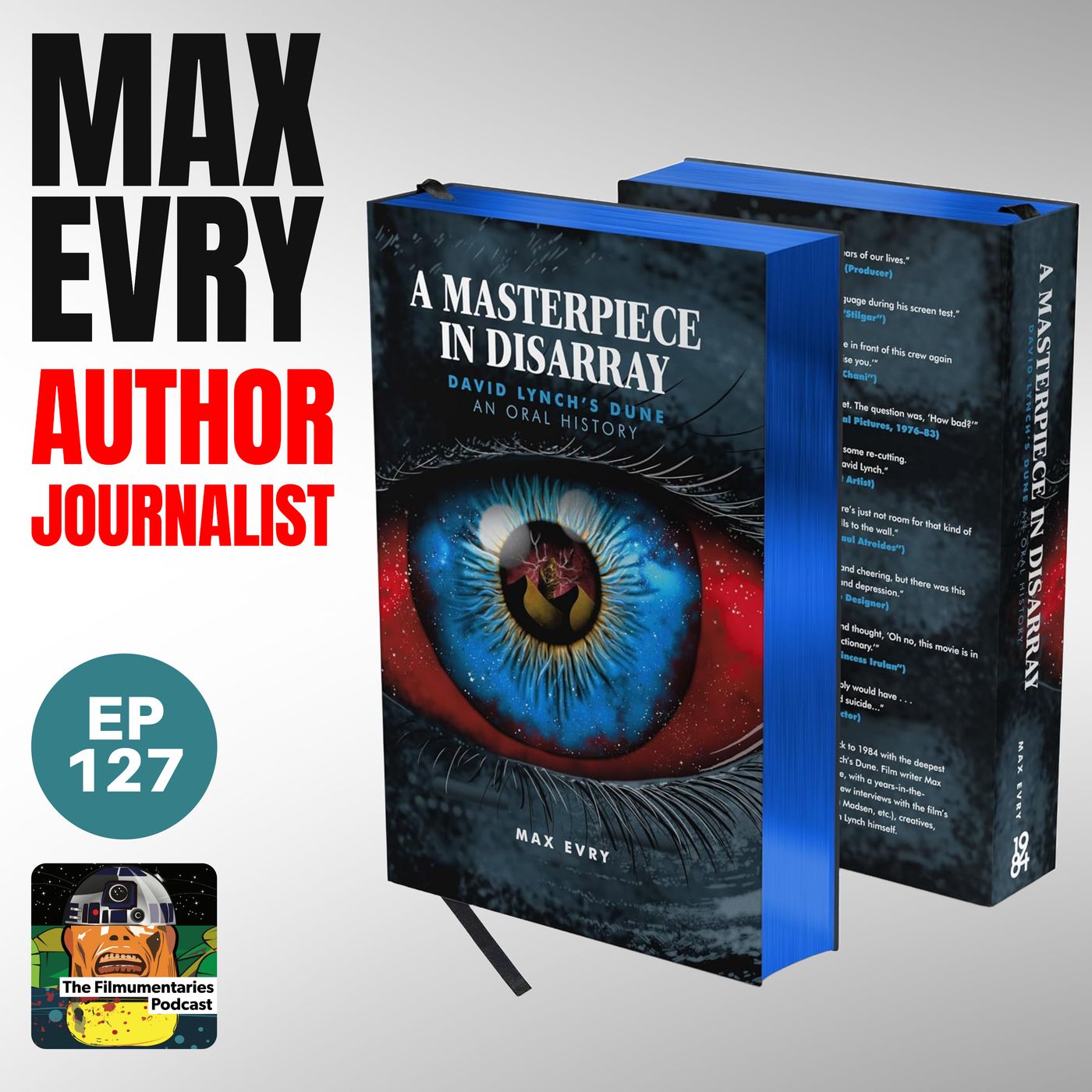
127 – Max Evry on A Masterpiece in Disarray: David Lynch’s Dune – An Oral History.
About this episode
Our Joe Alves GoFundMe Campaign
--------------------------------------------------
Episode 129 – Max Evry on A Masterpiece in Disarray: David Lynch’s Dune – An Oral History.
In this episode, I speak with film journalist and author Max Evry about his brilliant and in-depth book A Masterpiece in Disarray: David Lynch’s Dune – An Oral History. What began as a 150-page entry in a cult film series soon grew into a 560-page epic — much like the film it covers.
Max and I talk about the origins of the project, how he managed to get David Lynch himself to take part, and why the oral history format was the right approach for telling this complex story. We also chat about the book’s structure, Max’s archive work, and how his own experiences as a filmmaker gave him a deeper empathy for the challenges Lynch faced.
There’s even a fascinating discussion about Max’s restoration of a long-lost scene featuring Molly Wryn — which you can now watch here:
You can find Max’s book here.
If you enjoy these behind-the-scenes deep dives, please consider supporting the podcast or sharing it with a film-loving friend - patreon.com/jamiebenning
--------------------------------------------------
Our Joe Alves GoFundMe Campaign
--------------------------------------------------
This podcast is completely independent and made possible by listener support. If you’d like to help me keep making these episodes, you can join my Patreon community here: https://patreon.com/jamiebenning
Watch more on YouTube:
Check out the Filmumentaries YouTube channel for behind-the-scenes clips and extra content: https://youtube.com/filmumentaries
All my links
Transcript
Automatically generated, so expect the odd misheard name.
Weird Gtingway Media. Hello, and welcome to the Film You Mentaries podcast. I'm Jamie Benning, your host for the next hour or so, and you're listening to episode one to seven, one hundred and twenty seven. Before I get onto this object of this episode, I just wanted to let you know that I'm currently running a go fund me to get me and my co director Patrick Tindall to Martha's Vineyard for late June, which will be the fiftieth anniversary of Jaws and the subject of our documentary, Joe olves is going to be there, along with a few other key personnel from Jaws and. Jaws two, also Jews three D.
I guess because Joe's there and it's a real opportunity for us to shoot the final chapter of our documentary on Joe. It really will kind of be amazing to shoot Joe and interview Joe in the place that he originally wrecked in nineteen seventy three and obviously shot the film in nineteen seventy four. Down there in Martha's Vineyard. You know, it's probably going to be Joe's last visit to the island. He's now eighty nine.
It's the fiftieth anniversary, and it just feels like an opportunity that we can't miss. As you may have heard before, both Patrick and I have sunk quite a few thousand pounds into this project already and we can't continue to do that. So we'd really appreciate your support with this go fund me. Now. You don't get any perks, unfortunately, because you can't do that and go fund me, but what you would get is the satisfaction of helping us finish shooting this documentary about Joe, about his legacy.
It's not just about Jaws, it's about all the other things. He worked on Disney. He worked for Disney, He was on Sleeping Beauty, was on Vertigo, He worked with Hitchcock many many times. He worked with John Carpenter Escape from New York. He worked with Spielberg again on Close Encounters, and in fact in these early days in the TV stuff that Spielbog did on Night Gallery, Rod Serling's Night Gallery.
And it's so fantastic to have Joe with us and have Joe's archive that is all shot. We did that over. Twenty twenty two and twenty twenty three. We went out in March and both those years and shot that. We then shot multiple interviews with his collaborators.
You know, the dream is to get Spielberg as well at some point, and hoping also Dean Coundy at some point because he worked with Dean on Escape from New York. But yeah, this opportunity's come up. I had a job booked in Los Angeles and Athletics Live Athletics television job booked in Los Angeles, and the client were happy to fly me to Boston and fly me out of LA I would get the internal flights, so that meant I was being paid whilst I was there and the flights were covered, so that was the only way I was going to do this. Unfortunately, I then got canceled off that job because they changed the speck off the job and I was the last one in, so I was the first one out. So I went from having my flights covered and being paid whilst I was there to none of those things.
So I decided to start a go fund me, and within you know, just a matter of hours and a few days later, managed to raise a pretty damn good amount of money. Actually, But if you know anything about Martha's vineyard, it's extremely expensive We've had to spend on the cheapest accommodation available on the island. For the week. It's cost us over three thousand pounds. We then have to get flights on top of that.
Patrick also needs you know, extra baggage for the kit. Then we have to get a higher car, and it's the costs are escalating. So anything you can do to help us fund it, whether it's sharing it, or whether it's sending us you know, twenty dollars or twenty pounds or as one person did, one thousand pounds, which is incredible, then we'd really appreciate it. We really need to make this happen, and we really need your support. The people who love behind the scenes stories and the people that want to see this film get made.
We need your support. So I'll leave the link in the show notes. But if you go and typing go fund me and not your average Joe, or go fund me and Jamie Benning, you'll find that on the on the whearb. But I'm sure and thank you for anything you can do to help us, do really really appreciate it. In this episode, I'm speaking with film journalist and author Max every whose book A masterpiece in disarray.
David Lynch's Dune An Oral History. Yes, Nigel Smith, I do need the copy back when you finished it, I lent my copy to Nigel friend and former podcast guest. Anyway, it takes a deep dive into one of Cinema's most fascinating and famously flawed sci fi epics. It's got interviews with over sixty contributors, including key cast members and crew, and even David Lynch himself. Max pieces together a complex, intimate portrait of how this hugely ambitious project came together and kind of fell apart.
As well, we talk about the challenges of writing this book, what it took to earn the trust of so many contributors, and why the oral history format felt like the best way to capture this story. Max also reflects at the end of the conversation on his own experiences with creative disappointment and how that helped him better understand David Lynch's journey through June. So here's my conversation with Max every and as usual, I'll be back at the end for a bit muchabbring on, Max, Thanks for joining me. When did this book first click as an idea and did you always intend for it to be such a such a weapon. I mean, this thing is huge.
Yeah, Jason Bourne could kill somebody with it. Yeah, it's a big, big book, five hundred and sixty pages. It was actually right before publication we had to very quickly cut one hundred pages out of it, right because the spine would have broken. My publisher said Gravity was going to be the beginning. And that was good.
That was good because like all that was like filler. It was like, right, didn't need to It was like just like two academic didn't need to be there, Like you can look all that stuff up on the internet. It was like, yeah, it made I think it made the book more entertaining and more you know, even if I've sixty pages. But yeah, like where did it come from? It's weird because like Dune has been like one of those movies that's been around, you know, like in my life as like a kid of the eighties, you know, it was like I would go to yard sales looking for Star Wars figures and I would pick up a Stardu car and be like, I don't remember this from Star Wars, but yeah, like and I think I first read the book and saw the Lynch movie sort of simultaneously when I was in middle school that's like age eleven twelve, And yeah, it was a little befuddled by it, and you know, conte, but like every if, I felt like every like five or six years, I kind of pick it up and be like, all right, let's give it a shot.
And every time I did, I was like, I was like, oh, there's something here, it's a little interesting. And it also it doesn't help that there's two sort of competing cuts out there. You know, there's the long TV edit, which is awful, it's dreadful, and and that one is actually much harder to sit through because it's very discombobulated, and there's a and then there's the theatrical cut, which I certainly prefer because you know, it was supervised by Lynch and it does move very very fast, and it's it has an interesting pace to it, and uh yeah. And then basically that the opportunity to do a book came about, and it is like, originally it was supposed to be part of like a library of book of finn one hundred and fifty page books about cult movies, and you know, and I threw a bunch of names out I was like about the keep, how about use cars, how about the fog?
And but Dune, you know, I had this. We knew Dune was going to be having a moment with the Villaineuve movie, so we're like, let's ride those coattails. And then what happened was is the more I delved into it, the more I was like, oh, no, this needs to be a real book, like this needs you know, you know, deeper research, deeper, you know, try to get more, more interviews, you know, try to fill in some of the holes in terms of, you know, just what happened. You know, there had never been a proper autopsy on this movie. So yeah, I think, yeah, over you know, it wound up being about two years.
It was supposed to be like seven or eight months. It was supposed to be one hundred and fifty pages, and it wound up being two years and five hundred and sixty. And the publisher originally said, oh, you get two or three interviews, I'll be happy. I wound up getting like sixty, you know, three dozen of which are actual like core people from the movie. And yeah, so it just it was just this beast that evolved.
I mean, it was it was originally intended to be one hundred and fifty pages. It was I was paid for it to be a exit. Well. It was definitely a labor of love, but it paid off because I think I think that, you know, I've heard from so many people like, you know, this is the book I've been waiting for all my life. You know.
Yeah, no, it certainly feels that way. Just before we hit record it, I said, you know, I think a measure for me is always when I think, wow, I should have done this, you know, it should have been done by now, And I'm glad you took that mental and went with it. I think the oral history approach is really great because it sort of puts you I feel like you're sort of immersed in the making of the movie as it's being made, because people are recounting these stories, but you're hearing those multiple perspectives around a particular thing, you know, whether it's the visual effects or the casting. I mean that early stuff with the casting is just great. I really really enjoyed that.
Just there's something tantalizing about June because it's, you know, it became something that it wasn't initially intended to be. Perhaps and it's got this mystery surrounding it, and all of these stories you know that we've heard, and obviously Kenneth Godwin's seventy hours of footage that's been lost to the midst of time. There's so much mystery surrounding I think oral history really is the best approach. Was that always your intention? Did you have interviews like already with your work as a film journalist that kind of led you to down that route?
Was it always meant to be an oral history once you reach that sort of initial point of writing it. It wasn't an oral history until over a year into the writing, right, right, Because Yeah, originally I had so few interviews that I was just going to lay I was just gonna lay them in there. I was just gonna like, you know, I would edit them, but they would just be Q and a's, and they would be single Q and a's, and you know, and I only had like eight or nine initially. And then there there's sort of two phases of the book. There's B D and A D before David and after David.
So like once I got David involved, r I P Yeah, like you know, he really gave me a book, Like because it's like once he you know, gave me the time, like all of a sudden, it you know, it unlocked the doors. Yeah, you know, I did that. Come about because you know, he's he's notoriously sort of quiet about this movie. It's not something he likes to talk about. Obviously, there were those things later on where he was talking about, you know, George lucasoffering Return of the Jedi and sort of turning that down and all of that kind of you can almost see that trajectory that he's going in there, that he's got this you know, he's got this big film in him somewhere.
But yeah, he doesn't really like to talk about it. So how did you manage to convince him? Was it the amount of people you'd already interviewed that kind of made him feel like he was the last piece? Or what was it? I think so, yeah, I think the fact that, yeah, I'd already had, you know a number of people like like Alicia and Everett and Gill and Nomi Watts I spoke to briefly.
You know. It's like, yeah, I tried to get as many people sort of from the inner circle as I could, but I never intended to get him. I just assumed that was not a you know, a thing like I mean, I'd already talked to Daniel Griffith, who'd done sort of a you know, a kind of a making of for Errow video, and you know, he took his shot and he didn't get a A lot of people have tried, and yeah, and I think by that point I really wanted Rafaela raphael A Delarentis, who was the producer, And I think she's actually kind of the unsung hero of the film. And I think it's it's a much it's as much her film as it is David, I'll say. And it's funny too, Like I was.
If anybody was ever going to adapt this book into like a mini series or something, or or a movie, I would say, I would say, don't make it about David. Make it about Rafaela. She's the more interesting character, like David would be a funny sort of side character, you know, very obviously, very important, but like you know, she was speaking five languages, and she was you know, really holding this whole giant machine together and you know, uh, really you know, as you've read in the book, like pulling them out of some real tight spots, you know fires, you know equipment breaking down, you know, people having nervous breakdowns and sickness and just. Like pounded equipment and stuff. Oh the bribery that she had to deal with.
Yeah, oh my god. Yeah, her story is much more interesting. And I really wanted to get her. And her line to me was I'll do it if David does it. And I'm sure she said that thinking I would never get David.
And and I didn't find David until I was actually looking for Kyle. I was looking for a contact for Kyle, and somebody gave me a contact and I'm like, oh, this is actually David Lynch's person. Yeah, so then I by then i'd read enough about it to know there's certain things you don't want to go into with David. Like I would never ask him about the VILLAINEU movie. I would never, you know.
I basically I told them I'm going to approach this in a way that hopefully it will not be unpleasant for him. I'm like, I don't want this to be upsetting. I'm like, I will, I want to approach this in a positive way. And I think they, I think his people sensed that, you know, I was truthful, and I you know, I met what I said, and yeah, and so I got a little bit of time with him, and I'm, you know, ever grateful. Yeah, it really feels like people opened up to you.
Considering it's a film that has been considered a failure. People speak so openly about it. I mean, obviously getting people in their later part of their life. I'm sure some of them were in their seventies, eighties, nineties even, But I don't feel like you ever sort of sought out to dig dirt on anyone. If somebody offered a piece of information, it's you know, you clearly considered whether you should put it in the book.
And I'm sure there were things you were told as well that you haven't put in the book. How did you go about trying to find that balance? Well, I'm not a muck raker. I'm not like a National inquirer or whatever, like, Yeah, there were a lot of things that I was sort of like, there are a lot of people out there who this is the thing they would gravitate to, and I'm like, I'm not interested, like I want to know about the making the movie. And so yeah, I mean there are you know, there's stuff in the book about Flare Up, so about you know, conflicts and things like that, but they're all related to the movie.
They're not about Oh, this person slept with this person and this person did this drugs or whatever. It's like, yeah, it's like that stuff's boring, you know. And and also like you know, some of the you know, for some for some of the people involved, it's like you don't want to drag them through the mud, you know, especially when they're being so generous with their time and their memories and stuff. You know. Yeah, So like, yeah, I mean, whatever people gave me on the record, I think was fair game.
But yeah, if anybody said, like, oh, don't don't put that I don't want that person to get you know, I would, Yeah, I would. I would totally. Uh yeah, and I still have. It's some of it's hard. Some of it's hard to not talk about.
There's yeah, there's one scene in particular in the film. I can say this because it's broad enough, it's not damning, but like, yeah, there's a scene in the movie where someone is legitimately being injured, and I was held what scene is right? Right? But now every time I watch the movie, I'm like. You win now you see it?
Yeah, blinding. Yeah. I was thinking, actually, like when I finished the book, there's so many great moments in there, and so many great things, you know, talked about some of those experiences in Mexico just kind of insane. But I didn't feel there was ever like a click baity headline that anyone could draw from your book. You know, it's very dense, it's very thorough, but I don't feel like there's anything like, like you said, muck raking or anything like that.
So I think it would have been easy to do that, And I kind of applaud you for for creating something that has got real depth and has a real nice structure to I think that the you know, taking the structure of the way you've done it, where you've got like pre production, production, post production and then and then legacy and tying it up with some of your thoughts and relating it to you know, projects that you've worked on, and it really brought an extra extra depth to it. You don't have to comment on that. That is me given you a statement, right, But one of the questions I did have is about just the depth that you've gone to the amount of people you've interviewed like sixty on the interviews, I think you said, what what kind of crazy system did you have for keeping track of all that?
I mean, was it kind of spreadsheet chaos or like wall of string and post it notes or how did you keep on top of. All of it? It's a good question, That's what I haven't been asked that, And honestly, like, I think a lot of it was just like making lists and and then just kind of keeping track of it in my head, especially when I was building out the oral history. Yeah, there was. I was like, you know, I think I think it helped that I structured it in a way that you know, things specific lines could fit into specific places.
So yeah, and I don't think and yeah, And basically I would just go through once I was building the oral History, I would go through an interview and just be like, Okay, this could go here, this could go there, and yeah, and then they built out from there. And then towards the end it actually got to a point where I was I think I had enough resources that I was either going back to people to fill in holes or I would actually interview new people. I would I would be like, you know, oh, yeah, I got Steve. I got David Page from Toto, but I don't have Steve Luke there, and this person's talking about Steve lukeylor So let me get Steve Luke there. And I was able to do that, Yeah, because I you know, I think I yeah, like you said, I'd built up enough of a trust with them, with the people where they they knew I was.
I was writing a book about the movie and not about who fucked who or whatever. Yeah. I did enjoy Bob Ringwood, particularly, he just I like the way he speaks so openly but with a real sort of sense of humor at the same time, like you'd you know, just those those stories about raphael A sort of tearing up his immigration papers in his passport and him then being an legal immigrant in America. Just just the craziness of of the behind the scenes stuff is great. And he tells it, yeah, with such great humor and clearly a sort of an affection because you can see, you know, his work on those costumes, like I'm sure you've said, fed into his career later and he knows the importance of that film.
Yeah. No, And it's funny you brought that up. Yeah, I'm sure reading something like that, you wonder what I cut out? Yeah, inappropriate to cut out. Yeah, Like Bob was wonderful and like you said, like, you know, he has enough class two even if he's being brutally honest, which I think, you know, I think he said he has no filter, like he's he's just brutally honest about you know, the people he's worked with.
You know, he can be very complimentary too, Like he's not he's not abut to tear people down. He's just like, this is what happened, you know, and like and you know, that's something that's refreshing, I think to read. And yeah, I don't think anybody minded, Like nobody complained. Nobody was like, hey, why'd you put Bob saying that? You know.
It's like I think that is also something that speaks to just the production as a whole of Dune. It was it was kind of it was very much a family and they, you know, even though it was a hard movie to make and there were a lot of trials and tribulations, they you know, they I think everybody looked back on it with fondness, you know, even Bob. You know, even Bob said he wishes he could have done Velvet with David, you know, you know, I mean he wanted to strangle him, I think making you know, you know, like they were burning you know, they made like a thousand hats that they had to then burn because they didn't shoot the zne you know, stuff like that can make you upset. Yeah, but uh yeah, and I think he's right, you know, I think he's you know, he was angry at David because David let the movie get away from him, and you know, and some of that has to do with the fact that David, you know, had never made a movie this big.
But I also think it's important for people to realize, like almost nobody had made a movie this big. I mean, like this, this, this was the most expensive movie in universal pictures history at the time. Uh and uh, you know, very few people had made a movie of this, you know, of this scale, like you know, maybe Michael Michael Chamino with Heaven's Gate, you know, like I mean, you know, even even Return of the Jedi cost less than do Until There. You go, probably because it was kind of in house lucasfilm as you know, and they had kind of you know, shorthand with each other, and they had crews already that were carrying from film to film, but non union as well, non union as well of course. Yeah, I think your book really captures well the kind of not only the scale of the production, because like you just said, it's massive, you know, down in Mexico and Turubisco studios, and you know, entire sets that weren't seen in the movie, entire performances that weren't seen in the movie.
But it also I think there's some really nice kind of magnification of these tiny little things in Hollywood, in that churn of Hollywood, like that, the randomness of success versus failure, whether it's you know, on the film scale, or whether it's because well, Dino thinks he's got funny looking lips, or you know, David doesn't like his hair or whatever. Just these you know, talking about sort of our Kilma and Tom Cruise and all those other actors that were considered. Did you when you were writing this, did you allow yourself to kind of imagine what the movie would have been with some of those other choices. Yeah. Well, it's interesting because Rafaela talks about, you know, she often wonders what would have happened with the movie if she cast Tom, you know, and my answer to that would be, well, look at Legends.
Tom didn't help Legends. I mean, like Tom Cruise, the creature as we know him, didn't become fully formed until Top Gun. Like that's where he became Tom Terrific. That's where he you know, just like used all of his assets and you know, in what was essentially an Air Force recruitment video. And you know, and yeah, and I mean, I mean, and he's evolved to as a as a movie star and as an actor over the years.
But yeah, like you know, he wasn't you know, if you look at Tom at that time, like Key Business hadn't even come out yet, you know, like right. He was eighteen or something at the time. Yeah, yeah, yeah, And if and if you look at the the performance he gives in Risky Business, you can almost see another a whole other career he could have gone down where he's like a little more neurotic, a little more of a character actor, a little bit more like a Dustin Hoffman, you know, in the graduate kind of a thing. You know, I think, yeah, he just yeah, he you know, there is an alternate timeline where Tom Cruise is starring in Woody Allen movies and you know, and stuff like that. I think I think, yeah, like he just you know, he just he You know, you have to want to be a movie star.
You can't just it doesn't just happen to you. You have to want it. You can be you can become an actor, you know, and be in movies, but to be a movie star is a thing. You know. It's like, you don't you don't just become president in the United States and you know, just become a movie star, you know.
And I think yeah, And again, I don't know if he necessarily had the same qualities that Kyle had, and it certainly, you know, you can't discount the how Simpotico Kyle and David were, you know, like it's like they you know, he became Lynch's avatar basically, you know, they look similar and they you know, they have a similar backgrounds, you know, in the Pacific Northwest, and you know that they have you know, they're both very gregarious and outgoing friendly and yeah, yeah, and I think, yeah, like David just found his guy and that's beautiful. Yeah, And it's it's interesting to me the whole casting process, where you know, people were thrust in front of David, and he wasn't necessarily getting them to do a read.
It was more sort of based on personality and what he could see in them from screen tests, because he was sort of making an assumption that, well, their actors are they can you know, I can direct them. So Yeah, I thought that was an interesting thing because you often hear about you know, actors sitting in a waiting room, like going through the sides and trying to figure out the character, and you know, they didn't really have much to work with other than what they knew from the book. And I guess it was a benefit that Kyle had read the book as a as a teenager and and I kind of fallen in love with it and had kind of quoted it to his friends. I think he says at one point. Yeah, that bit was really interesting me because it seems to sort of go against what you would expect a big film of that time to have done in terms of casting.
Yeah, and it's interesting too to contrast him with Zach Gallaghan's story. You know, really I was really happy to get Zack yeah talk about it, because you know, that was a case where you know, he was very similar to Kyle and that he had that he had the same kind of in a sense and that same kind of attitude. And he was also a fan of the book. And you know, he was him that was quoting yeah to his friends, wasn't it. Yeah, Yeah, so it's like, yeah, it's it's it's like it's so it's it's not just one thing, you know, it's it's an it's an outcoming and you know, and it's and it's and yeah, for whatever reason, he didn't click with David, and for whatever reason, Kyle did.
And you know, and you can't you know, he can't define that. I mean, you know, I guess it's a little like speed dating. But yeah, yeah, you know, and I think, uh, you know, and and they also, you know, they really tried to make val work, you know, like I think there's a quote from Rafaela, an archive quote where she said, like we we screen tested him so many times, we convinced him ourselves he was the right guy. Yeah, and it got very close, didn't it. I Mean, he was basically signed.
He was like he had It's like, you know, even the casting directors like, what are you doing? Like he's our guy, Like you know, we got our guy, like, why are we going out and looking for more people? Yeah? And yeah, I think I think that was actually, you know, good intuition, you know, whether it was about his lips or whether it was about you know, his attitude or the way he related to David, you know, like they you know, I guess we know from you know, sort of history that you know, Val could maybe not be the most user friendly actor and in some cases, maybe not all, but certainly some cases not the most user friendly. And yeah, I'm I'm almost certain that like that is part of what David's process was.
It's like, do I want to spend six months with this person? You know, and that can be you know, that can be really important. You know, if you have somebody who has their own agenda, they can derail a production. Yeah, you know. So, Yeah, I think he did a really great job of you know, assembling a group of people who are extraordinarily talented, you know, and and all very right for their roles.
And also you know, we're able to form you know, a united front. Yeah. I think I always think of June very sort of visually. I can't really necessarily remember too many of the scenes as such, or bits of dialogue, but I can can picture every member of the cast because I think they were cast so well and fit so well visually that they always worked for me. I think it probably was helped along by that early game on PC where they were rendered again those those same actors in computer graphics, and I played that thing to death.
But yeah, it's just one of those films that I always have a real kind of sense of the space that it creates in my head. I don't know if that makes sense, Like I understand the kind of geography of it and the weirdness of it. I remember the first time I saw it, I would only have been I don't know, eight years old. I saw it a couple of years after its release, and I remember thinking, not necessarily that I liked it, but just that I thought, I like this feeling of this film. You know, it feels weird.
And did you always have that kind of relationship with the film that it that it felt a little bit on the fringe, and because of that, that that's one of the reasons you enjoyed. It absolutely that that's a very apt way of putting it, you know. Yeah, Like there's a I think was so much of Lynch's movies. It is about kind of the feeling they invoke. Yeah, you know, like I guess a good parallel example would be I remember reading years ago, I think it was in Scorsese on Scorsese, where Martin Scorsese talked about how he would you have it, you have it on yourself.
Yeah. He would talk about how he would put on like a different Mario Bava movie in every room of his house and then just walk through his house like soaking up the atmosphere. Yeah, right, yeah, and yeah, yeah, I think you could do the same thing with David Lynch. You know. It's like, yeah, like they're all they all feel of a piece.
They all obviously have you know, similar hallmarks and you know tendencies and you know quirks, yeah, and obsessions and yeah, and and doing is no different. You know. That's part of the point of the whole book is you know, the all the people who dismiss it because Lynch dismisses it. It's like no, no, no, no, no, this is a David Lynch movie through and through every scene. You know, there there's no like scene that feels like it was made by the second unit director.
Like it's all feels like a Lynch movie and you can kind of just you know, drift through it and you know, just being immersed in this world in the same way you would erase your head, you know. Or Twin Peaks, Yeah, like you know, yeah, I mean my particular favorite world. I love Caladan, I love you know, everything is kind of made out of wood, and you know it feels like, you know, you kind of like you're in Twin Peaks, yes, a little bit. Yeah, it's it's it's it's some of it is very cozy. It's very cozy movie.
Yeah, similar, sort of the same vibe when you get into the Seeches with the Fremen Yeah, and then when you're in you know, the disgusting harkonein you know, Wasteland, you know, yeah, you feel the revulsion and you feel that it's also fascinating in the same way that Blade Runner is fascinating, you know, like it because it's in that you know, that very specific mood. Yeah, Like these are all things that contemporary Hollywood is afraid to do, you know, like they don't want to make anything that's distinct, they don't want to make anything that feels uh, you know, authorial, like it came from someone, you know, they want to make something that feels like it came out of a factory. I was listening to an interview the other day with It was an older interview with John Landis, and he was talking about how he had, you know, within somewhere within the twenty ten's, had a meeting with a studio executive where they were you know, trying to see if he could make a movie for them, and the studio had said, John, the reason I am not going to hire you to make this movie is because we're afraid you're going to make the movie.
So that's the world we live in now. And that's what makes Dune you know, something else, something special because you know, David made the movie. Yeah, And it doesn't feel like you could say it's this movie mixed with this movie. It just it's Zune' it's its own thing. I've always felt that way.
It sort of stands alone in that regard. Just going to back to some of the sort of behind the scenes stuff that you you dug into the in the book. I mean you talk about you know, the crew and the cast, the cast being people they want to spend you know, six months with or whatever you know, I've crewed crews for my TV shows that I've worked on, and i'd sometimes have genuinely pier people I get on with better, you know, because I don't want the egos in the way. But they did go down to Mexico, and they were down there for months, and there was sickness, and there's that absurd moment where Dino builds an on site Italian restaurant to avoid all of the sickness and salmonello and everything. To me, it felt like that's a metaphor for the whole production in a way.
Did it feel that way to you. In the sense that they had to I think I know what you're talking about, in the sense that, like they came to Mexico is save money, Yeah, and then they wound up spending more money because they're in Mexico. Yeah. But you know, there's that thing of having to make good and having to do the best you can within the parameters that have been served to you, you know, because it's easy for everyone to kind of pick holes in the movie, but until you know what went on behind the scenes, I don't think you can fully appreciate what they managed to achieve with the film. Yeah.
I mean also, you know, in the sense they're like, you know, I believe it was a kind of a negative pick got deal, Like it was a Delarentis movie. It wasn't necessarily a Universal movie. Universal just had a stake in it and ultimately wound up having some say in terms of the length and the editing, you know, because they needed it to be x X length, you know, and because they invested X dollars and had to put more money into it because of shortfalls, you know. Yeah, then they wound up having more control over it. But yeah, it is essentially it was essentially an independent production, and and you know, and yeah, and because they were in Mexico, it gave them some distance from the studio and this you know, the studio executives don't want to be in Mexico City.
You know, the same same thing sort of happened with Peter Jackson when he went to New Zealand to make Lord of the Rings. You know, it's like, yeah, like, you know, like the executives don't want to fly out to New Zealand. Yeah, yeah, so yeah, so in that sense, they were insulated to a certain extent. And I also think that's why the first for the production went pretty smoothly, and then the second half was more rife with like oh, you know, I think you know, at a certain point they realized they weren't getting Star Wars, you know, like oh shit, like you know, like they're in trouble. Yeah, And I think, you know, I think they were expecting something more like Elephant Man and less like Eraserhead, but they were getting both, you know, and the yeah.
And I think, uh, you know, the way the Delaorentes made movies is uh, I think kind of wonderful. Obviously, you know, h it didn't didn't work a lot of the time, you know, but but sometimes it did beautifully. And you know, I think that's a testament to how much leeway they gave the filmmakers and how much support they gave the filmmakers. You know, like even you know, if things went sideways later, you know it did. It didn't always feel like you know, a corporate thing.
It felt like, you know, as Bob said, it's like you know, Judy Garland and Nicky Rooney putting on a show, you know, in the barn. You know, I think that's I think that's kind of cool. And again, like you know, one of the reasons why a lot of people enjoyed making the movie, you know, as opposed to you know, a modern, you know, blockbuster superhero movie or whatever, where you know, the cast probably feel like they're working at Starbucks. Did you ever consider, through the process of making the book to make a sort of visual companion piece or to make a visual book itself, because that film is so rich in terms of the visuals, and obviously you've been privy to a lot of you know, casting notes and original drawings and concept designs and photographs of costumes and things, and there's all that again, all that lost footage.
It feels like, I don't know, did well, that's my question. Did it ever cross your mind to do that? I'm sure it did. Yeah. I mean we were limited in the sense that this was an unauthorized book.
Yeah, and you know, and that's good. It's good for that reason. I'm sure if it had been authorized, it would have been a totally entirely different book. I I nobody ever told me, no, you can't print that. Nobody.
One person I interviewed asked to read the transcript of the interview, and I gave it to him, and he never sent me. So yeah, like it was there was absolutely no control from anybody except me and my publisher. And my publisher gave me a free hand as well, like there was nothing like, if anything, I was the one who was saying, let's cut this, let's cut this, let's cut this, you know, just because I wanted it to be a good book. And at a certain point you have to put your ego away, and you have to also not think about, oh, I spent so much time on this, you know, you have to just get rid of it. And yeah, and I wound up using a lot of that info later on things like I did an audio commentary for the Viavision Blu ray of Dune and you know, and that was three hours long, and I had you know, that stuff came in handy and yeah, and then in terms of visual things like I mean, I did create like a YouTube video of the alternate ending that was never shot, which I assembled with storyboards from Apple Gee.
And I did that, you know, myself, not through my publisher, you know, as you know, we didn't want to get sued, we didn't want the book to get cold. But then I was able to then make that video and a lot of people saw that video. And then I also worked with Molly Wrinn, who was an actress who played the character of Horror and her almost our entire part is removed from the movie. And there's one scene in particular with her and Alia and Jessica in the sea each it's an amazing scene. So it's almost like something from Scanners.
It's really freez. You put that out about a year ago, so didn't you. Yeah, I put that out of a year ago. Yeah, And we actually, you know, me and this other guy, Matt, we actually took the VHS that she had, which was luckily was the it was the letterboxed, so it was it was the full image, but it was really scratchy and it was from a work print and it was VHS. So we had it scanned into four K and then we went in and completely cleaned it up and restored it and we even added in the blue eyes and yeah and yeah, so stuff like that, those little projects, even though I wasn't you know, I wasn't getting paid to do any of it, but it was like I felt like it was part of the process of preserving the film and you know, sort of disseminating the idea that you know, Dune is more than the sum of his parts, you know, that is it is almost an un finished film.
Yeah, and in that sense, you know, it's like, you know, because there's so much stuff that went to the wind, you know, there were so many plans that David had that didn't come to fruition. Yeah. But you know, once you know about all those things, it definitely helps give you a better idea of what the movie could have been. Although I do have to say I think even in its compromise, flawed, current state, the theatrical cut is still an incredible film. And it's still one of those things that like, you know, I you know, it continues to give me things.
It continues to you know, unveil itself to me. You know, the more I watch it, and it's it's, you know, I can't think of any movie I saw recently that works like that. I don't think I'm going to get the same thing. I don't think I'm gonna get anything new from Captain America, A Brave New World twenty viewings that I didn't get on viewing one. Yeah.
I was talking to a friend earlier about how when you're a kid, every movie you see for a period of time, every movie you see is the best thing you've ever seen, and then at some point that stopped happening. I mean, it's kind of sad, kind of sad to even think when that might have been for me. But I'm sure it happened along the way in my forty eight years, where you just see a film you think, yeah, it's never going to be as good as X, Y or Z. But yeah, I think there's something about being a certain age and seeing a film like that that really kind of sets something deep in your mind. And then then it kind of.
Develops over time as you go through different periods of life, the film means different things to you. And the thing is Max, Now you are part of that legacy as well. Do you find or do you feel you have a responsibility or an obligation to sort of be this custodian And as new information emerges, is there any temptation to kind of make us I don't know, especially edition of the book. Oh that's a good question. I mean I certainly.
I mean, obviously I'm talking to you and it's been you know, almost two years since the book came out. Yeah, Like, yeah, like I'm not you know, I enjoyed talking about it. I enjoyed being part of the legacy. You know, I'm part of the Wikipedia page now, which is fine and obviously, and I'm on you know, I'm on that Blu Ray, I'm on a bunch of things. And then we you know, I guess to get to what you were saying, the we were going to do a paperback edition that was going to be a little bit more expanded, and then we realized people really loved the hardback.
Yeah, so instead of doing that, we just kind of went in made some corrections because you know, when you come out with a book, people love sending you emails with like, ah, this isn't right, and I do listen to them. And I went in and I fixed some things, and I added a few more little cameos, you know, like I added to some quotes from Matthew Vaughn and Joel Hodgson from Mister Saints Theater. This is a great quote from new quote from John Sales in the in the second printing. But yeah, but it's mostly the same book. We couldn't really add a ton of stuff because then it would mess with the formatting.
So yeah, so like we yeah, like the second edition has a few little things. But yeah, I have actually done more a few more interviews for what I hope will eventually be the paperback and uh yeah, and we also have an audiobook version that's coming out. We've I've been talking about it for so long because I'm working on for over a year. It's just is just how a lot of production problems and but for all the people who thought the book was too long or there's a lot of little called to acts that we go down in the book, which I love and which a lot of people actually loved. Uh, like, you know, like I like.
I talked to billson Kaevich, the guy who drew the comic book adaptation. I talked to the guy who's uh collects all the toys and knows everything about the toys. I talked to. A guy who did who wrote an episode of Chuck uh that had a sandworm in it. You know.
I mean, it's like, you know, I go down all these little culor sacs and you know, and and part of that was to show, like, you know, no matter what David says and no matter what anybody says about the movie, it has a legacy and it has impacted people, and it has you know, like you know, made an impact and and and there's a larger sort of even industry around the movie, you know, with you know, things like you know, the the uh, the action figures, the new there they're new action figures from the movie that just you know came out a few years ago. You know, like there's people still doing prints. There's still you know, it's like it lives on, you know, it's it continues to you know, be a thing. And then you have also the VILLAINUV movie, which has been the greatest gift to do nineteen eighty four because now there's something to contrast it with.
You know, now you can you can look at what Villain did, which is one hundred and eighty degrees different from what David did and and also has value. But you know, yeah, like you can you can look at it and you can say, oh, well, what David did is actually really interesting. You know. Villain News is more like the book, and Lynch's is more like Lynch. Yeah, it leans into the weird a lot more, doesn't it, Lynch.
But yeah, it's great to have that contrast. I don't want to spoil the end of the book for people who I'm hoping are going to pick it up and read it after we've we've. Had a chat. But you talk about your or Passion project and you know it kind of collapsing in different degrees and not working out in the way that you wanted. Did that do you think that give you that sort of personal flop as it were, gave you a better appreciation of what David did achieve with the film, or the struggles that you had in trying to make make the movie.
It's sort of that that last moment in the book really gives a kind of it reallyminds you of the emotional thrust of the book. I think you know that this is something that somebody's trying to achieve. Films are always something that somebody's trying to achieve, and in sharing a similar experience, albeit on a smaller scale, did you find that useful as a perspective. Are you talking about the sci fi movie I made when I was younger? Yeah, yeah, yeah, thank you.
Yeah, nobody's asking me about that. You're the first person, So yeah, no, that was that was definitely something I realized, like towards the towards the end of I was like, oh, this is why I'm so invested in this, you know, it's because I have experienced this on a much you know, smaller, more personal skill, but like definitely, yeah, like I I understand what he went through. I understand you know, putting years of your life into something and then you know, it doesn't it doesn't doesn't get received very well or or doesn't what was the. Name of the film again, remind me. That movie was called Blue Lollipop, and yeah, it was.
It was sort of a follow up to another sci fi movie I made when I was in college, and that that one had been successful, that would had been gone to festivals, and like, yeah, it was yeah, you know, stuff like that happens, and then you know, like again it's it's similar to what David went through also in the sense that you know, you try to carry the lessons through you try to you know, like you know, get something from it as well, like you know, oh, this didn't work because this this this will, let me try something, let me try something else. Yeah. In terms of David, you know, I think it is sad that we did, you know, we didn't get more movies of the ambition of doing you know, he made you know, obviously like you know, stuff like Twin Peaks is very expansive and has the same elements of world building and all that.
But yeah, but you know he was also he was an incredible fantasist. Yeah, you know, and yeah, I mean he could have certainly gone down a path, you know, much more like I don't know, like Tim Burton or Terry Gilliam, you know, and you know, really taking us into you know, he he loved exploring other worlds and you know, creating these unique, you know, sort of fantasy scapes. You know. His his script for Ronnie Rocket is very indicative of that. Yeah.
And uh, and I think you had I'm sorry, I'm forgetting his name. The guy who did the costumes and stuff for Return of. The Jedi uht Jamira. Yeah, yeah, you had Nilo on it. Neilo tried to make a DomU with David in the nineties.
You know, another movie that begins with Dune, that only that begins with d that only has four letters in it. I don't know what's going on, Yes, yeah, I think, yeah, that would have been fascinating my god. Yeah. Yeah, so yeah, it's like, yeah, I don't think you know, it's not like he made Dune, and then he never wanted to do uh, you know, science fiction again, or he never wanted to do you know, something fantastical again. You know, he talked about doing this movie.
I got it. I'm also so forgetting the name of it. But it was like about these creatures that live in a carpet. It was like an animated movie. He spoke about this fairly recently before he died.
And yeah, and I and I one of the things I uncovered after the book, I uncovered his script for June too, And you know, and that script has a scene with these creatures turning themselves small and going into a carpet. So you know, clearly, like you know, he was, he was investing himself into the world of Dune, and then the world of Dune gave him stuff as well. You know, I certainly think that the way Herbert approached you know, an ever expanding narrative and an expanding sort of mythology certainly and had an impact on Twin Peaks absolutely. I think people it's easy for people, it appears to be easy for people to dismiss June as part of David's filmography, But we wouldn't have the movies that we had subsequently, if it hadn't been, if he hadn't gone.
Through that experience. I mean, you always learned lessons, whether they're positive or negative ones, don't you. What are the lessons that you've sort of taken from writing this book? Was it? Well, shit, I'm not going to do that again.
That took too long, and I can do this. I can do this, and now I'm going to pick this movie, this movie in this movie. Yeah. I mean, certainly my next book will never be as long as this one, and I won't spend two years on it. It's not going to be one hundred and fifty pages though we both know that.
But I think the thing it taught me was just, you know, the more you just you just look, the more you'll find. None of the things that I discovered were like that hidden. You know, like a lot of this stuff was just out there and it was either about asking the right person or going the right place, or you know, just putting two and two together. Yeah. Yeah, It's like it's interesting because I think I think the fact that people look at it as this great, you know, work of investigative journalism, as a testament to how shitty the world a journalism.
No, but I think I think you know, as you say, the information is out there, but it's until you put it alongside each other, you know, different quotes from different people, and put it in some sort of context and some sort of not necessarily like like an invented narrative, but a lineage. You know, until you put it in some sort of order, it doesn't reveal. Itself, you know. I mean even from a very simple point of view. And this is me talking about a book I put together with a friend of mine, which is just the timeline of the production of Return of the Jedi is literally.
On this date. This happened on this date, This happened for the forty years that the film had existed at. That point, and people were going, wow, I didn't know this. I didn't know that. Well, it's from this book, and it's from that book, and it's from this interview and that interview.
But until you see these things side by side in a particular order, in a particular way where you've got maybe conflicting opinions or you know, like in the production of Return of the Jedi, you know, one day at Elstree, people were trying on ewoch costumes and it was the same day they shot the first scene that was deleted, and things like that, and people like, oh, you know, I get this real sense of the structure of the film and how it was made and how big it was and what was going on. And your book does that really well. Like I said at the start, you know, it really puts you kind of there. I think, even though the voices are talking retrospectively, for the most part, I really did get a sense of the size of it and the complexity and the chaos and the minushai and the scale and everything.
I think. I think that's what's really valuable about in aal history, and about your book in particular. Thank you. Yeah, and I and again I think that this you know, I've been in I've been in the world of movie journalism for two decades now, and you know, yeah, I think the thing that I've learned doing this book and also doing like audio commentaries for places like Keno, Lurber and Arrows, you know, as soon as you stop looking at the usual places like Google Search and Wikipedia and IMD beeps trivia, you know, like you might be able to scratch the surface with those, but they're not the be all end all. And you know, I hate to say it, but most of the movie journalism you read online, even from you know, uh trades like Variety and Deadline, they're getting most of their information from these places, not going back and looking at old newspapers, old magazines, old you know, archive interviews, you know, even videos.
There's even you know videos on YouTube, you know that you can see vintage stuff, and it's like nobody's doing the work. No, you know, they're just relying on aggregate information and that's going to kill history. And it's only gonna get worse because people are using AI to dig up these these facts that aren't always facts, and then it's just gonna end up in this kind. Of pool of brown sludge. And that's gonna be It's awful.
Yeah, I had I had to recently just get rid of Google because I'm just I'm sick of seeing wrong information at the top of my searches. Yeah, and yeah, it's like it's not even like will form this information like you might get on X. It's just like wrong. It's just it's just it came from like you said, sludge. Yeah, it came from some algorithm and you know, they're just they're putting things together that don't belong together.
Yeah and yeah, and so yeah, I hope that can die before it does too much damage. But yeah, but just in terms of you know, you know, regular movie journalists, you know, like seriously, like stop just using Wikipedia and IMGB Google likes. It's not helpful. There's nothing more valuable in talking to the people that were there at the time. You know, I'm writing an article at the moment about ILM's animation history, so I'm going all the way back to likely drawing you know, R two D two's electricity bolts around him and wrote a scoping Lightsabers up to you know, who framed Roger, Rabbit and Rango and then Transformers movie they did last year or year before.
And there's no way I could research that online. There's absolutely no way. There's just not enough information. And what I love and is just speaking to these people and digging out these little bits of information that don't exist anywhere else, and then having that as a record for hopefully people to reference in the future and actually find the truth. Yeah, yeah, yeah, and yeah, so yeah, so yeah, I think that's something I'm definitely going to carry through on whatever I do, you know, going into the future, you know, like even yeah, even just recently, I just did a commentary track for Kingpin and like there's a there's just like a factoid on IMDb trivia that's like Will Ferrell is giving is one of the people yelling in the background of the bowling scene at the end, and just like I did like, you know, marginal research and found an interview with Will Ferrell where he's like, oh, yeah, I didn't do that.
It's like but it's still out there, and it's like, yeah, you have to you know, correct it and you know, and and tell people like yeah, no, don't just believe everything you breen. Yeah. I think that's a really good place to end it. Thanks for your time today, Max, I really appreciate I love the book. I'll mention it again a masterpiece in Disarray, David Lynch's June and Oral History, the Big I mean, you could, you know, if it had not sold, you could definitely have built a house for yourself out of these, you know.
But thankfully it's an excellent book and I'm sure it's I'm sure it's selling well, and I hope it continues to sell well because we need more books like this, we really do. Thank you. Yeah, yeah, and yeah, I'm sure we could have talked more. I'm sure we could have gotten into like some of the visual effects stuff, because I know you're into that. Yeah, but I mean, it's it's all in my book.
But it is, it is all in. But I'm aware that my podcast meant to be all sorts of different jobs and disciplines in the industry, and I ended up interviewing like seventy five percent VI effects people, So that was that was deliberate on my part in this conversation at least. No, I love what you do and I yeah, I've listened to quite a few, so I really enjoyed it. And good yeohn, thank you for you ever having me on. Oh no, very welcome, and thanks for your time.
Thanks for listening to my chat with Max every year. His book, A Masterpiece in Disarray, is really worth picking up. It's been out a while now. It took me a while to find it. Thank you to one of my followers that pointed me in the direction of it.
I can't remember who it was, offhand, but yeah, appreciate that. Really did enjoy the book. So whether you're a fan of David Lynch, Frank Herberts, Dune or just love detailed behind the scenes looks at filmmaking, creativity and chaos. I guess then, yeah, definitely worth picking it up. You can find a link to the book on the show notes and on filmomentaries dot com, along with some extra resources Max mentioned during our conversation, including his restored VHS footage.
If you're enjoying the podcast, do consider supporting it via Patreon. That's patreon dot com, forward slash Jamie Benning, or if you can't do that, please share it with a friend who might be into this kind of thing. Every bit of support really helps keep these conversations going, and I do really need to grow that Patreon following. I'll be back soon with another episode later this month, but until then, take care. Thanks for joining me, and I hope you can do so.
For the next episode of the Film Yourmentors podcast, we are being way media. H



Similar episodes across the network
Matched by shared keywords.
-
Neil Marshall - Unsung Cinema
2 shared keywords: 1984, the
-
Justine Nelson - Unsung Cinema
2 shared keywords: sci-fi, the
-
Dune (1984)
2 shared keywords: 1984, dune