
Season 1 · Episode 13
138 - Jay Glennie on "The Making of Quentin Tarantino's 'Once Upon A Time ...In Hollywood"
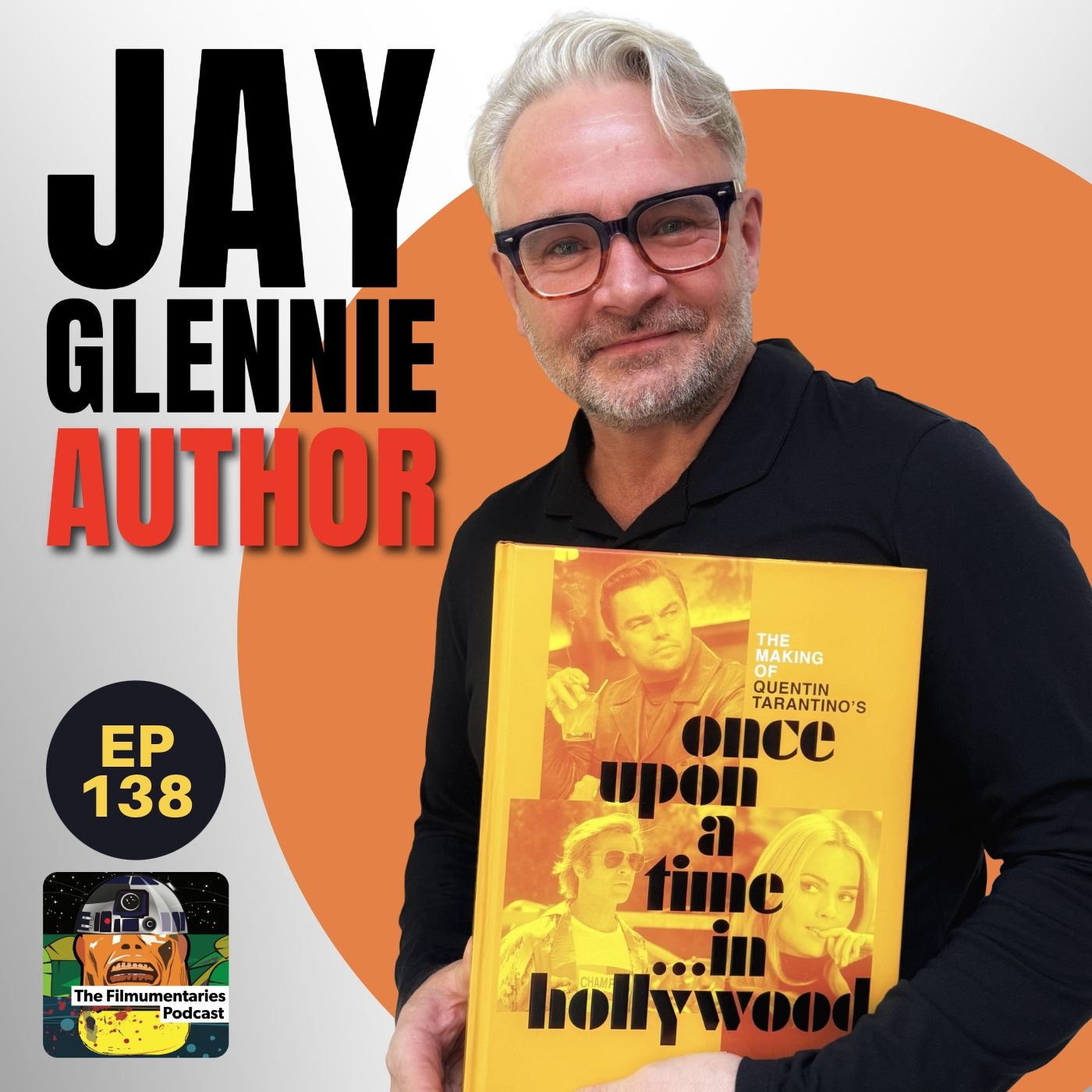
About this episode
Big thanks to Jay and to TITAN books.
Buy Jay Glennie’s book - published by TITAN.
This podcast is completely independent and made possible by listener support. If you’d like to help me keep making these episodes, you can join my Patreon community here: https://patreon.com/jamiebenning
Watch more on YouTube:
Check out the Filmumentaries YouTube channel for behind-the-scenes clips and extra content: https://youtube.com/filmumentaries
All my links
Transcript
Automatically generated, so expect the odd misheard name.
Weirding Way Media. Welcome to episode one hundred and thirty eight of the Film Yourmentary's Podcast. This is Jamie Benning, your host and the sole creator of the show. Thanks for joining me once again, or maybe it's your first time. It could be your first time.
You've got a lot of catching up to do. This week. I'm speaking with author and film historian and former guest of this podcast, Jay Glennie, whose new book, The Making of Quentin Tarantino's Once Upon a Time in Hollywood offers a deep, i would say, vivid look at how Tarantino's ninth film came together. Jay's known for his detailed work on his books about Raging Ball, Taxi Driver, and The Deer Hunter, but this one, it kind of sits in a different place, I think for me, because the film is so recent, It's still alive in the memories of the cast and crew that Jay speaks to, and he captures in his writing that kind of immediacy beautifully. It feels like the film is.
Really unfolding in front of you, being made in front of you. Before we get into that conversation. If you enjoy the work that I do here, please consider supporting the show on Patreon, Patreon, dot com, forward slash Jamie Benning. There are one hundred and twenty people doing that right now, but I need more. I really need to double that number.
That was my plan like two years ago. But you do get video versions, you get early versions of the podcast, get an AD free version of the podcast as well, and your support keeps these conversations going. You'll find the link in the show notes. So here's my conversation with Jay Lenny and I'll be back at the end for a bit more jabbering on. I mean, I spent a couple of years in a cocoon right in this and it's just slowly getting out there, and the response has been really good, but you never know it.
But I meant it really feels like, you know, I loved your work before, Like I mean, I've read a couple of your books and one of the one of them, the Raging Ball one, I damaged slightly moving some books around. I had to buy another copy of it because I want it there like pristine, you know, But this feels like a real step up again. I mean, you've made your name. Let's let's jump in here. Jay, You've made your name chronicling.
You know, great films from the past, you know, where you're piecing together history at a certain distance. But with this one, the story is like it's still warm, isn't it? And recent and everyone involved has still got that kind of energy in their memories that really comes across in your writing. You can really feel that in your writing and their testimonials. Did that sort of change your process with regards to how you've kind of done things before?
Is there is there less of a puzzle to put together when it's so sort of fresh? Yes, that's just post so Jamie, Oh, thank you for having me on as well. I haven't said that, but yeah, I suppose so in a sense because of what you said, you haven't got that that sense of time. But the I think because of the context of the movie, it felt like it had been made many, many years ago. Yeah, what you didn't have is perhaps you know, apart from some but sadly Burt Reynolds is and Michael Messon just towards the end of things, but you haven't.
All the main players are still with us, and they've all got such vivid memories of working with Quintin. I mean, just to go back to the very beginning when Q and I first met. He he is quoted in the front of the book, You've to given one of my flicks the j Glenny treatment. Give me a nod and amazing obviously soon if someone says that to you all over that especially suddenly like Quintin's stature, and I just sort immediately plumped for this book. Once upon a time in Hollywood, it just, man, it just I don't think there's a movie that hit me so much as this one in recent memory.
He plumped for In Glorious Bastards because there's a huge backstory which will come to it when we release that book. So we were sort of working on those two simumsanius, but I chose this because it just resonated with me. Man, I just fell in love with it. This will probably be like we've when we've chatted before, Jamie, I'll be skitting around the way. Yeah.
Yeah, so he I think one of the Quentin then went on to tell me when we spend the week together, and he went on to tell me that this one there was an idea that he could do a sort of a almost like another story, a bit more of a story to it, and then when he started writing the characters, he was just loving hanging with them. And that was the part that really I loved just hanging with these guys. I know a few people said, oh, there was much of a story to it. I love the fact that you could hang with it. I think we're a little bit more in tune with these things now, with these beautiful episodic TV we get now, which feels like film, And I think I just wanted to hang with these guys, and bloody hell, man, did I love hanging with them and hang with them offscore as well.
Yeah. And that's the great thing that comes across in your book is just everybody who's involved, from you know, the ad to casting director to DP producers, they all have that enthusiasm for this project and there is that kind of there's almost like this dance that they do around Quentin and his project because he's such a big character and because he's got such a great stature in the industry, and because it's a film about Hollywood as well. There's just something so tantal antializing about doors stories. People just getting this script that's already been thumbed through and has got coffee or beer stains on it because there's literally one or two of them. And I love that whole process because as opposed to a book that's sort of talking very historically about a film that could have been forty years ago, this feels like really vital.
It feels as I'm reading through it, it feels like it's happening now as well, which I really love. There's there's a real and you know, I don't want it to sound like this is diminishing it anyway, but it is such a page turn of this book because I just want to know where it goes next. Because there's there. It feels like all these threads are coming together. They're assembling this team of disparate people that Quentin has hoped to work with and they've like longed to work with him as well.
And I just love the way you've rewritten just feel so I keep using the word vital, but it feels so fresh and vital. Where do you start on a project like this because there's so many people. To talk to? Yeah, well you start at the beginning. So I don't mean that being really cheesy.
You literally start at the beginning. That's Quentina. But I struck this. I had this idea when I started these books. I wanted to take myself out of the story.
I'm in no way diminishing anybody else who's written anything to do with films, but I'm not a big love when it's me, me and me. And he said to me, and he said to me, I mean part of your ego. Guys and girls really like I'm going to be any bigger or better than the guys I'm talking to. So I love taking myself out of it. But what I really it's kind of intuitive.
Really don't know that. I wanted to make it feel like the Magnificent seven And you can see Steve McQueen's character and he keeps holding up the fingers as each team member comes in, and maybe a few people are going to get bored of it by the end of the tenth book with Quentin, but that's going to be the theme. Each time there's a new player comes in, they're going to get their time in the in the spotlight, and it's going to be almost like Steve McQueen in Magnificent sevens. You're going to feel it almost like a finger's going up and now it's boom, time to shine. And I think that's really that comes from Quentin when we made a packed at the very beginning that if he and I got a kick out of it, well, first of all, I wrote it for me.
I'm going to lift cut to the chase. I wrote this book for me. I want in my collection, no two ways about it. I wanted this book in my collection, and and I didn't want anybody else to do it. I thought, well I'd better do it.
But second, but more importantly, all joking aside, we wrote. I wrote it for an audience that too, and that was me and Quentin, and I thought, well, if we got to kick out of it, other people might. And I think the only way, I mean, could we have really we could have. I could have written the book just spending the week with Quintin. I mean, gee, wis I mean, everybody knows him, and he knows, he knows.
I love and we rear him. But you know, if there's anybody knows anymore about film, then I've yet to meet him. I mean, yes, I've spoken to Mark and Scorsese for my Raging Ball book, but it wasn't as length he ass as Quentin. I mean, this guy knows everything, but it was important to him that he had other people's viewpoints. And it was important to me as well, because I love doing that with the Ball Raging Ball book and the Deer Hunter brook and the train spot and book and performance book, bringing all these other people in.
Yes, as soon as soon as the as soon as the week had finished. My job then is to start inviting cast and crewe. And so to answer your question, where do you begin, it is with Quentin and then it's bringing in the cast and crew. And because as we just alluded to at the top of this is only six years old, people's memories are fresh. Raging Ball, Deer Hunter to performance.
Maybe to a lesser extent, Train Spotting, but you know, you're prodding and you're probing, and you're do you remember? Do you remember? This one was a lot more present. But I really wanted to make sure that it wasn't. It felt like, as you just said, I really wanted to be a page turner.
I love reading thrillers. I love reading books that you want to you know you can't, oh my god. And it was really important to me as well that the book wasn't a stuffy book that you know was going to be the only high grade university students were going to read in film and it had to be accessible. It had to be as accessible as Quentin's films. Yeah, that was my yard stick, really bring as many of the players that I could, and it had to be accessible to So for you to say it was a real page turn of man, I tell you that was a real card.
Holl That is Jamie. Seriously, Man, that's one of the biggest, biggest things I can hear, really, because that's what I set out to try and achieve. Yeah, do you hope that I have. I think you've really balanced that kind of nuts and bolts approach because you want to get into the minutia, you want to get into the detail, but you've also made it so accessible. And I wonder in what you were just talking about, you know, speaking to these people when it being fresh, did you find because it was more recent, that there were fewer contradictions in people's memory of what went down, as opposed to writing something like Raging Ball, where there's been forty fifty years of history where people sort of rewrite their story.
Yeah. Possibly, Jamie, Yeah, possibly, but I wanted to make sure that I didn't correct their memory because you and I are going to walk away from chat today and perhaps think of different things and what went down we would have it, you know. So when you've got a huge group of people, there's always going to be a different viewpoint. And yeah, I remember sending a list of of the people that agreed to come on board and it was cast and then it was crue not to diminish anybody, but it was just how I'd sent the list, and Q came back with in hell, that's everybody. That's everybody we are speaking part.
And I think that's really important, really, gee whiz. You've got to have Leo, Brad and Margo involved obviously, but it's really important that you try and get hate this word. It's horrible, isn't it, But you know, for want of a better word, a day player, because their memory is going to be as vitally important and and to a degree not known as a bradon Leo, O'margo. Yeah, fast forward and please please don't take this as I'm blowing smoke. And that now fast forward to me writing Django.
That's the third book which Bastards has written, Jango. I'm now writing. I wanted to make sure that Leo got an early copy because he I was chatting to him about Jango. Yes, he's the only player that was in Once in Djiango I've spoken to but I've spoken to him for Bastards, so I haven't finished Bastards. I couldn't give him a copy, but I could give Leo a copy.
So he had the copy of the book in his hand. And it was important for me to that that happened because I wanted him to see the scope of the story. And one of the things he actually picked up on was the depth of the people that I spoke to, and I think that was really important and for somebody like Leo to not want to hog the limelight. And this is a story about me and my association with Quintin on my role in the film. No, he really remember him saying the production design, you get involved with that, and and I think that's just fightally important.
But you can't talk down to people and you can't make it Suffy. One of a big, a big thing that I used to hate as a young boy, Jamie little Tangent was rushing into the newsagents back when we used to buy magazines religiously. And you see one of your heroes on the front cover of a magazine. Oh my god, there's an interview with Boom Bowie, David Sylvia or you know, one of your great actors, and you'd get this magazine home and it's literally there is nothing of any consequence about the person who whoever the interviewe was is put themselves in. They've got an agenda and they've just written about this person that you admire and you've got no context, You've got you've learned nothing.
Yeah. So yeah, that was another benchmark. I wanted to make sure that you guys went away with a come on film though you were there, Like I was saying, I'm not on these film sets. Yeah, I'm learning as much as you guys reading it. Yeah, And that's what I think you've managed to do really really well.
So I dunkey throughout, you know, up to where I've got, which is just be on halfway at the moment that you've given a real gift to these people that were involved in the film as well. They've got this historical tone. I mean, this thing is a weapon, you know, holding it up now for anybody just listening, it's a massive book. And you know, for somebody like Leo to like you say, not just be the only person in the limelight to sort of take a step back and understand and appreciate his experience which he's holding in his head right forevermore. But this is expanded on that experience for him forevermore.
You know, he's got such a great perspective now on all of the different elements that came together to make this, you know, this amazing film. And I was wondering, like you said, you started with Quentin, then you get two people like Leo and Brad Margo. Have you already got a structure in mind based on your conversations with Quentin or do you sort of let it flow fairly freely conversationally and then kind of put it together structurally. Yes, that the Yeah, it's that approach. Really.
I don't like to be hemmed in, but likewise you kind of know that it take Leo for instance, Okay, we would definitely want to investigate he's chatting with Alputuna. Definitely want to investigate his breakdown a process leading into that as well. He's research. See there is those pulse beats that you can hit. But yeah, he's so important.
I've told very early on, really early on, in this golden white sound. I'm on strictly come dancing my journey. But I was told really early on that bole means do you research. Bol means have questions, but listen to the first answer you get. Once that first answer comes in, that can take you on a whole different journey.
Yes, you can always come back to these, but listen to the answer. I mean, I'm sure you've done it, and I've done it. You when you've watched interviews and you think you have the interviewer hasn't even listened to the answer because they literally you can feel that, see their mouth working to get their next question out. That answer could lead you onto a whole new journey. And then when that answer comes in, if it is completely you're unprepared for it.
You're thinking, ah, now to fast forward, what happens. What has happened is that I meet up with q We spend a week together. I come home with what I've learned that then needs the basis for me to start writing the book. I then invite Cast and Crewe and Mike Simpson, Quentin's wonderful agent. It's been a huge help in that inviting Cast and Crewe, and then we have all those wonderful discussions, and then what happens is when a an Interviewee, God, what a horrible word, pomp us word.
But when the contributor should I say, I've spoken to a contributor. When that you would have thought that I could if you, if I gave you the manuscript, then the book was virtually written in my book, It isn't because then with that book and I then create another list of questions, and then when I go back to quintin the first sort of day of our next week is spent going over ah, Jamie said this, Jamie said that, and oh yeah, and that sparks him. Now I know in the book. I now know we've got a conversation for me, Yeah, because Brad told me this, and Leo told me this, and Margo mentioned that. Now for you, for the reader and for me as a reader.
I now I've got this conversation going. Yeah, that's great that you haven't just got that one chance of interviewing. Exactly exactly, and they've all been really receptive. If I have to go back, then what happens is after that first day ish, maybe a day and a half. Now, no, I can part that Okay, right, I've got that, and then we start work on the next book, and then the rest of the week is on the next book.
So then when I come home and then put the questions that contributors have sparked. Once all that's finished, then I can start the next book. Yeah, it feels like somehow your book is paired with the film in its ethos, if you like, because it feels like in reading where I've got to so far, that the film was given enough time to kind of just state in Quentin's mind, and there was this rumor going around that he was going to do this movie, and there were all these people that wanted to be involved, and slowly these threads come together, and then he puts it on the shelf for a little while and he comes back to it. It feels like your book in a way, And it sounds like in the way you're describing as well, that you've I'm sure you would have liked more time, as you always do on projects like this, but it feels like you're given the space and the time and the ability to write something to this level.
Because there are so many books. Of this kind that I have on my shelf right here, full of amazing photos, and they're full of interviews, but they don't have this sort of cohesive nature that your book has. It feels like in some cases. They're sort of a puff piece for the photos that they sat by. In this the photos are fantastic and wonderful.
What's the name photographer again, Andrew Cooper? Andrew Cooper, wonderful photography, So fantastic, But and it is a book that you could flick through and look at all the lovely pictures, but that in no way diminishes what you've written. I think what you've written is the scaffolding for the whole thing. You know, it really feels cohesive, and I just don't see that in this kind of book enough, because I think there is a tendency to say, right, I'm going to write this book about whatever film, and that people are either using archival interviews they haven't got access to the filmmakers, let's say, or maybe those people have passed away. But this book, it really feels like the time was taken and effort was putting in the right places, and that Quentin or Q as you call in which I really love, gave you the space to do that because he really like he said in the introduction, he wanted the Ja Glenny treatment.
It really feels like you were given. Yeah, afforded that. And allow my self to be egotistical. And if I was going to put my name to it, I really wanted it to be that. What I wanted to be to be is that the wordies could stand alone and the pictures could stand alone.
But when you bring them both together, and then you're really cooking. I've got some you just pointed stage left for anybody who's listening, I'm pointing stage left. Well in my office here and just stuoed with film books. And there's a lot of what you just said. And you know, picture books are beautiful, but if you've got nothing to drive you through those pictures, how often do you look at them?
Suddenly? Now that's just a picture book, that's just a photo album. If you've only got the words, Now you're thinking, I wonder what he looks like. I wonder what she looks like? And then if you but if you've only if you've got the pictures first.
So even if I've got been sent which could contributors give me some images? And I knew Andrew Cooper and he and I spoke quite early and Quentin showed me these wonderful pictures from Andrew. But what I'm really, really, really eager and keen not to do is to pin my words on the pictures. This story is going to be written if I've got no images. I do want the images because I want this big, beautiful book, but it's going to be written without the images.
And now you've got something that hopefully people are going to want to read and really want to get stuck into. And as you said, turn the page. My only bugbear is that this book is so goddamn beautiful you're not going to want to You're not going to want to curl a page back, you know, I really do. I mean an ideal world, I'd love a tiny little pageback with no images in so you could really cul that page back, you go on holiday with it, get suntannlation on the cover, and really look suriating the story. That's how I tell myself that this book's going to be Yeah, no it's not, but it has to stand like this.
One hundred and seventy thousand words later, you didn't get story, and Bastards is I think Bastards is finishing about one hundred and eighty odd thousand. Yeah, what is it? Four hundred and eighty something pages this book? Yeah, yeah, man, there was part of me, you know, when I'm sort of trying to read it. You know, it is this huge item where I was sort of wishing for that little novel size making of a book like you on the in the eighties.
But maybe, you know, once you've got this collection of all these books, maybe that could be a box it in the future. Who knows. Yeah, bring the whole story together, Yeah, haven't got it. Just listen to this. Haven't got their copy.
What you're going to see down the spine. You're going to see a number, and that's Quintin's the number of the film, and the the idea being is that you know, you're going to have to re scaffold a wall, that's a shelf on that's exactly ten on there. Man. Again, it looked like the old Encyclopedia botanicers, you know, yeah, down door to door selling them. But that's what I would want to look like.
Well, my office is up in my loft conversion, so I think I might have to move the office downstairs if I'm buying all of these just going back to those photos. I love how you describe that process that Andrew goes through with Quentin as well. There's just this pure love of the creative process. And some people might call it indulgent, but I just think it's giving that space for that creativity. You know, like he's shooting all of that stuff, he's then getting them down to a few selects, he's printing them on you know, good quality paper, He's browsing through them with Quentin, and they go in the bin.
If he doesn't like them, they're in the trash and they move on to the next set. And I really, like I said, some people might say that's indulgent, but I just think just being able to give the space for that to happen is just so rare, and being able to document that is just I don't know. I'm I love speaking to you, Jay, but I'm so eager to get back to like reading. Well, that's important as well. When I spoke to Andrew, I didn't tell Andrew this, but literally, I I don't know, it wasn't minutes, but you know I knew going quickly that he was not going to be part of this story.
Andrew Cooper. He was going to be aside from this story because I didn't want him to get lost, and I didn't want anybody to think that these images are just film stills that have just been cut off of a film and then put in there. That's not what a set photographer does. Did I know that twenty years ago? No?
I didn't, So I thought it was really important that people knew that Andrew, you know, she slides up, takes the picture, slides away, all nicely, quietly. This isn't you know. Apart from the Margo and the Brad and Leo first pictures to sell the film, these pictures are not set. They're just literally Andrew being as cool as he is and getting great pictures. So hence why when you read the book you'll see that he's a standalone pieces and not part of the narrative.
But what you said there is that I had time to write the book. Yeah, it's important to me that that's what the reader felt, that I did have time to it, because that's exactly how Quentin makes his films. Yeah, there's a period. God, you're gonna have to forgive me now, Dreamie. It's either in this book or it's in the Bastard's book or you're melded together now.
But but the you know, he I think it might be in the Bastard one says, I'm going to apologize to all listeners that I might be spoiln a little bit of Bastards for But there's a period when Quentin comes back and you know, he's he's had death proof it wasn't the the hit that he'd hoped and wished for, and people putting things his way which were cast iron hits, and there was a moment that I'm going to come back with Bastards now. I remember Quentin telling me this, and we've had a few drinks, and I remember I start laughing, said wait, laugh and I am. I said, what only you would think to come back after what you perceive is a misfire with the sure fire hit of Inglorious Basses, where I don't know, seventy percent of it is in subtitles.
It's killing Hitler. You know, most people would come back with a comic book adaptation sure Fire here. Okay, now now I can make my movies. But that's not Quentin. So it's this book had to give the reader the ability the knowledge to know that that's what he is.
He luxuriates over his film scripts. They're only going to be made when they're ready. They're going to be put into a draw they don't gather dust as such, and then pulled out and then he get back into it again. Then he carry on right, and then he get another idea, and then he go and make a jango, and then he go and make a bastard. But then this one to be pulled out again, and then here carry on working again, and he breathes this beautiful rarefi idea does quick that he's to breathe that raref idea.
And there's very few filmmakers breathed the air that he breves. And that's not to put him in some form of pompous, elevated seating. He's aren't that right? No, this is what I want to do. This is what I am going to do, and sod everybody else.
This is what I'm going to do. And his films are not made because x or Y is going to star in it. And you spoke. I don't mean I spoke, but you speak to Brad and Leo that they're oh, yeah, no problem, No, they know that the next film is not going to be the Nixt Leo film. The films with other directors may well be the NIXT Brad Pitt film and the Knicks Leo film.
But so they know that the film they're going to start and it's going to be the nixt Quentin Tarantino film that is starring Brad or Leo. Yeah, and they also know that it's not just you know, the fact that he's taken ten years to come to Fruition to the point where he now wants to make it and he knows who's he wants to star in it. Those stars also know, and I think you communicate that well in the book as well, that they also know it's a big risk. It's always a big risk, you know, regardless of the amount of time he's taken. Like you say, he doesn't rest on his laurels.
There's always something he's pushing. I mean, first time I saw this film, I was filled with absolute dread, like what was going to happen in that final scene? Because I know quite a bit about that part in Hollywood history. What was my train of thought on that though? Yeah, the stars know that it's always going to be a risk, is always going to be something different.
That's what's great about Quentin. He never Yes, he has his signature feel in his look, but he's somebody who's able to create this kind of intangible feeling in his movies that you always come away with a feeling. And I can feel that feeling now that when I first saw that movie, you know that feeling of dread I had heading towards the end of the book and again reading the book, I'm so interesting in how that thought process of what he was going to do with this real person of Sharon Tate and that final scene and how it's going to play out. I think the story behind this film is just as tantalizing as the film itself. And yeah, I can't even I can't get over how grateful I am there is you doing this because as soon as I saw that you were doing this, I've got it.
From your your publisher the email. I don't know whether you teed them up to send it to me or not, but I was just like, I breathed this sigh of relief, Jay, because I just thought, I know he's going to do a great job. Of this man, Jamie. That means such a lot, man, because I'd have often given back the money. I really do mean that.
Yeah, with all sincerity, I'd rather give back the money if i'd not you're not going to allow me to do it? Well, man, I've been given this huge and I do not take it lightly huge honor man to work with these guys that I absolutely love with vere and if I'm not given the tools and I don't need any tools or I need is somebody to allow me to do it properly, I can go way to do the rest. I don't need any help of writing it, any help with anything. All I need is the time. Give me the time and allow me to make something that is oh my god.
Obviously it's never going to be as important as Quentin's movies, but for here, I want to honor his his legacy that he's creating. He's taen out these books. You better your ass. They're going to have to be good. If they're not good, you won't see another one.
If they're not good, I'm telling you I'm not not interested. I can go sweet roads. These books are going to be them the best they can be. I'm sure there's I mean a hundred million better this, better that than me. But I guarantee you there's no one going to work harder.
And that's one thing I've got in my locker. I will work as hard as I can to make these books best they can be, man, because I want a bloody read them. Yeah, I want them. That's that's the best way to approach it, isn't it. And you've got you've got a lot road ahead here.
This is a big commitment you've you've signed up for here. Yeah yeah, how long a period of time are we talking about? For? Well, hopefully one a year, one a year. Yeah, yeah, yeah, you've just put your name down for a decade of work.
I mean, yeah. Another thing I thought of when I saw you know, your name attached to it is just that I thought of, like the Jay Lenny I spoke to what three or four years ago when I first started this podcast, that yes, you were striving to reach this point, but you must the Jay Lenny of the past must never have been able to imagine that he'd be in this position. J Lenny in the past, when I was writing TV formats and I come up with this idea for Oscar winners, and it seemed like a really great idea, and I made the foolish mistake of waking my wife up and telling her what a great idea it has, because the idea was a company with a nice Jack Daniels and early hours in the morning. And but what that led to was looking at these Oscar winners and building this interviewing the three producers of The Deer Hunter, and their stories were so full of rancors, regret and bitterness and triumph as the biggest story here.
So yeah, the j in the past, who had the temerity and the gaul and the damn like cheekiness to send Robert de Niro a message to see if he'd come on board. I mean, what the beep? How did I have the right to do that? But my naivety, that's the best thing. Yeah, why not?
So I did? And he said, yes, I got told you you can't call him Robert because he's Bob, so you know Nixon, and I'm calling him Bob. I know, I've now got a book on the making of The Deer Hunter, So yeah, I mean that, and then Snowball, and then Bob said, no, what's next? And it's got to be raging Born and we said, well, I don't we do taxi driver? Now go right, back to the very beginning of Quintin and I.
The biggest fan I know of taxi driver is Quentin Tarantino. Yeah. Then I ping Paul Schrader a message, Paul, what do you reckon? He then Pink's Quentin a message. Quentin said, Yeah, I'm all over this.
We jump on a zoom, a couple bottles of wine and a cooff over end of it, and Nick and I'm booking a flight and we're cooking up. That's amazing and I mean literally it sounds. But yeah, if you're going to put it on a little pin badge, that's is boom boom boom boom boom as it was. Yeah, And that's the thing, like I often say, like in what I've been doing, which is a much smaller scale, and what you've been doing is just leaving that door open to that opportunity, like give it a go. What's the worst that's going to happen?
You know? When I wanted to interview some of my heroes in visual effects and sound design, like Walter Merch or Dennis Muir, and I just thought, yeah, I'll send them an email. If they don't reply, they don't reply, next thing they're. On my podcast. I bump into a Walter at a funeral earlier this year.
He's like, hey, Jamie, how are you doing? And knows who I am and we're just having a chat. And you start having these relationships with people and that's what you come away with on a personal love. Yes, you've got this amazing document for the world to see, but you've come away with an experience that is second to none. You know which is it's one word, isn't It's one word with two letters, and it's no.
Don't be frightened of that. Don't be frightened if that's the only thing holding you back. Gee whiz, Yeah, because it's carte blanche, one word with two letters. I'm not frightening that, not a chance. And how is that going to hold me back?
Or somebody telling me you're not going to be able to do that? No way. The only person that's going to tell me that I can't do something with myself on this thing. I know that I'm never ever ever going to build a space rocket. I know I'm never ever going to play Premiership football, but this, Yeah, I want this.
I wanted this so bad. Yeah, I just went out and made it happen and created it, and I think maybe I don't know, other people fed off that enthusiasm. Yeah, you know. Then you so we're written around here. And then when you finished the book and it's really to rock and no one else is going to see this book before Quintin, there's not a chance in hell.
And then you send him the book and then the day goes past, and second go goes past, and there's a third and the fourth or the fifth, and I don't know how many days it was a week over a week, and you haven't heard anything, and you think you look, you're now there's two copies in existence, his mind and his and I'm looking at it thinking, well, what is something wrong? And now I said something one as a picture and but obviously I should have known. But when he's working, that's it. Everything's turned off. He doesn't talk to anybody know and knows where he is, and he's got his head down working.
I'm sure enough something an email come back. So man, I have my head down working. Cat locks X two exclamation mark and the expleted with all is it's fucking amazing. I mean that's all you need, man, that is that's all you need. And another introduction that he said he finds it funny, he finds it amusing because he's hearing things back from people that he's not having those conversations because he's so focused on making that movie.
For him, it must be quite. An indulgent moment to sort of look back and see his own reflections but also those people around him. And it must I'm sure that the reading this has made him a more considered filmmaker in many ways as well, because he's getting perspectives he wouldn't necessarily have beforehand. And that's what I'm really think. He's tantalizing about where you're going with this, because you're now going backwards through his films in a way.
I don't know what all you're doing them in, but it is in a backwards trajectory. And in this book you can see all those habits and rituals and all those things that have developed over time and culminated. In this film. I think it's going to be really interesting to see the sort of early versions of that emerging how he's developed over time as a filmmaker. That must be quite a tantalizing thing for you.
Yeah, I'm looking forward to it, and I am looking forward to it. Man. Yeah, it's some it's work, but not as we know it. That's a brilliant place to finish fate. That's awesome.
That was Jay Glenny, such a thoughtful and generous guest. I appreciate him putting his publisher in touch with me and sending me this huge It is massive. I'm just gonna pick it up now. It really is like a breeze block. It's fantastic.
He's clearly somebody who cares deeply about preserving film history. And this book is the first of nine. I guess when he gets to his tenth film, there'll be a tenth one as well. So there's so much more to come from Jay. As I said before, if you'd like to support the podcast, please take a look at Patreon dot com forward slash Jamie Benning.
It really keeps this show going. If you can't do that, please leave a review comment on the YouTube. I'm very close on YouTube to get into the next level. Not quite monetization yet, but three thousand watch hours, which means I can do things like memberships on there as well. I'm not sure I'm going to do that given I've got Patreon, but if I can get to four thousand, I can finally put advertising in there and maybe create a trickle of money.
Just just something. And if you want to pick up Jay's book, the link is right here in the show notes as well. Thanks for listening and I hope you can join me for the next episode of the film Yourmentaries podcast Weirding Way Media



Similar episodes across the network
Matched by shared keywords.
-
Primetime - Kulture Meltdown
1 shared keyword: a
-
Seasonal Differences, Shifting Fandom
1 shared keyword: the
-
Resident Evil - Kulture Meltdown
1 shared keyword: the