
Full episode
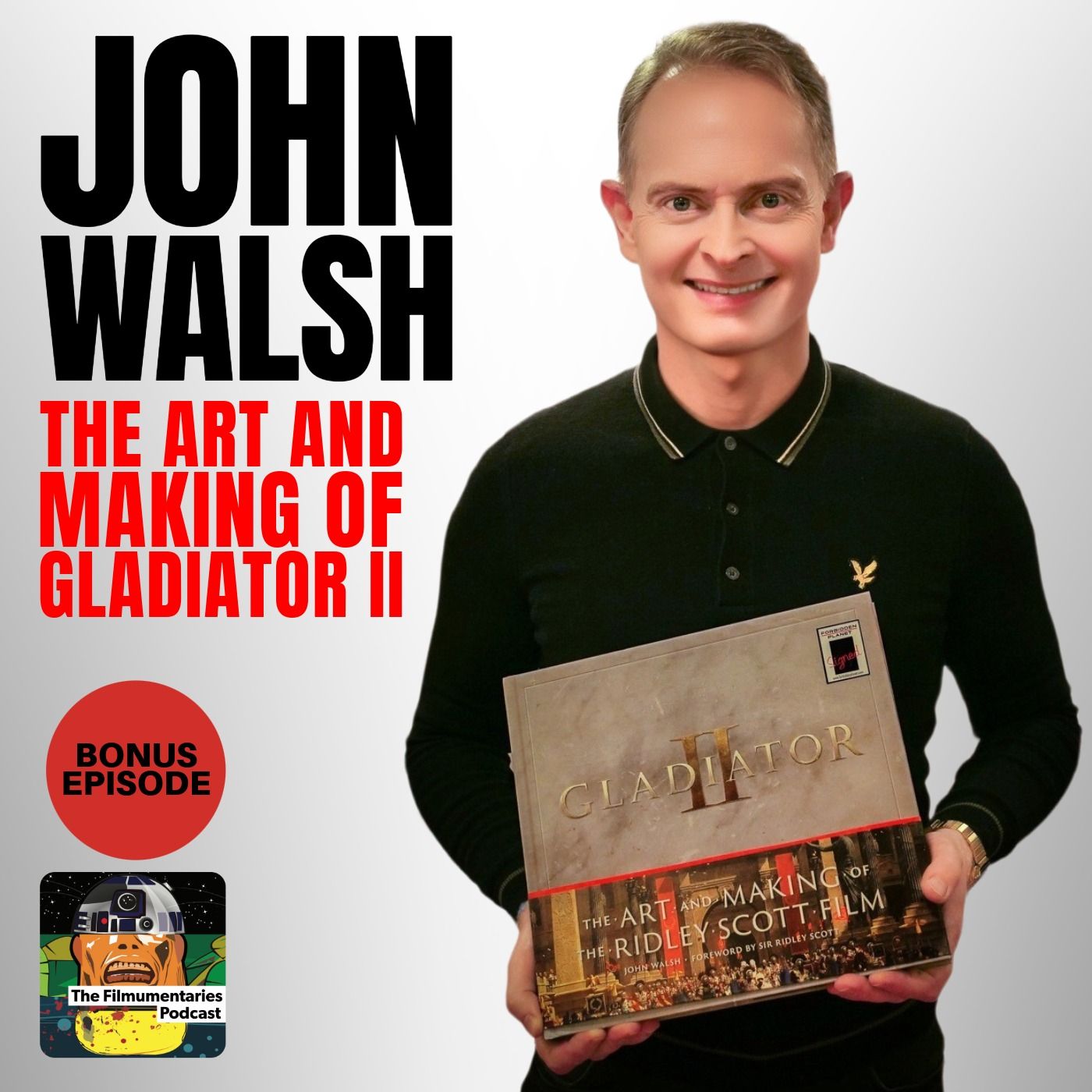
BONUS - John Walsh on Writing The Art And Making of Gladiator 2 Book
About this episode
Walsh discusses how he was approached by Abrams Books and Paramount Pictures to chronicle the creation of Ridley Scott’s Gladiator sequel, offering rare insights into the production design, visual effects, and creative collaboration behind one of the most ambitious films of the decade.
The conversation explores how Walsh handled the challenge of documenting a still-in-production movie, his access to thousands of behind-the-scenes images, and the process of balancing art direction, photography, and storytelling in an official studio book. We also look ahead to Walsh’s next project — a deep dive into The Texas Chain Saw Massacre, and reflect on the enduring value of physical “making-of” books in today’s digital film culture.
BUY THE BOOK HERE
This podcast is completely independent and made possible by listener support. If you’d like to help me keep making these episodes, you can join my Patreon community here: https://patreon.com/jamiebenning
Watch more on YouTube:
Check out the Filmumentaries YouTube channel for behind-the-scenes clips and extra content: https://youtube.com/filmumentaries
All my links
Transcript
Automatically generated, so expect the odd misheard name.
Welcome to this bonus episode of the Film You Mentories podcast. I'm Jamie Benning, your host and the creator of this show. This time, I'm joined once again by author and filmmaker John Walsh, whose latest book, The Art and Making of Gladiator two, takes us inside Ridley Scott's long awaited sequel. So John and I talk about how the book came together, what it was like working so closely with Paramount and Scott Free, and how he balanced the art, photography and behind the scenes stories from such a massive production. So here's my conversation with John Walsh about his Gladiator two book, and I'll be back at the end for a tiny bit of jabbering on John.
It's great to have you back on the podcast. I mean, this collection of books of yours is growing bigger and bigger year on year, month on month, it seems. I mean, I think we first spoke about Escape from New York, and then hone and maybe now you've made this book about Gladiator too, the Art and the Making of Gladiator two. Have you now got to a point where studios are approaching you or did you approach them? How did this book come about?
No, you guess that right, Hi, Jamie. Great to be back on. Thank you. They approached me so they said, we want someone to do this book. We think you're the guy.
And I was like, really, who's recommended me. It's a new publisher, Abrams, and I'd been recommended for it, partially by my previous commissioned editor at Tyson Simon Ward, who's now Ian Fleming Publications, and so he kind of spoke up for me. And it was a departure for me because of course it's a book about a new film, a film that hadn't been released, that wasn't finished when I started writing it, And of course all of the people are alive, and there is thousands of images. All the things I complain about before, Oh they're all dead and there's no decent photos. Now is the opposite.
There was more people than I could interview in the time I had, and thousands and thousands I think it was like thirty thousand images that I was preview to some of. But of course it's all a very lockdown process because I'm an external person, and although I signed an MDA for the script and images and so on, stuff had to be shared on a need to know basis, So it was very much how you'd imagine I five might operate with a newbie in the office. But it was great fun, very exciting. Yeah, because, as you said, the books you've previously done are all about films where you know, we've had decades potentially to think about them, and you know people have passed away and you've been lucky enough to get some of those people before they passed away.
But this is a different tone entirely. How did you sort of approach that tone? Because you're doing a couple of jobs here. You're not only trying to tell the story this making of but you're also trying to kind of publicize the film in some way as well. You have to sort of Did you find yourself having to fit in with a with a tone and a style that was sent to you by the studio?
No, not really. I think they'd looked at my previous book and thought can you do something like that? And with previous films, if you take The wicker Man as a good example, there were lots of unanswered questions over fifty years that were conflicting about was it really cuts by Michael Deey and Barry Spiking's a British line or did Christopher Ee gets it wrongly got it wrong? You know, we were able to put to bed some of the myths. There are no myths around this film because it hadn't opened and it was a switch and studio.
So Paramount Pictures have gladiated too, and Universal Pictures, who were entirely separate company, had the first film, Gladiator, back in two thousands. I think one of the first things I did was to start to take a look at something they never asked me to look at, but was a chapter called The Road to Rome, where I kind of walked through all of the other scenarios the film could have been. And there are some right interesting variations on sort of time travel, on having Russell Crowe return as a ghost walking through different time periods, so all of that was kind of covered but had to be verified and with the folks there at a Paramount, and of course Ridley Scott is a producer on this picture, so he wasn't a gun for hire, so everything had to be go through Abrams and Paramounts and to Sir Ridley Scott's production company Scott Free and sort of back again.
And there are different producers and different writers involved, so I think it was very important to get the architecture of the history correct because it was going into a book, and I think there was a lot of scrutiny about that, and particularly because it's the official book of the film, so once it's in, it becomes law, as it were. So that was something that they didn't ask for. And I try to bring that to all these books, something extra, something that perhaps will surprise people when they look through it. But of course for me, it was new. It was a new area because it's although it's my eighth book, it was very new.
People were around, they kind of could speak to me. I was given lots of interviews that were done on set. I had to track people down myself who they hadn't interviewed, and then I was able to enhance what they gave me with new questions. But as you'll find with something like this, there are areas that you can't really ask about. So if you imagine your perfect dinner party with maybe Stanley Kubrick at one end of the table, Alfred Hitchcock and so on, and Charlie Chaplin, the questions you ask these these wonderful people, you're not really in that position with all of these folks to ask them about other films and other projects.
It's although it didn't stop me because I am rather cheeky like that. And in the case of Sir Ridley Scott's my next book, which is now nearly finished, he had a kind of a there was some connecting DNA as it were, so I couldn't let the opportunity go without confirming a story regarding that no very different from me. And I must say, Jamie, since we last spoke, you've you've done your Return of the Jedi arnofficial timeline as well, so you're in the book club, you're in the authors Club. Yeah, yeah, yeah, we got it out there. It's still selling a few copies every month, which is which is great.
You know, a couple of years on, I think now nearly but yeah, no, I I'm always amazed when I see that you've got another book coming out. You seem to be able to do these at such a pace. But given the scale of this production and being brought on kind of early, what were the first steps you took in kind of shaping the book. Because you've got to think logistically, you've got to think editorially, you've got to think in terms of design, Where did you begin? Well, I kind of thought about, why has it taken twenty five years?
Is there a story there? Yes, when they did start shooting, they stopped because of the various Hollywood strikes that there had been. How did that affect things? Can I talk about that? You know?
The financial impact of that. I'm always a kind of a stats person, you know, how much does something cost, how much did something make? So I was able to have access to that information as well, So rather than it just being people talking in an what's called an ePK on electronic press kit and for people listening who don't know what that is, and I know you know, Jamie, it's where interviews are done on set where everyone says had a great time and had distributed amongst daytime television where they can cut them up into their various programs, have interviews with the grace and the good, but very much saying a similar sort of thing. I was quite keen myself that the book was more than that, and I certainly think it is.
And I know Abrams wanted to do something that was quite sort of landmark and special as well, and that certainly came through in the design. It's massive it's a weapon. I've got this thing behind me on an easel, but I've got a massive fat head and it's even bigger than that, and it's like wow, and it's really it's thicker than an Argos catalog from the eighties, and that's pretty good measure. So there was a lot of investments in terms of the book and in terms of the production of the book. So I think for me, they wanted something which was deliverable, and with previous books, I've always made sure I'd delivered on time and on budget.
We've never missed either of those two things. And this had to hit beats, you know, the film was coming out. We wanted to be in a position where we could talk about everything in the book because other recent making of books, I think on one of the Star Wars films didn't reveal that was it, Palpa time was back on the third Star Wars movie, the JJ Brams one, what was that the Rise of Skywalker the third one. Yeah, So I think in some of the making of books there they didn't mention the Emperor was back. And we kind of thought, well, we want to make sure we can mention everything please, and so we did.
But it was interesting. I wasn't sort of sent the script in the traditional way or the photos in the traditional way. I had to watch them on a on a secure server and read things over and over. So I wanted pull quotes from the actors again, something I suggested. I had to read the script many many times over.
But the script itself was on the time limits, so I had to get the reading of it done. I think by the was it first of June last year, So I had to make sure I memorize and copy it out what I needed. So it was a very different way of working. And of course, like all these projects, people have a point of view, so the truth is kind of subjective to some extent. I mean, facts never are, but people's experiences.
I had a great time and someone else was I had a terrible time, and they're on the They're on the same boat, So how do you differentiate those stories? But of course, I suppose the biggest change for me was it's a major, major studio picture, possibly the biggest film of last year. So if there were controversies, how do you get into them? How do you document them? Are you burning your own bridge by doing that?
So it's it's it's kind of it was. It was a tricky balancing act. And of course the book would go back to Abrams, who I was very pleased enjoyed what they read, then back to Paramount, back to sir really Scott's people, and so it would come back with, you know, with notes as you'd expect, but all of them were terribly constructive and everyone liked what was happening, and it all moved at quite a pace. And I was enormously flattered to be asked because they could have asked anyone and they chose me, which was, you know, rather special. I was very pleased.
Yeah, I was pleased to see your name on it, because you kindly sent me a copy of the book and I thought I didn't order this and opened it up and I was like, oh, it's John brilliant, amazing. I mean, that's yeah, it is a big leap for you, and one one that you've worked hard to read, and I'm glad you have. You know, but in a book like this, you know you want to, as you say, you want to document what went on at the time in the making of this movie whilst it's being made. So how do you go about kind of making sure that it isn't just a surface level art book with just pictures in it that you've got, you know, the stories and the descriptions of what went on to back up that kind of process and intention for the movie.
Well, you've got the if you like, the witness statements, so the people who were present in what they saw, which was what you can imagine. But then you have the background stories. So Denzel Washington, for example, the director he's most worked with in his career is Tony Scott, Sir Ridley Scott's brother. He's worked on him. I think it was on thirteen or fourteen films, it says in the book.
And so there's a whole section on Tony Scott and the films and the relationship between Tony and Ridley. And of course Tony made his directorial debut with The Hunger, which is a marvelous vampire film if people haven't seen that, it's Catherine Denerve and David Bowie as well, and it's really a wonderful film. Considers the sort of an art house film at the time, it's i think been reassessed in recent years. He went straight from that to do films like Top Gun and Beverly Hill's Cop two and so on, and had and Days of Thunder, and he had a marvelous, marvelous career and teamed with Denzel Washington. Of course, Ridley teamed with him on other films as well, like American Gangster, and so getting some of the background there and the sort of connective DNA between Tony and Ridley and Tony Ridley and Denzel is kind of fascinating.
So I did that in all the departments. When you're speaking to the production designer, when I was speaking to the art directors, the directors of photography, they all had history with with Ridley, and the visual effects as well, you know, with a whole section in the book separating visual from special effects. I'm a bit of a geek when it comes to all that stuff. While we're awsk you down industrial licen magic asking him about that. But always the shadow of the other film, you know, always the shadow of Gladiator, And so often my questions would refer back to, well, did you try and do that.
I've heard you try to do that on the first film. Why not? What happened? Why have we got it now in this film? So there were quite a few technical aspects of Gladiator two that were achieved this time around that couldn't be achieved originally.
And that sort of thing fascinates me. You know what could have been and what should have been. And there is already now talk of a Gladiator three, and as a there's a concept in mind for and I'm more than happy to go out to Morocco. I'll wear a massive hat, I'll have a tin foil umbrella and fac to fifty so I'm already prepping my emergency bag. I think what you always managed to do in your books is you know, you have that technical description, you know within certain departments, within certain interviews that you've you know, people that you've spoken to, but they're always very accessible your books.
Did you find with this, given that you had such a plethora of information kind of thrown at you, with all these images and all these interviews, that that balance was difficult to find? Or is that something that comes easy to you now? I kind of knew going in it was going to be a different sort of creature, and that it was going to be so fresh in people's minds that people would for base them have very similar points of view. So I try to sort of pick and choose which ones I put in the final book, because you don't want everyone saying the same thing, all the witnesses saying giving the same testimony, So trying to find a voice for each aspect in each department was crucial. A lot of times that crossed over the way in which Arthur Max, the production designer, would create his sets.
Knowing how John matheson paints with golden lights meant that there was lots of crossover there. So I was kind of interested in those areas where departments crossed over. I haven't been able to do that before and other books because there's been no one really around to ask, you know, I couldn't ask people on The wicker Man or The Third Man or Conan about camera loading and about who did you know were responsibilities shared in departments when people were sick and you know what happened on emergency days. So there was the advantage of that. Luckily, with the fosos, the thousands and thousands of photos, Abrams and their team got on board.
The design team there kind of looked at things much more closely. But what not to include is so so difficult. How many pages of the book I have to have a cheeky look. I can't remember. It's it's my longest book so far.
It's two forty pages, which were a big hardback kind of coffee table book. Is it's quite out there. But even then we could have done twice the size of a book. And there are aspects of the film that I didn't have access to at the time because the book had to go to print. So the kind of animated title sequence, all the poster variants, stuff with the music, the deleted scenes, what could have been a gladiator too that wasn't, who was nearly cast and who wasn't.
We could do a special edition book. So I've said to Abrams, if they want to go back again and revise in updates and charge people rather chiefly for the book again with a little sash on the side saying new material added, then there are areas we could add to I mean that goes through all the books, I think, but I think here it was crucial to recognize what I did before, but take advantage of the fact that people are here now and we can ask them the details. I mean, I'd really like to ask people what they had for breakfast and what they had in the case rom There wasn't enough space in the book for all of that. But when you can ask that, why wouldn't you? Yeah?
Absolutely, And you know in this day and age where we've got you know, videos online almost immediately showing us behind the scenes stuff like the UPK stuff you're talking about, and potentially documentaries on Blu ray releases. Where do you see the role of a physical book like this in today's film culture. Well, I think a book like this has to sit alongside. So most of my books have had a release to some extent with Studio Canal, perhaps with The Third Man, The Wicker Man, Escape from New York, and Flash Gordon. They all had.
In the case of some of those, they had mini versions of my books in their four K releases, which I was always a bit anxious about because I thought, well, if they've seen a little mini taster, they might not bother with the book. But it's very much a companion piece, so it's recognizing that there might be some overlap. But really, I think the trick for these books is to find images the studios don't have, and find things to say that are not in commentaries, that are not in DVD extras, Because I think if you just collated what already been talked about and have nothing new to say and have no new way of presenting it, then people would think, you know, I'll listen to the director's commentary and I'll have a flick through the gallery on the Blu ray set.
That'll cover it. I don't need John Walsh's book, you know, Untidying my House, but we need to make sure that we have something new to say. So in the case of say the wicker Man, we were trying to debunk a myth that had been gone around for fifty years much I think to the horror as some of the fans who held on to that myth. But it was nice to kind of straighten out the truth there. So I think with all these books it's crucial to offer up good value and good penmanship and good photography, of course, but also if you have something new to say, and it doesn't have to be new for the sake of it or controversial for the sake of it.
But I think finding new information out we did it on all of the books so far, and certainly on Gladiator too. The images that were released to the press were not the ones that were in the book. A lot of that was held back for Abram's, bip Parra Amount and Scott Free because they wanted the book to have its own, as it were, presentation, own marquee potential. So people have said to me, saw the film, I've read your book. I went back and watched the film again because actually it gave me a greater appreciation because the film goes by in quite a kind of a hectic hour two and a half hours.
I saw it in Imax when it was finally finished, finished, and I was like, wow, that was incredible. But my book took me ages. Why did the film go so quickly? So you kind of need to slow down. The book, I think slows you down into looking and examining more closely what happened.
And you know, there are people who are bigger fans of maybe the first film than they are of the second, and actually some of the other way around. You know, if you've only seen Gladiator two, remembering there's a twenty five year gap between the two films, so people who were fans of maybe the Marvel universe, they might see this film, see young Paun Moscow who was brilliant and say, ah, this is Gladiator for me. They seen the original film and go, oh, okay, that's okay. The fer Gladiator too. So it has been interesting how it's divided amongst age lines to some extent, and the same with you know, most films where there's a I mean, there are people who prefer The Phantom Menace.
Yeah, so the original stars and you know, I mean, there's nothing to take away from the Phantom Menace, but you know, lots of people in their top tens wouldn't put it in necessarily the first or second place. But who knows, very much a generational thing, as you say, yes, I guess with you know, having all those thirty thousand images or whatever it was, there was a temptation sometimes to show the sort of iterative nature of the framing and you know, the effects layered on top, and the production design and the sextension and all of that stuff, which to some aspect is in the book. But it must have been very difficult to kind of rain yourself in and not go to a thousand pages. Because a film like this is so visually low you kind of want to, you know, give it as much credit as you possibly can in a book like this, and I think you have done that but again difficult to find that balance, I'm sure.
And was there ever a version of this book where you where it was three hundred and fifty pages and you had to kind of rein it in or did you kind of always were you always aware of that ceiling and once you hit it, you were then adding and deleting. From that stage, I think. We realized going in what the limitations would be on my first standalone film book, Flash Gordon. I ended up writing nearly twice the size of the book that was asked for, and so it made a lot more work for everyone later down the line. So I was kind of fairly I was wide eyed but realistic about what was going to be achieved.
But I did know that the brief that was coming back there was never a specific brief, but the intentions that we got back from Sir Ridley Scott's was that it needed to be a coffee table art book. So if we think of coffee table art books, you know, if you're picking up a David Hockney book, for example, you know a selection of images would be chosen in their very best quality, as large as possible to illustrate a certain period of his art. And so that's perhaps the way we took this. You know, what were the very best images that most represent the construction of the coliseum or the production arts for the flooding with the shark sequence. But yeah, I mean, I'm like a kid in the toy shop.
We could have done two books. We could have done a double the size book. I'm even talking to you now about revisiting the book, opening it up and putting more things in. So it's recognizing from the brief what they need from me, and also the experience from the other books, making sure that you know what I've learned I'm bringing with me because they want that guy who did all those books to do something for them which is contemporary, but also with an eye to those books which have all sold sort of magnificently. Well, I do like that you've given space for those images.
There's nothing that winds me up more in this type of book where there's an image you really want to see up close and it's like a postage stamp, you know. Luckily, of course, you had the benefit of this very recent archive that have been created, as opposed to digging into a historical archive where maybe image quality isn't so good. But I think, you know, there are sections in the book where you just linger for so long because there's just so much imagery kind of being thrown at you, but always backed up you with your writing, which I enjoy. And it feels like in some ways it's you know, it's part oral history, even though it's a recent oral history, it's part design book. It's filling these two kind of different categories of book.
But I think it does it, does it really well. There's not a question there. That's just purely a statement. No, thank you. I appreciate that, Jamie, thank you.
Are you beginning to see yourself as a bit more of a visual historian now? Then, now that you know you've got an act that you've had access to an archive of this size, and you've been working with the publisher to kind of whittle it down to the to the images that are the best choice for the book and the brief that you had. I mean, is this something you'd love to go on to do further be more of a visual historian? I guess. I mean it's much like the documentary work I used to do for TV.
You'd find the best clips that most illustrates something, or you'd recreate something to show the point in a way that's most effective, or animation. You know, I did animation on a homeless series which was thought to be controversial at the time. It was rotoscoping, and it was a homeless series about children for the BBC, and I remember the BBC being very anxious about using animation with children in a series about children living in shelter accommodation, because it might have seemed to be flippant and so on, but it was the best way to illustrate that in that series. And so film is a visual medium. When we think about how we doom scroll as people call this on our phones, were kind of we're looking instantly at images and it's the image that will draw us to the post and we might read them beneath it.
So it is taking that on board. And I'm very aware that the image sells the page and therefore sells the book. So if it's unseen and it's your favorite film, never seen those shots before, that's going to do it for you. So a brief description, a respectful caption without saying the obvious, and learning to pair the text back so that it does say what it needs to, but without too much of my voice, and I learned on the early books that if I get that out of the way in the introduction, I can say what I think that's done, so we don't need to hear from me again. Right, Let's get on with the people who made this film and what went wrong or what went right and so on, so you can get your little confession out of the way in the intro and do your fanboy thing that you need to do if you're a fan of that film and so on.
But I think the visuals here are key because when these pages are put on Amazon, publishers will choose those pages which best sell the book. So it is definitely a visual medium in terms of these books and selling them. I'm looking at doing other things as well. There's a possibility of a novel on the horizon as well, which I'm kind of excited about. But really a lot of this writing I've been doing for years for TV without being properly paid for, because when you're pitching stuff and a commissioner needs to see sort of an outline for four or five pages or ten pages, you're busy typing it away sending it in for pitch, and either the pitch happens or doesn't because of what you've written.
But you don't get retrospectively paid for that. If a Green Lights comes on, you get commissioned. So I've kind of been doing it for a long time for free. So it's nice to do it, be recognized, to be paid, and have it within hard back covers. Yeah, it feels like you've got your your feet in a lot of different camps here.
You know, you're you're a documentary maker, like you said, you worked in animation and television, and we've got this visual feast of a book. Now we've got your other books that are more kind of historical leaning. You're talking about a novel as well. I mean, you just don't seem to stop, John, You're you're very shark like, just driving forward all times, thinking of the next step. Thanks.
Yeah, I see it as that. Is there another project on the on the r for you that is in an area that you've not dipped your toe into. Yes. So my next book, which is now mostly finished, is on the Texas Chainsaw Massacre. So after doing a book on the biggest budget film ever in my series of books, to the smallest budget film of the series of books, that I've done so Toby Hooper is nineteen seventy four.
Texas Chainsaw Massacre will be coming out next year. I think it's already available to pre order on Amazon and everywhere else, all the various bookshops. And that's been fascinating because Ridley showed a print of that film to the crew just before we started choosing Alien in nineteen seventy nine to give them an idea of the claustrophobia, the person under attack and the handheld cameras and what was achievable. Of course, Texas Chainsaw was shot on sixteen millimeter and has a kind of absolutely hair curlingly crazy backstory that we which I was super pleased I was able to actually guess properly involved with and untangle because the fans, I think have been waiting for the story on that more than the wicker Man.
So that's kind of done and dusted, the manuscript just waiting for final sign off. I'm going to be working with the art department that Tyson Books and the layout assist for that, and that's going to be going off to print at the end of this year out next So it's kind of a big slasher horror film, and one that the Variety is called the best horror film of all time controversially. And was that something you pitched or is that something that they came to you with the idea of? And they came to me Tyson said to me, do you fancy doing this? I said, yep, okay, we'll do that.
So I think it's been a kind of an even split of what I've pitched and what's come to me. And sometimes you know you're doing a book and they'll come to you and say what about this, and you haven't had the headspace to think of a new book for yourself, and then this comes along and you think, oh, actually, yes, if we can, if it's no holes barred. And I did say this to the folk folks at the license or who owned Texas Chainsaw and to Titan Books, I said, dam can we go no holds barred? Because the real story of how this film was made is actually a real shocker And they said yeah. I was like you sure, They said yes, passed, Yeah, yeah, And I can briefly preview it with you and tell you what the shocking story is if you'd like to hear it.
Yeah, go on. Yeah. So when the film was finished, so shocking was the content and the material They didn't They didn't have a distributor in place, and normally when you're making a film, even in the independent film, you'll have a distributor ready to do something with it, to strike a few prints, to get it in a few theaters, and to get the ball rolling. So they took it round to all of the major studios, all of whom said no, most of whom wouldn't watch it because they knew what it was about. And so they did find one distributor called Brianston, which sounds fairly innocuous, but Brianston mostly distributed films in adult theaters, which meant pornography cinemas.
And that's if you like the good news compared to what the bad news is. Brianston was run by the proper, real life solid gold mafia, right, so it became a real problem moving forward for people to get a share of the film. And in the book, we've tracked down the son of the owner of Brianston, Chris Cephro who runs Trickle Treat Studios now does fabulous masks and toys and games based on classic horror franchises, and we've really unraveled that whole story of what happened, how it happened, and what the ramifications are today of a film that was owned and run by the mafia who went to prison. All of that's in the book The British Border Film Census. Here we spoke to them about what happened, and everyone who survived spoke to me for it.
So Kim Henkle, who co wrote it with Toby Hooper and produced it, Terry McMinn, who's the girl who's hung up on the meats hook and spoke to her, and of course the guys who still are alive from the minibus. So that was that was quite something. To find enough images for that book in high resolution was kind of tricky, and luckily we came across a stash of amazing images that have never been published before. Surrie Surprise of my Little Mantra. So that's that's going to be one I think that will excite people.
It's going to be launched at Comic On next year, so there's going to be a bit of an announcement to go with the book at Comic co On. So that's going to be in July and in the books available at Comic Con, but mostly in the shops from the first of September. But yes, it's going to be a busy sort of twenty twenty six and I'm speaking to a third publisher now about another book, so I'm spreading my favors. That sounds amazing. It sounds that it's like ripe for a documentary as well, that you just put on these threads and get deeper and deeper into the mysteries of that movie.
That's fantastic. Well, listen, John, I always liked talking to you. I was appreciate your time and come on come back on the podcast any time you like. I'd love to come back for Texas Chainsaw and shock you all with what we found. That was John Walsh talking about his latest book, The Art and Making a Gladiator Too, which is available now from Abram's Books.
I'll leave a link in the show notes. You can also hear my previous conversations with John about Escape from New York and The Wickerman in earlier episodes of this podcast. As always, if you enjoy these chats, please share the podcast and leave a rating or review either on YouTube, leave a comment, maybe subscribe to the YouTube channel, or go on Apple Podcasts and leave a review. It really helps others find the show. Thanks for listening and I'll be back soon with another full episode of the film.
You mentor this podcast



Similar episodes across the network
Matched by shared keywords.
-
Seasonal Differences, Shifting Fandom
1 shared keyword: and
-
Lobster Man from Mars
1 shared keyword: and
-
Halloween II (2009) — "Man was meant to eat meat. We, all of us, have a little bit caveman in us."
1 shared keyword: sequel