
Season 1 · Episode 146
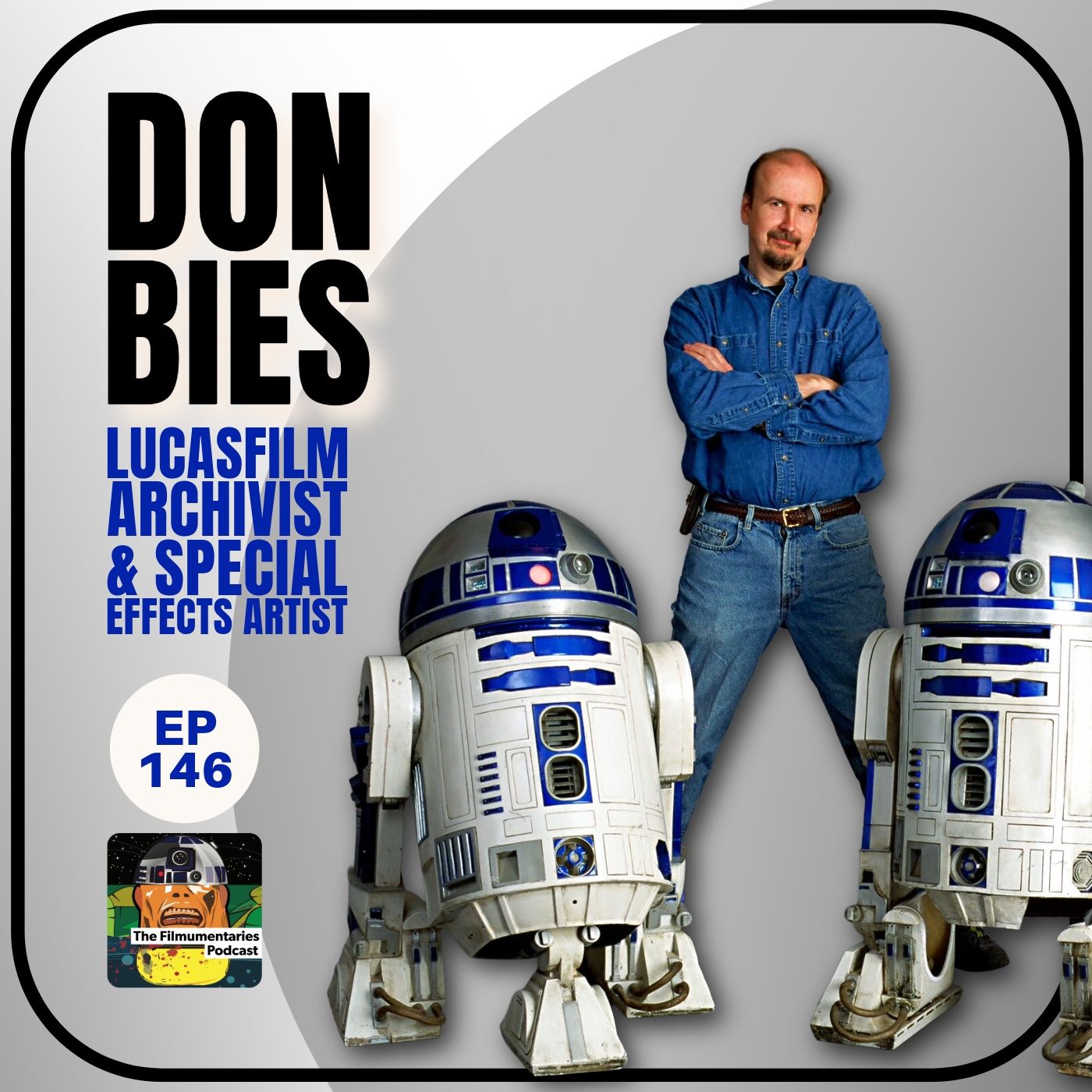
Ep 146 | Don Bies — Inside the Lucasfilm Archives (R2-D2 Operator)
About this episode
- His role in early Lucasfilm exhibitions and the growth of the archive
- Working at Skywalker Ranch and the unique creative environment there
- The transition period between Return of the Jedi and the Special Editions
- Wearing multiple costumes (including Boba Fett) during the Special Edition shoots
- The reality of preserving film history inside a working production company
This podcast is completely independent and made possible by listener support. If you’d like to help me keep making these episodes, you can join my Patreon community here: https://patreon.com/jamiebenning
Watch more on YouTube:
Check out the Filmumentaries YouTube channel for behind-the-scenes clips and extra content: https://youtube.com/filmumentaries
All my links
Transcript
Automatically generated, so expect the odd misheard name.
Weirding Way Media. Hello, and welcome to the Film Youmentaries podcast. This is Jamie Benning and this is episode one hundred and forty six, And in this one, I'm chatting to Don Bee's former Lucasfilm archivist and special effects artists who worked at Magic as well during his stay at Lucasfilm and during a pretty pivotal time. Actually, Don's story is a great one because it cuts across so many different corners of the lukesfilm world, from discovering filmmaking through classic monster movies to working on the fly, to becoming the guy responsible for digging through and in some cases saving the original Star Wars archive. We get into his early fascination with makeup effects, how he blagged his way into mechanical design, what it was like arriving in California in the mid eighties, and how a job that was supposed to last two weeks turned into ten years inside Lucasfilm.
There are some brilliant stories in here, including finding a very rare Darth Vader helmet at the bottom of crate, listening to some original recordings of Irvin Kirshner on the set of the Empire Stracks, back working with Anthony Daniels and Peter Mayhew on commercials and even suiting up as a few characters for the special editions. So if you've ever wondered what it was like working at Lucasfilm during that time, this is a really fascinating look behind the curtain. So here's my conversation with Dombe's and I'll be back at the end for a bit more jabbering on. Don great to have you on the podcast. We had a few time, a few attempts at this, but we finally managed it.
So I first became aware of you, as I'm sure many did, was and that was on the laser disc the tour of the archives, and I was like, who's this guy? How's he got that job? You know? But I want to go all the way back. I believe you grew up in Chicago.
I just want to kind of know how the sort of the film world was first brought to your attention when you were a kid. The earliest memory I have told story my my beginning in the film business was when I was six years old and a cousin, a much older cousin. I was the youngest of the kids. I was like, way younger than everybody else. She thought she'd tried to scare me by showing me the nineteen thirty one force Carlo Frankenstein and yeah, yeah, and uh and it did the exact opposite.
I was enthralled with it, you know, and and and what what amazed me the most was was the makeup. You know, how did why does that guy look different? How did they do that? You know? You know, I didn't understand any of it at that age, and you know, I would ask my mother and she would just say, well, it was makeup, and you know, and to me, makeup was you know what she put on, you know, yea lipstick and and stuff like that.
So so I think she was the one that brought me home, found me a copy of a famous Monsters of film, you Phil y Ackerman's and and so that started my love not only of Frankenstein and and that, but also the film film world. And fortunately my mother was a huge uh and my father for that matter, but my mother more so was a huge film fan. So she they loved watching movies and we'd go to the cinema all the time. And I very my very first recollection was Mary Poppins saying Mary Poppins when it first opened, So I must have only been about four or five or something like that. And that's got a combination of so many things, and it hasn't it.
I mean there's paintings, there's animation, it's musical. I mean there's it's quite an onslaught of a movie that as for a young kid, you kind of it's a fantastical world, isn't it too? Yeah? Absolutely? And and and that that started that love of fantasy films.
And you know Ray Harryhausen and Willis O'Brien and you know John Chambers with Planting of the Apes that I became a huge plant of the Apes fan. I was really into Gorilla's you know, and Apes and everything because of those movies and anything that had that in it, you know, I would try to find and watch. And there was a show on Saturday nights in Chicago called Creature Features, which is so common in a lot of areas. They had their own versions of that and they would just show the old universal horror films. So I would, you know, bribe my parents to let me stay up, you know, because it started at like ten thirty at night and watch watch those movies.
So again became an officianado of all the old universal horror films, and so it just was that was it and it and like I said, it sparked an interest in the process. So anytime there was like a behind the scenes or anything, you know, that might be on TV, because occasionally they did that, I would watch those and watch that art, you know, that how people were making the film itself. And so, like I said, it led along. The nineteen seventy seven was just a huge year for me because I had turned sixteen here in the United States, at least at that time, you could get your driver's license at sixteen, and I got my first job, and that all happened within a matter of months. And then of course Star Wars came out, and to.
Know that it was coming by the way, had you they've been pressed building up to that in the magazines and things that you look, you. Know, I remember seeing the one thing I do remember seeing was the Time magazine that had although they got bumped from the from the front cover, but I remember seeing the Time magazine article. For some reason, we had a subscription of Time magazine. And then Starlog had their issue seven I believe it was, and that's when I became aware of Starlog. And then I do remember seeing a trailer or two on TV.
But what got me interested in it was it had a big ape in it. Because I was in the apes, you know at that point, so it was Chewbacca. Right, It's like, well, I gotta go see this. It's got an ape in it, right, So so I went to see it and it just it knocked my socks off the. The you know.
It was a very that evening. Was a couple of friends we went. We I didn't have access to a car, so we had to get driven there by friends of their family. And we we got to the screening that was I think it was supposed to be like a four thirty screening. We got at four fifteen while it was sold out by that point, you know, and the line was stretched around the around the theater, so we had to wait till the next screening, which was at six thirty or something like that.
So, and it was a Sunday, I remember that very clearly. It was at a mall, and the mall was closed because it was Sunday, it closed early by that point, so we couldn't do anything, so we just hung out in the lobby and so then you know, we wait, didn'tuntil the movie came out. There was this onslaught of as as people we were trying to get into the theater and and you know, then it opened and I just wasn't, like I said, enthralled with with what I saw. And later that year, so that was I actually didn't see Star Wars. You know, right away it came out in May or so here.
I didn't see it until there's there's probably July, late June, early July that I saw it. But later that year, in August, I was working this first job I got. I was working at an amusement park in Chicago, outside of Chicago, and it was an indoor amusement park. It was the first indoor amusement park, and it was called Old Chicago, and they had rides and you know, carnival rides and carnival games and everything. And I was one of the carnival game attendees and you know, I take the money and give you the balls to knock over the clowns and stuff.
And they came to film a movie there. It was called The Fury, was Brian De Palma's movie with Andrew Stevens and Kirk Douglas and Amy Irving, and it was his follow up from Carrie, and so I had unfettered access to the to the work location because I was an employee either and so I would just follow around the crew, you know, I would just watch them film, and I particularly got really friendly with the effects crew because what they were going to do is in the in the course of the story, the Andrew Stevens plays this character with telekinetic abilities and he sees a bunch of Arabic men that because he blames them for kidnapping his father, killing his father, which didn't happen, but anyway, he has a vendetta against him, and they're they're on a ride and he puts the ride through a window of the restaurant, and so I got to watch them rig that I got to watch and the guy that actually was running was the head of the effects apartment, was a guy named A.
D. Flowers, who apparently I think he went back to Wizard of Oz, but his more previous was uh uh. The credits had been Tiring, Inferno Beside and Adventure to to Tour, you know, all movies that I was like big fans of and yeah, and and like, wow, this is really cool. And then I got to watch because I was also in the makeup I want I saw that the makeup man was putting this on on Andrew Stevemens forehead, This throbbing vein appliance, which I found out much much later was either made by Dix. I think it was Dick Smith or Rick Baker, but I think it was Dick Dick Smith that that made the points.
And I'm like, oh, you know, I got to so I got to meet that makeup artist and I found out later it was William Tuttle, who did Seven Faces of Doctor Lao and Time Machine and everything, so so I you know, I like, I was just like, okay, this seals that I got to do this kind of thing for the living. And that's that started that journey. So wow, that's the I mean, you didn't have a chance, really, did you. It was all coming at you from all angles. It was all fate.
Yeah. I was like yeah, yeah, But then how do you go from you know, being in Chicago, which isn't necessarily a big film town, to then getting into the film industry itself. I mean, you said you were interested in the makeups, and stuff. Were you making stuff yourself? Were you trying to make eight masks and things?
Oh? Definitely, yeah, yeah, And I would any any like willing friend that would sit for me, you know, for my crude life casting or crude sculptures and stuff like. I remember one guy when I were taking the makeup off a lot, he lost part of his eyebrow. But yeah, it was just it was just experimenting with that stuff. Dick Smith had came out with a handbook I think it was published by the same publisher that did Famous Sponsors of film Land, and he came out with a handbook on how to do makeup with kind of things you could find around the house, more type of stuff, you know, gelatine and cotton and you know, you had to get some makeup supplies.
But and so I played with all those and learned about, you know, where you can get fake hair and things like that. So I was definitely playing around with that. And yeah, you're right, Chicago didn't have much of a film scene at that point. And then so I got into a theater. I did the theater in high school, and then I got into community theater in Chicago, and did you know, started doing that kind of work and at least let out a creative side of me while I, you know, was trying to build up portfolios of stuff.
And I did set design and did props, I did I did a little bit of acting, and you know, I did kind of everything. And and then my brother, who, like I said, is older than much older than me. He's a he's a pediatric surgeon. And he tells me this one day. He said, told me about this patient he had that whose son was really into makeup, and maybe we should get together.
So I, you know, we connected. And his son's name is Keith Edmeyer. And Keith was this wonder kid of a sculptor, you know, he was. He had been corresponding with Dick Smith. He had been in touch.
I think he went with Rick Baker at that point. And and so the two of us started doing projects together. He was still in high school, I was. He he's I guess he was about five or six years younger than me. So he was still in high school.
So he had like a couple of high school projects that he was doing that I would help him out with. I remember, they did this really high value production of Jesus Christ Superstar and and we're you know, they were having blood effects and stuff. So it was it was, you know, we we got to do a lot of fun stuff together. And and then in uh we did a couple he helped me out with a couple of shows. We did a stage production of Frankenstein and he did the makeup for that, and and then he left to go work with Rick Baker down in Los Angeles, and and then he was down there a couple of years.
I kept in touch with him, and then he when one of the times we were talking, he mentioned, oh, yeah, there's a company up in northern California that's looking for people. They're working on this remake of The Fly. And so I put my portfolio in, which at that point was just heavily makeup stuff. But the one thing I had done when I would when Star Wars came out was I made my own full size R two D two radio controlled R two. D two from the prints that you could get.
No from I scaled up. I did have those, but that was only one elevation of R two or I had a couple only a couple of shots in there of that. But what it did have. What it did have was the model kit of our time, which wasn't I found out many years later it wasn't terribly accurate, but it's still was enough to you know, I figured, yeah, I guessed at what the scale would be roughly, and you know, did the math and you know, fixed it that did it that way. And so that was in my portfolio, just to you know, just to round out my portfolio.
But my portfolio was, like I said, mainly makeup heavy. And so the company was Chris Wayliss Incorporated c w I and Chris you know, I sent my portfolio in and you know, here I thought I was going to be the next great makeup artist, you know, up there with Dick Smith and Rick Baker and all that. And and he wasn't interested in my sculptures or makeup at all, he says, But he says, I see this, uh r two D two you did? He says, so you do mechanical design, and and I already knew at that point just say yes, you know, yeah, sure, yeah you know, and and he he says, oh yeah, I said yeah, yeah, oh yeah, yeah I do yeah, And at which I kind of did. I mean, I did, you know, had to learn all that stuff for to make it art two.
But you're like twenty this. I was twenty four. I think it was okay, it was. Yeah, it was sort of early eighties, wasn't it. Yeah yeah, And and so uh he said, uh, he says, so you know how to use a mill and a lathe?
And I said yeah, yeah, yeah, yeah, And I didn't know what a mill was. I knew what a lathe was, but I didn't know what a mill was. And so a week or so goes by, and then I got a call saying they wanted me to start on such and such a day. So I packed up everything, moved out to California, and and and then they've been out here ever since. So yeah, so I started on the Fly and again doing mechanical design, and that's that's kind of how I get it.
And then you know, you meet people, you know, yeah, it was only fly up Perio at that time. It was a small community. Yeah yeah, So on the Fly then described to me a particular sequence or shot you worked on that. Well, it's funny because a lot of yeah, a lot of the stuff I've initially worked on was all stuff that got cut. It's in the special edition DVDs and stuff like that.
But there was a sequence there was a special edition. I didn't think, yeah, well that's it's it's it's like the Blu ray that had all the cut scenes in it, and right, not so much a special edition, but it has the cuts. There's a sequence where he tries to reverse the results of the fly and he takes a cat and an ape and puts them in and blends them together, and with the idea that he would unblend them. And so we made this monkey cat. We call the monkey Cat puppet.
So I made that. I worked on that. I made, well, there were two versions of it. There was the free the one that like wobbled across the floor, pulled on the string, it looked like it was running. That's the one I mainly worked on.
Then there was another one that was more animatronic, that had articulated faces and stuff, and I worked a little bit on that one, but I mainly worked on the other one. And then after that, he beats the really brutal. He beats the thing to death with a stick, which the hands were David Kronerberg's hands when he beat it. And then Brundle is distraught because it wasn't working. So he climbs up on the roof and there's this remnant of this scene that's still in the film where he keeps scratching his side.
He's constantly doing this in the film, and it turns out when he gets to the roof and he's looking over the city and everything, it's starting to bother him more and more. And a little fly arm pops out. So I made that. I made the fly arm that comes off, and then he gnaws it off with his mouth, and then and he throws it aside and it twitches, so that again, that was something else I made. And uh, and then at the end he he has uh he the the the other guys staff is I think it is.
He does the fly vomit and this, and and acid eats his uh, his foot and he a tone comes out and he slurps that up. I made the tongue that that came out. So that's all the stuff that didn't make it in the film. And then oh, and then there was actually a stop motion sequence that I worked on that we did after film shot, which I can get into. But the the thing that I did work on that did make it into the film is a big thing.
He turns into at the end. And so there was a there's a group of us led by John Berg, who did the Walkers from Empire Strikes Back, who is to this day. He was a mentor at that time and then he's become Yeah, he's a really good friend of mine, you know. And uh and we we we've stayed in touch all these years, and I just talked to him a couple of weeks ago. But John and I and a few other people worked on that, so we got to do all this mechanical design.
John ended upuppetearing on said, I didn't go to location. It was shot in Toronto, but I helped John with all that stuff. And then there was walking legs. There was a shot you know where these legs were walking. I helped build those.
But then, like I said, the movie was finished rapping and there was a sequence at the end of the film that that they were trying to figure out how to do, and they decided to stop motion. And what the sequence was is that Geena Davis wakes up from a from a dream, you know, shot like a nightmare, and she sits up right. And again this is on all these cut scenes that you can see these uh, and she wakes bolts up upright from this dream, and and and the guy laying next to his status, the guy that got his hand in his foot melted, and and she's obviously pregnant. She's really obviously pregnant. And and he's like, what's wrong.
She's I had that dream again and about the baby, you know, the maggot baby that she had earlier in the film. And he says, well, don't worry, you know, we that we got rid of that baby. This one's ours or something. So she lays back down, closes her eyes, and then the camera flies along, and in the distance is a branch with a cocoon hanging down. A crystalis hanging down from it, and the fly.
The camera flies along and and comes up onto the cocoon and the cocoon and shakes and breaks, and the sides split off, and these butterfly wings unfolding its human baby with butterfly wings, and it crawls up to the top of the branch and you know, kind of dries its wings, flaps its wings and dries and and then dives off and flies off and and and the camera and fade out. And that was how the original movie was supposed to endow, and so they they decided to do it stop motion, and on Berg being a stop motion animator, he was, he was, and he wasn't up for it. Uh, he went not so much. He wasn't up for it. He he had kind of given up stop motion after after Empire Strikes Back.
It had taken so much out of him, and you know, he he just like he was not at a place where he really wanted to do something like this, but out of deference to his good friendship with Chris Wayliss and everything, he agreed to do it. So he needed a couple of, you know, a few people assisted obviously making the puppet and everything. But I built the branch shot of steel pipe and and we covered it with latex and make it look like branch, you know, bark. And and then he asked me to be on set with him as a as a you know, not so much an animator, but you know, just assistant. And so I was.
I was on set with him with another stop motion animator, Tony Liddatti, and and yeah, and we shot this thing. And it was a real compressed schedule because the movie was going to be coming out. It seemed to recall. We shut this like April. Move was coming out in August or something like that, and we had to do it very quickly.
We had no time. We put in a thirty two hour day to do the first take of one of these shots, and like at two three o'clock in the morning, we were really punchy. John and I were the only ones that were still awake, really, because each each frame took about twenty minutes for John to with all the wires of the thing, and we would just get the giggles and it was just you know, the camera operator, John Gaza, he was a camera operator. He would you'd see him sleeping over by the side and then John said, okay, ready, and John would wake up and say shooting and press the button and then go back to sleep again and goodness. And so it was this real peal to get it done and it got finished, and then it was decided it was cut.
And I don't think it was cut from so much a technical reason, but it just wasn't totally right for the film, you know it is. John will even admit, you know, it's kind of rough animation. It didn't fit with the realism of the movie because we were really pressed for time, but. So you went too fuss that it was removed. Well, I always wanted to see it, and I didn't get to see it for years.
I saw the rushes, you know, I saw the rushes at the time, but I never got to see the sequence because it was never released, you know, until one of the DVDs came out and it's like. Oh yeah, right, yeah, so thank goodness for DVD. Yeah, so what came after that? Then? I mean that that's quite a big movie to be a part of.
I mean that must have felt pretty good, A good and a good reference on your resume. Yeah, well yeah, it's yeah, it won an a came Award and it's a bit downhill ever since. Uh yeah, I'd forgot about that. Yeah yeah that Chris and Stefan Dupui won Caamy Award for the makeup on it. Uh so you know that.
Yeah, that ended up being only I like, I started started in November of eighty five, and I think we were finished with that's thought motion sequence in April or something. There was a period like a month or so where there was no work until we came back to that, and so it was the six months of work really and so then it was a matter of trying to make connections in northern California and find other work. I was, of course trying to get into ILM at that point. John was trying to help by, you know, making introductions and that, but you know that was working. So I was working at another company that did like Christmas window design, set design.
I was I was acting as a draftsman and a carpenter and building things for them. And through that connection, one of the Christmas, the Christmas windows stuff, I would help do some mechanical design of making the things move. And this guy named David Schaefer who was an electronics engineer. He I met him and he was doing all the you know, interfacing with repeatability, and at that point it was literally like the old Disney stuff. It was audio and amtronics.
He was using a code on a cassette tape running you know, running an electronic device that would be able to repeat functions and stuff. It was quite clever at the time, but you know, it was all stuff that he had to create. So a very very clever guy. But one of the other gigs that he had was he worked as the R two D two operator for Lucasfilm for special events and special appearances and so, so we got to be friends, and he knew of the R two that I made and everything. And then in nineteen eighty seven he went down to Disney for the opening of Star Tours and while he was down there, he made connections at Imagineering and they he got a job.
Essentially, they offered him a job at Imagineering. So left a hole for somebody to fill for the R two D two appearances, and it just so happened. In eighty seven, Lucasfilm signed a deal with Panasonic of Japan. Yeah, the commercials to do the commercials. Yeah, so and and feature George and all the Star Wars characters.
So yeah, it would Daniels, Peter Mayhew as well. And then yeah, my very first an set was with Anthony Daniels, Peter Mayhew, George Lucas, uh, some of the Ewoks that were originally it's not work Wark Davis wasn't there, but some of the local northern California and uh, yeah it was. It was quite a auspicious first day, you know. And did you take a moment to just kind of look, Oh, I was. Like, you know, like you know, it was funny at ILM.
It was kind of frowned upon to be a fan. You know, you couldn't be a fan, and you know, really it wasn't it wasn't like a spoken thing, but you know, you know you could tell the old timers were Liken nerds, you know and everything. So you know, all those years I had died my my fandom, and you know, getting getting to do that kind of stuff was just like, you know, a dream come true. Yeah, so yeah, I did these commercials and I met Anthony, and Anthony became a good friend and and you know it continued doing a bunch of appearances over the years with with him. And did you shoot he was in Japan or they shot?
No, we shot, well, we shot most of them in northern California here because the ones with George, he didn't want to go anywhere for so we shot them in at il M. A couple one of them actually, I don't know how well you know them, but there's one where they're all out in the field, all the Star Wars characters are in the field and George walks up. That's right down the road from Skywalker Ranch. It's a there's a reservoir called the Nicasio Reservoir and it's right across the street from there. And what was ironic about it was we were shooting it in late August or something of eighty seven.
It was almost ten years to the day that I was doing that shoot in Chicago with you know where where this it all started. So yeah, it was for me, it was like, oh, this is kind of neat, you know this this time it worked out, so yeah, So from that I started, I made the connection with Lucasfilm to do uh the commercials, and I think we we Oh the other place we shot was we did went down to La to shoot a couple of them and went down there with Peter Mayhew and against some of the Ewoks and we shot some stuff and George wasn't in those. And that was the one with the There was one with the like a jamb of the hot animated jamb of the hot. Yeah, that we shot that. Yeah, we shot that at Island.
Yeah, where he was crying to like a Ray Charles blues tune. Yeah, such a weird ad. Yeah, And yeah, they're all are bizarre. They're all really bizarre. There.
That one was it was like a half scale Jaba that was made. I've seen it the exhibition that traveled over to the London as well. Always I wondered for years what that was from. And then just a few years ago I saw it online that yeah, yeah. Yeah, and and uh yeah, Tony Hudson is a sculptor that that did that, and and he puppeteered that, I believe too.
And yeah, they wanted job and job of course by that point was long gone. They had the eyes, the eyes and the arms of Jaba at the archives, but ye, but that's all they have. And that's when when I realized that Jaba has a tattoo. Yeah, he has a tattoo on his arm. So anyway, the yeah, we we we did a whole bunch of those up here and then we I think it was for the next three or six years that occasionally they would pop up.
They introduced their own mascot called Sparky, and the Ilum Creature Shop built that and we shot that with George and R two and and Sparky and and it was like watching a I don't know, like a Model T with R two and then this Lamborghini with Sparky because Artie was Yeah, we used all the original arties, all the original even into the prequels, we used the original arties. Were you modifying the costumes a tool? Because I know for Anthony particularly, it was a very uncomfortable Yeah. He was always complained. Yeah, no, Actually the only thing so when we jumping ahead to the prequels, uh, you know, episode one was a puppet ofc repeo.
Episode two was the multi colored one, which was actually an Empire Strikes Back era costume we just painted. So that was that was one of his costumes and we didn't do any modifications to that. But on episode three again we used an Empire era costume and it was all the gold plating again, and we we took two of the costumes and cleaned it up and replated it. And for that, he was always complaining that because you know, his body while he was still amazingly fit for being in a costume thirty years later, yeah, he you know, your body still naturally SAgs, you know, in places that you don't expect, and so things didn't fit him quite exactly the same. And he around the throat, there's a there's this like piece that goes around the throat, piece of plastic, and so he was always complaining that I was rubbing against his Adam's apple, So I made it.
I pushed the points a little bit more forward, and I carved out the mask a little bit to give him a little more air there. And then also the plate, the big round thing on his tour so in the you know, if you look at it from a profile, the it all it kind of dug in this way at the very bottom, so we popped it out so that it wouldn't beg into him. Plus then the wire corset that he wore, the original one with some sort of cast It was like latex or something cast onto spandex with real wires on it. I found a source where there were like silicon wires that we used, and we made a silicon rubber base that everything was tied to and nothing at a little Pokey's or anything. And you know, we tried to make that as comfortable as possible.
But still the majority of it was still the original suit. I don't don't think it was until The Force Awakens that he got a proper news suit. What about the Chewbacca suit, because that, I mean that couldn't have survived too well. The survivor Tribacca suit. We used that as a personal appearance cost in the original suits, I think they're probably well, they're probably were cleaned up a bit for Return of the Jedi, but we use those up until the nineties for Peter.
Really yeah, it wasn't again, It wasn't until episode two that he got the new suits made by the Dave Elsie David Leeuwelson, a creature shop in Sydney, and then I did a personal appearance with well, it was a series of marketing appearances with Peter in in when episode three was coming out in two thousand and five, and we used the new suits for that. But Peter actually liked the old suits. Better, really yeah. Because the new suit, the mask in particular, was had animatronics in it, which they ended up not using a whole lot of, but it had servos in its head and everything, you know, the originals. The original mask didn't have any of that.
It was all operated by Peter opening his mouth. Yeah. And also his original suit was simply he wore a big jump uh you know, leotard and then he wore this mohair sweater you know, jumper basically all over that and and that was it. Whereas the the newer suit had a muscle, a little bit of a muscle suit underneath it, right, Okay, Yeah, so I think the original suit was a little more comfortable. Was comfortable with that kind of thing can be, but yeah, it's a little bit more comfort.
Imagine spending hours in those things. But it seems that you joined Lucasfilm at a really interesting time though, because it was kind of post Star Wars when they were really kind of you know, growing as a company. They were you know, putting out tendering for particular jobs. You know, they were putting bids in for particular effects work at ILM and Skywalker Sound, and then there was LucasArts and Lucas Education all that stuff. It seemed like the company was getting bigger.
So an interesting time to be there. Yeah. They It was funny because they kept then changing their name and sometimes we were working for Lucasfilm, then we were working for Lucas Arts. You know, my check kept changing. Who I was worked different budgets.
Yeah, yeah, yeah, basically, Yeah, what happened after I got that connection in with with the commercials, the Panasonic commercials. Judy Nails, who had hired me for the commercial, she was running the other special event things. And so she she and a guy named David Craig, who was the very first archives so Lucasfilm arcoves. He was actually worked for the PR department, but he, you know, he would do the press releases and everything with Lynn Hale who was who had just started at the time as well. But David and Judy did all these So they put on the just prior to my time, they put on the tenth anniversary celebration in Los Angeles, and so they were always putting on like these little events.
So because of that, I was constantly getting doing you know, R two goes to an event in San Francisco, you know, for some children's thing or whatever. And then in nineteen eighty eight, Marin County, where Lucasfilm is based had been had been there was a board of supervisors that were kind of against the expansion of Skywalker Ranch because Georgia wanted to move I ALM into an adjoining ranch that he owned and joining property that he owned to Skywalker Ranch, and and they were kind of against the expansion of the ranch. And so George. Ever since George had moved back to the Northern California, the Marine County Fair, which happened over the Fourth of July weekend. Every year was always courting George to come and do something, have something happened from the representing Lucasfilm at this County Fair.
He always, you know, he wasn't interested. But this year because of all the not so much negative press, but because of the fact that he wanted to get more of the public at least this is my opinion, but he wanted to get more of the public back on his side to support his expansion plans. He offered to have an exhibition at the Allowden. Exhibition happened at the Marine County Fair. So it was the first exhibition of all the Star Wars Indiana Jones and at that point Willow and Tucker Edge was just coming out memorabilia at this County Fair.
So it was very well publicized that, you know, to get into the fair was something like ten dollars or something and that was then free to get everywhere else. We had forty three thousand people come in over four days and literally from all over the world. We had, I know, there was a fan from Germany that flew in just to see the stuff, and so we had we had all the original model or not all, but a lot of the original models. And I helped Judy and David put this together, so we had original models costumes. Unfortunately, Indiana Jones, they were shooting Last Crusade in the UK and elsewhere, so that we didn't have a lot of stuff.
I think we had we had might have had one jacket and hat or something like that. We had the Ark of the Covenant and that sort of thing. But we had the painting from the end of Raiders up as well. So but it was really heavily Star Wars and like I said, and also Willow and Tucker. We had an actual Tucker automobile that George Jones.
So we had this incredibly successful exhibition of over four days. People were the line. You know, it was a two or three hour wait in the summer heat to get in and we fire department would only allow so many people in at a time, so we had to you know, keep keep the crowd flowing. And and after that, then all of a sudden, then Lucasfilm's like, hm, maybe the stuff sitting in the warehouse is an asset that we can exploit. So they hired me to clean out the archives after that for two weeks and I ended up staying for seven years or something like that.
What kind of state was it in, Well, it was just storage, you know. It was just a warehouse of things just toward and they really didn't know what they had because it was kind of like they finished it put it in the warehouse, you know. So so my job was to kind of go through everything, and I unofficially and then officially became the Lucasfilm Archive. It's actually the second the technically the second one, because David was the first one. So I started, I researched what, you know, what I should be doing, the proper way of doing things, and I got a bunch of information and research on restoration and conservation and also ac sessioning, you know, like how a museum sessions of piece and David had started some of that, but I convinced them to buy a computer and I learned how to make a database so that I could create a database of a sessioning software, which while there were things like that at the time, I just wanted something custom plus I want to learn a new skill.
So so yeah, so I started going through things. You know, there was a lot of boxes of of memorabile, not memorabilley, but like give people the departments just use it as a dumping ground kind of. So there was like stuff. Yeah, so there was like these whole boxes of like from legal department, you know. So I'd be going through them and finding cease and desist letters for people dressing up as Darth Vader at the local supermarket opening and and things like that.
And one of the more fascinating ones was Alan Arnold did the making Once upon a Galaxy, the making them. Yeah, and I found the original manuscript for that, and and absolutely and and what was not in it was even cool because he was What was interesting is you know Alan Arnold is I'm sure you know it was was a well respected journalist, and he was not used to anybody editing him apparently because the there was there was again you'd I'd look through this whole manuscript, original type written manuscript, and there'd be like big sections with you know, crossed out. A lot of it had to do with Carrie Fisher and her tendency to miss shooting days because of her her addiction issues. And. So they they they while it was pretty much, you know, a very truthful account of all of all this stuff.
It was also they wanted to protect, you know, certain people. So, like I said, Carrie was the one that seemed to get the most editing. And and but there was a series of letters that went back and forth between Alan and his agent, his agent Lucasfilm, Alan and Lucasfilm that were like not so much not with these words exactly, but kind of how dare you dit me? You know, yeah, and uh and you know, trying to justify the need for those sorts of things. Well, Lucasfilm went out because or you know, del Ray, whoever it was that published it one went out because they had the rights to do whatever they wanted.
So despite all that redaction, like, it's still quite uh, you know, a full on account of making a movie, isn't it, because it includes that stuff between Harrison and Carrie and the arguments they had with and He's coming He's coming up with lines and I'm not allowed to come up with lines. Yeah. And I had also found the original tapes that he had of those converses, and so I would put them on and listen to them because I was so familiar with that book. Again, for me, it was it was an amazing book. It was probably the best of the best books ever on the making of a production, definitely, And I remember particularly this that I think the one you're talking about was, uh was they put a microphone on on Irvin Kershner and and one day when they're shooting in the carbon freezing chamber and uh and and you know, there it's basically like six hours of of Kurshner, you know, just converse, converse with everybody.
So I put these tapes on and listen to them in the background while I was doing stuff, and it was fascinating. You know, there's a one in particular where and it's part of it's in the book where Mark Hamill. It was towards the end of filming and Mark Hamill was talking about I guess he made some joke that wasn't like received well by the by Kirshner or something or maybe it was the UK crew, I can't remember, and it was kind of like there was a friction between some people and he's he's addressing it in there, and so it was it was a real fascinating insight into the making of that. And there's a whole story that goes with that too, because when we were I eventually, like I said, I was Lucas from Mark Ives, and so I was able to jump between my work as a model maker and the stuff that eventually did at ILM.
And in between those jobs, I was able to go back to the archives, which was which was a nice, a nice gig, and I eventually helped move the stuff to the to the to the to the ranch. But my dictate at the time, the lady that was running the archives, or was in charge of the archives technically my supervisor, was a lady named Debbie Fine, who was the head researcher at Lucasfilm at the time. And she basically wanted she says, just get rid of stuff, you know, just dump them, just get rid of it. And and I didn't really want to. I mean, I recognized the I recognized the the historical value of some of the stuff.
Some of the things were like for legal department, is that I'll just send it back to legal. Well I found out later that they threw these things away, you know, they destroyed them. So so I don't know whatever happened to that original manuscript it might have that might have been I'm sure, I'm sure it was destroyed. But these tapes. It's like, oh, these tapes are so so she wanted me to get rid of I took them home, you know, I figured I'll just take them home.
It's the only thing I ever took home, you know, from the archives. And and so I took him home. And then years later, Uh Jonathan, oh gosh, I can't remember his last name, who was making writing the making of Star Wars Empire and Jedi uh Wrinsler. Jonathan Uh and I were talking and I think he had just come out with the making of Star Wars. He had he knew my experience with the archives and everything.
And we were talking and and I said, yeah, I said, you know the the there Alan Arnold did these series of interviews. I said, I have the tapes. He says, you do, I said, I said yeah. I said do you want to do you want to listen to him? And he goes yes.
I said, well, can I get him back, you know, I because I mean, they're they're not you know, Lucasfilm told me to get rid of them. So uh so he says yeah, he said, well, we'll transcribe them and get them back to you. Well, they I gave him to him. They transcribed him. I never got him back, but but he did.
He did use them in uh in the thing and uh in the making of Empire strikes back. Very cool. I just thought, have him imagine you though, in that archive of like a crowbar opening a box and like, what's going to be in here today? Were there any physical items that you were surprised to find, like not just e femera, but like props or absolutely? Yeah.
Yeah. One of the ones was again there were there were lots of crates of stuff, and a lot of this stuff was the crates that they shipped stuff over to London, particularly creature stuff that because they made all the creatures in California ship them to London for shooting and then, which. You can see in those documentaries. Yeah, you could see that. Yeah, yeah, yeah, And we had those crates, right, and and so I would open a crate and see what's in it, and and you know, I'd take out as much of stuff.
Well, there was one like one particular crate there was relatively large. You know, it was like I couldn't reach down, I had to climb into it and it just had you know, paper and bubble wrap and stuff like that looked it looked relatively empty. It looked like it just had garbage in the bottom of it, and so I figured, I bet I better, you know, search through it. So I looked through it, and in there was this like a and flannel bag, like a pillowcase basically, and I opened it up and it was the mass that they pull off a vader at the end of Return to the Jedi, and and it was just in the bottom of this this crate. And I almost threw the crate away.
So so, yeah, that that was the one big surprise. I mean, there were there were other things that were like I'd find something, it's like what, you know, what the heck is it? So I go and watch the VHS tape of stuff and and try to place it in the film and and occasionally find it, you know. But yeah, there there was a few a few surprises like that. The photo archives in there as well.
There, so when we yeah, when we moved to the ranch, the ranch, the archive building originally was just there. There's now two buildings there, but originally it was one building with the intention of having the second building, but the model prop costume archives the second floor and on the first floor was the film archives. They also had George had bought the Paramount Library Research Library, which was a series of books and not only books but for research, but also file cabinets full of like documents and everything again for research for making films. It's not it wasn't like about Paramount per se. But it was like, oh, here's pictures from the Civil War, you know, and there would be images of that, or there was like I remember finding looking in and finding like bonds from you know, years before money, you know, like money from the eighteen hundreds and things like that, and so they would have all this stuff for the research of it.
The books were fascinating because you could check the Paramount people could check them out, and so you'd open it up and it was checked out by Cecil B. De mill Or. I remember one Native Americans and it was Marlon Brando. I checked it out. You know, I don't think it was their signatures on it, but it was their name on it, you know, so check it out would put that in there.
So you'd see these famous names within the books. But they also had some of the film the picture archives in there too, and so there would be these big binders full of the proof sheets from the different productions, and it was fun looking through those to see what what pictures got killed. You know, they'd have excess through them that were never meant for a publication, and again there's nothing you know, it just it was a lossy photo. Yeah, yeah, right, yeah, but I remember that's the first time I saw pictures of like Mark Hamill's kid on set, you know, yeah, from Return of the Jedi. You know he's standing there in sitting in the Emperor's thrown room and stuff.
Yes, yes, so, but yeah, there there was some of that stuff there. But again the film archives were there too, which was really interesting thing because I knew the film markovist and we would try to pull up on a flatbed because there was all film still, you know. We we found the original blooper reel for Star Wars, but without the sound and other you know, other things like that were you know, and Ben Burt would come by all the time, look because he had his archives of some sound effects that were still there, you know, his original recording as a matter of fact, the original tape, you know, the real to reel tape decks and stuff. So yeah, I just before my life is over, I just like to be locked in a room and watch all of the the film Marker, because I understand.
I think it was when the documentary for the last of the sequels is being made Rise a Skywalker, or maybe it was the one before that. The woman I can't remember her name who directed that documentary, so she went through three hundred hours of behind the scenes footage from the original trilogy that had been digitized. I was just like, wow, let me add it, you know. Yeah, I love to see that stuff because it's just like an alternate universe us in there right is like and in dozens of other films that could have been made without takes. And whether it's there's a whole original cut of Star Wars before that that editor got cut John Jimpson.
Yeah, a British editor, wasn't he. I remember seeing some bits of that on that old CD ROM from many. Years ago right right there that I think still exists because David Wes Reynolds I believe watched it. I believe he did. There was an article, wasn't there, and inside or somewhere like that.
Yeah, yeah, because I think George said that it was something like it was just too formulaic. It was like wide shot medium, close up, close up, back to the wye, and he just didn't have that kind of kineticism or he might describe it that George was looking for. But you've become by this point, you become like an expert, right, So were people coming to you to say like, what's this? You know? Or if something was found, like is this the real thing?
Or yeah? There was quite a bit of that that there was. I became kind of really well connected with the the toy people, the you know, the market those kind of for for new products and stuff, because they would have me vet them, you know, it's like does this look right? You know? And uh.
And then also uh, there's the infamous story the death Star being found in a in a and I was in I was. A three store or something. I was peripherally involved with that story. And and the the full story, you know, the story that's out there because I've read the Gus Lopez who has it now and the people he bought it from. I read their version of it, and and it leaves out the details of what was happening at the ranch at the time.
Was the story goes, is that the there was when I lem was in Van Eys and some in California. Before they moved to northern California, they had a storage unit down there. And this is the story that was told because I got the letter from the people that found this. The thing and the couple that owned that storage unit were retiring or moving to the Midwest. They were moving out of the southern California and they were trying to get rid of stuff, and there was a storage unit that was left.
I've also heard conflicting stories about this aspect of it, but anyway, so in this they had, you know, this stuff, and according to these people, they had like these little airplane models that they let their grandkids play with, which has been always been alluded to be X wing models. You know. And they had this big ball that was the death Star. They didn't really quite know what it was. So they moved to somewhere again Midwest of the United States or something like that, and they took the stuff with them and opened a thrift store, and I guess they had some of this stuff there and the death Star was there, and the the guys that found it and you recognized it immediately, and they they saw it and they went I can't remember the details of how what they their negotiation was.
But the aspect was that they sent pictures to Judy Niles, who was the head of fan events at the time, and and she was she was sent She didn't know. She she was not a you know, big Star Wars fan and everything, so she would send them to me and said, do you know what's going on? I said, that's a death star. I said, that's that's the that's the model, you know, I said, that is it. They're what they're what their version of the story is that Lucasfilm said it wasn't.
But what what was happening was I was saying it was. I said, that is the real thing. And I remember seeing the pictures and everything, and and and the and this letter that this person wrote and and she said, well, we asked George, and George says, we blew it up. And it said no, no, they didn't blow it up. They blew you know, they made an explosion and super imposed it.
Yeah, he says, and he's we've got the death starre on the He says, no, that's a death Star from Return of the Jedi. It's not the same one. It's a it's the actual one. And so anyway, that what they were saying was what George they were repeating with George was saying officially to people. I was like, no, we don't that real death Star was just a model.
Was a Matt paying There's a picture Dennis Muir and lighting it. I said, it's it's one. Yeah, yeah, it's it's I think I pulled up that picture. He says, here, look, you know well they George says, well, I'm not buying it from him, because I think he was asked. They were asking, you know, we could sell it to you for thirty five thousand dollars or something like that, right, And George is like, I'm not buying any of my stuff back cases you give it fair enough or or you know, forget it, you know, and fullily enough I was.
I was sat next to Gus Lopez just a few weeks ago. I went to a prop store auction here at BAFTA in London to see how the other half live. And I'd interviewed Gus for the podcast and I'd sort of introduced myself. He's a hey, Jamien. While we're chatting, he's just casually bidding, you know, tens of thousands of dollars of chatting is just a different world.
But he's got some crazy stuff, that guy. He really does. Yeah, i've met Gus. I've never seen his collection, but I. No, no, I'd like to someday.
But I have to say before before we go, I just I read that article recently that you did, you and Clayton and marked it on Oh yeah, Skywalker Sound, and I have to say, so, having all the knowledge that I have of lucasfilm and its connections and it's growth, you know, because I was you know, that was one of the most accurate articles I've ever read, Yes, sky Sound and the history of the ranch and all that sort of stuff. So good job on well very because a lot of them are like pr pieces and this one was nice. And yeah, yeah, well all three of us have been there. I've been there once, Mark's been there once, Think Claim's been there a bunch of times. But it was just we were invited to write about it, and I'd already kind of written an article about it when I came back, and that's what led to the guys at ILM and scold San saying would you write for us, you know, after writing this kind of report.
So yeah, it was just a very cool experience. And I wasn't going to sort of pretend it isn't a stunning place. I mean it's just a beautiful place. I mean, you were there many many years. Did you find working there in comparison to anywhere else you'd worked?
You know, did you find it difficult leaving there for instance? Because it must have been it's such a beautiful places it sets. It just makes you feel like you're among nature, but you're among you're with creative people. It feels like the sort of the dream for so much any people. Yeah.
Yeah, well, I mean aside from what it meant, you know, from being part of that world, you know, Star Wars and lucasfilm and George and everything, it was just a beautiful place, you know, to work. I remember one guy he that worked there, he says, it's beautiful. He's a beautiful prison. And what he meant by that, I think what he meant by that was that once you got there, it was hard to go, you know, like to go and do any like errands for on your lunch shower because everything was a half hour away, you know, so you couldn't you know, once you got there, you had kind of had to stay for the day because you know, unless you had you could schedule your day out. But but I didn't mind that kind of prison whatsoever.
It was. It was gorgeous. And the hardest part about at the time, they had three places to eat, you know, the main house had had a dinner service or lunch service, the tech Bolling Skywalker Sound had had one, and the recreational center had one, and they each had different different kinds of food. The main House had more like a proper sit down with you know, very very fancy cook food and that, and they usually have two options, you know, of food. The Skywalker Sound had a little bit more of like a buffet style of types of food, and then the rec center was more like pub style, you know, burgers, sandwiches and that kind of thing.
And so the hardest part of the decision every day of working was where we're going to go for lunch, you know, so you know, they would publish on through company internet, you know, what the what the menu was for the day, and it's like that's the tough ch And I was good friends with people in other departments, for instance, like Granny and Mahara who went onto MythBusters and so you know, we'd all like correspond to each other, where do you want to go for lunch today? But no, I was glorious, say, it was definitely spoiled. And then the other thing was that the people were just amazing. There's totally true value M too, total different vibe. You know.
ILM was very not like again, not like today where it's all cubicles and computer screens and stuff like that, but you know, it was very industrial, dirty, dusty, you know, more hands on, more in the trenches kind of thing, whereas where you're definitely more clerical out at the ranch. One of the more only frustrating things I found at the Ranch is people weren't used to deadlines as much because they had pro tracted schedules of things, whereas ILM we were always like, we got to finish this by next Friday. You know. So jumping between the two worlds was a little took a little adjusting at times, but I would never have given it up. It was both of them.
Places were great, but again the people were was what my fondest memory of it. And then I have friends still to this day because of those Yeah. Yeah, I've said it many times on the podcast when I've spoken to people that have worked there, and it seems to be there's a sort of personality type as much as anything. It's just the outlook that people have seemed to be common. You know.
When I arrived at Skybalgo Sound, it was Max Smith, supervising sound editor, that invited me there, and then Laurn Peterson found out I was going there because I mentioned on my Facebook and he said, oh, I'll go down there as well, and he gave me the tour with Mac and then we coumps into John Goodson, you know, and it was just I was like, these people are the best, you know, They're just such gorgeous, amazing people. Yeah, Lauren and John are amazing. Yeah, there really are. It's funny. John was saying, Lauren, I could I could use some help.
Actually, I keep finding things and thinking where does this go? You know, just a piece has fallen off the bottom of a star destroyer or something, because I think at that point they were shipping some bits out for the museum. Yeah. John's been up there doing restaurant for stuff. Yeah yeah, yeah.
Yeah. We did a big we did a big exhibition in ninety three and the first person I heard to do do. Restoration was John Goodson, So. That would have been. I wonder when the exhibition was at the Barbican over here in London, because.
That was later. I think that that was like yeah, you know, yeah, it was after I had left there. This one was for Japan is referred to as the hot To Exhibition, but it traveled around Tokyo. From Tokyo and traveled around in Japan and we did a restoration of about of over one hundred items and what we discovered, that's where we discovered a lot of stuff, and in particular the Rebel Blockade Runner, you know, the first ship you see Star Wars was retrofitted for Return of the Jedi, which I never realized up until that point. Yeah, because there is a yeah you do see one, don't you when the fleet is a massing and yeah.
Yeah, And they just carved out windows in it and give it a little paint job. And so John restored it back to the original condition. So and he's the one that with the Star Wars poster and it had the it had the Playboy pin up. Yeah, John put the Star Wars poster in it. Never and that's mystified fans.
It's like well, they couldn't have had a Star Wars poster in there at the time because the movie hadn't come out yet. It's like, well John put it in their nineteen ninety three so. Right, yeah, yeah, yeah. We can't talk about Don Bees though without talking about well, why I started with the archive tour. I mean I watched that thing a thousand times.
I didn't even have laser disc. I couldn't afford it at the time. I think I was just about to make the leap and it was like this new DVD thing was coming, but a friend of mine had it and I got a little v VHS knockof copy of it, and I wore that thing out watching that. Yeah, there was that I have to my my appearance, and that was very disappointing in that the way they edited it. And again I they they they didn't tell me much other than they recorded me, you know, doing an intro and yeah, I'm not a performer and uh and so I felt very stilted then and then they they gave me like a recorder and just told me to talk about different things and that's you know, that's what's in there.
And then yeah, I love the fact that I made it into the little program. There's a program that goes with it. But they spilled my namern so did they did they miss up the iron the Yeah yeah. But people mess up the irony all the time. With me, I know, it's all.
Yeah, but that was that was a very sort of cool introduction to wow, this stuff is still there and that kind of what year was that that would have been, well, we. Moved archives over in ninety one July ninety one. That would have been like ninety three then, wouldn't it. I think probably around that time ninety two, yeah, yeah. Because that was when like Stars Inside it was starting to appear later a bit, a little bit later, and then it was Stars Galaxy magazine and like all these special edition talk was coming back, and then of course you were heavily involved in the special editions.
Yeah, I mean yeah, that yeah, the there there was like that dark time between Jedi and the special editions where almost and again there's just from an observation, not an actual thing. But like George didn't even want to talk about Star Wars. He's like, I want to do other stuff, which I completely understand, and so but at the same time, I think everyone recognized that was their strongest, strongest thing. So that's when the what was the Shadow Shadow, Shadows of the Empire, Shadows of the Empire came out and everything. Yeah, that was kind of like a soundtrack and a book and a game everything, but the movie, Yeah, I saw a multi media explosion.
But yeah, and then there were the games. I you know, Lucas Arts Games was starting to boom at that point, and there were a lot of games. And I got to meet a lot of the game designers and they every everybody would use an excuse to come to the Archives. You know, it's like and I was like, yeah, come on in. You know I didn't I didn't mind.
I like the company, but uh yeah, and that's I got to know a lot of people from that point of view. And then the other thing was was fun at the archives was particularly when once we moved to the ranch. You know, we'd be having lunch or something and there'd be some celebrity and you know there, and we're like invite them up to the and so like Nelson Hall is a good friend that he was, you know, my cohort up there, and and uh oh gosh, uh Graham Nash was he was a big fan of Crosby, Stills and Nash and a Graham. Nash came h for lunch with somebody and and Nelson's like talked to the He knew the person that Graham was talking to, so he invited Graham to come to the archives. And Graham's this is lovely.
He says, you know, my son would would really enjoy that. I'm going to be back here in a few weeks, where you think you could give him a tour when he comes back. So Nelson gave his son a tour and and and became kind of became uh pen pal buddies with non uh and uh and stayed in touch for years. So yeah, so we always talked about grant Imahara would shoke. He says, oh, you're using your powers for evil again.
You know, every time we would invite somebody famous into the Archives, I. Did get a few looks when I was sitting there in the having lunch with Lorn and Mac like, people like he's doing over there with Lawn Like you know, oh, he's not famous. You know, I sometimes would get mistaken for Moby a few years back. So yeah, so I wondered if that crossed I did have. I did look up to see a few people staring at me, but I was beef burger.
I was at ILM one time that during the prequel time, and because I had spent so much time on first unit with on the shooting that George knew me, you know, and knew me by name and everything and uh. And there were again kind of an unwritten rule, they don't don't interact with George, you know. They were particularly the younger, you know, c G people that could. They didn't want anyone to get starts for So George was in line to get a coffee at Java the Hut. This is we We had Java the Hut, which was a little shack that was at the old ILM studios, and and I was standing in line with Nelson and we were waiting to get a coffee and George came out of the line and he saw me, and he goes and he said, ho, hi, and you know how you doing and everything, and we chatted for a few seconds and then he off he went.
And it was very funny because then there was all of a sudden this all the people around me, who none of them who I knew, but they're all employees kind of like, then, who's he that that George knew? You know, it must be somebody. So when you when you sort of realized that the special Editions are coming, that was an exciting time for you, like in terms of your employment, but also in terms of your fandom as well, if you like, because it's like, wow, I get to see these films again on the big screen and get to be involved. I mean, how cool to be Boba fair. I mean, it just kind of it's kind.
Of crazy that one happened. That one happened kind of not by accent, but that was like a last minute edition the other ones because I'm I'm in all three of the special editions, either as a Stormtrooper, Imperial officer or something like that. You're in the band, in the Band and Jedi the Jedi Rocks sequence. Yeah, but a lot of that came about was like you know, again it was Nelson and I. I did a lot of that, and they would need extra stormtroopers.
And because I had done stormtroopers, I did a stormtrooper the Panasonic commercials with George Nelson and I both were in that for and so we were all the right size, you know, so we need a stripcher. Okay, I'll do it. I guess trying to find well, this is going to be a New Hope, I better find a New Hope stormtob board. Was it like everyone was investigating. Yeah.
To be honest with you, I even as the archivists at that point, I didn't realize a deep dive that some of the fans ultimately would go into. To me, they were all stormtroopers. They all looked roughly the same there there. I don't think there was actually I think there was one helmet there, you know, eventually I found out, but I don't think there was. There was only one helmet from New hep period.
The most of them were from uh, Empire, Jedi or combination of both. But I know when they were doing the sequence with the do Bachs in in the desert and and they had it, they brought in a couple extra you know, storm trivers for that. We sent costumes off, but the backpacks and everything had to be remade, had to be faked because none of that existed. So very very little of the New Hope actually was in the archives. Uh.
That was you know, costume. Bits and sold in a thrift store in. The Yeah, somewhere outside or outside of L Street somewhere, you know they yeah. Yeah, maybe, but with the buffet costume in good condition? Was that together or did we well that one.
It's funny because I did an interview with the Boba Fet Fan Club, a group of fans, and I have been told that, you know, my cop my costume that was cobbled together for that was a combination of a bunch of different eras of Boba Fet. And the story behind that on was we we were we were shooting the the Jedi Rocks thing I helped provide you find the help. The mass that I wore with was the bith the big band member. Nelson was wearing the greedo looking character, which was sculpted because Gredo long Long had disappeared and it never made it through the archives, but it would have been unusable because of the rubber. And then and then some of the other characters were newly made, you know, all the dancers were newly made costumes.
And we were shooting that sequence that day and George is directing and Eric McCallum producing, and it was shot at I l M on the main stage where we shot pretty much everything and uh, George and Rick were talking over by the video monitors and laughing and and and then Rick came up and to me. We were in a break and Rick came up to me. He says, it's done it because he knew I was the Archives. I had left the Archives at that point, but but it was only a few months prior. And he says, is there a do we you?
Is there a fat costume at at at the Archives? And I said, well yes and no. So the the big Smithsonian exhibition was going on, which I think became the Barbican Exhibition evctually, and Uh, I said, we had just sent the one pristine bulba fet costume to to the UH to this to be photographed for its Smithsonian and it was so we didn't have one complete one. I says, I probably could pull together one. I said, but no, there's not you know, one together.
And he says, would it be would you be able to do I said, yeah, I could do it. He said, okay, Uh, lunchtime, can you run up there and get We'll send you up with a pa. You run up and get the bubba fet costume? I said sure, And he says, who can wear it? I s and I had done it once before, and I said, I you know, if it's me.
He goes, okay, well you play it. Then he says, George has this great idea. He wants Boba trying to hit on the dancers. I said, oh okay, And so lunchtime rolled around along. They gave me a pack lunch and I ate it on the way up to the ranch while the PA drove me up there.
And I had like ten to fifteen minutes to pull together costume from memory. And the hardest part was finding pieces that were in good condition. You know, while the costume is beat up by design, there's a difference between beat up and broken, you know. And the helmets were pretty good condition, that body armor was pretty good condition. The backpack I had a hard time finding, and the only one that I was found, and I was thinking, well, as long as I don't turn around in it, all we need is a silhouette of it, you know, so the rocket pack and the little nozzle, rocket nozzles on the side and everything, And so I was looking for pieces that weren't broken, because a lot of the rocket nozzle, either rocket pack or the nozzles were chipped or cracked or whatever.
So I found one that was kind of good, but it had a actually designed in the back a slash which is supposed to be the battle damage from the Battle over the Sarlac bit. Yeah, so I figured, well, as long as I don't turn around, that one would be fine. So I pulled all this together in a matter ten to fifteen minutes and got back to the to shoot. We finished shooting what we were shooting, and then at the end of the day jumped into the costume and shot this sequence. And that's how that's how it came about.
I you know, I think we only did two or three takes and was over in ten or fifteen minutes. And was that you also in it for the a New Hope bit with the new Jabba. No, that that was Mark Austin. Yeah, yeah, he's he's so Mark was. It was a funny story because, uh, when I worked back on The Fly, a movie called The Fly.
Uh, the the Guy Hudson was a guy I worked with. And guy started out in the UK in London, uh in with Brian Johnson effects on Alien and a whole bunch of other films. And he was actually according to Guy, he was the one they tested tested the chest burster on uh when when they you know, for for Alien Anyway, Guy did a whole bunch of stuff in the UK and then and then he worked on Enemy Mine and made this connection with Chris Wayless's company because Enemy Chris worked with Enemy Mine on Enemy Mine and he Guy eventually made it to the US and I worked with him on the fly. So Guy became a friend. And and through this weird connection, Mark Austin, who's from the UK, was working at an ad agency and somehow Guy knew the his boss or something.
So Guy was over in London at one point he had already been working here, had been working on movies and everything. So Guy and Mark met, you know, at at a function, a company function or something, and they stayed in touch. And then eventually Mark made it to il M and Guy was at at that point working at ILM as a match mover, and and they they they were buddies, you know, they they were friends. And and I think it's the first day Mark tells, the first day that he worked at ILM, he saw a guy. Didn't know he was working there anyway, So I get this call from Guy one day he says, I've got he used to call the fans squids.
He said, I've got I've got this the biggest Star Wars squid. I know. He says he wants to he wents to come to the archives. Do you think you could show him? I said, yeah, sure, bring him up.
So Guy and Mark came up, and that's how I first met Mark. And then I found out Mark was this huge Bubba Fett fan. And it was like a religious experience for Mark to hold the Boba Fet helmet and he got to put it on and everything. And years later we were doing this thing for marketing. They in the ramp up.
It was, it was special editions were already happening, and it was a ramp up to the prequels. And they had this Mark huge marketing summit, a licensing summit they called it, at the Ranch, and as part of that, they had entertainment throughout the day. So we opened up the proceedings at the Stag Theater and Skywalker Ranch with all the attendees there and and Darth Vader strode in with you know, twelve storm Troopers or whatever, and and gave a speech which was pre recorded by James Earld Jones. That was customed for the thing, and we had our local actor play Vader. And then at the end of the presentations that day, George came out, but he was preceded by c THREEPO and RTD two who introduced again with custom dialogue from Anthony Daniels.
But it was a grant E Mohara that played three and introduced George, and then George talked about he had just started writing the prequels the night before, and then everyone was to retire to the scoring stage, which was set up like the cantena from Star Wars. And so what we needed, what they wanted is the Canteena to be populated with creatures and denizens of moncisely. So what we did was recruited all these ILM people. We had about thirty or thirty five people. I put out like a casting call, and some people got to wear costumes with masks, and some people were just you know, with their face with makeup or whatever on.
And we just populated it with this, and of course I called Mark up. I said, we got we want to have Boba Fett. You want to play it? Yes, you know, and so Mark got got to be Boba Fett. So when the special editions came along for it to do that sequence, which is only a couple months later, I believe, or right around the same time when it came up that we needed a Boba fette, Mark was selected for that.
So that's how he That's very cool. He probably would have done what I did had had they had more time, but because it was the same day. So yeah, I wonder if you'd be able to answay. I've been trying to dig into this for many, many years. You know that bit in from Stars to Jedi the making of a saga where they talk about George actually wanted to Matt in a jab of the Hut, and there's like these designs, these penciled or pen drawings of the original actor Declan mulholland, wasn't it, and then a character sort of over the top never been I would to figure out who those drawings are by.
They're not by Nilo, they're not by Joe. It looks like Joe, it looks like Joe's style. It does look like Joe's style. But yeah, I just wondered if you ever came across anything to do with that scene, because it's something, you know, I found out back then, and I've always wondered about, Yeah, it really was George's intention, because otherwise why would there be a costume, And maybe I wondered if it was maybe like a re release idea at some point in the eighties, you know, when the films came out again. My feeling always was, I, I have no proof whatsoever, and I've always been mystified by well, I assumed that was a Joe drawing.
It could have been a Ralph. Maybe it was Ralph trying. Yeah, maybe, but if if if it was truly at that time, it would have been Joe or Ralph, it wouldn't have been anybody else, but because Neilo didn't come along till lampor right, So yeah, yeah, but I always felt that was retcond you know, you know that it was something that they did after around the Jedi time, and George said, oh, this is what it would have looked like, you know. Yeah, I wondered if it was to do with like the trilogy re release or something when Jedi came out with it, Oh, should we just do this now? And that's because I always had in mind maybe, but yeah, no, interesting.
And then of course you were there for the prequels as well, like building U R two units, puppeteering droids. I mean, it's one thing to join the company that made the film that inspired you to get into the industry. It's another to then do the sequels or the prequels to those movies. I mean that must have been the rule blast few. Yeah, yeah, that was I mean, I kind of It's funny because every couple of years when I was at ILM start, you know, starting in the late eighties early nineties, there's always this rumor, Oh, George is going to start up the prequels, Oh Georgia, you know, and it was not always unfounded, you know, I don't know if somebody was just being hopeful.
And so then when it finally started and I heard him, you know, I mean we knew it anyway, but then I was at that licensing summit where he actually says, yeah, I just started working on the prequels last night. It was all of a sudden. The whole place was energized, you know, and you know, they ramped up with the art department, which Doug Chang heading that up on the third floor of the main house, and you know, friends started working. John Goodson started working for them. I would be giving them tours of people.
Gavin Bouquet came out when he was selected as production designer, and I was showing him stuff that we had, you know, and we struck up, you know, a good friendship and everything, and so I was always looking for was only looking for a while. How am I going to get into this? How am I going to get involved in this? And so I was working at ILM and I got you know, I got to be involved in some of the early stuff. The models hadn't started yet because they had they were slowly ramping up, but they were doing stuff like they needed a battle droid built full size and the Droidika the three leged and built a full size for reference in London.
And of course the early days of how we're going to do this kind of thing, people figuring it out, so they needed these kinds of things which they would have probably in this day and age. I wasn't involved with that, but then they did the C three po puppet and so I got involved with that. I was asked to be on that crew. So I got to model the head and a couple other bits and pieces of it. And Michael Lynch, who was running the the that project, was going to be the puppeteer for it, and then we got this call one day.
We were also at the time ILM was very busy with the commercial division, so we were bouncing back and forth between film working commercial work and everything like that. And I might have been working on a commercial when this, but we got this call one day there was already started shooting in London and and because I was the you know, one of the key personal appearance operators, and then I trained Nelson Hall and Grant Yamahara to also do some of that. But then we would use Grant for C three pos, so either Nelson or I would operate R two when Grant was C three PO. We got this call one day from production saying Rick McCallum wants to talk to you three of you about our two issues that they're having on location in London.
And so we got on this conference call and it was myself, Grant, Nelson, I think there was the head of the model apartment at at il M, and H and then Rick on the other and Peter Hutchinson, who was effects supervisor. And I felt so bad for poor Peter because he really got the raw deal on on the whole thing. But they're basically saying that, oh, AR two is not working and and this and that, and it's like, well, I think George basically forgot how to shoot ART two. You know. I didn't say that at the time, but you know that It's just like R two is very limited in what it can do.
You know, there's surfaces that it can't run over, you know. And George I had worked with George ready enough to know how he works, and and he tend to direct AR two like an actor, you know, and walk up the steers over there, you know. And there's just some things AR two can't do, you know. And and so the the effects crew were very capable, amazing, amazingly talented group of people, but they were overwhelmed with all the other stuff that they had to do, and they really didn't have the time to do what they needed to do with this character. So George is I guess, progressively getting frustrated at you know, the functions and stuff like that.
So at the by the end of that call, Rick decided, Okay, here's here's what we'll do. Well, you guys at ILM, you you build an R two and then we'll have these guys do some modifications to an R two here, and then you know, we'll we'll get a fine functioning R two out of the whole deal. So I sat down with a team of people and we came up with a way of coming up with any of the possible things that they could throw at R two that you know, because the problems we were hearing is running over certain surfaces, not enough power to push through. So so we we came up with solutions for all these and we built an R two essentially in about three weeks. And then I went over to London and shot, and so they had they shot at Leifsten for a few weeks, went to Tunisia, shot for a few weeks there, and then they were come they came back to London and so I got there the towards the end of July ninety seven and I think it was, and and stayed until September and shooting.
But by that point the hard R two stuff was kind of done, you know, and so the AR two that I brought over got regulated as a background R two unit. It wasn't the blue and mine was yellow, and so I shot a lot of stuff with second unit. I did a couple of shots with first unit, the R two leaving the Naboo Starfighter with with Liam Neeson and Ewan to go on to the desert and the introduction of the first time Anakin Obi Wan meet I was. I helped with that. Kenny Baker was archer in that shot.
But so it was pretty easy. It was a pretty pretty easy gig for me. And again I felt I felt really bad because I was kind of put in this position, Oh, this sky is gonna come over and show you it's done to the crew, and and I was I didn't want to be in that position. So I was trying to be as nice as possible to the to the effects crew, and and I would say everybody but one person, uh welcomed me with open arms. And and and I again, I'm still friends with a couple of people that I met that day.
Uh there and we got we had a lot of fun shooting the background r twos. You know, there's a team of us that did all these background r twos and and we had a great time. And then when they announced when that they're going to be moving production to Sydney for episode two and three, I thought, well, this is my opportunity, you know. So I wrote a letter to to Rick McCallum and I said, just f yi, I said, you know, if you think the R twos are ready to go, they're not because again just the needs of production, things are pulled apart and you know, they're just kind of thrown into a crate shipped over and they need to be gone through. And I said, you know we need R two is not not ready to just go before cameras, and I'd be happy to be involved in some way.
And so he welcomed that, and he's put together a budget. He says, go and check out, you know what condition everything's in. Give me a budget and we'll go from there. And I did that, gave him a budget, He accepted it, and we worked more than if you Yeah, well I was I was a paid I wasn't getting the money directly. I was paid as an employee.
You know, I knew that he had a limit, you know, I couldn't. You know. Rick was a very very fiscally minded producer. Yes, as one should be, I suppose, And so yeah, so I pulled together team and Nelson Hall, Granny Mahara, a couple other people and we for three months, I think it was. We we pulled apart all the r twos, Grant cleaned up all the electronics.
We we we cleaned up everything. We restored the original blue color that that had been overpainted on episode one, and and got this, got a whole collection of AR twos for that. And then when I went over to Sydney for episode two and three to do that, and then also I was meant to operate see three Pao puppet when we got there, because the original in the original script you first see see three Paol as a puppet and then he padme clads him with with the armor, which is and again a cut scene that's never been really revealed. And uh, when I we got there, Tony Anthony Daniels uh said he wanted to give it a try as as the puppeteer. And I was more than happy to relinquish the duty because the idea of being in the desert wearing that thing is was not something I was looking forward to.
So so Tony did it and and he was great. So yeah, amazing, like you said earlier, amazing he was still in shape to be able to fit in that thing. Well, it was really interesting is because he talked about that. You know, he called while I was in Sydney, he was still in London, and we talked about, you know, what's going on and how we're you know, and he says, yeah, I started dieting, and and he got there and and he fit fine. You know, we put the costume on the first day he arrived and showed George.
You know that he walked on set and even though he wasn't called that day for on set, but he came on set and we made this big thing and George commented and everything, and but he fit the costume fine. But he continued to diet and so as we as the week's rolled along, it was fitting looser and looser. Yeah, it's like you can always tell. The hard part was putting the little trunks up onto him, and you know, it's a little squeeze in the beginning. At the end, it just.
And then you went on, I'm sorry, we've been just interjected. We've been to for an hour and a half. Here, if you've got another ten minutes just to kind. Of oh, I'm yeah, I'm completely good. Yeah, good, as long as you're yeah, rattling on too long.
No, No, it's brilliant. I mean it's great, this is my stuff I love for us. And then you know, after the prequels as well, just having that time working for ILM and you know, other museum projects and things. We Starship Troopers. He is in there, yeah, Galaxy Quurtet, Glex Request, Yeah, Galaxy Quest the other day John Duncan, Oh yeah yeah, John Duncan, Yeah, building the protector and oh yeah yeah yeah yeah.
So very cool to be able to sort of do more big projects like sort of tempole movies. What was your involvement on some of those? Well, and a Galaxy Quest. I supervised them. The dry dock model, Uh, you know that the protector is in when they leave, so it's a it's a small all bit.
I mean, we we worked on it for quite a bit of time, but it was it was a fun engineering project because it had to be self sustaining. It was kind of like the dry dock from the original Star Trek, you know, so we knew it had to be self sustaining and it had to be able to be hung and lit and all that sort of thing. So, uh, you know, trying to engineer that and come apart in pieces because we it had to you know, had to be able to get a camera and stuff so still maintain its structure while being able to pull half of it away. So that was that was fun. Parts of the Caribbean was another fun track.
I had just come off, you know, one of the Star Wars movies. And then I was working on the Matrix sequels, which was not through ILM, but it was through a bunch of ILM model makers that they a local they they created essentially a model shop locally here in northern California to work on the Matrix sequels. And Michael Lynch again, who was the original project manager on C three po puppet and also puppeteer, he led that team and and so I was working on that for a little bit and then I got a call to come back to ILM to do Terminator, which is a female where the female terminators I can't. Remember is that three three? Yeah?
But when I got back, they weren't quite ready, so they threw me out of Pirates Caribbean. And because I had three D modeling experience, I was able to I was able to help build the ships and we figured out a way to do it with laser cutting. And all sorts of stuff, and we worked with a real ship, right, which was amazing. So it was real fun to do. That project is one of the more fun ones that I got to do because we were learning a new skill and also you know, working with materials and in a style even though we were using modern technology, we're using in a style that was hundreds of years old, you know, making making these pirate ships.
And so we built I think three pirate ships for the first film, and and then there was a spate of ships all of a sudden. We did a ship for Hook for Peter pan uh that it was the PJ. Hogan when with Jason Isaac's place captain. Yeah, and that was that was a drama, that one, because we ended up building the ship twice through miscommunication, not mine but someone else's. And then uh, and then we did a ferry for War of the Worlds that that turns over by the trying to get on it.
Yeah, yeah, yeah, yeah, that was a lot of that is a model that uh. And then and then we did The Pirates two and three, and so it's like in the course of five six years, all of a sudden it was built. I built like eight or nine ships, you know, so there's a thing while yeah, it runs in cycles, and but yeah, there was a lot lots of and lots of commercials and it was an amazing time to be an island. Like you said that that the transition also part of the the end of the golden age of model making and then into the digital You know, I was there when Jurassic Park was being done. I wasn't involved whatsoever, but you know, just that that energy of like, oh, we're doing something new and exciting, and we're all like, okay, you know, our time is numbered.
We're going to be Blacksmith's here. You know, we're not gonna Uh but we got busy and busier and busier, and you know, there there's apparently a figure that and I think it was episode three we made more models on episode three than they did in the original trilogy. Wow, we had almost one hundred, over one hundred people working in the model shop, huh, which you know the original trilogy I think had twelve to fifteen or something. Yeah, yeah, at any given time, so, uh, we were we weren't doing model ships per se. We're doing a lot of environments and things like that.
But and then and then getting the occasional fun little job like episode one, we got to had to refit the Anakin's uh pod racer cockpit for inserts, so we did all that. Ben Bird got to direct that. So it was fun to be to be doing all the you know, shooting second unit or insert unit stuff, you know, little bits and pieces that you know, did a lot of the switches and yeah, yeah, yeah, yeah, yeah. My wife's hand is Anakin's hand in the pod right at one point the we did uh lots of R two pickup shots at I l M see you know things that we missed either on both episode one and two and three as well. I watched episode two recently just because nothing was else is and it's like, oh yeah, I forgot I did.
I've worked on that. You know. It was just there's lots of little pieces of and stuff that we got to do. But there's an amazing time to be at Islum. Yeah, and and then you know, like I said, that transition to digital and then ultimately they moved out of the location and then we got sold to another company and and yeah that's unfortunately that's when it started all going away.
But yeah, yeah, it must have been difficult for you at that point to leave somewhere that you've been so long that you've you know, your heart was there, I guess definitely. Yeah, Well what more is it like the the passage of the time of of of like you know, I will never be together again doing all this. So, you know, we occasionally have these reunions every year there's a Model Shop party, a reunion party, which is not just limited the Model Shop. It was like whoever was at Islam or on. Yeah, and so it's great to see all the people and unfortunately to see some of the you know know that some of the people have no longer with us, but yeah, there.
We had the in twenties seventeen, well we didn't do it in twenty twenty because of pandemic twenty twenty one, and then twenty twenty three we had the fortieths of Star Wars, Empire and Jedi and I got to be got to be there. I got to meet Marshall Lucas, which was amazing, oh nice, and got to thank her for you know, all of her work, and she was she was, you know, really the heart of lucasfilm. I think at the time, you know, she and she got so much love and attention at these parties too, so o great. I didn't realize she'd been to those. That's really nice to hear.
Yeah, you know, I once went to a thing here in London some years ago, now, maybe ten years ago. Gary Kurtz was the guest. It was just a small venue, made. Bad to meet Gary at the first one too, Yeah. Did he Yeah, maybe thirty people in the crowd and a friend of mine runs those And at the end there was you know, questions and answers kind of thing, and Gary was, you know, he's quite a formidable guy, you know, and he was talking very measured about things, and I asked about Marshia and he lit up, changed completely, and he was saying, thank you so much for your question, you know, and he sort of went into you know, how she was really the sort of emotional heart of those original films and how much you know, she's kind of been written out of the history to a certain extent.
So yeah, it was nice to hear that. It must be cool, though done, looking back at all of this stuff that you achieved, all of these amazing jobs that you had over the years, do you do you take a moment to kind of go. That was pretty damn cool. Yeah, it's funny because I, yes, I do the you know, my kids are not nearly as impressed, but but I did. I actually did two projects in the last year.
One in Australia. I worked on a TV series in Australia which is a lot of fun, and it was we were making Nome puppets. It's called Gnomes. It'll be out well hopefully it'll be out worldwide, but it'll be out sometime this year. And it's uh, it's a six part series that was the way to described as hot Fuzz meets Gremlins, and.
It's totally the vibe, you know. And yeah, it's a bunch of garden homes attack a small village and we got to do rod puppets and you know, all sorts of like little physical effects. I mean, I'm imagining most of it will be replaced or you know, layered with cg but but we had a blast, and I I, you know, I never out what I've done, but it's always fun when, you know, when somebody recognizes it and they say, oh yeah, what what else U really? You know, and then they start asking stories and I get to tell the stories on that one, I got to work with Justin Dix, who worked with me on episode two and three in Australia. And then I did a commercial locally that's running in the US for a company called Rubric, where my wife and I made this cloud puppet.
And and you know, again, people at the last day, people were like wanting to take pictures because I was Boba Fett, you know, and I they knew that. I I don't know how they necessarily knew that, but I guess people like start looking you up on call sheets. It's like, well who am I working with? You know? So so yeah, it's it's it's it's fun to to look back.
And like I said, I missed the most is the people and that environment of like we kind of can do anything, you know. There there was there's always this this feeling like if if you didn't know how to do it, there's somebody there new or had an idea and set you on a path to do that. And that was what was That was what was the most empowering and coolest part about being part of that team. And then everyone was great, and you know, like you said, there was almost like a personality of people that work there, and you could always tell the people that weren't going to make it because they didn't they were they didn't quite fit in with it. And it wasn't a matter of like aligning, you know, politically or morally or anything like that.
It was just that there was you know, there was good people that that there were opinionated people, there were you know, but but you work well together and you looked out for each other, which was really great. So yeah, well, a cool place to work. I mean, the coolest thing about this podcast is I get to talk to people like you done and I really appreciate your time today and all of the stories. I'm sure you and I could talk for six hours if you had the time. Next time you make it out here, let's get together.
Yeah. Well, I'm actually making it out to LA this month, but not not going as north. But yeah, no, that would be good. It'd be good to good to see you in person. But I appreciate your time today and maybe come back on the podcast if you know, if there's a specific film to talk about or something in the future, because it's so you know, you've worked on so many it's just a sprinkling of what you achieved.
But yeah, thank you from all of us on this side of them anyway. Well, thank you, and it's, like I said, as well as honored to be asked to be honest, I really I like your show, so it's great. Oh thank you. That was my conversation with Don Bee's. I love this one.
Don's got that perfect mix of being a fan who made it in and then ended up right at the center of preserving the very thing he grew up loving. I love all those archived stories, the idea that some of this stuff was just sitting in crates or nearly thrown away and rescue last minute. It really makes you appreciate how much film history hangs by a thread. If you enjoyed this episode, do check out the rest of the film we mention this podcast. They're over one hundred and forty episodes now with the people who actually made the films and helped make the films that we grew up watching, as well as some new films as well.
If you'd like to support what I do, you can head over to patreon dot com forwards last Jamie Benning, where you'll find early episodes, bonus content, and a few extras, all of which keeps the podcast going. Honestly, your support is what makes this possible. I don't make money on this on advertising. Patreon is the way. So yeah.
If you can share, you can leave a review, you can join on Patreon, you can retweet or repost or whatever any of the posts that I put out there. You can follow me on Instagram, blue Sky Mastered, on Facebook, just about everywhere. Thanks for listening and I'll be back for some more jabbering on on the next episode of the Film Youmentaries podcast. Mm hm, we are getting way media. H



Similar episodes across the network
Matched by shared keywords.
-
Seasonal Differences, Shifting Fandom
2 shared keywords: and, the
-
Episode 755: Return of the Jedi (1983)
2 shared keywords: ilm, lucasfilm
-
Resident Evil - Kulture Meltdown
1 shared keyword: the