
Season 1 · Episode 147
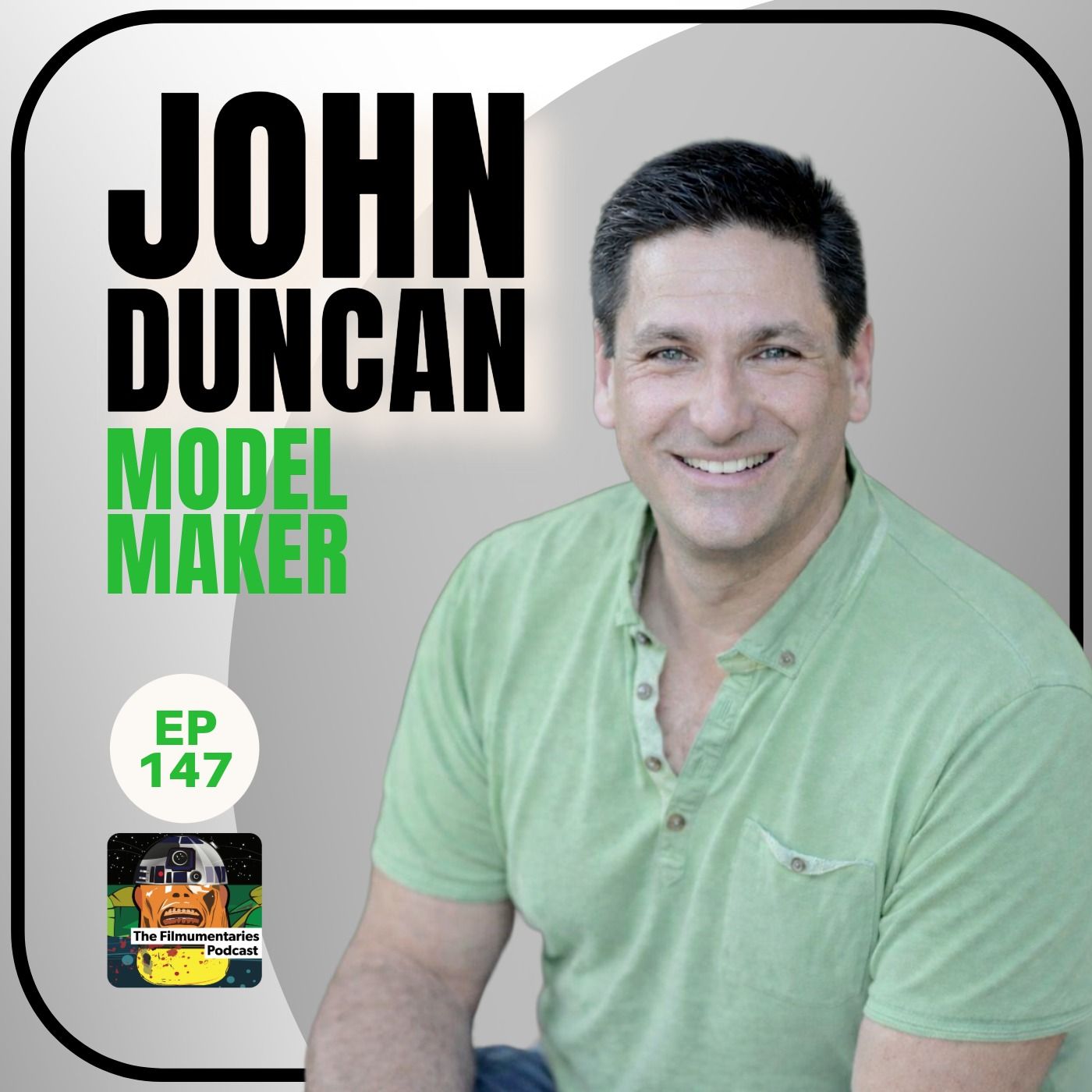
Ep 147 | John Duncan — ILM Model Maker (Star Wars, Star Trek, Pirates)
About this episode
In this episode, I’m joined by model maker John Duncan, whose career spans nearly fifteen years at Industrial Light & Magic and includes work across Star Wars, Star Trek, Galaxy Quest, Pirates of the Caribbean, The Matrix and more.
John talks about his early fascination with building miniatures as a kid, making models out of paper and cardboard, and how that instinct to just try things eventually led him into the film industry. What started as architectural model work and a stint in television quickly turned into a career at ILM, beginning in 1993, where he arrived for what was meant to be a two-week job and stayed for over a decade .We get into the realities of model making for film, learning to build for the camera rather than for close inspection, working under tight deadlines, and letting go of work when it needs to be modified or destroyed for the shot.
John also discusses his time as a concept model maker on the Star Wars prequels, working with Doug Chiang to create what he describes as “3D blueprints” for the wider production. These models helped bridge the gap between design, practical builds and digital assets, ensuring consistency across departments.There’s plenty here on specific projects too, including building the Enterprise-E for Star Trek: First Contact, working on the ships for Galaxy Quest, and contributing to the large-scale pirate ships in Pirates of the Caribbean. He also shares stories about unusual materials, problem-solving on the fly, and the collaborative nature of the ILM model shop.
We also talk about the shift from practical models to digital effects, where miniatures still have a place today, and why physical builds continue to resonate with filmmakers and audiences alike.John is thoughtful, practical, and clearly still passionate about the craft. This is a great insight into a side of filmmaking that often goes unnoticed, but is absolutely fundamental to how these films were made.
Topics covered
- Growing up building models and early creative influences
- First steps into the film industry via architectural models
- Joining ILM in 1993 and working alongside industry legends
- Building models for camera vs building for display
- Working on Star Trek: First Contact and Galaxy Quest
- Concept model making on the Star Wars prequels
- Collaborating with Doug Chiang and George Lucas
- The idea of “3D blueprints” in film production
- Practical effects vs digital effects
- Working on Pirates of the Caribbean
- Materials, techniques and problem-solving in the model shop
- Replica prop community and fan research
- Why physical models still matter
This podcast is completely independent and made possible by listener support. If you’d like to help me keep making these episodes, you can join my Patreon community here: https://patreon.com/jamiebenning
Watch more on YouTube:
Check out the Filmumentaries YouTube channel for behind-the-scenes clips and extra content: https://youtube.com/filmumentaries
All my links
Transcript
Automatically generated, so expect the odd misheard name.
Weirding Way Media. Hello and welcome to episode one hundred and forty seven of The Filmingmnitary's podcast. This is your host, Jamie Benning, and this is the show where I dig into the behind the scenes stories with the people who were actually there at the time making the films that we all grew up watching and loving. In this episode, I'm joined by model maker John Duncan. Now, if you've ever been fascinated by the physical side of visual effect, you know, the miniatures, the ships, the props, the actual stuff that exists in front of the camera, then this is the one for you.
John's career spans an incredible range of work from Star Trek and Star Wars to Pirates of the Caribbean and Galaxy Quest. Another favorite of mine the Matrix as well. And what's great about this conversation is that he's done it all really concept models, hero miniatures, props, even making prop replicas himself. He loves doing that. It's his hobby as well as his job.
It's his passion. We talk about how he went from building things out of paper and cardboard as a kid, and how he got into ILM in nineteen ninety three and suddenly he was working alongside the people he'd only ever seen on bubblegum cards. There's loads in here about. The craft itself too, the reality of building for camera, learning not to be too precious when your work gets chopped up or repainted or exploded. We also talk about his time on The Stars prequels, working with Doug Chang as a concept model maker, essentially created what he calls three D blueprints for the rest of the production to follow.
There's also some great stuff about Galaxy Quest pirates, like I said, and the shift from physical models to digital and where miniatures still absolutely hold their ground. And like a lot of these conversations, it's also about the moment where you realize this thing you've been doing for fun is actually a job, or in John's case, a career that kept him at ILM for for many, many years. Before we get into it, just a quick mention of Patreon. I'm currently aiming for two hundred patrons and I'm at one hundred and seventeen right now. So if you enjoy my podcast and want to support what I'm doing, and it is just me doing it, I get no other help.
It's a lot of work, and I know there's a lot of you listening out there. You can head over to patreon dot com, forward slash Jamie Benning and support the podcast that way. It really does help keep these conversations going right. So here's my conversation with model maker John Duncan, and I'll be back at the end for a bit more jabbering on. John.
Great to have you here today. We finally did it. I've always been intrigued by the work of a model maker, and I just kind of want to know where it all started for you. Was this something you did as a kid or did you have a different route into this. Absolutely, I always built stuff as a kid when I was as long as I can remember.
I remember going on car trips as a child and making things out of paper and tape, just like to kill the time while we were driving. And you would arrive at my cousin's house with a little tiny paper suitcase with like folded clothes inside of it, and so just you know, stuff to keep me busy. And I've always had a fascination with miniatures as well, So it was always the smaller the better for me when I was little, and it kind of less so now as an adult. I've gotten into bigatures too, but the it was that was kind of the draw for me was Wow, you can take something that's existing in the real world and make a little version of it, and that always and I can make it. That was that was the thing that was always fascinating for me.
My parents were both kind of crafty and do it yourself for types, and so they just encourage that in, you know, with my my w and I to you know, do things ourselves, like if the car broke, we. Go out and we fix it. You know. I remember learning how to do you. Know, carpentry and sewer repair and all kinds of different things because hey, when it needed to be done, and that's what you did, and so it gave me a sense of I can do that sort of thing.
So that I was I always felt like, well, I don't know how to do that, but somebody does that, so or I should be able to learn how to do that. So I would try it. And eventually you can try enough things and you start learning that you. Can do stuff. Yeah, that's really cool.
I mean it's very not my skill level, what I have to say on I think I had sort of parents that had that kind of attitude of oh, give it here, I could do it quicker. You know. It was never really sort of my parents never seem to have that kind of patience to teach me. That's a different mindset altogether. But I found that I have a little bit of what you were talking about, your parents wanting to help my kids.
I'd be like, oh, hey, let me show you how to do that, and I would end up doing it for them, and my kids actually had to tell me sometimes, Dad, let me do it. We're like, oh, okay, sorry, I'm just trying to help. I was so exciting. It sounds like like your your skills were also drawn through sort of just being in that environment, through osmosis in as many ways as not not necessarily sitting you down and saying, sound, this is how you do this necessarily, but maybe just being in a world where your parents would fix things, they would make and mend and when it was necessary, right. Yeah, or just learning you know, doing crafts, you know, making candles or you know, paper mache or that sort of thing.
When I after I got my driver's license, I crashed a car and my dad said, I guess you're learning automotive repair. This summer so I learned how to do bodywork that summer. That's great. So it was always this sort of that's what you do. Yeah, And when you were a small kid making these little paper models and things, was there a particular model in a shop that you wanted, like did you have or is there one you can remember buying and thinking, Wow, I've.
Always wanted to build this. I recall a number of different things. There was. The first, well, the first model kit that I ever got was a submarine model. My dad.
Well, I'd building things. I'd start out with paper, and then I moved into cardboard, and then I started getting interested in, you know, plastic models of like ships and cars and what have you. And so my dad took me to the store and we picked out a model kit, and I came home and I was young, I think, maybe ten or something like that, and all I had was Elmer's glue, which is just white glue, and so I built it all with that, and of course you put in the submarine, put the submarine in the bathtub then and all that water gly just just alls away and it falls apart. But it was so fun doing that. But I remember there were these little tiny cars that I saw in a store once and I was like, oh, I got.
To get some of those. And then my dad got me into trains, so I had an HO train set. And then of course I learned that there were N scale train sets. And I said, oh, I must have those, Dad. And then I think around the age of fifteen, I just discovered that Markland did Z scale trains.
So I gotta have the Z scale train. I just kept going smaller and smaller and smaller throughout as time progressed. Yeah. I remember I was a sort of avid radio controlled car builder with my dad, So I would have those Tamia cars and i'd get a Tamir catalog. I've still got a couple of them over here actually, where I kind of pore over the pictures and be amazed at how well people could make these models.
Then I buy one and make a complete mess of it. I mean, there is a sort of lowering of expectations at a certain point for a young kid when you know, when buying those models, But when did you realize that maybe you had this kind of knack for it. Well, I mean, as a kid, I always felt that I was pretty good at it. I was in boy Scouts, when I was younger, and this was what pre around twelve thirteen years old or something like that, and we had carved the little neckerchief slides and it was an Indian head and you just basically got a block of wood that had the shape. Of an Indian drawn on it.
Native American, I should say, but anyway, the uh so, everybody in the troop was carving them, and I carved mine, and it was a thing we did over the course of a few weeks. And I went home and I carved mine at home, finished it up, and I brought it in and all the other kids were accusing me of having my father do it because it looked like what it was supposed to do. And the same thing happened with a birdhouse that I built that you did your dad build every and. It's like, no, I did. And so I kind of felt like, Okay, well, I have a knack for making these sorts of things that and then I discovered science fiction and I had a I would make money by mowing people's lawns and then as soon as I'd get I'd run down to the to the local drug store and I'd buy all the star trek kits because Star Wars didn't exist then, so Star Trek was.
It for me. And I'd get the Enterprise and the Klingon Ship and all those things. And that was that. I bought every single one of them. Did you have them hanging from your bedo ceiling, hanging in my room and that sort of thing.
Yeah, And it was it was fun. It was a fun time because you just I would work with whatever I had at my disposal. So if you know, I remember the the what is it called the technical the star Trek Starfleet Technical Manual came out and I got a copy of it and it had drawings of full size drawings of what the phaser, communicator and the tricorder. All looked like. I was saying, oh, I got to build those.
And they were built. I built them out of basically stacked corrugated cardboard like for just shipping boxes, and you know, painted in black, and and they looked really good. The top could flip open on things. But you know, if you looked at it, you could see, you know, on the side, it's all that corrugated cardboard, waviness and stuff. But it you know, as a kid, you just use what you can find.
I used to. Hoard, you know, like broken pens and toys and stuff, so that I could use those to to. Build other things with. And it was just that was that was part of my my growing up was just what can I make this out of. It sounds like you sort of major own apprenticeship almost for what you were going to become as an adult.
When did that When did that switch kind of happen for you? When did you realize, oh, maybe I could make a career out of this. It was it was it was well, I think it was after of course Star Wars came out and then they had the behind the scenes makings of and it's like, oh, wow, there's people that do this for a living. And I'm sure that's the story that a lot of people have said, Uh is you know, oh you can get paid for doing that? Well, it's not just a hobby.
Yeah. Of course, at that time, I thought, well, what are the chances that I would ever get to work on Star Wars or anything like that? And so I and that was what that was around high school for me. Jedi came out in eighty three and that's when I graduated high school, and so I was kind of I was sort of the prime demographic for Star Wars. I think I was already a science fiction fan into Star Trek and Space nineteen ninety nine and Battlestar GALACTICUD all this, and then and and Star Wars comes out, and it just took the world by storm, and it drew me in immediately.
I was always drawn. To the the robots and the bad guys. Those were my Those are the ones that I paid attention to the most. But then in college, I tried a number of different major and eventually kind of stumbled across television film production and I ended up getting a degreen television film production and thought I was going to go work at a TV station. I actually did for about a year and a half.
I was working for an. NBC affiliate doing the evening news as a technical director, and and found immensely boring vision So. You actually like vision mixing as we call it here TV. You would call it, yeah, just pushing the camera buttons kind of thing. I was pushing the buttons and you know, yes, different.
Yeah, And it was after a year and a half of doing the nightly news, found it exceedingly tedious. And just boring. So I yeah, while I was working on my degree, I did an internship in San Francisco at KQDFM, the NPR affiliate there, and of course they also had their television station there and it so I got exposed to it then, but I wasn't really working in it, but I was making money because of course the internship was not paid doing architectural models. A friend of mine had said, hey, why don't you come work. It was also in San Francisco, so I could make money while I was doing my internship, and I was building architectural models in San Francisco, and then through that ended up doing a commercial, met some people from that, and then started doing ride films like Star Tours.
I didn't do Star Tours, but I did ride films like that. And then eventually the company I was working for was right across the bay from where ILM was located in San Rafel and we were having a lull our. Producer called ILM and said, hey, I got a couple of guys we're going to be down for a little while. They could use some work. Do you have anything available?
And they said sure, send them over. So I got hired for two weeks like everybody else does there, and ended up staying for nearly a decade and a half. What year was that when they say that was. Nineteen ninety three when my first project that I did there it could just been done kind of No, that. Was ninety three.
That was just prior to the release. Oh yeah, I think right, So you were early ninety three kind of thing. Yeah, yeah, because I remember I remember going to see it and everybody was being really like worried about future of our careers. And I was just so excited I was here. I was like, Yay, I'm finally here where I never thought i'd be.
So it was it was sort of a weird feeling to have everybody go, oh my god, this is the end. So what were you first hired to do? Iland? The first project I worked on was actually a commercial, was for Malaysian Airlines. And that was an amazing day for me because, like I said, I was a fan of Star Wars.
So I'm showing up my first day and I'm just trying really hard not to geek out over everything. And I walked into the model shop and I'm assigned to Larry Tan who's heading up the project or that part of the project, and he says, hey, Okay, welcome, You're gonna be working with Steve today. And he introduces me to, of all people, Steve Golly, and inside my little little John was like I have his Bubblegum card. And it's like, hell, hello, mister Golly, and he's like, hey Steve, call me Steve. You know.
But that's how it was. It was so relaxed there. I mean, it was just so welcoming. I felt to to be there, and everybody there was someone who could teach me something and was willing to teach me something. That was one of the wonderful things about working there was you didn't get a lot of gatekeeping.
You got people who were like, hey, let me show you how to do this, or hey check this out. And yeah. But shortly after that commercial came Star Trek First Contact. So again one of my childhood thrills was to get to work on Star Trek. And here I was building the new enterprise, the enterprise e for for Star Trek First Contact and a new board ship and you know, other things like that.
So that it was it was this like. The culmination of these childhood fantasies were coming true. Yeah, ticking things off as you guys want taking things. And at that point, the whole idea of Star Wars coming back was completely off the table. As far as we knew, George was done making Star Wars.
Star Wars was never good. There were gonna be no more Star Wars movies made, you know. So I was just excited to be there working on other movies. And it was a little while after that. I think we had Men in Black and there was a couple of other movies and oh, I think this, well, the Jurassic Park of course came out.
Yeah, And that was when and then Steve Golly came to me and said, hey, the you it's been requested that you come up and work at the ranch on the new Star Wars film. And I was like, what the way? So yes, yes, yeah, wow. Just just going back to us one second, like when you arrived there, though initially you're used to making models on your own, right now you're in this very collaborative world. Did that take some adjustment?
Sure? Absolutely, because in the of course, in the film industry, you're not building them for yourself. You're building them for the show, for the shot, for the director. And I got a good lesson than that on that first Malaysian Airlines commercial that I did, because you can't be precious about what you do. Whatever you make could be you know, not used, destroyed, whatever, repainted and something I'd built this nice little model of a tram.
They got it on set, realized it was too big for what they needed. So somebody took it, just ran it through the band saw, took a few inches out of the middle of it, closed it up and redid it. And you know, of course all the detail I'd thrown in there was like, oh, it was gone. And but you have to just go, you know, that's the way it is. That's what's needed for the shot.
So you don't build things to be viewed up close unless it's going to be shot up close. And so you have to learn like how to build for what's needed for the film. Mm hmmm. And I guess as well. When you're doing it for yourself, you can kind of take your time and you can really labor over it.
And but when you're working on a production, obviously you've got to have sort of speed and accuracy and and the level of finish and be problem solving all in this world of uncertainty that you've just kind of joined as well. That must have been. Quite an Anything you could do to do it faster and better was was, you know, needed, because the deadlines were never long enough. I don't I don't think there was ever any model that went out on set where you went, oh, yeah, that's done, we didn't need another week or so on that that was that was I mean that maybe that happened, but that so rare. You were always like, oh, if we just had another two weeks.
I think every model maker has probably said that. Yeah. And I imagine as well, like when you get a design from somebody like First Star Trek, First Contact. Obviously the enterprise kind of changed throughout that series of movies, didn't it. There was always like a sort of bigger and better one in a way.
Are you working with quite detailed drawings from the concept department and the design departments or did they leave enough for you to really kind of put your own stamp on. It on every production? Every production varied, of course, but the production the production drawings were always fairly loose. I mean they would do close ups of things that they were they felt were important. The drawings were often I mean we never got blueprints per se.
Well, I take that back. On parates of the Urban, we did get blueprints because Disney was producing that one, and they were building full saze. Sorts of the ship and stuff too, But a lot of. Times it was just they were just loose concept drawings and we would take that and then interpret that to get the look of what they wanted. And there was always this back and forth that art directors would be in and out of the shop to say, oh, yeah, can you make that longer or narrower or whatever to fit what they were really trying to get from the from the model.
And it's part of that learning process, also knowing what level of detail you have to do for the camera, because obviously you can go beyond that for the naked eye. I mean, I've seen some of the models I've been to Ilm and to the Runch in recent years, and I was kind of blown away at the level of detail because when I compared to something like that Mate painting. Some of those Mate paintings are like Chris Evans and Mike Pangratzio and Jeck Green did some of them are quite sort of, you know, rough a point because they knew they didn't need like the finest detail because the camera would do what it needs to sort of run. Yeah, they could trick the camera the way. What I always loved about the mat paintings was like where the cutout was, where the insert shot would go, That's where all the detail was, That's where all the sharper details.
And then it's sort of the edges of the painting. Which is that's where you're going to focus your eyes. And do you apply that to the model making as well to a certain extent, like you know what's going to be in the foreground for this shot? Yeah, if you. Know, otherwise you have to complete it as near as possible to perfect.
Right, yeah. Yeah. And we would always provide coverage too, Like we would get the storyboards to show like, Okay, the model is going to be shot from this side and above and below and over here, and so you'd realize, oh, this whole backside of the model doesn't even need to be painted. And then. But at the same time you would provide coverage, you detail beyond what the storyboards would say, because you wanted to make sure that if they changed their mind, which often happens, they get down and they go, oh it's a slightly better shot if we take it from this angle or move over here, or they've added a shot that wasn't in the original storyboards.
Now we need to see it from this site. So you'd try to give them as much. But then, of course that's always part of the budget too, as your you're having to balance out. How much work can we do on. It and stay within budget and time?
Yeah, and not drive ourselves crazy. That's always and that's always the flight in films is how much can you put on the screen. With the amount of time and money you have? Yeah? Yeah, I saw one of the ships you would have worked on when I was at the presidio when was that twenty twenty three from Galaxy Quest?
The protector is hanging there. It is huge. I was as much bigger than I expected it to be. I think, you know, I'm a big obviously a big fan of behind the scenes stuff, but I've always sort of taken aback when. I see these things in reality because they're.
Right, okayt Yeah, Because there was the there was a smaller one about three feet long that was built as the TV version of the uh yeah and uh and so it had a little bit lower resolution detail, so that it looked like a you know, a TV era model, and then the big Galaxy Quest had to look like it was a really actual, big existing ship and so that you know, so we we scaled it up and added detail and all the deep weathering and that sort of thing that goes into it. That's really cool. And that was a very fun project too. Yeah, I was just gonna ask that. Yeah, it tied together, of course, the Star Trek and Me and the Star Wars and me and and and it was being and it was a parody, so there was.
That was one of the most fun projects I think I worked on there. That and probably Pirates of the Caribbean. I mean, they had a lot of projects that were good fun for different reasons, you know, Star Wars of course, but you know, Galaxy Quest was one that was just so much fun because of just. The subject matter. And it was obviously written by people who love Star Trek, so they weren't making fun of Starguars.
They were having fun with it. Yeah, it's sort of one of the best Star Trek movies in a way. For me. I just I know it's not Star Trek, but I just I've shown it to my kids who have no real reference. At the time, I had no real reference to Star Trek itself.
And in subsequent years they sort of worked out what Star Trek is, you know, and they're like, oh, that's where that comes from. You know, they saw it back to front. But did you get a sense that it was the director and that was a Dean paraso, wasn't it? I don't recall. Did he ever come into the model shop?
You didn't know? You didn't meet the director. Now I didn't meet the director. No, some directors did. We had a number of directors that came to the shop and sometimes they and sometimes it was all shot by our our directors of photography, and the director wasn't It was viewed the stuff from from a remote location.
And did you did the villain ship on that show as wellther was it? Sarahs Yes, Sarah, that's a very. Very different design, far more kind of organic and. Yeah, and that one was we had a team that it was all sculpted in clay. And again it was what eight nine feet long or something like that, and it had a structure within it.
But then all the detail was we just sat there and you know, sculpted the clay to make all the scales and spikes and. You know weirdness on it. Uh. And and then we took a mold off of it and cast it in fiberglass. But the yeah, the original sculptive, it was all just you know, oil clay.
Yeah, right, A very different sort of approach to doing a spacecraft that you know we have because yeah, you're going for like detailed and symmetry, and. Yeah, I actually have a little trouble with that. I'm much much better with. Rectlinear things like you know, or mechanical things. Doing organic stuff is always a challenge for me.
And trying to make things look random is is tough for me because I sort of innately want to do, you know, keep things regular. I have a funny story about that from Pirates of. The Caribbean. Was we had to glue barnacles on the bottom of the pirate ship. The Black Pearl was probably twenty five thirty feet long, and so there's a scene where it rolls over in the water and they wanted to see barnacles on the on the on the bottom of the ship.
And so I'm sitting there with Randy Ottenberg and a few others. R. Randy is a fantastic scenic, and she's really good at random organic looking things, and I'm gluing mine on. I'm trying really hard to keep them, you know, sort of random clusters of of of of of things. And then I stepped back, and my random clusters are all equally spaced along the side the whole and I look over at hers, and hers just looked like they grew there, and Randy, please help me out here.
It was it was so challenging. I'm trying so hard to do it, and it was coming out so perfectly regular that I. Saw the pattern that wiring must be very difficult. Yeah, you're so used to doing that, it must be very tough. Yeah.
And Sarah's was interesting that way because it was all like just clay, and so I wasn't making straight lines. It was all curves and with grapes, striations and things in it. But it was great, very cool. Yeah. Well it's nice, always nice when you have to sort of learn a new discipline, isn't it.
And kind of you know, talk about the brain being you know, elastic, and you know, you just want to kind of create a new a few neural pathways into a new into a new zone. Do you still do you still find the sort of model making meditative? I guess is the word I'm looking for, because as a kid, I'm sure I can imagine you sat in your room with like a desk, lamp and magnifying glass and maybe there for hours. You know, it's very different to what kids do today. But do you do you find a sort of meditative state that you get into and.
Now you're working. Yeah, it's funny. Steve Garley asked me one day what I did for Harby's. That was early on when I started there, and I said, I build models. And he was like, this is my.
Because he came from a design background, and so I guess he didn't build models for fun. And so yeah, I still build models today. I have a few of them, a few projects going right now. But it is it is nice to be able to kind of have the time to just sort of get into that flow of just making it and and and you're gluing the parts and shaping the pieces. And it's one of the things about il M that was so good for me was it was it was like a candy land of learning new things.
And if I you know, if I didn't know how to do it. There was somebody that did, and so they I could go ask them and they would teach me and show me. I mean I learned. I learned machining, you know, how to use you know, the mill in the lathe and molding and casting. You know, there's there was so many different techniques that it's like I've never done that before, but hey, let's try it, and somebody would have advice on how to do it, and you and you learned how to do it.
It was just I just ate that up. That was That was just. You know, it was like having living in a in a in a fairy tale to have the opportunity and the encouragement to try anything and everything. So yeah, it was it was. It was a wonderful place to work.
Yeah, I've spoken to Lawn Peterson. Who did you ever work alongside Lawn? Yes? In fact, on that first commercial I worked with him. Yeah, yeah, good guy Lawn.
And I wonder if like, if there's anything of those people you work with, like Steve Gorley and Lawn Peterson, that is that you would sort of regard as specifically theirs, you know, like oh, that's Lawn's kind of thing, or that's Steve's kind of thing, because I know Lawn talks about that kind of boiler plate idea, you know, making sure the piping is making sense on on a spaceship and all that stuff. Is that, Yeah, gone, what what do you think about those guys? Steve, he was just a fantastic model maker, and I recall him really enjoyed like he he seemed to have an affinity for like trains too. Because he he. For the longest time had like the blueprints on his wall of the train from Back to the Future that they did.
I think that was something that really appealed to him. He and uh uh Irack Heeler was one that I kind of sat at his knee and learned a lot about making patterns, uh carving patterns with techniques and tricks and stuff. And he was way into trains as well. He actually did some things for some some special cars and stuff for for some oak age train sets and things. And then Lord Peterson was always he was.
He was sort of known for coming up with unusual choices for uh materials to use. I mean, yeah, that's what I and ground up walnut shells seemed to be one that came up a lot Oh. Yeah, he spoke to me about that. Wasn't that for a wild West? I think?
And they got used for a lot of other things too. Yeah, and maybe he wasn't the only one. I remember Bill George showing me a model of it was a very small model. Of the Was it the Devastator? It was Darth's Darth Vader's Superstar Destroyer executed.
That's what it was called. Sorry, Yeah, and the they needed a shot of it like way in the distance, so they made one that was maybe a foot long or something like that, and for detail on that, they covered it in walnut shells, so it was just this lots of little shadows, but he couldn't make out what it was, but for a distance shot it worked. I remember Lauren also came up with using salt for waterfalls, I believe after using sugar and finding out that it drew drew ants, so switching after. That, And I guess that would have been on the Phantom Menace when that the water. Yes, that was on other pictures as well.
But you said you worked on the Star Wars movie as well, So tell me about that experience working on on the Star Wars film. Well, it started off I was in the art department, uh for as a concept model maker. So that was when Steve Golly came to me and said, hey, they want you up at the ranch to to do to do work for the new films, and uh so. Uh. I showed up at the ranch my first day and I met Doug Chang and the first, I want to say, the first model I was a son mind was the Naboo Fighter, the end one, and I remember getting the design and looking at it and going, this doesn't look anything like Star Wars because I, as I was all indoctrinated into the boilerplate technology as they called it.
Yeah, yeah, here was this swoopy, shiny, clean. And I was like, oh okay, And of course they explained it as like this is pre war so like nineteen twenties automobiles, you know, just these swooping pontoon fendered ships, you know, boats, land, yachts, whatever, And in this case, this was pre war spaceship technology. So that was that was my first introduction into it and. What was really tough to get used to it. First there was the ranch.
We were on the third floor of the main house at the ranch. The main house is not designed to be a model shop. It had dark blue carpeting, lovely paneled walls. We had dust with plants on them. And every day John Goodson and I would sit there making just snow drifts of plastic chips and things on the floor and bits of you know, sanding dust all over everything, and every every evening somebody would come in and they would vacuum it all up every day and we'd come back to a nice clean desk.
And it just felt wrong. Yeah, it was. And so you know, over time we ended up we built a spray booth and some other things to try and keep it cleaner. But it was, it was. It was a very unusual environment to be building models in because building models is a messy job and you don't want to be ruining the This is beautiful house that we were in.
Yeah, it's a stunning place, isn't it really is? Yeah? But you said you worked as a concept model maker on that was that? Did you ever consider that kind of step back compared to making stuff. For the screw?
Not at all? Actually, And and actually I did both on the Star Trek Star Wars, but I was I couldn't. They wouldn't allow me to have two credits. So I had to choose the one. So I chose the concept model one.
But so what is that exactly involved? Then? So you've got this drawing from Doug Chang and you just have to find the three dimensional yeah. Yeah, and he would design. He would say, oh, this is the important this is what how it was inspired, or here's what the details that are important to me or important to George and uh, and then we'd start off doing like a quick just foam model something all you know, maybe you know, five inches or something, and just do a few of them, shape them out of foam and then uh.
And then we'd have our meetings with Georgie every Friday, and he would talk about what he liked or what he didn't like, and then we'd eventually roll into doing a larger model that was more finished, had details. And I have to say this, that was one of the. One of the times when I was really allowed to sort of indulge myself in the details. Because the we came up with the term of three D blueprints. Basically what we were doing was making it.
Rather than making very loose models, we were making three D version, you know, versions of what was going to be used by the computer department, by the set department, by the model shop, and they all needed to match. So if we had a really loose model, then there might be some interpretation that didn't match up. And so the we ended up get. The luxury of kind of detailing them out to where we almost wanted them. There were some times there were off Oftentimes he said, I wish I could have a lot more time on that.
Funny story, one of the sculptors, Robert Barnes, was doing a maquette and he he was one that he would work on it right up to the very last minute, and he was never done. And so one model we actually had to pick up off of his desk while he's still sculpting it and take it down the hall to the meeting because George was coming in like any moment now and he had to be there for it. So and that was the thing I minded to put all the detail you possibly could into these things. Couldn't let go of his baby. Yeah, you're right though in saying that, you know you were doing this model that was like a three D blueprint because in those films, and that film in particular, I'm thinking back now, I haven't seen it in a few years, but the full scale versions that the actors are sitting in do match the model versions, the CG versions.
You don't really know where the line is on. A lot of that stuff. Good Yeah, well yeah, I mean I was in it, you know, I was. I was not in it, but I was in that world when I was watching it as what was I eighteen when that came out. I think I love those designs to this day.
I think Doug's work is fantastic, and a lot of that design team's work has really stood the test at time. And it was really nice because the well, for instance, Doug was really nice about letting you kind of take the ball and roll run with it. He would give you what was important to the design and then and then trust to you to fill it out to do the rest of it. Parts that weren't you know, they didn't always have drawings of everything, Like most of the robots didn't have feet, or they had really rough the sort of shading bits that sort of looked like a foot. So so I got to design the feet for all the robots that I did, So I put different different shoes on different robots for different It's like the Battle Droid they're wearing spats because they felt like they were more sort of like show you know, show soldiers.
And then the Super Battle Droids have combat boots, and the the Pit Droids have sneakers, like high top sneakers. Those are sort of like things I got to do. Yeah, that's cool. You know, you've already got this language of the universe, the styles universe, and then you're putting on another layer of another design language on top of that in a way, and were the sort of rules you felt you had to obey or well, I suppose you've already said it. Really that you had a bit of you know, you had a bit of leeway to add to your own flair to it if you like.
Yeah. Well, and like I said, Doug was very clear about things that were important or to keep an aesthetic style with something like the The Battle Droids, for instance, were inspired by the the Skeletons from Jason and the Argonauts, so they wanted to have this sort of gaunt thinness to them, sort of skeletal looking. They were originally bone white and then they changed it to us and color. And the Super Battle Droids there was some inspira inspiration with blades. So if you look at the forearm, it kind of has this sort of you know, knife like edge on it.
Yeah, those were sort of things that he would kind of give you and let you run with it, and and and you know add that into the to the rest of the model. Mm hmmm. So you worked making models for the screen, You've worked in concept. I see that you've worked in the props department as well on movies. So yes, I've done some specialty props for things.
On the last Matrix movie, I got to do the pills, and which was a sort of a strange little bit to do. And they because the first pills I think for the first films they came out that they wanted they were gel tabs, and and that was sort of a new thing, and so now they wanted something to look different because gel tabs are very common now, and so they wanted something that looked sort of metallic, and so that's what inspired those. Did some some rubber rubber ice cubes to get thrown into uh someone's face for a movie, and other. You know props like that. One prop for commercial that I really enjoyed doing was for a Nokia commercial.
It was to tie in with. Men in Black and you remember the the Men in Black worm guys. Yes, So the puppets for those are actually oversized so that they can puppeteer them easier. So for the commercial, they needed an oversized cell phone for them to to use, and so I got to take a Nokia phone and scale it up like eight times or something like that. It was.
Kind of comically huge, but it had to look like a Nokia phone because it was an Nokia commercial. So you see, you can't make it not look like the actual product. So that was a lot of fun kind of taking something and and going the other direction that I'm used to going. It was like taking something small and making it big. Is both some big and make it small?
Yeah? Yeah, what what did you think people see as a kind of the John Duncan signature thing? That because it sounds like you've you've done such a range of things. But you know, there's bound to have been conversations without you hearing the way people said, you know, who's the guy for this? John Duncan could do this for you.
You know, what do you think that is? Well? Around the shop, I was known for being fast and detailed. That was that was my thing. John Goodson and I were both kind of that way.
We ended up working in a lot of projects together. In fact, someone jokingly told us that they had a meeting where they're asking how many Johns would it take to do this project? And also because we had several Johns in the shop, because there was John Foreman, John Goodson, John Duncan you know. That's the other thing about the work that you did is it wasn't really built to last forever, right, These things were. Built for the screen for a couple of weeks and a couple of days.
Shoot. Yeah, And the joke was if it falls apart after the camera stops rolling, it did its job. Yeah, yeah, yeah, And yeah, they weren't. They weren't necessarily built to last. So what do you think about these people then who collect this stuff?
You know, this stuff goes to walks and sell the sales for a fortune. In a way, they sort of need to be preserved for history. But at the same time, you know they're not. They're not these kind of gilded precious objects in a way that an antique is. Let's say, yeah, yeah, but it's they're they're their own pieces of art.
In a way. Definitely. Yeah, there's so. I'm I'm a member of the Replica Prop Forum, so I interact on there a lot. And it's amazing what because they're some of these guys are are replicating the props that were built for the films, and the amount of research that they do have done is just remarkable, because when we're putting the models together, we're just digging through bins of parts and we often don't know what model the piece came off of, because it could just be like, oh, there were a couple of them loose in the bottom of the box.
We used to have these big boxes upstairs at at ILM that were filled with the model park trees from different model kits, and then we had kits that we could open up brand new ones and stuff too. But then eventually the park trees would just ended up getting dumped into these boxes and you just dig through them and they'd be green and gray and blue and brown, and you just pluck off the parts you wanted and stick no. Idea where they came from. Yeah, and they people would just research the heck out of what kits were available and what the model trees it looked like. They'd look at the back of the piece sometimes and that's it's amazing what they've done, and I truly remarkable replicas of the ships.
I take my hat off to them. It's amazing what they've done. It was so much, so much harder than what we did when we were making them. Yeah, they're reverse engineering it all, aren't they. And Yeah, I'm amazed at some of the stuff I've seen over the years at places like prop Store here in the in the UK.
In London they had a few mountions this last year and got to see some of the things up close, which is such such cool items. And I do love that people kind of pour over them and research them, and you know, like Boba Fett's rifle was there, and it turns out the hilt was from a real World War two flamethrow or something. You know, somebody had found. That this chunk of wood that was taken out of it happened along, you know, decades and decades ago, and. It's just it it does kind of blow my mind.
I mean, I know David Mandel as well, who you know paid three million dollars for an X wing, you know, and it's it's crazy money. But I never can understand what, Oh, you didn't know who bought it? No, I didn't. I never heard who bought it. I was I was wondering.
But yeah, yeah, David Mandel, Yeah. It's because it's really I mean, it's I mean Star Wars has made such an indelible mark on modern life that people people want that connection, and especially some of these things that that when they get out of the public arena, it's just it's it's yeah, they want to have it, and I remember, I will have it. I build replicas of things all the time. And it shifted a little bit when I actually started working on the real things. Then of course I wanted to build real things.
But yeah, I still build replicas all the time. Just have you got is there one in particular that you have that you you really love having around? I would see there's a lot of them. I'm working on a Probe droid right now from Empire Strikes, and uh, there's there's there's those models that that just have a special connection for you. Like I have to finish painting it, but I have a model of the MTT from from the film.
And it's it's a casting of one of the original ones. Well, long story so I made the original maquette of the MTT the Troop Transport, and it was about two feet long, and it actually ended up being used as a shooting model for when it coming out of the landing ship that they made casting molds the original and used it for that. But then we needed to make it in different sizes. So there's a six foot long version that I worked on with Brian Dewey, and then there's about an eight or a nine inch long version that's the one I have that I carved for a shot where they're all lined up I think in a hangar bay. And then somebody else made like a little about like inch and a half long version for another long shot.
So there's like four different sizes of that particular ship, that particular vessel. So that one kind of has a place in my heart because it's just it's a neat looking thing. It reminded me of. A a railroad train and a charging elephant, So it's, uh, it's just I really enjoyed making that. I got to put a little fun bit on the as part of the detailing of it.
It reminded me a little bit of when I was working on the on the the mackeat of it. It reminded me a little bit of the sand Crawler, and so kind of in my head, I was imagining that what if one of these had, you know, been destroyed on Tatooine and the Jawas. Had turned it sand crawl off the front or whatever. And uh so I actually went into the archives and took reference of the details on the top and so it's not exactly the same, but I mimicked some of the details on the top of the sand Crawler onto the top of the the MTT. That's very cool.
Another fun story about the MTT is it's it's a it's a Honda. I'm very black of it. There's all this detail in this just greebally. First in the middle and at the very bottom of it is a Honda symbol that I stuck on the original mackead of it, and then when we built the six ft or six foot long version, we did another version with it. It also has was that from a from a model kit or was it just like a decal or something?
I think that, yeah, the mackuette it was a model kit part that just the symbol, the nose emblem from some car and I just stuck it on there, and then when we did the big version, we were like, okay, we got a copy it, so what's the on there. I bet the probot is a hard one to do because that's quite individual design in a way. There's nothing else like it in those films. I mean, that's what I really like about those original films, actually, that everything feels like it was designed by many designers, you know, rather than like none overarching. Yeah exactly, and that and claws and.
Yeah, yeah, yeah, that's and that. Fortunately for me, there's folks on the replica prop forum who've researched all those parts and have a list of like, here's all the kids you buy to build this, and you still have to make your own patterns and things, but that it's that's something I can do. But it's it's just, yeah, it makes life a lot easier having the fandom that has done all this legwork for me to do it again super big thanks to them. Yeah, I bet there are some model kits that are hard to find though, right, there must be. It must be getting to a point where trying to find a model kit that they used on an original ship or character or whatever.
Back. Yeah, some of them are and some of them are just ridiculously expensive too. Yeah, like, well, some of them are still in production. Like there's a lot of the Tamiya and Hasagawa kits that are still around. The c Lab kit was used for a number of different models and it went out of production and people were like hoarding them like their gold.
And then but there's a company I think that's just actually re releasing that kit kind of almost specifically for the the scratch built model companies or fans that want to, you know, use it for Star Wars stuff, which is ridiculous. That's that. That's how it's happening. Yeah, that the comand comes from that world. Yeah.
Yeah, But then there's like these old was it uh, it's like a Porsche kit. I think it was a large scale Porsche kit. I think it's out of production and so trying to find one is like hundreds of dollars. So it's nice. Yeah, yeah, pretty cool though.
I love I love the level of research, the deep research you've been let's say, in the public eye with the with Adam Savage doing the R two build and stuff. I've seen that last week and that looked like a lot of fun. But I sort of wanted to no, because I looked at the viewing figures and it's like, I don't know, seven hundred thousand people have watched it or something. People love the kind of physical items that you guys build. So where do physical models still kind of win outright for you?
And where does digital genuinely replace the need to have physical models. Hmmm, well, there's. As far as the industry is concerned, the models get used I think primarily as said, extensions and things now and then maybe for like specialty work like pyrotechnics and water because it takes a lot of process power to do particle effects like so water splashes and movements, fog and fire and that. Sort of thing. Those are all things, of course, you get for free with when you have an actual physical object.
When the water splashes up against the side of it, it splashes just like water would splash. I know there are some directors who really like to use models still, and I think. There's also a desire. From the fans to have models. It just becomes sort of this physical touchstone I think to the production the so like even like shows like The Mandalorian or and or they they may not build models of every spaceship that's used in it, but they do do a couple and I think that is the production saying this is something the fans want and.
So we're giving it. Yeah, I mean, and there's some things that. I'm sure the marketing department likes it as well because it creates a story around the film as well. Doesn't it to a certain demographic as well? And I think it's that.
I think that's it's really good too because it lets other directors know that, hey, because I think model's got a reputation for being difficult to shoot, you know, like, oh, they're really time consuming and difficult to shoot, and you know, sometimes they can be. But it's again one more sort of a tool in the drawer, as it were, because computers are great for a lot of things, but when computers do everything, some things don't look quite right because it all comes down to the artists that are using it and the and the limits of the technology and the time. So that's I think it's it's it's important to know as a filmmaker what the proper tool is because you can do everything with you can't build a house with just a saw.
Yeah, so's you gotta you gotta you gotta use the right thing for the right, the right to get the right thing. I like it. I like that line, like I like the line you can't build a house with justice all. I was looking through your films when I was doing a bit of research on you, and I was like, Okay, so Star Trek, Star Wars, Planet of the Apes, Hulk, these are all like you know you so you've been in the Star Trek universe, the Star Wars universe, the Planet of the Apes, the Marvel though, although Hulk was kind of pre Marvel in a way before it kind of took. Off, like yeah, that was the angry Hulk.
Yeah, mission impossible. I mean, what's left? What's left? Like for you as a as a desire of a film to work on our franchise. I don't know.
It's funny because Pirates of the Caribbean came along and that was such a fun. Project for me. Sorry about the noise. My dog just I just had a dog snore. I've ah, he snorts like a pig.
But I was gonna say, uh, Pirates of the kerb and was such a fun thing to work on because it was a big departure from all a lot of the things i'd done were you know, robots and spaceships and things like that, and sort of work on pirate ships was so fun. We even had. A a shipwright come and work with us who taught us all about tying knots and what the names of the sales were and all this sort of thing, and it was it was so much fun to learn all that stuff because it was, like I said, it was it was so different than you know, building a spaceship, which i'd done at a hundred times at that point. So now you've worked on a couple of those, right. Yeah, three of them?
Yeah, the first three? Oh three? Yeah, the first three. I always think there's three, that there's four. I think there's four or five.
Yeah, yeah, at least four. Yeah, so you worked Yeah, so you worked on three. Yeah. That's the thing in those films, In those science fiction films, people expect visual effects, right, they expect models, and they expect computer graphics these days. But with a film like that, you don't expect effects necessarily, so you're not really looking for them as well, and it's a very different.
Experience, I think for the for the. Viewer, and maybe it's more if nobody notices. Then you did the job, right, Yeah, yeah, that's. You kind of Well, let's face it, you do want to show off a little bit. You want people to say, Wow, that was a that was a cool set piece or whatever, that was a cool ship.
But you don't necessarily want them to say that that was clearly tense scale y. Or that was a really that was a crummy model, or that's what you want to say, or recognize it, or that looks a little off and I don't know why. That's that's what you don't want them to say. You want them to just see it excepted for being real and keep them in the movie. You know.
That's that's that's what the story. Yeah, yeah, I saw that you worked on Wally Wally as well, doing models on that, so these are models to be scanned. Or well, that was actually it was a costume that I worked on for that one. Fred Willard was in in Wally and he's I think the first. Maybe only live action human in a Pixar film.
He he played. I don't remember the name of the character or anything, but he was he was supposed to be telling there was a video that was watched on the ship in the in the Wally movie, and he was saying, you know, when the planet is safe for human habitation, you guys can all come back. And in the meantime, you know, and in the background there's a spaceship taking off and it's supposed to be like when all the humans are leaving Earth because it's uninhabitable, and he's saying, when it's all habitable again, you all come back and it'll be all great. Don't worry about a thing. And then he's like trying to skid out all out of there because it's not safe for him to be there anymore.
But we shot that at thirty two ten Studios and the so the costume that he was wearing had like this chest play with the beeping lights and things on it, and that was that was what I built for that. Right, Okay, Yeah, it seems like you've done lots of different disciplines over the years. But what would John Duncan have done if model making had not come along? What was what was oh the other path in your destiny? Well, when I was younger, my parents kept saying you should be an ear surgeon, because I was.
I was always working a little tiny things, and so they thought working on the inner bones of an ear. Would be something that got it work for me. I don't think I would have enjoyed people are weird and squishy and blood and all that stuff. That's something I think I would enjoy working on. Well, it sounds like you made the right choice all along on the you know, it feels like you know, you set out with an intention and the sort of the path came to meet you almost, which is often the case when I speak to it.
Yeah, it was. It was. I didn't I didn't set out to go work for ILM. I I thought that was a cool thing, and I thought, you know, when when I realized it was actually a career, I did think about, like, oh, that would be cool to do, but I never thought it would be something that I would do. And then life just kept sort of diverting me that way, and and it was I mean, I I just kept going with it.
That was the thing I I tried to say. Yes, that was my chat there with John Duncan. Thanks so much to John for his time and for his dog snorting on the recording. I really enjoyed that. One's there's something about hearing from people who are you know, were right there in the physical era of effects work, building things with their hands, solving problems on the fly, figuring out how to make something look right for the camera, you know, not just for the eye.
And John's got that great perspective of having seen the shift from physical into digital without losing sight of what makes physical stuff so valuable. And this is not an anti CGI podcast. I find it interesting to talk to people who've had hands on I like talking to people who are coming up with new digital effects. This podcast is very much about celebrating that that creative mind and whatever the tool is. So if you enjoyed that episode or any of the others, please do share it around, tell a friend, or leave a rating or review wherever you're listening Patreon, dot Com, forward slash Jamie Benning as well.
It's just gonna help more people find the show. All Right, that's it for this episode. Thanks for joining me, and I hope you can do so for the next episode of the Film You Mentors podcast. Red Thingy Moving toward the Green Thingy? What red thing you moving towards the Green thing.
I think I think really green Thingy weird in a way. Media



Similar episodes across the network
Matched by shared keywords.
-
Linus O'Brien - Unsung Cinema
3 shared keywords: john, of, the
-
Seasonal Differences, Shifting Fandom
1 shared keyword: the
-
Resident Evil - Kulture Meltdown
1 shared keyword: the