
Season 1 · Episode 140
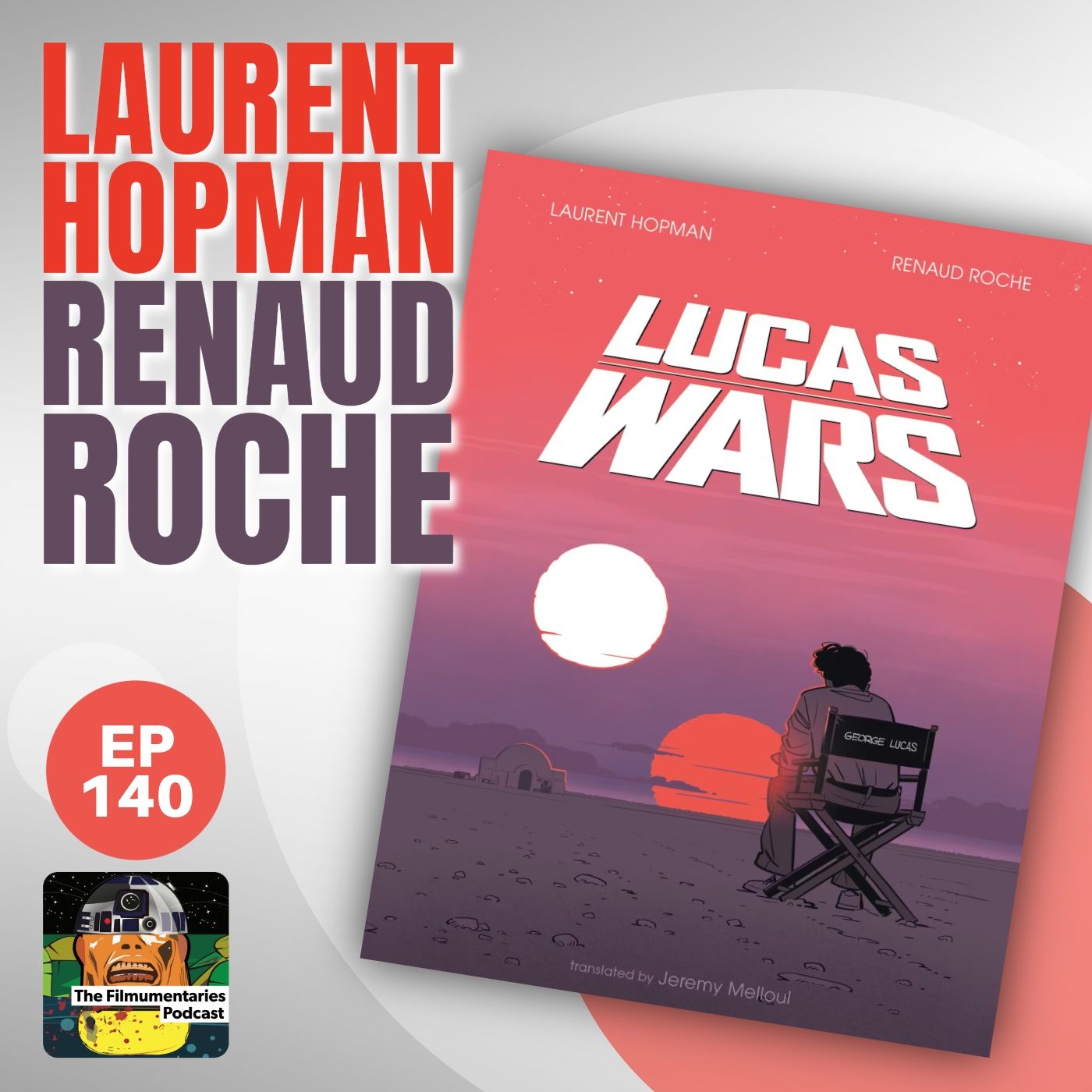
Ep 140 | Lucas Wars — Laurent Hopman & Renaud Roche on the Star Wars Graphic Novel
About this episode
- Why the emotional journey of George Lucas became the heart of the story
- How the pair condensed vast amounts of historical research into a tightly structured graphic novel
- The challenge of visually dramatising meetings, offices and creative conflict
- The relationship between Lucas and Spielberg, and how it shapes both volume one and the upcoming sequel
- The meaning behind the iconic twin suns cover
- Visiting Skywalker Ranch and Lucasfilm after the book’s release
- Balancing historical accuracy with storytelling
- Why Lucas Wars connected with readers beyond the core Star Wars fandom
BUY IT HERE
This podcast is completely independent and made possible by listener support. If you’d like to help me keep making these episodes, you can join my Patreon community here: https://patreon.com/jamiebenning
Watch more on YouTube:
Check out the Filmumentaries YouTube channel for behind-the-scenes clips and extra content: https://youtube.com/filmumentaries
All my links
Transcript
Automatically generated, so expect the odd misheard name.
Weird Being Way Media. Hello and welcome back to the Film we Mentories podcast. I'm your host, Jamie Benning, And in this episode, it's landing at a very appropriate time of year, because today I'm joined by the writer and the artist behind the brilliant new novel Lucas Wars. That's writer Laurent Hotman and artist Reno Rosch. And if you're currently wondering what on earth to buy the film nerd in your life, or indeed what to put on your Christmas list, this might just be the answer.
Lucas Wars tells the extraordinary behind the scenes story of how Star Wars was made, but crucially, it does it through the emotional journey of George Lucas himself. It's not just about the tech and the effects. It's about doubt, pressure, friendships, studio politics, sheer, bloody mindedness, and persistence. And it's all told through this beautifully cinematic graphic novel format. So in our conversation we talk about how the book came together, Laurn's background as an entertainment journalist, Rena's journey through animation and storyboarding into comics, the mammoth research process behind the book, and how you make boardrooms, film sets and creative disagreements for genuine lead.
On the page, we also get into Spielberg and then Lad Junior, ILM Fox and the very real personal toll the film took on Lucas at the time. So, as I said, it's me, Laurent and Renault, but we're also joined by my friend and super talented BBC radio producer Mark Berman. I'm working with Mark Berman on a project at the moment, like I haven't got enough projects. Unfortunately, Mark didn't join the call with great success. He kept dropping in and out.
He had a lot of echoes. So for the most part, Mark is not in this conversation, but towards the end he'll hear another voice chime in with a few questions, and that's Mark. So I thought i'd just let you know that upfront. So here's my chat with Laurent Hopman and Renault Rush and I'll be back at the end for a bit more jabbering on Theron Renold, thanks for joining me on the podcast. You kindly sent me this book some months ago now kind of pre release, and it was it was exciting to get and see before for a lot of people, and I've been through a bunch of times now, and I went through it again this morning just to remind myself of how much I enjoyed it.
How did this all begin for you? Like, you're clearly both fans. Let's let's set the scene. When when was the first kind of inkling of doing this project? Well, basically, the whole idea was to tell the crazy story of how Star Wars got made, but through the eyes of George Lucas.
There aren't many movies in history that have that kind of impact. But what's really hooked us wasn't just the movie itself. It was the human side of the story, like how does this young guy, barey, thirty, super shy, introversed, how does he take on something so massive? What doubts was he dealing with? What impossible obstacles did he face?
And how did he push through it all? When people talk about the original Star Wars, they almost always bring up the technical stuff, the groundbreaking effects and all that, and that stuff, of course is incredible, But what was really interesting was the human drama, the psychology of the people making it happen. Who were they, what were they like, and mostly what drove them to do it? So I was personally convinced that there was more than enough there to make the behind the scenes the story feel almost as epic as the movie itself, and George Lucas all So as a character is just fascinating. Is the ultimate underdog the last person you would expect to pull such a huge movie?
Yeah, I mean he's not your typical hero at all, is he? I mean he's not like this bold, charismatic, big character. He couldn't be more kind of shy and retiring. But this, you know, it's kind of amazing. This story has not been told before.
I always think when I see something like this, it's one of those why didn't I think. Of that moment? Because it's such a good idea to tell it in this visual form. But tell me a little bit about your background, Reno, like, will you approach by Laurent by this? And what is your background in animation and storyboarding and all of that stuff.
Yes, Actoria was saying that I was actually walking in the storyboarding team at Illumination in Paris when Lauren and Juliard publisher contact me, and I first I said the same as you said, Oh it's weird that nobody had this idea before and uh and and I guess the first thing I said to is are you not worried about Disney attorneys or something like that, you know? And and then when I discovered the script, it was it was like like obvious, you know that the script Laurenta ave done was very good and very good, yes, synthetic of of all those stories and and but yes, it's actually my first, very first comic book, which was a big jump for me because even if I drew, since I'm a child, I was dreaming as a child to become a comic book artist.
At some point, I divulged a bit because I discovered fittual animation when I was a teenager, so I focused more on this. I went to Goblin in Paris, which is a fitteral animation school. Back in the days, it was really focused on traditional animation. I spent two years only here and it was really like the drawne traditional animation, as you can imagine, which was really what I loved because it was drawing, you know. And that's the thing.
When we went out with our diploma in two thousand and two, it was the big shift in the industry when they start to do more and more CGI movies, and let's. Say I tried. I went to. A special effect company called Buff Company in Paris. I stayed one year or something like that.
At first it was to be hired, so they teachers their own treaty animation software, which was very clumsy, I must say at that time, you know, it was like not intuitive at all. And but we were originally hired to work on the Luke Beason animate animated features called Arthur, and he spent a lot of time waiting. We spend a lot of we wait a lot a long time for the production to start. So I was working, you know, on on on commercial or movies, sometimes some clips. It was fun, you know, but I was not drawing, and it was it was a drama for me because I chose animation because I wanted to draw movies in a way, and I was not prepared to to let the drawing to just keep the animated part of the this craft.
So so I went away and and I focused on storyboard directly because I really loved also the Missancene and all the cinematic language of course, and then I worked for a long time for commercial because this is where actually the money was back then, and then after I worked a bit for cinema or illustration work, so some illustration for magazines to different kind of project and finally illumination and then Adelica. And always it sounds like creating that kind of visual language, that language of cinema, and it's obviously paid dividends because there's some fantastic moments in the book. Just rewinding a little bit for you, then, Laurent, I believe you're an entertainment journalist. Yes, I was an entertainment journalist for more than twenty years, mostly covering movies, the TV show and music.
I was also a magazine the publisher, also in the entertainment world. But I've always wanted to try my hand at script writing and it happened with this project. Yeah. And you know, writing an article for an entertainment publication is very different to writing a script, let alone a script for a graphic novel, because there has to be a certain conciseness, you know, involved in writing for a graphic novel. You have to convey the message in a very short amount of writing.
How did you go about kind of getting that discipline, Laurent, to do that? Were you looking at other were you inspired by other graphic novels. Yes, yes, I'm an avid comic book reader, so I know the language. But as you said, concisiveness is the main. Thing in comic books.
You have a limited number of panels, obviously, so you have to get everything in and you have to anticipate. The the drawings. What what will the drawing convey and what will it's what what kind of information will it give? So so yes, yes, you have to to to be very careful with words. You cannot write too many words, include too many words, because people don't really like to read when they when they're reading a comic book.
With graphic novels, you have a little bit more freedom. You can you can have longer text but in balloons, but overall you have to be very careful with words. Yeah, and if he if he sorry, if he if he write too many worlds, I tell him, no, no, we don't need this. Look that the picture is enough. Look my drawing say it also, we can remove this and it always agrees that there was.
The direction in there. Laurent from you that said, you know, Lucas might say this, but at this point he's downhearted, he's pissed off, he's he's lonely. Did you have those words in there? Well, the way the script is is there's there's always a breakdown of what we must see in the panel, the essen shoals, and then quite often, well that's one of the flaws of the script writers in in the comic book world. They tend to write too many words, so the artist usually begs for less.
And most of the time the drawing is explicit in some ways, so you can cut off a little bit of text because because you can see the action. Yeah, yeah, there's that great bit, just one that springs to mind where I think Gary Kurtz is talking to George about Mark having burst a blood vessel in his eye from the trash compactor, and then you've got that lovely shot of looking at the back of George looking at the empty set there, and I know that photograph. I remember seeing that photograph of the first time years ago, and yeah, the way the light's coming in and George's body language is kind of hunched down and you can see he's kind of feeling dejected. I think you communicate all of that stuff really really well throughout the book.
And I thought, I know everything about Star Wars. You know. I don't know if you know much about me, but I spent four years making a thing called Stars Begins, which was a you know, a behind the scenes everything from behind the scenes that I could find, and I put it in a timeline, and I was reading through this and going, I didn't know that detail, and I knew that, you know, I knew that Lucas had suggested John Williams, for instance, I didn't know it was like a matter of months away from the release date when that happened, and it was scored so late. So I think you've. Done a really good job at kind of conveying the overall feeling of what it must have been like for George there, but also there's really nice moments of specificity in there as well.
What did you do for your research, then, Laurent, in terms of trying to put this story together, were you just trying to get hold of everything you could old magazines, books, documentaries. Yes, it was really a painstaking. Process to read and get to hear or watch everything that's available. And as we all know, there's a huge amount of documentation on Star Wars, so it was a long process to get it all in in order to synthesize everything and try to give this version of what will happen. Yeah, and sometimes you find in that behind the scenes law, you find different versions of stories, you find different details.
I think there's one you mentioned where Spielberg says it was two and a half percent that they shook hands on over close and counters of styles, but it's actually one percent. And it's interesting to include those details. But did you find how did you go about finding the truth in that case? Did you just see what was most prevalent back from a particular time or did you. Yes, Yes, going back to the original interviews was paramounts.
And as you said, when you when you read all the different anecdotes and and the way they change through time and memory doesn't serve people well. And they reinvent their own histories right. Exactly, and it becomes legend. Then, so you have to go back to to to the to the beginning, and they gave a pretty candid and spontaneous interviews back then. So that's that's where I drew from most.
Yeah, and then I like you look at the script ultimately, it's a lot of people talking in empty buildings and talking in offices and all of those things. How did you go about kind of making those moments visually dramatic and emotionally engaging. That's a challenge for sure, And that's where I really dive into my storyboarding knowledge, because that that's the good point. When you're doing story about for cinema or you you are supposed to draw everything in every anger on, you know, every framing possible, because you are at the service of a director generally which possibly has a very precise direction in his head. So it was the ball really to to to play a lot with that.
And and of course most of the time when there was those guys in suits in offices, I tried to put some visual diversity, uh, to to not draw every time the same anger or And also it is of course, of course there is a narrative purpose some buzzy crueles like if you put a long girl and and someone he gets more amazing and charismatic and higher girl is still opposite stuff like that, uh. And sometimes also I had fun because I guess it is obvious when you or the fans that know the movie was but you know, I frame some some of the reunion cases as the death Star meeting room, Nion room. You know, for example, sometimes there is a really a fun player to to to make to to visual parallel with that, because yeah, obviously the Imperial of the book add the fox guy basically, so there was something very funny to explore there.
And you play with the light also you can put something more more dark sometime, and yeah, it was really an obsession for me to really as as possible to not to withdraw always there some type of a frame and. Yeah, yeah, I'm sure I don't know what age you guys are. I mean, I'm forty nine, how old are you? Laurent fifty five. And pretty soon forty fail.
Well, I just want The reason I was asking is because you know, anybody who's been sort of invested in this world for any length of time of my age and laurence sage, you are a little bit behind. Reno knows those stories, knows those legendary stories about George showing the screening to his friends, to Department Meson. Spielberg and so on. But I think it's very easy for the sort of later generation of moviegoers, particularly people that are into the big Marvel studio these that these films are kind of crafted in a very commercial way, and they're kind of designed down to the tiniest the nth degree, whereas with Star Wars, and I think you've conveyed this well in the book. It kind of appeared out of nowhere, you know, and it was this group of rebels, if you like, kind of getting together and doing the best they could in very very difficult circumstances.
And I think that's communicated really, really well. And that relationship between Spielberg and Lucas is going to be important in your next book. I understand. We could talk about that in a minute, but just having you know, Spielberg's ear there and him saying to him, I think this is going to be great. You know, the rest of the rest they don't understand it, but trust me, this is going to be you know.
You can see those relationships forging in the book as well, and I think you've done that really nicely. Was that something you enjoyed putting together? Yes, we knew that the general public wasn't aware of the fact that all these great directors who who are going to define the new Hollywood, they knew each other, they were friends, and they made this amazing group. So that's one of the things that people discovered with the book in France when it came out the general public. Because we reached out, we were very fortunate to reach out to a wider audience than the Star Wars sandem.
So and all these people never knew about about this group of friends. So it was great to show the start of this friendship between George and Steven Spielberg and all the other guys. It's incredible. I really like actually the narrative purpose. You know, Spielberg in the book is like an archetypal character, you know, is the ally or obviously a bit a bit like Alan lad Junior of course, but is even more positive figure, is always supporting, is always enthusiastic, even when when George is really down, and and I think it helps to uplift the the general story and uplift George at some decisive moments.
And there is trust, there is admiration, a bit of competition. Too, especially at the healthy competition exactly. And I guess the only. I was I was thinking about that, the only picture, the only drawing ways he is actually not smiling. It's when you know he has to postpone the the after the smash of Star Wars, he has to postpone a close control, you know, for a few months, so it is a bit depressed.
But he said, how we can possibly show this movie now, and why. It was a. Movie too. It'd be incredible, what if to see them go up against each other. I saw Star Wars recently on a thirty five millimeter print of the BFI here in London, and it was yeah, and it was honestly like Time Travel.
You kind of were reminded just what a quirky little movie it was in many ways, you know, and you could see the gaffer tape and you could see the cables pulling the droids along and all of that stuff. But that had such a chant to and I think Close Encounters it is visually a more striking film, and you know, and kind of holds up better today, probably visually. But I was just going to go back to Laurent to something you said about the general public, because you clearly had to have the general public in mind if if you want to make a book successful. Of course, yes, you've got to appeal to those niche fans like me who pause over every detail and yeah, it's still learning stuff from your book. But also you want to make it appealing to the general public as well.
Is that something you had to think about during the writing pro and run over during the process of doing the artwork. Yes. Yes, we were hoping to reach out to a wilder audience, so it was important to keep the story as easy to understand as possible, mostly all the questions and the matters of the contracts and the relationship with the studio, which is crucial and essential to the story, but at the same time, it can get boring very easily, so it was a matter of keeping it simple and yet faithful, So that was one of the concerns, and also explain everything so that the general audience could follow the story when they don't have necessarily all the references. Yeah, and I think, you know, just from an artwork point of view, I've just got to hear that cover is really nice, sort of poetic cover, because that's the bit of the film.
So many people always cite as their favorite moment when Louis looking at the twins sounds you got that wonderful John Williams score I saw in the back. Because you've fantastically included not only a bibliography, but some of your behind the scenes work and there's that other cover that you considered at one point, which would have had a very different feel. It's interesting how the cover has such an impact. Yeah. The funny story is the original idea was was the cover which is at the end of the book, and of course it was the idea to do something more in a Drews through that composition style, even if the graphic stage is very different, you know.
And and the thing is, I was almost done with this one when when we discussed with Laurent and Julian the publisher, and they were having dubbed. So at first I was a bit a bit annoyed, of course because the job was already done, but very fast. I said, no one, but they write it this this because the what became the cover, the true cover with the suns, It was already a case and I guess almost a three quarter of a page in the book, you know, so it was supposed to be a very important picture already, but and in color too, because it was such a pivotal moment in the story. It is ready when he's waiting for the fox, contract is about to shoot, but he cannot start. So it's it's really like looking at your destiny and reflecting of what will actually happen and to have hoped that it will happen.
So it much very well actually looks destiny at this point, you know, and so and then yeah, we choose to focus on this to expand and yeah, it was the best shows because as you said, it symbolic, it's iconic. And there is also because in the book this is like a true picture, like there is one son, because it's basically like if George was waiting on the set, you know, exactly. So we had the second son of course in the in the cover to to really emphasis the surrealistic and to do like, yeah, a mix with fiction and reality and being the scene, and to mix all of it in something yet more more powerful, I guess. Yeah. Yeah.
One of the other things I love about the book is the way you portrayed the characters within, you know, not only in terms of the writing, but visually as well, because we all know what Harrison Carrier, Mark and George and you know, Alec Ginnis, Peter Cushion look like. But then you've got other. People in there, you know, Richard chupaul Hers, she's in the Marsha Lucas is in there. Did you have to kind of go back and research like old photos from back in the day, because there's not much of Marsha actually is there. Right, Yeah, you know that it's quite hard for Marshall because and not much and most of them in a very crappy resolution too, which doesn't help to catch details.
Hopefully there was like a few that that was more more good and and but at some point, yeah, I tried to also create my own version of Marcia. Of course, you know she she has most of the time the same haircut because it's it was more easy for me to to to draw her almost always the same to and of course just this little point you knows, it's very easy to to to to identify, and and also the general mood you know of the character and the fact that she's quite the hope pos it in terms of nature from Georgia, and this is what's worked very well. But yeah, for every character anyway, the challenge is that it was true people and especially the actors that very famous. Everybody knows their faces, so I had to to synthitize to simplify my style because this is I was I wanted to talk this before when you were saying about the general audience.
My agea also was not to put too much details in the graphic styles because I wanted the reading to be very smooth, you know. And this is the way also to be appealing to people that are not very focused on Star Wars. You need to to to hook them and then makes them stay on your book until the end. And this is also where my knowledge of narrative, cinema peteographic language really helped, you know. And uh and and I guess it worked because a lot of people and readers was thinking to us, I make the mistake to start a bit late in my in my in my bed, you know.
And I was not able to to to to stop until the end, so I went I would follow asleep very late because of you. So it was a very good, very good review and a good compliment because it meant that, yeah, there was something to say that coherent in the way the graphics style matched the narrative and the script and and all together make a pleasing reading experience, which was the very first goal. Yeah. I remember reading carry his book for the first time, and you know that that was the first time I think it had ever sort of been publicly admitted in a way, and I think she actually ran it past Harrison and he said, like, you know whatever, just you knows your bo. Kind of thing.
But yeah, you're right, You're absolutely right. Star Wars is a very sort of non sexual universe, and here we do have those those scenes. But I think that's I think that that's why the story behind the films is just as interesting, I think, you know as the story in front. Yeah, that's it. It's completely a hands on movie, Bil Taylor.
You know, sort of struggling with George about moving the lights. It was this thing that everybody had their hands on it. That's the thing I really get the sense of in this book. Yes, it was divided by a continent, you know, ilm over in California and them shooting in London, but you really get that sense of the hands on and if if one of those elements hadn't worked out, whether it was a performance or a set, or a visual effect or the music, we wouldn't be here today talking about it all these years later. I think you.
Convey that really really well in there. I was going to say as well, like when you make some whenever you make anything, whether it's a piece of artwork, piece of music, whatever. You sort of at some point you have to stop and you have to sort of release your baby into the world and let it have this life of its own. Did you have a deadline in mind when you were going to release it? Did you stick to that?
Did you have to extend it? We did have a deadline, and we managed to meet that deadline. But it took quite a long time. I think writing writing the script was about six months and not including a lifetime off reading about hours and everything. And Ronoa took two years to draw.
So it's a very long process. Especially also it was as it was my first comic book. I had to put in place some rules, some you know, graphic and or a tear rules too, and and how to compose my pages to really have something current from beginning to end. And also of course I was a bit sometimes not very confident in all my decisions. So I readraw some stuff at the end, you know, the funny joker that make a long love back in the days.
Because I readraw almost old George Noses, you know, at some point at the end, because I thought there was too big sometimes or not the good cub or stuff like that, you know. So and ectually. On the second book, it was more focused on the hears whatever reason, but you know, I'm very yeah, I'm very obsessed some time and by this kind of details. And for the second book, actually it was really more about the deadlines because we had the far less time. You know, I've done the is long a bit longer and it was only fifteen sixteen months of wark instead of twenty four, so it's not a big difference.
So it was harder in this in this way. And also that's the good point. I was more confident this time, you know, in every way, So it was I was more efficient and I get more to the point, I guess more quickly. And the second book it was your sequel exactly. Yeah, your second album, but not your difficult one.
And with the second book, I understand it deals with Empire and Raiders at the same time, because there you've got that collaboration with Spielberg, You've got Lucas again putting his life and his money on the line. What's the what's the current stage of that at the moment you talked about having finished the artwork, but is it is it? Is there a release date yet? Oh? Yes, Oh, hang on, he's leaning out frame.
Here, Reno is leaning out frame to Yes, there we go. Fantastic, A great cover. Ah, that's the question. I hopefully they will not take two years like the first one, because it took literally two years, so we don't still know, but hopefully fully in a few months. Great.
I was going to say, when you put these these babies out into the world, oh, yeah, it's to a free more But yeah, when you put these things out into the world, you know, you kind of hope that people like you were going to enjoy them. But for you guys to have the feedback that you've had, not only from fans, but from the people who were involved in making this movie, I mean, I saw pictures of you recently at Scyland Morant at Lucasfilm. Tell me about that experience. How did that come about? Oh, go go First, Well, since the book came out, yeah, we've we've been incredibly lucky to get feedback from a few people who actually appear in the book.
And okay, the first response we got from was from Joe Johnston and Ben Bert, which was really amazing to be able to to talk to these legends, and we were invited at the ranch for a visit and we got the whole tour with ben Bert with all the anecdotes and well, it was it was really an out of body experience. Yeah, yeah, I've been in I've been to the ranch as well and lucasfilm. I got invited down there after doing my podcast, And it is a surreal experience, isn't it being in that environment, in that world. All right? The film wasn't created in uh in you know, the ranch, but there's so much history there and just being amongst all of that stuff, all of those props and all of those like matte paintings.
And everything else. Do you think that has given you inspiration for for the next volume. I guess yes, it's not because as you know, as you know, like we cannot take so much picture, especially at the ranch, you know, so it's a bit frustrating. I was not able, like to do a lot of documentation, even if there is already quite a lot of pictures, especially of the building and and and and the exteriors. But it's what I guess it was more in terms of mood, you know.
It's really because, especially in the second book, we talk a lot about the project of the Raunch. When you first go to the valley when he bade the land, when you started the construction and the designed stuff like that. And it's really like his main focus actually in those years. And and you understand that in a way, even if you want to tell the rest of the Star Wars story, he's doing so this also because he has this dream in his mind of this little alternative Holiwood utopia, and it's really like his dream, you know, and and everything drives this, and so so it was important after I've seen a lot of documentation after drawing these places, to to to go there and and to really breezy hair fill the grass and stuff like that.
Even if you know, we stayed like maybe four or five hours something like that, it was it feels very short anyway, but I could have diad weeks, you know, doing doing sketches and just you know, imprint myself. But still it was. Yeah, it was great to to to feel out peaceful also and well designed. It is you really you really feel like it's a perfect place to to to put your mind in a creative state. And and so probably it will help at some point when I have to make some very precise graphic decision.
Yes, yeah, Yeah, it's just about sort of soaking up that atmosphere, isn't it. I wonder if is the book going to be for sale in the Lucasfilm shop. It is actually yeah, because we we we actually went we had the signing there, you know, for Lucas Film employees and yelem employees. I also went crazy at the store, as you can see, you know, it is not the only one I bought, you know. And and no, it was very very It was amazing too because this time it was really like the people working there now and developing the new project and and and so they were very curious too about this piece of myth that it's connect to to to our company of course.
And it was very nice too. It was a few amazing days, to say the list, because it was like we felt, especially me as pill. Grims, you know, yeah, yeah, what about you one, how did it feel for you? It was a surreal experience to be there and having read and and watched so many need documentaries and testimonies about these places and these people, and to be there it was it was really a strange experience. It was a beautiful place, the ranch, very calm and uh and with so much history, and when you're there you realize you think about all all that Lucas had to invest and the price he had to pay, not only in money but in personal struggle to get this done, and what it meant.
The dream is really very real when you're there, because he worked so hard to create this place. So it was very emotional and touching to be there and to see it with my own eyes, and being at Luca's film it was a very different experience. That's amazing as well to see all the artists and all the people working there and to think that the livelihood is to create this type of magic and dreams, and and also to see how humble all these people were. I was really surprised. How humble they all were and how welcoming they were with our book.
This was really impressive and extremely nice, lovely. Yeah, do you know my house is kind of adorned with you know, Star Wars memorabilia and Jaws. I've got so many books. And I said to my wife the other day in England, the tagline for Jaws two was just when you thought it was safe to go back in the water, right, And I held up your book when I got it, and I said just when you thought I'd got every book about Star Wars, along comes another one, and and you know, it is amazing that you've managed to find something so new and something so fresh to tell, and a new way to tell to tell that story. So there's always a new way.
There's always a new way, Jamie, as we discover, can I ask you to a quick question emotionally, what were the harder things to find you couldn't get to? So you're quite good at exploring Lucas's emotional state, and it's essentially told from his perspective, but there's obviously other souls involved. So you did a relationship with Fisher and for which is fabulous, But there's a whole thing with Kurts which will be rent asunder by the time of Empire and fall apart, that whole sense of Marsha and him that will eventually spread. So what was what kind of emotional insight did you think you might get to but you just had to leave aside by that point. I would say we brushed on that, but and we will get into each a little bit deeper in the next book.
But his relationship with his father, which is really interesting and important, and it always in creation, it always goes back to childhood and your parents, the relationship you had with your parents. So this is really interesting and important and hopefully we'll get deeper into that, but this is Yeah, this is the most interesting thing to me. Yeah. I was saying to Mark before we jumped on the call that I was aware that his father had that stationary store in Modesto. But what I didn't realize is there was that seed planted there of him selling toys in the store and actually making money from the toys.
I'd never heard that before, I don't think. Again, just I don't know whether that's something you kind of projected or is that something you found out. Is that a fact? Is that something No, No, it's yeah, it's a fact. Yes, it's a fact.
It's a fact. So it has been documented. It's not well known, but you can you can hear about it from a few people. Yeah, but there is a act it well of my favorite it's very small, but one of my favorite pieces and cases in the book. And I think a long it was a recreation in a way, because we are not quite sure it actually happened.
It probably did, or maybe not exactly here it's when they boss actually going, you know, to see a shop, you know, with toys and towers, and especially this case when when you can clearly see George is moved, it was important for me to really catch it well because of course we are not sure it turned out exactly this way. But and maybe George was too much as an introvert to express it this well. Because but actually I met some I have done some research and deep dive. I actually contact one of the the sons of the people who were having this actual shop in San Francisco back in the days, because it was a true shop and and it's a family business. And so I asked if I could have a picture of the shop in the seventies and very kindly and sell me and and send me some pictures, because I wanted to to at least to be a true place in San Francisco, and and and maybe if something like that happened, it may be happened in another cities or maybe a smaller town.
But anyway, I wanted it to ground it in some reality. And this is I told you one of the thing if if if one day maybe we how path and George cross to to to ask, yeah, maybe what he liked what he didn't well, what was more touching. For him to see? He has seen it, right, he has, Yeah, he has seen it. He probably have now, I think fully radi it.
We we don't have a very specific review. We just know that when he. Discovered it he was very pleaded, and and after that he was still had positive feelings about it. But for sure there is some stuff he mass He might think it's not precise or accurating his in his memories, which cannot be also the most really reliable source in a way, you know, his own memories. But but yeah, it's not to be so special ific on what is true or not from his point of view, but more what it felt.
Sometimes we know that the old martial part might be not the more pleasing part for him to read, probably, but maybe I don't know. Maybe in a way it helped me to recollect some some stuff also from that time, So it would be very interesting. I know for the fact that Jeer the artist, the French artists, that it's thanks to him that the book went to George in the first place. And we know, I know for a fact that they read it together, you know, and Jia was translating, so it was a few few months ago before we provide him the translation, so jer was reading to him the pages, so any any there is video of them talking about it, so it's very good. So at some point maybe we're able to dive into this.
But yeah, I really love to know what he felt, especially about the pages of his childhood for example, stuff like that, you know, if he filthy, it is true. To to to to what he is, and that's got that's got to be the final chapter in the special edition of the book, George. Reading the comic, and then you can just maybe. Were there any parts in the book where or any particular scenes that you felt like you could almost make a spin off comic from. Because there are so.
Many stories within those films being made, there must be points where you just think, well, this alone could be a graphic novel, you know, this little this little thread. Yes, well, in volume two we we we deal with the conception of the Raiders of the Lost Arc and and in itself that that would be a great graphic novel to tell the story in details of Indiana Jones and how the movie was made, because that's that's an amazing story as well. So we're dealing with that in the second volume, and we will get into it a little bit deeper in the third and last one. So that but that would have made a great graphic novel in itself, definitely. Can I just ask a question for me, I'm not going to probably include this, but is Nilo rodis Jamiro in the second book the designer.
I know is the as young American artist. Is Filipino American? Yeah, yeah, I see what he probably is in the background at some point. Yeah. Now, I just wanted to know because I'm going to go and see him next month after next.
I'm visiting him in Vancouver now because I picture him of course in some documentation. But to be fair, because that's what we said before, to be a petting to the general audience, we have to make some choices and sometimes focus on some So you have on the front you have of course Georg Johnstone, and and you have also Ken Ralestone and Lorne Patterson this is I think the true and you and you have also sorry Denis Murren this time which is a release scene which was not quite and and we have a I will show you a little exclusivity because I listened actually your your episode with event was really great. So we have a little page there dedicated to. You see I get nice nice Yeah, yeah, yeah, John Berg and fil.
And filter pets, you know, yeah and uh and and also these cases was away also to to to reinclude their work on the on the first movie, you know, to to present them and to to to to teach some readers that maybe not don't know that they were also involved, less but still involved in the first movies. Yeah, and of course exactly exactly. So you have to make choices, of course, but when I can, when it's possible, I always try to know to match some character with two people if it's possible. Yeah. But I mean one of the things he touched on there with with Lucas, I mean we're now approaching the Cities anniversary, which means Lucas is getting old.
Many of the people involved in certainly the first film along dead, and this is the thing that's now passed into history. So in a way it's almost beyond one person's narrative control and it's moved into the realms of the basic foke, myth and history for a period now for anybody under thirty five or something, they haven't got clue, you know, this is the analog world. It was made in a time where Hollywood was very different. All these kind of things come into player. I wonder what your sense is.
Having done a trilogy of where history and filmmaking kind of merge together, you now see this is a kind of piece of cultural history. From the part, it was interesting to try to set an historically faithful account of this story. So that was the goal to try to to to to say, okay, this is how it happened as faithfully as possible, to to to give the next generation maybe and the newcomers, this image of how it all went down, and to have a reference, a respite, respectful and faithful reference to how it actually happened. That was the goal. Hm, hm.
And what I can add is also other artists that spend most of his career in the background. Actually, of course, I always try to push a bit lowand to to feature a bit more those guys, you know, the helm guys, the visual artists, because it was a way for me to pay homage to to them, of course, and and because well you are a great poscast about those guys you know, mainly and and this is really helpful to to really talk to them and to hear from from them. But yeah, generally the general public, they are not quite aware. You know. It's it's George, it's the actors and and maybe sometimes and maybe one figure of the special effect, and that's it.
And so of course we cannot fiture everyone but artist we retired to to be to this part of the story or sorry, yes, on the human level. Yeah, yeah, well, Mark and I are in the early stages of embarking on a project that is related in some ways but in a completely different medium. You'll be pleased to hear. But yeah, I just wanted to say thank you for you know, from a fan, I think you've done a fantastic job. I can't wait to read the second one and the third one, and then who knows what might happen.
I'm sure there's already ideas swirling around in your head of what could come next, but we'll leave that as a tantalizing, you know, idea in people's minds, rather than trying to pin you down on these things. But yeah, thanks for joining me today and you thanks so much for the book. Really did enjoy it, and everybody you can buy it now worldwide. I believe in twenty plus languages, right exactly, Yes, thank you so much, Thank you guys, huge thanks to Laurent Renault and Mark as well for joining me on the podcast. I genuinely loved Lucas Wars and I can't recommend it highly enough and honestly, as I said, if you're still hunting for Christmas present or something to put on your list, particularly for somebody who thinks they already own everything styles related, this is the exact sort of thing that will surprise them and make you look like you've put some real thought into it.
So win win. And while we're on the subject of Christmas gifts, if you'd like to support the podcast what I do here on the Film Thementaries podcast, you can also gift a Patreon membership that will directly help me keep the podcast going making more of these deep dive conversations with the people behind the films we love and people who have made projects about the films we love. Think of it as a present to you and a present to me, the creator of this podcast. Tell your friends about the podcast. Available on Apple, Spotify, YouTube, just about everywhere you can hear a podcast.
Check out the Film Youmentary's YouTube channel. Two've been putting some videos up on there recently, still trying to get to the vital four thousand hours of watch time when I can start to monetize it. So yeah, keep those keep those videos rolling on YouTube. All the links you need are in the show notes, and for those in the UK, I'll leave a link to the Lucas Wars book on Amazon dot co dot UK. Thanks so much for listening.
Just one more episode before Christmas on the fourth Tuesday of December. Until then, have a great time frantically buying presence for your loved ones as I'm about to do, and I'll see you here for the next episode of the Film Youmentaries podcast m Weird Pakway Media



Similar episodes across the network
Matched by shared keywords.
-
Seasonal Differences, Shifting Fandom
2 shared keywords: and, the
-
Linus O'Brien - Unsung Cinema
2 shared keywords: of, the
-
Episode 755: Return of the Jedi (1983)
2 shared keywords: ilm, lucasfilm